Jivan Lee grew up in the rural New York community of Woodstock, exploring the bucolic landscape of the region. He later earned his bachelor’s degree in biology and his master’s in environmental policy from Bard College. At the same time, he pursued his interest in art. He came to Northern New Mexico to visit a friend, and shortly after his arrival, he became incapacitated with Lyme disease. During his recovery, he started doing environmental consulting and working on sustainable communities. He moved to Taos and taught at Taos Pueblo.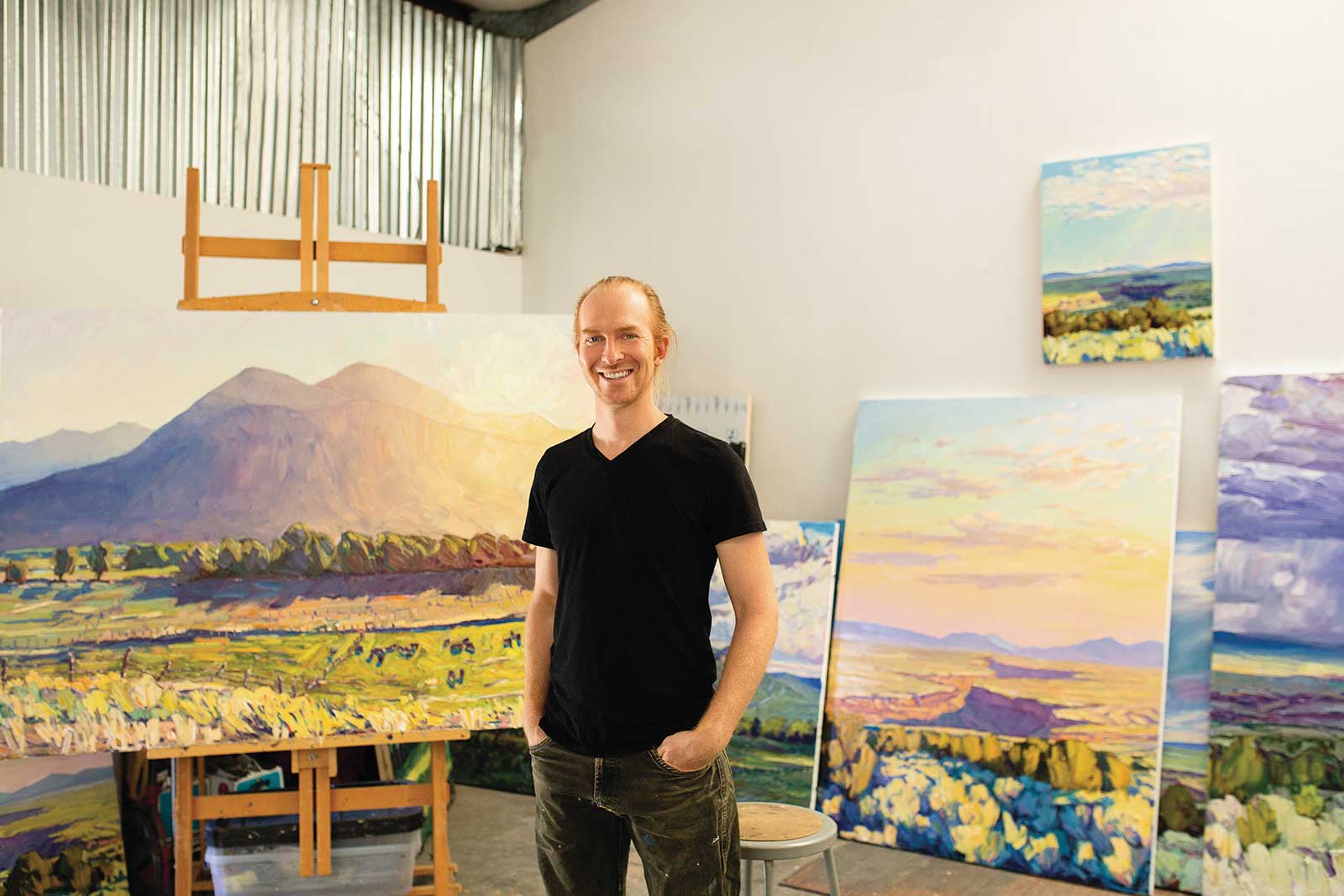 The artist in his Taos, New Mexico, studio with works from Monument. Photo by Ella Sophie, www.ellasophie.com.He became captivated by what is called “The Land of Enchantment” and stayed on. “The environmental stuff was part of why I went into painting,” he says. “Something in the art process felt essential and powerful in its potential to directly relate affectively about things that I felt often remained isolated in the conceptual realm in my previous career. I felt like I needed to find a more direct, tactile, emotional dimension of my relationship to landscape and place, and painting has been a most welcome vessel for this.”
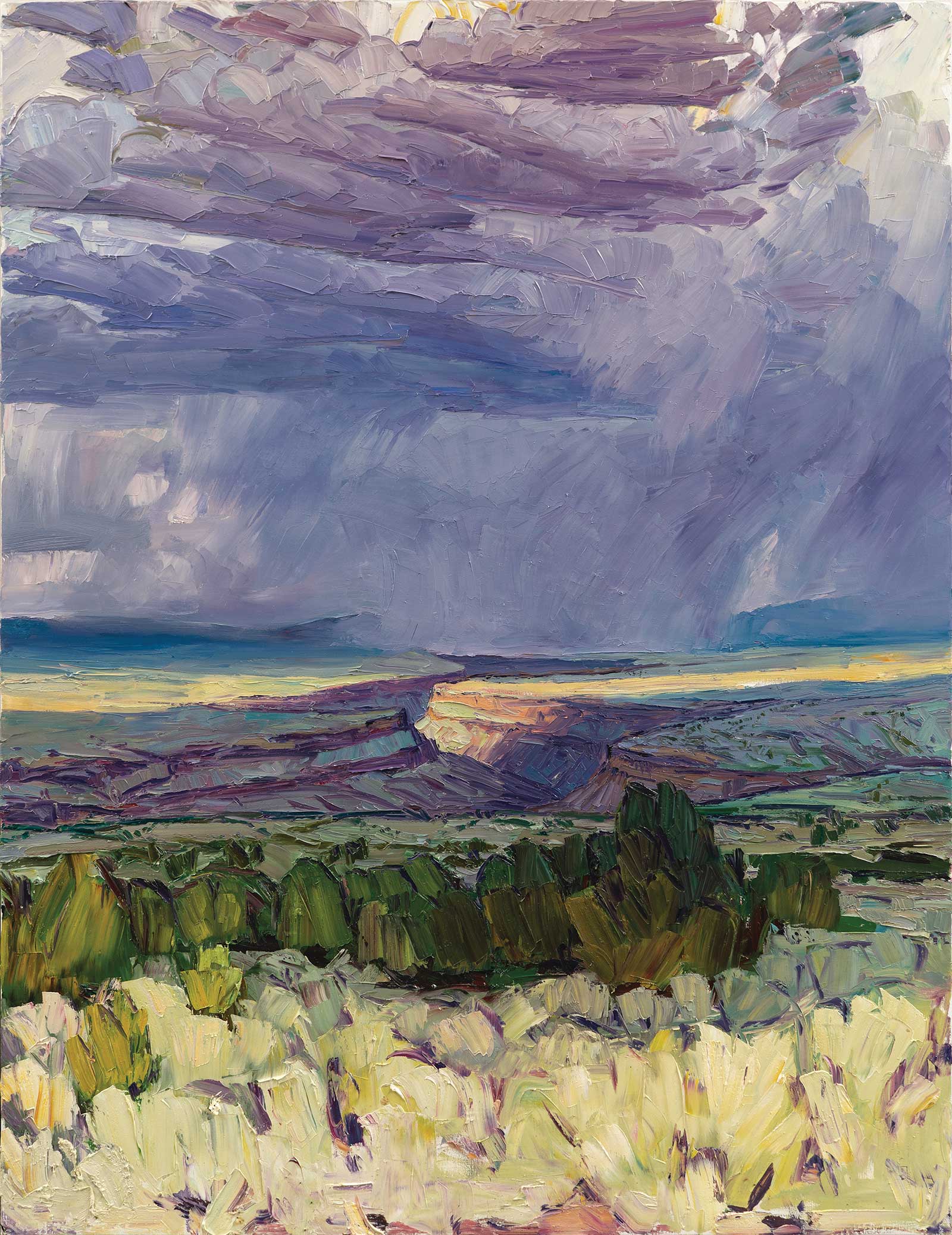 Monument #6 – Big storm, oil on linen, 70 x 54"The landscape around Taos is one of highs and lows. Nearby Wheeler Peak rises to over 13,000 feet above sea level and the Rio Grande Gorge is 564 feet deep. The combination is spectacular. There are a number of paintings of the Gorge in his exhibition Jivan Lee: Monument at William Havu Gallery in Denver, November 15 through January 11, 2020.
He explains, “Amidst the changing land use priorities nationally (such as delisting of national monuments) and global debates regarding human habitation and its implications for ecosystems worldwide, Monument scales down to one locale—Taos, New Mexico—with a rich tapestry of intersecting cultures, land use designations and monumentally grand vistas. Monument is an homage to the grand vista and the immersive landscape of northern New Mexico.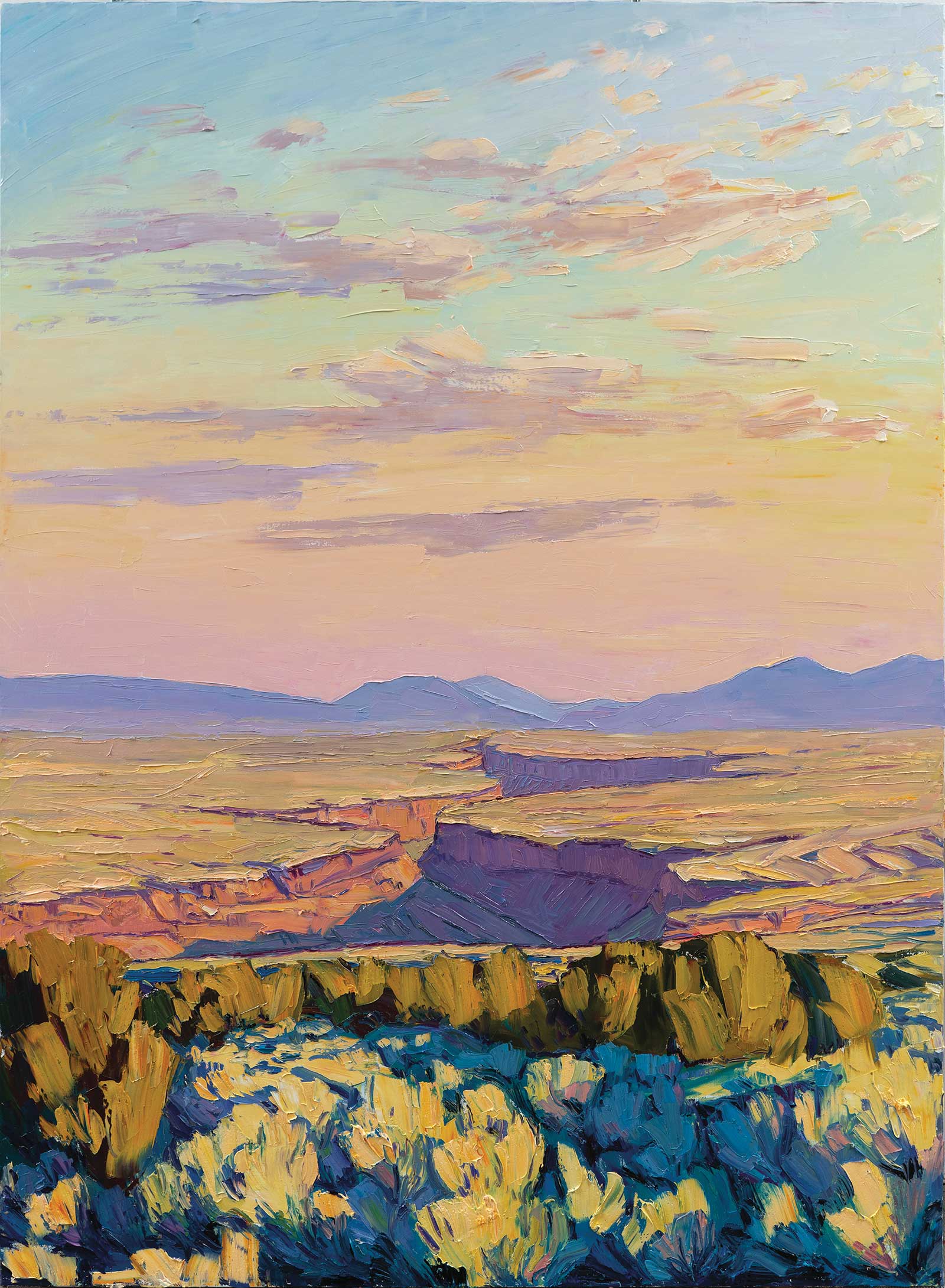 Monument #5 – Sunrise spectrum, oil on linen, 68 x 50"“It’s so engrossing,” he continues. “I wanted to see what would happen if I indulged in the joy of that spot. I’m interested in the passion, the mood of a place over time. In the foreground, there is sagebrush, a line of pinon and juniper, the gorge, then the sky. That’s the basic composition. Almost all the paintings were done on site. I wanted to get out there and touch the sagebrush and feel the weather.”
As he painted, he discovered that the vastness of the scene began to affect his perception of it. “I found that my attention coalesced in areas of a scene that weren’t contiguous, and that this ‘seeing’ wasn’t expressed in a, say, single neatly composed 40-by-60-inch canvas,” he explains. “I spent more time looking at a leaning thunderhead exploding upward into the atmosphere than at the horizontal plain below; at specific locations along a snowy tree line rather than the whole tree line at once. My attention meandered and dwelled and grew and skipped throughout the landscape. I didn’t really recall what was in the gaps between my attention. And I was always parsing and framing and reducing the expansive, no matter how wide a view I took. So I started making the work to express this experience. If I got excited about a cloud ascending upward, I’d paint it ascending upward and add as many panels as necessary to do so. If I kept following the branches of trees as they stretched outward, I’d arrange panels such that they followed the branches, too, and I left vacant other parts of the scene that I didn’t notice. If I noticed a tree line in parts, I’d paint it across many individual panels—more like a filmstrip’s frames than like one long contained scene.” He calls these works Fractured Landscapes.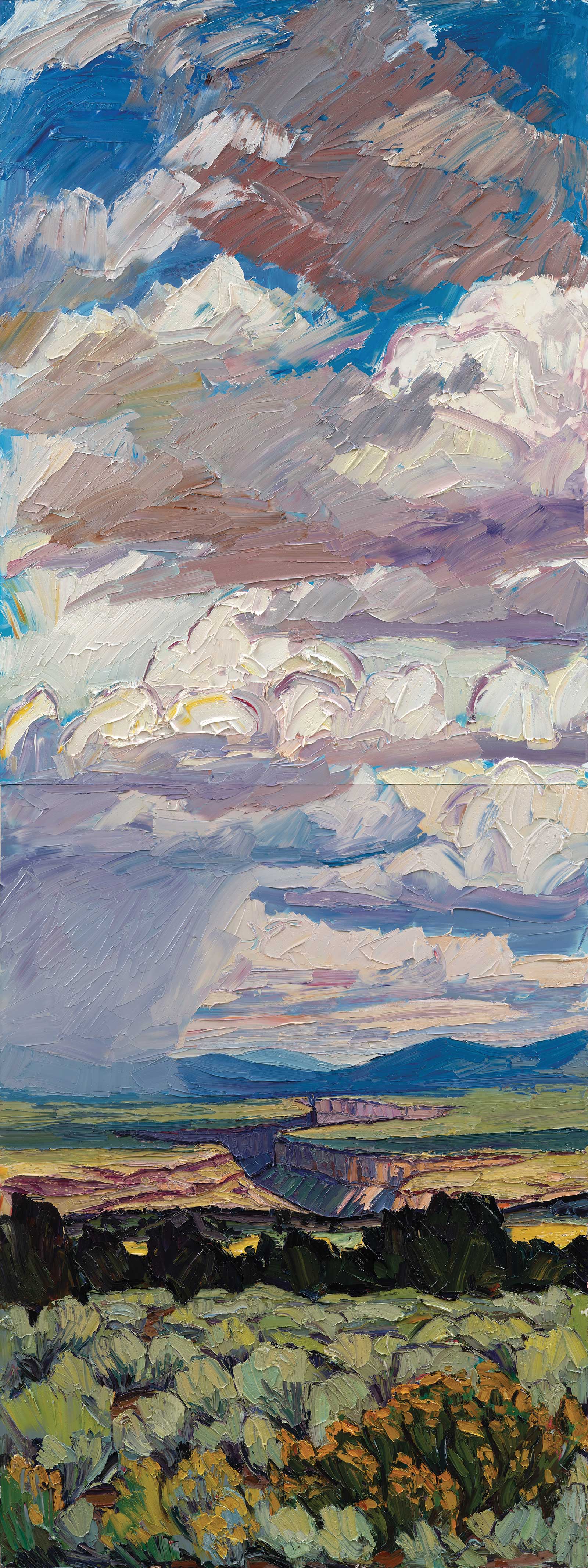 Monument #10 – over/under, oil on panel, 96 x 36"He observes, “The works’ divisions, disjunctions and asymmetries seem to reflect something of how people ‘see’—through lenses of bias and imbalance, forgetting and omitting information, selectively remembering and so forth. Limiting the infinite and complex; containing it despite every effort to speak to it. With this work I aimed to express the ever-growing experience that is being in the landscape, and I still have arrived at work that is compartmentalizing the vastness and intricacy.”
He has also explored how we see in a series of paintings of the very top of the peak of Grand Teton. “The mountain is huge, beautiful, grand and reverential,” he says. “I began with a series in plein air at sunrise, closely cropped to the mountain’s peak. I took them back to my studio and as I sat looking at them I realized they had a funny composition. The peak became banal when it was reduced down and decontextualized. I began thinking about how our perceptual filters might influence our view of the landscape as well as our involvement in it.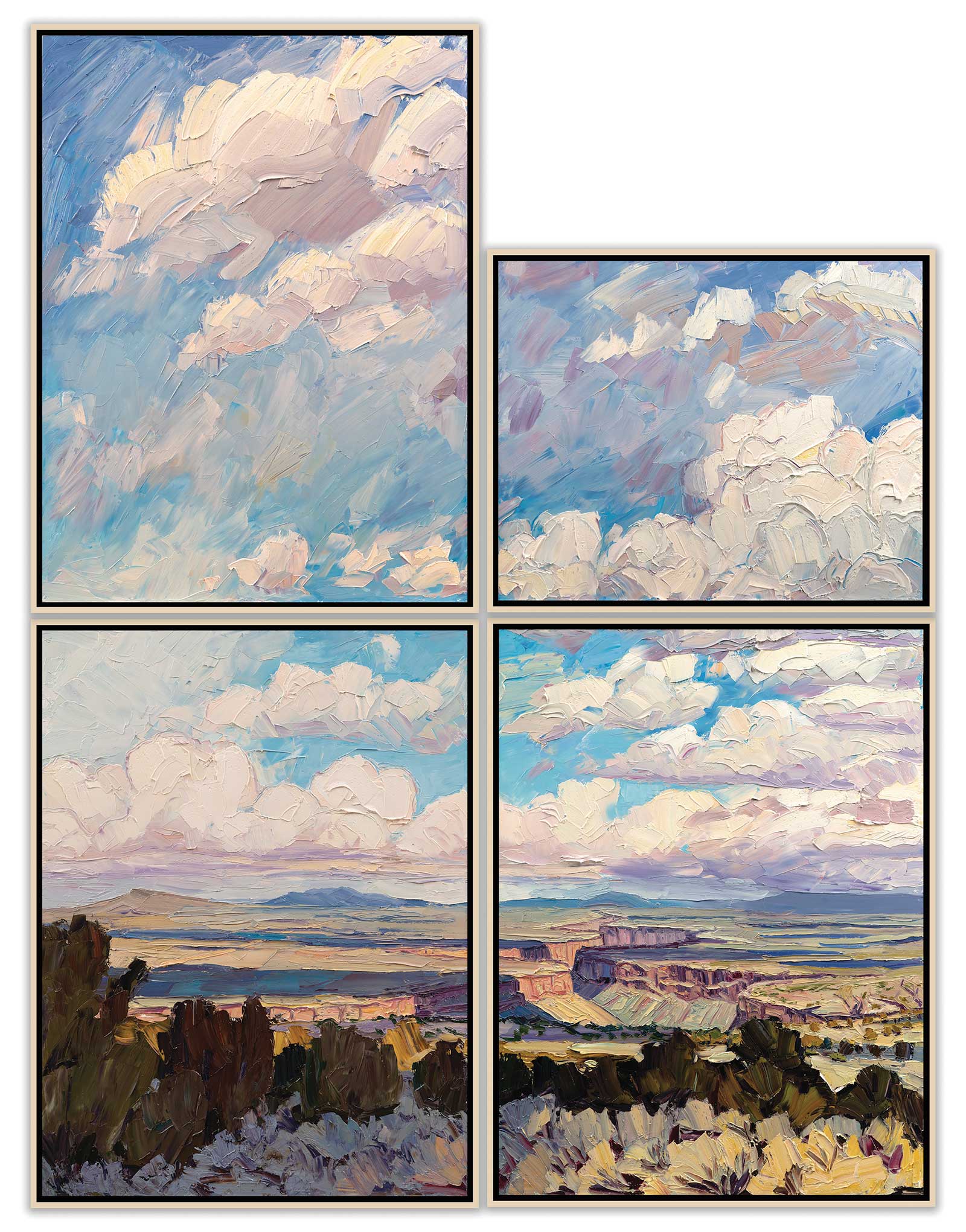 The Gorge in Four, oil on four panels, 80 x 60". Courtesy the artist and LewAllen Galleries, Santa Fe, NM.“It occurred to me the mountain is timeless in scale of humans, rising up, eroding. In these paintings this force is reduced to a high school yearbook photo,” he adds. The colors of the paintings are not observed colors. He began breaking them down into the chromatic color spectrum and then began experimenting with different color relationships and incorporating the iconic colors of different brands like Nike, or the palette in Andy Warhol’s paintings of Marilyn Monroe. “When I’m hustling on location,” he says, “I’m immersed in the felt sensation of weather and time and landscape force. In the studio I can pull apart these visual things. In Grand Teton – Berries and Cream, for instance, I was working with textural paint of contrasting color against a flat background.”
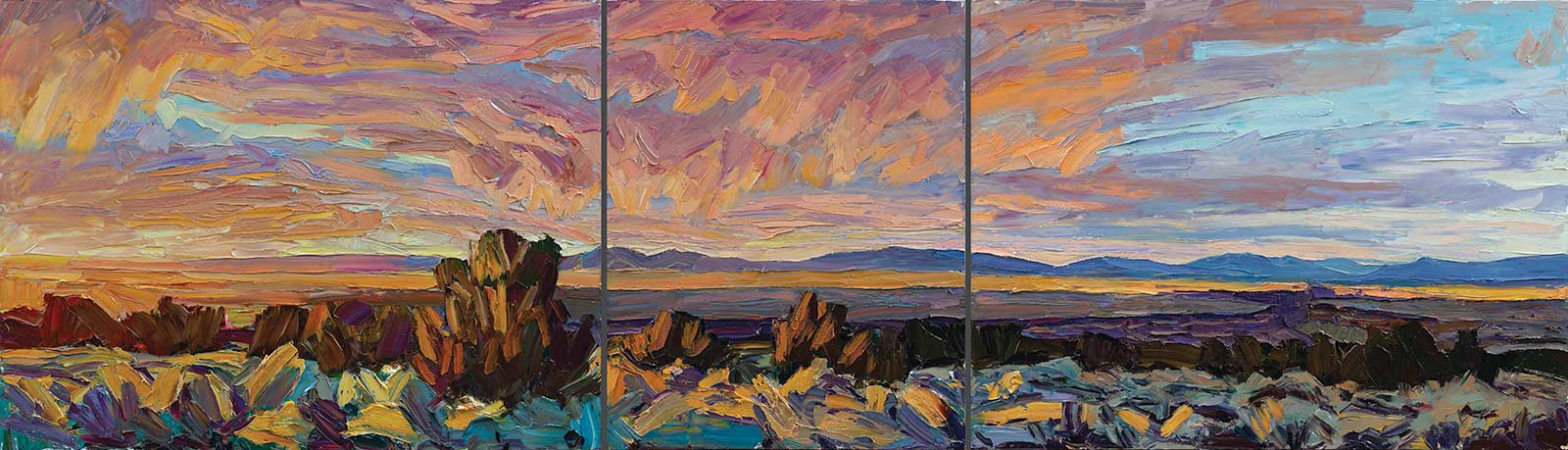 Monument #8 – Sundown storm (triptych), oil on panel, 30 x 104"Lee, having been immersed in programs of land use, continues that interest as he immerses himself in the landscape—experiencing it visually and viscerally, exploring how we see and respond to it. He also explores “what we choose to monumentalize and deem iconic, how our view and treatment of these places is filtered by modern day media and consumer culture, and the simple celebration of places that we can’t help but respond with awe and wonder.”
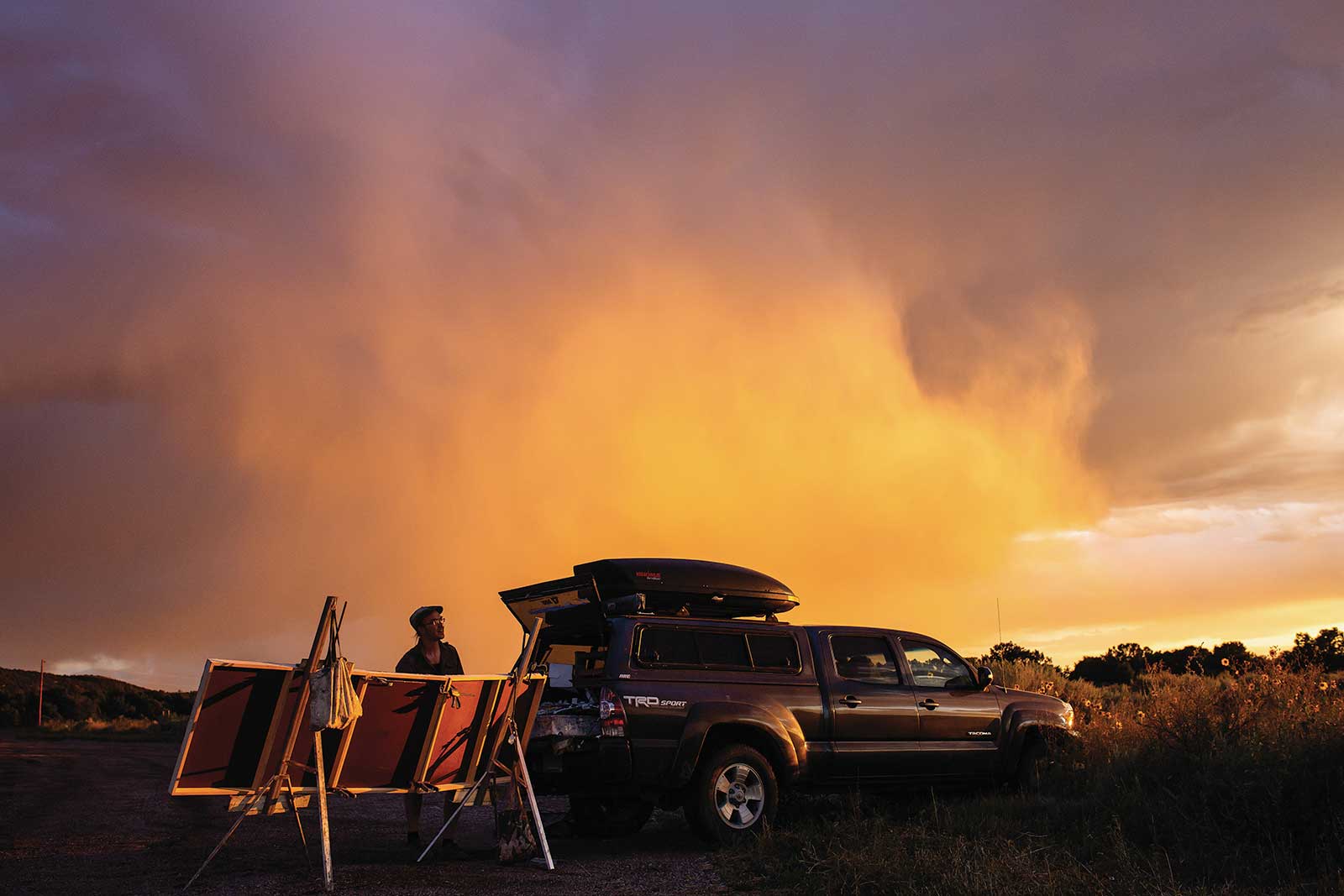 Jivan Lee on location making Monument #8 – Sundown storm. Photo by Ella Sophie, www.ellasophie.com.In addition to the solo exhibition at William Havu Gallery, he will have a solo exhibition, Weathervane, at Altamira Fine Art in Scottsdale, Arizona, January 6 through 18, 2020.
Jivan Lee: Monument
When: November 15-January 11, 2020
Where: William Havu Gallery, 1040 Cherokee Street, Denver, CO 80204
Information: (303) 893-2360, www.williamhavugallery.com
Powered by Froala Editor