It can be argued that art is a period. It’s a conclusion. It’s finality. It’s an artist applying the last bit of paint, standing back to look at the canvas and proclaiming, “I am finished.”
But before that period ends the sentence, there are usually several commas—pauses in the sentence to denote other thoughts and ideas. For artists these pauses come at natural places: the pause between idea and sketch, the pause between sketch and prepping a canvas, the pause after a rough drawing, after passes of light and detail are added, after a signature is signed. 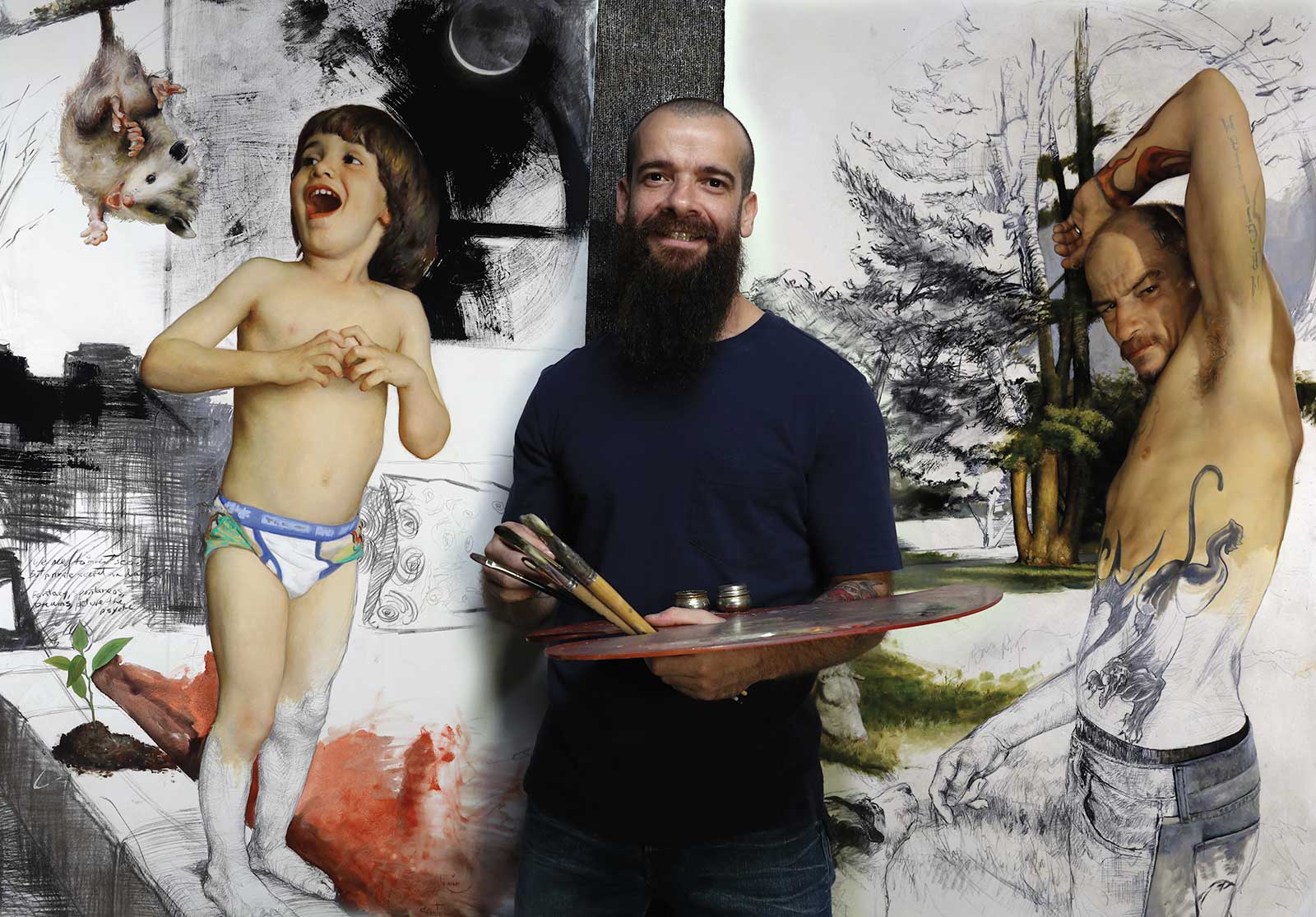 Cesar Santos in his Miami studio.In Cesar Santo’s newest pieces, the Florida artist argues that art isn’t just the finished work. It’s the process. It’s every layer between the initial idea and completed painting. It’s layer after layer of paint, each one its own work of magnificence, each one informing the one to follow.
And it’s a shame those layers get covered.
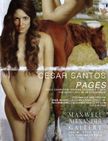
“These are the building blocks of art, and I want people to see them,” Santos says from his Miami studio. “Sometimes as artists we have to cover that magic up as we finish a painting, but with these new works I want to leave the magic exposed to the viewer.”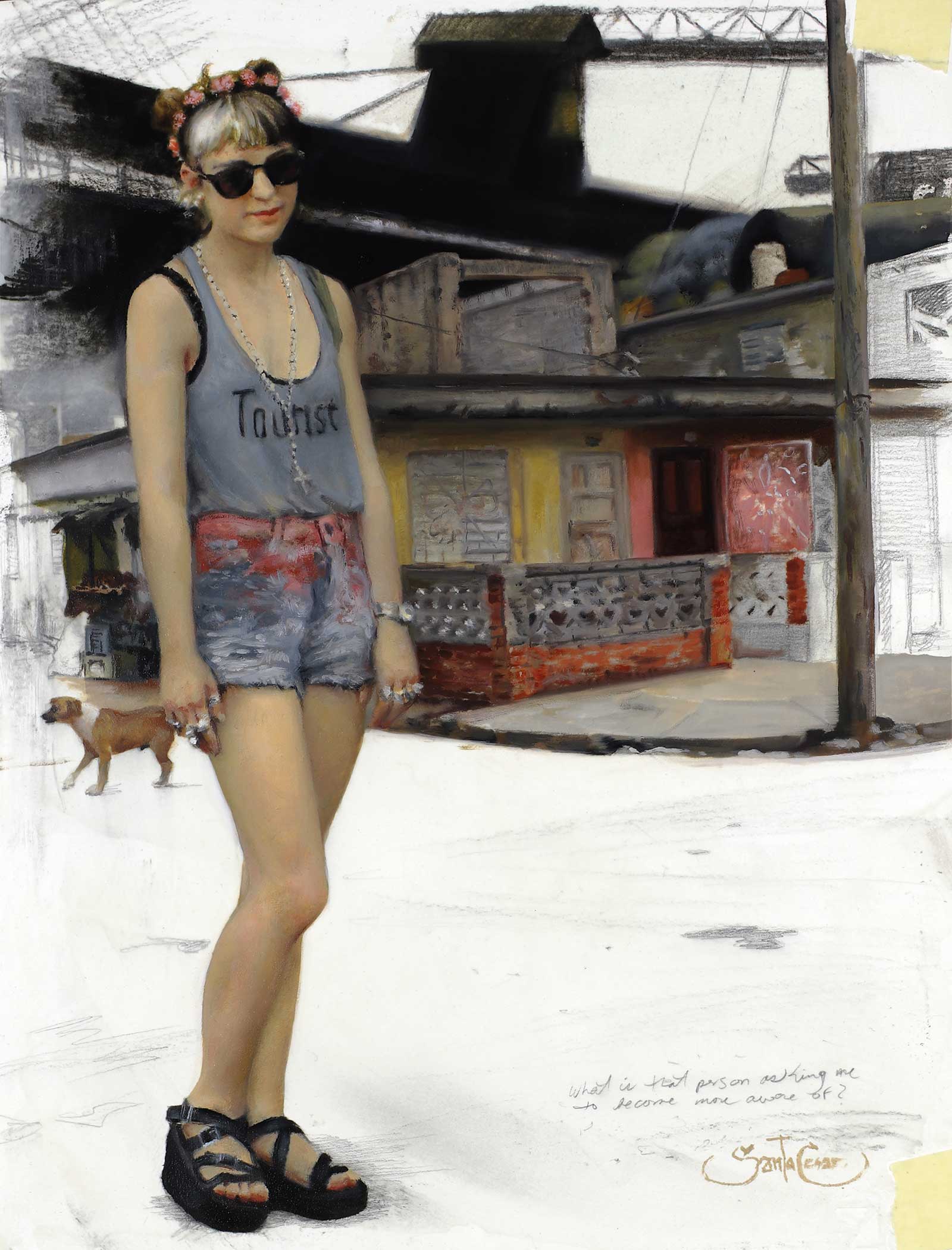 Page 36, Tourist, oil on gessoed paper, 12 x 9"Santos’ new show, Pages, which opens December 7 at Maxwell Alexander Gallery in Los Angeles, will present paintings that highlight each stage of a work of art. Many of the pieces include every step Santos goes through in the course of a painting: from blank canvas to quick sketches to color studies to detailed drawings to the initial layers of oil paint to, finally, his fully rendered figures. And these layers aren’t just static blocks of ideas glued together—the layers are fluid and they swirl together in comforting ways.
“I love seeing the drawing underneath, the charcoal and the shadowy shapes. The proportions and forms, they are all right there, I’m just leaving each piece in an unfinished state,” Santos says. “I’ll typically do the drawing first and spray it with a fixative and then add a layer of color. I have an impressionistic approach, but just sort of selectively with each area of the work.”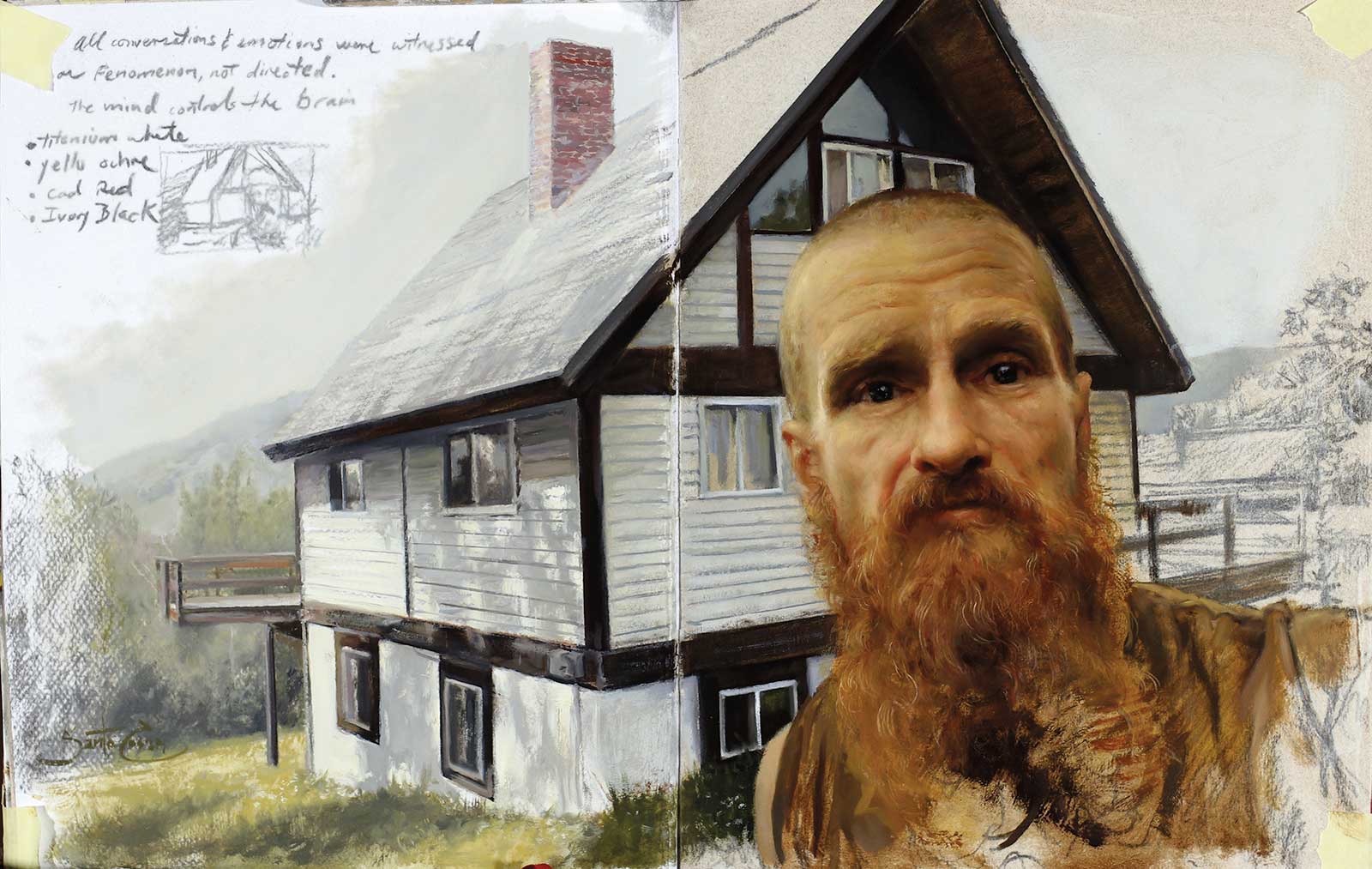 Page 37, Welcome Home, oil on gessoed paper, 12 x 19"
Paintings in the show include Page 43, Domesticated, which shows a man with his arm lifted to reveal tattoos on his bare chest and side. A dog appears ready to lick at his fingers while a cow grazes in the background. Santos bisects the main figure with color and style: his upper torso is fully painted with exceptional detail in the facial expression and skin, while the lower torso and legs are essentially a drawing with varying degrees of detail. “I saw this man in downtown Miami. He was homeless and I had seen him several times before. I saw him changing his shirt and I asked if I could pay him to photograph him and he agreed,” the artist says. “I loved his tattoos and his poses. He was in the city, so I added later the cow and the more natural landscape.”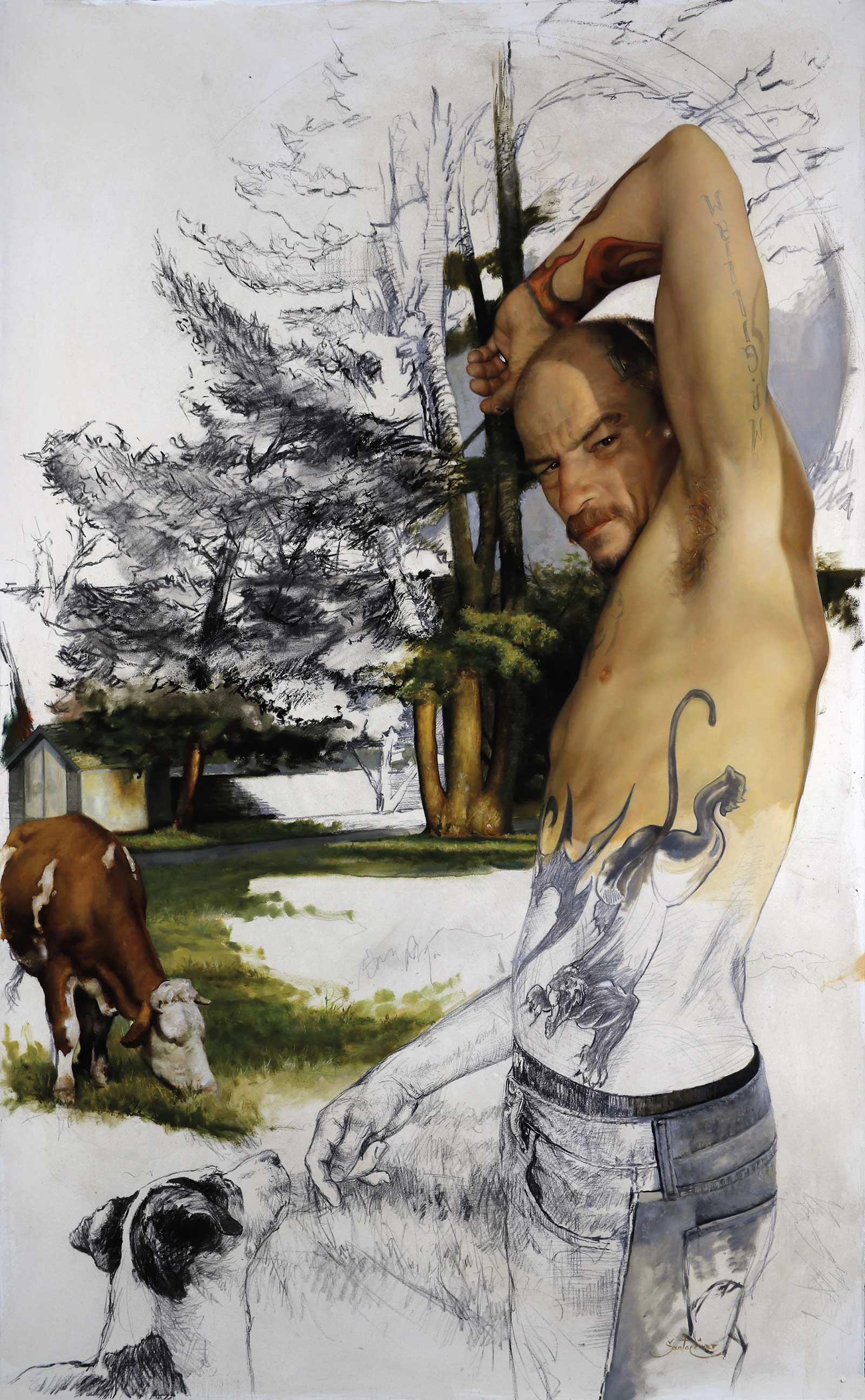 Page 43, Domesticated, oil and charcoal on gessoed paper, 55 x 34"In Page 41, Wild, he paints his young nephew, who is reacting in a big way to an opossum that hangs from a branch in the corner of the painting. The work functions as a dual exploration of the strange dynamic of Santos’ world: the possum and the boy in his underwear seemingly have no reason to be together—just like the beautiful realism in a scene rendered in crosshatch, smudges of charcoal and dabs of test paint—and yet the artist has overlapped their stories in an intentional manner to tell a story of his making.
 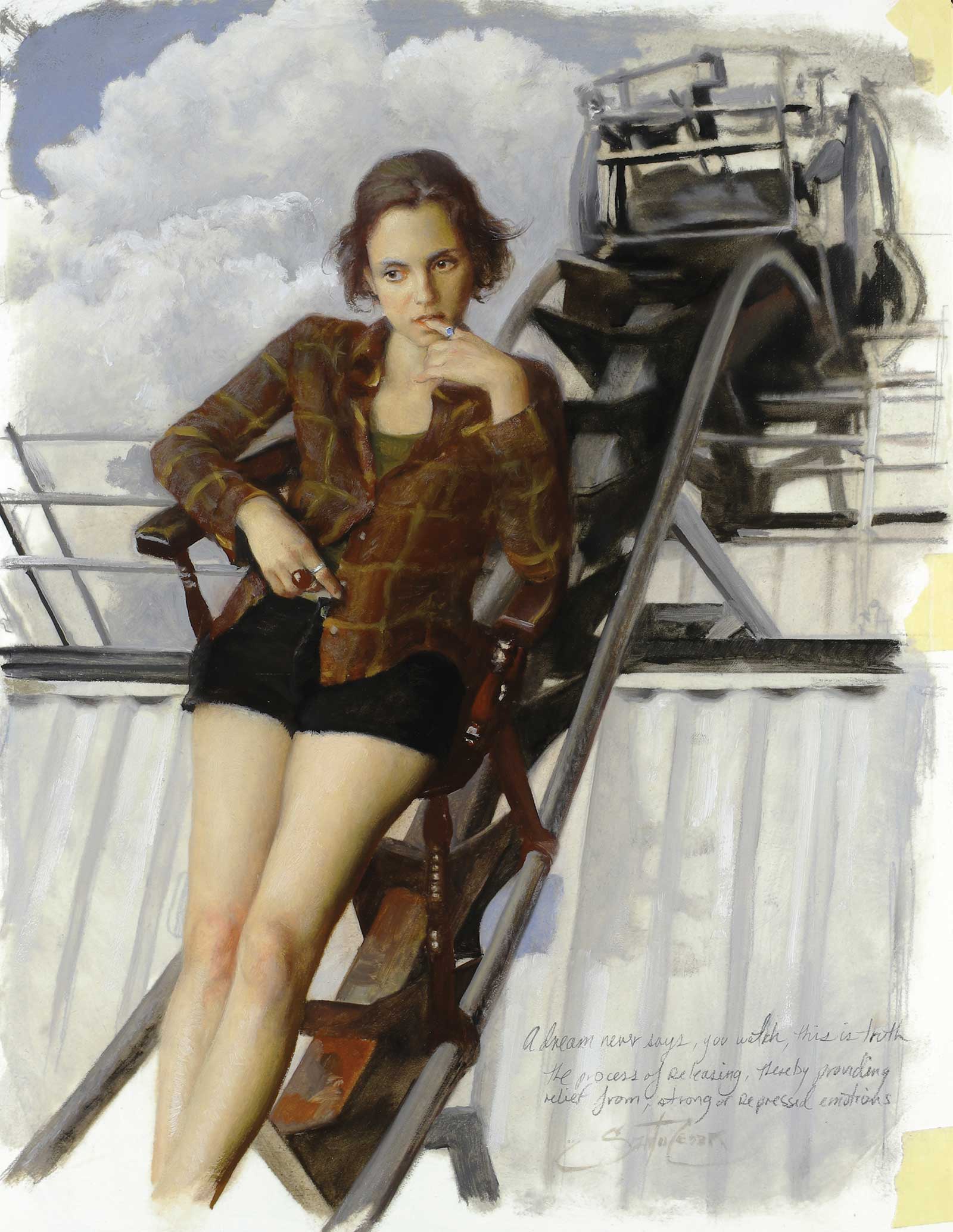 Page 38, Catharsis, oil on gessoed paper, 12 x 9"A remarkable byproduct of these “incomplete” paintings is how the viewers’ eyes tends to fill in the painting to the desired layer. Although only a third of Page 41, Wild is in color, it doesn’t require much for the brain to fill in what’s not rendered in detail or color, as if by some automatic translation mechanism. Or the other way around: it’s easy to picture the boy as a drawing when the rest of the work is in charcoal. There is freedom in his style, enough that the momentum from that alone propels the eye through each work. “It definitely creates the potential for a lot of imagination. Your mind can run free. Your interpretation will be based on your subconscious, and while there are hints to what’s going on there’s enough there to still think about,” he says. “I didn’t invent anything with these paintings. I think most artists have done this before. Maybe they’ll leave some sketch exposed or maybe a surface. Most studies do that. The difference here with these pieces is I’m calling explicit attention to it. Here it is.”
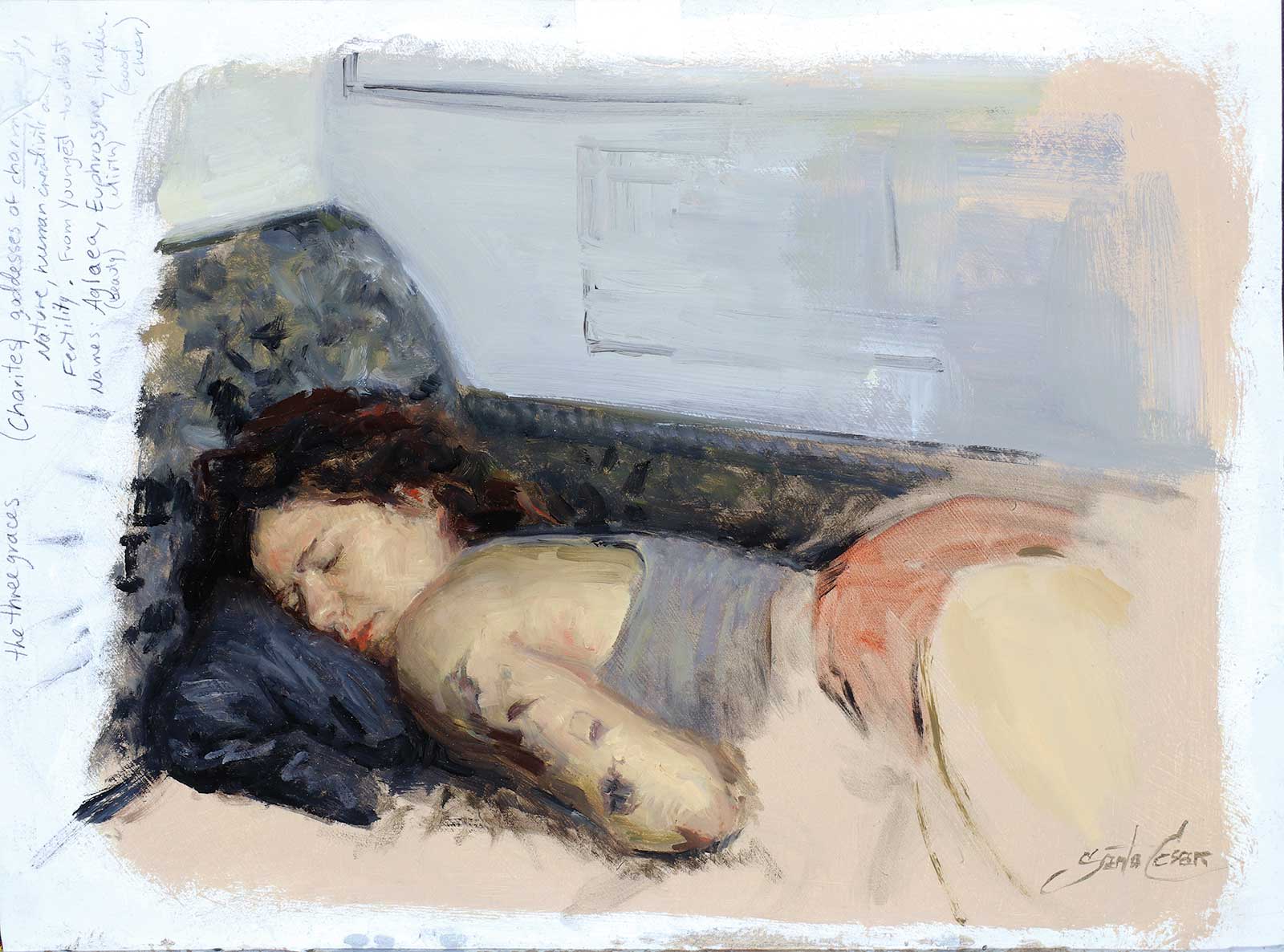 Page 44, Valentina, oil on gessoed paper, 9 x 12"This is not the first time Santos has embarked on a journey within the construct of art itself. His earlier series Syncretism took different styles of art and smooshed them together, creating unique new comments on art from different movements, genres and time periods. The mashups included Botticelli with Pablo Picasso, Leonardo da Vinci with Willem de Kooning, Venus de Milo with Takashi Murakami and many others. Pages, which will include paintings made to look like oversized sketchbook pages as well as actual sketchbook pages, is the logical next step in his journey into art as a subject.
 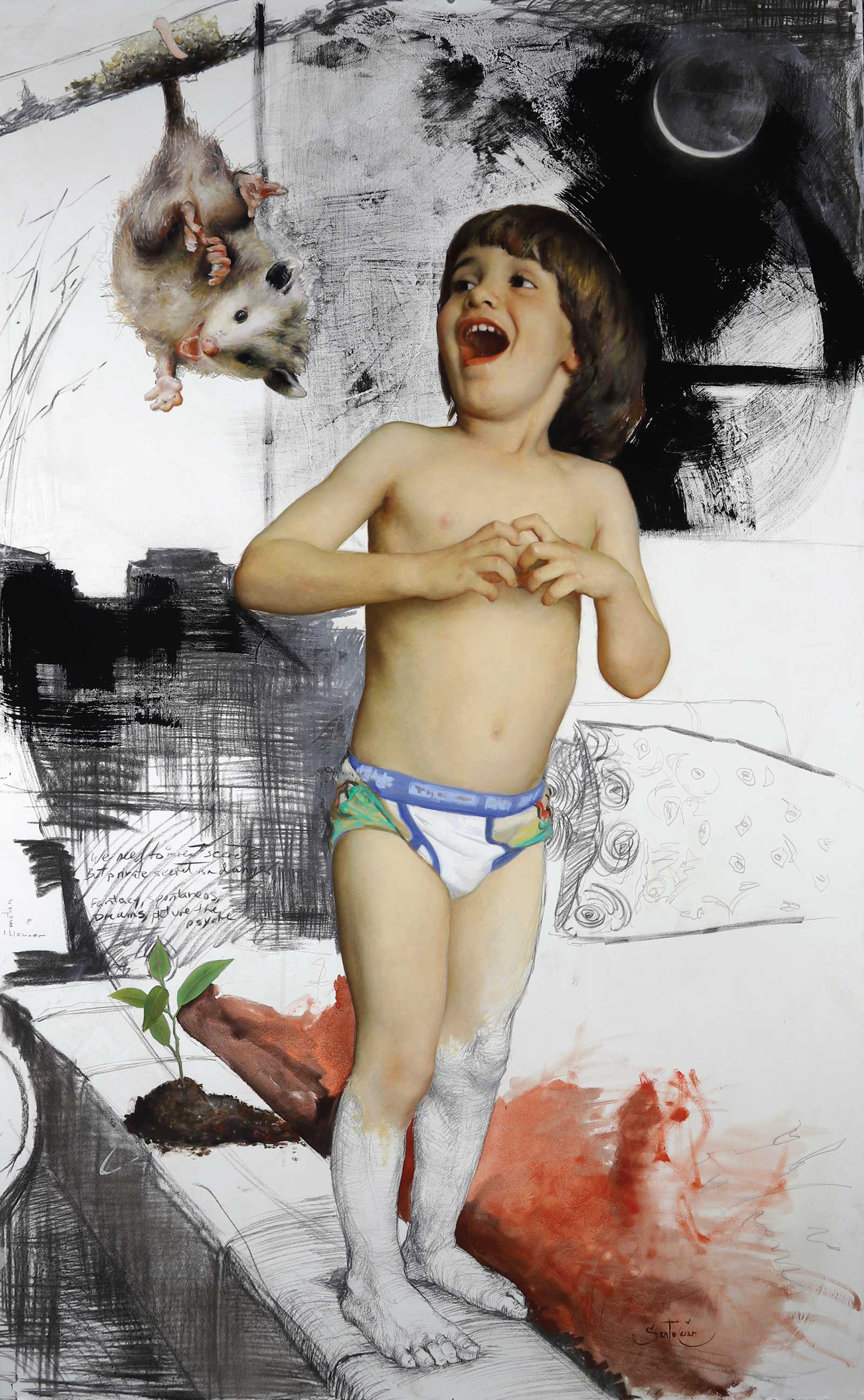 Page 41, Wild, oil and charcoal on gessoed paper, 55 x 34"“Where Syncretism was maybe more naïve, this is literally putting the art together in one work. It’s syncretism, but on a technical level,” he says. “Everything starts with a sketchbook. It’s easy for an intellectual artist to forget those foundations of art, but that’s what I’m having fun doing—I’m showing my work from my sketchbook. A sketchbook is a complete work of art as it is. It shows the line work, the notations, it leaves traces of the artist throughout. You get every layer, every part of the growth process. It all comes through in sketchbooks. That’s what I want to bring to these new works, that sketchbook process but big and with all the layers. The process is just as important as the completed painting.” —
Cesar Santos: Pages
When: December 7-21, 2019
Where: Maxwell Alexander Gallery,
406 W. Pico Boulevard, Los Angeles, CA 90015
Information: (213) 275-1060, www.maxwellalexandergallery.com
Powered by Froala Editor