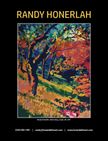
What I experience when I look at Evelyn Rapin’s paintings isn't quite thought or thinking. No. Rapin’s paintings compel associations that skip like a stone across the pond of memory and insist on a response. Literary theorist Ihab Hassan called this Paracriticism, a desire in the perceiver not to explicate, but to respond in kind, to make art in response to art, to calligraph a poem onto a painting, to paint in response to music. The Greeks called this ekphrasis, an idea rooted in synesthesia—moments when we seem to hear a painting or see music. Ekphrasis forms the scaffolding of Rapin’s newest works, The Concert Series, on view at Kingston, Ontario’s Studio22 Open Gallery through October 12.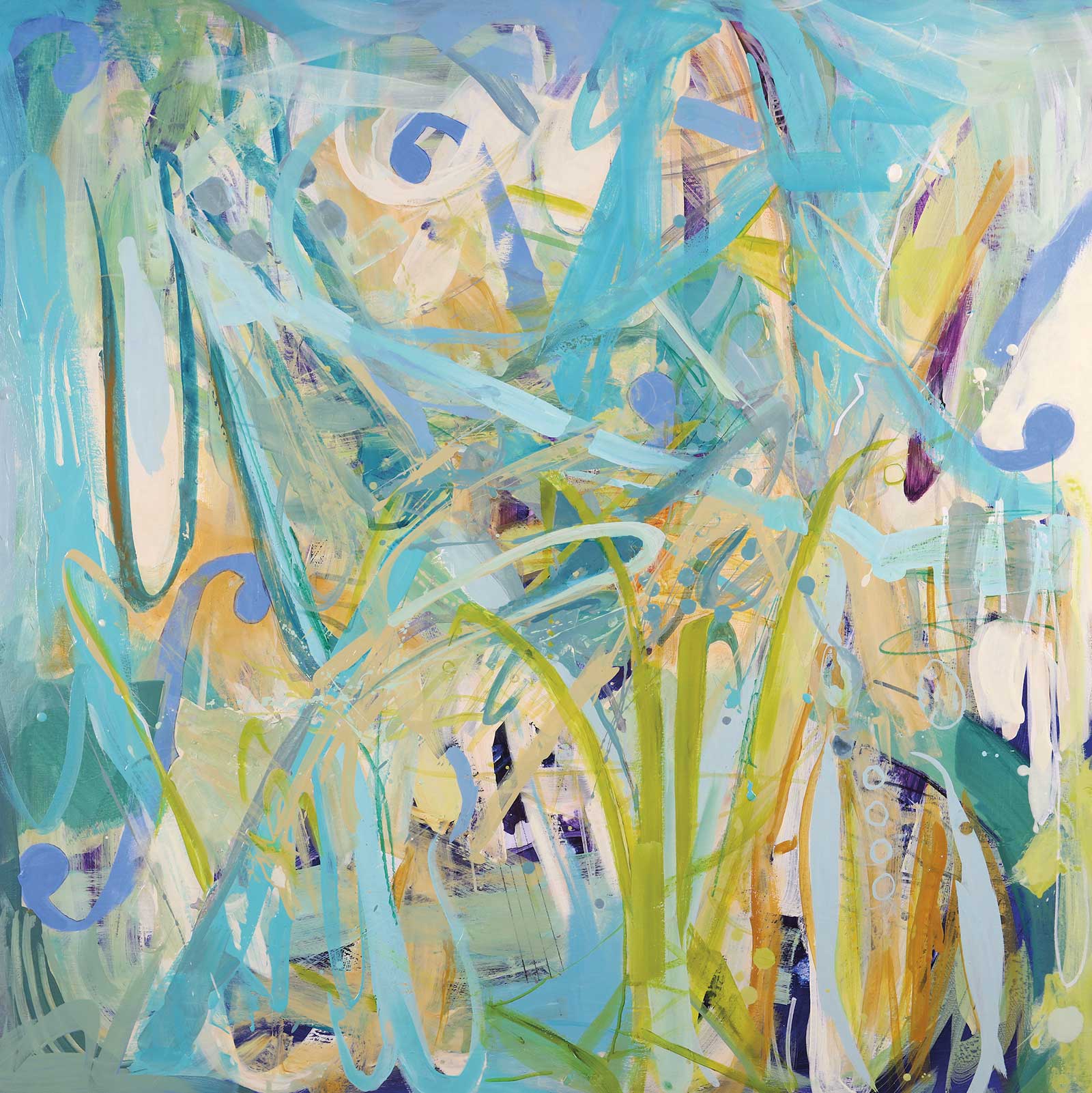 Trampled Garden II, mixed media on birch panel, 40 x 40"
Uncharted, inspiration’s course. A voyage without map, compass or guiding star. But when Rapin described sitting in the front row at a concert of works by Canadian composer Marjan Mozetich—a concert that would lead her to Mozetich’s Lament in a Trampled Garden—how the music began to assume a form that would inspire her next work, it was as if a lost, handwritten journal of an artistic odyssey had suddenly come to light.
To human eyes, the simple perception of nature may be an art form. Its otherness requires that we make sense, order, use of it. Nature conceals deep structures, patterns, a fractal chaos we barely comprehend and long to master rather than coexist with. But Rapin’s art is art before and after art, re-inscribing the joy of the natural world while reminding us of its fragility, and ours. Hands in Rapin’s Sound and Vision paintings recall Keith Haring’s electricity; their outlines and swirls also suggest ancient hands traced on rock and cave walls. These hands reach for cello heads—graveyard markers, telegraph poles, squat sculls rowing across an electric melodic current—and cello scrolls—garden snails, furled ferns, spiral galaxies.
Inside this lamentation for a trampled garden, synecdoche for the world we trample, inside this thanatopsis, Rapin plants reborn music, new poiesis.
Insight: elemental. Four forces of the universe: gravity, electromagnetism, the strong nuclear force, the weak nuclear force. Rapin paints these infinite and infinitesimal strings spanning our universe, strings whose musical vibrations create the star-stuff we are made of. Notes in her paintings hover over the green world, twisting the staff, impatient for instruments to play them, willing their own music. Jagged, pent-up energies don’t wait for hands to reach them.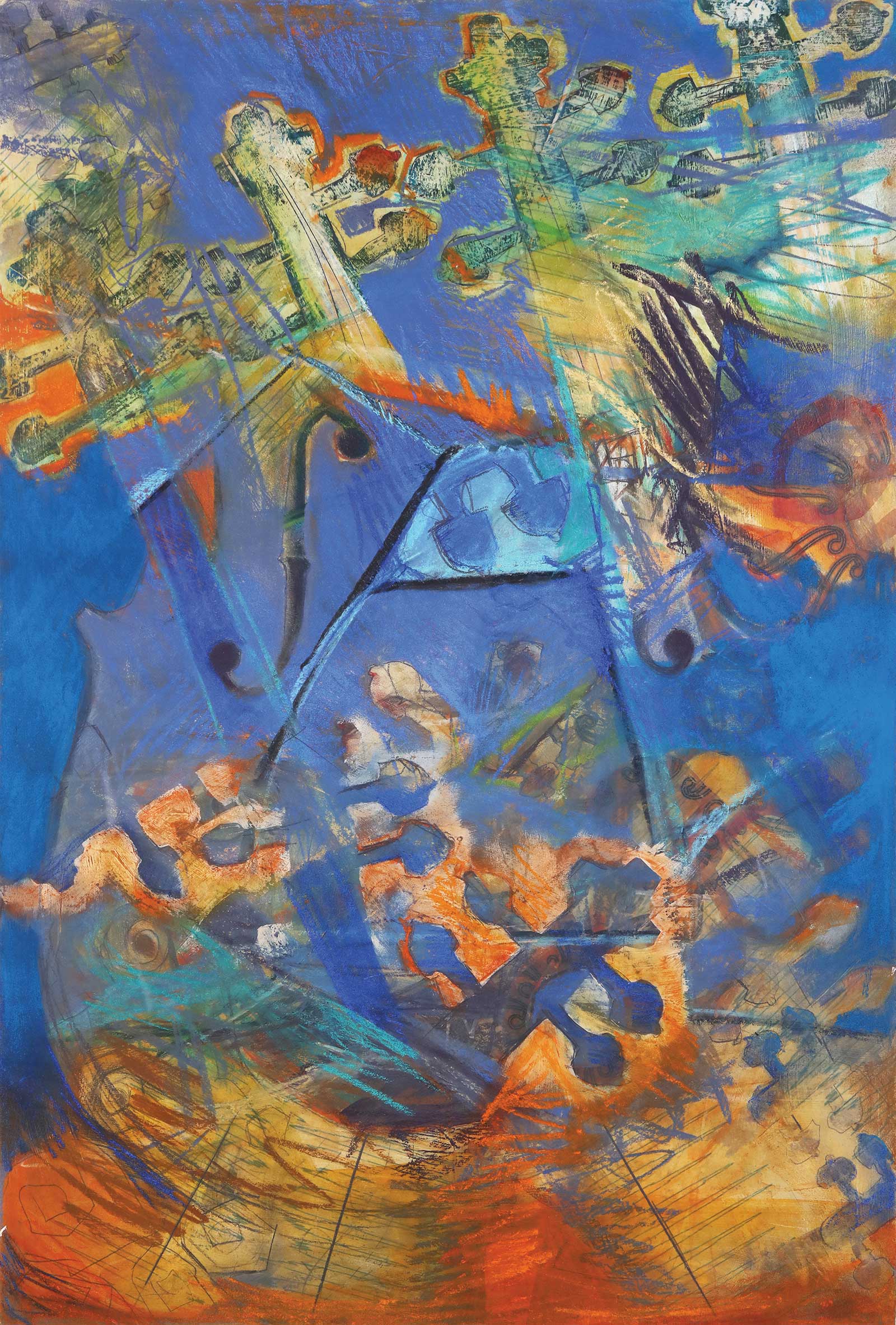 Sound and Vision IV, mixed media on paper, 44 x 30"
The sound holes in the cello are F-shaped, antique S’s, long, medial, descending arabesques in old texts that resonate as
I read them silently. Rapin deploys them in sound gardens like abstract buntings or dragonflies, these holes, cutouts, negative spaces turned positive, shaped absences, releasing vibrations and resonances from the body of the instrument. They are the breath of the gardens she paints. She cites Umberto Boccioni’s apprehension of space around movement as an artistic wellspring. But Charles Burchfield’s visible music and the vegetable, batik patterning of his closely observed moments in nature are in her works as are Arshile Gorky’s bioforms.
Theory: vibrations of soundless, endless strings, the music of spheres, play the universe into being, motion, life. What makes the vibration? What rosins the bow? Resonance. And what makes resonance in music? Atmosphere, air in a contained chamber. Nothing resonates in a vacuum. Outer space is soundless. Inner space, then, is the atmosphere Rapin’s paintings chart. The resonance of creation.
Poems on 12th-century Chinese landscapes and Japanese shigajiku are perhaps the ultimate in ekphrasis, leaving room for poems, theirs and others, on their scrolls—“scrolls” circles back to Rapin’s cello forms. We call such poems colophons. These works, like Rapin’s, present a secret, tonic place displacing the toxic—as in Frances Hodgson Burnett’s Secret Garden—restorative even as it is restored, un-trampled. 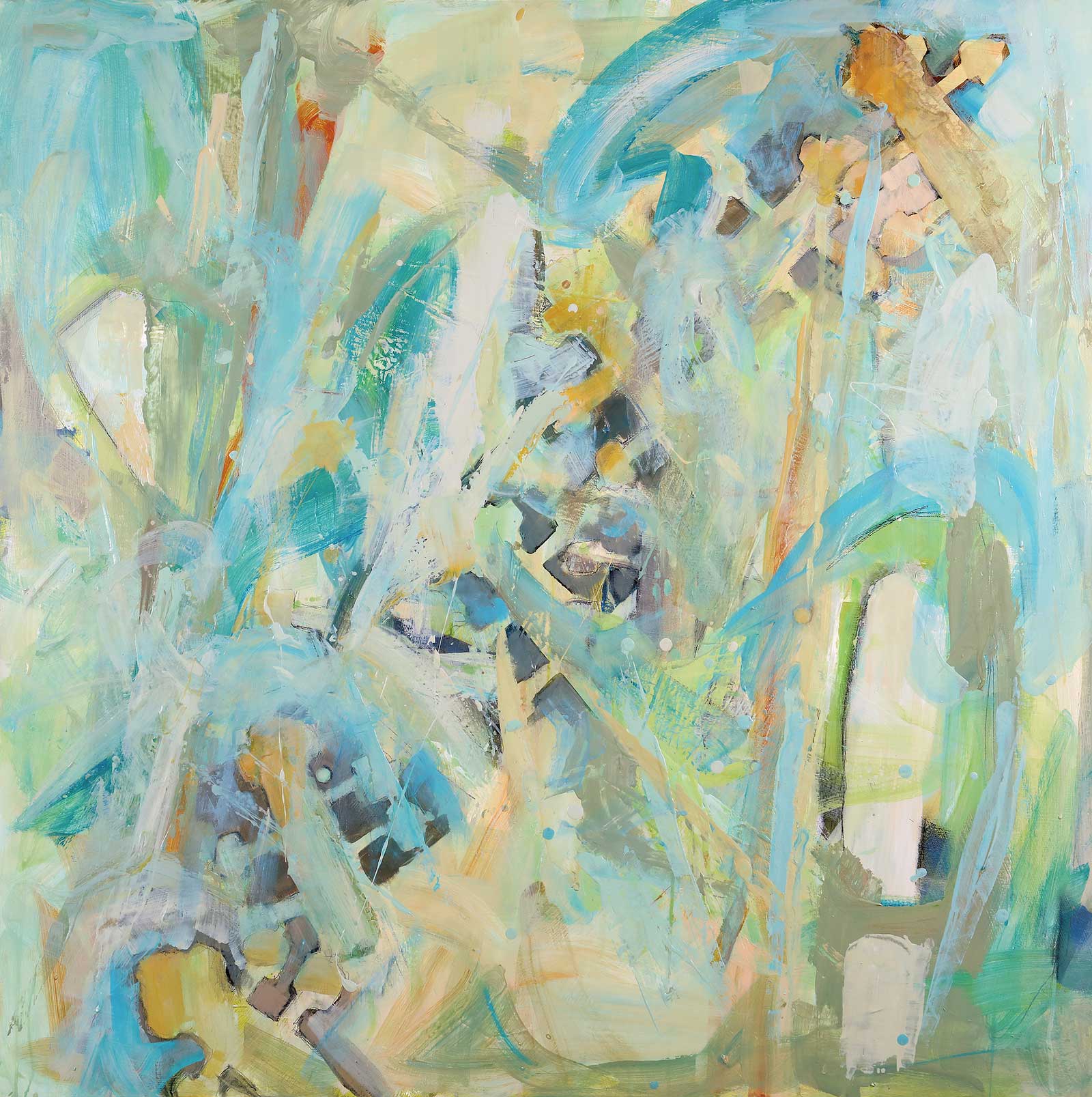 Ensemble IV, mixed media on panel, 40 x 40" Photography by Bernard Clark.
If I could inscribe a colophon onto one Rapin’s paintings, these might be the words:
The peony nods under the weight
of its own beauty
like a twilit monarch
taking the hammering
of coffins
for the flutes of the thrush.
Milkweed nods in the mailbox garden,
flyers in the post hawk steaks,
timeshares, stocks, stakes, time.
Very hungry caterpillars hatch
from periods on sentence ends
—this, any—making Ovid’s breath
catch in his lyrical throat.
You never do find out what they turn into—
Monarchs or manna the Mantises pray for. —
Studio22 Open Gallery 320 King Street East • Kingston, ON K7L 3B4 • (613) 546-7461 • www.studio22.ca
Powered by Froala Editor