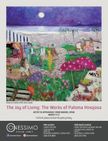

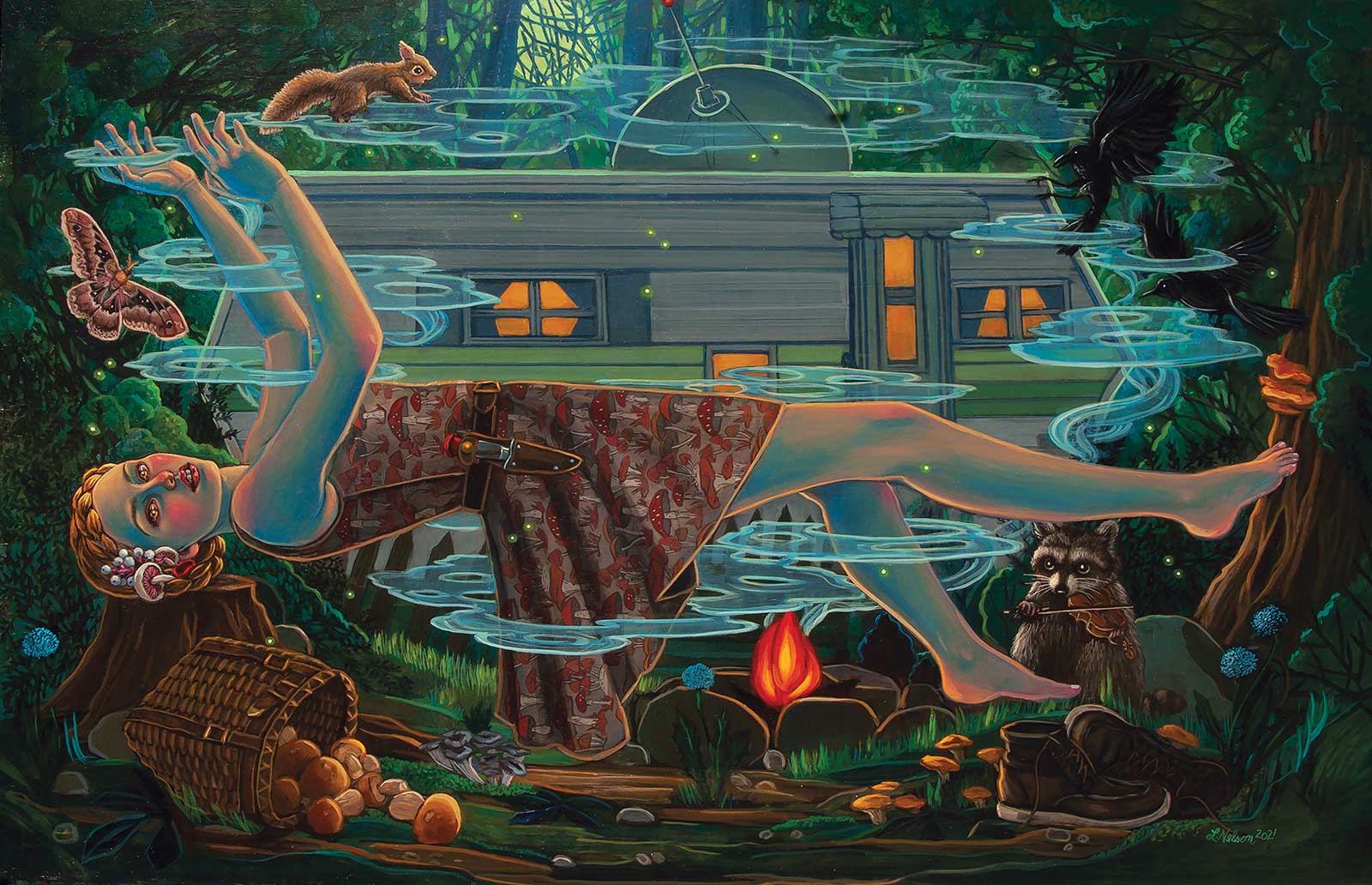
 Lori Nelson, Summer of the Shutdown, oil on panel, 24 x 36"
Lori Nelson has mastered the style and mood of the age. Her Summer of the Shutdown is a painting of a young woman floating before a trailer set in a forest landscape—she is in the dreamlike state Nelson experiences when walking from her home into the woods which blanket the Catskill mountains. The floating woman is her niece, wrapped in an ethereal cloud which twists around her, tangling a squirrel and two flapping crows in its ghostly tendrils. She has dropped her shoes beside her safe and contained campfire. A comical raccoon fiddles, and a huge moth hovers on the thickened air. “She’s entranced and affected in a magical way by all the things she’s encountered in nature,” says Nelson, “These are all things I’ve found while being in the Catskills. I found that trailer in the background abandoned in the woods. I like a good hidey-hole. The moth, the raccoon, the mushrooms are a big deal—we do a lot of foraging up here. Fire’s a big deal for me too. Living in New York City I missed the hearth, and the fire.” The mushrooms scattered in abundance on the grassy foreground and growing on the trees are fungi foraged during the COVID-summer of 2021. More mushrooms grow in the girl’s hair, and her summer dress is decorated with a print of amanita muscaria—the iconic fly agaric, red symbol of the polka-dot allure and danger of mycophilia.
America’s art is changing—and that is expected and necessary because it is the nature of our culture to evolve—and Nelson is part of a wave of women shaping the new aesthetic. Influenced by manga, comics, sci-fi and fantasy movies, while also admiring and respecting “the real thing” of the Old Masters, this women’s wave is driven by generational change, for it is also the nature of our culture to constantly experience the revolt of the young against the old, and after a century of dominance the tropes of the misnamed avant-garde are practically prehistoric. These women are strong, are equipped to deal with their world.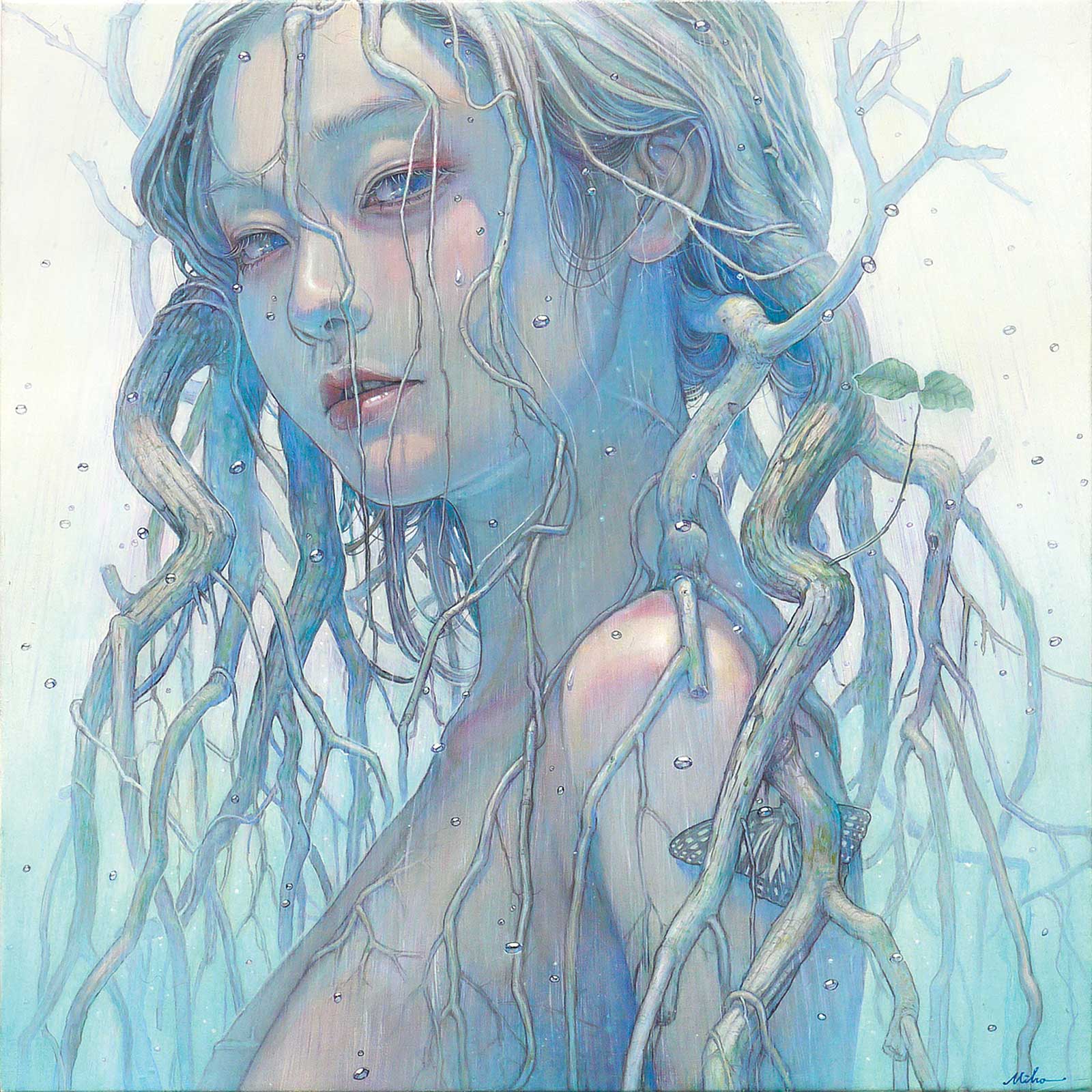 Miho Hirano, Time of Eternity, oil on canvas, 16 x 16"
“That’s my daughter’s knife,” says Nelson, “It’s a Scandinavian knife that she carries—these are personal references. A big part of why I almost exclusively paint women and girls is that I’m drawing from my own experience—I paint the girl as a metaphor for all women, for people who identify as female, what it’s like to grow up in our society. Most of them are strong, and sometimes armed, they’ve got their weapons, they’ve got their tools, they’re not victims. In contemporary and also historic art you see women as just an object of beauty to be gazed upon and desired, but most of the women I paint are actively engaged in doing something and being strong people.” No iconic Isis, Nelson’s icons are of a new archetypal huntress.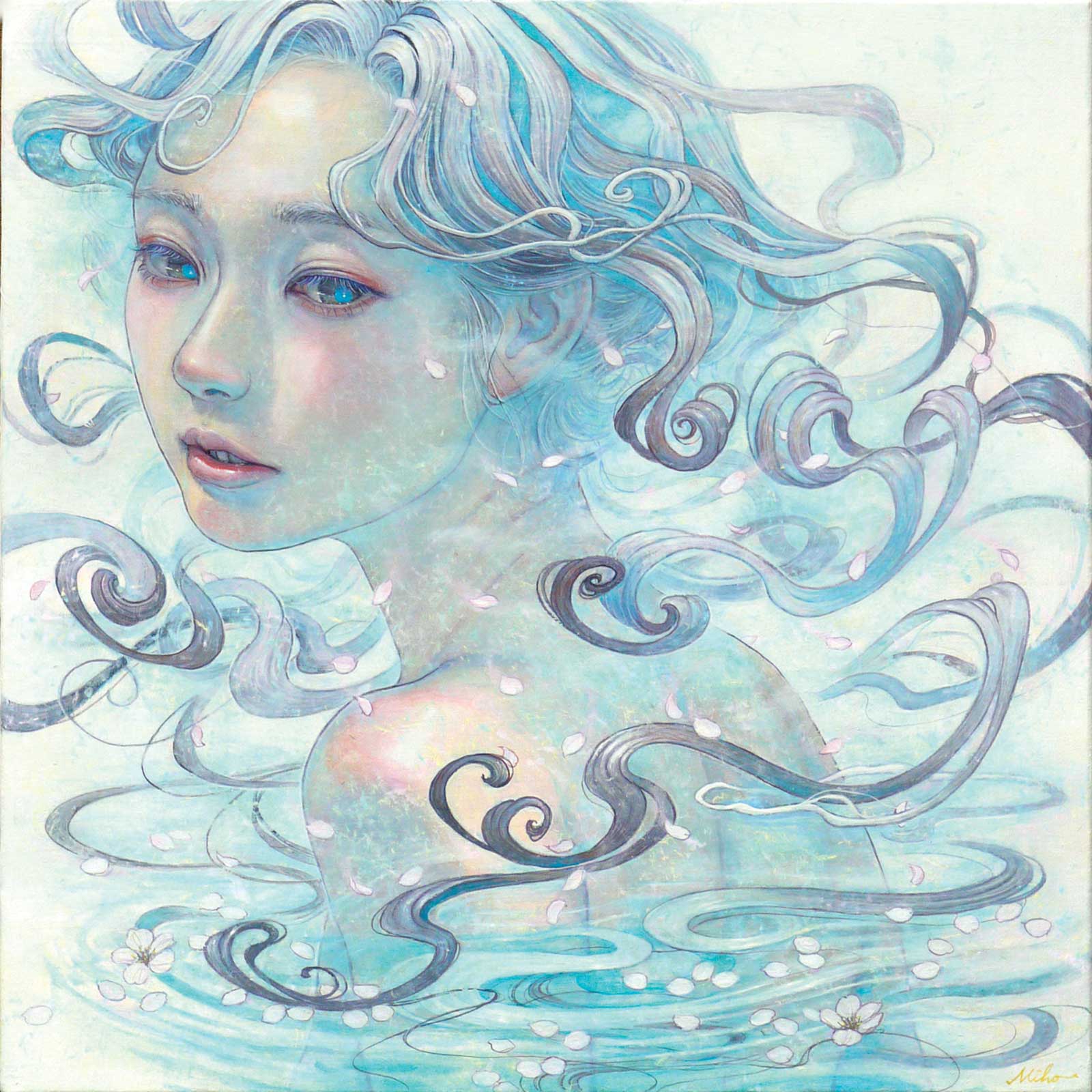 Miho Hirano, Serenity of Mind, oil on canvas, 12 9⁄10 x 12 9⁄10"
Generation Z and millennial collectors have an honest and sincere respect for male and female artists alike—the impulse for honest equality is strong in them. As the wild age wakes into consciousness, it finds new desires and appetites that must be satisfied, among them cultural recognition of the power of women. Women’s paintings are collected by admirers who buy it for their own pleasure, and by young investors who buy it for its long-term potential, recognizing it as a groundbreaking shift from patronizing and patriarchal modern art of the 20th century. But these are subtle revolutionaries. These artists make paintings to satisfy themselves and their communities, not to bend to the requirements of gray gatekeepers.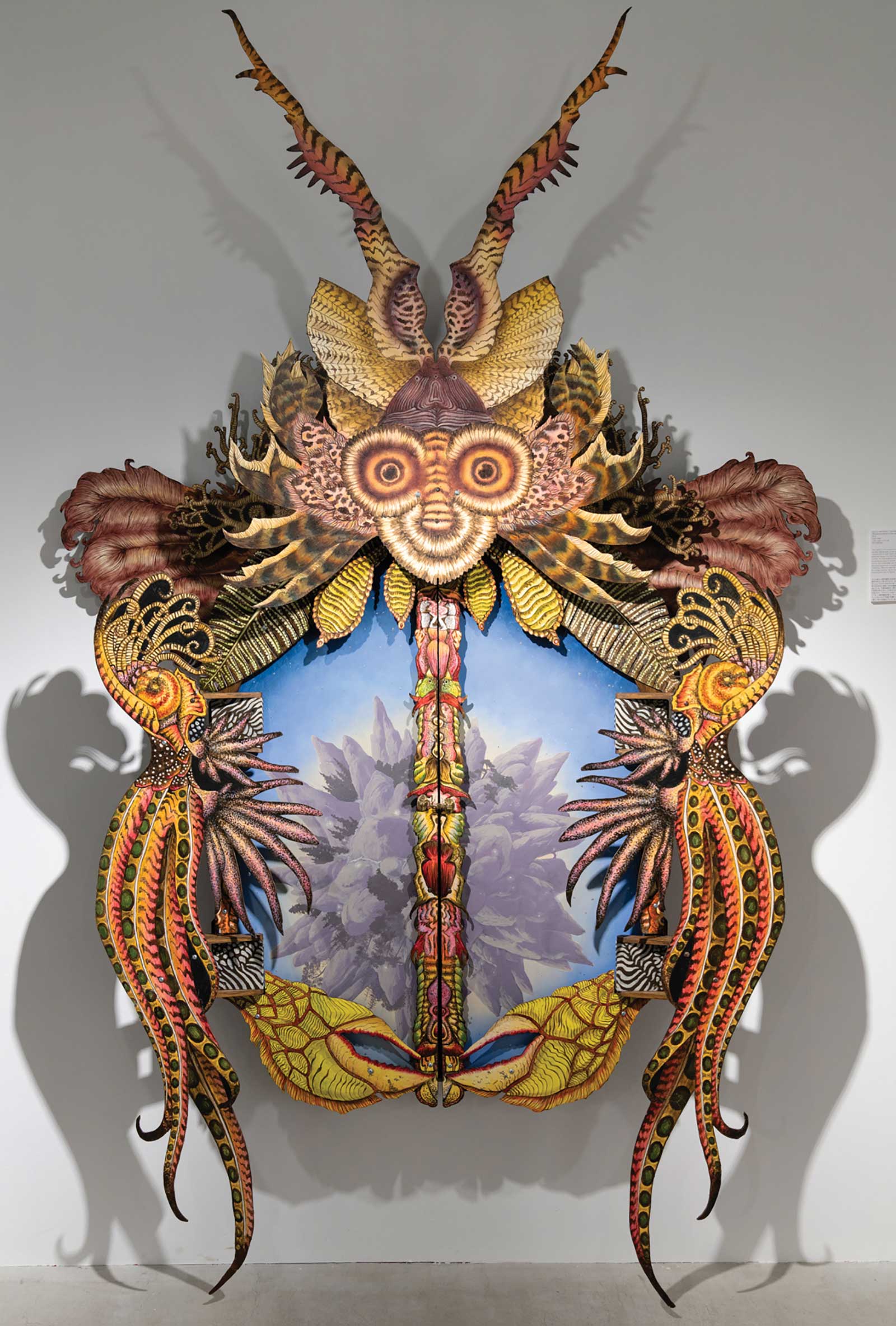 Freyja Dean, Door to iDoll World (closed), acrylic on oak and birch, 108 x 72"
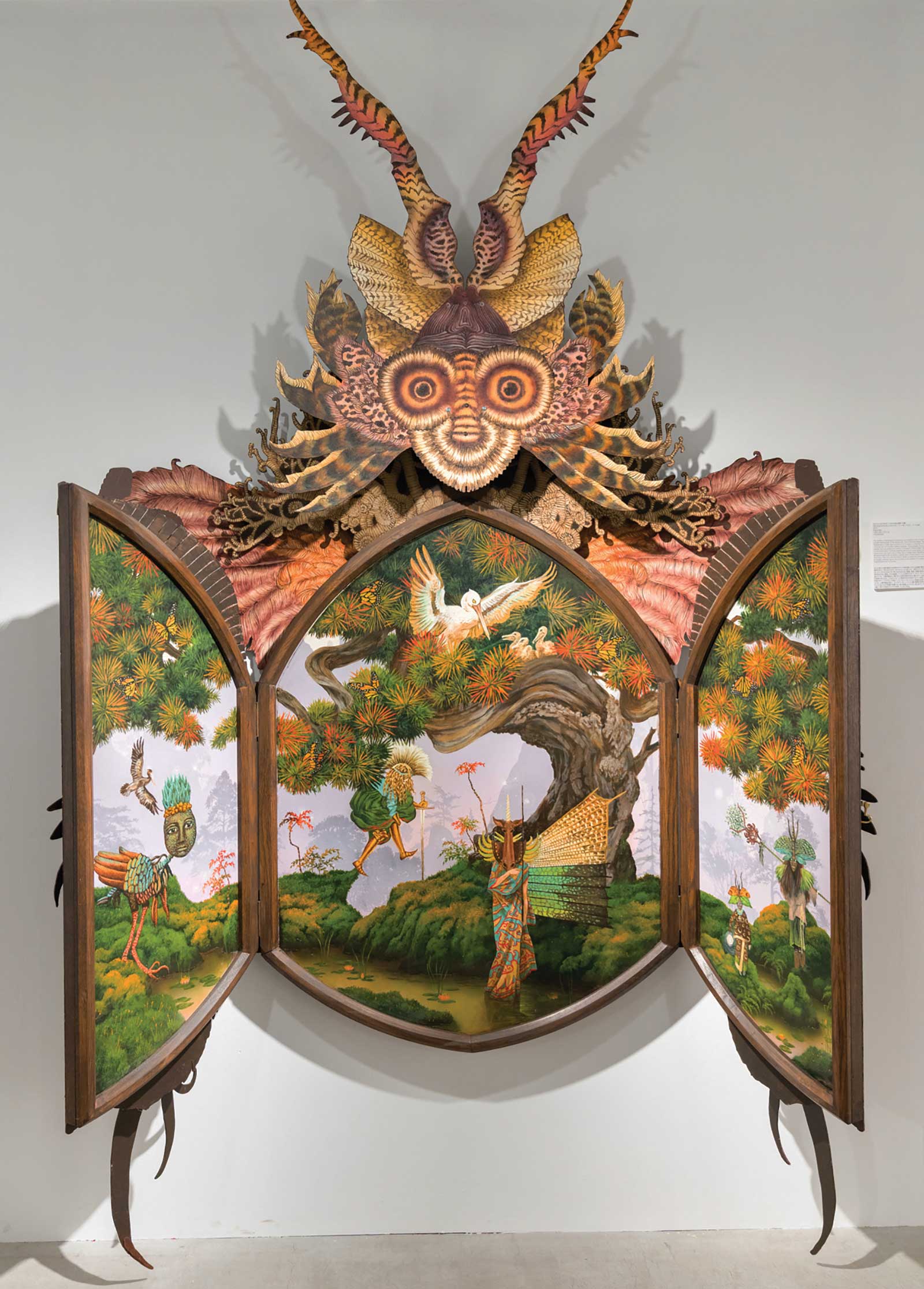 Freyja Dean, Door to iDoll World (open), acrylic on oak and birch, 108 x 72"
Miho Hirano’s decorative oils of young women are as delicate as cool watercolors. Paintings of beautiful girls are often critiqued as the objects of the male gaze, the patronized objects of sexual desire, and patriarchal oppression, but here they are the elemental subject of a woman’s eye, and Hirano’s subject is a modern muse—a reassuring goddess born to this fearful age under the female gaze. In Time of Eternity she gazes back at us from under a hood of earthy roots, through a rain of crystalline droplets. The paintings aren’t self-portraits, although Hirano explains she uses herself as a reference, but the woman exists “only in the world I draw.” In Serenity of Mind she is wrapped in the embrace of filigreed water. In Wishes, her hair becomes a tangle of windswept ribbons. These aren’t paintings made to express romance or love, but “to capture the subtle flickering of emotions that arise from our relationships with people and our environment.” Hirano says,
“…nature can be healing, bountiful and sometimes fierce, but it can also be gentle and dangerous and changeable.”
Freyja Dean is profoundly moved by nature, too, and makes imagined landscapes which suggest what the world might be, rather than what it really is—an idealism which is strangely but beautifully mutated from reality. Her shimmering Breakfast at Titania’s shares the same sense of wonder in the fantastic face of fecund nature, where cherry blossoms spring from old wood in a foreground defending a soft woodland glade, bordered by three solid old trees. Behind the trees a pride of sparkling deer gazes at us. This is not reality—it’s the magic of a midsummer night’s dream, the colored land of the colleen queen.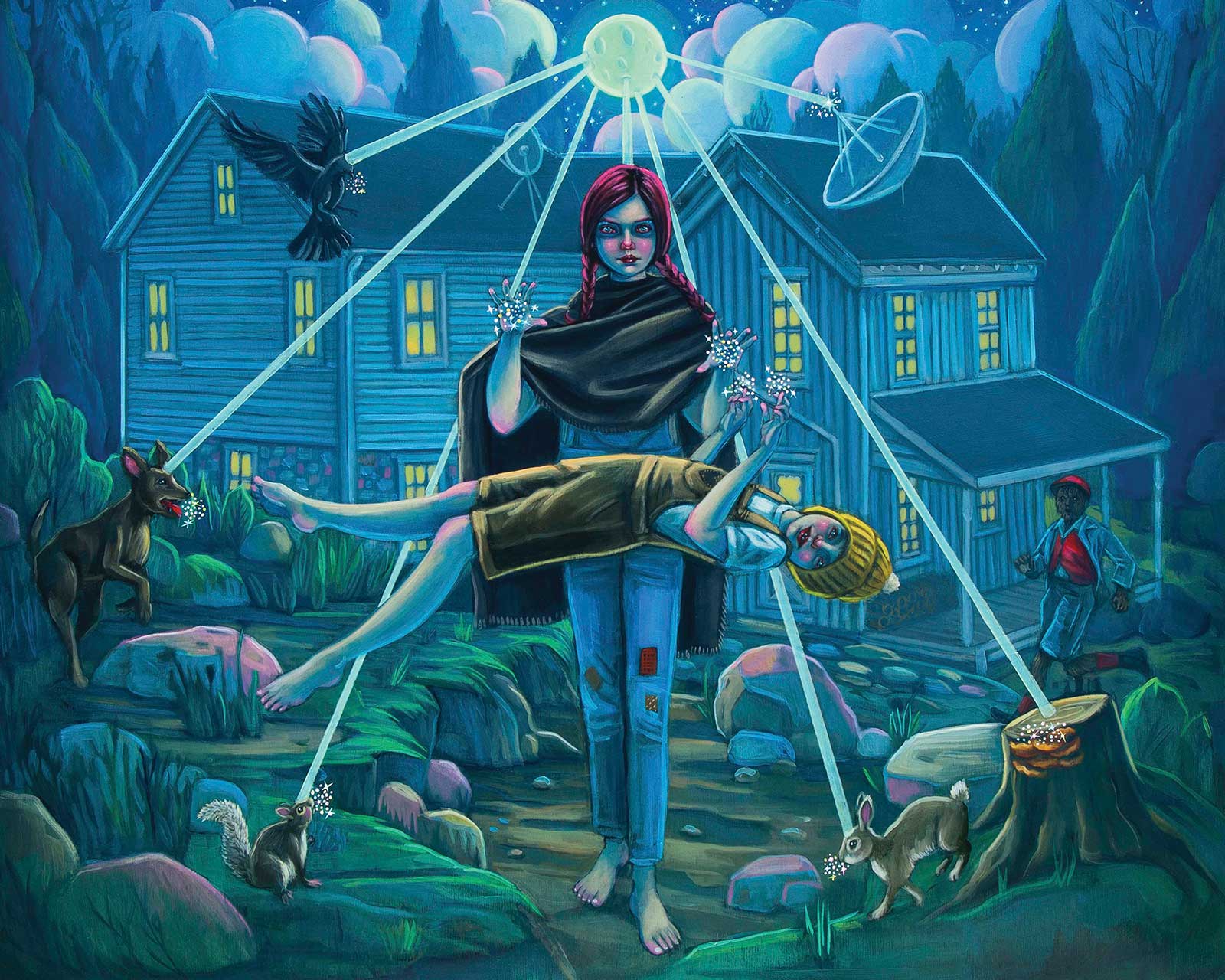 Lori Nelson, The Supermoon Sessions, oil on panel, 24 x 30”
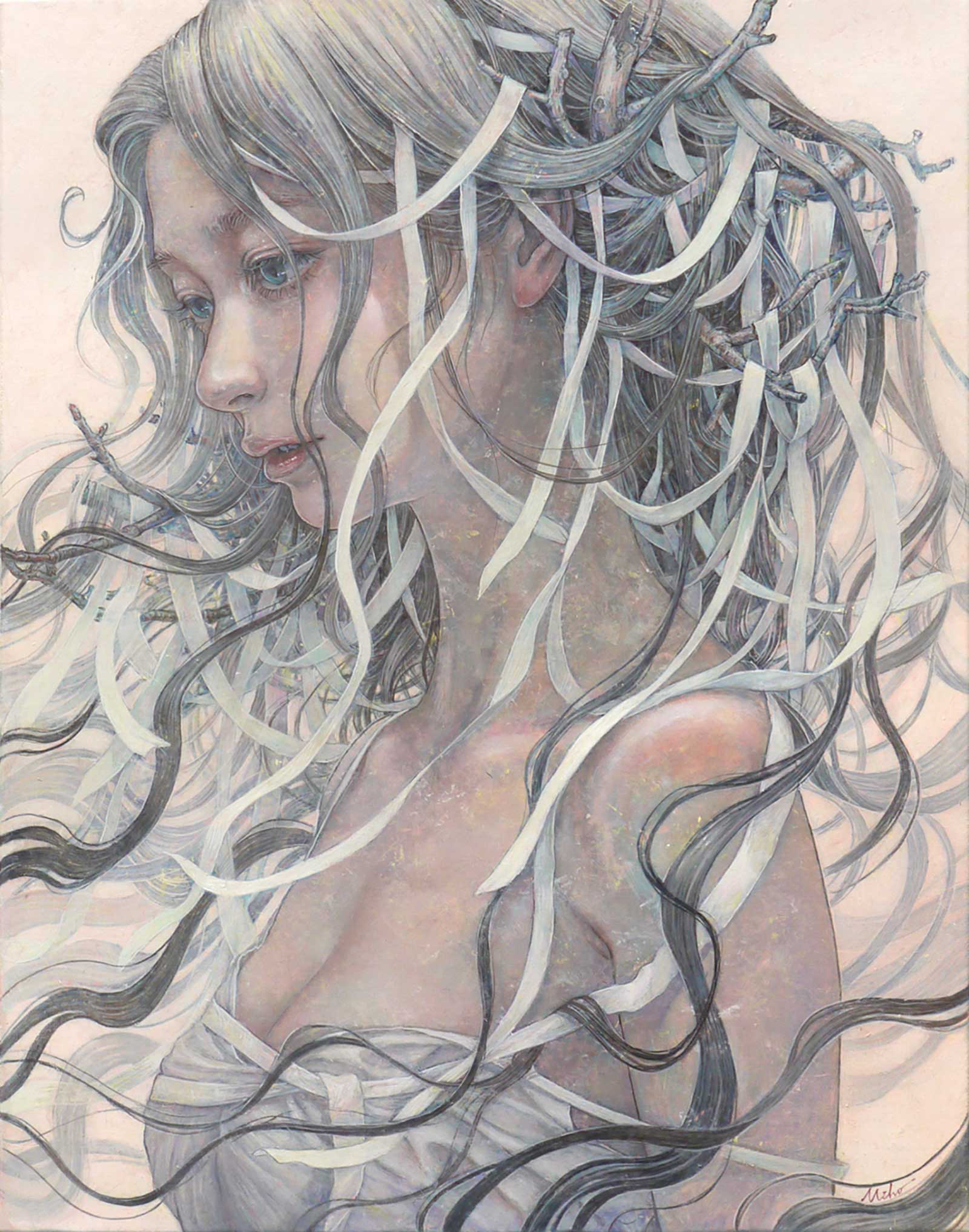 Miho Hirano, Wishes, oil on canvas, 16 x 12½”
Dean cuts perceptively into the edgy future with her Doorway to iDoll World, an altarpiece decorated with hybrid creatures from air, earth and sea. The altarpiece’s swinging doors are painted in the image of a mountainous sphere reminiscent of Hieronymus Bosch’s ecce mundi which shelters his Garden of Earthly Delights. In Dean’s interior world, cryptic figures appear in an idyllic landscape, like Bosch’s weird creatures, but while Bosch crafted clever visual puns from the language of his religion, Dean’s are shaped from the alarming but sensual potential of genetic modification—a refreshing, pagan creation for an altarpiece to the new gods. A bovine unicorn, and moth-headed tribesmen confront us in there.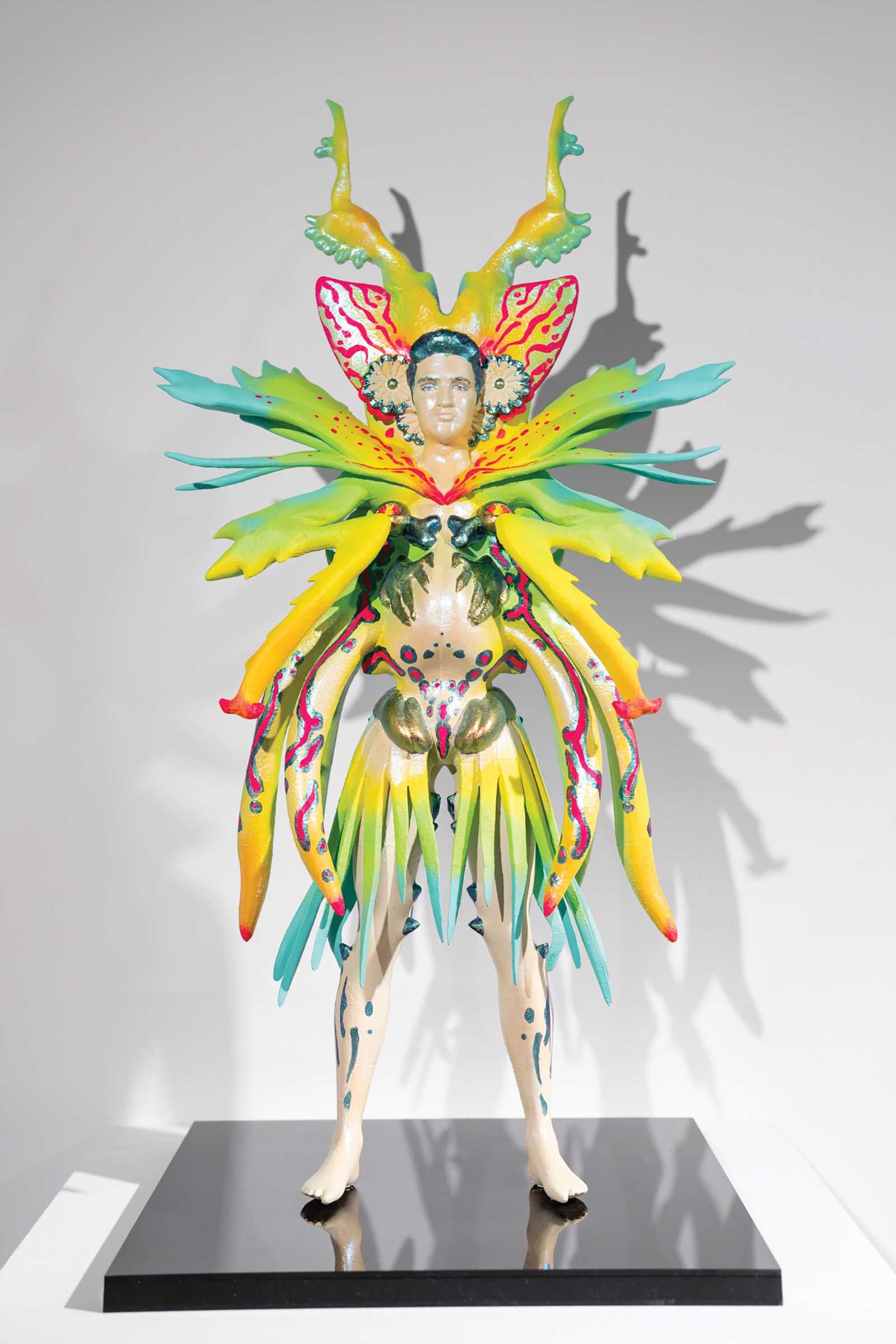 Freyja Dean, Florian, 3D printed acrylic, 47¼ x 31½ x 15¾”
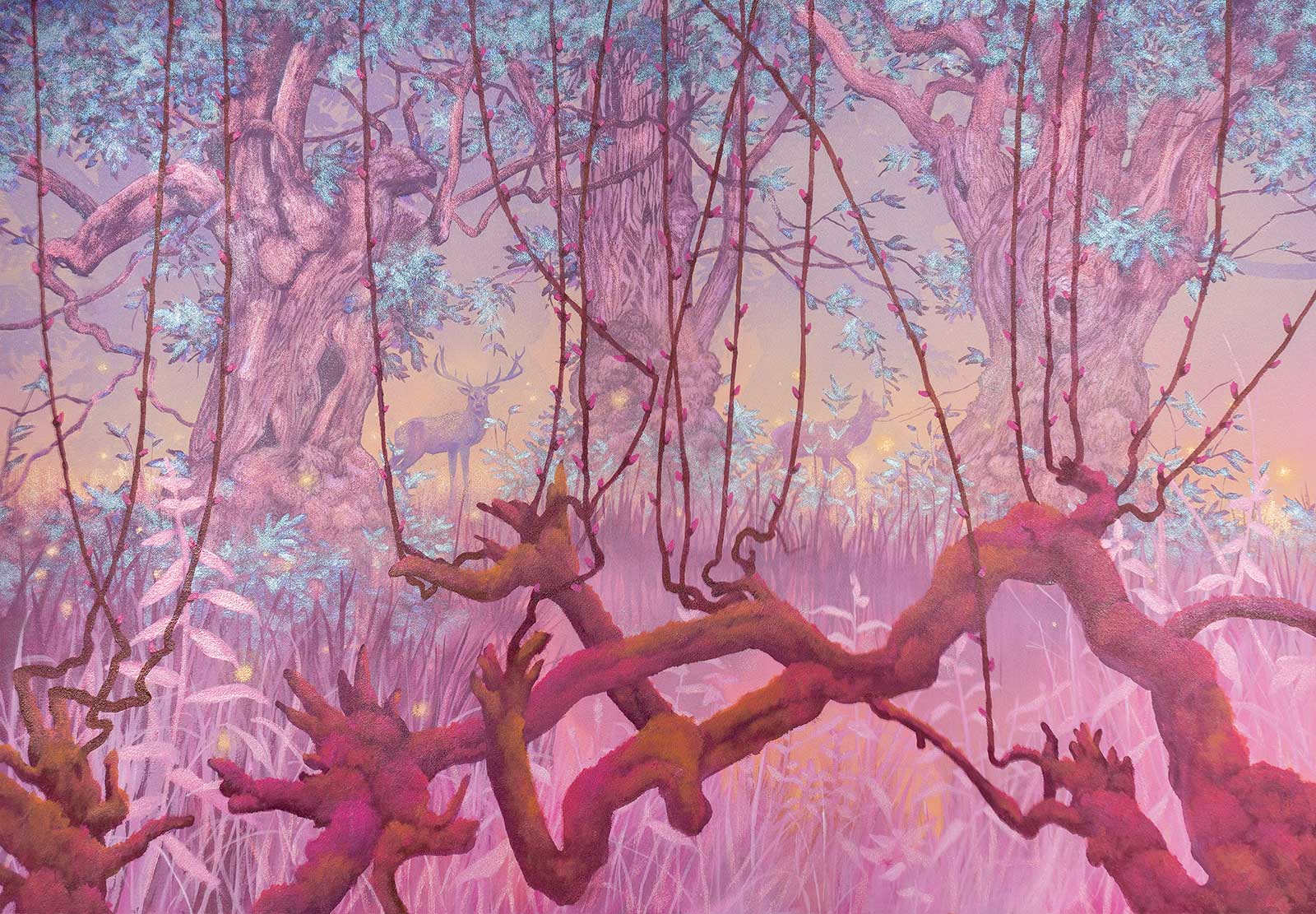 Freyja Dean, Breakfast at Titania’s, acrylic on panel, 27½ x 47¼”
Her sculpture Florian is more human than human, an idol enhanced in color and form and biology, like a pregnant birdman from a sci-fi paradise. Dean describes her interest in transhumanism, “Everything I read considered the fact that the technology was moving faster in many cases than the ethics of these advancements could keep up with. In my mind it created this image of a potential future where people (but generally and firstly only the very wealthy) could make gods of themselves. If we can create technology that makes us think better and faster, move faster, be physically stronger and extend our lifespan, aren’t we making ourselves Artemis, Mercury, Hercules, Chronos? What separates us from the mythology?”
As bionic technology and DNA modification make transhumanism possible, we are capable of surpassing the limitations of the human body—of expanding our sensory capabilities. Dean sees the potential and danger of radical individualism, an imagined and improved version of humanity. Like Nelson and Hirano, she has the perception and creative vision to show us the spirit of the age, but to her, metamorphosis can be beautiful, and nature can be alien. —
Want to See More?
Freyja Dean
www.freyjadean.com
Miho Hirano
mihohirano.mystrikingly.com
Lori Nelson
www.lorinelson.com
+++
Michael Pearce, Ph.D., is a highly productive writer, curator and critic. He is an active and enthusiastic participant in the conversation about 21st-century art and its roots, especially contemporary representational art and imaginative realism. He has published dozens of articles about art and artists, and wrote a book about art and neuroscience titled Art in the Age of Emergence. He co-founded and chaired The Representational Art Conferences (TRAC), a series of major international conferences that addressed the issues and aesthetics of contemporary representational art. He is Professor of Art at California Lutheran University.
Powered by Froala Editor