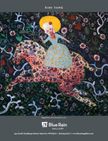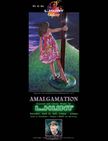
In 1791, the Chinese artist Shen Tsung-chi’en wrote a Treatise on the Art of Painting. “It should be possible…for the human spirit to express the spirit of the universe through the brushwork without difficulty,” he wrote. “For painting is only an art, yet it has the power of creation of the universe itself…When the artist is ready to start a picture, his mind can plan only the general type of brushwork and composition. Yet as the splash of ink descends upon the paper, guided by the artist’s spirit, it comes out in myriad forms entirely beyond the original plan…If the artist insists on doing what he did yesterday, he cannot do it. Why? Because when an artist insists on something, he is already obstructing the free flow of spirit…A scholar painting starts out with nothing in his mind, but when his spirit begins to move the brush, the forms of objects present themselves on paper, for it is the circumstance of a moment, totally unexpected, and hard to explain in words. In a brief moment the depths and heights appear, all well expressed by the brushwork, and the disposition of different objects is perfect, too, better even than the actual scenery. This is because the grand idea [of the universe] has been thereby expressed.”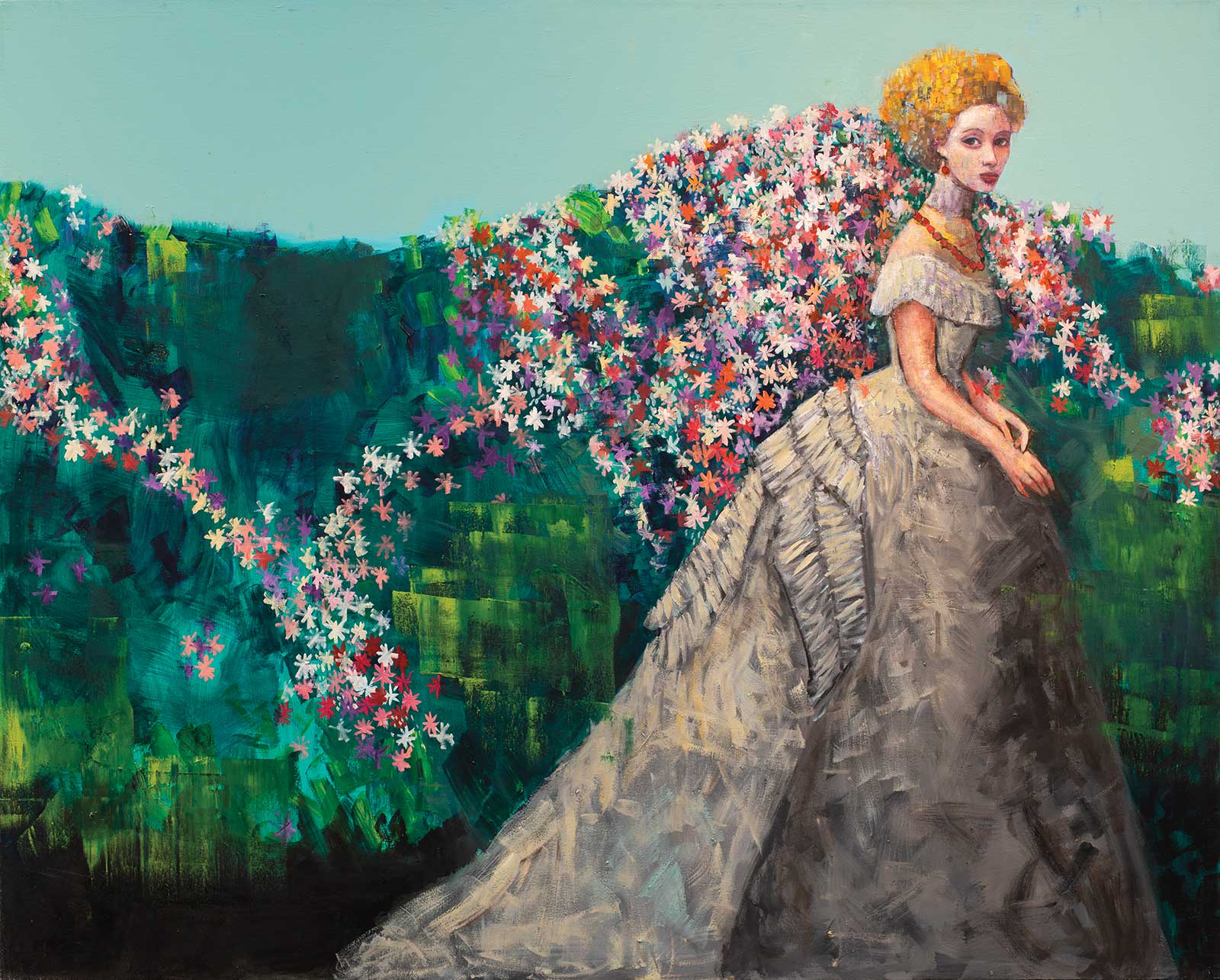 Lady’s Daily Walk, oil on canvas, 48 x 60". Courtesy Blue Rain Gallery, Santa Fe, NM.
The Taoist philosophy of wu wei refers to the state of being in which we are in accord with the natural cycles of the universe—a state of effortless action or “no action”—being in the zone.
Rimi Yang refers to Shen Tsung-ch’ien when asked about the inspiration and technique of her colorful, complex paintings. “I do not dismiss artists who have a great intention and message,” she says, “yet, simply in my case, I cannot. I try not to have any didactic narrative in my paintings. I tend to have a big head, so my narrative will eat up my paintings.
I am sure of it. I want to keep my paintings simple and quiet, so the painting itself will grow with viewers. Thus, I think wu wei is the best way, even though ‘no action’ is quite hard to do actually.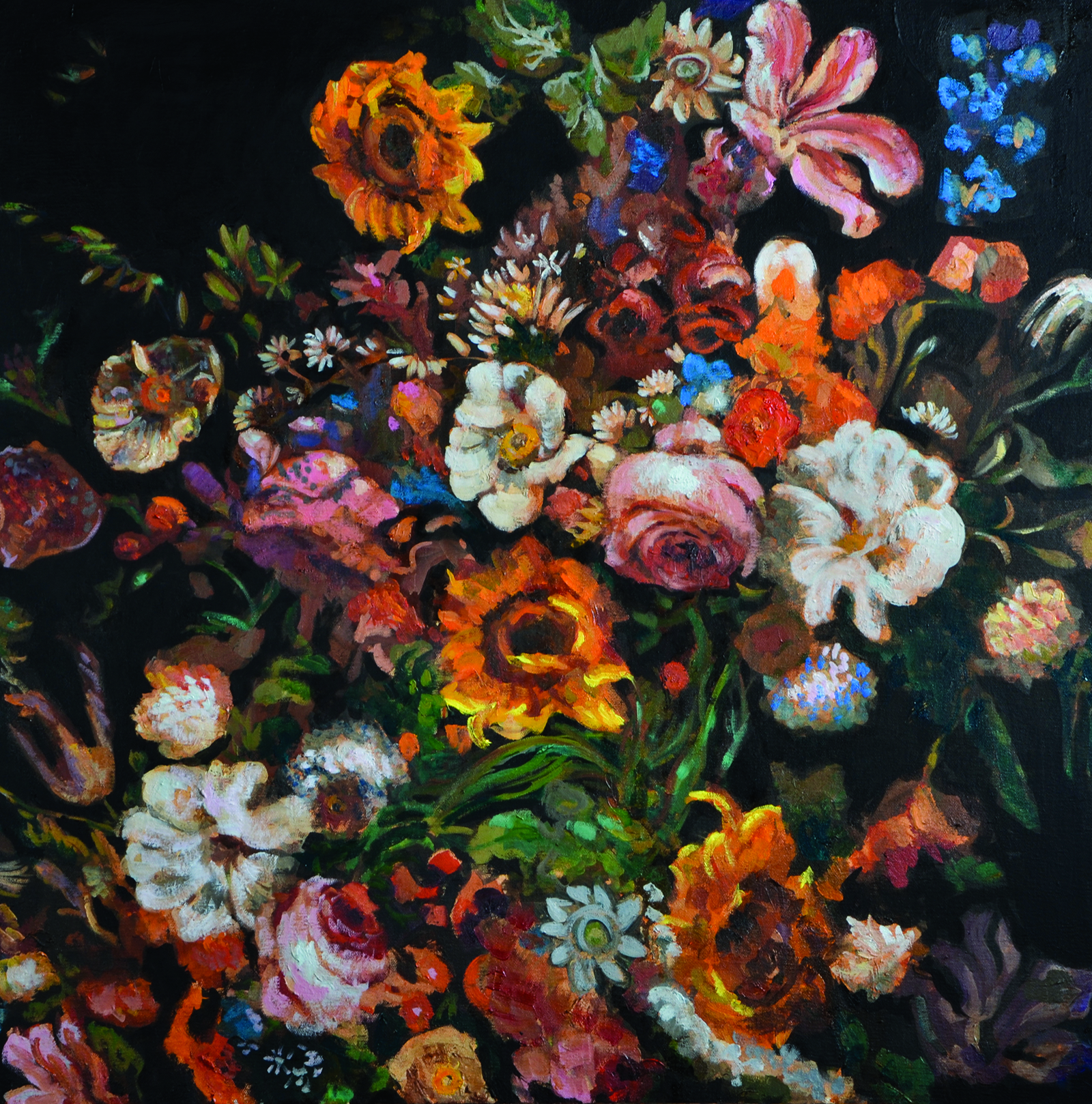 Flowers Wonder, oil on canvas, 30 x 30". Private collection. Courtesy Watson MacRae Gallery, Sanibel Island, FL.
“If I know what I am going to paint beforehand, my painting must be too awful to describe,” she continues. “Thus, this confusing act of describing my art in static words is quite nonsense, yet we want to explain and to describe our art. Our mind searches for logic to settle our mind. Actually, the world is simply just illogical. If you really are aware of it, you might become quite happy. It is very interesting for me to think that we can write about illogical, vibrant and ever moving art with limited static words.”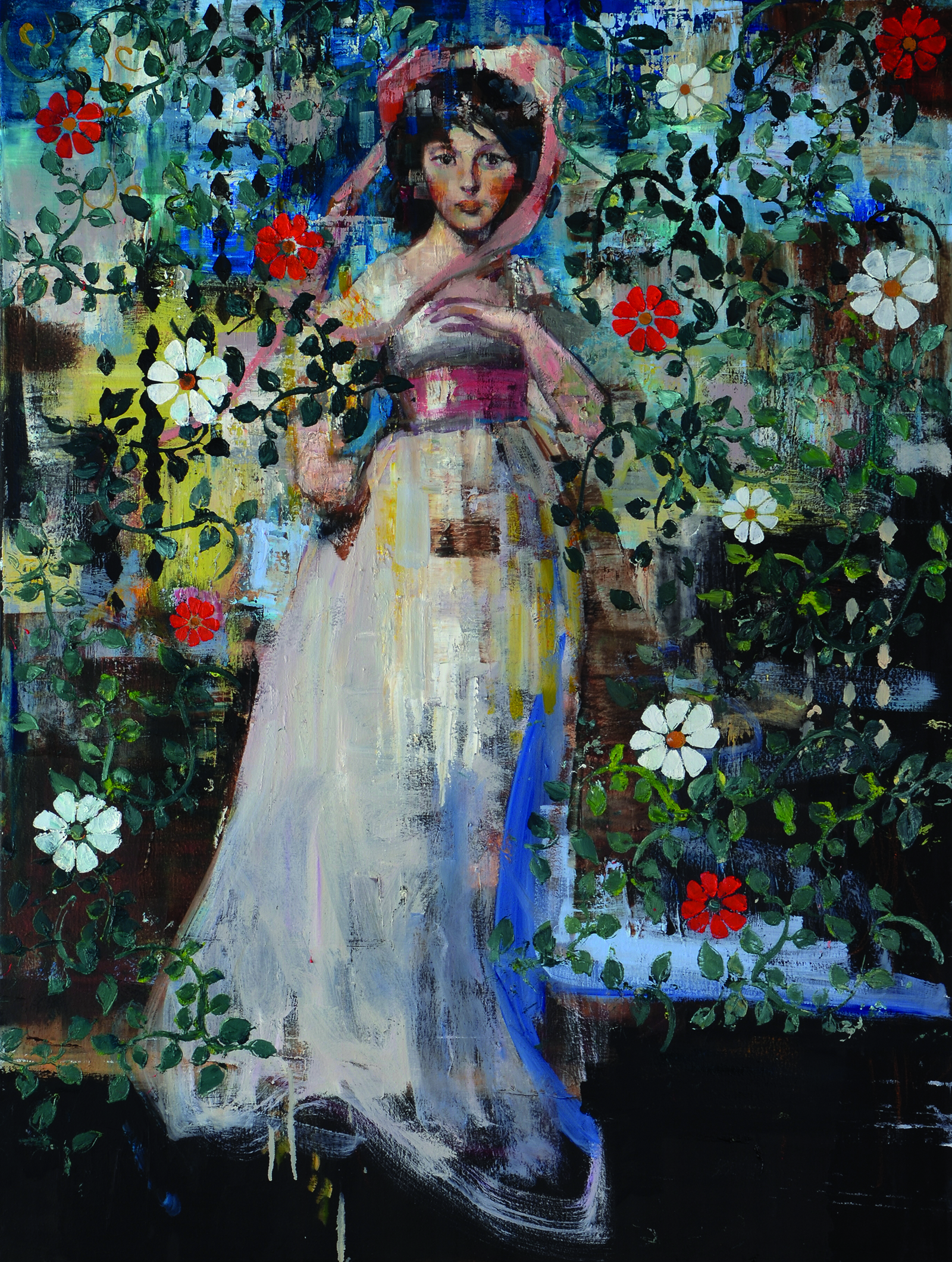 Pinkie, oil on canvas, 40 x 30". Courtesy Sol Art Gallery, Dublin, Ireland.
Yang was born in Japan, of Korean parents, and came to the United States in 1986. Her paintings incorporate her own mixed cultures and that of the U.S. as well as her interest in historical paintings. Pinkie, for instance, borrows the image of a young girl from Thomas Lawrence’s 1794 painting of the same title. The Lawrence hangs in the Huntington Library opposite Thomas Gainsborough’s The Blue Boy. Yang comments, “I like to paint references from Old Master paintings. I do like early 18th-century British portraits like Gainsborough’s Blue Boy. Not like Picasso’s reinvention of Velasquez, I simply would like to revisit the painting my way. In Asia, with old ink paintings, one must keep copying the masters’ paintings repeatedly to be able to master, but my intention is not to master either. Somewhat, I want to revisit the beautiful gardens and enjoy the views. I do not follow much historical background, but I love each era of historical art movements like different tasty dishes.”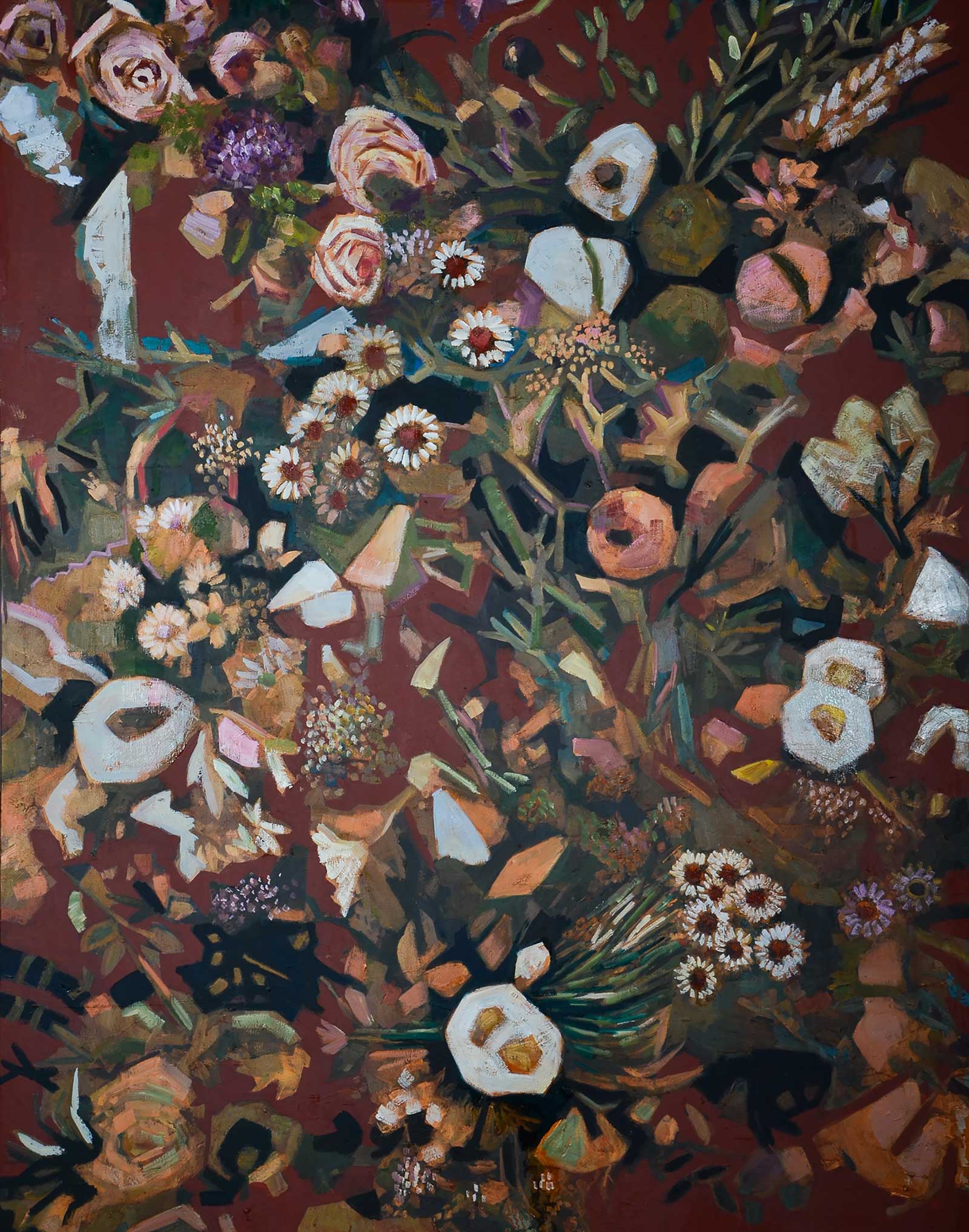 Smiling Flowers, oil on canvas, 60 x 48". Courtesy Blue Rain Gallery, Santa Fe, NM.Flowers often surround her female figures as they do in Pinkie, devoid of symbolism for her, and simply expressions of the beauty of the world. She comments, “Flowers to me are simply beautiful. No one taught us flowers are beautiful, but we all enjoy their beauty. We share the same feeling…and I found there is a truth in it. Each flower looks the same, yet we all know each is different from the other, and each flower shows off its energetic beauty in such a short lifetime to the world. I find flowers are simply beautiful and truthful.”
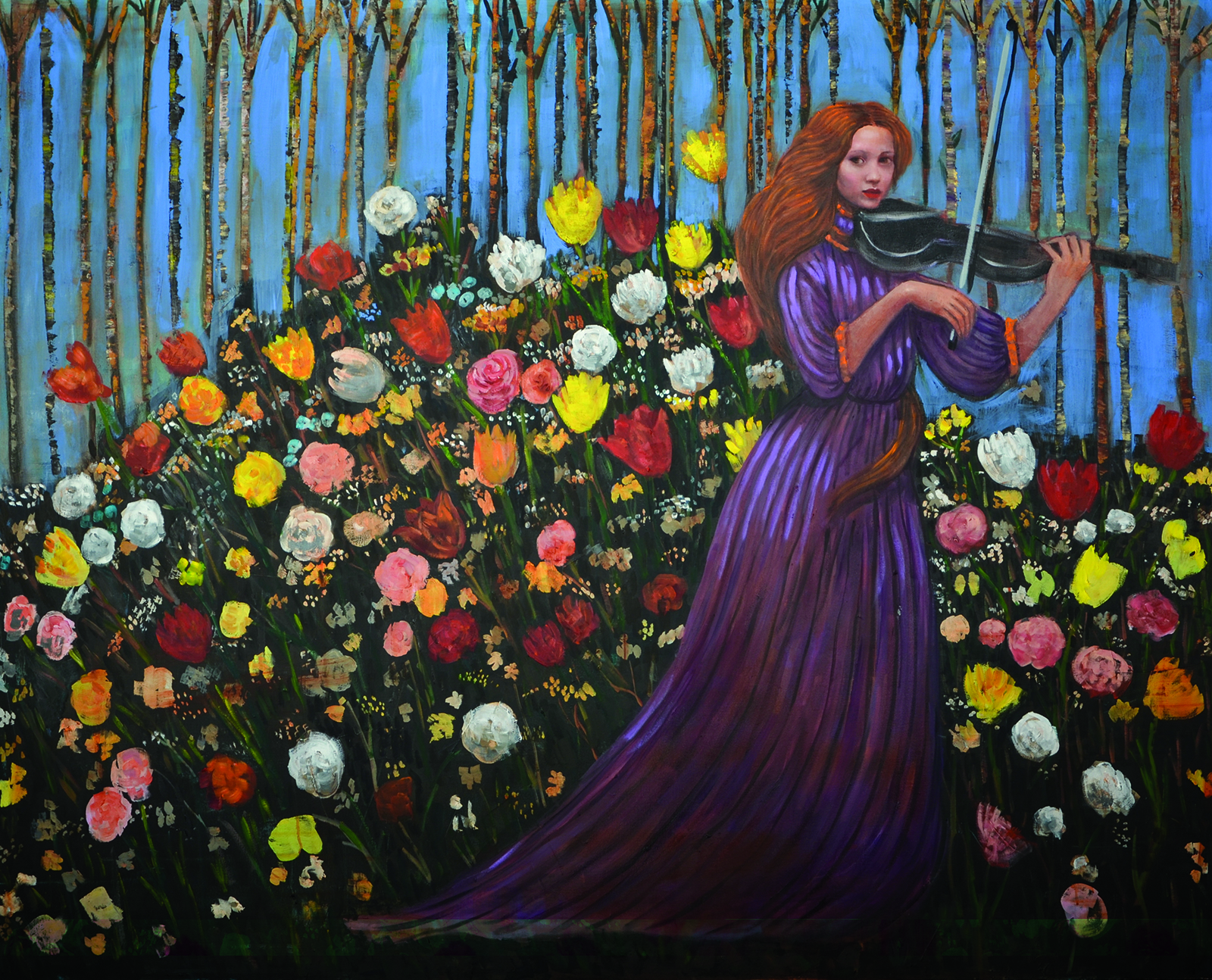 Melodic Garden, oil on canvas, 48 x 60". Courtesy Sol Art Gallery, Dublin, Ireland.
As for the women who populate her paintings, she says, “I simply enjoy painting faces. I guess I relate more to women since I am a woman. When I look at the faces of my paintings in the process of completing them, each day they give me different emotions. She looks like my family, myself, friends or heroines in movie stills. They are quite enjoyable to be with, actually.”
In accordance with the custom of the time, Lawrence painted Pinkie with a low horizon giving a sense of monumental importance to the 11-year-old girl. Yang places her in an environment of vibrantly colorful vines that place her in a timeless, universal milieu. When I ask about her use of color she replies, “I believe the world consists of the frequency of energy. As often described, the world is dancing with frequency. Each color has a different frequency, and we are constantly beaming our own frequency…so it seems.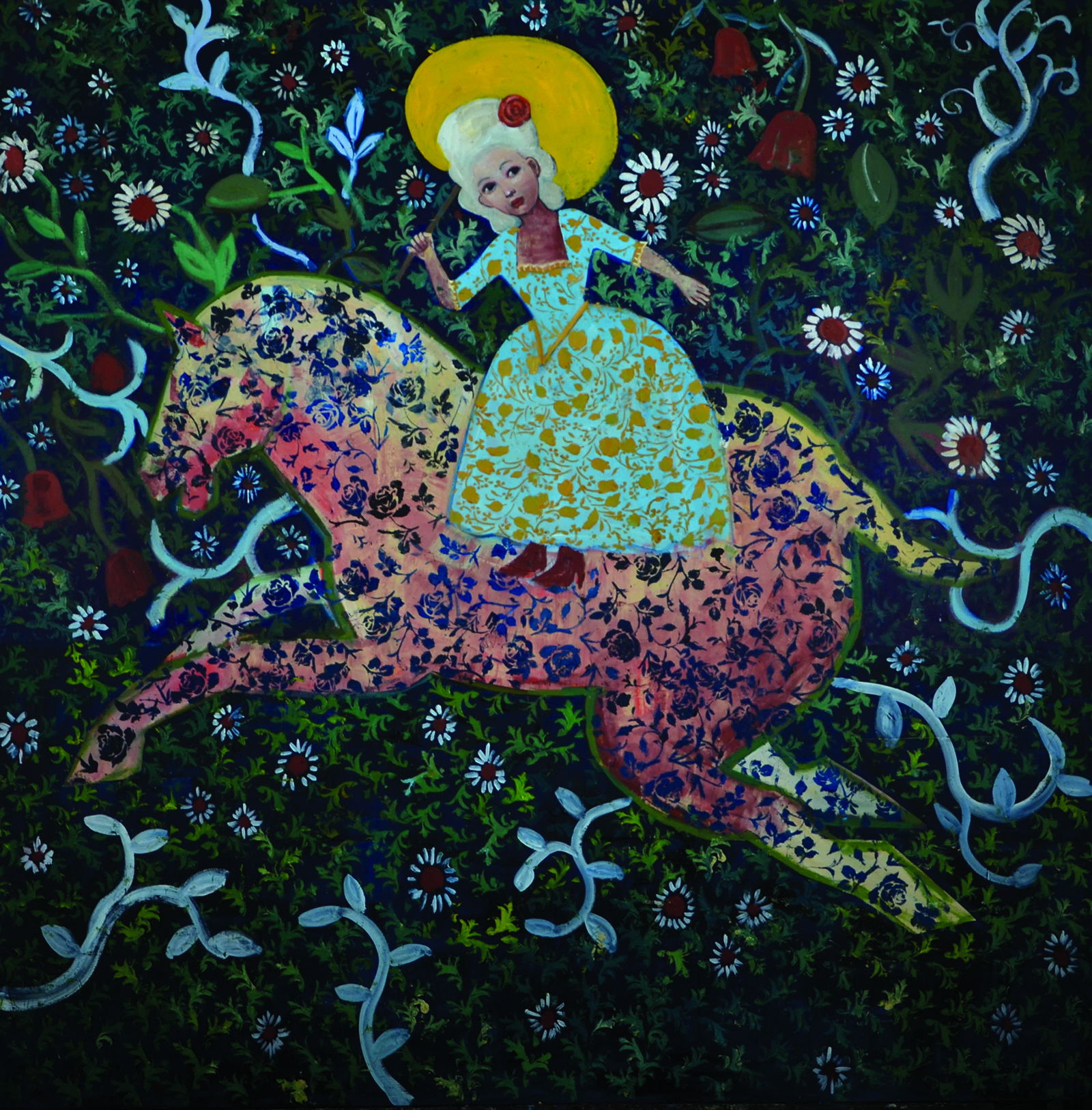 Happy Flower, oil on canvas, 60 x 60". Courtesy Blue Rain Gallery, Santa Fe, NM.I think colors seem to reflect my emotions which change daily. I also truly believe that viewing a painting itself is part of the process of creation. Each person’s viewing of my painting is beyond me since each viewer creates art in the process.” —
Powered by Froala Editor