
For 25 years, Elizabeth Turk has been creating emptiness. Today she is creating form from the formless. With finer and finer tools, she carved discarded blocks of marble to reveal the blocks’ interior spaces, delicate filigrees that recall its once fluid state. “My marble sculpture emphasizes what is not there,” she explains, “that which no longer exists.”
In the midst of creating her work she has witnessed her native California erupt into flames. “Fire invades our beings with its smells, cracked air, itchy eyes, fear and, above all else, the change it leaves behind. The charred, barren, vast acreage lends an indelible intensity to our loss,” she says. “It is quiet. The wind is different. Ash is our new soil. The air holds the memory of every sound that is no longer there.”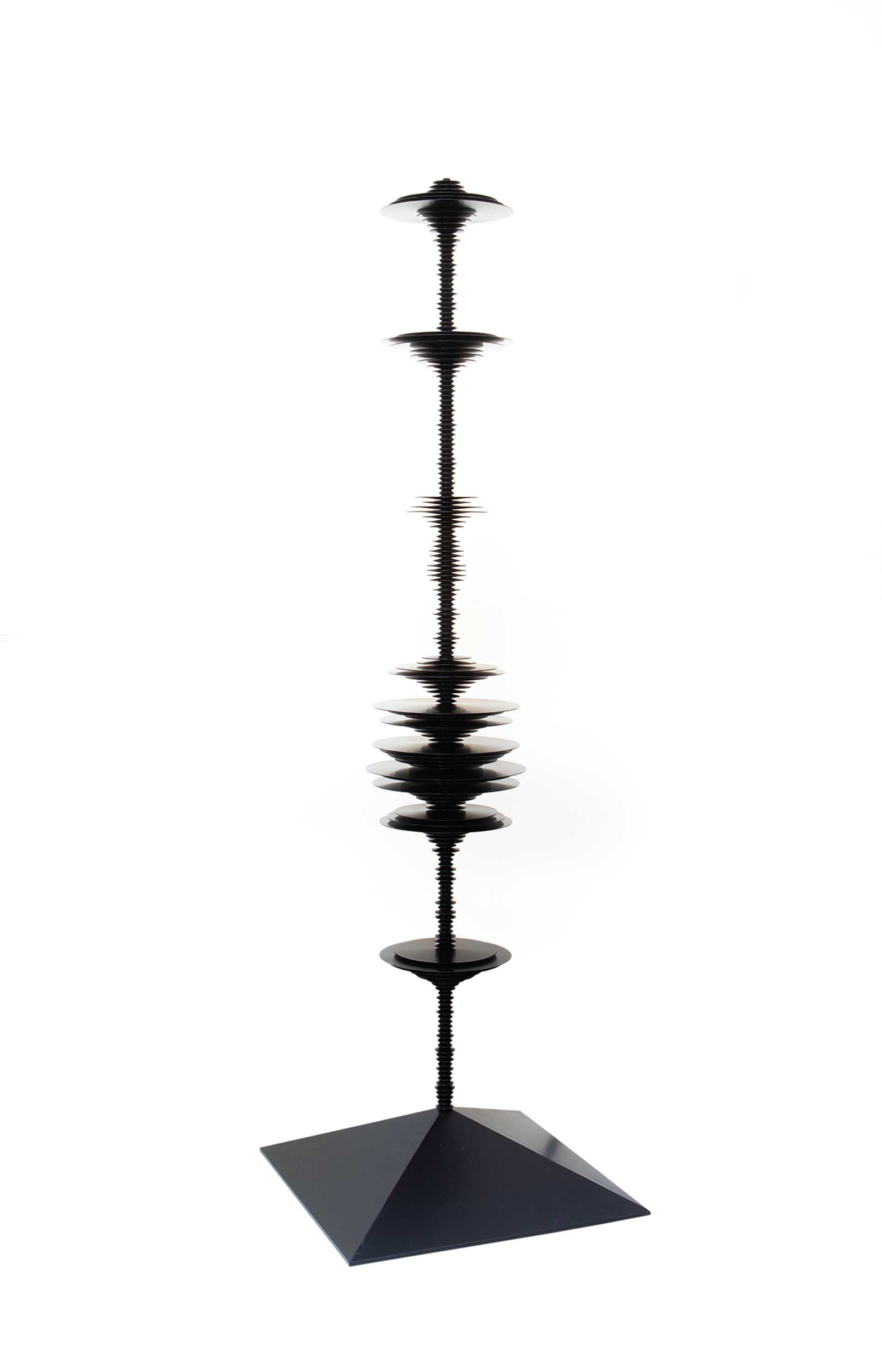 Gould’s Emerald, anodized aluminum, 79 x 16"
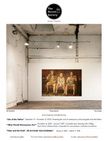
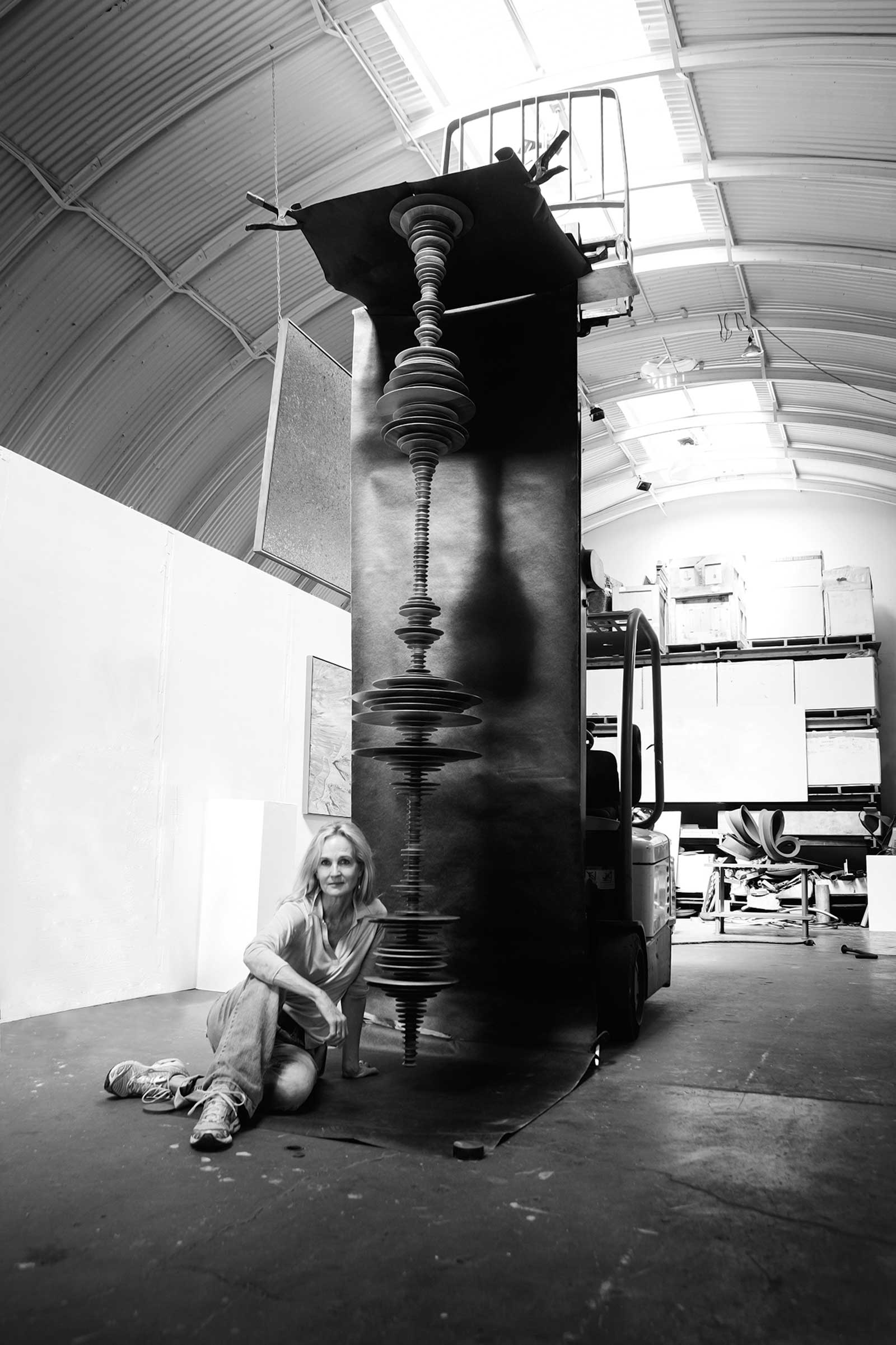 Elizabeth Turk in her studio with the work South Island Wren.
Birdsong fills the air less and less as habitats are diminished by fire, by encroachment and by the overuse of pesticides. An article in Scientific American stated, “bird populations have continued to plummet in the past five decades, dropping by nearly 3 billion across North America—an overall decline of 29 percent from 1970.”
The artist says, “I began researching birds as a symbol to ignite conversations on emptiness and extinction. Birdsongs are a backdrop to daily life. Their songs and colors reminisce on early mornings and childhood stories. In fact, annual migrations define an instinctive, reliable marking of time.” As she researched and experimented, she gathered ash from the area of the 2019 Getty Fire to make her drawings.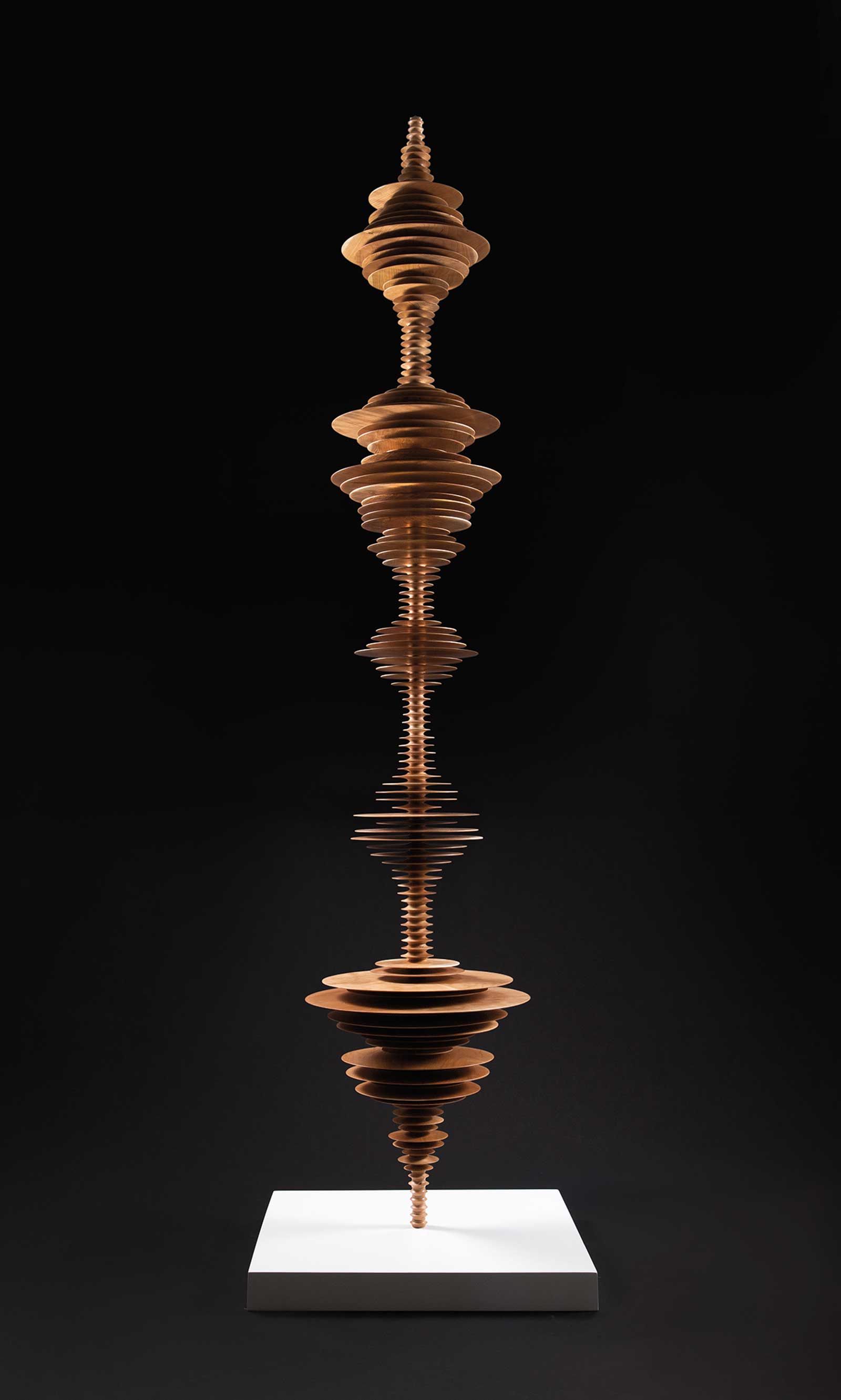 Bald Eagle, cherry, 96 x 17½"
“The birdsong recordings safeguarded by the Macaulay Library, Lab of Ornithology, Cornell University, inspired me,” she notes. “Hearing recorded songs of creatures, both endangered and extinct, I knew how to invert my sense of the void.”
She recorded the songs on her iPhone, which, in the process, gave her a visual representation of the sounds—the rising and falling lines on the screen of an oscilloscope. As her concept developed, she held an open studio at the Doyle Gallery of Orange Coast College in Costa Mesa. One day a quartet of singers came in who often used the space for practice because of its acoustics. “As I was sitting listening,” she recounts, “the sounds of the notes stayed on top of one another as they reverberated. It changed my vision. The sounds were much more layered than linear. I began to think of vertical stacking.” She worked with her concepts on her computer and then did three-dimensional prints of them.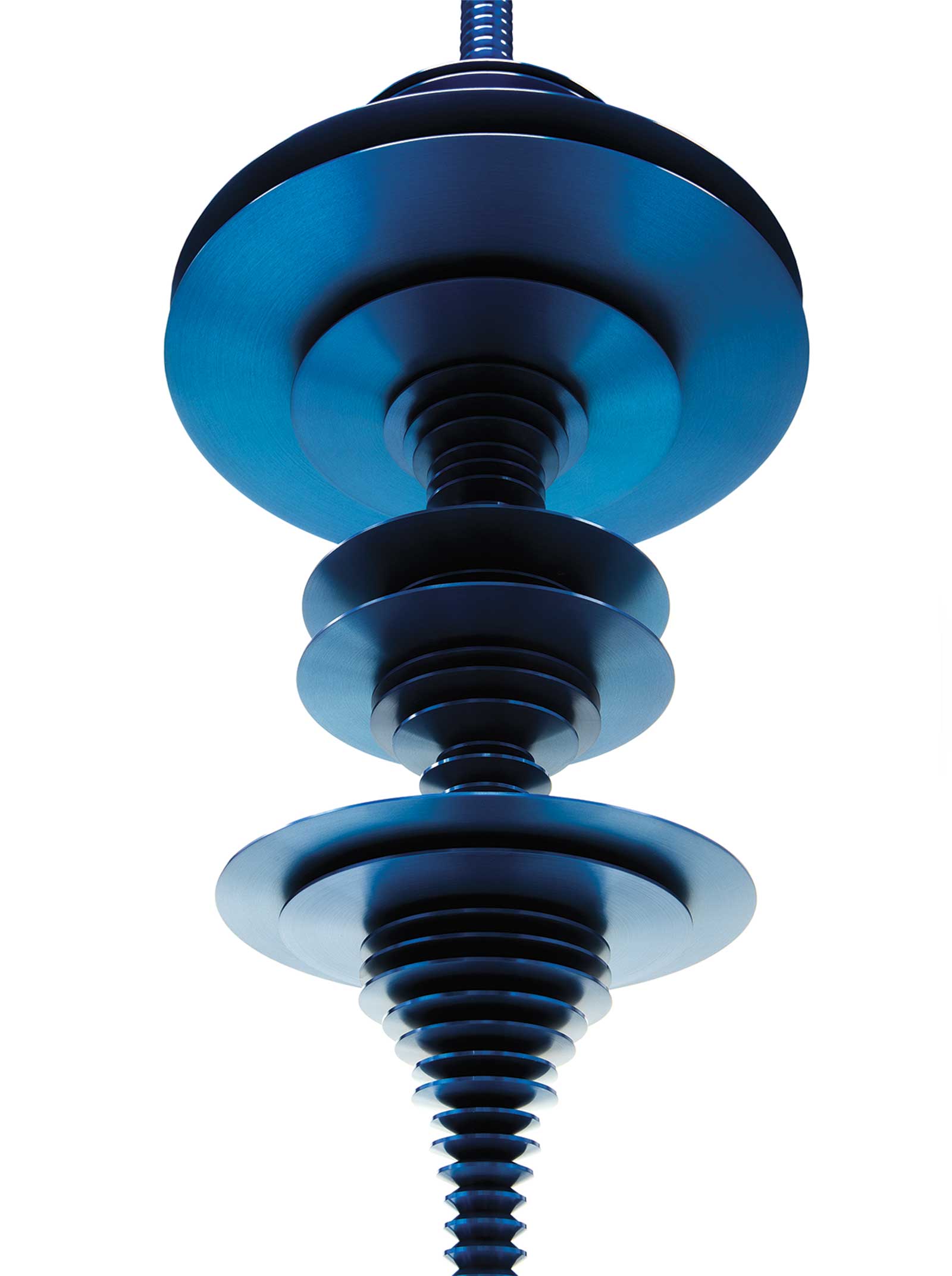 Hyacinth Macaw, anodized aluminum, 83 x 12½" Images courtesy the artist and Hirschl & Adler Modern, New York. Photographs © Eric Stoner.
Her Sound Columns are the ephemeral oscilloscope images made solid in wood, anodized aluminum, bronze and plastic. The columns commemorate extinct and endangered species and are in the exhibition Tipping Point: Echoes of Extinction at Hirschl & Adler Modern in New York, October 1 through November 20.
The song of a South Island Wren is rendered in cherry in a sculpture 14 feet tall. It hangs from the ceiling and sways subtly in the air. Other sculptures are slightly larger than human life-size, creating a totemic presence and inviting a conversation about the extinctions and our own presence in the world. She asks, “Are we creating a silence?”
Hirschl & Adler Modern • The Fuller Building, 41 E. 57th Street
New York, NY 10022 • (212) 535-8810 • www.hirschlandadler.com
Powered by Froala Editor