Cornelia Foss’ love affair with the East End of Long Island began the morning after a dark and stormy night. “There were so many interesting poets and painters out here,” she recalls. “I wanted to see what it was like. The piano duo, Gold and Fizdale, offered to rent us their old farmhouse in Water Mill, on Mecox Bay. ‘We think you’ll like it,’ they said. We arrived in a terrible thunderstorm with lightning and pouring rain. I wondered what we had done. But in the morning, there was the beautiful bay and the ocean behind it and the amazing light—and those shadows! The area was still pristine and untouched. The potato and rye fields would go right up to the dunes by the ocean.” 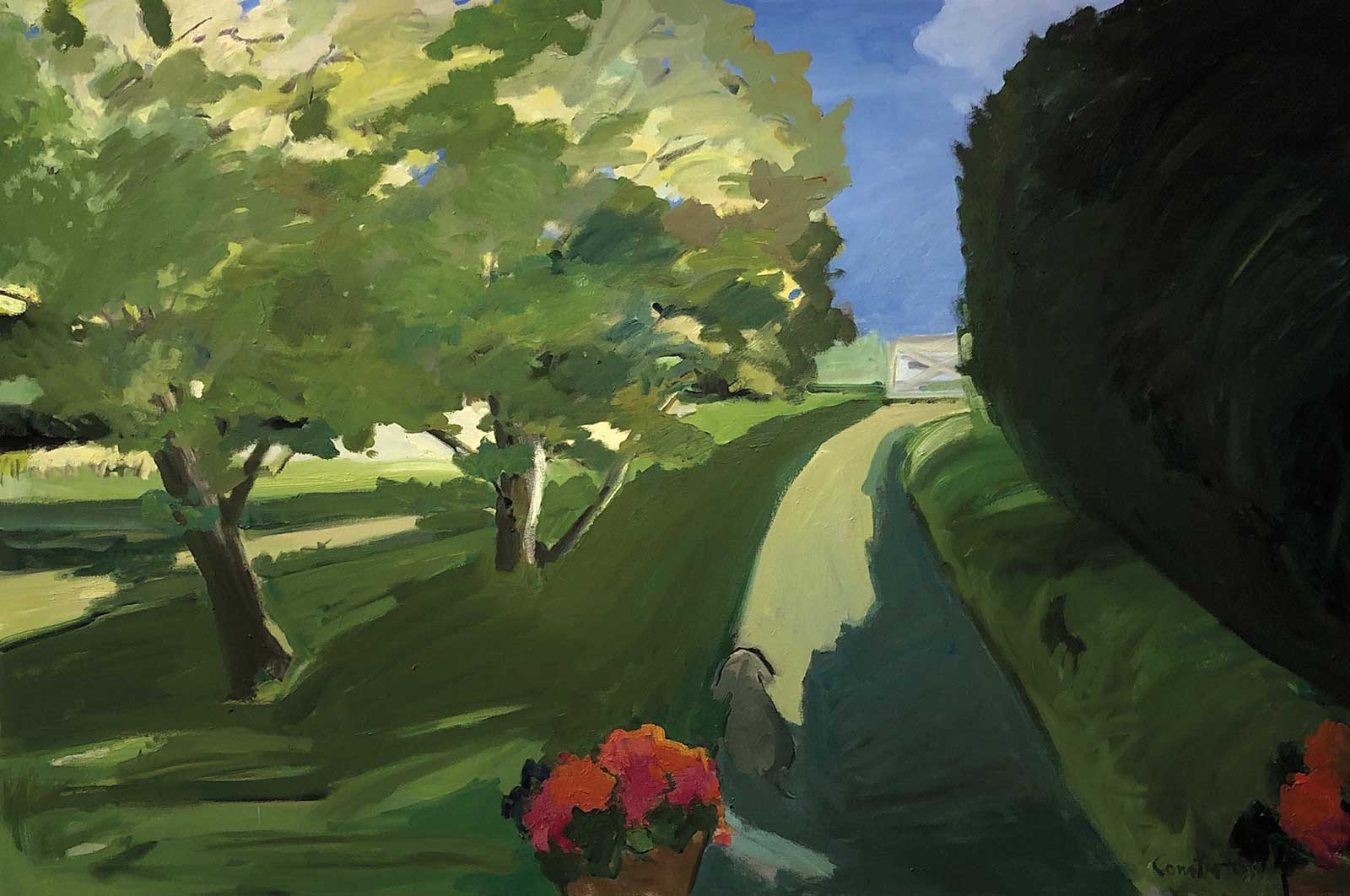 Charlie in the Driveway, oil on canvas, 48 x 72"
Foss was born in Berlin, Germany. She and her Jewish mother fled and came to the United States in 1939 and joined her father, who, not being Jewish, had been allowed to enter the country two years earlier. In order to get his wife and daughter here he had to prove financial stability. This was the law in America at the time. He was a classical archeologist and became professor at Washington University in St. Louis.
When she was about 10 and living in Bloomington, Indiana, she knew she wanted to be an artist. She copied Audubon drawings and, when she was 12, Picasso’s lithographs, etching and drawings. She was fascinated by Picasso’s line and that the works were “simultaneously so ugly and so beautiful.” As a young teenager, she and her friends were dreaming about how they would live their lives. Her dream was “to be a painter, have a nice husband, children and to have W.H. Auden sitting in my living room”—all of which came to pass.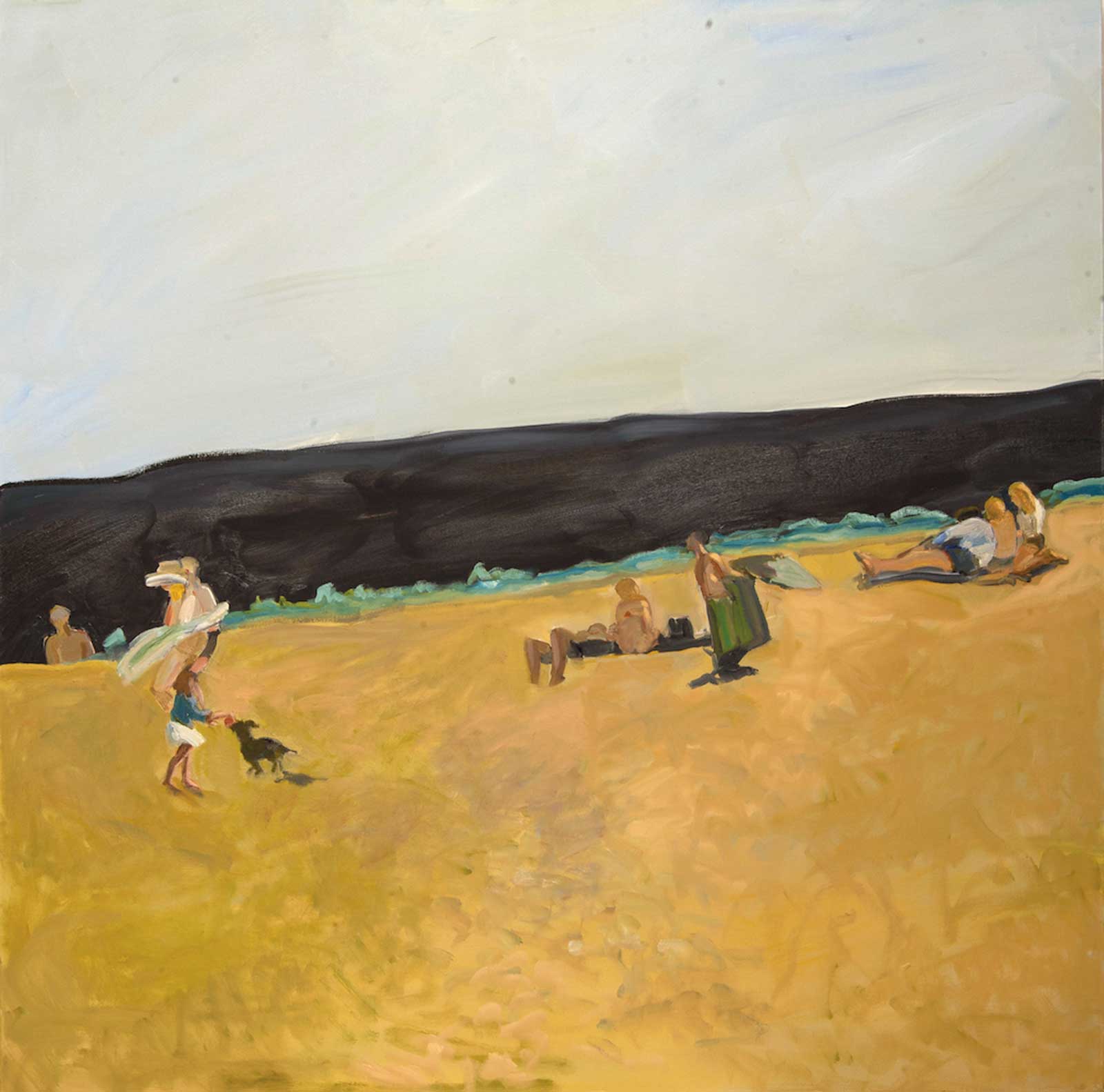 Beach People, oil on canvas, 48 x 48"
Foss’ husband was the composer, pianist and conductor Lukas Foss, who died in 2009. The two artists shared their lives and raised two children but didn’t get in the way of each other’s creativity. She likes to play classical music while she is working. When her husband would step into her studio, he would wonder why. “Any composer hates hearing music as background. It should be listened to with attention! Also, they have their own music going on in their heads,” she observes. “When I was painting a portrait of the composer Ned Rorem he asked me turn off the radio.
“Music keeps me in my own bubble,” she continues. “I don’t hear outside noises. The music gives rise to one’s own inspiration and to one’s own feelings. It inspires a recognition and understanding of something larger than one’s self. Painting is a form of communication. I can be struck by the sunlight coming through the trees and by the way Wainscott Pond, for instance, meets the dunes and the ocean beyond.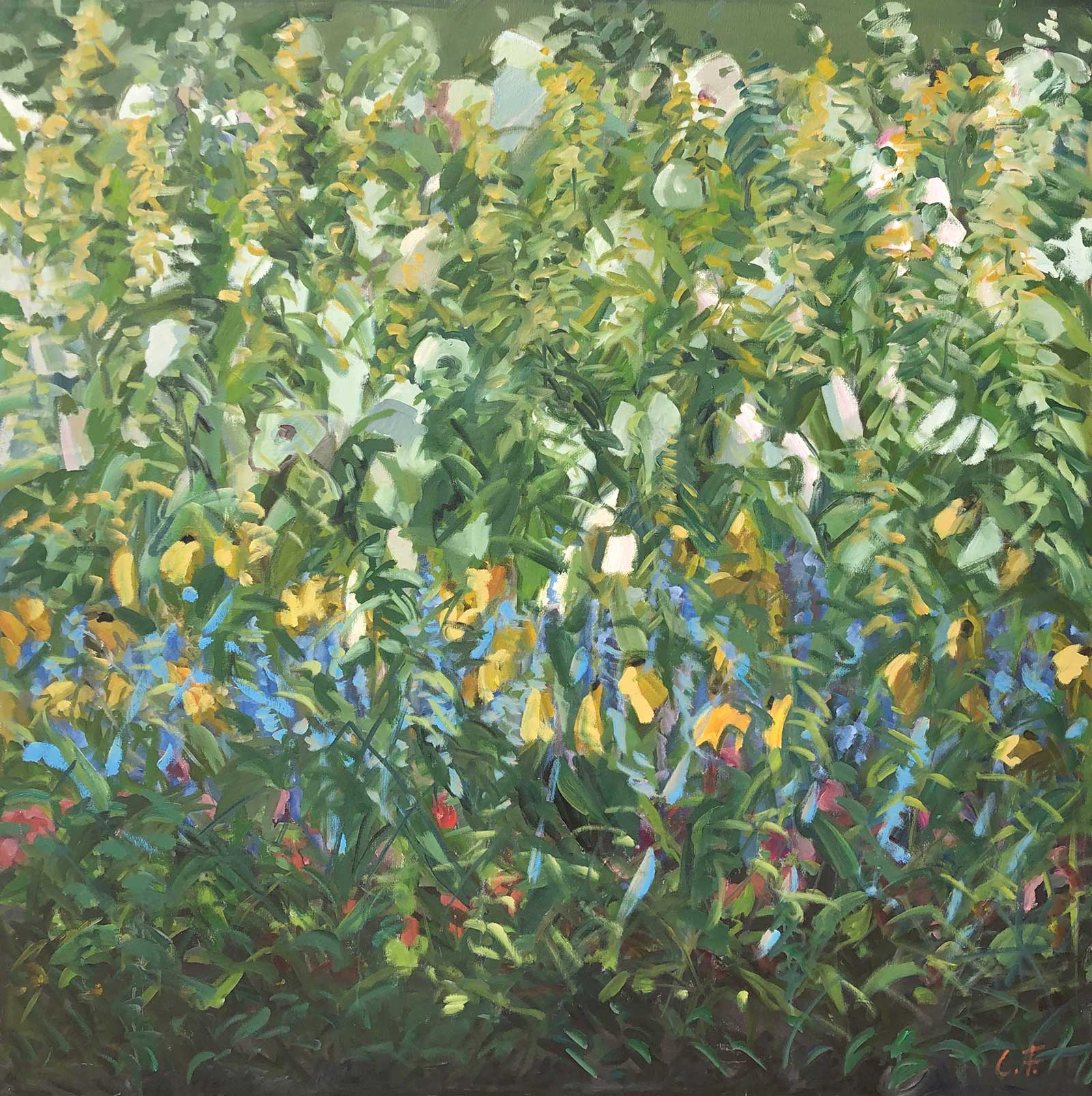 Garden Flowers (Green & Purple), oil on canvas, 50 x 50"
I can be mesmerized by the scene. I paint the pond over and over and could paint it forever, always seeing some new way to describe what’s going on! The complicated interaction of myriad components in nature is a never-ending challenge.”
She adds, “I admire the work of Fairfield Porter who said, ‘I try to paint the itness of things, as in the warmth of a cup of coffee.’ When I teach, I teach students how to see. Once they can do that, I tell them they will have that wonderful ability for the rest of their lives. What sort of meaning does something have in itself? I’m a human being colliding with something out there and I consider how we face each other and what do we do to each other. I want the viewer to recognize the subject and to recognize what we all share in this world.”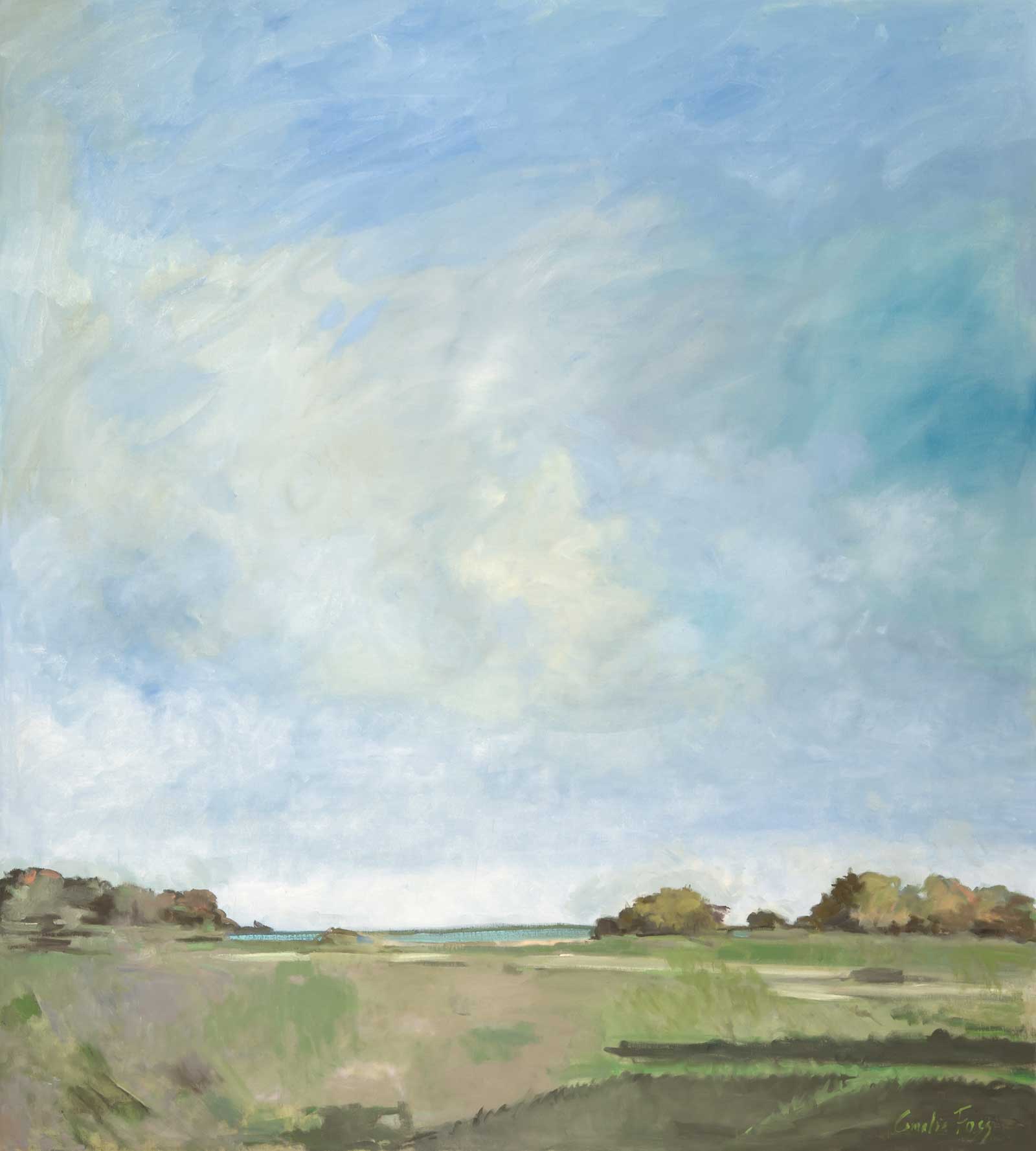 Sag Pond and Shadows, oil on canvas, 78 x 70"
The year she arrived in the United States was the year Irish poet William Butler Yeats died. Auden, in his poem In Memory of W. B. Yeats, wrote,
In the nightmare of the dark
All the dogs of Europe bark,
And the living nations wait,
Each sequestered in its hate;
Intellectual disgrace
Stares from every human face,
And the seas of pity lie
Locked and frozen in each eye.
In 2020, Auden might have written the same lines. Foss’ paeans to nature and, in her portraits, to our common human nature and hope for the future, can be seen in an exhibition at MM Fine Art in Southampton, New York, August 22 to September 6.
MM Fine Art 4 N. Main Street • Southampton, NY 11968 • (631) 259-2274 • www.mmfineart.com
Powered by Froala Editor