When Steven Auerbacher and his brother were about 12 and 13, their parents would drive into Manhattan from their home in New Jersey and drop them off, alternately, at the Metropolitan Museum of Art and the American Museum of Natural History. They would then go off to attend to their business, leaving the boys to explore the museums on their own—like a daytime version of Night at the Museum.
“We would roam around the museums for a couple of hours as if they were our playground,” Auerbacher recalls. “I was interested in art and my brother was interested in animals, so we would get to choose which museum to visit based on our respective interests. I was always interested in history and other cultures and particularly liked the Egyptian, Roman and Greek statuary—more so than the paintings, at that time.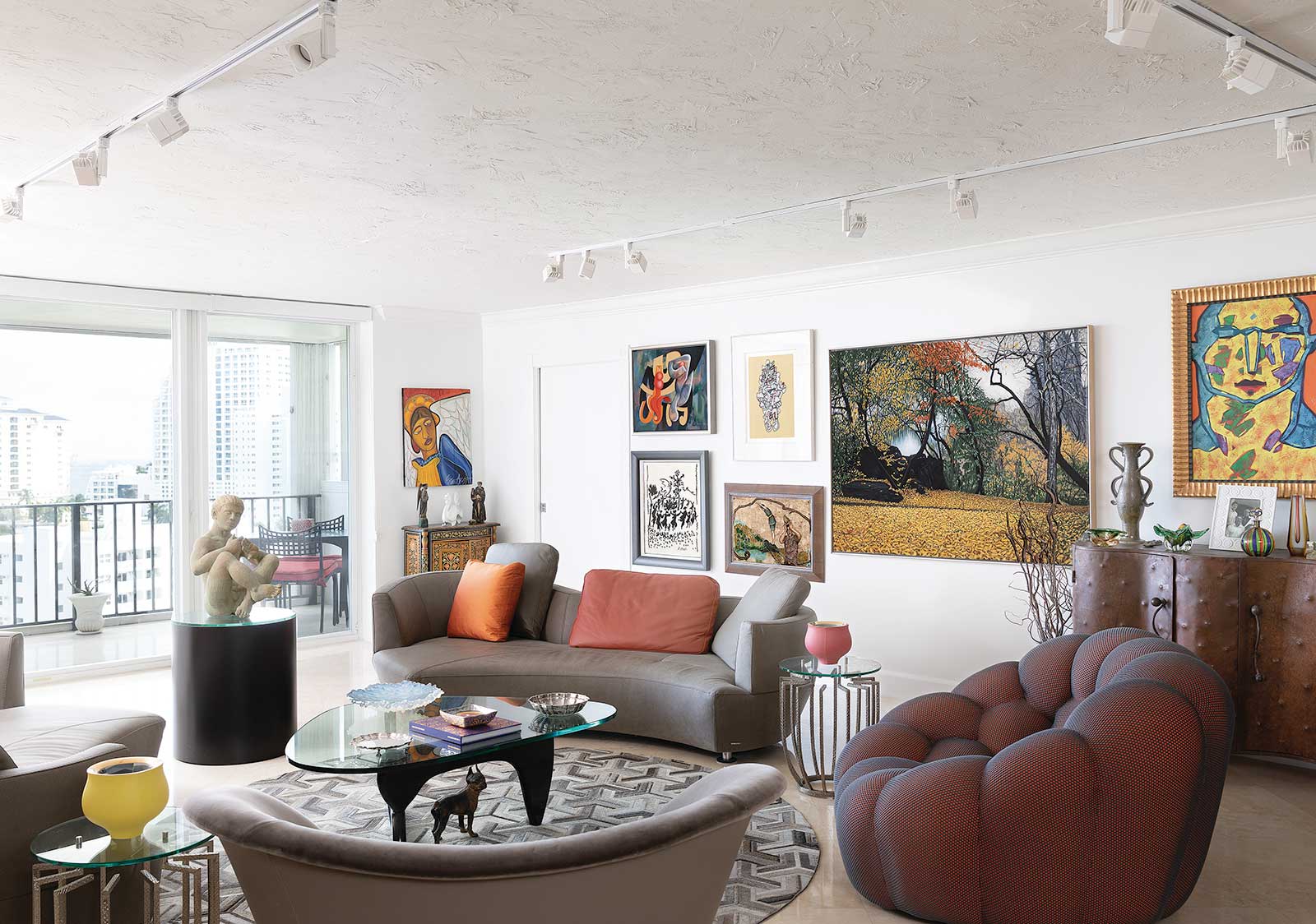 In the far corner is Yom Kippur by the Guatemalan artist Santos. On the adjoining wall are, from top to bottom and left to right, an abstract oil by Cuban artist J. Salas; a vintage Picasso print purchased by the collector’s mother at a New York City auction in the 1960s; a signed and numbered Jean Dubuffet silkscreen, Denegrator, 1973; and The Starling, 2006, acrylic and gold on bark paper, by Cuban artist Alejandro Mazon. The large painting is Park with Yellow Floor, 1986, by Kevin Moss. Above the chest is an oil portrait by Cuban artist Gustavo Valdez. The sculptural vase is by Alice Federico. On the round pedestal is James Tyler’s clay sculpture, Tadaio. The red and yellow bowls on the end tables are by Peter Pincus.
“Ours was a Eurocentric home. My father was German and my mother is a Hungarian Holocaust survivor who appreciated the fine arts. She exposed us to art, theater and museums at an early age. I think my going when so young to museums developed my deeper appreciation of art in a visceral sense,” he continues. “Later, once I bought one or two paintings, the idea grew that I could own pieces and have it be part of my life. It was an evolution. I never imagined I’d have this many pieces of art. There’s been no rhyme or reason to my eclectic collecting. ”
After completing law school at Syracuse University, in a city known for its harsh winters, he moved immediately to Florida. “I had spent my junior year in Jerusalem and backpacked through Europe allowing me to visit many European cities, museums, palaces. Then, being here in Florida opened my eyes to Latin and Caribbean countries and cultures,” he says. “Caribbean and South American art is both colorful and affordable. A friend exposed me to Haitian art and we frequented a long-standing, jam-packed Haitian gallery in Key West.”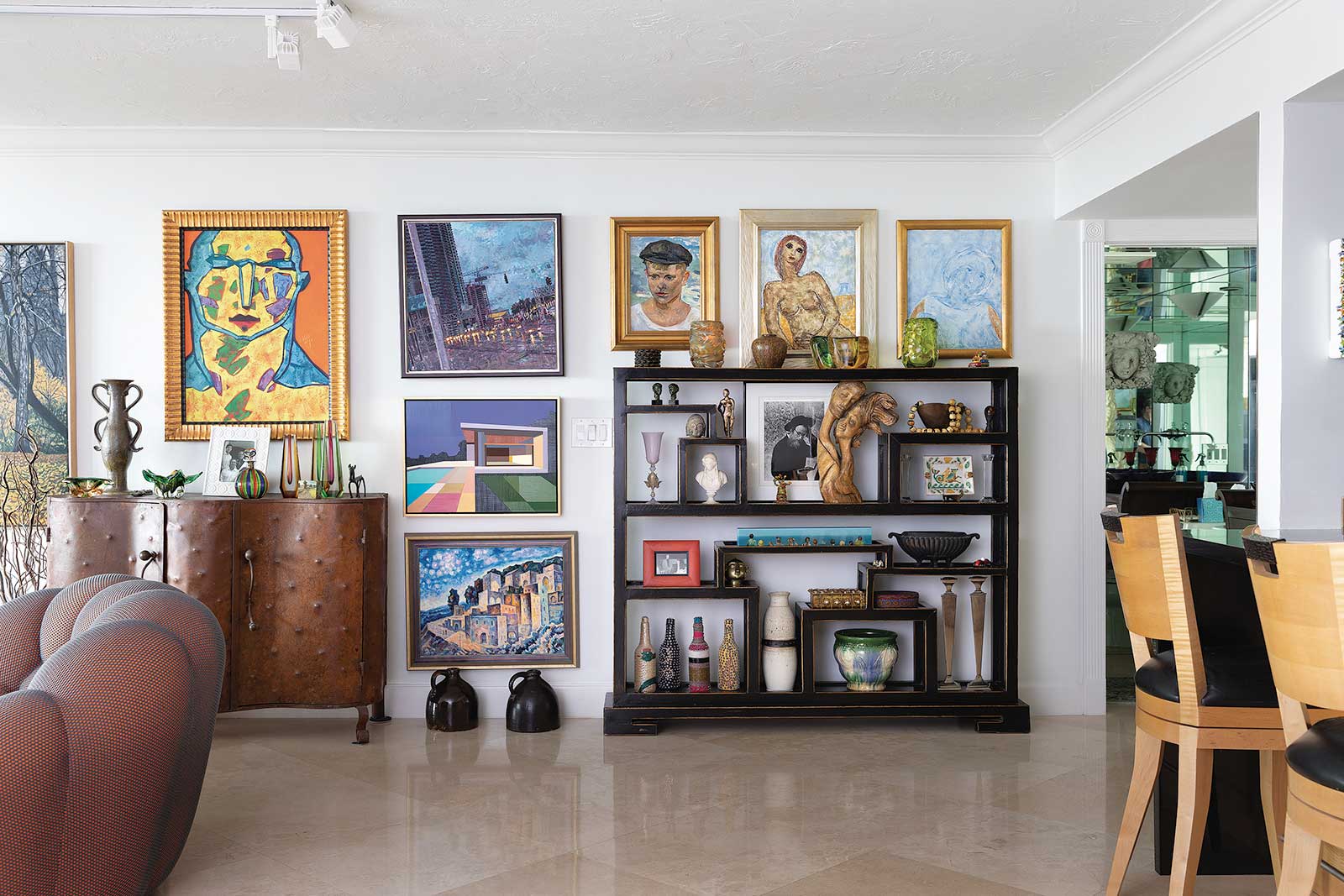 Hanging above a Mexican metal cabinet is an oil portrait by Cuban artist Gustavo Valdez. On the cabinet are, from left, a sculptural vase by Alice Federico and three glass vases by Czech artist Pavel Hlava. Next to the chest are, from top, Estampida, 2010, by Cuban artist Gustavo Acosta; Pool House III, 2013, by English artist Andy Burgess; and Zefat, by Israeli artist Leonid Zikeev. Across the top of the bookcase are, from left, Sailor Boy by Ukrainian artist Vasili Makulukha and two portraits by Haitian artist Arijac. Beneath the Zikeev, on the floor, are two 19th-century American ceramic pitchers. On the top of the bookcase are Murano glass vases and Danish ceramics by Salto. On the shelves are two small bronze busts attributed to Anna Coleman Ladd (1878-1939). Beneath them is an antique Murano glass goblet and beneath the goblet is a horizontal painting by Deborah Wasserman. On the bottom shelf are four Haitian beaded spirit bottles.One major piece in his collection has a Haitian connection and an interesting provenance. In 1995, the same friend commissioned the Florida muralist Andrew Reid to paint a triptych based on a photograph of a sculpture he has seen in Port-au-Prince. Le Marron Inconnu was created by Haitian architect Albert Mangonès as a symbol of Black liberation. When his friend moved into a smaller apartment, he gave the triptych to Auerbacher, since it fit perfectly on the wall where it now hangs.
His love of other cultures and history has stayed with him. On one set of shelves, there are an antique Murano glass goblet, Haitian beaded spirit bottles and Danish ceramics. He had seen the Danish pottery in Copenhagen but hesitated. “I didn’t know much about it but about two months later I saw the same work in a booth at Design Miami at much higher prices. I called my friend in Sweden, who had been with me at the store in Copenhagen, and asked him to return to Denmark to buy some pieces for me…which he did,” the collector says.
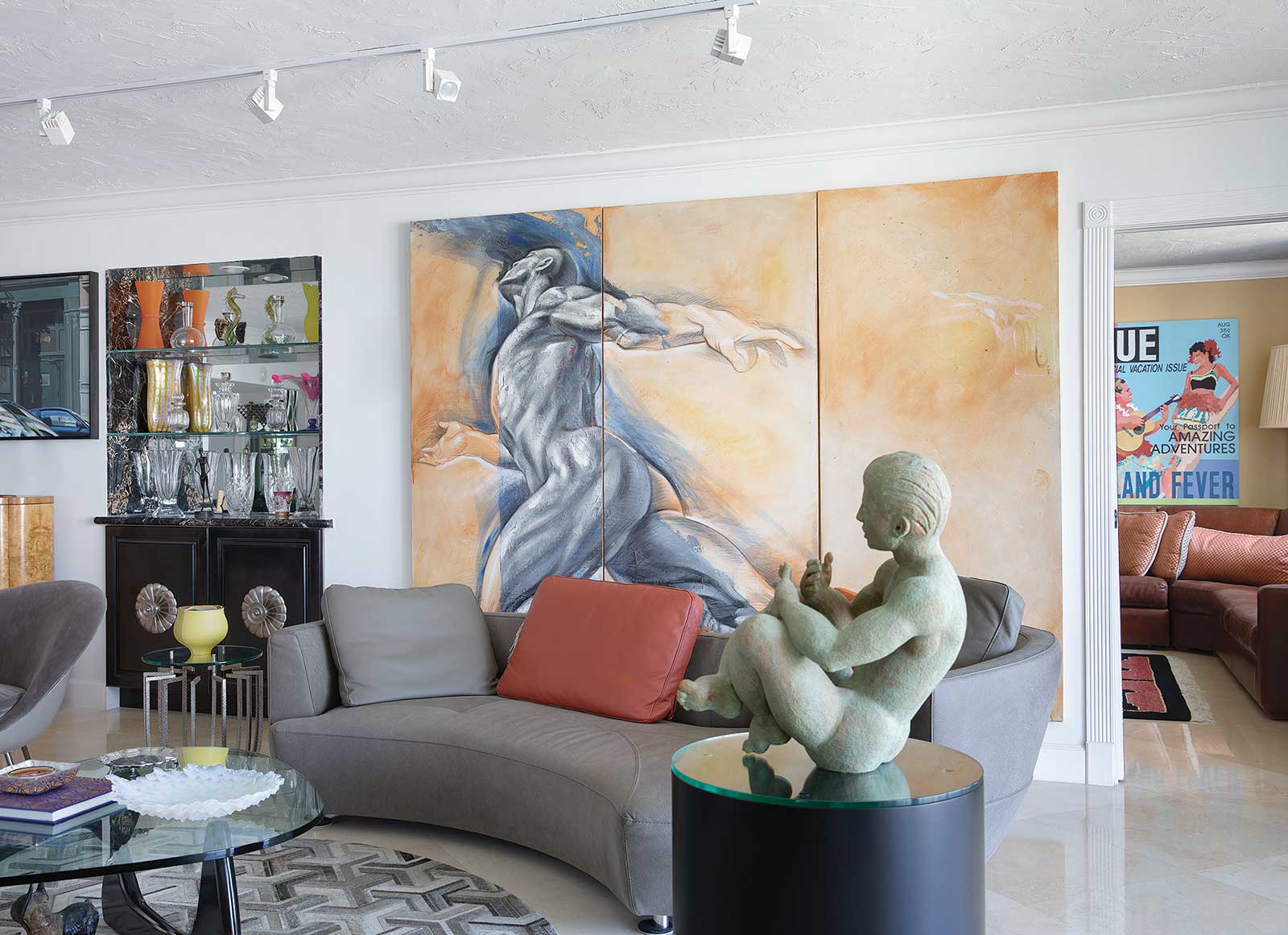 The triptych above the sofa was commissioned by a friend in 1995 from the muralist Andrew Reid and later given to the collector. On the round pedestal is James Tyler’s clay sculpture Tadaio. The yellow porcelain bowl is by Peter Pincus.
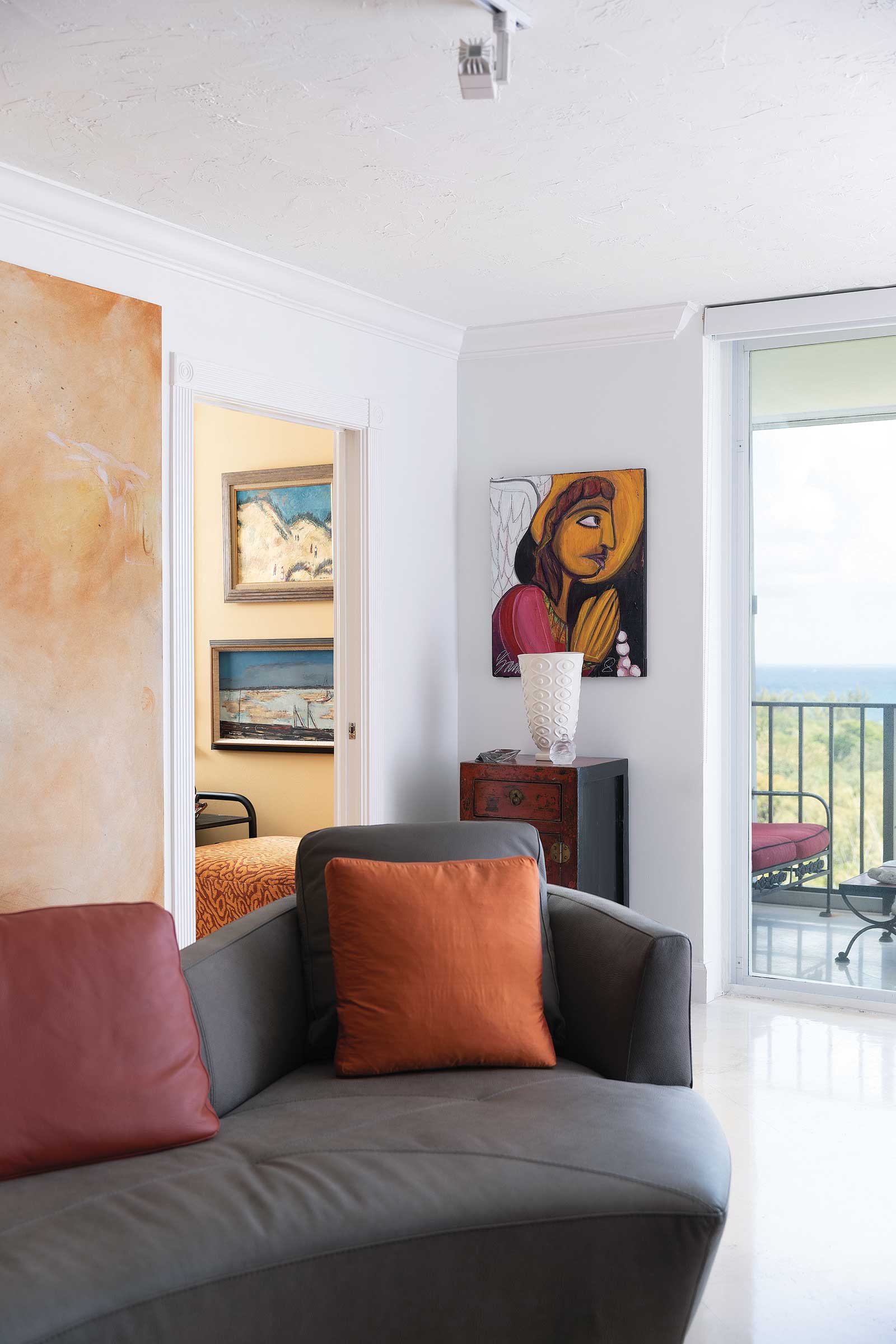 Through the doorway are two scenes of Provincetown harbor, circa early 1960s, by Sol Wilson (1893-1974). Above the chest is, Rosh Hashana, a painting on a shipping crate panel by Guatemalan artist Santos. There is a matching painting on the opposite wall of the living room. The two are called by the collector Rosh Hashana and Yom Kippur. The vase is by Jonathan Adler.
The idea of commissioning a work of art led him to ask John Germain to create a piece for his dining room. He asked the Miami artist to combine elements from his athlete and island series to create a narrative of escape.
“I later met George Billis of the George Billis Gallery at one of the first Art Miami art fairs, and he really introduced me to artists, the art of collecting and the business of art fairs,” Auerbacher says.
Part of owning a contemporary collection is getting to know the artists. “I like to have the artists explain their thoughts,” he says. He had bought a Seamus Conley portrait of a cowboy from Andrea Schwartz Gallery in San Francisco. Intrigued by the eyes in the painting, titled Fabricatti Diem, he wrote to Conley. The artist wrote back, “I wanted to deviate a little from what I was doing and work on something more simple, sometimes simple concepts produce the strongest works. In retrospect, this painting could be interpreted as a metaphor for myself being an emerging artist from the West Coast, focused, and simply saying ‘Make my day.’ The eyes always get a strong response; they were done with a glazing technique that is comprised of a few thin layers painted on top of each other which gives them that glassy look.”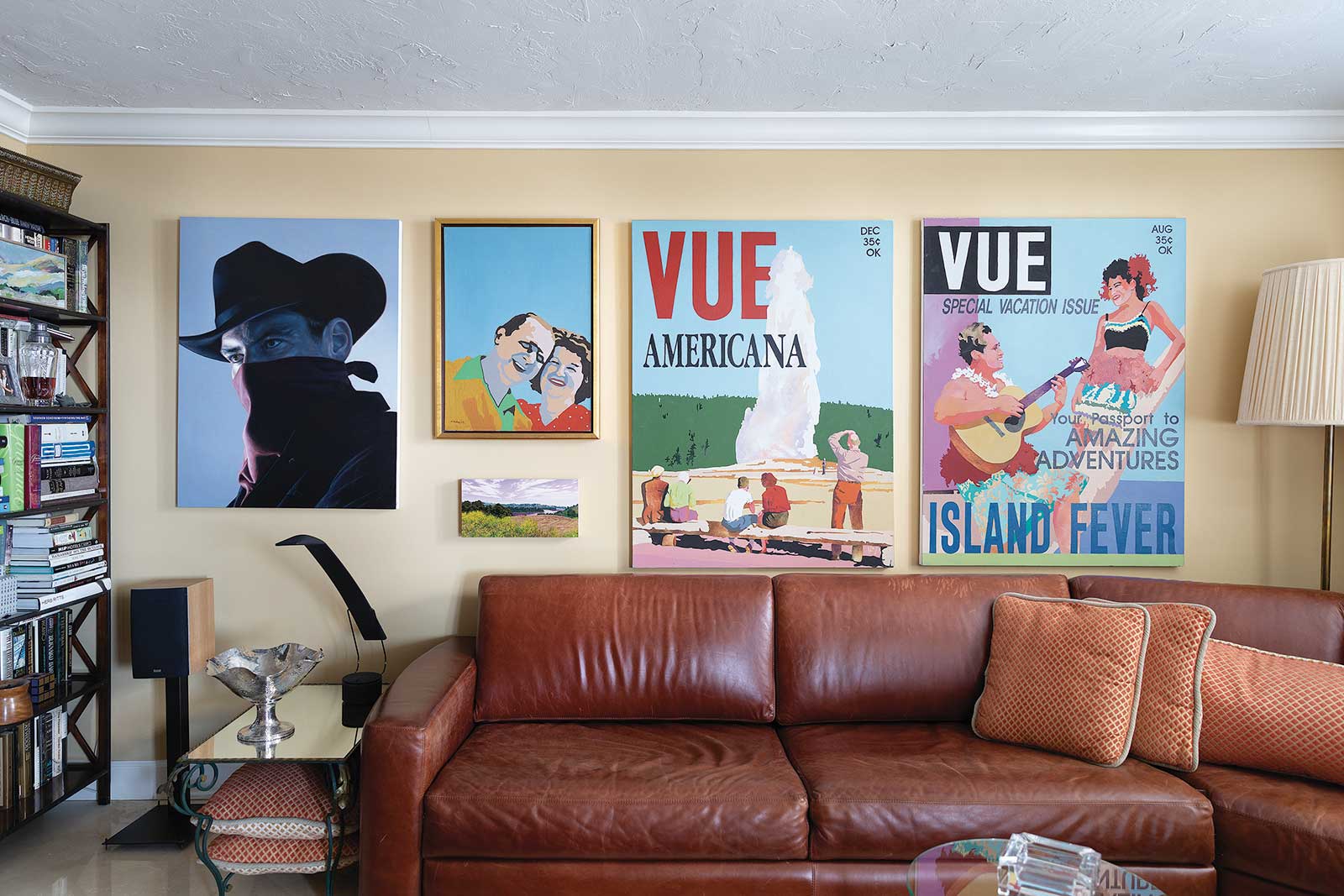 Behind the sofa are, from left, Fabricatti Diem by Seamus Conley; Martin Kreloff’s portrait of his aunt and uncle, Fannie and Joe; and two Vue pop art paintings by Hiblex. Beneath the Kreloff is a landscape by Todd Brainard. The silverplated, hammered brass bowl, circa 1920, is by Joseph Heinrich.
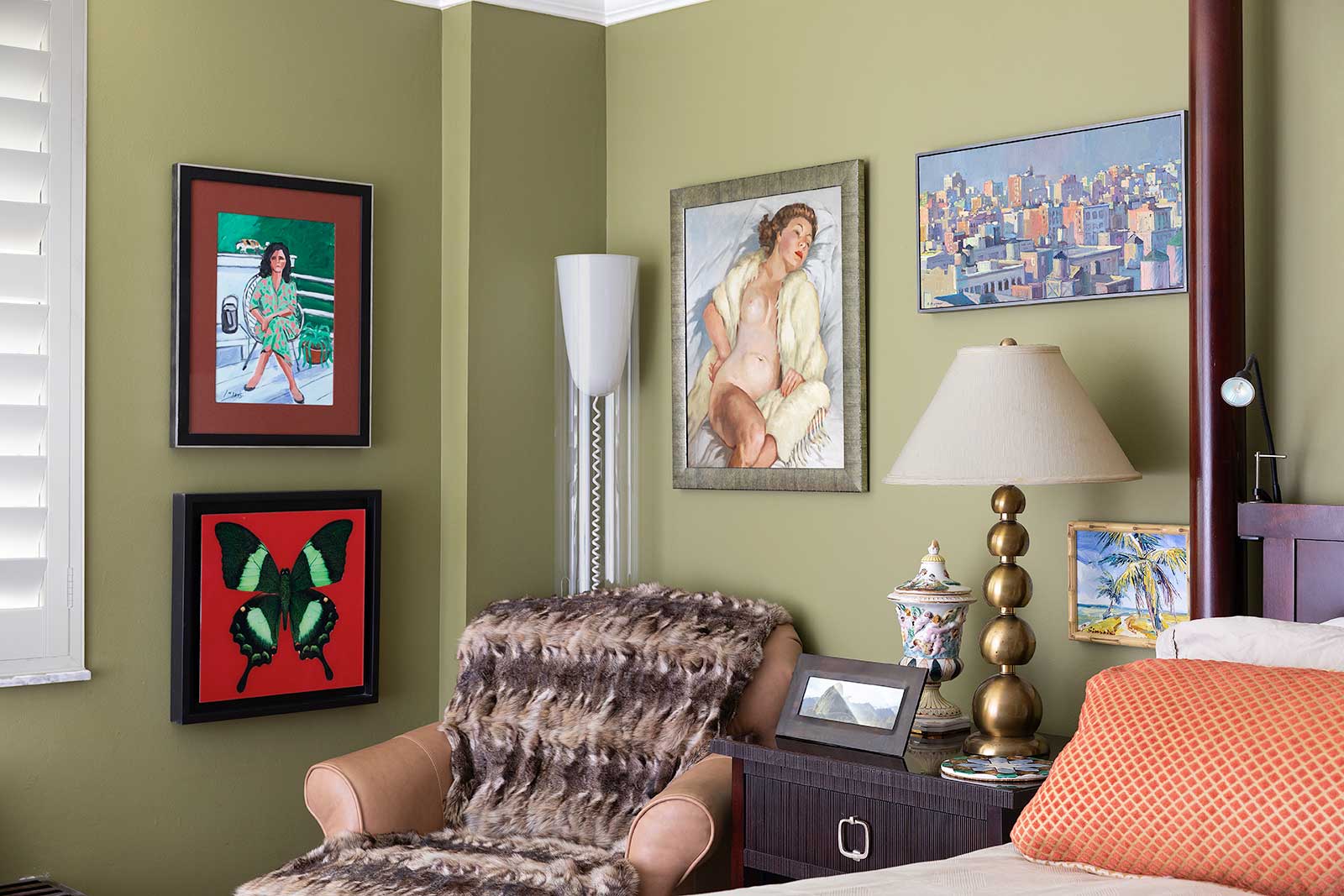 On the left are a watercolor portrait of the artist’s wife, Sandra and her Cat, by Amos Biderman, the collector’s cousin and a political cartoonist for the Israeli newspaper, Haaretz. Beneath it is Butterfly, by Rubem Robierb, part of his Bullet-Fly Effect Series. On the adjoining wall are, from left, Reclining Nude by Harold B. Slingerland (1898-1985) and Manhattan Sky, 2005, oil on panel, by Derek Buckner. Beneath the lamp is Island Edge, 2003 oil on canvas by Paul Simonini. Next to the lamp is a Capodimonte urn.
Some pieces refer to his Jewish heritage. Two paintings on shipping crate panels, that he refers to as Yom Kippur and Rosh Hashanah, are by the Guatemalan painter Santos, who lived in Miami. “I found them in a shop in Ft. Lauderdale,” he recalls. “I later happened to meet Santos at a party in Miami and invited him and his partner to come up to see the paintings, which they did. Having an artist visit and see their work on my wall makes collecting even more interesting.”
Israeli artist Leonid Zikeev painted a view of the city of Zefat, known historically as the center of “Kabbalah,” which Auerbacher describes as “the mystical study of God and the way the world turns.” The purchase of the painting from the artist while in Zefat made the painting all the more appreciated. A contemporary painting by Robert Sagerman is titled 2,126, the number of thickly impastoed brushstrokes that make up the composition. Sagerman’s paintings are animated by his studies (resulting in a Ph.D.) of medieval Jewish mystical practice.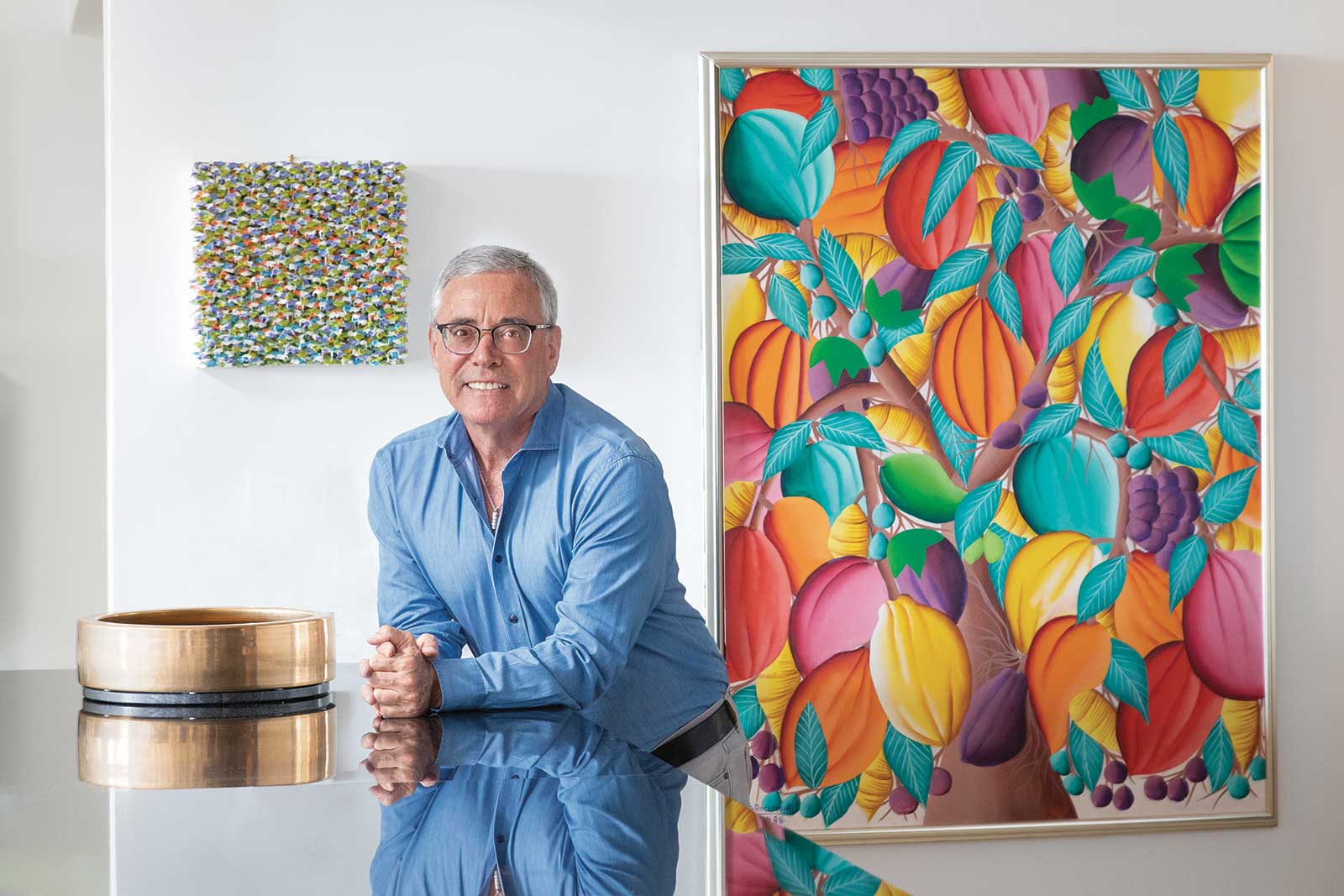 Collector Steven Auerbacher, with Roger Sagerman’s 2,126, 2007, to his left. The title refers to the number of brushstrokes in the painting. At his right is a 1988 painting by Haitian artist Louis Rosemont.
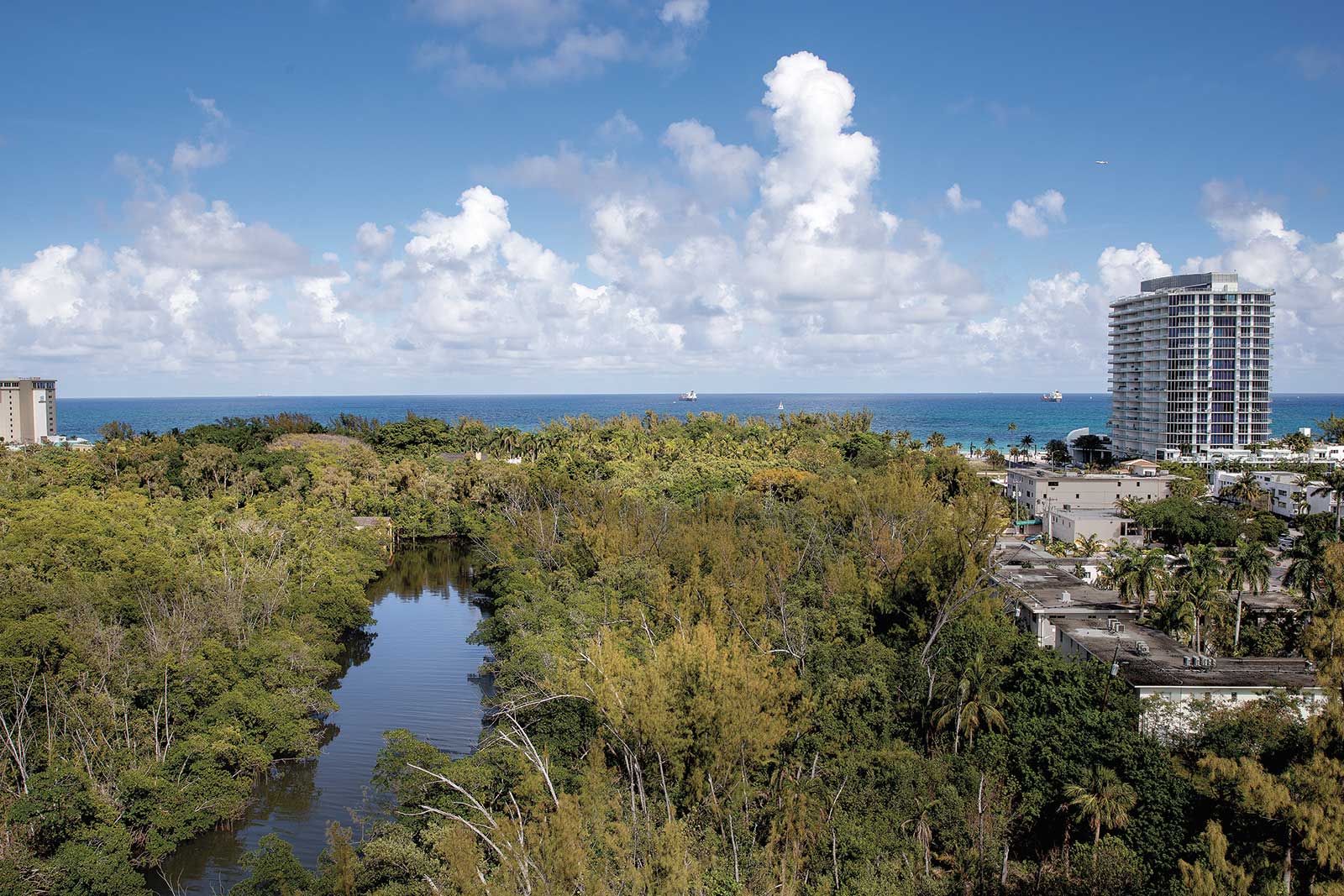 The view from the collector’s balcony across Bonnet House Museum and Gardens to the ocean.
Notwithstanding his many years in Florida, his roots are still in New York. He says, “I bought Kevin Moss’ Central Park painting Park with Yellow Floor at the Rhinebeck Fair because I love textural paintings and liked the feel of the leaves. They reminded me of New York in the fall.”
The depth as well as the tangibility of his collection is a grace for the collector. “This is not a museum,” he says. “Living with the art—looking at it, touching it—gives me a lot of pleasure. I’m a busy lawyer. When I come home, it gives me peace.” —
Powered by Froala Editor