
In 1907 John Singer Sargent (1856-1925), the eminent expatriate portrait painter, declared that he was through with portraits: “I abhor and abjure them and hope never to do another.” Although he did much quicker portraits in charcoal, he traveled and painted what he wanted to paint. Watercolors of the intense sunlight on buildings in Corfu, Capri and Venice, and of his travel companions in the dappled shade of picnic and camp sites display his continued mastery of color and value.
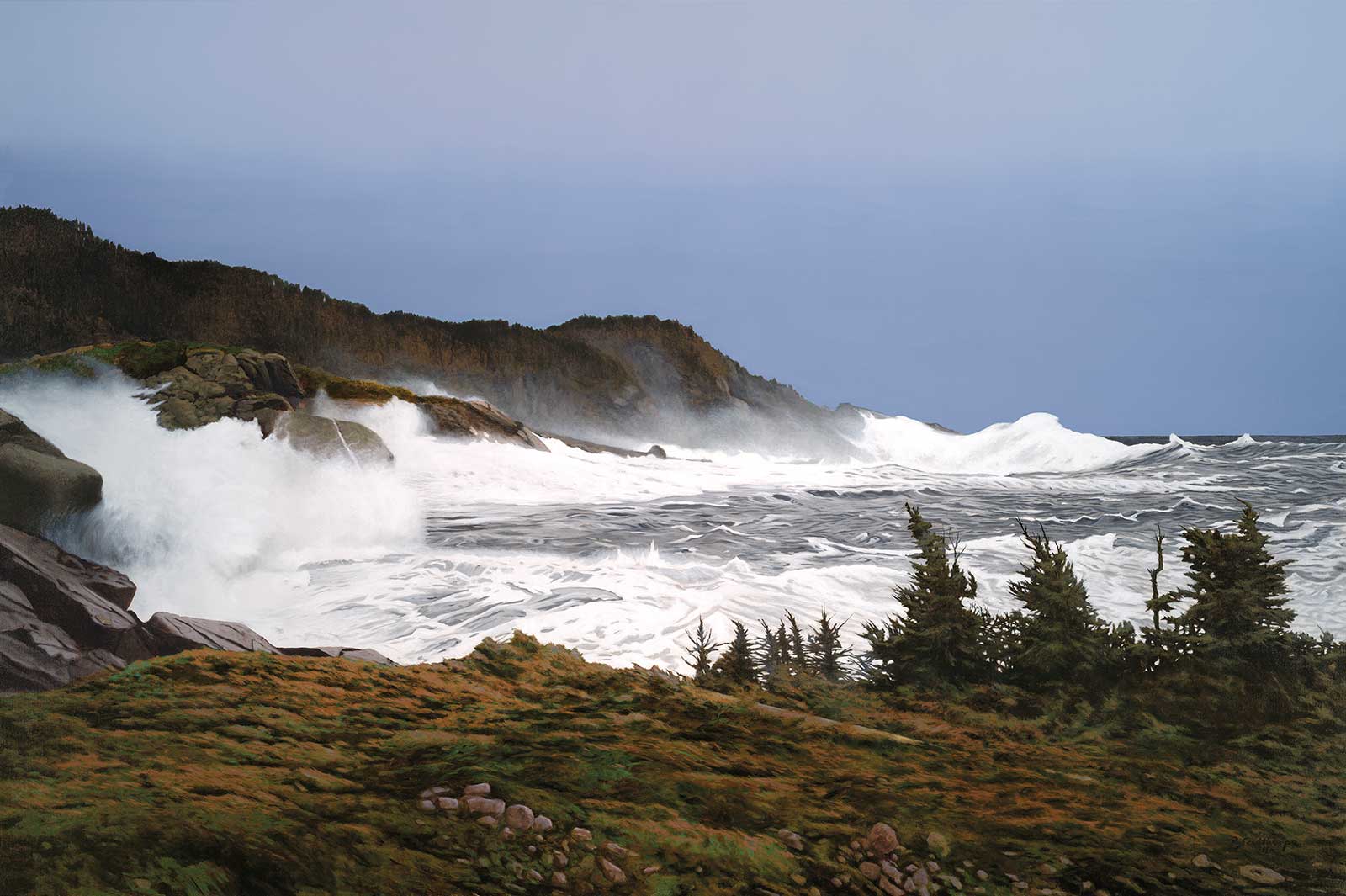
Peter Sculthorpe, Aftermath, oil on linen, 32 x 48”. Courtesy Somerville Manning Gallery, Greenville, DE.
A Tent in the Rockies was painted around 1916 on a trip to the western United States and Canada. He outlined his composition in pencil and then painted highlights, shadows and the translucency of the tent against the dark forest in washes of watercolor.
The painting is in the collection of the Isabella Stewart Gardner Museum in Boston, the palatial residence Mrs. Gardner and her husband Jack built at the beginning of the 20th century. Sargent was the first artist in residence in 1903. He painted several portraits of Mrs. Gardner and others in the palazzo, and over the years Mrs. Gardner purchased 61 of his paintings, drawings, watercolors and sculptural reliefs. She purchased A Tent in the Rockies at a Boston gallery in 1916 for $325.
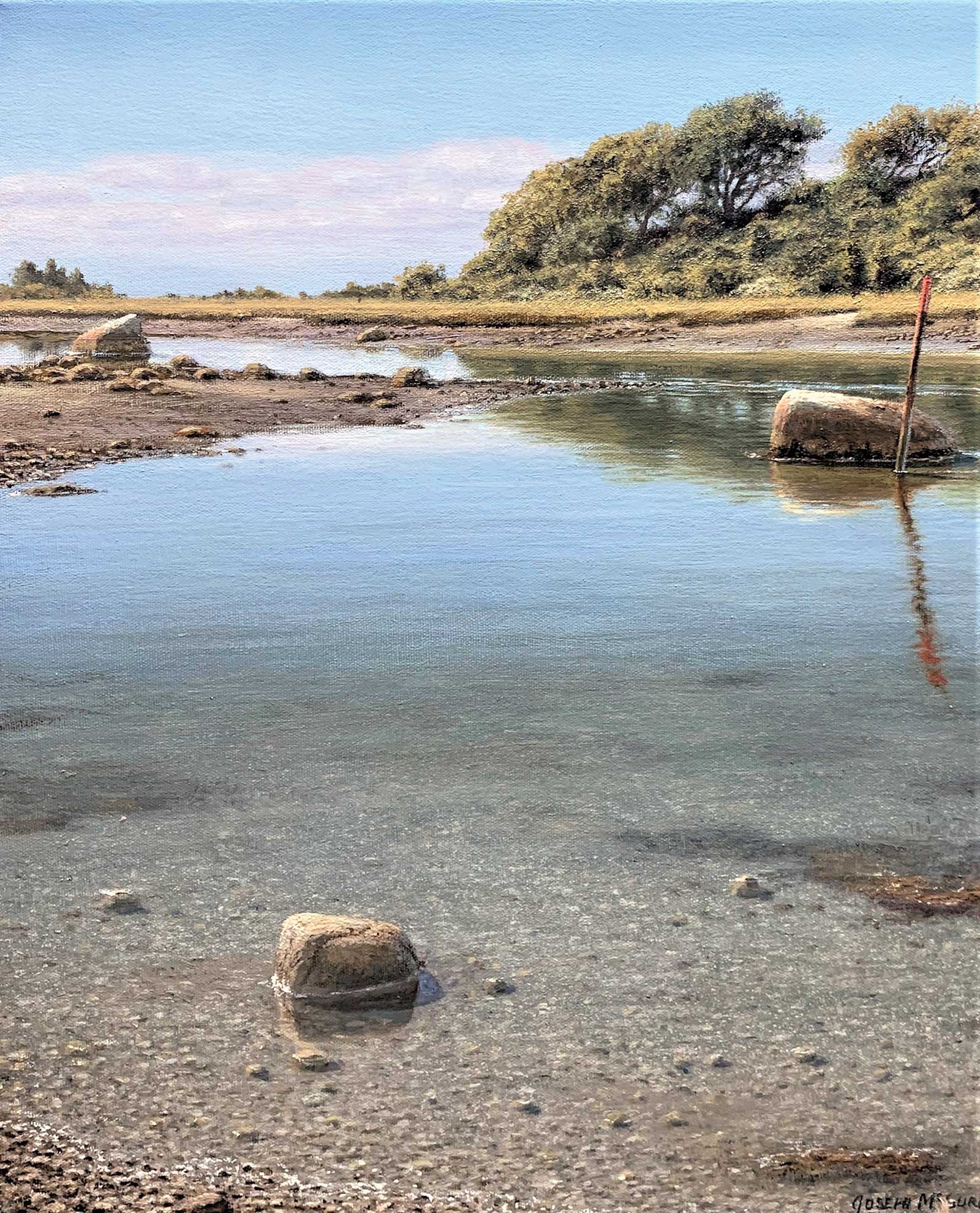
Joseph McGurl, Incoming Tide, oil on canvas, 20 x 16”. Courtesy Principle Gallery, Alexandria, VA.
Wolf Kahn (1927-2020) painted Barn in a Summer Haze in 1984. He wrote, “The artist’s alertness to the coloristic demands of each picture, the ability to respond to the picture’s needs, to feed the color until its appetite is satiated; these are the true measures of a colorist’s talent.”
The glaring sunlight is visually softened by the haze, but its physical heat makes the deeply shadowed interior of the barn both visually and physically appealing. The dark is enlivened with a multitude of colors in contrast to what at first appears to be the barn’s relatively monochromatic rendering. But it, too, is full of subtle gradations of color.
John Whalley writes, “Having just reached my 70th birthday, the theme of time spoke to me in a new, richer way.” In a recent exhibition, he included works that “somehow spoke to the passage of time, of survival and endurance.” His studio in Maine is full of carefully-ordered objects collected over the years with his wife, Ellen, each piece rich with its history of use and with the potential for being the subject of a drawing or a painting.
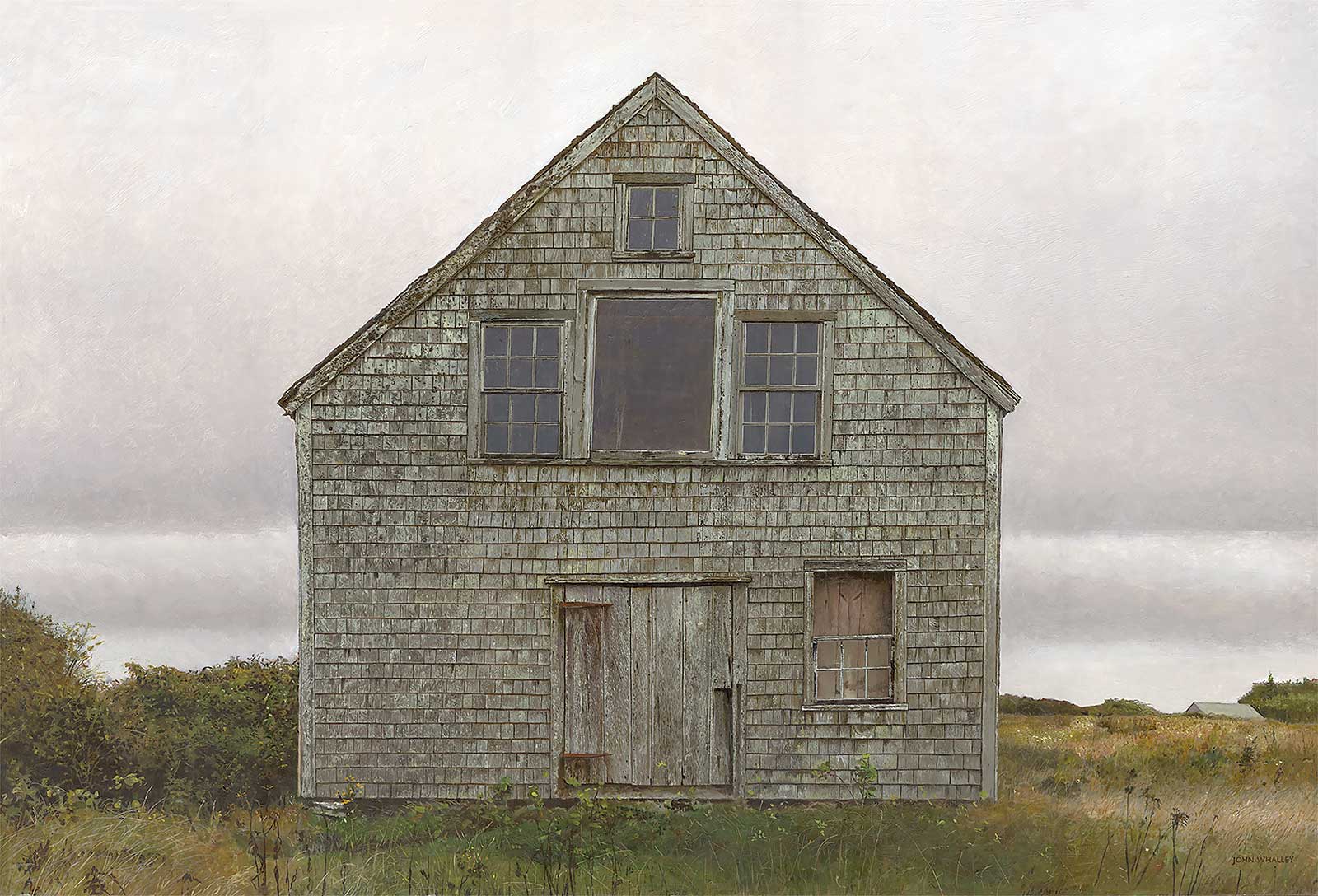
John Whalley, Fish Shed, Stones Point, Cushing, oil on panel, 26 x 40”. Courtesy Greenhut Galleries, Portland, ME.
In Fish Shed, Stones Point, Cushing, he found the same qualities in a weathered building on the coast directly across Maple Juice Cove from Andrew Wyeth’s iconic Olson House. Skillfully built for its simple utilitarian purpose, the century-old shed has withstood the sometimes brutal weather and the assaults of salt spray and waves. Its gray cedar shingles are enlivened by patches of green lichen. Maine Indigenous people used white cedar for their canoes because it is insect and rot resistant. Early colonists then used it to build and to make protective shingles.
Whalley presents the building on an ostensibly “colorless” gray day, painting all the actual subtleties of color in the soft oneness of building, landscape and sky.
In Aftermath,Peter Sculthorpe paints the threatening sea as it begins to calm down after a violent storm. In the darkness of the cloudy day the white foam of the waves seems to generate its own light.
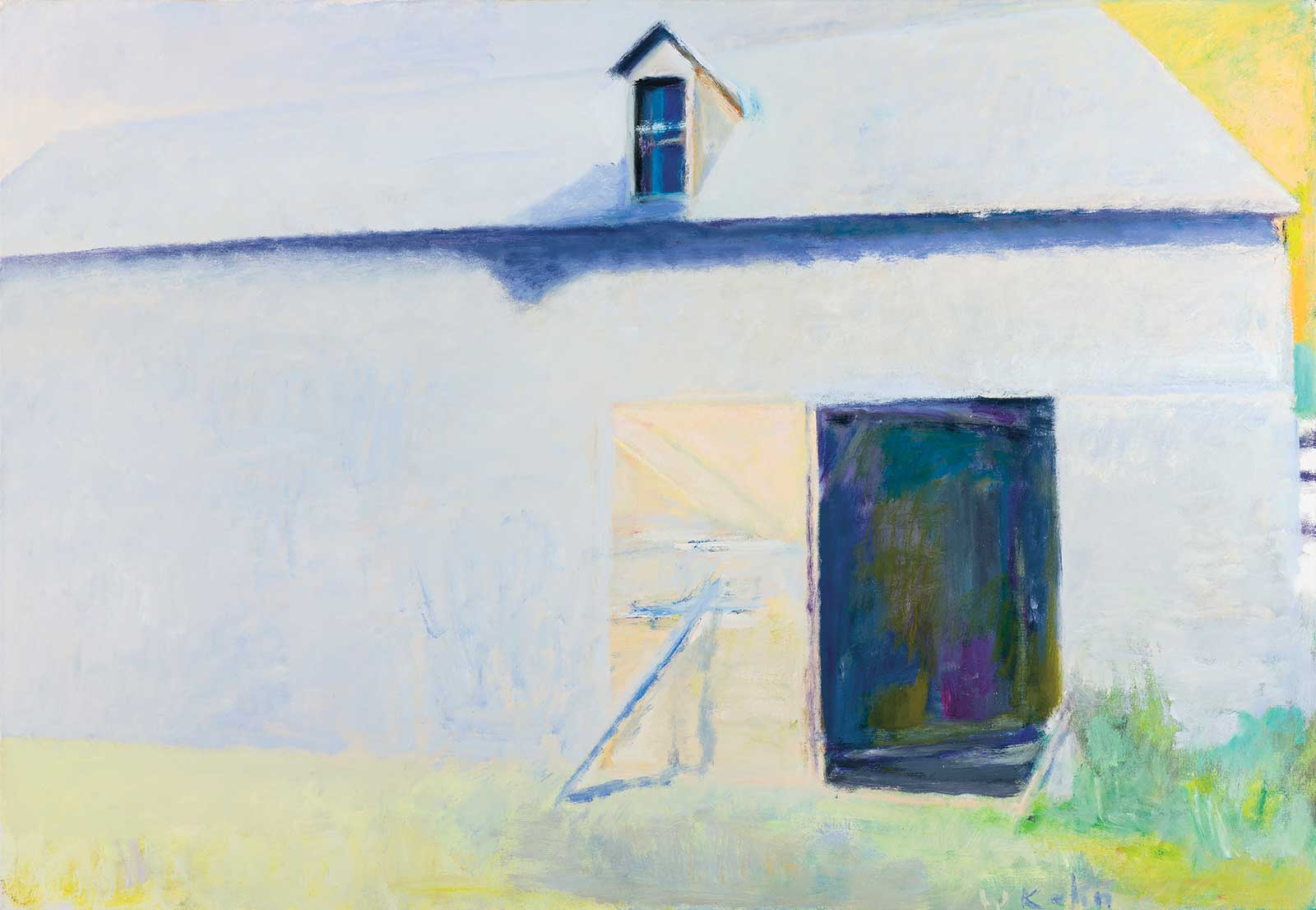
Wolf Kahn (1927-2020), Barn in a Summer Haze, 1984, oil on canvas, 36 x 52". Courtesy LewAllen Galleries, Santa Fe, NM.
Aftermath depicts a scene that has been repeated for millennia. Sculthorpe explains, “I’m not a blue sky painter.” The soft light of this painting attests to that. “The subject takes precedence,” he explains. “The atmosphere is secondary.”
He continues, “I contemplate the reasons I feel compelled to paint and the importance of what I paint. I need to imagine the world without modern artifices, a world more simple, a time before. Technology has invaded the innermost crevices of our being. Even when painting far from civilization, I am reminded of modern life by the invasive and loud roar of a jet overhead or the prying glint of an automobile.”
Nathan Mellott paints the variety of light in the Valle Vidal in the Sangre de Cristo Mountains of New Mexico. Plants in the diagonal, shadowed foreground of his painting are silhouetted against the sunlit middle ground. The shadows of clouds animate the distant hills. Mellott comments on what he considers the simplicity of the composition with its “simple shapes, simple foreground, simple midground and background and then the sky, more complex in contrast.”
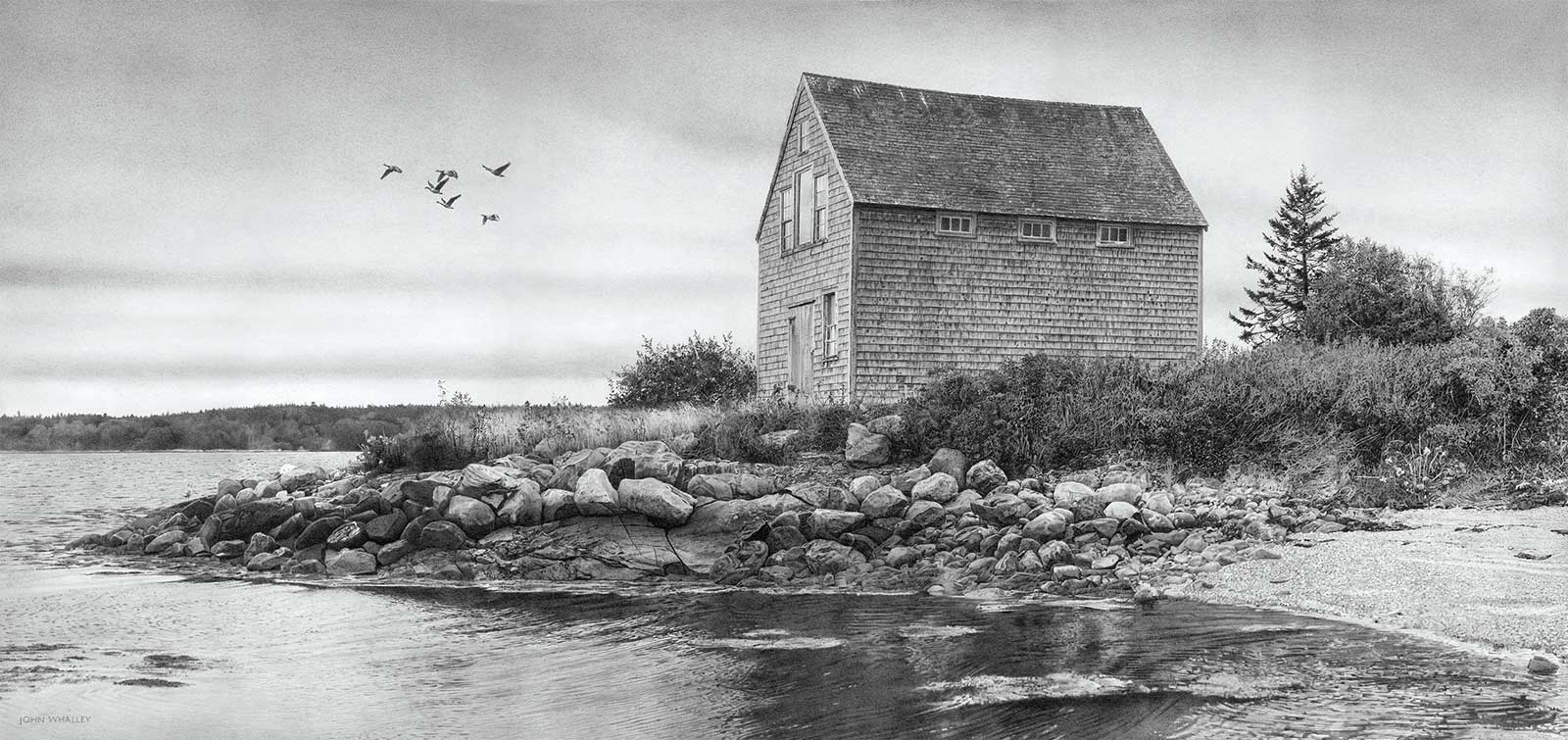
John Whalley, Stones Point, Cushing, graphite on paper, 193⁄8 x 42". Courtesy Greenhut Galleries, Portland, ME.
Contrasts enliven a painting, he asserts. “If you want something to look sinuous, you put in rigid things, and if you want something to be bright, you put it by dark things. If you want it to look rich, you put it next to neutrals.”
Mellott often paints in plein air but brings the memory of the experience to his studio work—“the smells of grasses and coyotes barking when the sun goes down.” His rich, gestural rendition of the clouds and the sky are more poetry than accuracy. “I think people can kill beautiful things with accuracy,” he says.
Joseph McGurl’s accuracy, however, comes from a poetic and scientific mind, enabling him to express the beautiful in his paintings without killing it.
In his painting, Incoming Tide, the variations in the way sunlight affects our experience of water in the landscape range from the featureless reflection in the far distance to the detailed reflection of the sky and shore in the middle distance to transparency in the foreground.
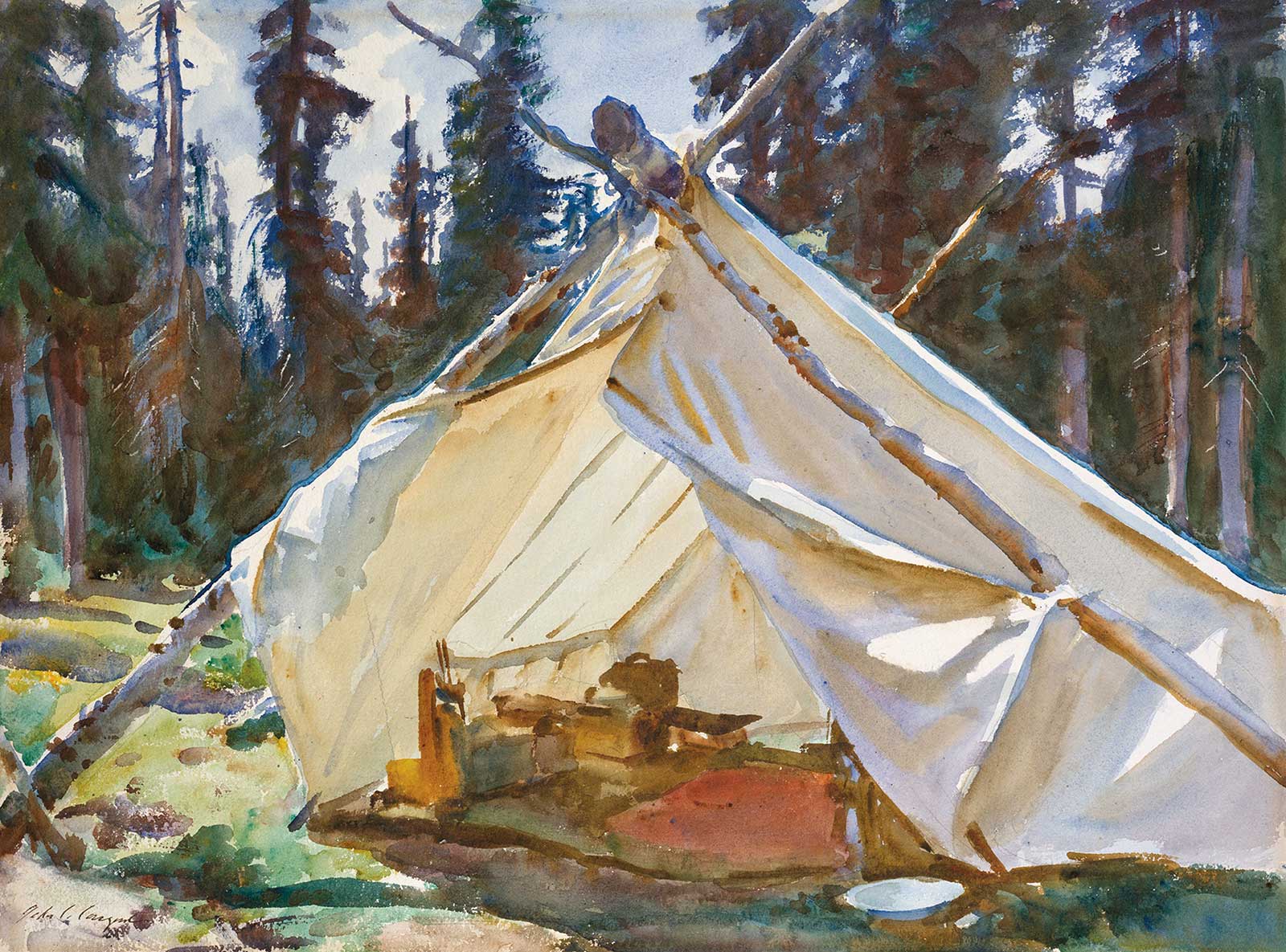
John Singer Sargent (1856-1925), A Tent in the Rockies, ca. 1916, watercolor on paper, 1415⁄16 x 20½". Isabella Stewart Gardner Museum, Boston, MA.
He has written, “Although I have a deep personal connection to the landscape, it is also a vehicle to explore my interest in modern physics, spirituality, and the exploration of light, form, space, and color interpreted with paint.”
In response to a litany of my questions, he says, “Often a literal transcription of the scene does not convey the emotional response. For instance, when looking at a mountain, it often does not look as massive as it ‘feels.’ That is because if recording only what you see, you are missing out on what you feel. So I may alter the mountain to convey this massiveness. A better example may be a storm at sea. I have often been out on a boat in stormy conditions and have taken photographs. The photos are always disappointing as the weather doesn’t look very stormy. What the photos don’t show is how my other senses are activated. I hear the wind whistling through the rigging, and I feel it on my face while adjusting my body as the boat rolls with the waves. I smell the salt water as the spray blows across the deck. I may be cold and wet and there is tension in these stormy conditions. If I were to paint a storm at sea, I would want to give an indication of these other sensory impressions. I am also ‘fooling’ people into thinking that what they are seeing is real life and multi-dimensional. Often, I exaggerate or minimize elements including shadows, sunlight, perspective and color to enhance the illusion.”
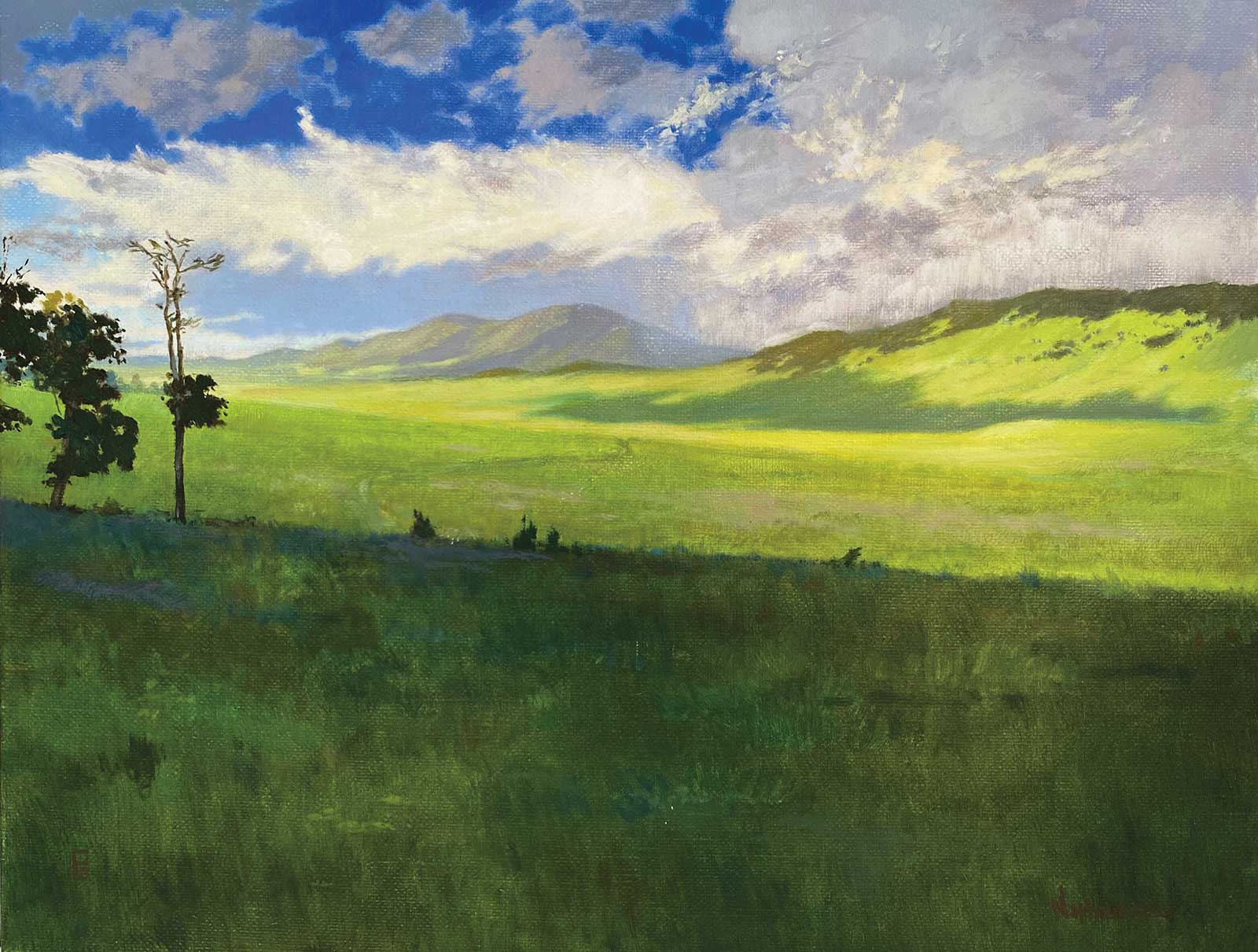
Nathan Mellott, Valle Vidal, oil on linen, 11 x 14". Private Collection.
These artists, through their interpretations of light in the landscape, invite us to go beyond the experience of the phenomena either firsthand or through their paintings. As McGurl says, “By being able to enter a scene which appears natural and has no stylistic barriers, I and hopefully the viewer, may begin to contemplate the answers that nature provides to the ‘big questions.’” —
Powered by Froala Editor