My conflation of Michael Scott with fire began when I sat in his living room contemplating a large painting of a snowy owl rising phoenix-like from a fire as he cooked dinner for his guests over an open fire in his kiva. Over the years I’ve thought more about that conflation and about his representation of the four elements in his landscape paintings. I thought of them as representations of themselves—earth, air, fire, water—as discreet elements in the landscape. Recently I saw his study, Geyser and Sky Fire, and suddenly grasped the depth of his representations of the elements, their interrelationships and their intimations of something other. The geyser became more than a visible explosion of water and steam. The phenomenon is caused by invisible fire deep within the earth. The sky fire is caused by the light from the nuclear fusion of the gases that make up the sun. 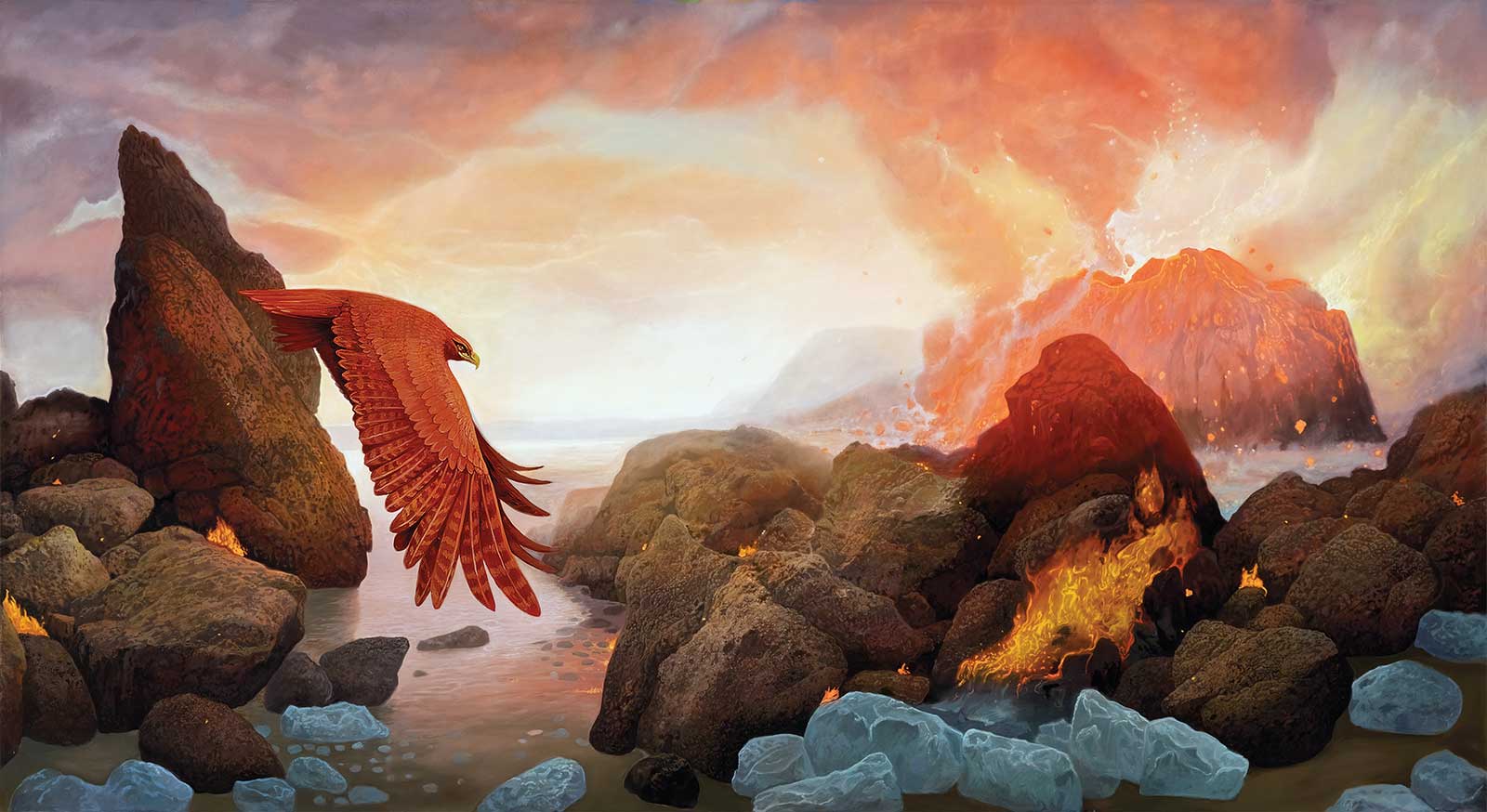 Michael Scott, Firebird, 2019-2021, oil on linen, 58 x 107". Private Collection.
The landscape painter Albert Bierstadt (1830-1902) wrote, “The magnificent beauty of the natural world is a manifestation of the mysterious natural laws that will be forever obscured from us.” Scott contemplates the “mysterious natural laws” but also delves into their scientific bases.
Bierstadt was a student of Thomas Cole (1801-1848). Cole emigrated to the U.S. from Northeast England and returned to Europe for several years in 1829. On his return in 1833 he began a series of five paintings known as The Course of Empire. In a letter to his patron he wrote, “The philosophy of my subject is drawn from the history of the past, wherein we see how nations have risen from the Savage state to that of Power and Glory and then fallen and become extinct....” At the time, the American West was seen as pristine, embodying the presence of its creator and untouched by human hands—despite thousands of years of habitation and cultivation by Indigenous peoples. Cole believed in the harmonious relationship of man, progress and the divine nature of the landscape but feared for its future.Bierstadt’s romanticizing of the landscape supported the idea of Manifest Destiny, that the movement west and its settlement by European immigrants was divinely ordained.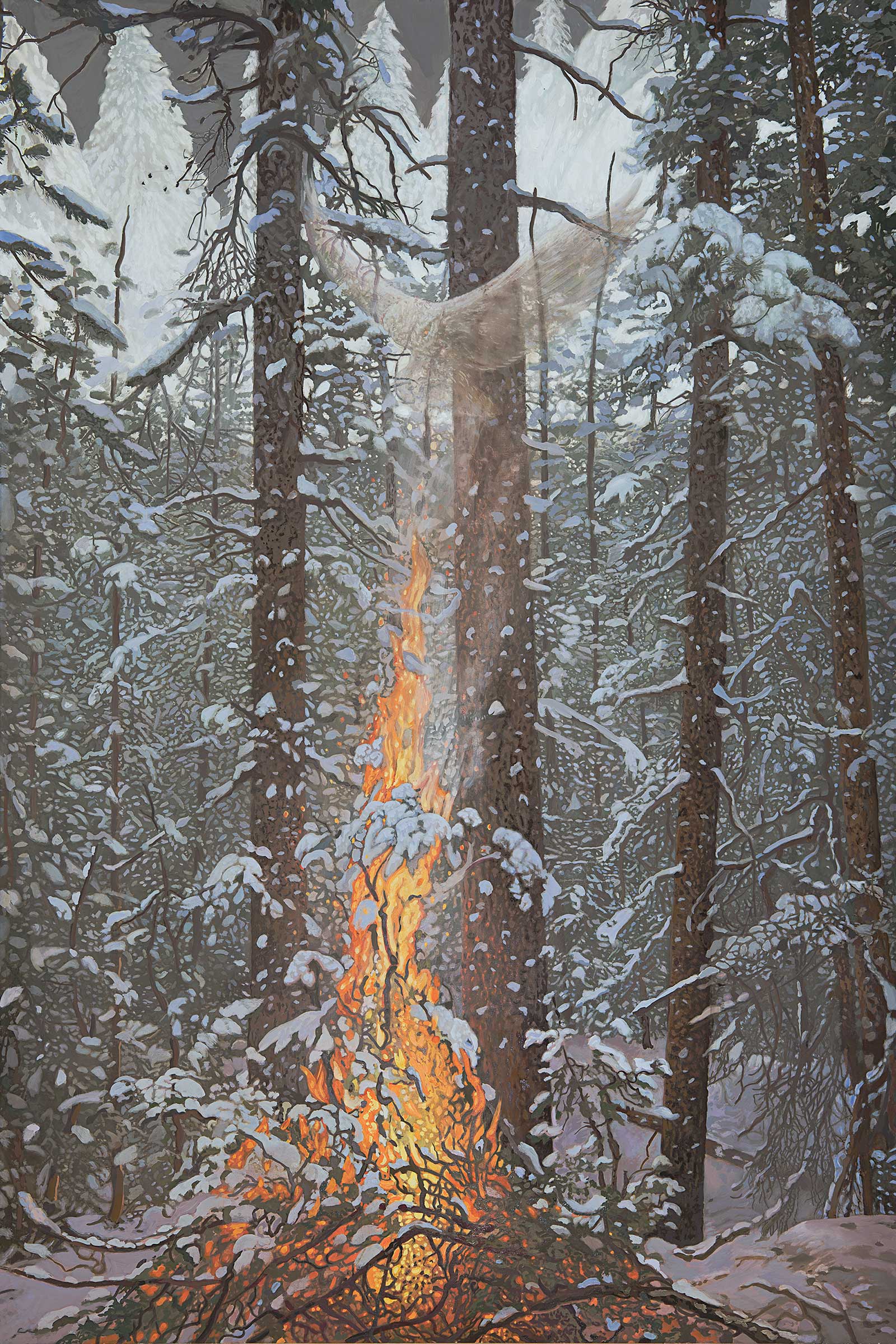 Michael Scott, Winter Owl Over Fire, 2014-2018, oil on linen, 88 x 58". Private Collection.
While creating his five-painting series, Cole also painted The Titan’s Goblet, a gigantic, mysterious cup set down on the landscape, seemingly holding the history of civilization around its rim and containing life sustaining water that overflows the rim, perhaps a never-ending source of nourishment.
In Titan’s Cup Revisted, Michael superimposes the goblet on a monochromatic rendering of Bierstadt’s The Domes of Yosemite—the colorful promise of the West diminished, the history and the presence of mankind in flames.
The blazing of campfires and the aromatic fires of piñon in kiva fireplaces here in Northern New Mexico provide warmth and are occasions for reverie, for our becoming lost in the ever-changing flames or the glow of the final embers. Ritual Fire is a representation of fire as a sacred force in ceremonies from pagan times through the Jewish lighting of an oil lamp at the end of the Sabbath or the lighting of the new fire in the Easter vigil services in Christian churches, symbolizing Christ’s victory of light and life over darkness and death.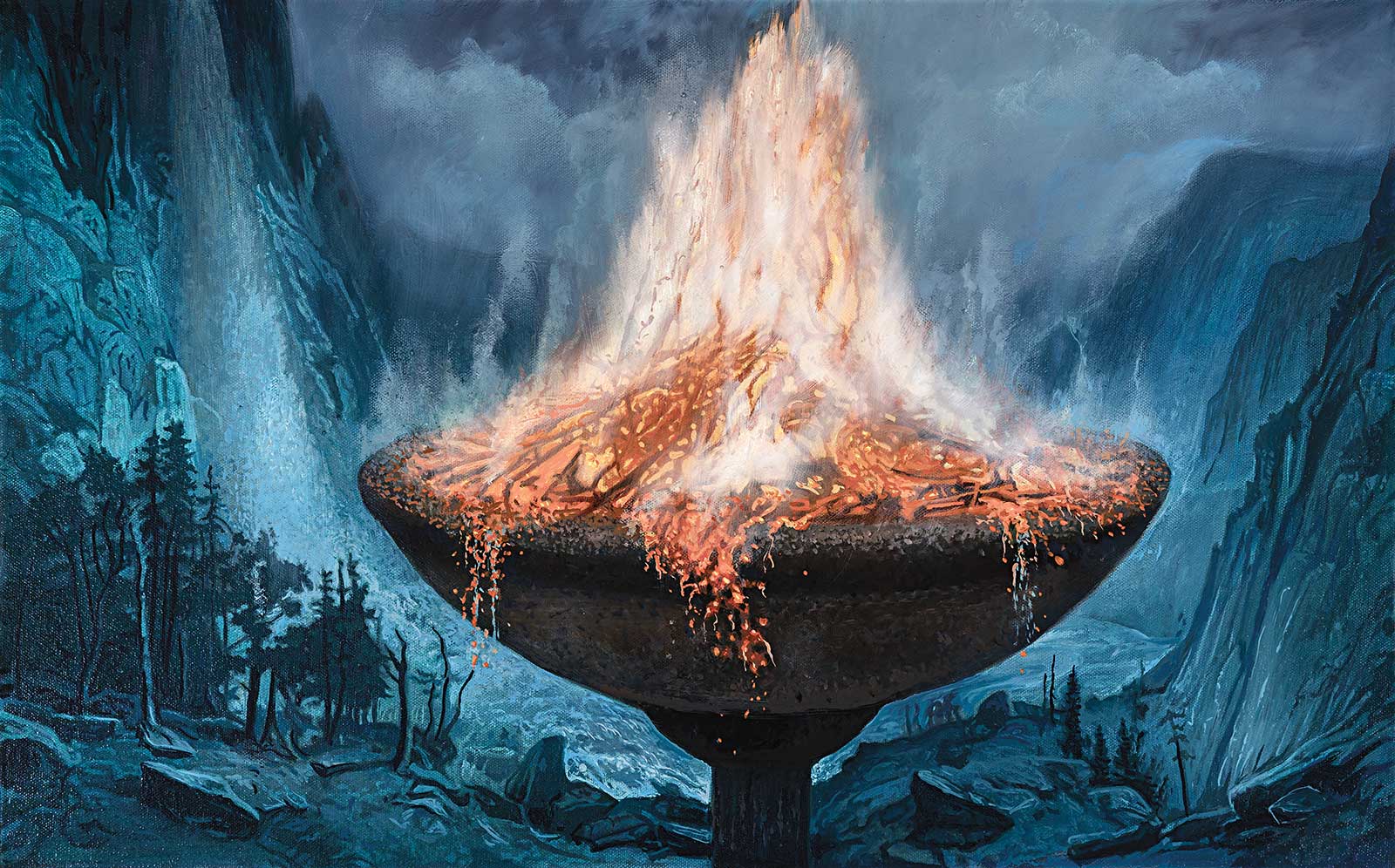 Michael Scott, Titan’s Cup Revisited, 2020-2021, oil on linen, 15 x 24". Private Collection.
In Ghost Owls Mt. Rainier, a fire blazes on the shore of a lake beneath Mt. Rainier. The solid, snow-covered mountain appears as a passive constant in the landscape but is actually an active volcano, monitored constantly. Although its last eruption was 1,000 years ago, it will erupt again. Its volcanic activity is caused by the subduction of tectonic plates, a phenomenon understood but not predictable. Commenting on one of the consequences of climate change, Scott ponders how climate change and the weight of rising sea levels will affect the movement of those plates.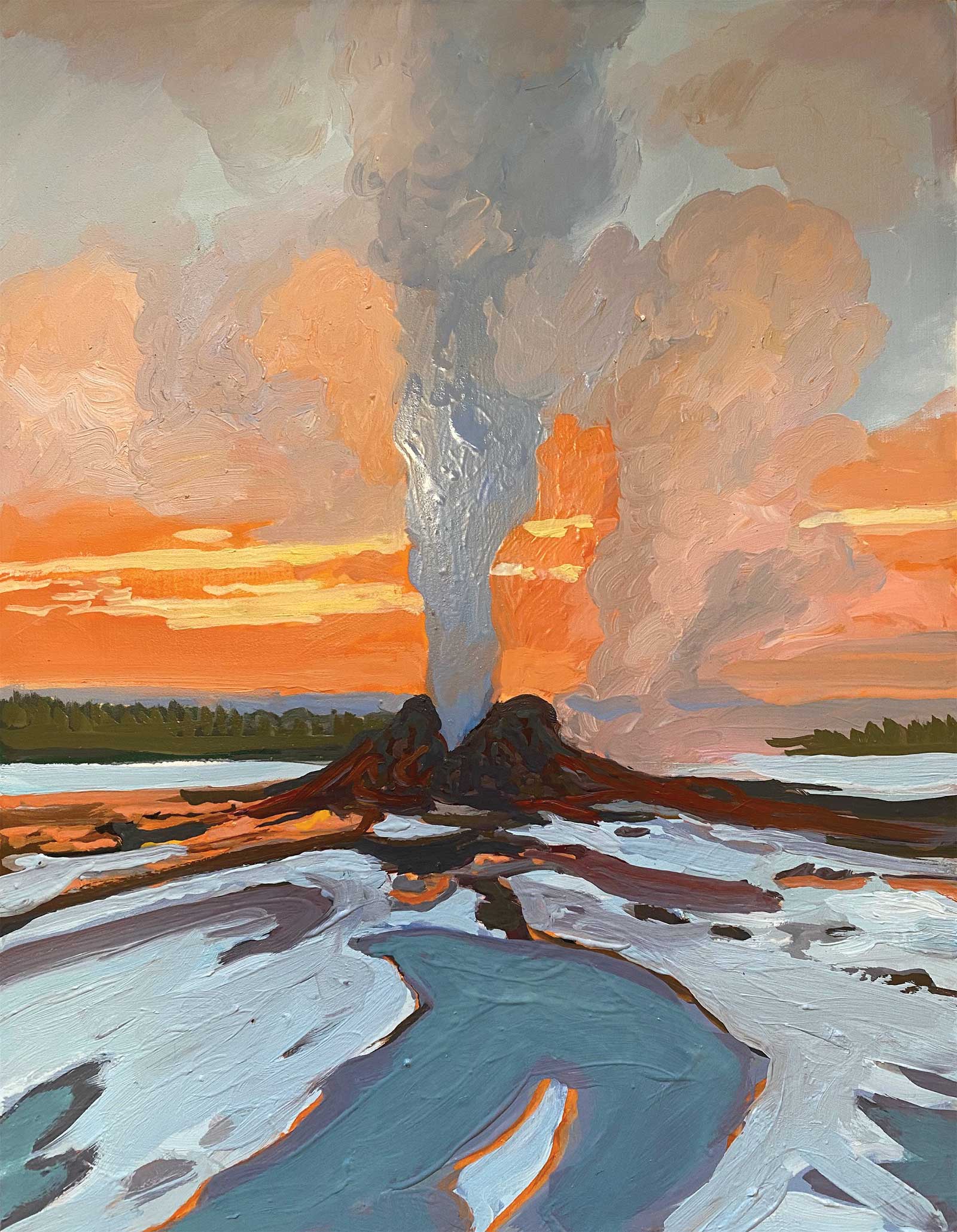 Michael Scott, Geyser and Sky Fire, 2019, oil on panel, 10 x 8". Courtesy Evoke Contemporary, Santa Fe, NMHe comments, “The occasion for a fireside reverie provides opportunity for meanings and contemplation. This painting addresses just that with its on-looking owls, one representing the fire as motion or sudden change, its characteristics displaying rapid transformation speeding up the passage of time. The other owl sitting in silence slows down time and represents thoughts embed in geological histories, linking the fires hearth to the volcano of Rainier. Certainly the life of the logs before the viewer trigger thoughts of purpose, however its combustion is far more than the physical change evolving, The logs also represent thoughts of life’s renewal, and how living matter is transformed, and how we as humans participate in that transformation. Within that association both owls become a metaphor for us!”
Describing Winter Owl Over Fire he writes, “Set in a vertical stage, a translucent owl rises in hope for renewal of life. The owl is seen in many cultures as a messenger and the recipient must determine what message is being given. This owl is referencing the myth of the phoenix, a mythological bird that is born again out of fire. Often associated with ancient Egypt, fire and the worship of the “Sun” the phoenix obtains new life by rising from the ashes of a nest it has created. This desire for transformation can be viewed as an opportunity for awareness and change providing greater health, for all species and the health of our planet. The polarity of warm and cool found within the stage can also be seen as a conversation about the warming of the planet and what renewal might mean in that context.”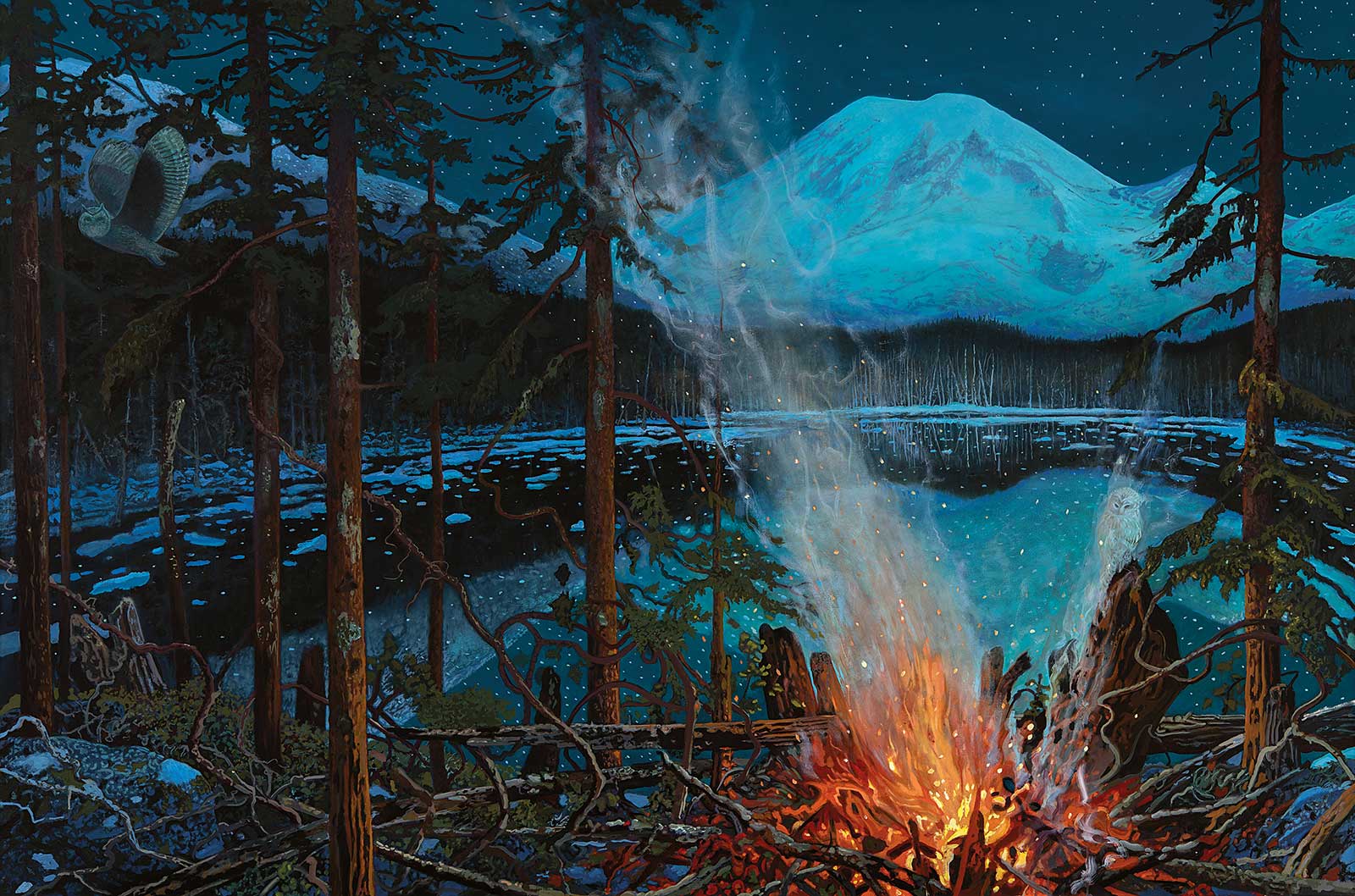 Michael Scott, Ghost Owls Mt. Rainier, 2016-2019, oil on linen, 62 x 88”. Courtesy Evoke Contemporary, Santa Fe, NMIn Firebird, he contemplates the physical manifestation of the elements over billions of years and the threats to their manifestation on the tiny planet Earth. He says, “The Firebird is described as a large bird with majestic plumage that glows as it passes past a turbulent flame. In this depiction of the myth, all four elements are present. There is the flight of the bird representing Air, Water represented by the ocean tide carrying blocks of ice from the glaciers, Earth represented by the volcanic rock and distant mountain formations and Fire represented by the bird itself and the danger from the eruptions of earth’s volcanos. In folklore, the bird represents a symbol for a difficult quest or a very hard journey ahead. In this painting, that journey is represented by man’s quest to conquer the effects of global warming and climate change. The magic that the bird holds is the magic of science. If we follow that science we will succeed in saving ourselves.”
If we don’t, and we are lost, nature has always been good at saving itself. 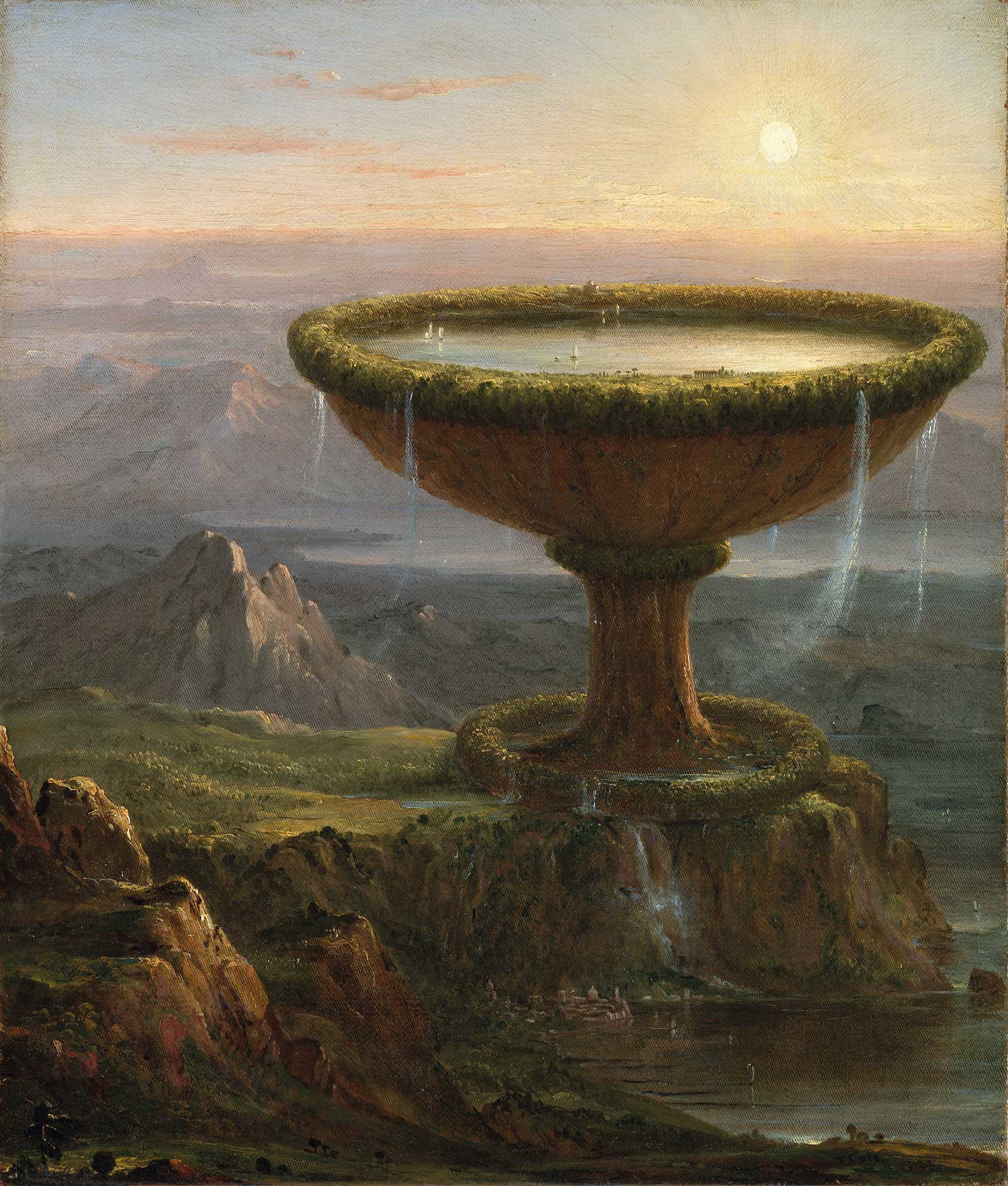 Thomas Cole (1801-1848), The Titan’s Goblet, 1833. Oil on canvas, 19³/8 x 16¹/8 in. The Metropolitan Museum of Art, New York, NY. Gift of Samuel P. Avery, Jr., 1904In his painting Bitterroot Overlook, green springs from the ashes of a fire. He observes, “The sound of wings sculling through the charred trees breaks the silence of placid air giving sight to both blackened bark and blackened wings. The carbon filled timbers, which have fallen, provide rich nutrients that will replenish the soil and provide habitat for plants and animals for many years to come. These wounded trees with their patterns of black and white are often referred to as the standing dead; their roots proudly holding on to their histories and the home that they know. On their horizon, the suns light washes their jagged limbs, only to soothe their shadowy coats. Light and dark, dark and light the very properties that paintings are made of, becomes a metaphor for the mysterious conversation known as life’s cycle, and bringing hope to the next day's dawn.”
 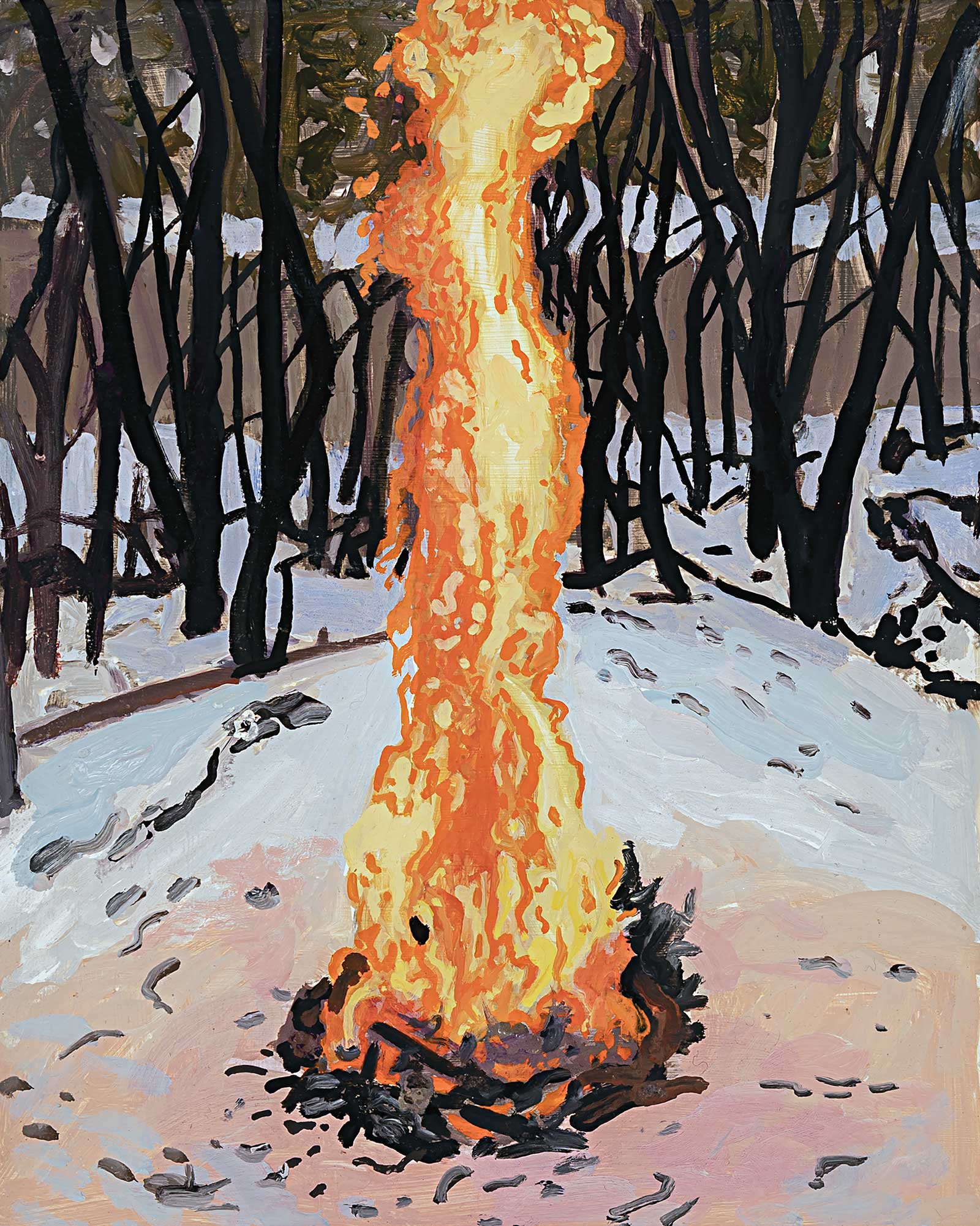 Michael Scott, Ritual Fire, 2020, oil on panel, 10¾ x 8½”. Private Collection.In The Witness, the four elements interweave, smoke and mist combining in a liminal state like the place between waking and sleeping, visible and not visible, real and unreal, present and past. A fire burns from among ferns and lichen-covered rocks. The wolf becomes revealed and sees what else is revealed. In this painting, the wolf appears to observe Earth in a primeval state before mankind or, perhaps, after. Michael notes that the wolf “characterizes a symbol of guardianship and ritual.” Among Native peoples, the wolf is often a spiritual guide.
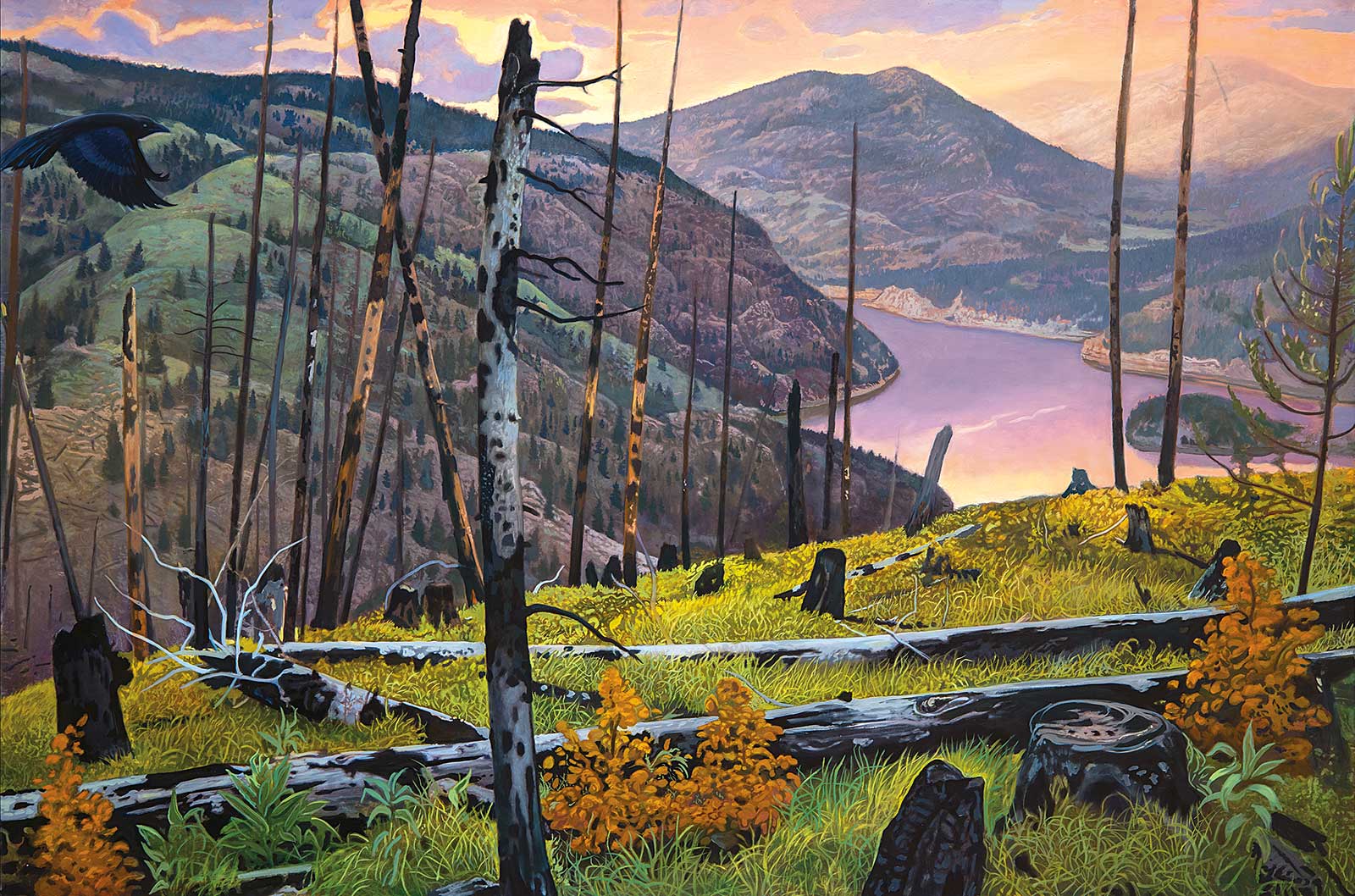 Michael Scott, Dusk Bitterroot Overlook, 2017-2020, oil on linen, 58 x 87”. Private Collection.The wolf reminds us that despite our efforts to right our wrongs, cutting down on carbon emissions, reintroducing bison and wolves to their historical habitats we, as a species, may not survive. As observed in Bitterroot Overlook, nature will go on. The “‘gray zone’ of the smoke and fog crosses all belief systems and is a state between reality and unreality,” he says. “It is both real and imagined at the same time as it confronts the viewer in both physical form and spirit. The smoke symbolizes the transition of matter into spirit and sends signals that represents the material manifestation of the soul’s journey.” Scott offers hope as well as warnings in his paintings and that the non-material may be our destiny. —
Powered by Froala Editor