Artificial food and fast lights forge cheerful islands of color against gray and darkened streets in urban paintings by Marc Trujillo, memorializing the ghastly spread of ruthlessly economical architecture in beautifully rendered glazed grisailles. Trujillo’s technical oil portraits of buildings superficially resemble Edward Hopper’s urban nocturnes but shed Hopper’s comforting harmonies of nostalgia by using cold L.E.D.’s and strip lights for illumination. Hopper’s tones are warm and jazz-like and sing tragic melodies of men and women finding themselves alone. Trujillo’s songs of San Fernando, California’s streets are cold and electric and indifferent to individuality. Hopper’s buildings tell us about people. Trujillo’s people tell us about buildings which, while sterile, are the only personalities in these smooth paintings.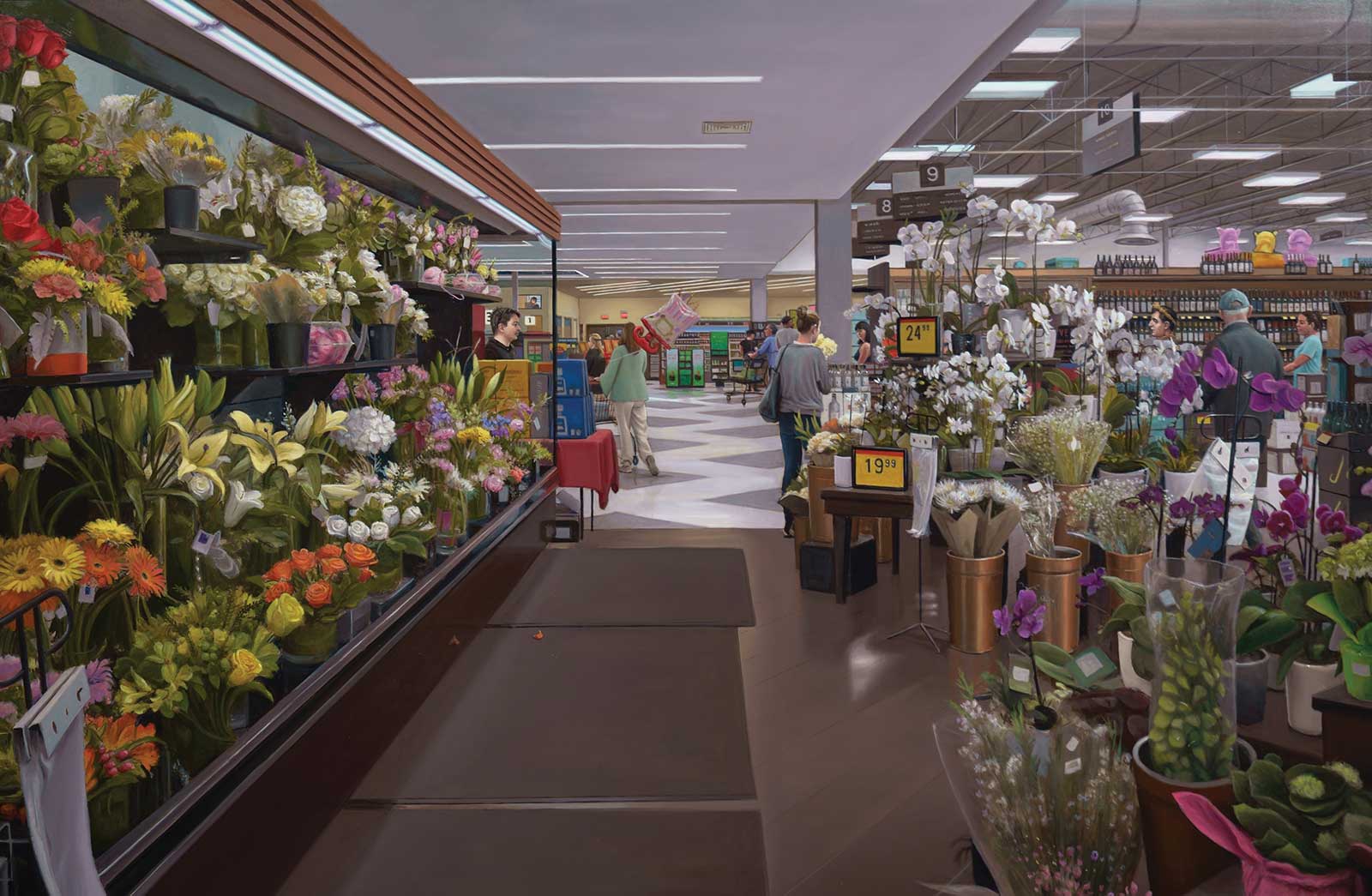 12057 Wilshire Boulevard, 2021, oil on Dibond, 27 x 41"He calls the paintings his American purgatory. If Trujillo is our Virgil, we are his Dante to guide through the indeterminate space between the edge of hell and the gate to heaven. He shows us impersonal and unhappy meals and hungry trays, cold aisles and fluorescent airports, square-tiled supermarkets, buzzing refrigerators in minor-key and melancholy pictures of unloved places and thankless food staged in a grim, concrete city. He is the lover of loveless commercial architecture.
In a tragic series of paintings he shows us the synthetic plexiglass and alloy casements of convenient drive-through windows glaring hot and bright, framing blank-faced shift workers suffering in the cells of their service, building doubles, super-sized, with a side of lies and corn-syrup ketchup, the glass slides across cheerless kitchens, onto the disinfectant and polish of surfaces punctuated by the mechanical necessities of mass-market catering—freon pump-pipes driving frosty refrigerated sugar-soda drink machines and fake ice cream dispensers; stainless steel doors and plastic countertops. The form of the furniture follows the grim functionality of the buildings. Airports, warehouse markets and convenience restaurants have singular purposes, and they are not designed to uplift the human experience but to meet their purpose with complete efficacy.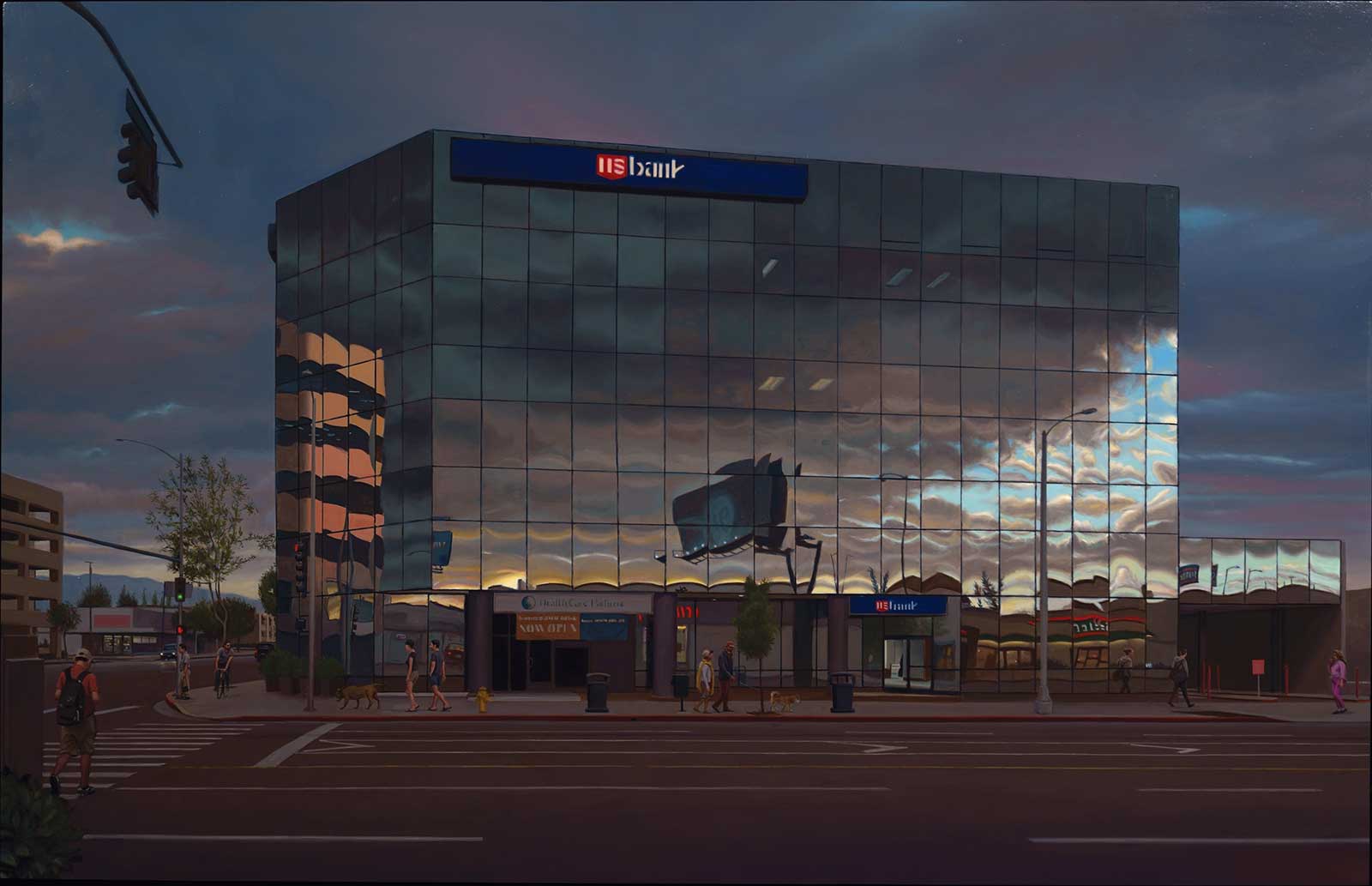 6360 Laurel Canyon Boulevard, 2020, oil on Dibond, 27 x 42"
The buildings are nameless in this place. Trujillo has cleverly altered the familiar lettering of iconic advertising, metamorphosing omnipresent brand names and logos into new forms. Their disjointed similarity to commercial reality complements the strangeness of the paintings, emphasizes the alienation of their functionality. The titles of the paintings highlight the anonymity of the buildings—14522 Burbank Boulevard tells us little about a restaurant decorated in eye-catching red and white stripes, crowned by the transparently backlit and smiling face of a carpet-bagger Colonel, grinning in gold and blue and bleached white against incarnadine plastic above a Nighthawks interior of his chicken chain, promising Southern good cheer but delivering disposable deep-fried combo meals served on instant plastic to impersonal fast-food customers silhouetted in the flicker of austere backlight of a commercial kitchen. Careless welcomes, false hospitality, the family feast reduced to the quick and anonymous gratification of cheap fat, protein, and carbs, seasoning and salt. This is Van Nuys, but it could be set in any Springfield, U.S.A.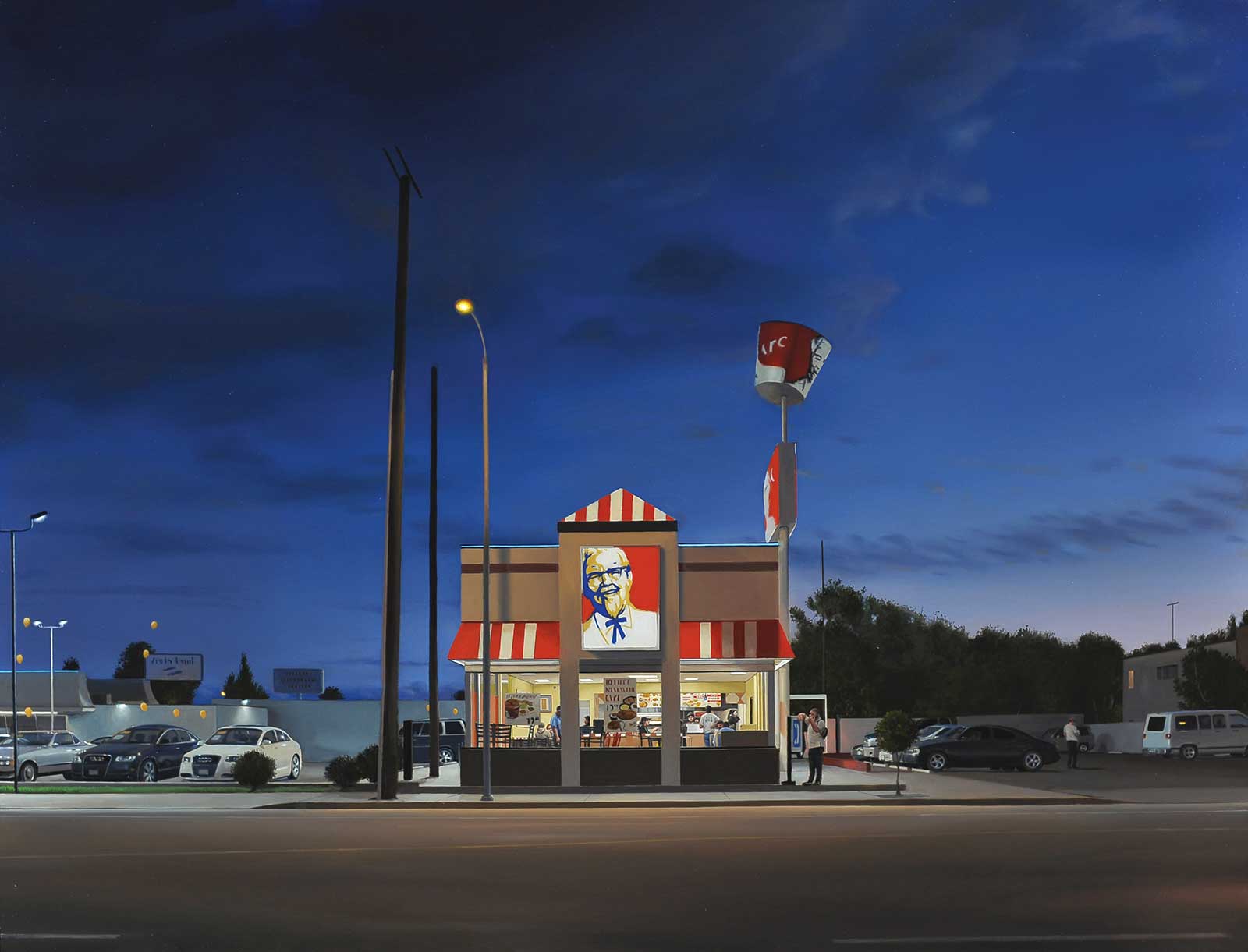 14522 Burbank Boulevard, 2010, oil on panel, 25 x 32"
Although Trujillo satisfies the American avant-garde’s rejection of kitsch by avoiding sensual humanity and has won acceptance into the end days of the canon of modernism, he also cleverly embraces idealism, pushing his paintings into the liminal spaces of imagination. This is not realism. There is none of the ubiquitous broken human debris of Angelino homelessness here, no ordinary potholes break the perfect pavement, no commonplace cracks fault the smooth sidewalks, no careless windswept wrappers fill the clean corners of his car parks. His pictures are a fantasy vision of America, the painted essence of convenient America, an idealized metamerica, perfected and purified. His liminal vision of architectural mediocrity casts the slick metropolis as a clean phthalo-skyed limbo poised between death and paradise.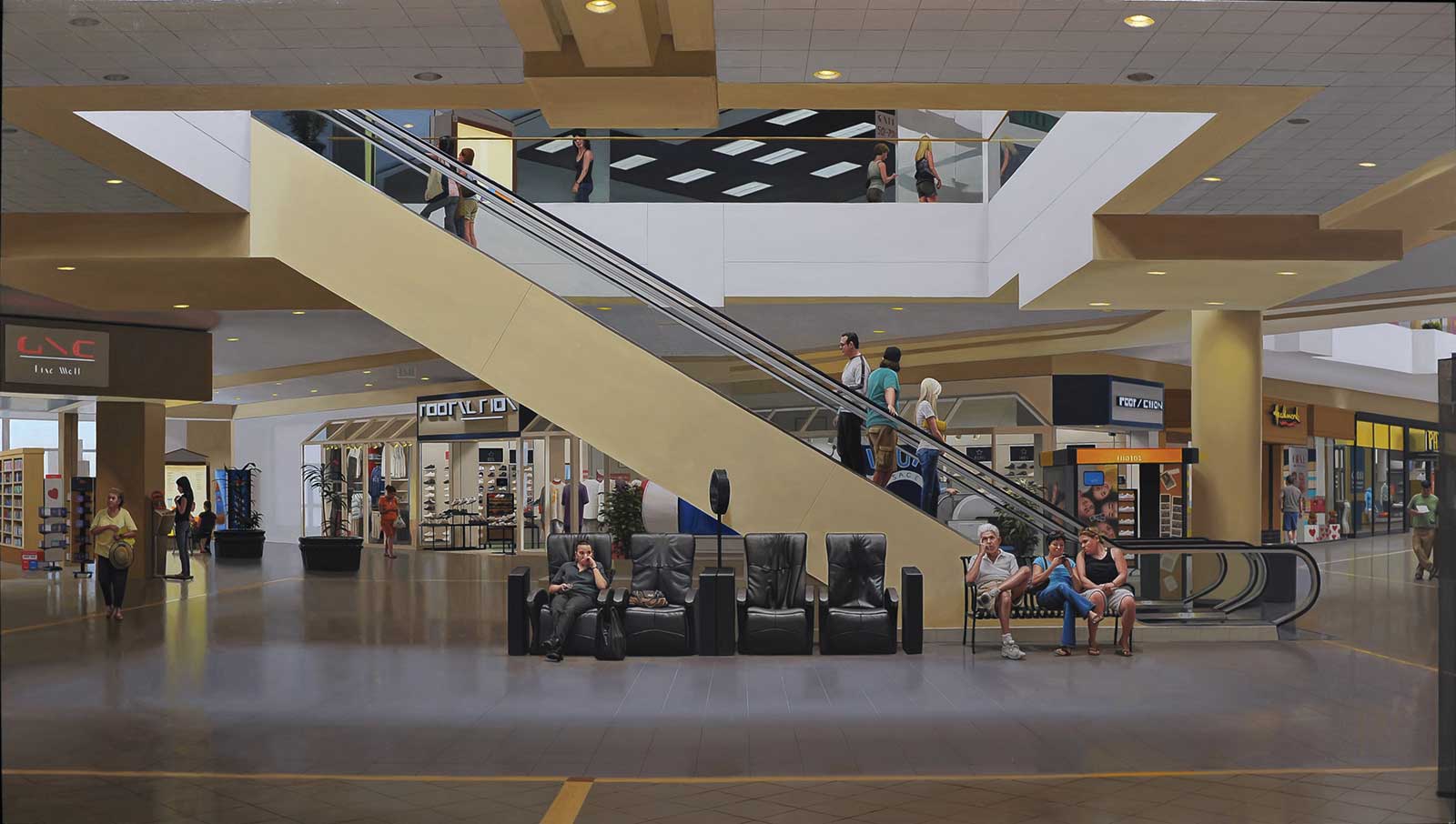 200 East Cypress, 2009, oil on polyester over panel, 38 x 67". Courtesy of Hirschl & Adler Modern, New York.
Evading human personalities, he guides us to unkind megastores and humming malls, populated by silent and anonymous shoppers who witness nothing—they are the oblivious subject of the relentless functionality of the objective spaces they inhabit, reduced to empty lives as formal mannequins by architects indifferent to human sensuality. Once, craftsmen decorated the deepest corners of public spaces, gifting humanity with sensual experiences. Once, we treasured grand buildings as the spiritual heart of communities. Once, humanity was the guide of scale, and we hoped to build heaven on earth, to live the good life. Now, people are dwarfed by the tilt-up architecture of these massive concrete walls and vast swathes of glass, shining and reflective.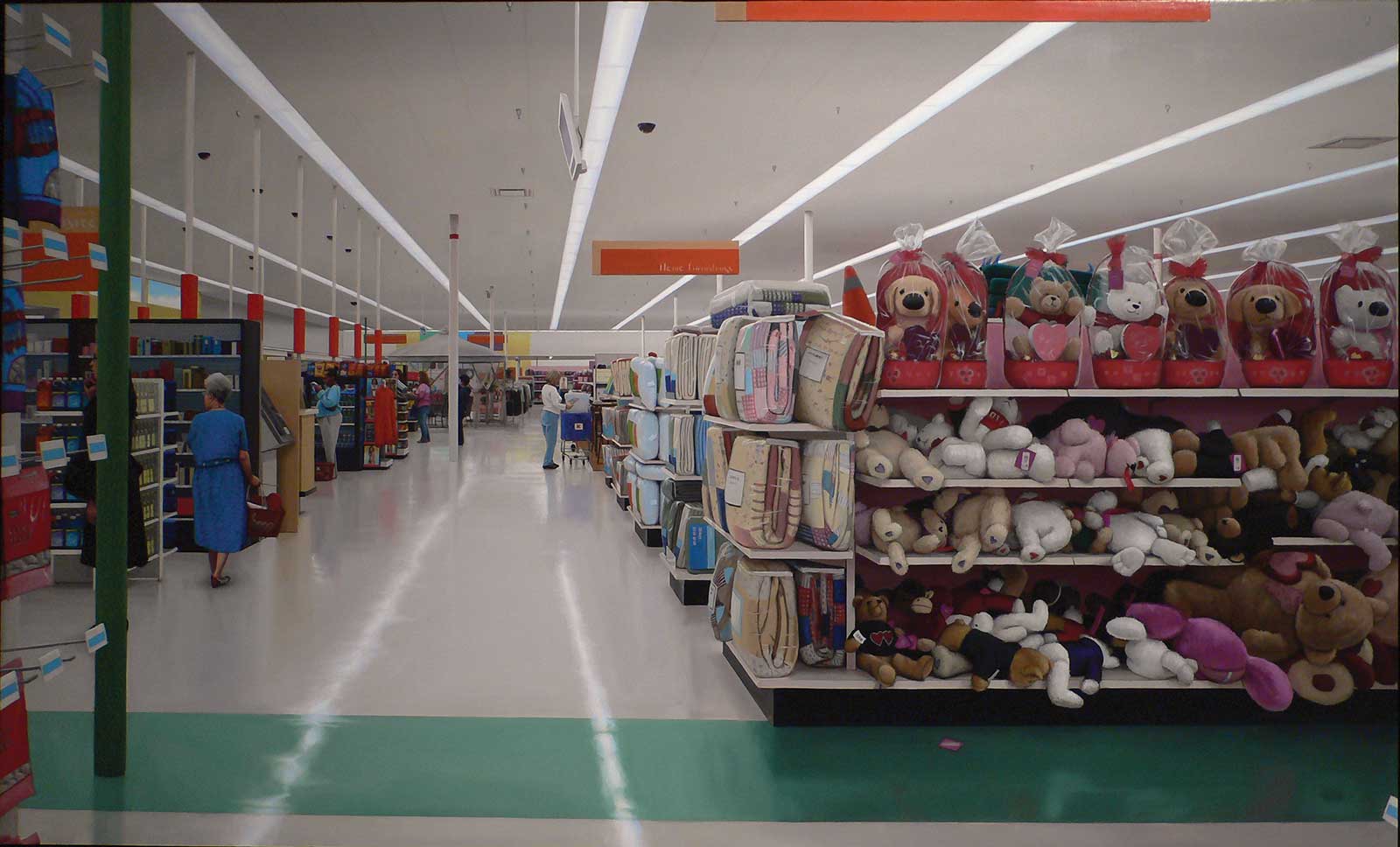 1000 San Fernando Road, 2007, oil on canvas over panel, 42 x 69"
In Trujillo’s work, people are incidental to the composition and never meet our gaze, never show emotion. This is not their story, although he loves Jan Vermeer, who he describes as a perfect painter. He once made a copy of A Maid Asleep, a napping servant girl, an exemplary sentimental image made for the bourgeois market. But Trujillo deliberately avoids using Vermeer’s techniques, which lead viewers to his models with perspective tricks and leading lines. These are ruthless portraits of a transcendent threshold to heaven, then, where sin and souls are scraped before the reformed and repentant make their righteous entry to paradise.
The inhabitants of Dante’s Purgatorio were cleansed of their pride, envy, wrath, sloth, greed and gluttony.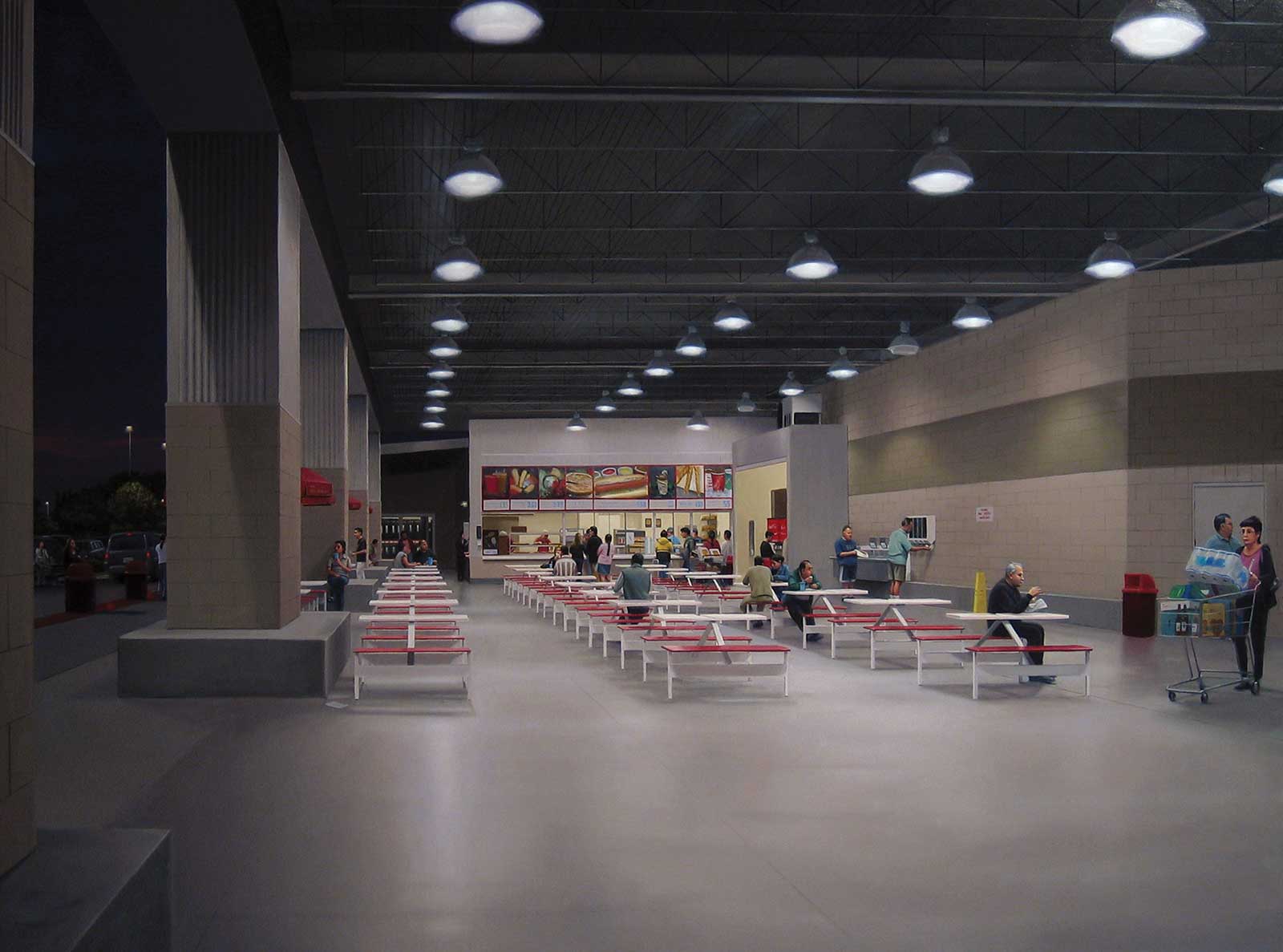 1052 West Burbank Boulevard, 2006, oil on polyester over panel, 38 x 51"
Past painters of purgatory described the heated agony of flame, but the torment we observe in Trujillo’s American limbo must be a slow sterilization of empty modern hearts using bottled sprays, kitchen sanitizers and bleach, not the burning purification of passionate medieval flesh under torture, violence and the lash, and the grim scenes of his sinners’ scourging are set in the bargain buildings of a sad city built by discount architects, whose horrid work sets the scene for all seven sins. Their cold cleanliness chills the void. Paintings of the medieval purgatory echoed with the shrieks of torment, but Trujillo paints his with a whisper. Except for the antiseptic buzz of strip-light ballasts this substitute for the city is silent.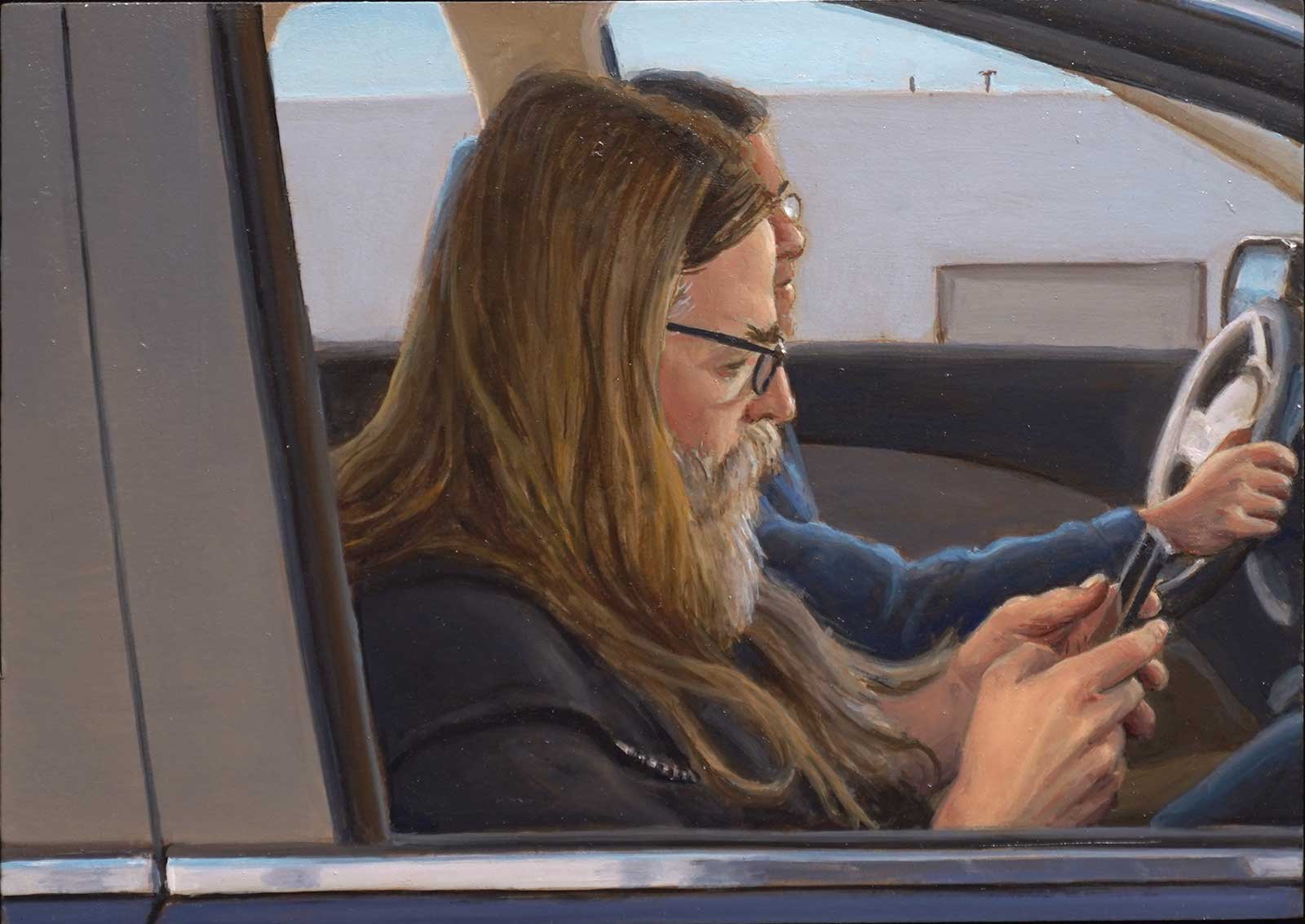 Marc Cabrillo, Cabrito Road January 3 2022, oil on panel, 5 x 7"In this echo of purgatory, the bland mediocrity of punishment balances an account of insignificant crimes. The penance is impotent. This is the afterlife after man abandoned God. God isn’t watching. God is indifferent. Man has built purgatory in his own image. Cheap, functional buildings are the efficiency and price of the idealized goal of bourgeois life. We build cheap restaurants so we can know the pleasures of expensive restaurants, and we are proud to eat in them, proud to be better than people who can’t afford luxury. We envy the rich who fly in private jets and helicopters and avoid the privations of commercial travel. We rage at horrors created by others, but we create convenience stores to enable our laziness, and our greed, and our super-sized gluttony.
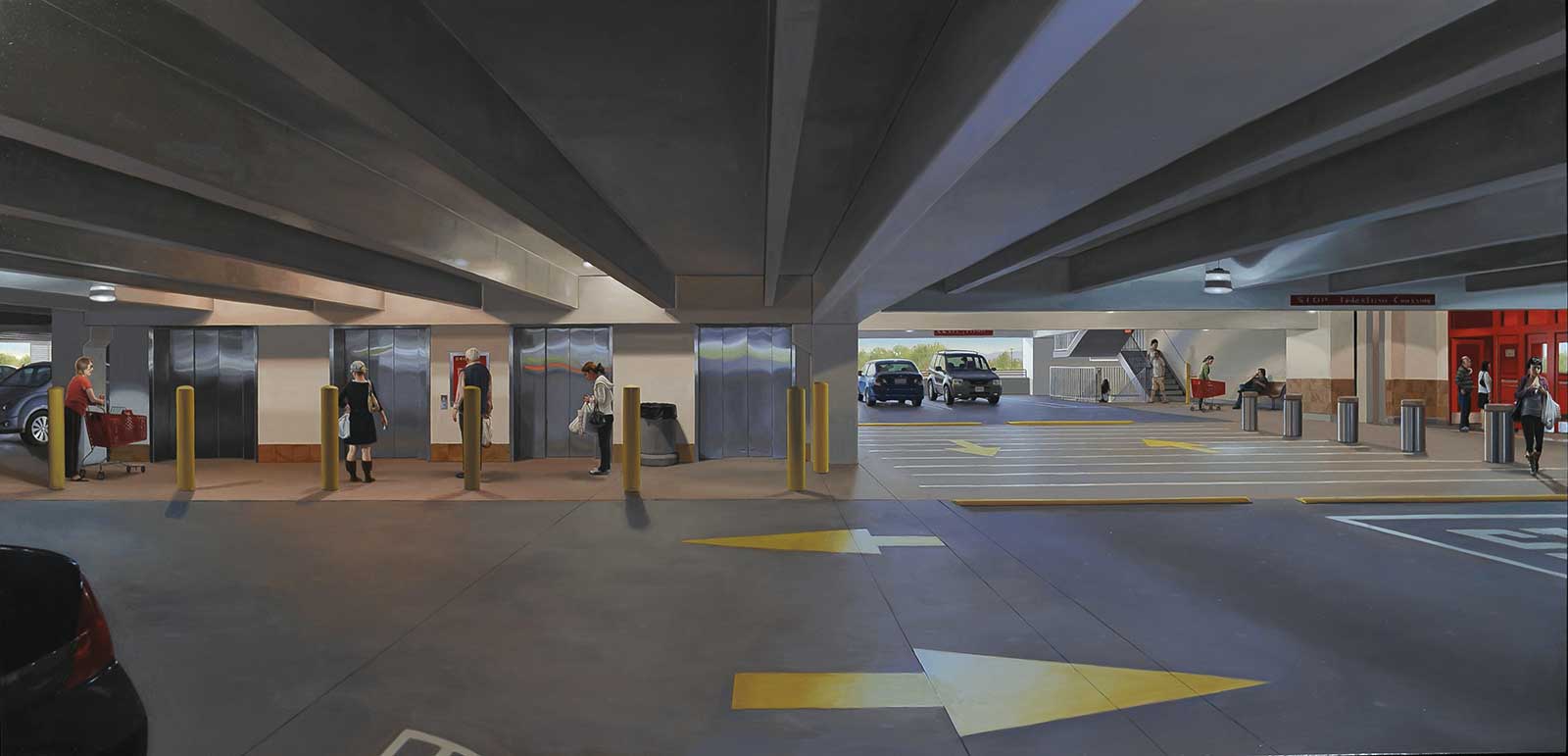 5711 Sepulveda Boulevard, 2010, oil on polyester over panel, 30 x 62"But Trujillo has hope. At the end of Purgatorio, Virgil gives way as Dante’s guide to Beatrice, the personification of human and divine love, who shows him paradise. In recent paintings, Trujillo has turned his scrutiny to portraits of people sitting in their cars, and these people have personalities, and his disinterest in the population of the cityscapes gives way to tenderness and open an entrance to emotion. Some of the portraits are famous members of the Angeleno brotherhood of the brush—the figurative painters Carl Dobsky, F. Scott Hess and David Legare are caught in the commute. With these portraits he paints the unspoken and unwritten events of his subjects’ lives—these are notable people whose biographies emphasize their outstanding moments—but the greatest proportion of the currency of their lives is spent on the routines of work, and commutes, and ordinary tasks. The paintings memorialize the mundane majority of our human histories. Ecce Homo. We shop, we text, we live. —
+++
Michael Pearce is a dynamic writer, curator and critic. He is an active and enthusiastic participant in the conversation about 21st century art and its roots, especially contemporary imaginative realism. He has published dozens of articles about art and artists, and is author of Art in the Age of Emergence. He is a champion of art that emerges from popular culture and shapes the spirit of the age. He is Professor of Art at California Lutheran University.
Powered by Froala Editor