The number three has been a mystical number for ages. In Greek myth, Zeus, Poseidon and Hades ruled the sky, the sea and the underworld, respectively. In Christianity there is the Trinity of Father, Son and Holy Spirit. There are the Three Jewels of Buddhism: The Buddha, The Dharma (his teachings) and Sangha (his followers). There are three primary colors: red, yellow and blue. There are three main states of matter: solid, liquid and gas.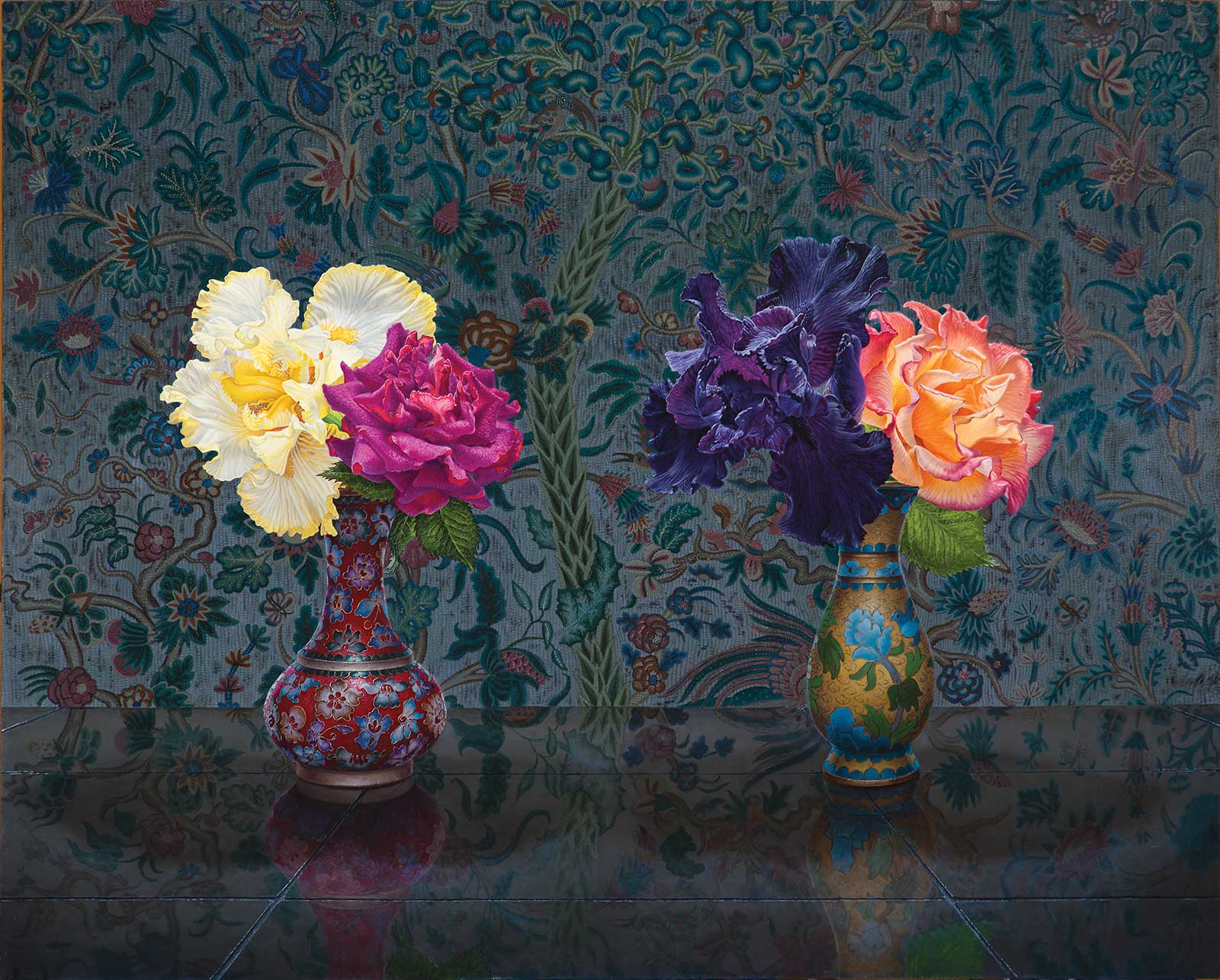 Gallery Henoch, Iris and Rose (detail), oil on canvas, 40 x 50", by Eric Wert.
Three has crept into rules of artistic composition. In the rule of thirds, an image is divided into thirds both horizontally and vertically and objects are placed on the lines or their intersections. A pleasing landscape would be two-thirds sky and one-third land or vice versa. There is also the rule of odds, beginning with three and continuing with higher odd numbers. Odd numbers of objects, it is said, are more pleasing to the mind.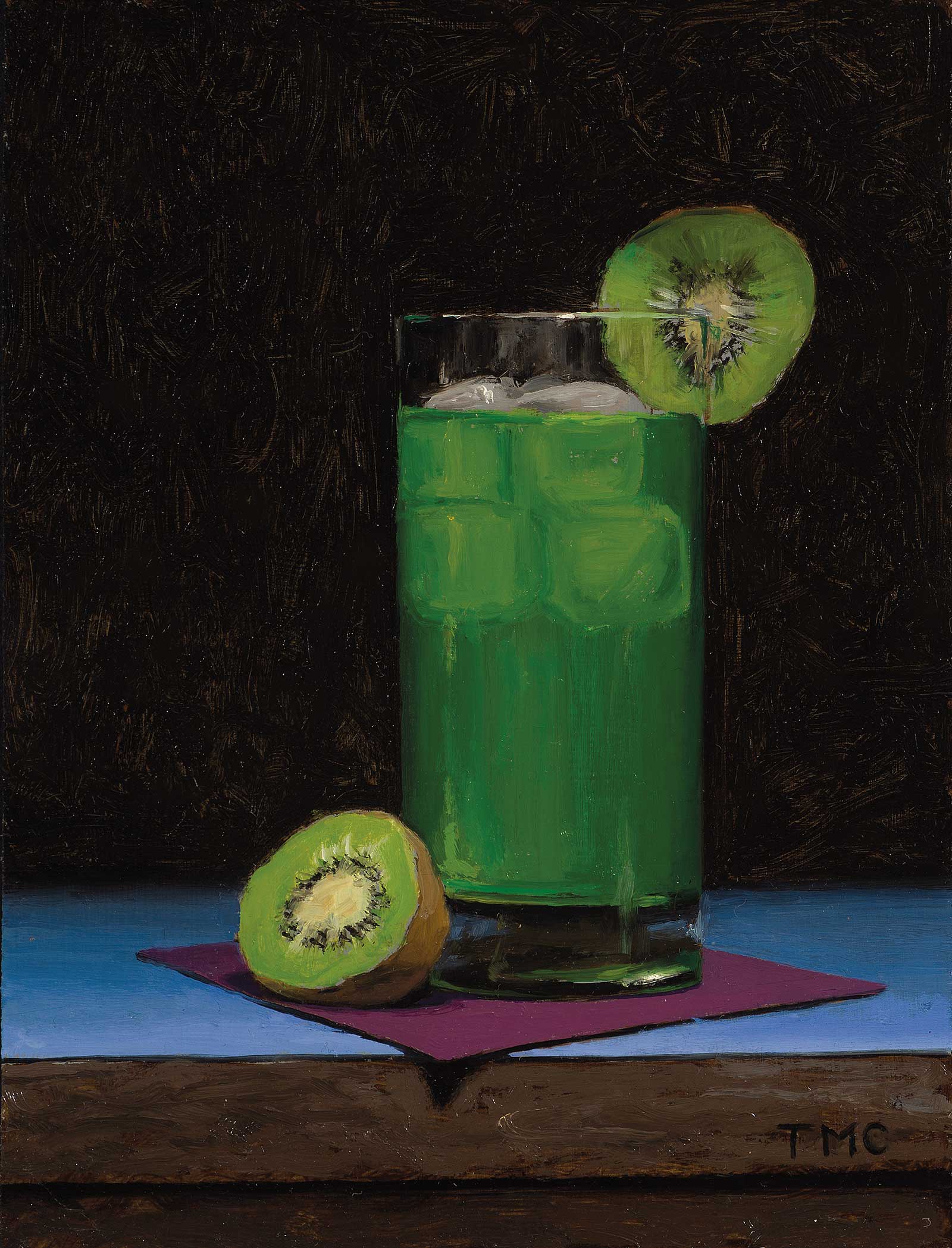 Rehs Contemporary Galleries, Incredible Hulk, oil on board, 8 x 6", by Todd Casey
The abstract expressionist painter Helen Frankenthaler, pronounced, however, “There are no rules. That is how art is born, how breakthroughs happen. Go against the rules or ignore the rules. That is what invention is about.”
Eric Wert breaks the rules in his painting Iris and Rose. Although he has divided the tile counter into nine sections, he has placed two cloisonné vases squarely on their intersections. In the vases are two flowers. He frees himself from his rule-breaking with the three petals of the iris flowers which, to the ancient Egyptians, represented wisdom, faith and valor. The fabric background is gloriously asymmetric. The shifting eye movements that caused someone in the past to come up with the rule of odds is evident. The eye moves back and forth between the two vases, drawn even more cleverly by the flowers toward the edges of the canvas being brighter than those facing the center.
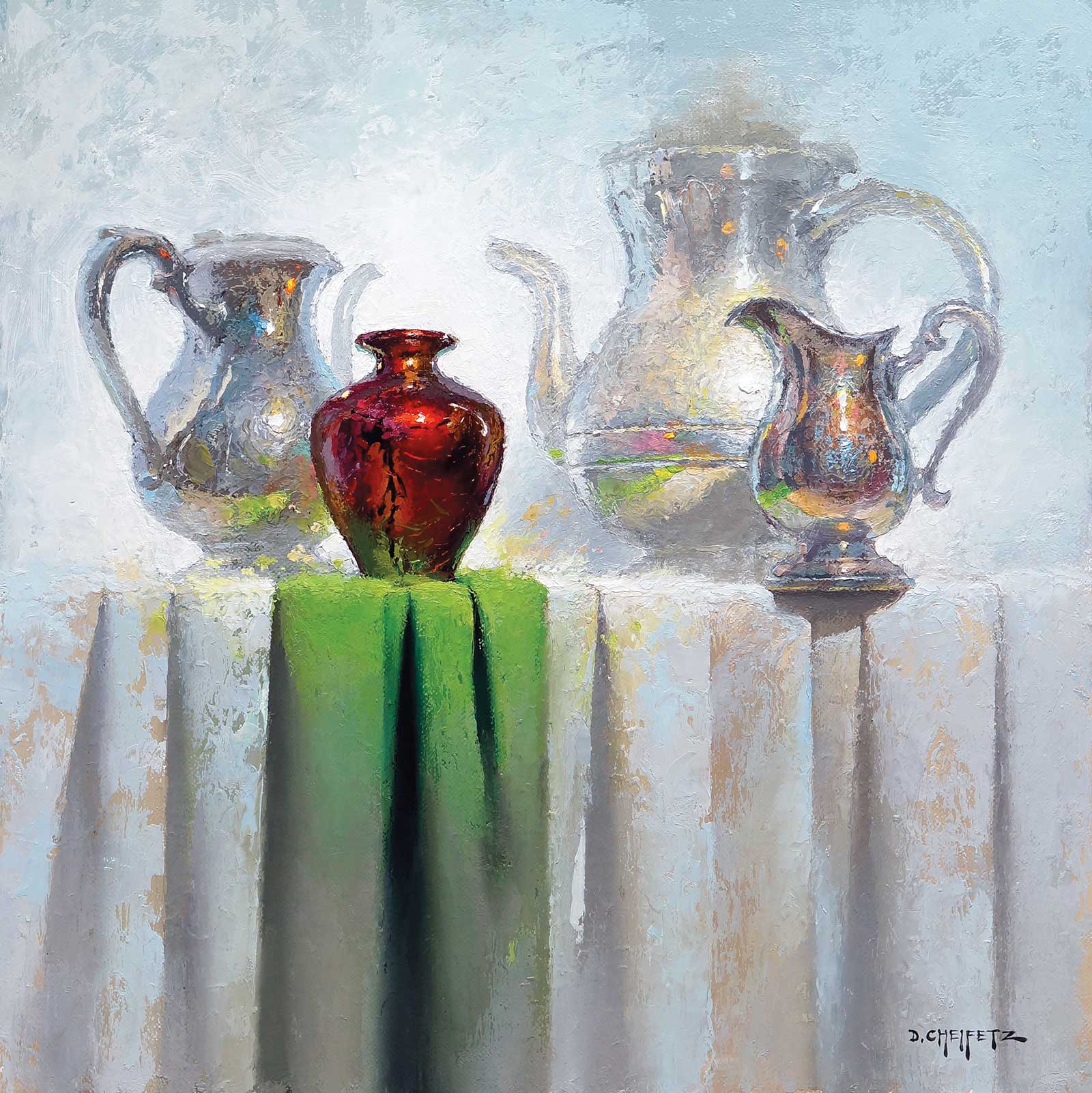 Gallery 1261, The Artifact, oil on artefex linen ACM, 12 x 12", by David Cheifetz
Todd Casey’s rule breaking is simple but more obvious in Incredible Hulk—four ice cubes and two slices of kiwi. The composition becomes dynamic with the diagonal formed by the kiwi slices and the tall green drink. The vibrant greens pop out of the dark background just as Marvel’s muscle- bound Hulk bursts from his man-sized shirt. Later this year, a book, Cocktails, A Still Life, will appear, featuring 60 of Casey’s cocktail still lifes and recipes by beverage historian Christine Sismondo and drink expert James Waller. 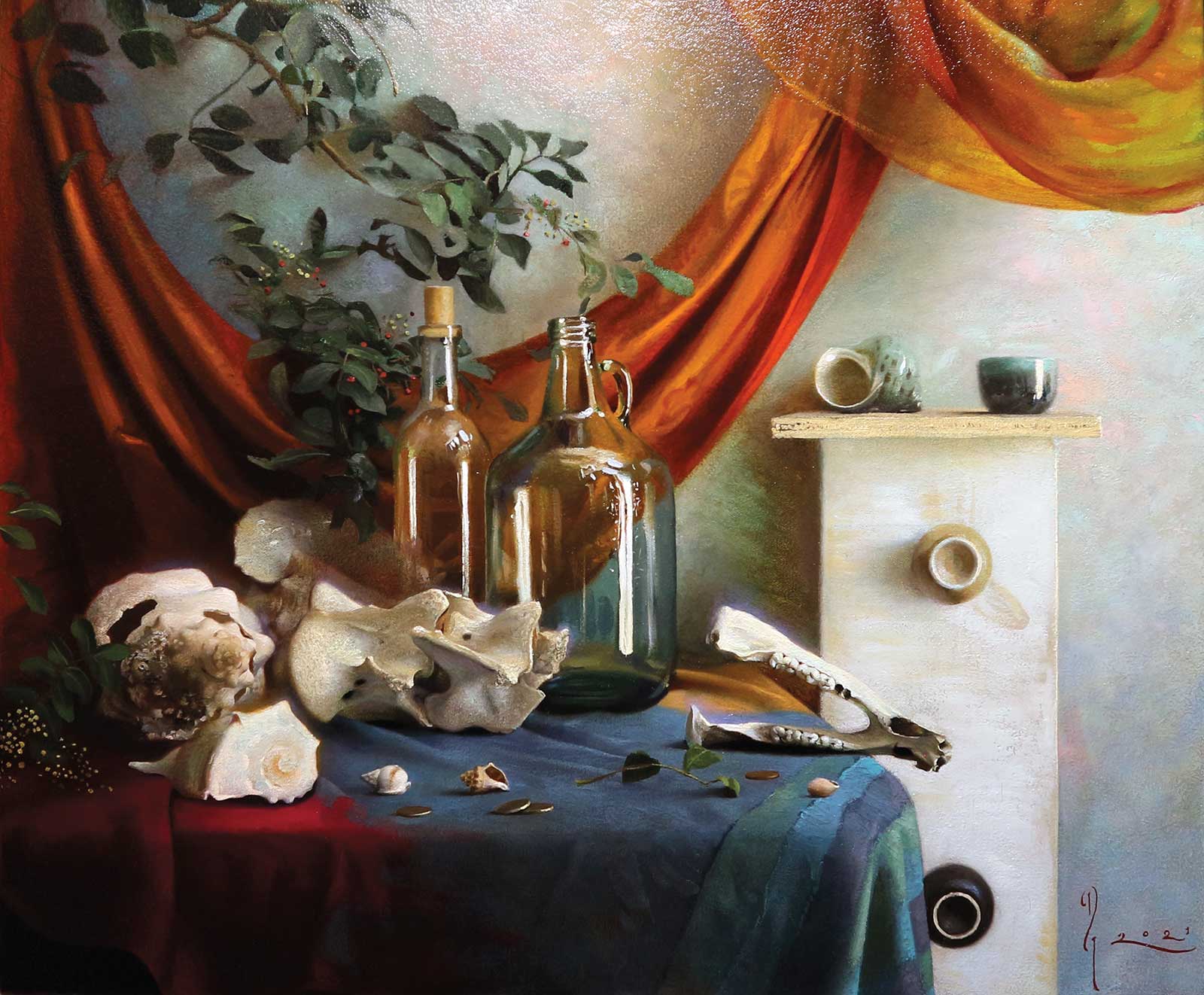 Diego Glazer, Empty Bottles, oil on canvas, 20 x 24"
David Cheifetz puts a strong one in a composition of fours in his painting The Artifact. There are four vessels in the composition. The three silver ewers become one with the background but are given life by reflecting the colors of the vibrant red vase that sits atop a column of complementary green fabric. He brings the inanimate to life with his dynamic brushstrokes and light that appears to emanate from within the objects rather than being reflected off them.
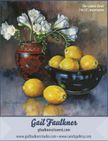
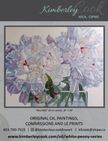
Cheifetz says, “I don’t believe in hard and fast rules for composition in still life, whether that means number of objects, or placement of objects. It depends on the way you paint it. It could be painted in such a way that it doesn’t work, or it does work. Those rules are meant to be broken.”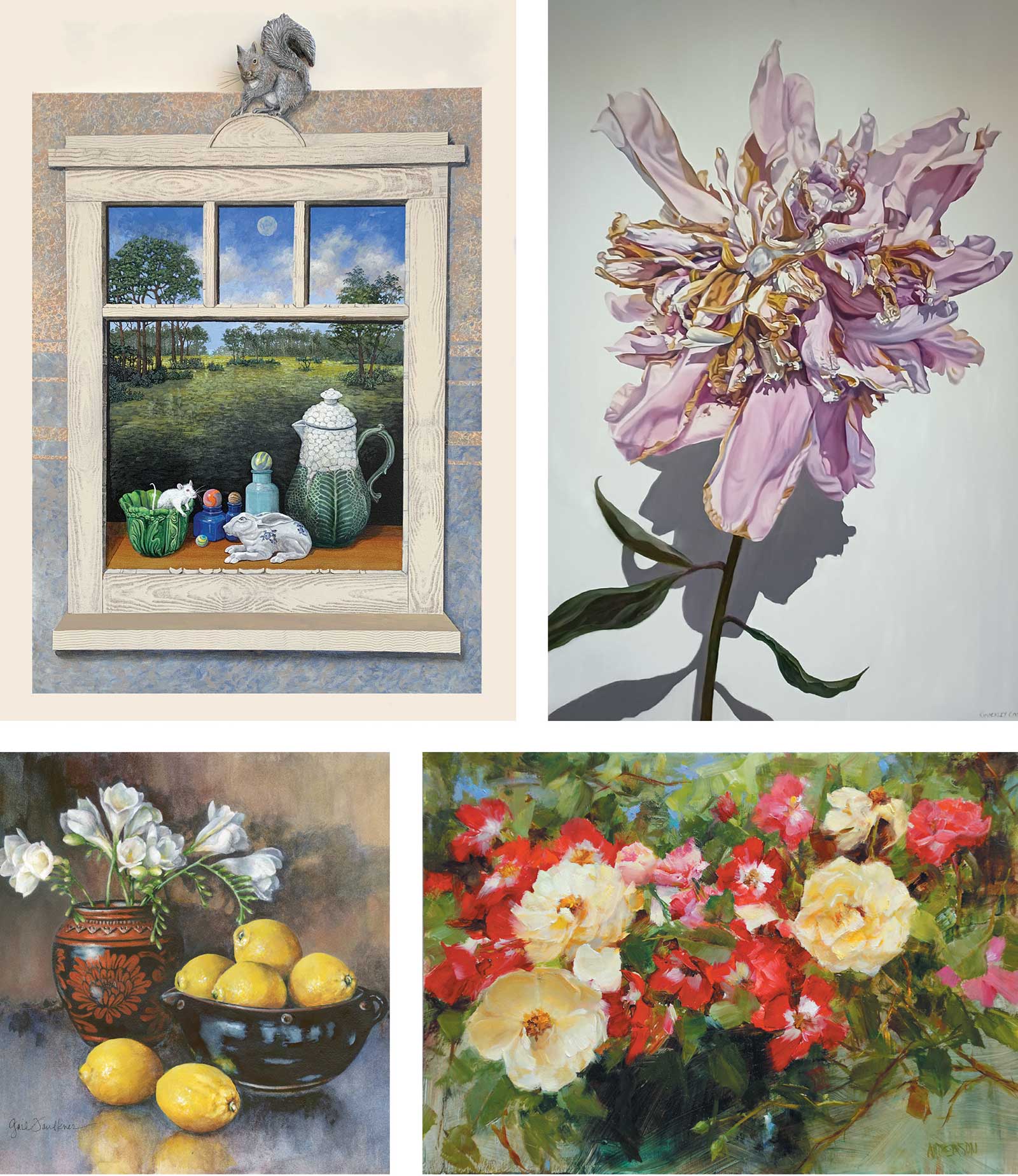 Clockwise from top left: Richard A Johnson, The Squirrel Jumped Over The Moon, acrylic on canvas and wood, 44 x 30"; Kimberley Cook, Blissful, oil on canvas, 60 x 40": Kathy Anderson, Mixed Fall Roses, oil, 10 x 14"; Gail Faulkner, The Lemon Bowl, watercolor, 14 x 15"Contemporary still life painters are redefining the conventions of this time-honored genre. Whether painting a traditional subject matter in a unique way or using objects of today, they are elevating compositions to new heights. In the pages of this feature are nearly two dozen examples from artists who are creating their own rules.
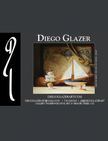
For as long as artist Diego Glazer can remember, he has “been on a quest to convincingly represent on canvas what I see in the physical world, what I see in my mind and what I feel. My ideal is to find that exquisite middle ground between the three.”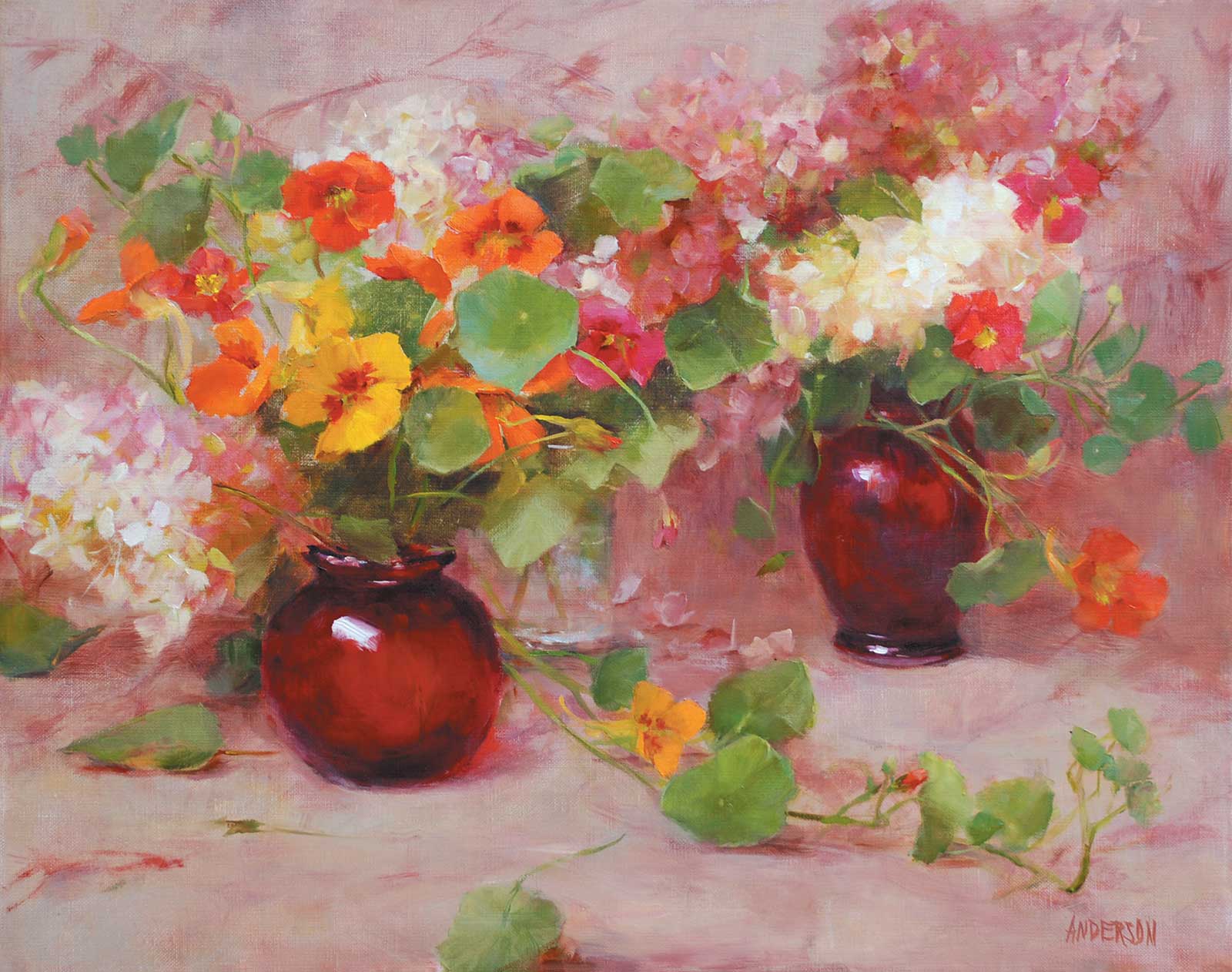 Kathy Anderson, Ruby and Nasturtium, oil, 16 x 20"
Glazer continues, “As an artist I love to find inspiration in unpredictable places and situations. It could be getting lost in a conversation, hearing a piece of music for the first time or exploring landscapes in the countryside. I enjoy trying to tame the difficult medium that is oil paint, as well as the mess and accidents that happen when using it. One of my priorities as an artist has been to explore many different styles, mindsets and methods of painting that often have little to do with each other, and to bring them together in a coherent and satisfying way. I want my paintings to transport the viewer into a dreamlike atmosphere, and at the same time, give a familiar feeling. I want them to be beautiful physical objects that the viewer can get lost in, explore and ultimately be moved by.”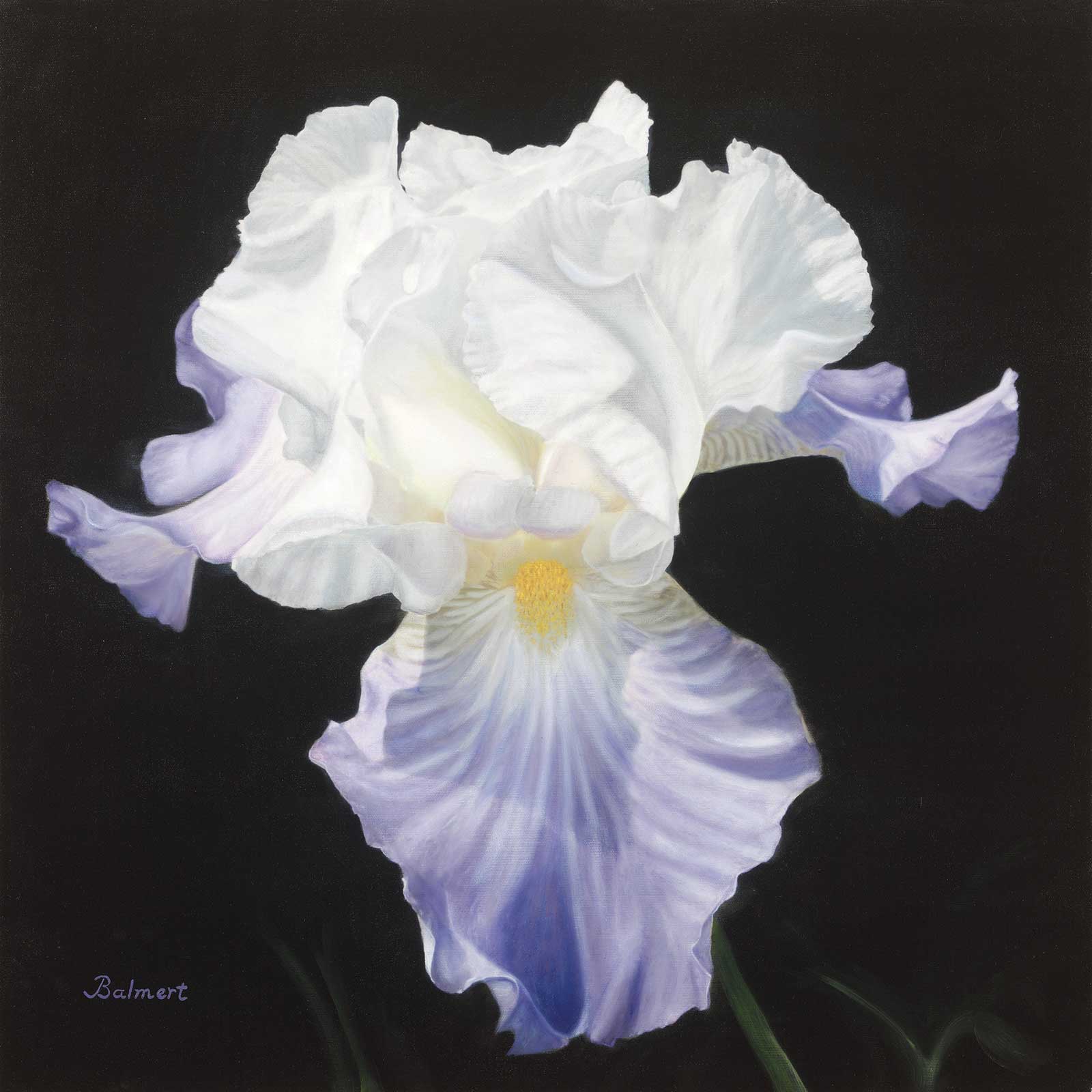 Nancy Balmert, Monet’s Iris, oil on canvas, 24 x 24"
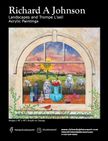
Richard A Johnson became interested in still life painting in art school, and after 50 years, hasn’t stopped creating new works. “They started very simple but have gotten much more complicated over the years.
I use lots of antique pottery and since my wife is a florist, I use lot of flowers,” says Johnson. “I sometimes work from photos but would rather have a still life setup in my studio. My studio has lots of bottles with marbles, like the ones in my paintings. I have one that was my mother’s when she was 7 years old. It must be over 100 years old as my mom died last year and she was 99. It’s the largest one I have.”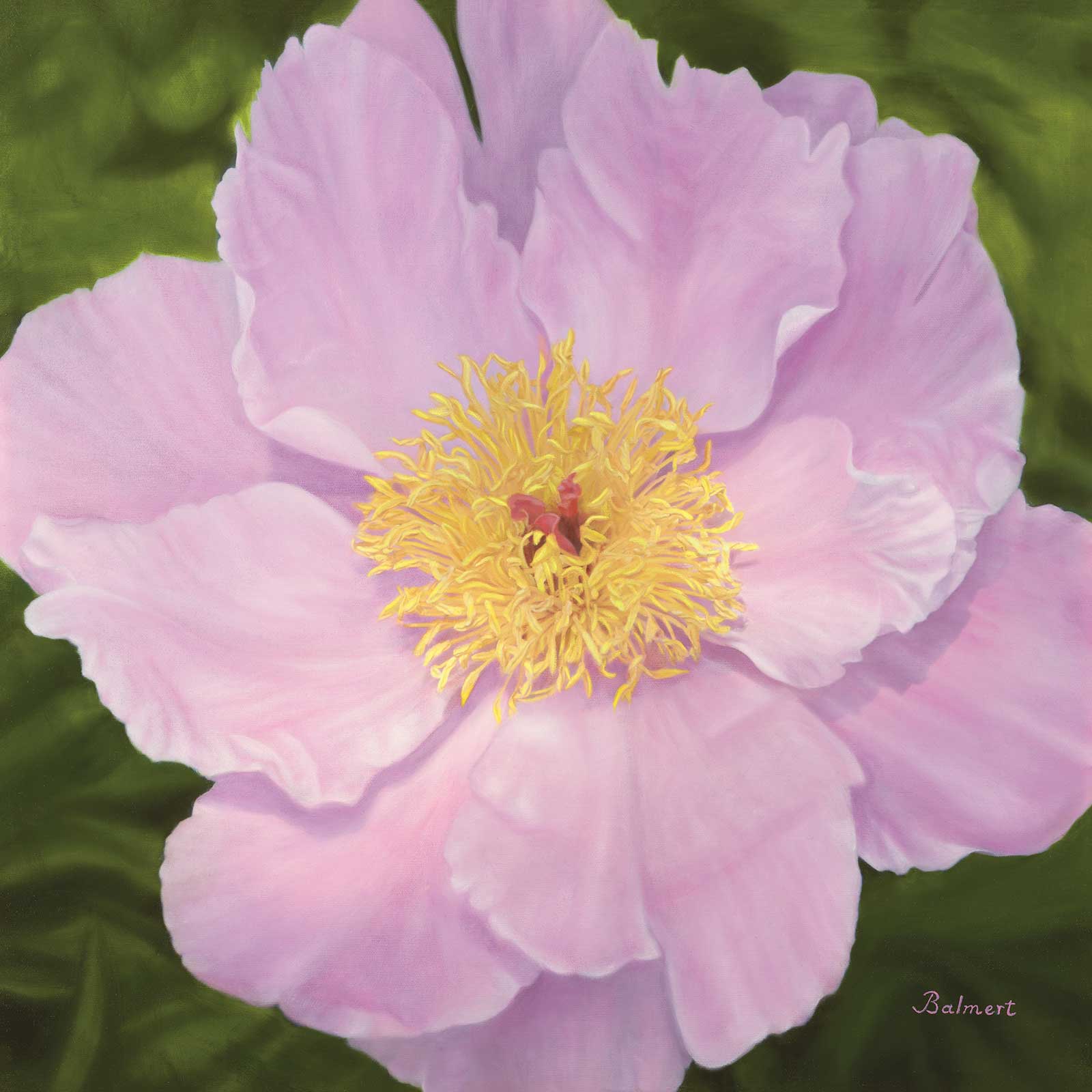 Nancy Balmert, Lady Penzance, oil on canvas, 24 x 24"
He continues, “Most of the larger pottery pieces came from photos I took in antique shops and other places. The birds came from photos of birds in my yard. Most of the flowers came from our yard as well. Cindy brings home some very nice flower arrangements sometimes which end up in paintings. I’m having fun taking parts of paintings beyond the edge of the canvas. The squirrel in one painting [The Squirrel Jumped Over The Moon] is partly painted on the canvas and partly carved out of wood. My cat went crazy when she first saw it. It took a couple weeks before she quit attacking it. I had to cover it with cloth for a while before she quit. I enjoy painting still lifes. They are more challenging than landscapes, which I also enjoy doing.”
Artist Kimberley Cook creates floral pieces that are inspired by the ephemeral nature of fresh flowers and blossoms. The artwork leaves the viewer feeling grounded and peaceful. Blissful is from her Peony Series “focusing on a pink peony in the early stages of decay.” She paints peonies in all of its stages, beginning with it in the bud, and she finds beauty in the most challenging of subject matter.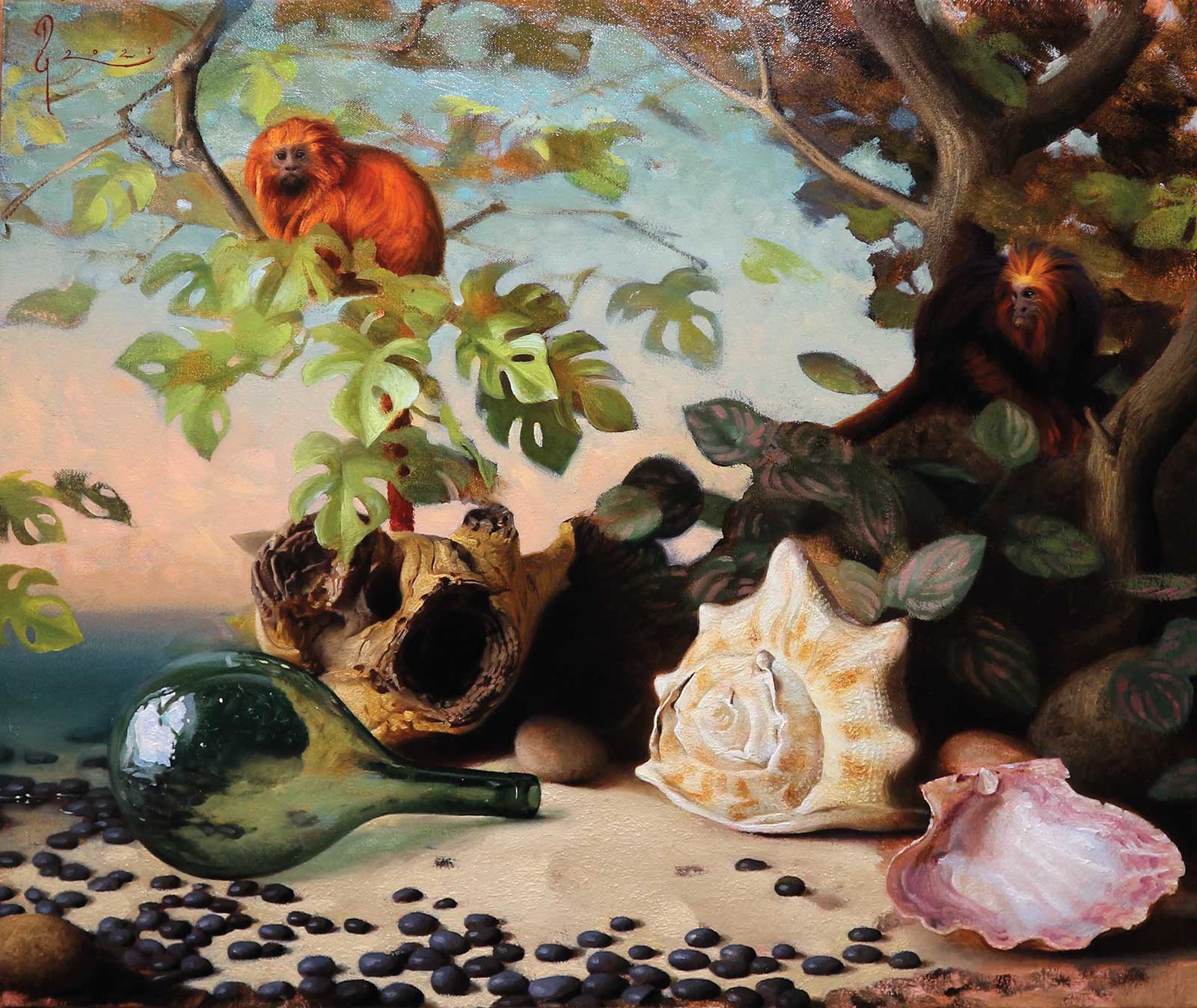 Diego Glazer, Tamarin Beach, oil on canvas, 20 x 24"
Still life painter Kathy Anderson says, “I seem to be powerless to stop painting my garden and its abundance of ever-changing flowers from April to November when I finally put everything to bed! The beauty of what I see, not just flowers but everything in the natural world—rocks, trees, animals, birds—fills me with a joy that I constantly strive to pass on to my viewers.”
Among artist Gail Faulkner’s latest paintings is The Lemon Bowl, a watercolor depicting a beautiful bowl of lemons alongside a vase of flowers. “Lemons everywhere! That’s how it is in Southern California…a never-ending abundance of beautiful fruits and plant life that so naturally complement my favorite objects,” says the artist. “In this painting, the grace of the cascading freesia adds a soft contrast to the brightly colored lemons.”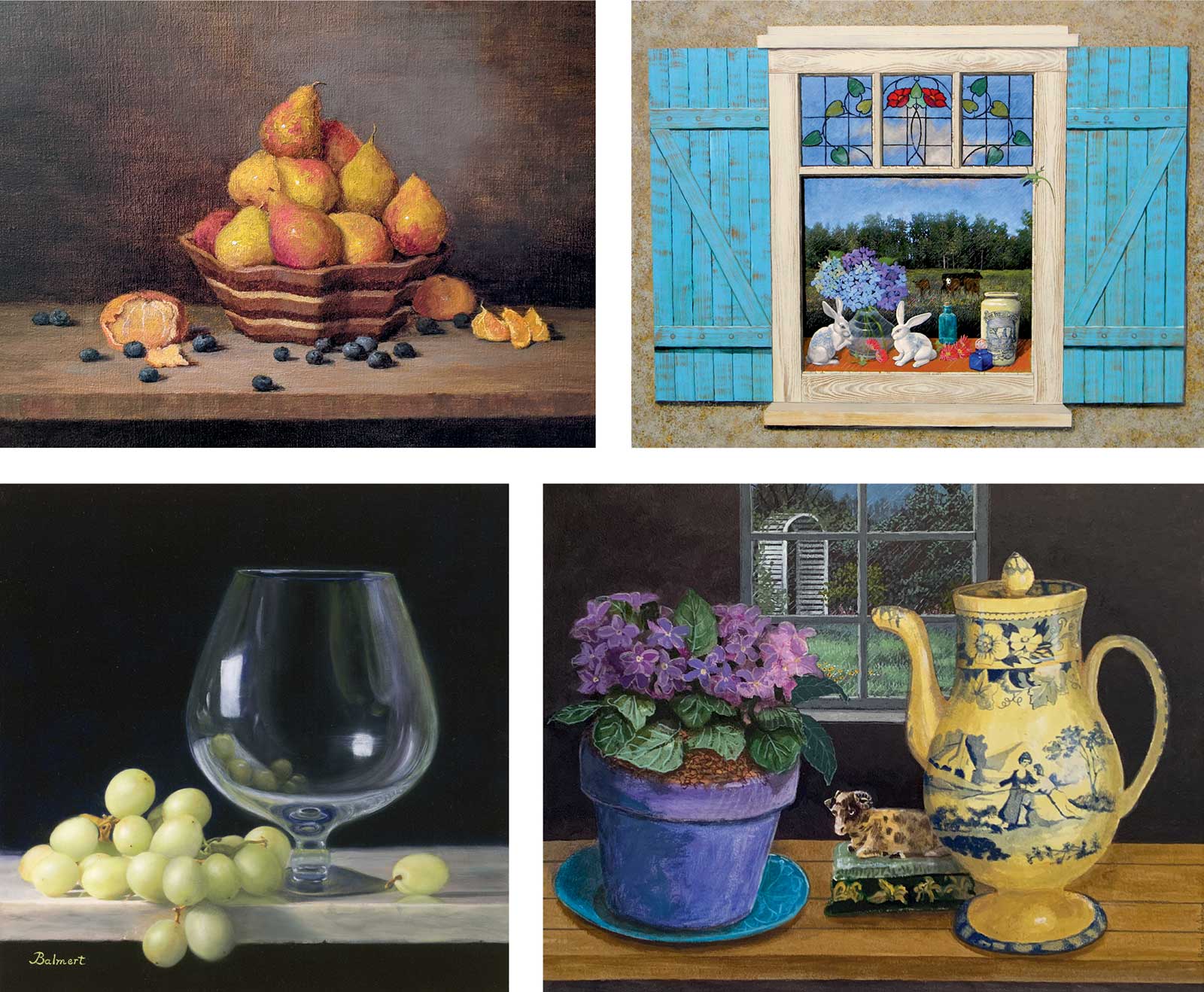 Clockwise from top left: F. Lisa Hannick, Pile of Pears, oil on linen, 11 x 14"; Richard A Johnson, Pasture View, acrylic on canvas, 60 x 40"; Richard A Johnson, Memories of My Aunt, acrylic on watercolor board, 14 x 18"; Nancy Balmert, Vintage, oil on canvas, 14 x 14"
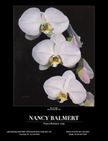
Flowers are the principal subject of Nancy Balmert’s paintings. She says, “There is so much beauty in the world.
I love bringing the beauty of flowers inside.” Currently, Balmert has several of her floral paintings on display at the Amsterdam Whitney Art Gallery in Chelsea, New York, where the curator, Ruthie Tucker, has nicknamed her “The Queen of Flowers.”
Balmert has cultivated a strong following in Europe, where her floral paintings have garnered a host of international awards, including International Artist of the Year 2018, 2019 and 2020. Recently she has been named as one of “Fifty Artists to Invest In.”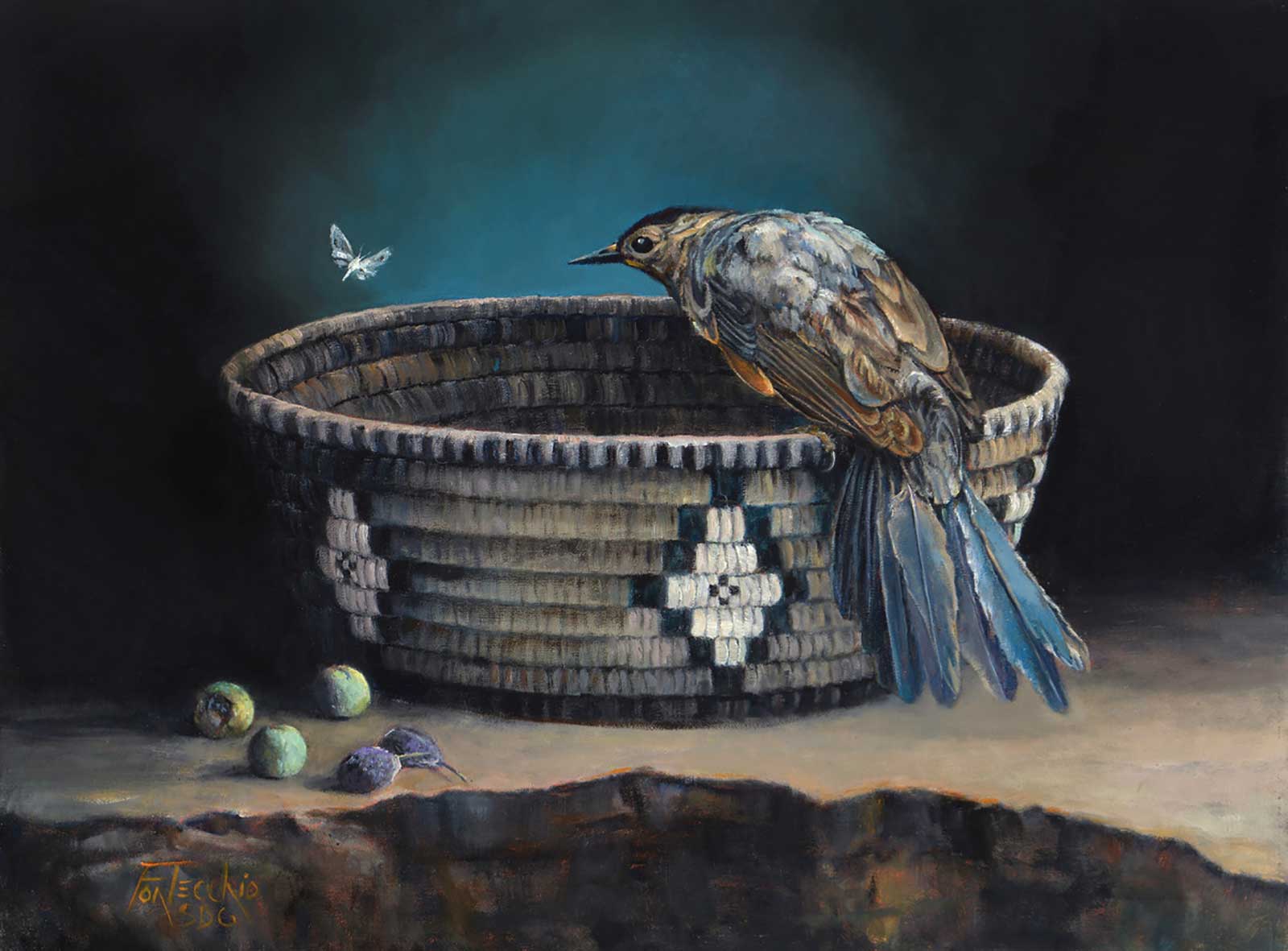 Jan Fontecchio, Nez Perce Basket, Wild Plums, and Gray Catbird, oil on panel, 18 x 24"
“Paintings of fruit and vegetables have been around since ancient times,” says artist F. Lisa Hannick. “In Egypt, hieroglyphics have been found depicting bowls of fruit being offered to the gods. This offering of food illustrates how magnanimous and selfless it is to give that which sustains us. Centuries later, still life continues to be painted. Although they are not giving that which sustains us in the literal sense, still life offers us solitude and a chance to escape into the ethereal beauty of the painting.”
Hannick’s goal as a painter, whether painting flowers, landscapes or still life, is to share with the viewer “peace, serenity, thoughtfulness and joy—and all else that which sustains our soul.” The painting Pile of Pears, depicting a precariously stacked pile of pears in a bowl, is available at Beacon Fine Arts Gallery in Red Bank, New Jersey, while the intricately composed Tom’s Vase with Grapes & Philodendrons is at Morgan Gallery of Fine Arts in Blakeslee, Pennsylvania.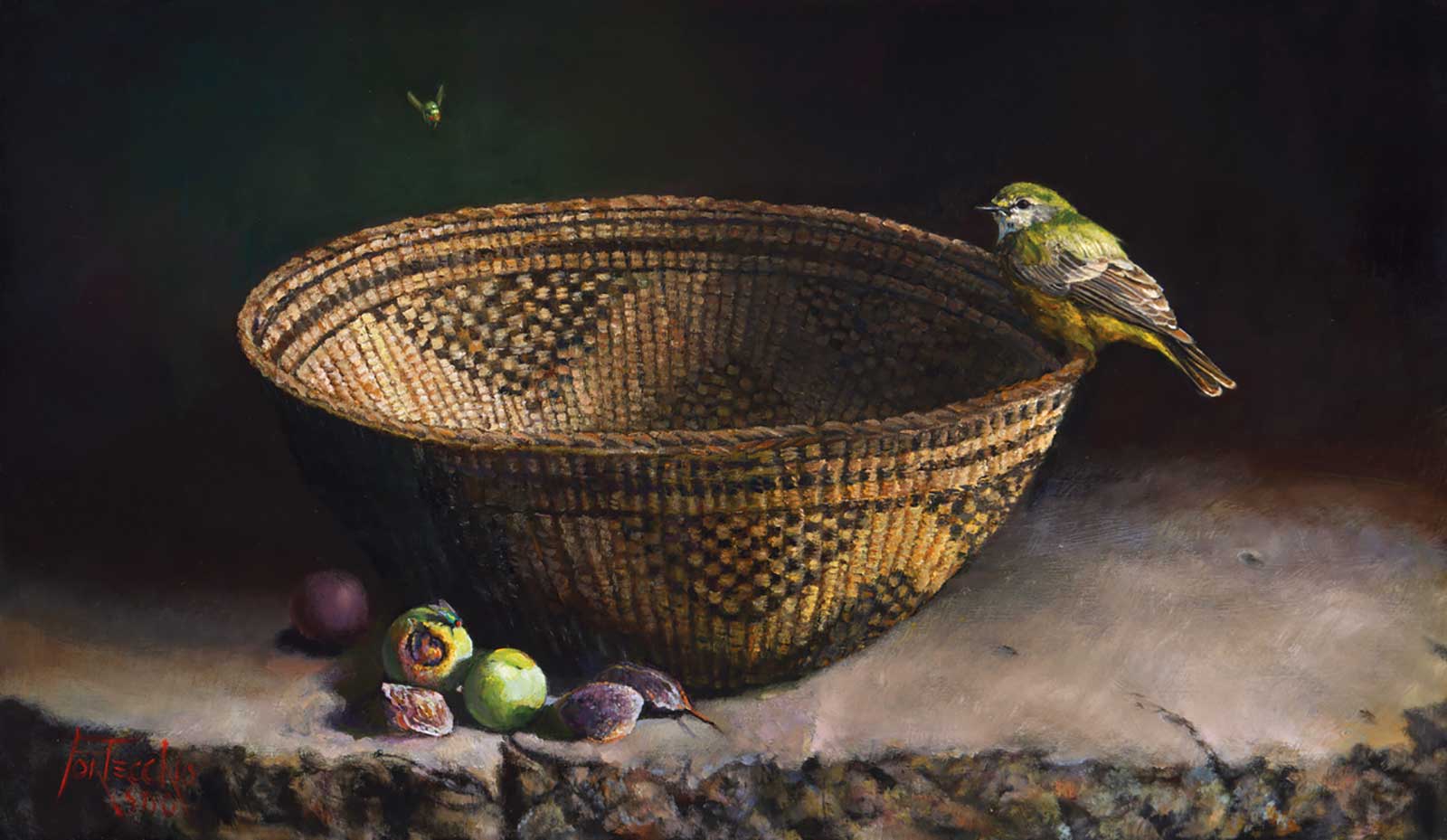 Jan Fontecchio, Tule Basket, Flycatcher, and Wild Plums, oil on panel, 14 x 24"
“My work focuses on celebrating the things we see every day in our homes—items that are part of our lived experience but that we seldom study intimately,” says artist Sarah M Paddock. “I love spending time with these lovely objects and thinking about their histories and the lives that surround them, really working to capture the nuances in how they absorb and reflect light and interact with their surroundings. Rarely are our most treasured belongings the most valuable in terms of dollars, but these are often the most significant mementos of the people who have given meaning to our lives. The durability of oil painting allows us to ensure that the impressions of these personal effects last for generations—perhaps even longer than the physical objects themselves. It’s a beautiful way to celebrate and honor our stories and legacies.”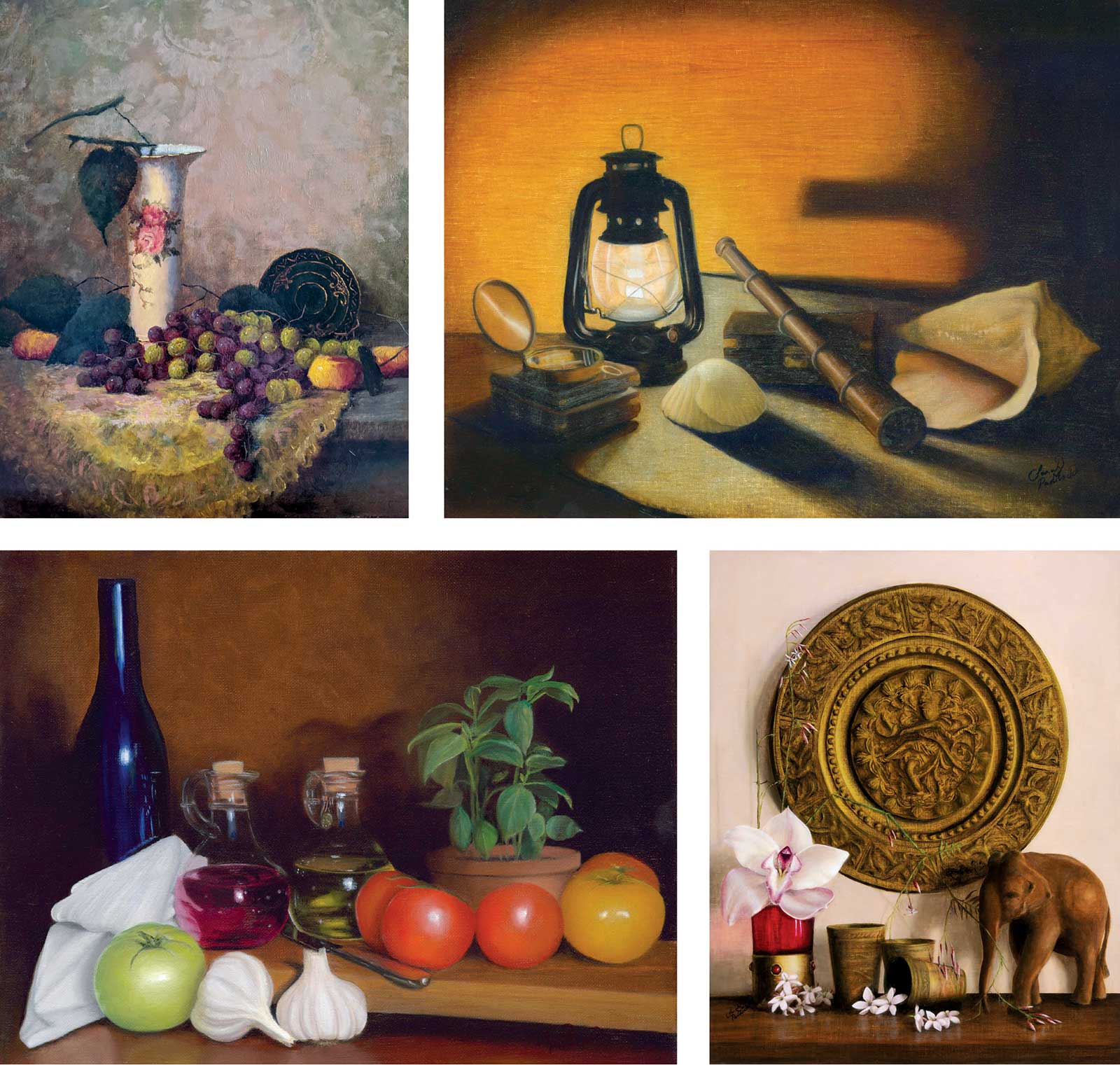 Clockwise from top left: F. Lisa Hannick, Tom’s Vase with Grapes & Philodendrons, oil on board, 14 x 11"; Sarah M Paddock, Voyager, oil on linen, 16 x 20"; Sarah M Paddock, Whisper of Jasmine, oil on linen, 20 x 16"; Sarah M Paddock, Italian Kitchen, oil on linen, 12 x 16"Painter Jan Fontecchio says. “I’ve done art since my first memory. My parents say I drew a three-dimensional wedge of cheese when I was 3. I don’t remember that, but my book covers at school were covered in sketches. A pencil was always in my hand and if the teacher didn’t grab my tests quickly enough, there might be a little horse drawn in the corner of the paper.”
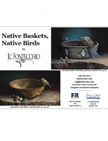
Fontecchio has long had an interest in the Western lifestyle and wildlife, which is reflected in her paintings. Her still lifes Nez Perce Basket, Wild Plums, and Gray Catbird and Tule Basket, Flycatcher, and Wild Plums combine these ideas into one composition. For instance, a Native American basket, the natural element of the plums and the wildlife through the birds. —
Featured Artists & Galleries
Diego Glazer
(720) 238-5263
diegoglazerart@gmail.com
www.diegoglazerart.com
F. Lisa Hannick
lisa@hannickfineart.com
www.hannickfineart.com
Gail Faulkner
gfaulkner@iswest.com
www.gailfaulknerstudio.com
www.sandzgallery.com
Gallery 1261
1261 Delaware Street, Suite 1
Denver, CO 80204
(303) 571-1261
www.gallery1261.com
Gallery Henoch
555 W. 25th Street
New York, NY 10001
(917) 305-0003
www.galleryhenoch.com
Jan Fontecchio
www.jfontecchio.com
Kathy Anderson
kathy@kathyandersonstudio.com
www.kathyandersonstudio.com
Kimberley Cook
(403) 700-7915
www.kimberleycook.com
Nancy Balmert
www.nancybalmert.com
Rehs Contemporary Galleries
5 E. 57th Street, 8th Floor, New York, NY 10022
(212) 355-5710
www.rehs.com
Richard A Johnson
(843) 229-0660
richard@richardajohnsonart.com
www.richardajohnsonart.com
Sarah M Paddock
Sarah M Paddock Fine Art
sarah@sarahmpaddock.com
www.sarahmpaddock.com
Powered by Froala Editor