Napoléon III appointed Georges-Eugène Haussmann to “aerate, unify and beautify” the city of Paris in 1850. Haussmann created the long boulevards, plazas and apartment blocks we know today, wiping out the chaos of medieval lanes. He left out the district known as Le Marais. Now known as a place of cafés and galleries, the district has traffic-packed, twisting lanes as well as the ordered serenity of Place des Vosges.
Ben Aronson has said, “The main objective is not merely to capture physical likeness but rather to aim for the most concentrated form of a powerful visual experience.” What better way to concentrate the energy of Le Marais than in a 10½-inch square painting? Speaking of Monet’s painting of a train station in Paris, he commented, “the true subject of the painting wasn’t the train or how realistically it was painted, the real subject was Monet himself. That realization was a turning point for me, understanding that it wasn’t simply about making still life objects, figures or buildings look real—it was about how I personally saw the world around me and communicated in paint how it made me feel.”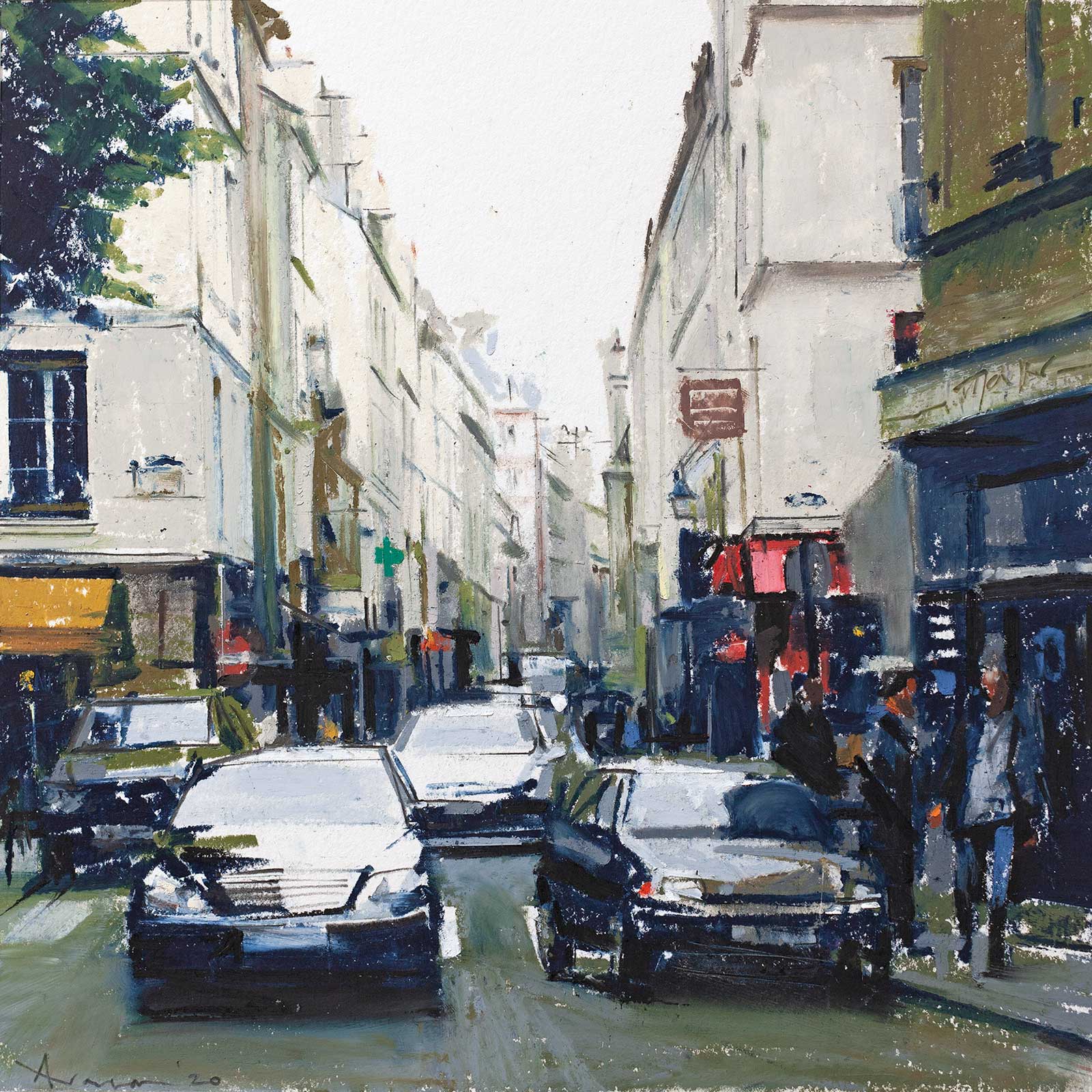 LewAllen Galleries, Le Marais, Paris, oil pastel on museum board, 10½ x 10½", by Ben Aronson
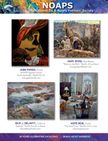
Philip R. Jackson’s still lifes often feature less than perfect fruits, vegetables and objects perfectly painted on a highly reflective surface. He quotes the still life painter Walter Tandy Murch, who said, “I must not paint the thing itself, but will paint the air between myself and the thing and beyond.” Jackson’s objects are physically reflected on the surface he places them but the reflection takes on depth suggesting a reverse world beneath the table’s surface. In Transitory Spaces: Fruit, Chrysalis & Moth, the moth appears on the reflection of the fruit, not on the dimensional fruit—as if it emerged from its chrysalis into a different world. There are more reflections of cherries than cherries themselves. In fact, there is often only air where a cherry “should” be.
Jackson suggests a world within and beyond the objects he paints. His paintings are poems of time and timelessness, musical compositions in which the space between the notes is as important as the notes themselves.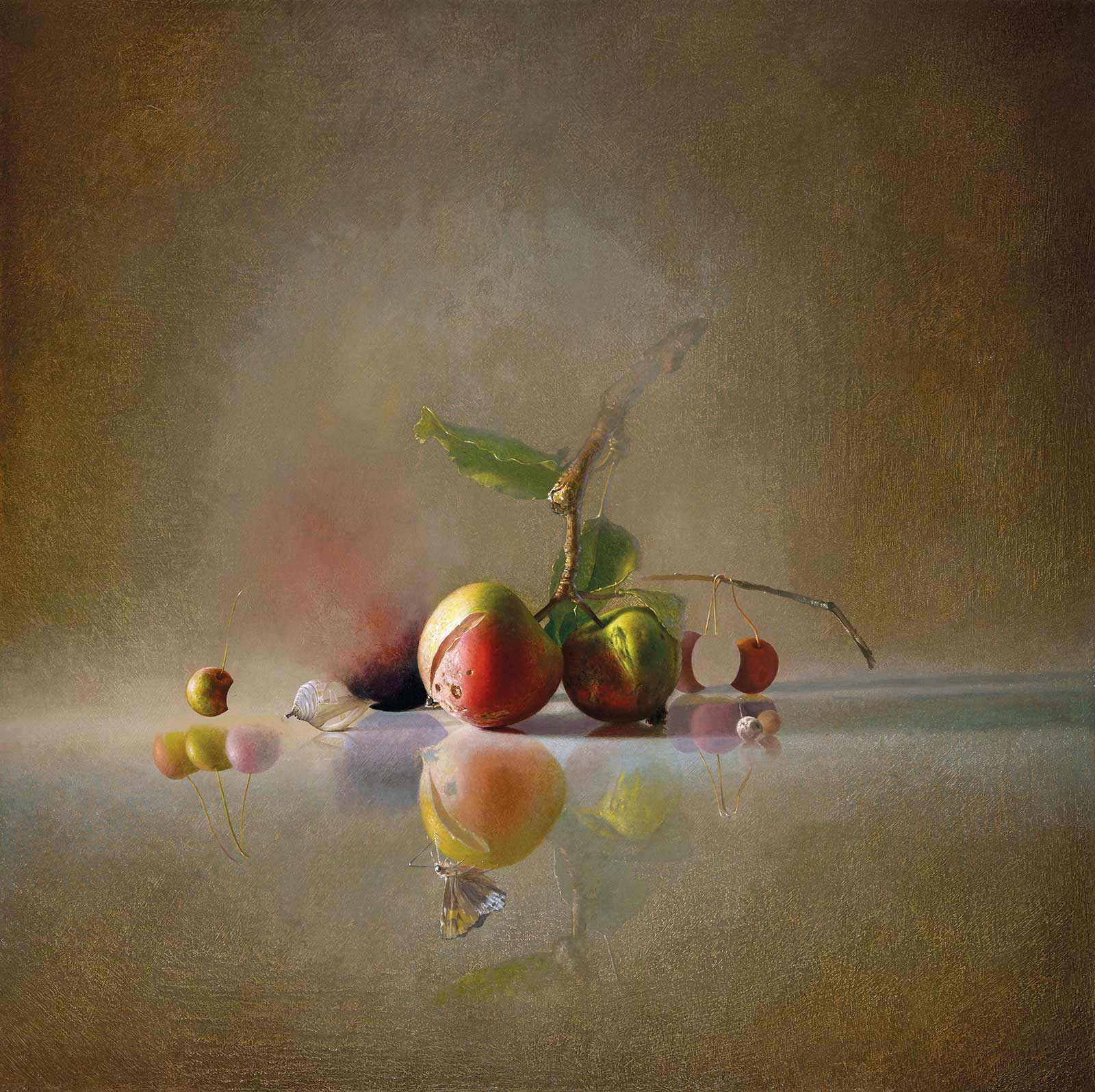 Winfield Gallery, Transitory Spaces: Fruit, Chrysalis & Moth, oil on panel, 11 7/8 x 11 7/8", by Philip R. Jackson.
Time appears again in the egg tempera paintings of Doug Safranek. The ancient technique of painting with pigment mixed in egg yolk and water is arduous. It dries immediately and has an extraordinary luminous permanence. Safranek says, “The slow meditative process of layering the delicate brushstrokes that make up the surface of a tempera painting has the effect of imparting an intimate stillness to even the most active composition.”
The intimate stillness of Safranek’s Apples and Insects reflects the ephemeral nature of the objects and the long life of their representation. The fresh, green vitality of their lives will soon fade, their brief tasks accomplished. 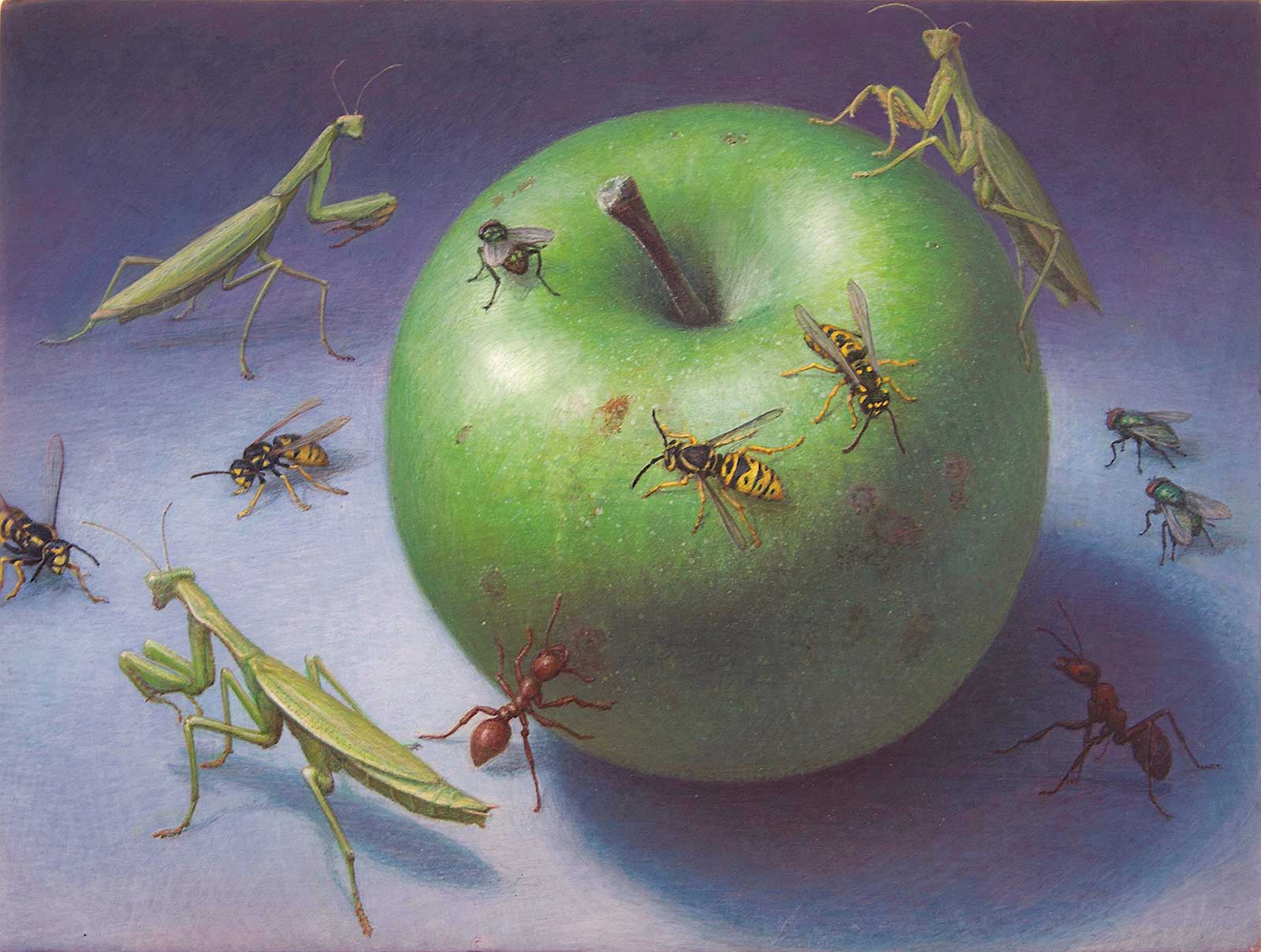 Garvey | Simon, Apples and Insects, egg tempera on panel, 6 x 8", by Doug Safranek.
Safranek also uses tempera for intimate scenes of life in the big city, New York, as well as insightful portraits that, along with his still lifes, are evocations of the beauty of the ordinary.
This special section devoted to small works and miniatures includes artwork in a range of subjects and styles, showing that artists can capture anything in a scaled down size.
Artist Joni Jurek says, “Every place and every moment holds its own story. Painting small and from life allows me to capture the spirit of a subject, inviting the viewer to pause and realize the widespread natural beauty among us from vast vista scenes to the delicate fleeting life of a flower.” Among her newest works are the florals Happy Mother’s Day, which is a mixed bouquet, and Summer Hydrangeas, capturing the blooming white flowers.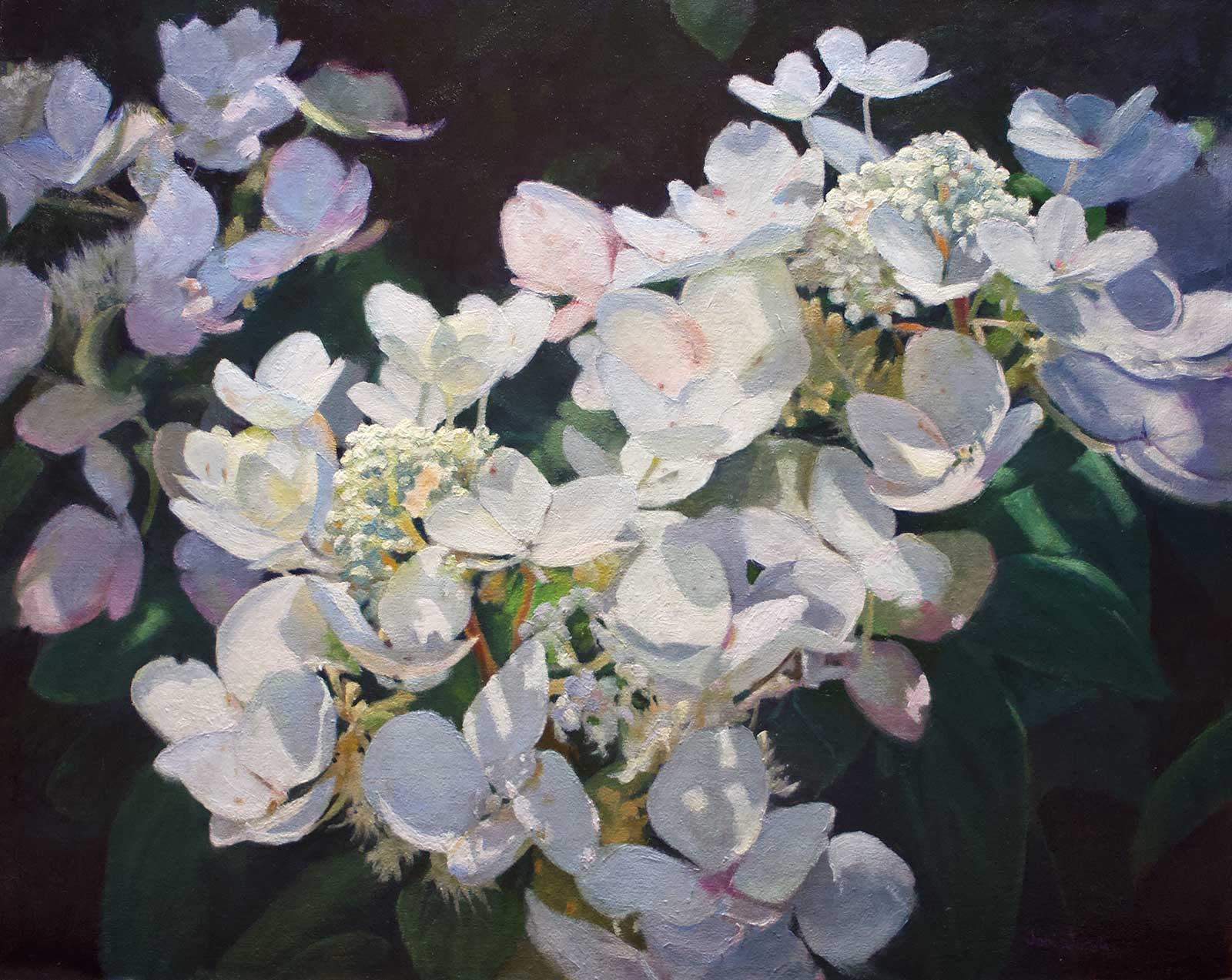 Joni Jurek, Summer Hydrangeas, oil, 16 x 20"
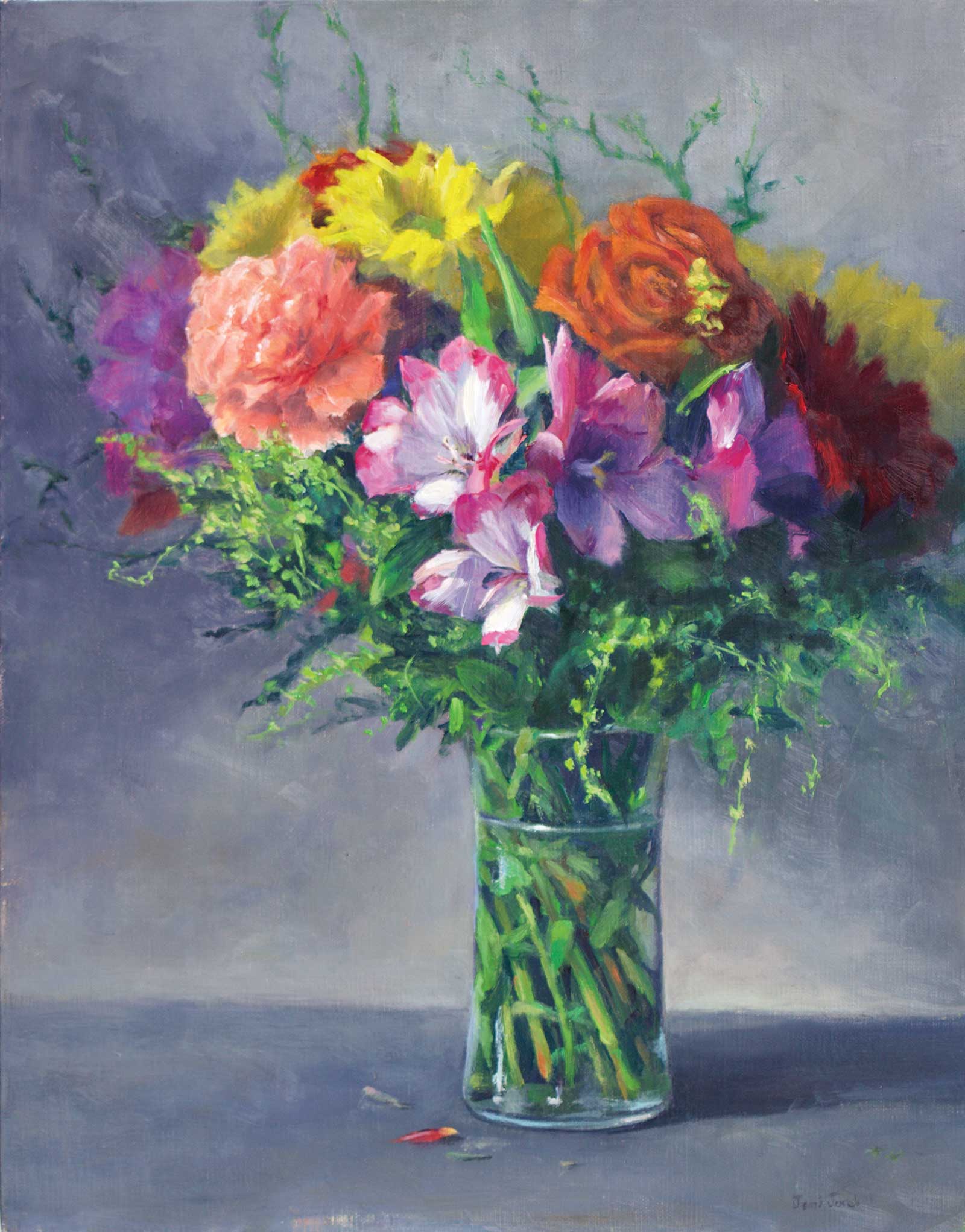 Joni Jurek, Happy Mother’s Day, oil, 14 x 11"
Chantel Lynn Barber is on a journey to capture the vision in her mind’s eye—“the one blood we as humans share,” she says. Barber does it all in acrylic through strong color, energetic brushwork, light and story. Her loose style draws the viewer’s attention, visually beckoning them to wonder at the essence of life. Artist Nicolas Martin says of her work, “She is painting with her own identity and has found a beautiful way to express herself with her own freedom.”
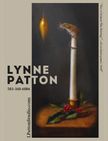
Lynne Patton says, “I am inspired by nature always and often the small and overlooked parts of nature.” Her series of mouse paintings is an example of this idea, with her adding, “We often don’t even know they are there.” For the holiday season, Patton has painted the mouse hiding around holiday decorations, such as Well Maybe a Mouse, where a mouse is dangling on an ornament.
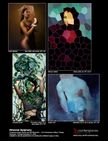
Peace and tranquility is a goal of the monotypes of Portland, Oregon, artist Annie Meyer. Her vibrant minimalist landscape and figurative works transport one to a calmer place. Luminous colors and sparse lines capture the essence of a figure or a landscape with simple but brilliant power—matching the composition’s intriguing essence of an abstract sense of time and place. Her inspirations are the landscapes of France where she has traveled the last 25 years, her Midwest roots and her Oregon home. This past spring she created a body of work based on the reflection and sky in the water at Sauvie Island, about 10 miles from her home. The works were featured in an exhibition at Laura Vincent Design & Gallery in Portland.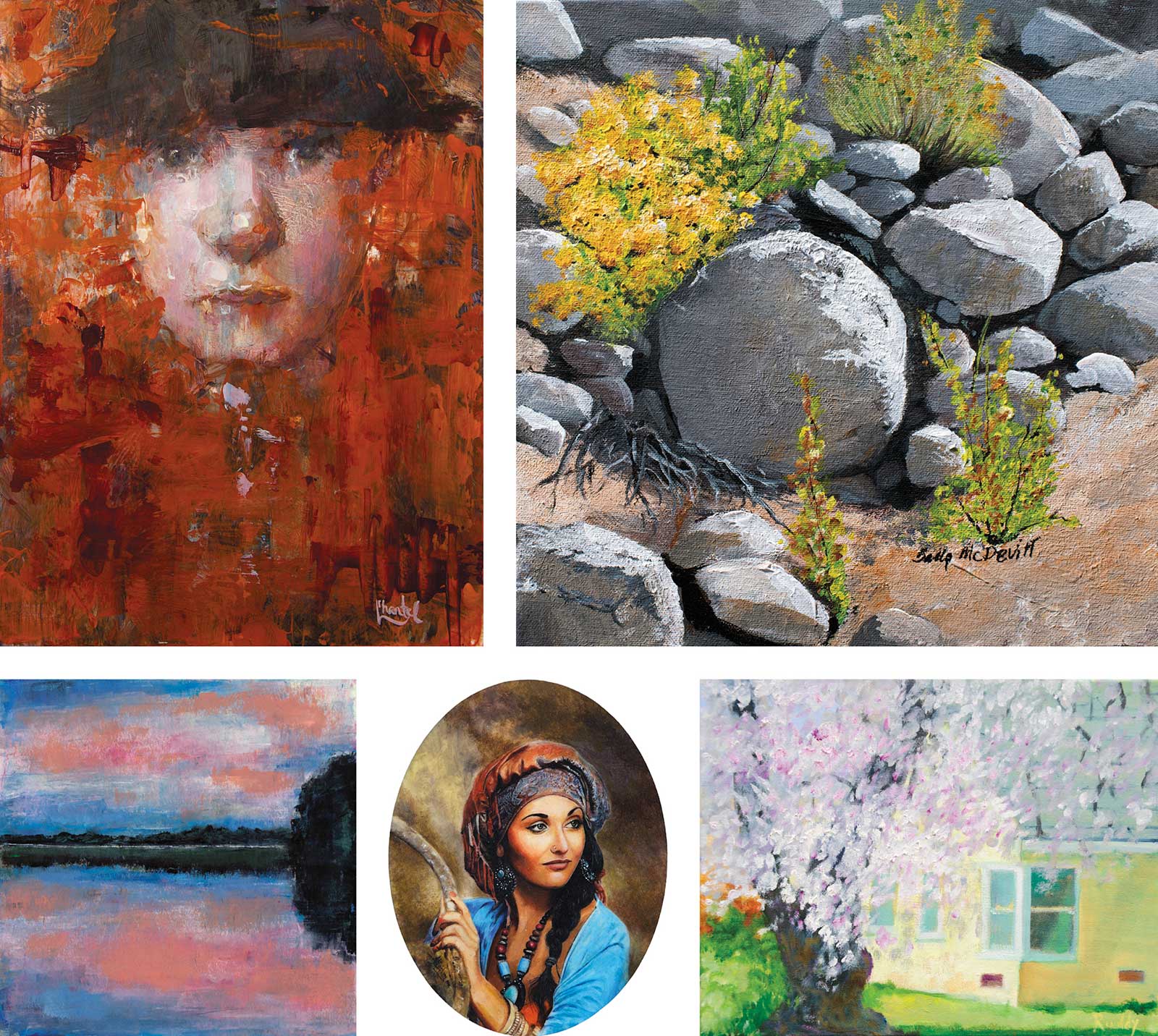 Clockwise from top left: Chantel Lynn Barber, Dare to be Bold, acrylic on panel, 8 x 6"; Sally McDevitt, Spring in Pino Arroyo, acrylic on canvas, 12 x 12"; Sally Ruddy, Ancient Almond, oil on canvas, 11 x 14"; The Miniature Painters, Sculptors & Gravers Society of Washington, D.C., Woman from the Desert, oil on vellum, 3½ x 2½", by Ihtesham Hassan; Annie Meyer, Sauvie Island #1, oil monotype on paper, 10 x 10"
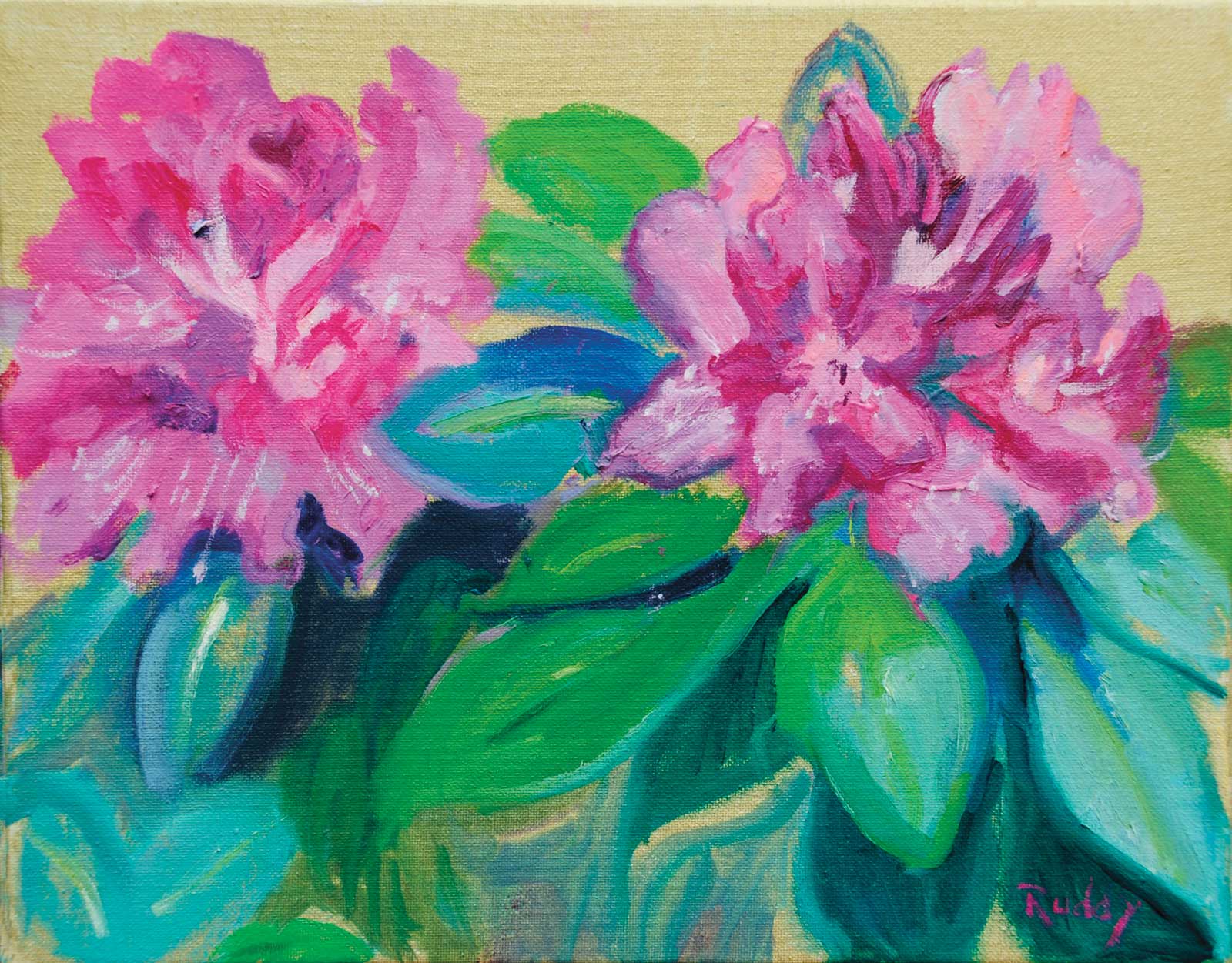 Sally Ruddy, Rhododendron, oil on canvas, 11 x 14"
California-based oil painter Sally Ruddy responds to her painting subjects in a sensual way rather than literal, feeling her way through a painting. Soft brushstrokes and an airy, effortless blending of colors contribute to an environment focused on emotional response and personal narrative. Omitting fine details in the scenery, Ruddy creates otherworldly settings that transport her viewers into her intimate memories of family and self. Ruddy’s suggestion for a buyer is to “find what you love, that small gem that speaks to you.”
Sally McDevitt paints New Mexico landscapes on both grand and small scales. She captures the atmosphere of the place through the color and her brushstrokes. “Often, several of my smaller paintings will work better for a space, especially in a powder room or bathroom,” she says. “[It is] nice to get lost in a landscape instead of looking at a blank wall. It enlarges the room. I have one in my laundry room, and it makes me smile as it fits so well in there.”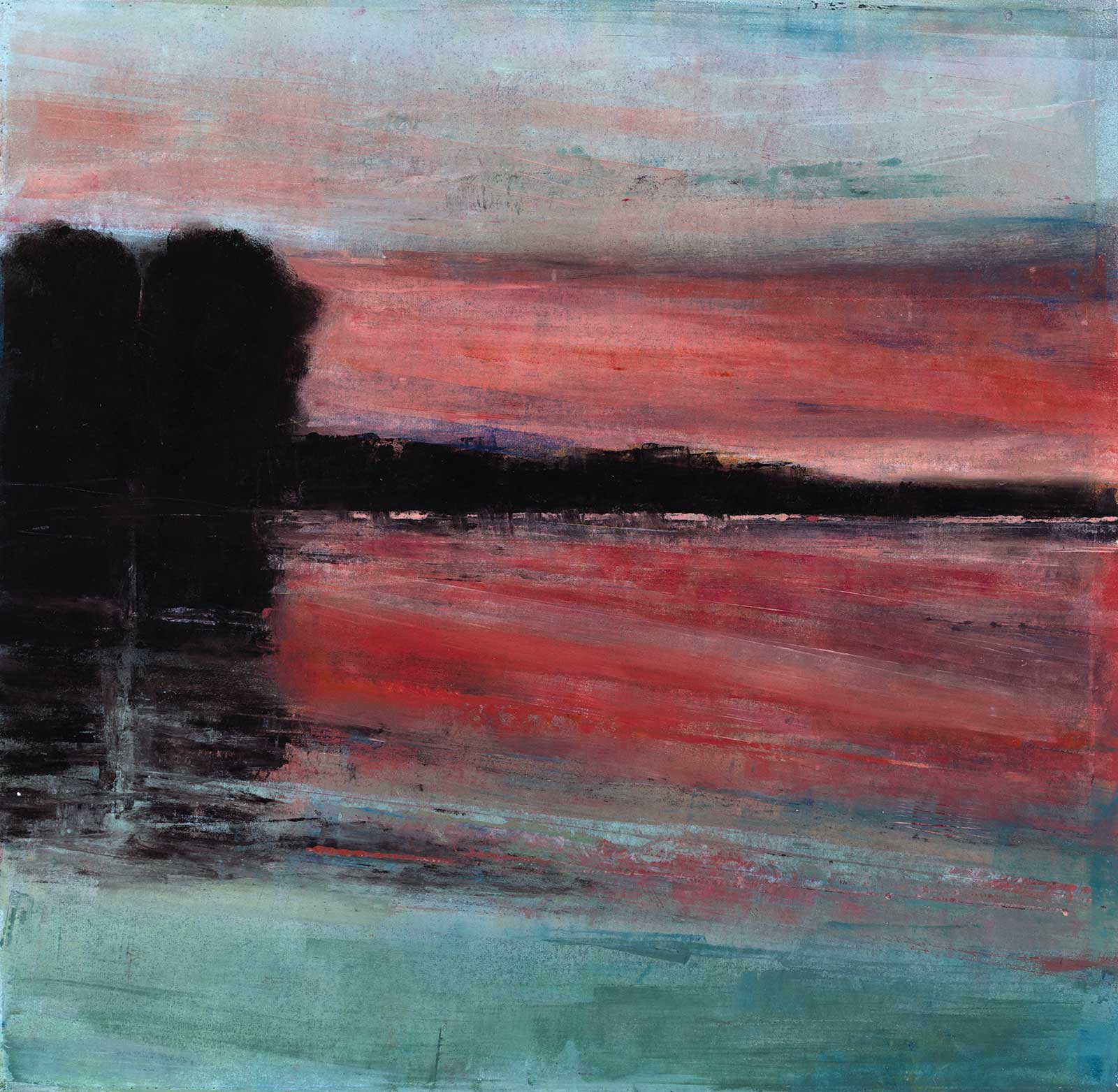 Annie Meyer, Sauvie Island #2, oil monotype on paper, 10 x 10"
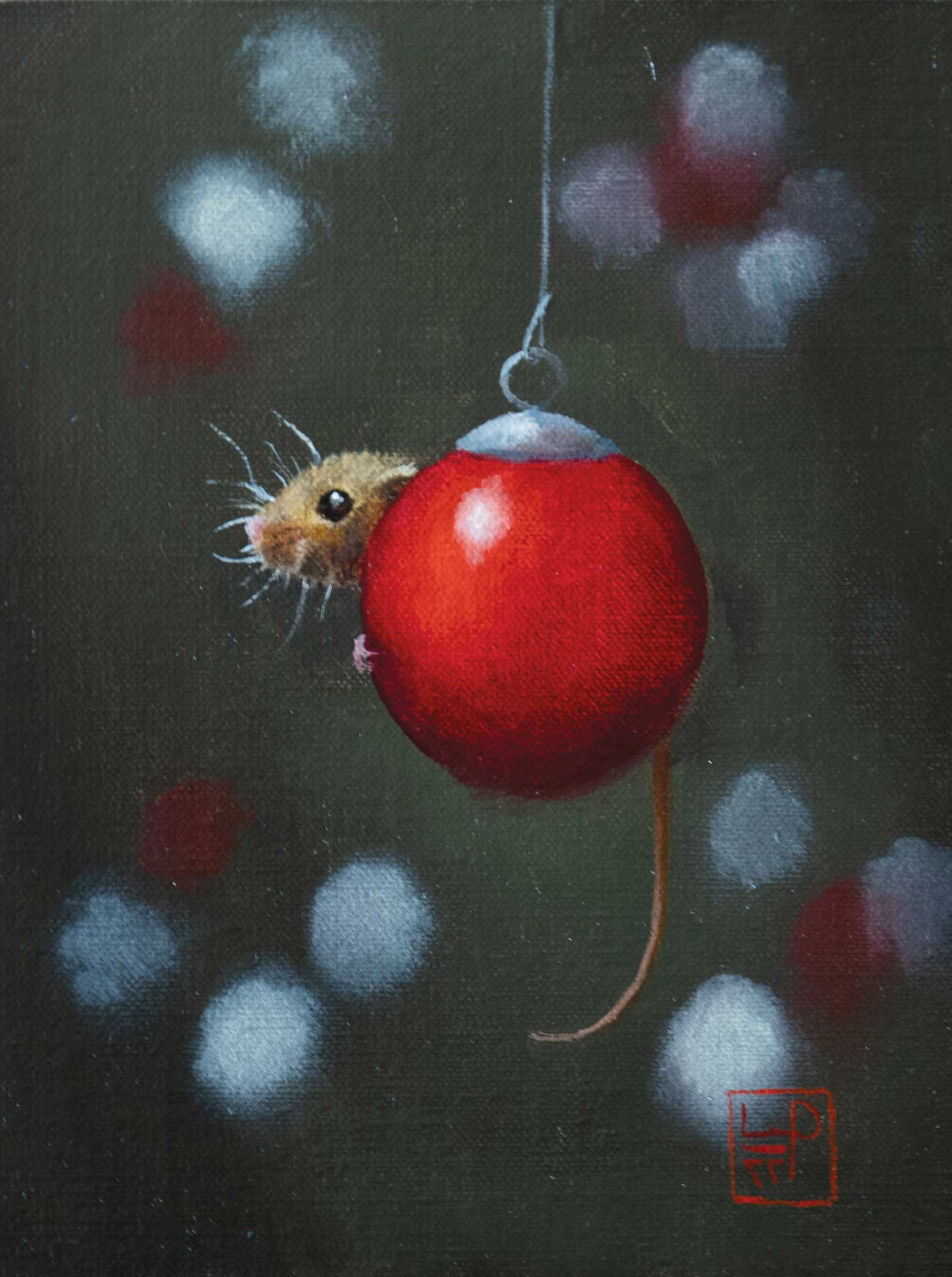 Lynne Patton, Well Maybe a Mouse, oil on linen panel, 8 x 6"
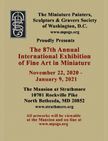
The Miniature Painters, Sculptors & Gravers Society of Washington, D.C., is considered the oldest miniature art society in the United States. Its objective from its inception has been to encourage and stimulate interest among artists and the public in the beautiful forms of miniature art. Its 87th annual International Exhibition of Fine Art in Miniature will take place November 22 to January 9 at The Mansion at Strathmore in North Bethesda, Maryland. The 2020 show, of which Ihtesham Hassan’s painting Woman of the Desert received Best of Show, includes 723 works of art all under 25 square inches. The artwork will be on view at the mansion as well as through the society’s website. —
Featured Artists & Galleries
Annie Meyer
Annie Meyer Gallery
(503) 957-6800
anniemeyerartwork@gmail.com
www.anniemeyergallery.com
Chantel Lynn Barber
www.chantellynnbarber.com
Garvey | Simon
(917) 796-2146
www.garveysimon.com
Joni Jurek
joni@jonijurek.com
www.jonijurek.com
LewAllen Galleries
1613 Paseo de Peralta
Santa Fe, NM 87501
(505) 988-3250
www.lewallengalleries.com
Lynne Patton
(503) 360-6084
www.lpattonstudio.com
Sally McDevitt
(505) 205-0093
mcdevittsally@gmail.com
www.sallymcdevitt.com
Sally Ruddy
info@sallyruddy.com
www.sallyruddy.com
The Miniature Painters, Sculptors & Gravers Society of Washington, D.C.
Nancy Still, nancy@miniartsupply.biz
www.mpsgs.org
Winfield Gallery
Dolores between Ocean & 7th
Carmel-by-the-Sea, CA 93923
(831) 624-3369
www.winfieldgallery.com
Powered by Froala Editor