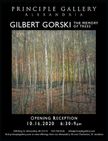
Among Gilbert Gorski’s accomplishments as an architect is the Oceanarium at the John Shedd Aquarium in Chicago. Today, he devotes himself to painting and to walking and biking through a nearby forest preserve in western Pennsylvania. In both careers, he has worked to create an emotional response in the viewer.
“As an architect,” he says, “I was interested in the nature of man-made space. Woods and forests serve as a vehicle for exploring the patterns and infinite labyrinth of nature-made space. In the forest there is no perspective and no straight lines.”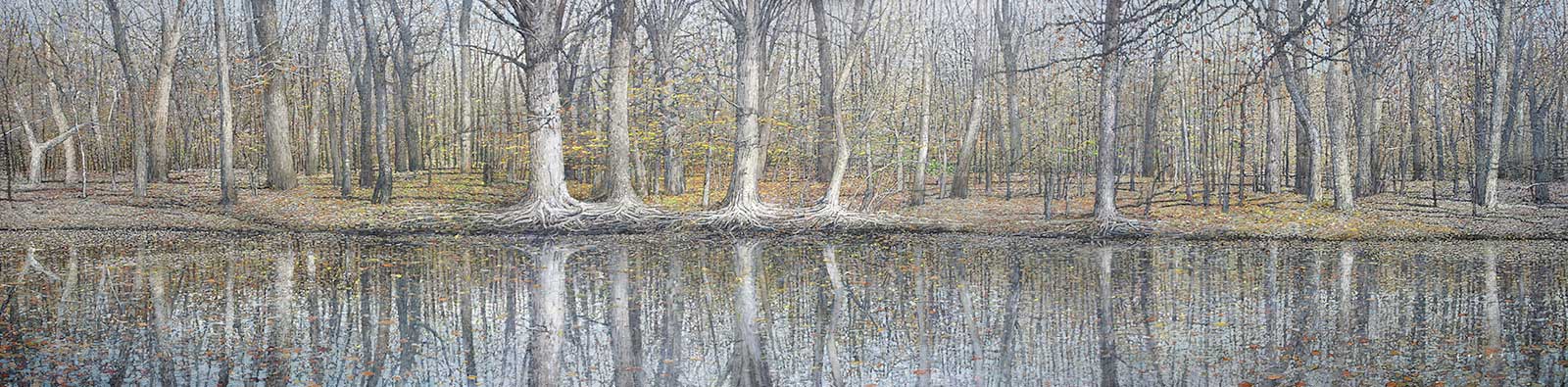 Eurythmiora, oil on linen, 18 x 72"
Frequenting the forest, he can be present for a phenomenal moment of light or color and can anticipate what will be the best moments. He remarks, “I am interested in the poetry of common things; painting allows me to express the extraordinary I see in the ordinary.”
The flatness of the picture plane in Japanese prints has influenced architects like Otto Wagner and Frank Lloyd Wright as well as one of Gorski’s favorite painters, the late Russell Chatham. Chatham wrote of his own softly atmospheric landscapes, “Not everything in life can or should be explained. Part of every painting should be incomplete...to be completed in the mind of the viewer.”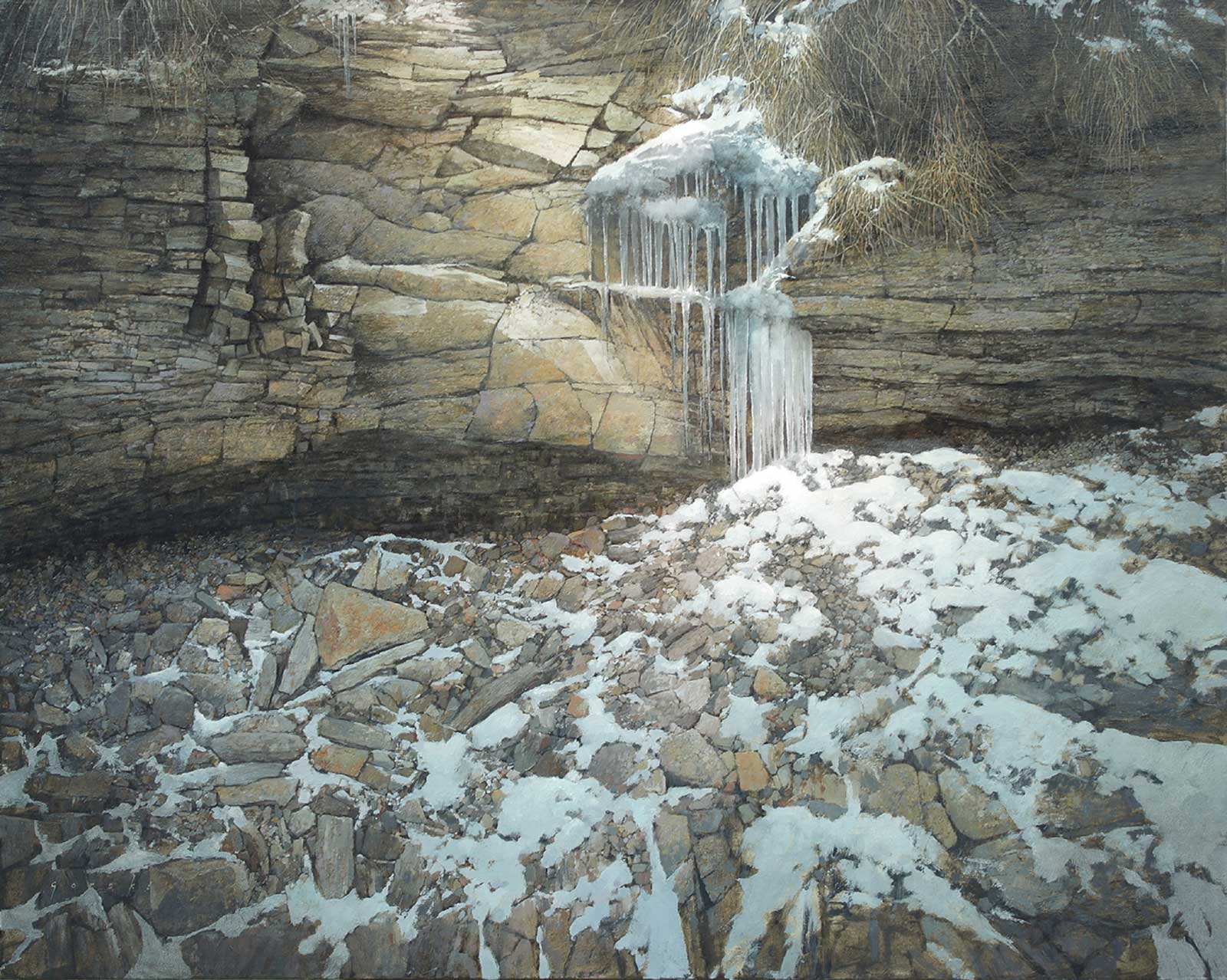 Rockfall, oil on linen, 32 x 40"
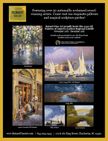
The viewer of Gorski’s recent paintings being shown at Principle Gallery in Alexandria, Virginia, from October 16 to November 10, will have a unique experience. He says, “I don’t paint sunsets and snowcapped mountains.” In fact, he doesn’t paint “views.” He sees his paintings as two-dimensional objects built up with brushes fully loaded with paint. In paintings such as Eurythmiora, which is an enveloping 6 feet wide, the glistening varnished surface and thick paint emulate the flickering light on the leaves of the forest trees as if they were frozen in a moment from a rhythmic dance. 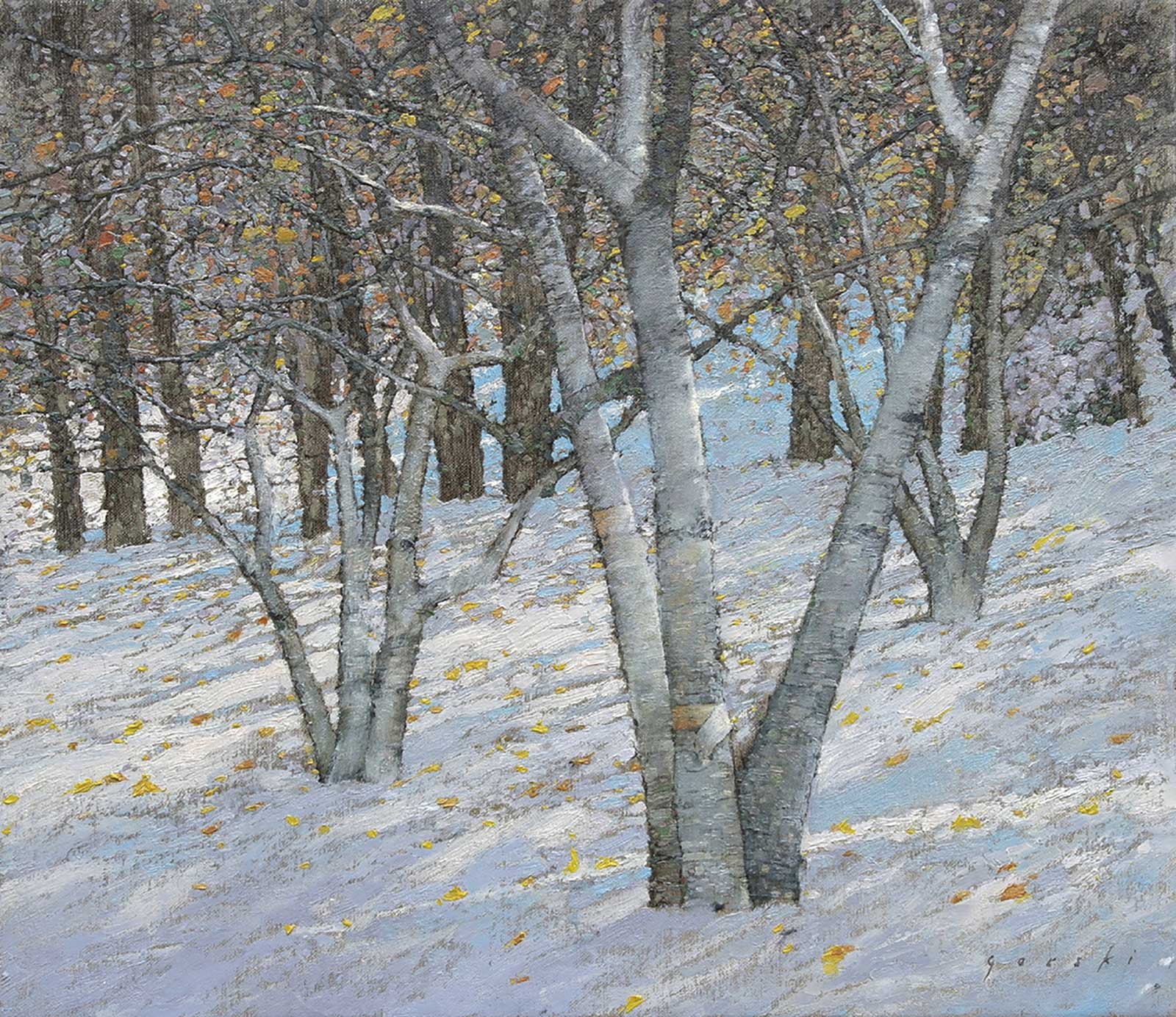 Obbiligato, oil on linen, 14 x 16"
The illusion exists simultaneously with the awareness of it being a handmade object constructed of paint on canvas. In addition to acknowledging the influence of the representational painters of the past, Gorski recalls the paintings of the abstract expressionists Mark Rothko and Jackson Pollock with depth implied by thicker and thinner applications of paint and the unexpected feathery brushstrokes at the edges of Rothko’s color fields. —
Principle Gallery
208 King Street • Alexandria, VA 22314
703) 739-9326 • www.principlegallery.com
Powered by Froala Editor