The English painter Bruce Sargeant (1898-1938) has been described as “a mythic figure in the modern art movement.” He is also mythical, the imagined great-uncle of Mark Beard and one of many imagined artists that allow Beard to paint in different styles without appearing to be unfocussed. Sargeant, who died tragically young in a wrestling accident, was in his virile prime during the First World War thought then, optimistically, to be the war to end all wars.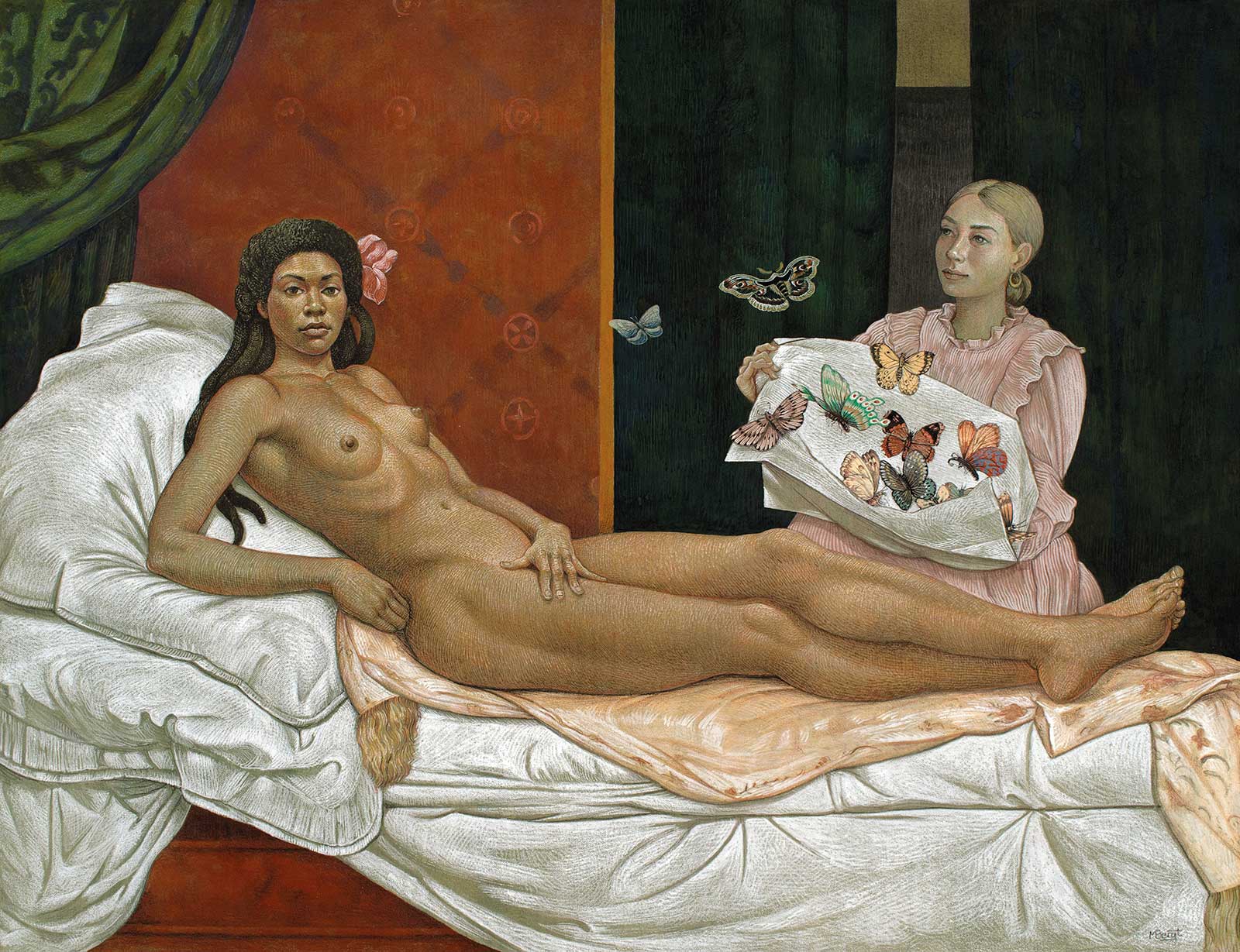 Nüart Gallery, Released, gouache, colored pencil on toned paper, 21½ x 28", by Michael Bergt
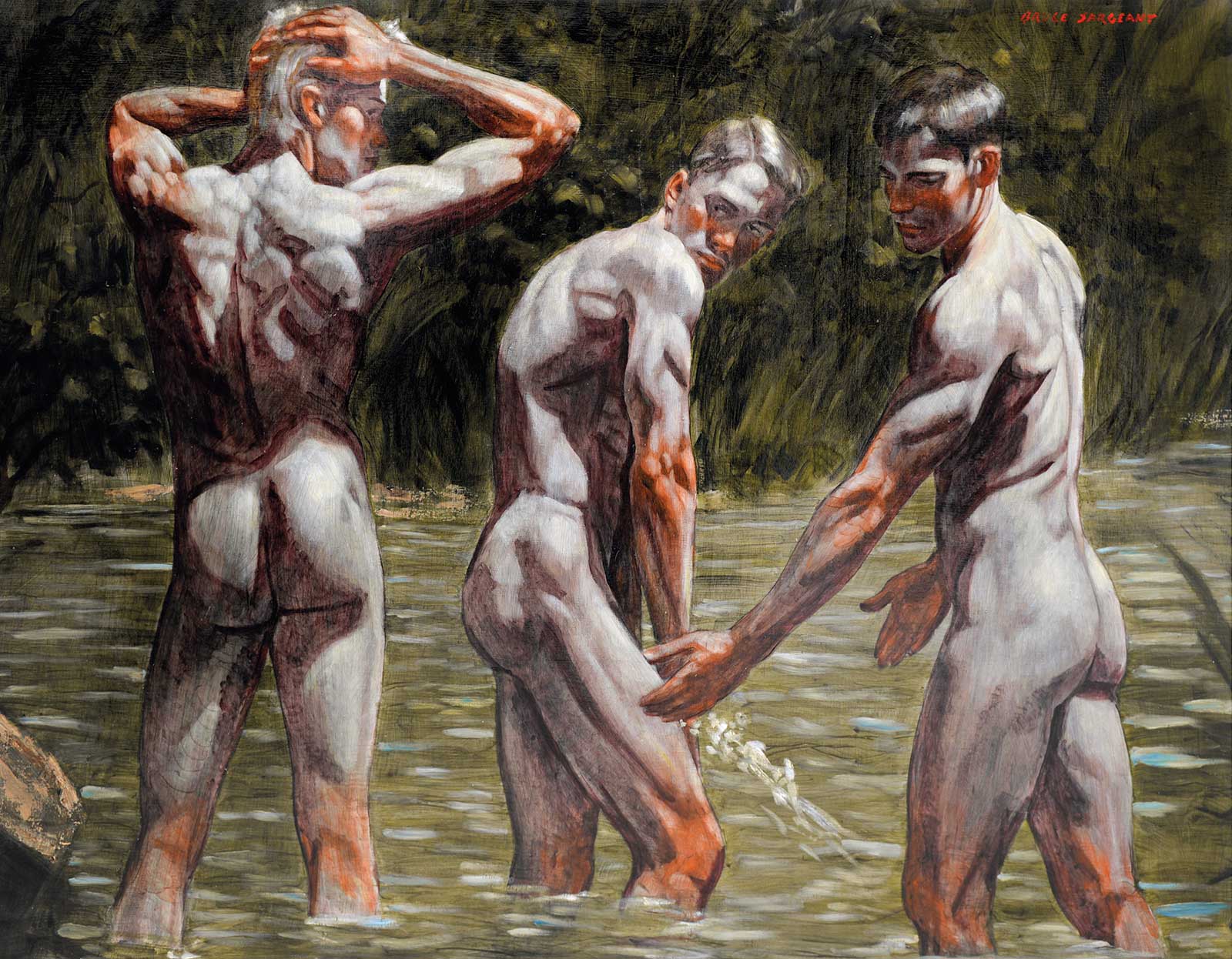 ClampArt, Bathers by the Shore, oil on canvas, 66 x 84", by Mark Beard as Bruce Sargeant (1898-1938).
Sargeant’s Bathers by the Shore recalls early photographs of WWI soldiers bathing or at leisure—impossibly handsome and improbably innocent. These figures appear to have farmers’ tans as if they had been freshly harvested from the farm before being sent off to slaughter. (The war claimed nearly 10 million military personnel and another 10 million civilians.)
Sargeant’s name is an oblique reference to John Singer Sargent (1856-1925) who produced homoerotic drawings and was rumored to be gay. Sargeant was born several years after the infamous libel trials of the Irishman Oscar Wilde in which the phrase “Love that dare not speak its name” arose. He and Wilde would be amazed that over a century later Ireland would be the first country to legalize same-sex marriage on a national level by popular vote. 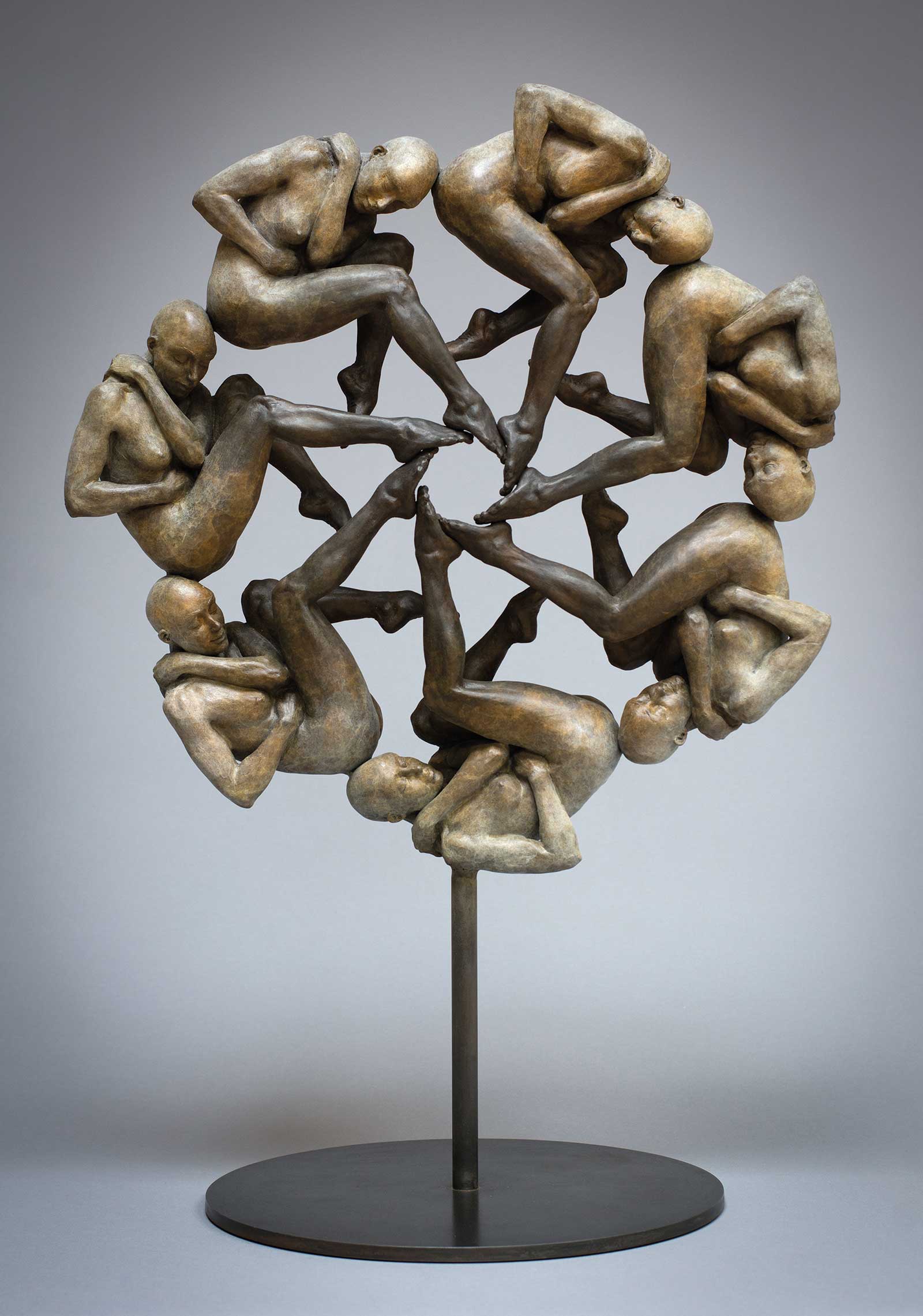 EVOKE Contemporary, Quaquaversal, bronze with steel, ed. of 10, 14 x 14 x 3" with 20" high base, by Kristine Poole.
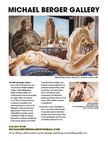
Michael Bergt approaches art history by reversing the elements in Manet’s iconic painting Olympia, 1863, a female nude reclining in her boudoir being presented with a bouquet of flowers by a black servant. It was deemed indecent at the time by the French public. Bergt comments, “Often, the only way for people to understand how their specific perspective may be skewed is to be able to occupy the ‘other’ perspective. Societies create structures of what is commonly accepted to be ‘normal.’ In Released, I wanted to reference a groundbreaking painting that represented modern female nudity, which, at the same time, reinforced an old racial stereotype. By flipping the roles, we’re compelled to see our own unconscious projections.”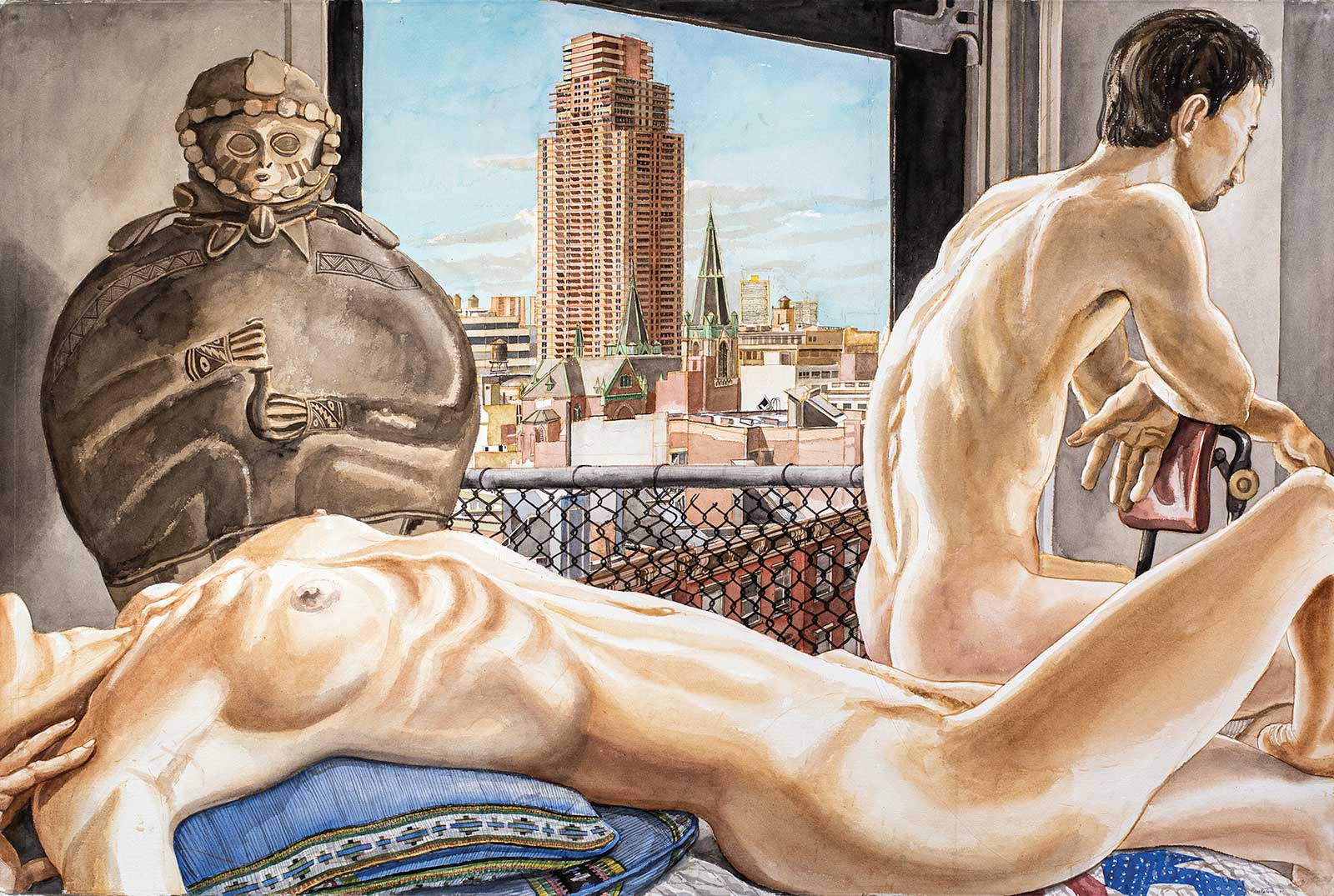 Michael Berger Gallery, Gothic, watercolor on paper, 40 x 60", by Philip Pearlstein.
He continues, “Instead of a classic reclining white female nude, we see a reclining black nude. Instead of a black servant, we see a white servant. In Manet’s painting, the black servant is presenting the nude with a large bouquet of flowers. In my painting, the white servant is releasing butterflies. The butterflies represent the metamorphosis of a dynamic, the change of a state and a new mission to pollinate these ideas to the world.”
The butterfly element complements his recent series of works, Chrysalis, symbolizing transformation and emergence.
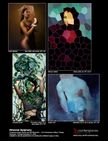
Kristine Poole recalls, “Repetition and pattern in sculpture have always been intriguing to me. I created my first curled figure for the sculpture Chrysalis. I had a number of wax casts of the original sculpture sitting on my desk and I started playing with them. I was mesmerized by the way they coalesced into these amazing geometric patterns.”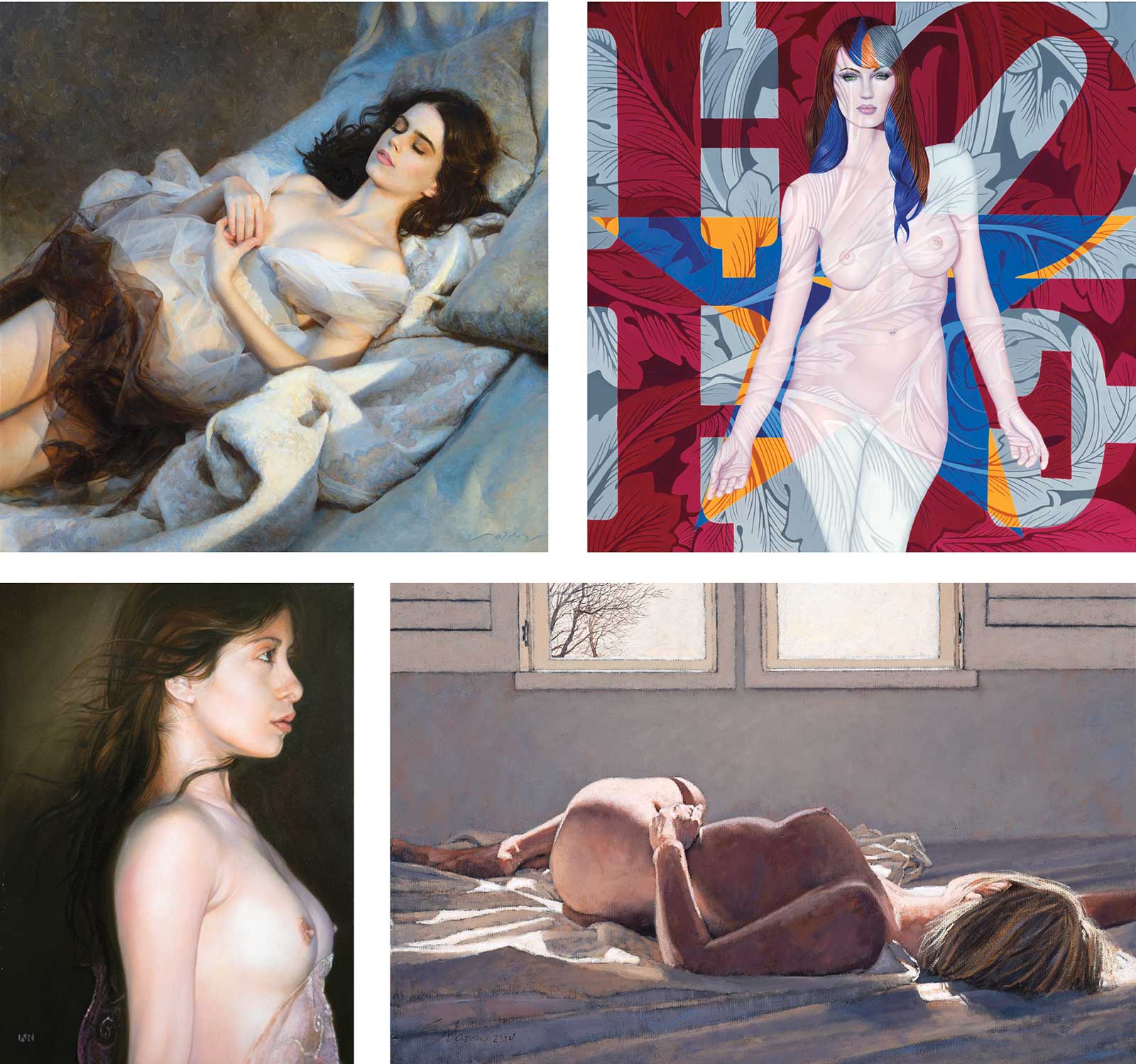 Clockwise from top left: Lotton Gallery, Repose, oil on canvas, 24 x 24", by Aydemir Saidov; 33 Contemporary Gallery, Surrender, oil on canvas, 36 x 36", by Suzy Smith; Nathan Solano, Winter Light, oil, 20 x 30"; 33 Contemporary Gallery, Anna, oil on canvas, 16 x 12", by John Rowe
Quaquaversal, with seven figures, is the first in the series. Its title means “moving outwards in all directions from a common center.” Mandala comes from the Sanskrit word for “circle,” representing wholeness. It is used as a focusing device for meditation and spiritual practice. Quaquaversal suggests the common roots of humankind, the individual figures emerging from and coming together to form a symmetrical, ordered whole.
The founder of the Bauhaus, Walter Gropius (1883-1969), wrote hopefully in an earlier period of crisis: “We are in the midst of a momentous catastrophe of world history, of a transformation of all aspects of life and of the entire inner human being. This is perhaps fortunate for the artistic person, if he is strong enough to bear the consequences, because what we need is the courage to have inner experience.”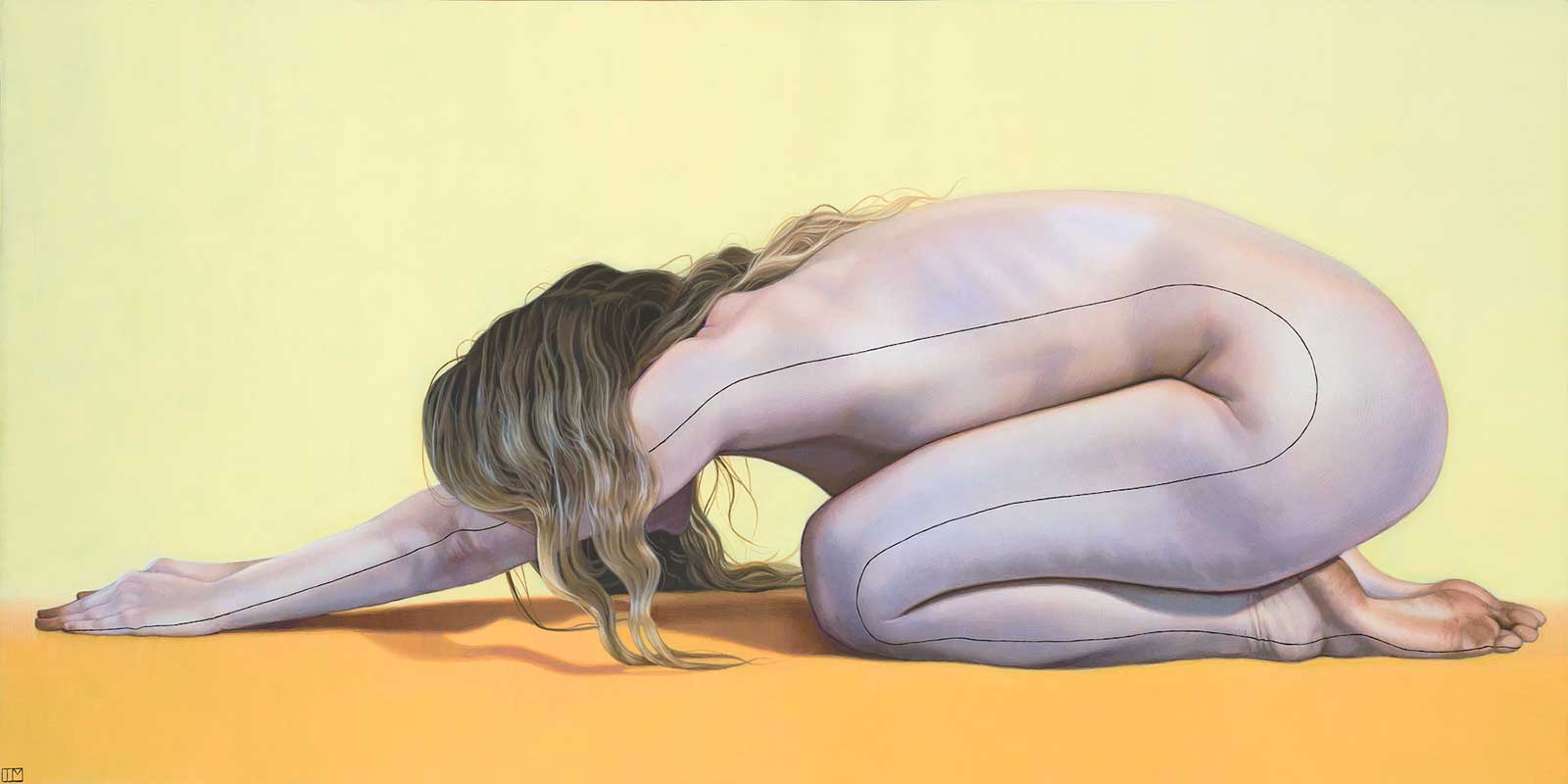 Stone Sparrow NYC, Orange Kismet, egg tempera on wood, 18 x 36", by Teagan McLarnan
The Art of the Nude includes artwork that is rooted in a classic tradition, but the artists featured expand on the techniques and ideas to create paintings and sculpture of today.
The Pittsburgh-based Michael Berger Gallery, since 1970, has hosted four one-man shows for Philip Pearlstein. A fellow native Pittsburgher, Pearlstein’s massive talents and achievements have far exceeded his origins. When he was just 15, in 1942, two of his prints won a national competition and were reproduced in color in Life Magazine. As the preeminent figure painter of the era of the 1960s to 2000s, he led the revival in realist art. Pearlstein has always stressed the masterful architecture of his human figures, and of their contextual surroundings. Their anatomy always builds from his profound understanding of the human form. He approaches each work with the same unwavering commitment to painting precisely what is in front of him, without either eroticism or idealization.
The gallery says, “To live with a work of Pearlstein’s art is to have the daily privilege of experiencing the interaction of figure and environment at the most sophisticated and the most accessible levels all at once.”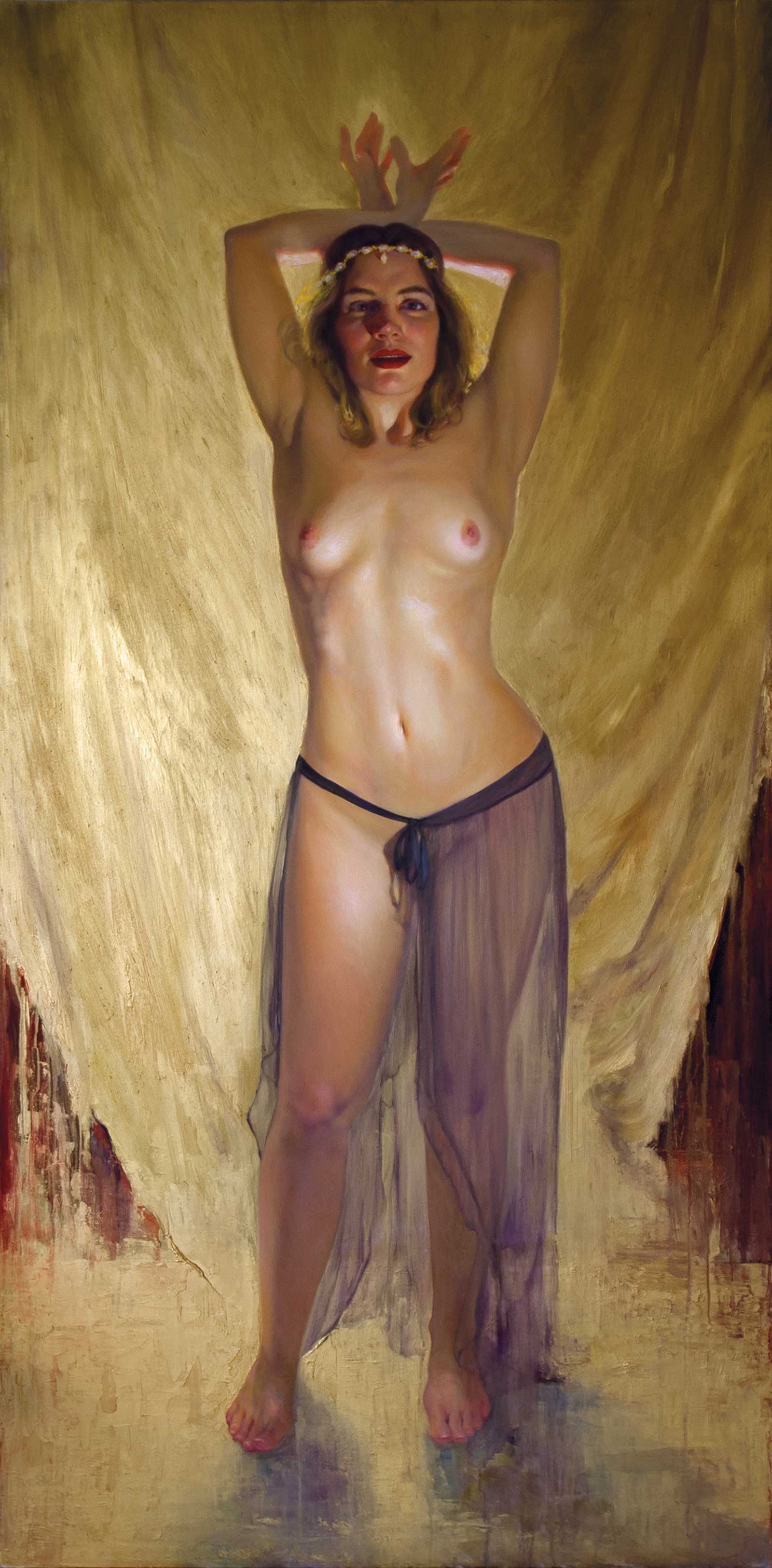 Stone Sparrow NYC, Salome, oil on linen, 80 x 46", by Luis Alvarez Roure
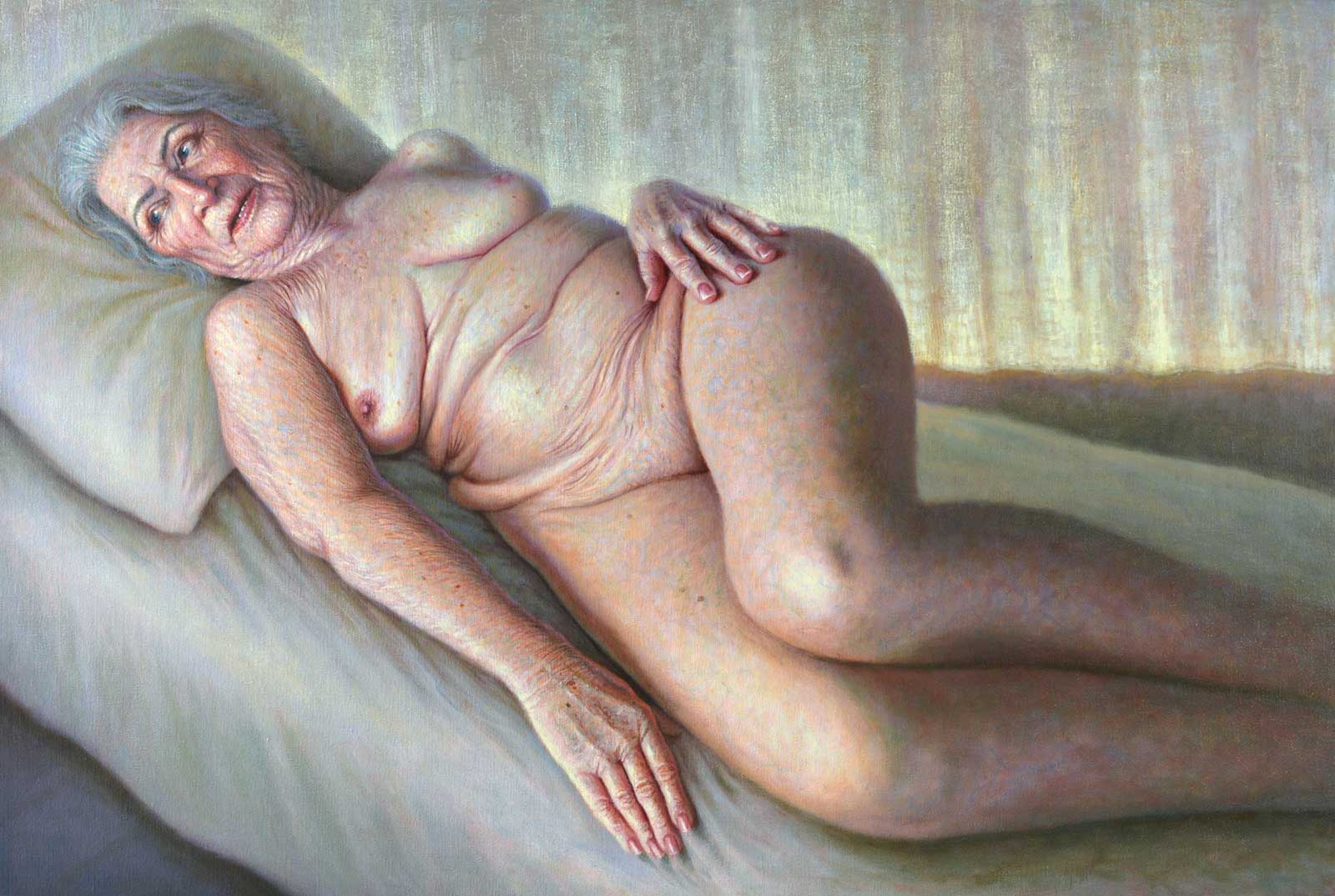 Stone Sparrow NYC, Delicate Flesh, oil on linen, 31½ x 47½", by Francien KriegStone Sparrow NYC features artwork by a number of figurative artists, including Teagan McLarnan, Francien Krieg and Luis Alvarez Roure.
McLarnan paints in egg tempera and primarily focuses on flesh in her figurative paintings. She has received a number of awards, including the Eldorado Hills Art Association Scholarship and the Chandler Scholarship in 2012. These two scholarships helped her attend Lyme Academy College of Fine Arts in Connecticut.
Krieg says, “The truth is I paint myself…and therefore the battle of my own body with age, my own fears and my fascination with death.” This came from her father’s preoccupation with death that stemmed from his mother passing away at a young age and it was a taboo topic. “This had such an impact on his thoughts that as an adult he conducted a thorough investigation on whether there is life after death,” Krieg explains. As her interest grew as an artist, she began to paint other people, “especially those who deviate from the ideal of beauty,” she says. “But even more, I really wanted to paint people like you and me, a universal image of the aging person.”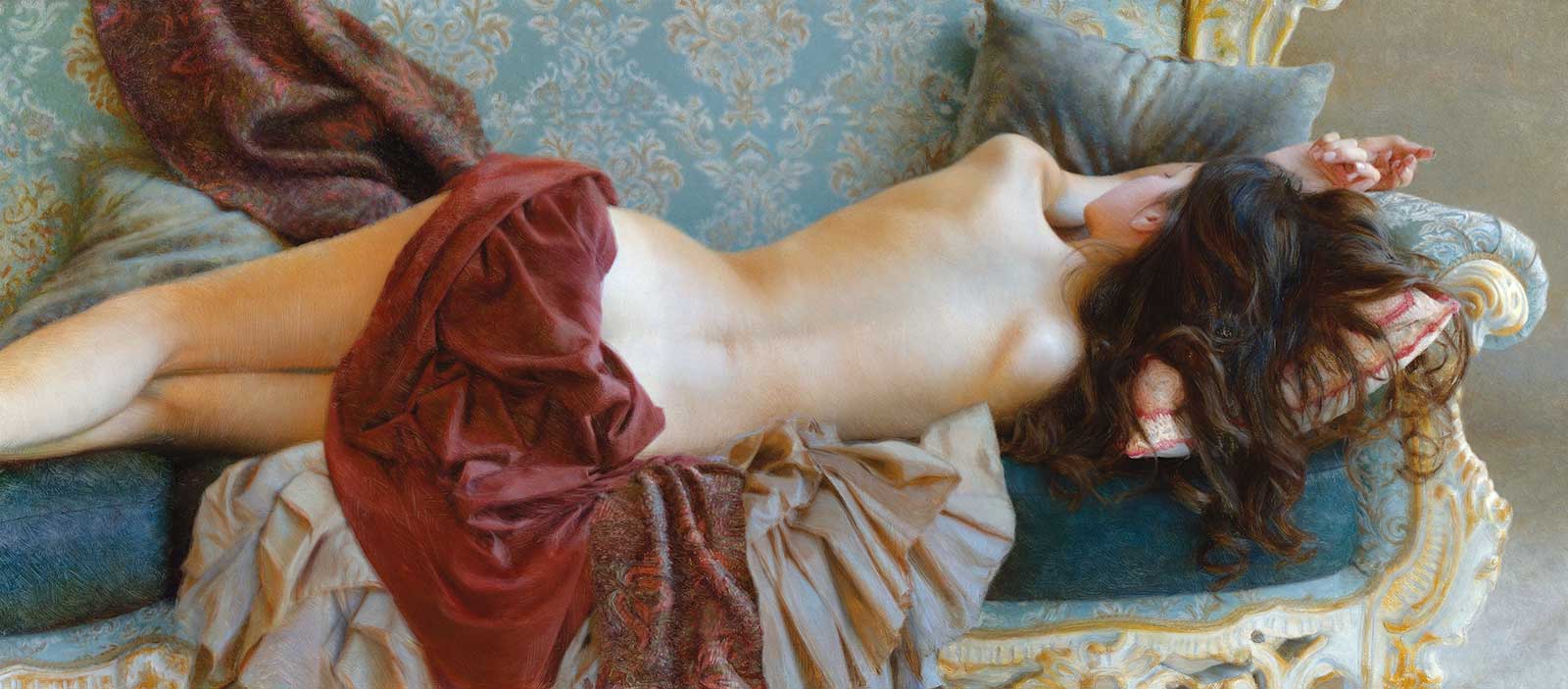 Lotton Gallery, Tranquility, oil on canvas, 16 x 36", by Marina Marina
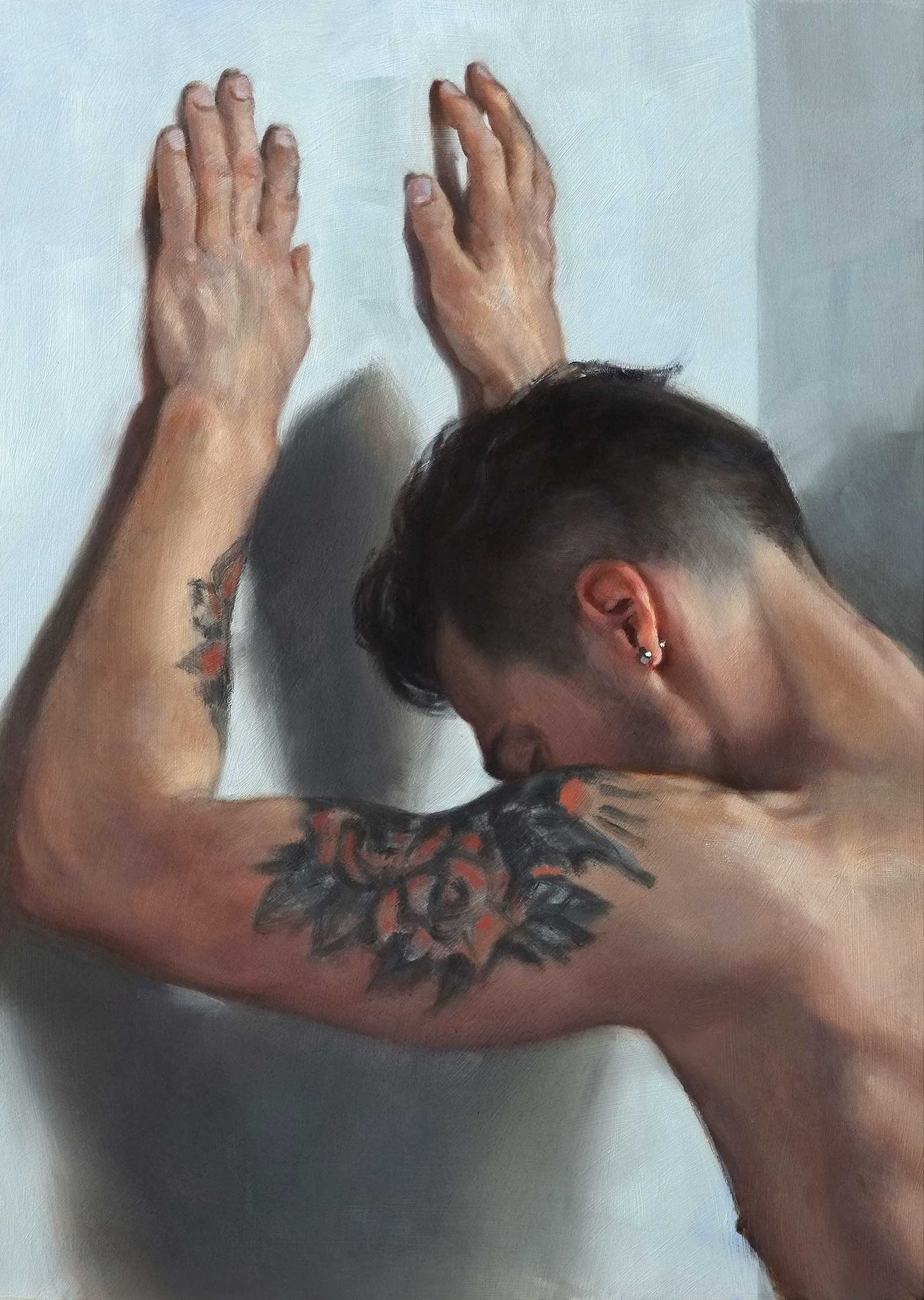 33 Contemporary Gallery, Leave In Silence, oil on aluminum panel, 13¾ x 10", by Alessandro Tomassetti.
Roure is known for his figurative and still life paintings, and his artwork has been included in American and European collections, and he has painted figures such as Philip Glass, Joshua Bell, Larisa Martinez and Paul Volcker, to name a few.
Lotton Gallery represents husband-and-wife artists Aydemir Saidov and Marina Marina, who met while studying at university in St. Petersburg, Russia. Spectacular detail and softness of touch are recognizable in both artists’ paintings. The beauty of the female form is a celebration in Marina’s painting Tranquility, specifically the model’s delicate back and neck with the tendrils of her hair draping down. Repose, by Saidov, is a captivating work of femininity; his model featured is most sought-after by collectors for her stunning beauty.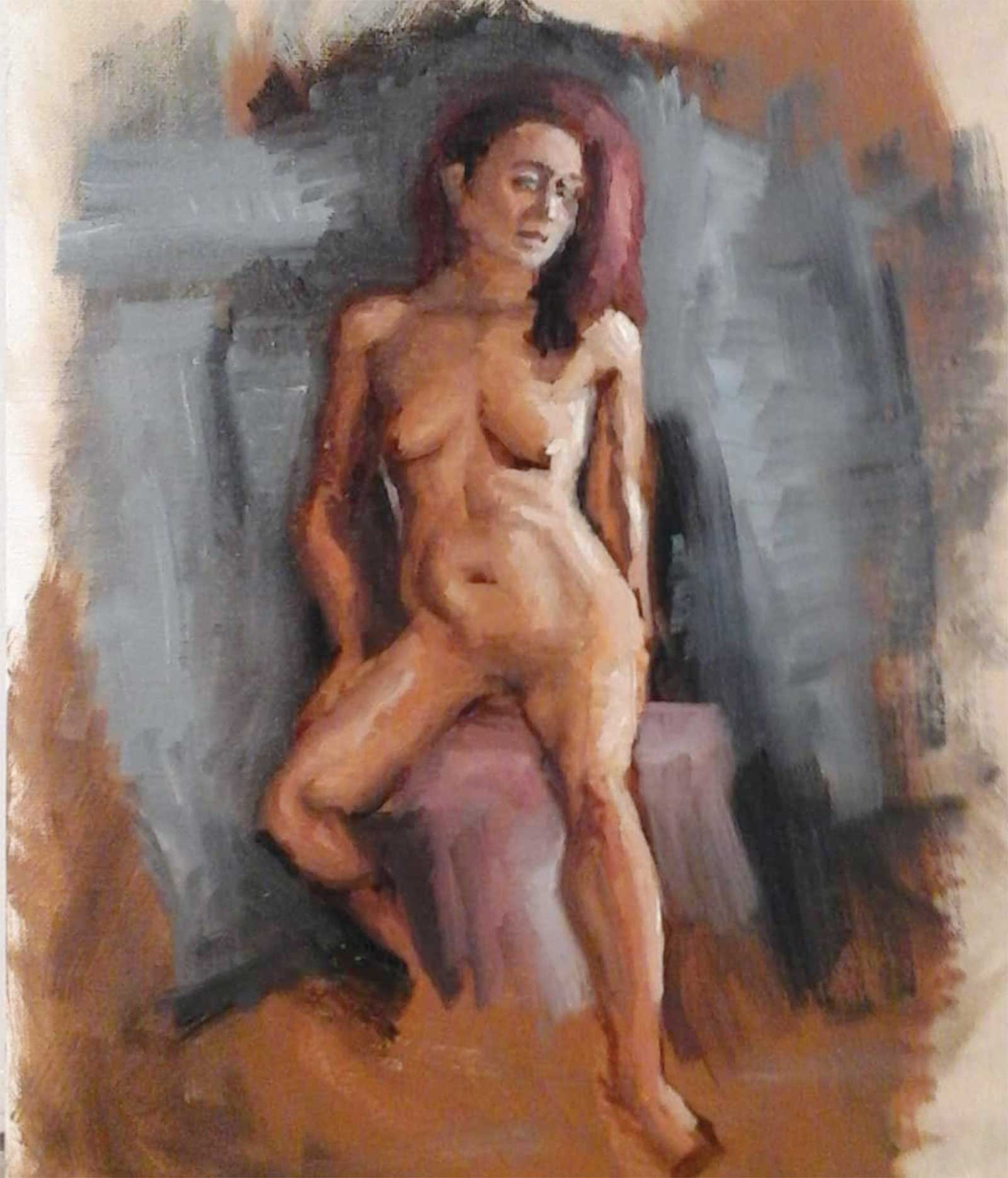 R.J. Palat, Redhead, oil, 14 x 11"
At 33 Contemporary Gallery in Chicago, collectors will find works by artists such as Alessandro Tomassetti, Suzy Smith and John Rowe.
Tomassetti’s Leave In Silence is based on his thoughts from having been mostly inside over the past seven months, where he was “oscillating between feeling safe and feeling trapped.” The artist continues, “My studio work continued and offered a daily respite from the new cycle and the changes the world was facing, but there were days that the luxury of being able to create work during a lockdown wasn’t enough. I kept coming back to the thought that I wanted to make a painting that summarized how I was feeling without being too specific and while still staying true to the aesthetic I have been building upon. Leave In Silence is the result of my pondering. It touches on the heaviness and relinquishing of control that I certainly have felt, but I think it can also be seen as capturing a moment of resolve, of gathering one’s self and one’s strength.”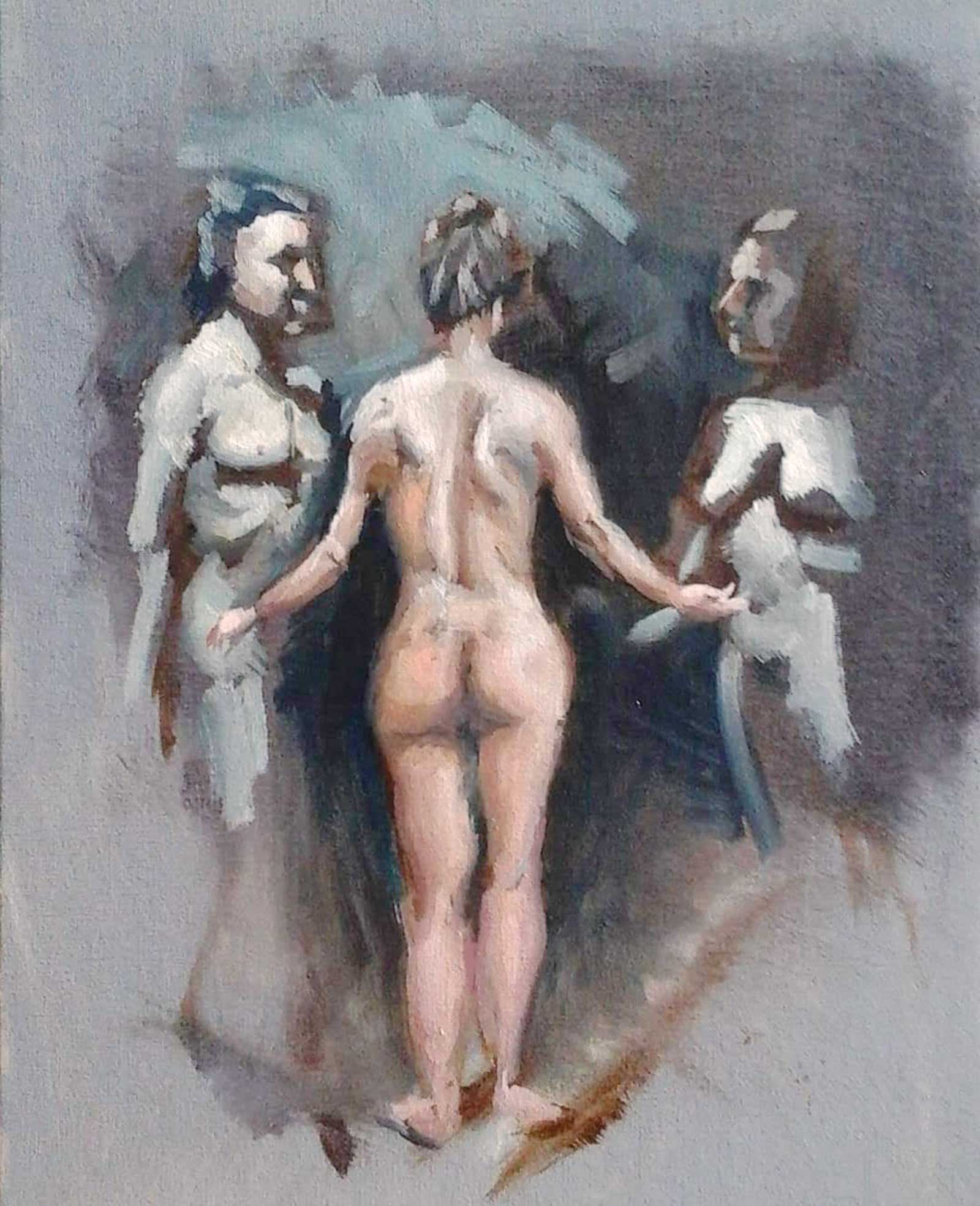 R.J. Palat, Trio, oil, 14 x 11"
For Surrender, Smith “was interested in combining color with black and white, as a design tool, making the word ‘HOPE’ and the blue and gold star the standout features. My model is holding her hands in a ‘surrender’ pose you often see in paintings of Mary and the saints. This is significant to me, as I have learned that in life, sometimes the only choice is to surrender to a higher power. I wanted to add an organic element, so I added leaves, which also act to obscure the nudity.”
Rowe’s painting Anna is from when he first started figurative artwork. “I wanted to study the human form and especially the myriad of amazing colors in skin,” he explains. “There are subtle areas and color notes of blue and pink and green and purple in her skin; I am captivated by them. Each person’s skin tones and notes are different from the next person.”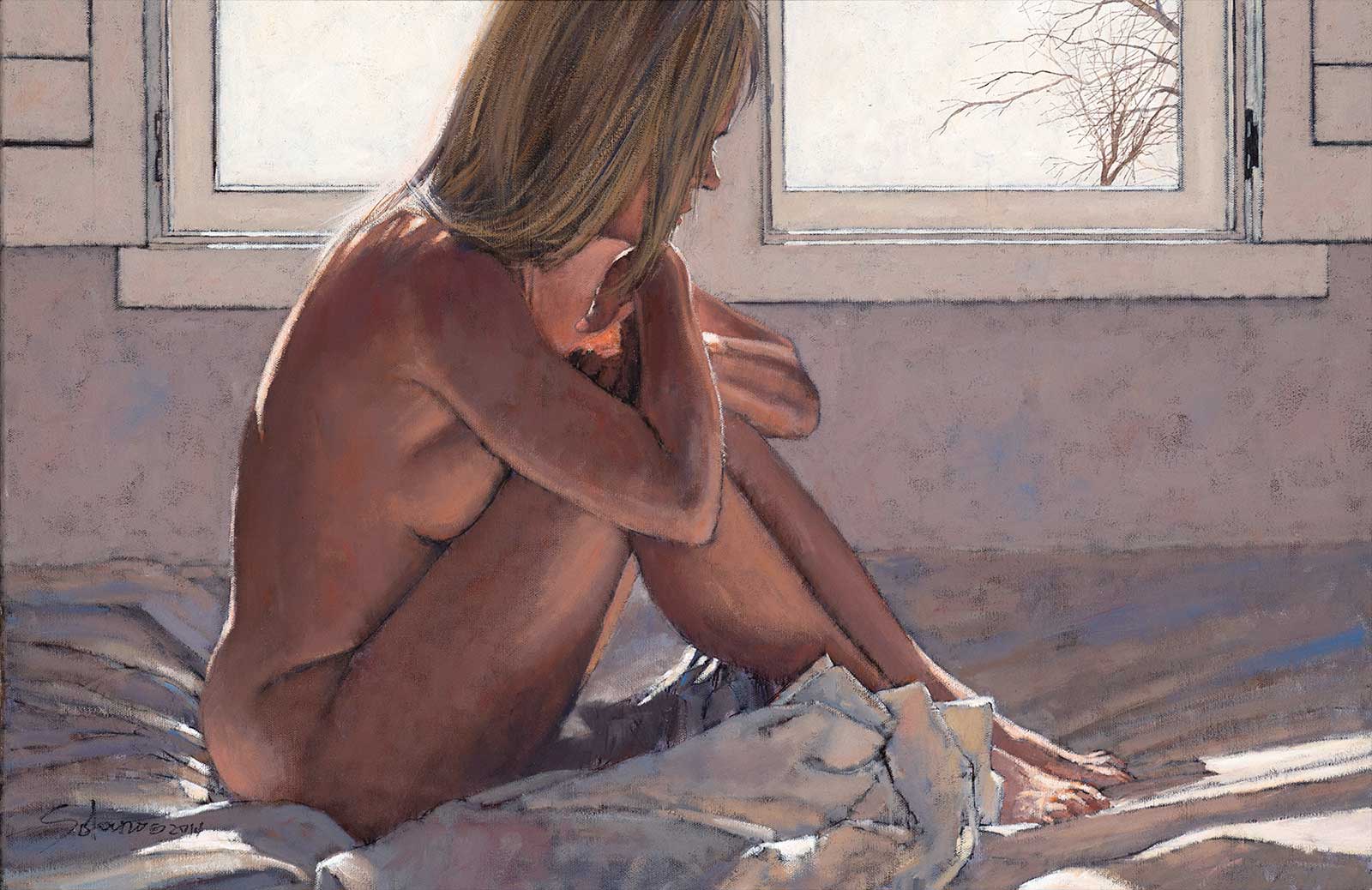 Nathan Solano, That Was A Mistake, oil, 20 x 30"
Nathan Solano’s relationship with art began at an early age, but he didn’t become a professional artist until he was in his 40s. He was born in Utah and raised in Colorado, and then enlisted in the U.S. Army where he served as an infantry sergeant in the Vietnam War. After he was discharged, Solano returned to school before entering the workforce, with his artistic career beginning as an illustrator for an advertising agency. He is known for his depictions of cowboys and Native Americans, but his portfolio includes contemporary figurative works, landscapes and more.
“We are all drawn to a good story,” says artist R.J. Palat. “That is why being able to paint figures is so important, to have something, or someone rather, to relate to. The same also goes for buying art. The skill set helps go a long way, but it is the connection made—the story being told—that brings the collector to the work. It’s all about what you’re trying to say, and how you’re saying it.” —
Featured Artists & Galleries
33 Contemporary Gallery
Zhou B Art Center, 4th Floor
1029 W. 35th Street, Chicago, IL 60609
www.artsy.net/33-contemporary
ClampArt
247 W. 29th Street, New York, NY 10001
(646) 230-0020, www.clampart.com
EVOKE Contemporary
550 S. Guadalupe Street
Santa Fe, NM 87501
(505) 995-9902
www.evokecontemporary.com
Lotton Gallery
900 N. Michigan Avenue, Level 6
Chicago, IL 60611
(312) 664-6203
www.lottongallery.com
Michael Berger Gallery
(412) 431-5140
michaelbergergallerist@gmail.com
Nathan Solano
(719) 671-3632, www.nathansolano.com
Nüart Gallery
670 Canyon Road. Santa Fe, NM 87501
(505) 988-3888, www.nuartgallery.com
R.J. Palat
(213) 655-7374
www.instagram.com/rjpalat
Stone Sparrow NYC
45 Greenwich Avenue
New York, NY 10014
(646) 449-8004
www.stonesparrownyc.com
Powered by Froala Editor