Long Island stretches 118 miles from New York Harbor to Montauk Point. It is home to mansions, quaint villages and safe harbors and boasts a long history as an artists’ mecca. William Merritt Chase opened his Shinnecock Hills Summer School of Art in 1891. Childe Hassam purchased a summer house in East Hampton in 1919. Thirty years later Fairfield Porter established a home and studio on the East End. Jane Freilicher began summering in Water Mill in 1957 and built a home there several years later. Even abstract expressionists were attracted to the rural quiet and the non-city light. Jackson Pollock settled in the East End in 1945 and Willem de Kooning had his first studio in East Hampton in 1961.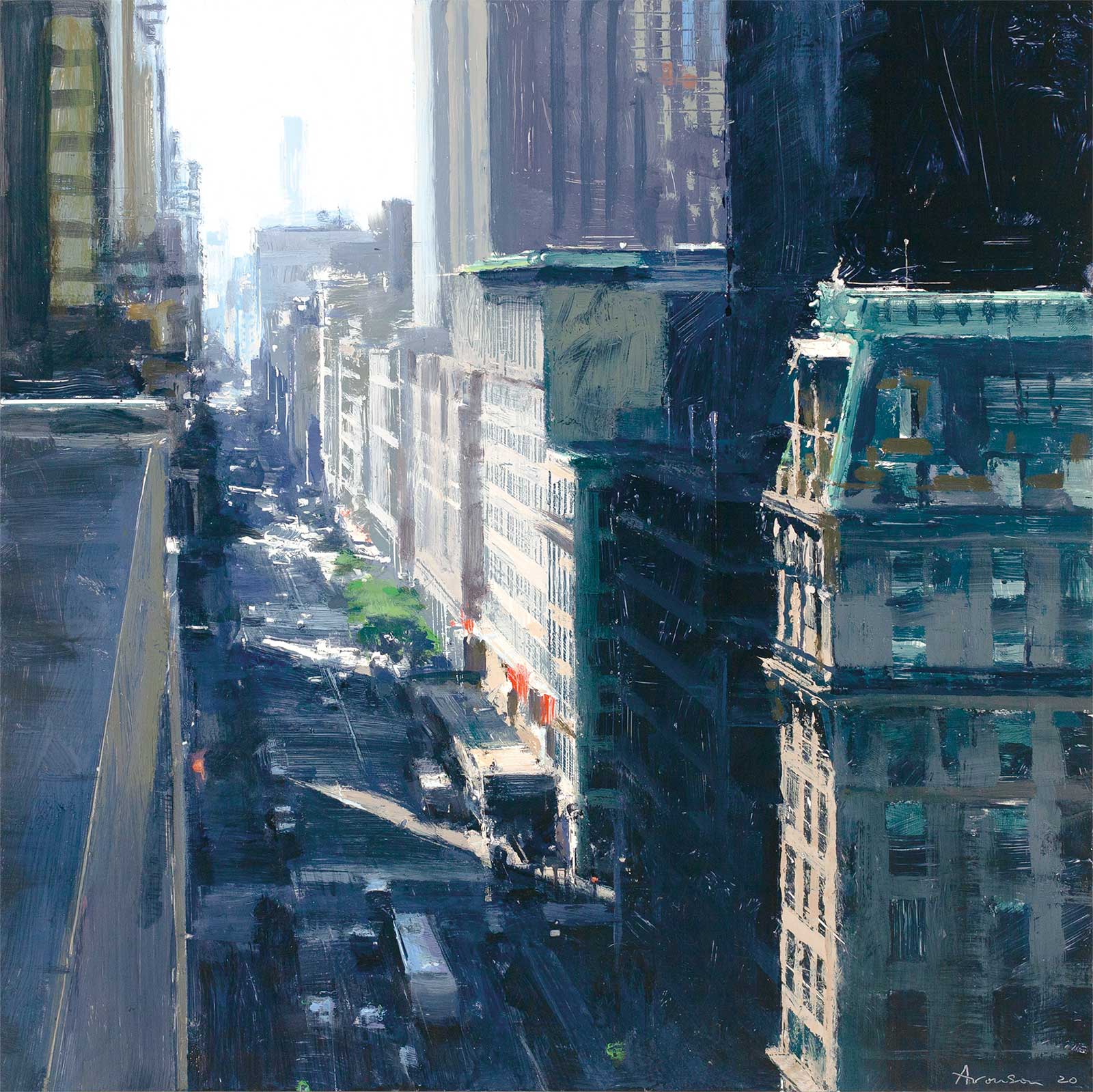 High Balcony Over Fifth, oil on panel, 12 x 12"
F. Scott Fitzgerald wrote about the feel of Long Island: “It was dawn now on Long Island and we went about opening the rest of the windows downstairs, filling the house with gray-turning, gold-turning light. The shadow of a tree fell abruptly across the dew and ghostly birds began to sing among the blue leaves. There was a slow, pleasant movement in the air, scarcely a wind, promising a cool, lovely day.”
Ben Aronson is a newcomer to Long Island. Delivering paintings to a Southampton art fair, he discovered the beauty that had enthralled countless artists before him. He observes, “The southern coast is oriented nearly east/west so, essentially, the sun rises and sets on the water. There is a different character to the light when it’s sunny or overcast and it bounces off the water in some magical, mercurial way. The light seems to come from everywhere.”
He has produced a series of paintings for an exhibition, Manhattan to Montauk, at MM Fine Art in Southampton, New York. Known for his painterly, abstracted cityscapes of Manhattan, he has taken the journey of the artists before him, “escaping to Long Island as an antidote to New York City,” to the literally more reflective potato fields, bays and beaches of the island.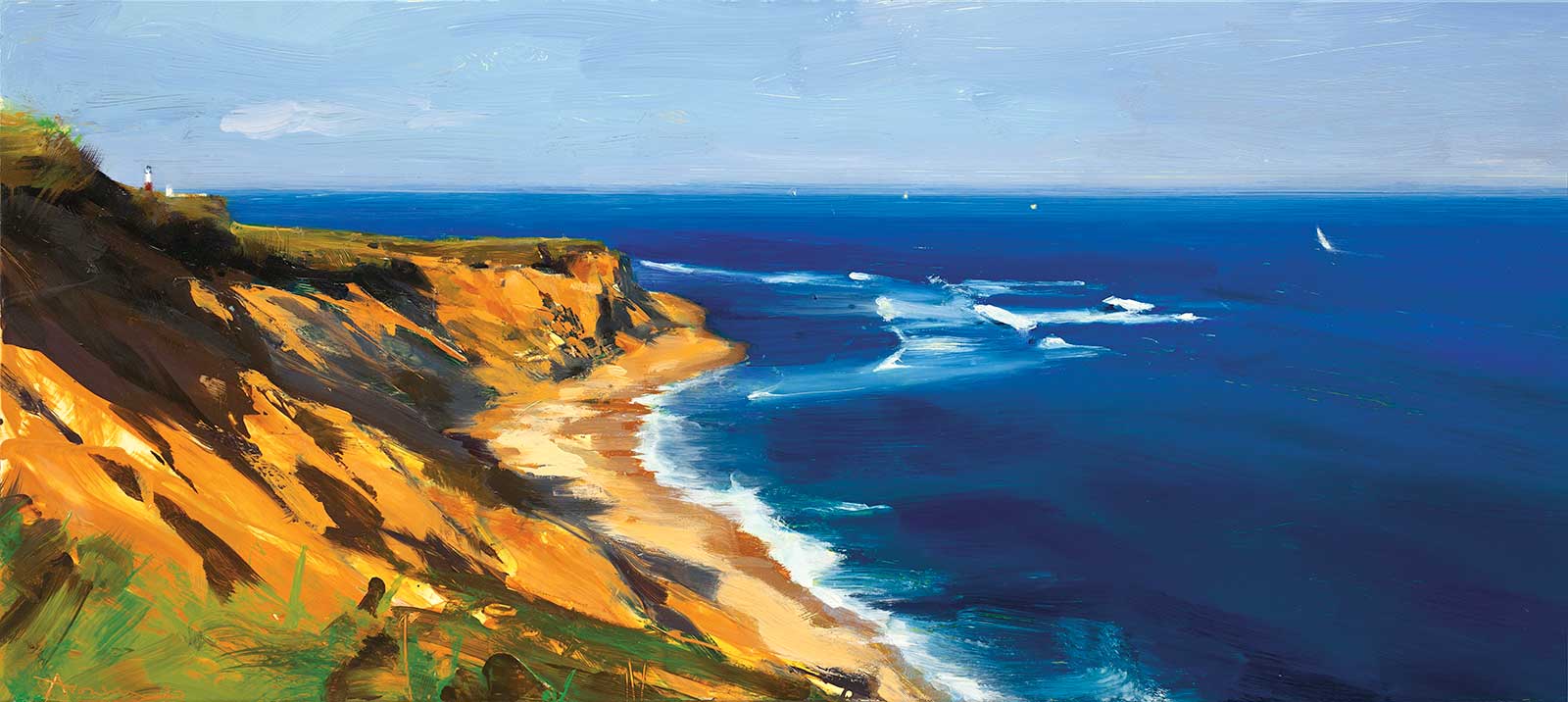 Cliffs at Montauk, oil on panel, 10 x 21"
“Light is at the center of it for me,” he declares. “In California the light is bounced into all the shadows. In New York, the shadows are inky and dark. On Long Island, the light slides over you.”
Eschewing the “low hanging fruit” to “get past the literal and the obvious,” he says, “The main objective is not merely to capture physical likeness, but rather to aim for the most concentrated form of a powerful visual experience. You need to depart from what’s in front of you. It’s about how one can see past that to how one can make paintings.”
Long Wharf, Sag Harbor “gets beyond the cliché. The first thing you see in the harbors is the mega yachts. They were not a subject I wanted to paint nor a message I wanted to put across. After being there for a while, I began to see the scene in terms of visual components—brilliant whites, the mercurial aspects of light that dissolved the recognizable identity of boats into flickering forms reflecting in the water that’s also reflecting the sky. It’s all about the light referencing the impressionism of Hassam and the abstraction of Pollock and de Kooning. I’ve always been interested in realism and am a great fan of abstraction. This painting evolved into a study of contrasts in a tight palette of cool colors—that paradoxically generates a sense of heat.”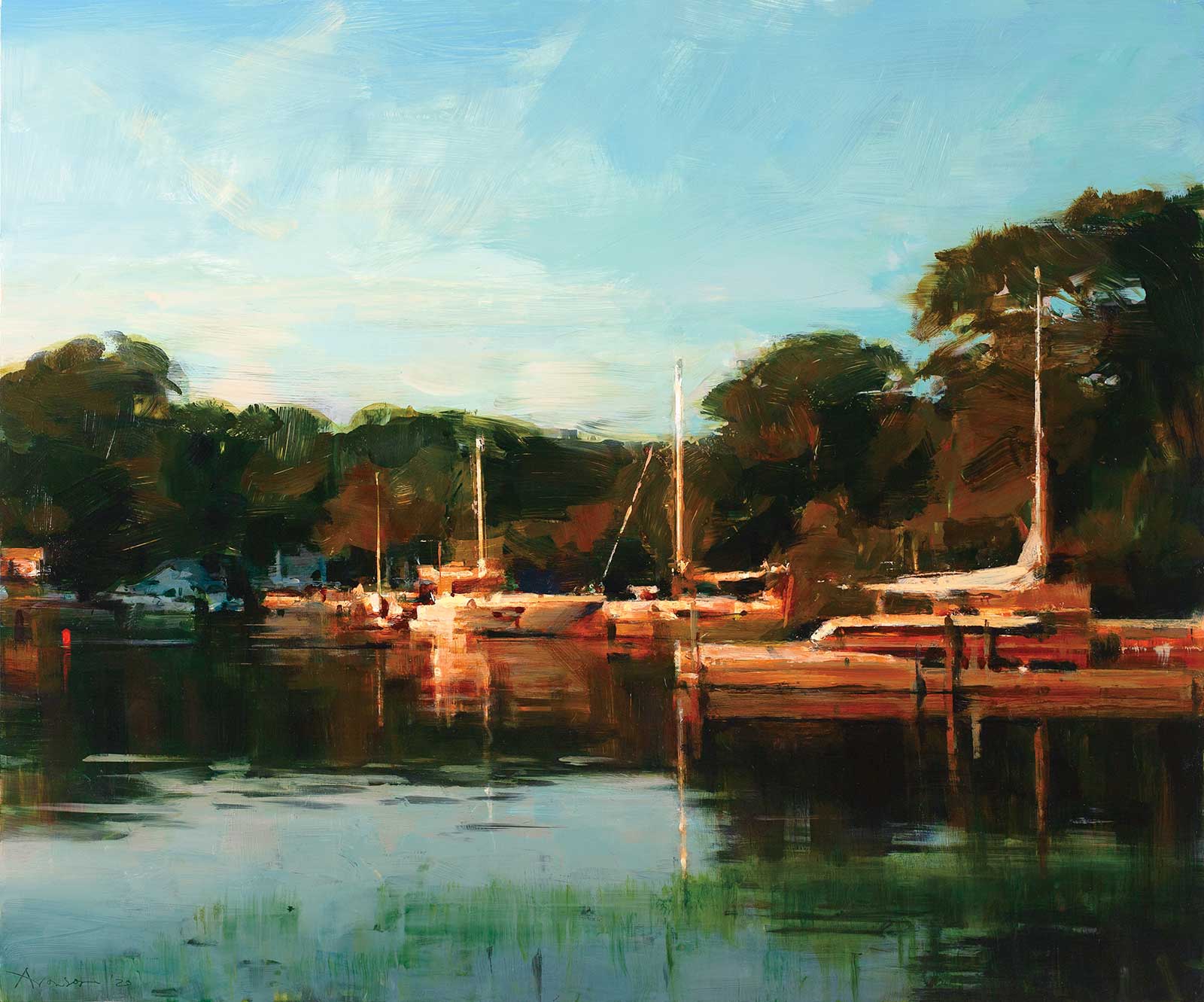 Evening, Sag Harbor Cove, oil on panel, 20 x 24"
Among the paintings is a figurative departure in Polo Players, riders and ponies bathed in the moist, atmospheric light. “I wanted to involve figures,” Aronson explains. “Polo is celebrated in Southampton culture, and I always wanted to paint horses and riders. They’ve been a theme in art from the caves of Lascaux through the impressionist paintings of Degas. I didn’t approach the subject with too many preconceptions. It wasn’t part of my territory.”
Aronson is animated by the process. He likens process to a chess game where “all the pieces are laid out, the forces are assembled. What transpires is a result of the steps you make and your opponent makes. In painting, you make a mark and there’s a reaction and a response. Things occur to me from one step to the next in the development of a painting just as in a game of chess‚” he shares.
“There’s an inner eye and an outer eye,” he continues. “What we see is translated into electrical impulses that become intermingled in our brain with memory. The eye doesn’t simply relate to what happens to be in our field of vision. We bring our entire history to what we see.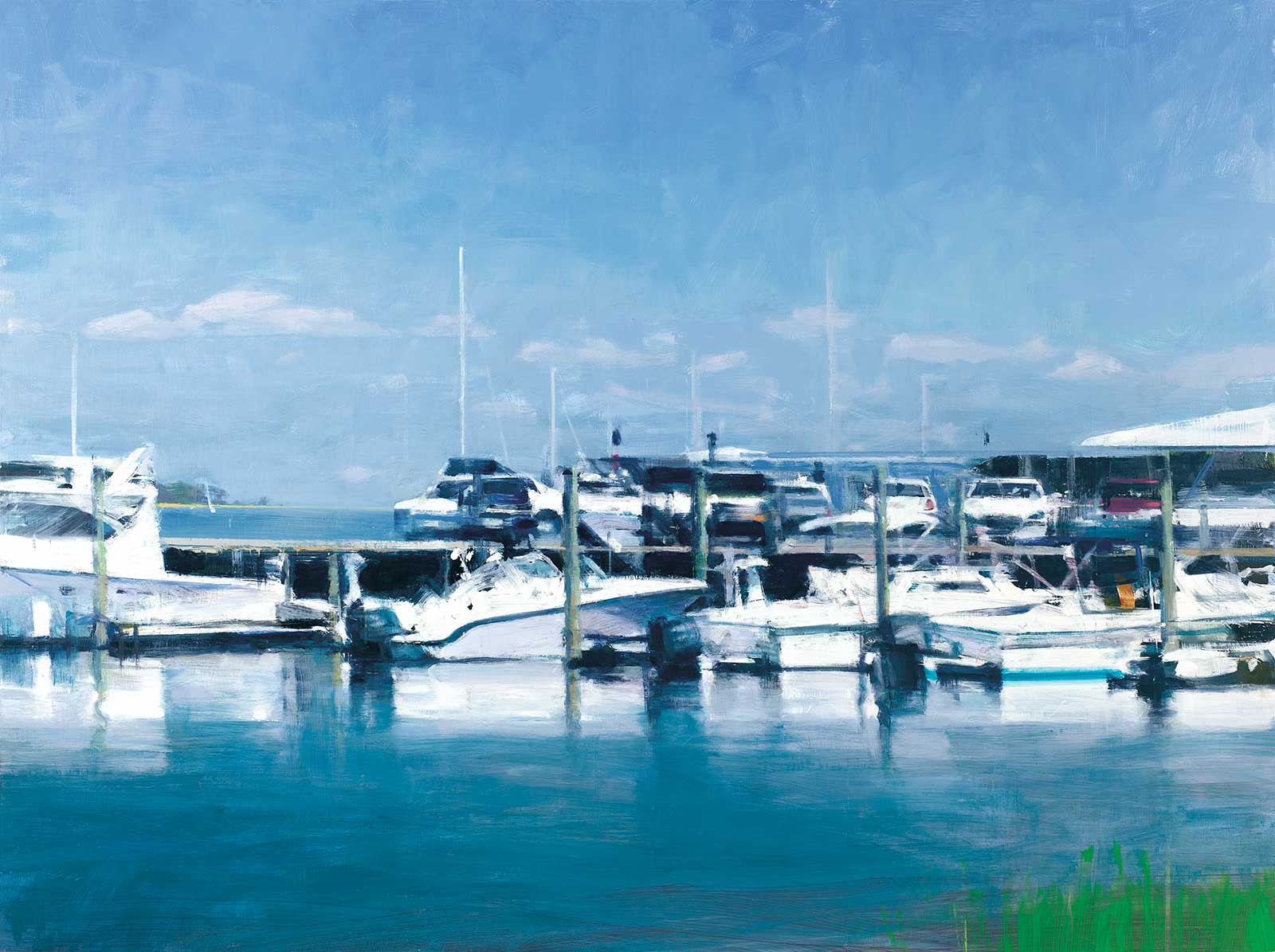 Long Wharf, Sag Harbor, oil on panel, 36 x 48"
A painting carries an inner life and an outer experience. It’s not just a mechanical effort to reproduce a subject. I think the best realist paintings are abstractions in terms of their scaffolding.”
He adds, “The concept of beginner’s mind is extraordinarily wonderful. Think of the wonder and awe of seeing something like a child for a first time. Once you learn, though, you’re no longer a beginner. I don’t want to over intellectualize a subject before I get a chance to paint it. I don’t want to constrict myself with preconceived boundaries. Artists can develop strategies to see things fresh. In the first few seconds when
I walk into my studio in the morning, I’m able to see the work apart from the hundreds of steps of painting the day before.”
Painting, for him, can be a meditative process, calming the mind’s meanderings, “reaching a kind of clarity by stripping away the non-essential, realizing the inner self apart from what we do and where we are.”
It’s at that level “from which we most meaningfully connect to others,” he says.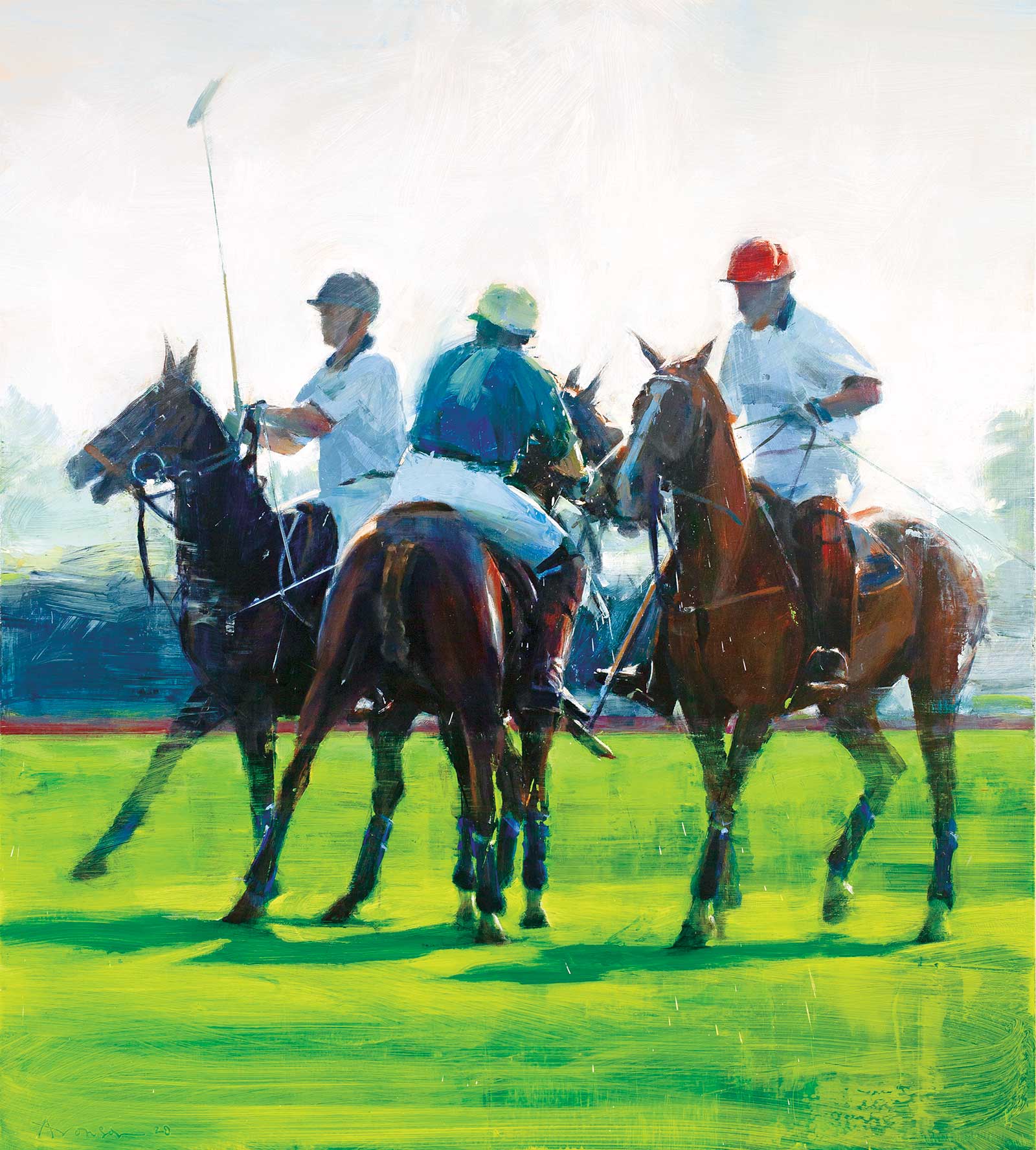 Polo Players, oil on linen, 40 x 36"
It is at that level where we connect to the painters of horses in Lascaux, Pollock dripping paint on Long Island, and those who read the words we write and the images we make. It is where we can reconnect to beginner’s mind.
Rachel Carson wrote, “A child’s world is fresh and new and beautiful, full of wonder and excitement. It is our misfortune that for most of us that clear-eyed vision, that true instinct for what is beautiful and awe-inspiring, is dimmed and even lost before we reach adulthood. If I had influence with the good fairy who is supposed to preside over all children, I should ask that her gift to each child in the world be a sense of wonder so indestructible that it would last throughout life.” —
Ben Aronson: Manhattan to Montauk
When: July 11-26, 2020
Where: MM Fine Art, 4 N. Main Street,
Southampton, NY 11968
Information: (631) 259-2274, www.mmfineart.com
Powered by Froala Editor