
When Randall W. L. Mooers discovered “the quintessential bunch of grapes” at the market, he was reminded of a painting that has always inspired him-a still life of a hanging pheasant by the French painter Jean-Baptiste-Siméon Chardin (1699-1779).
Mooers studied at the Art Students League and at the National Academy and developed an admiration for the 17th-century Dutch masters, still life innovators such as Chardin, Cézanne and Morandi, and contemporary masters of hyperrealist still lifes.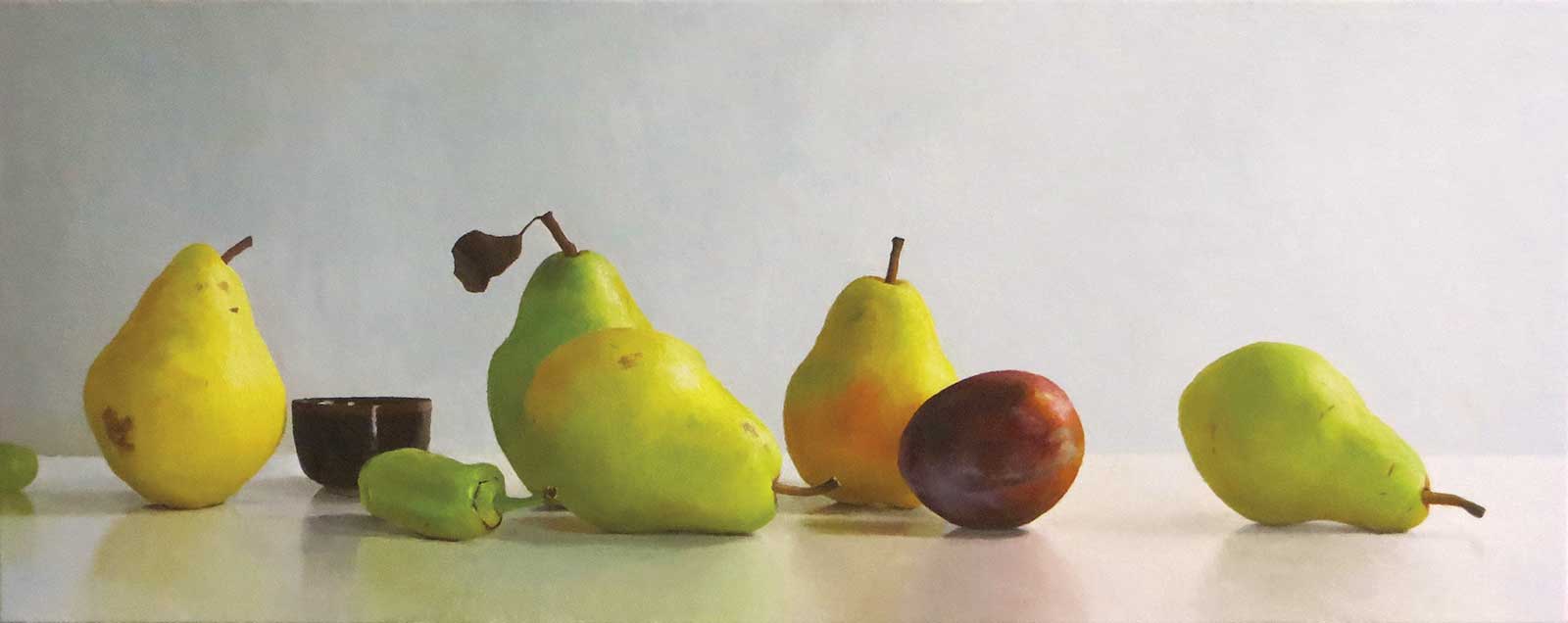 Five Pears with Nectarine, oil on canvas on panel, 12 x 30"
Chardin was a modest painter who bucked the grandiose painting traditions of his time by painting simple genre scenes and still lifes of everyday objects. Denis Diderot (1713-1784), the French philosopher and art critic, wrote, “We stop in front of a Chardin as if by instinct, like a traveler weary of the road choosing, almost without realizing, a place that offers a grassy seat, silence, water and cool shade.”
A century later, Marcel Proust (1871-1922) wrote, “We have learned from Chardin that a pear is as living as a woman, that an ordinary piece of pottery is as beautiful as a precious stone.”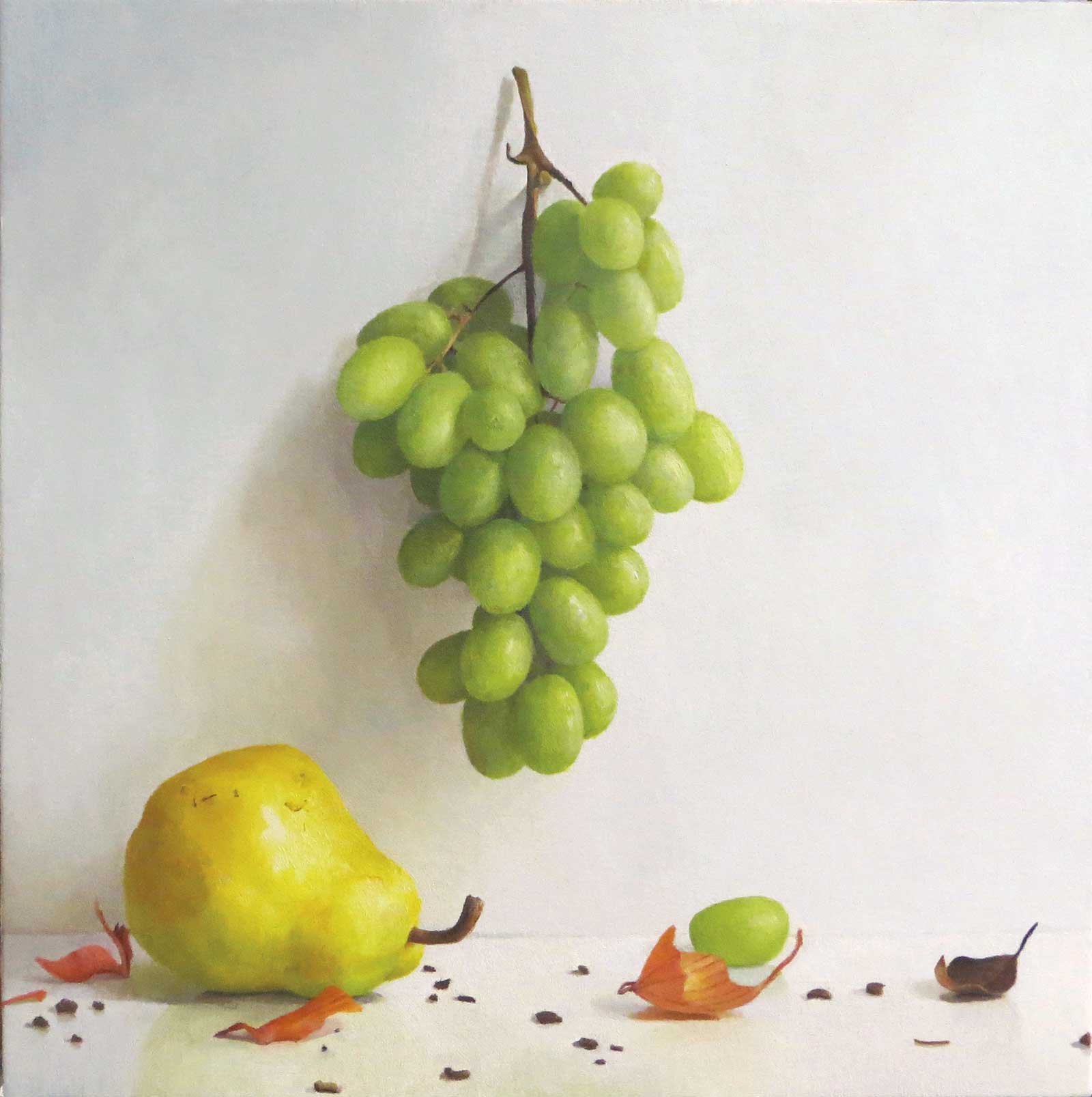 Hanging Grapes, oil on canvas on panel, 14 x 14"
Mooers recalls, “I liked the natural shape of the bunch of grapes, and I always had in the back of mind the idea of hanging something in a still life as Chardin did.” He comments on the rhythm of Chardin’s painting, a quality that is prominent in his own paintings.
He has said, “My paintings begin with a serious sense of play, both in the staging and the creating of the compositions. It is at this beginning stage that I operate under the Dadaist dictate that ‘anything can be art,’ and at the same time I seek out a balanced and harmonious composition by way of line, shape and color. I work according to my whimsy, sometimes seeking to assert some form of narrative however personal or ambiguous, and other times I am simply satisfied with the hint of a human presence.”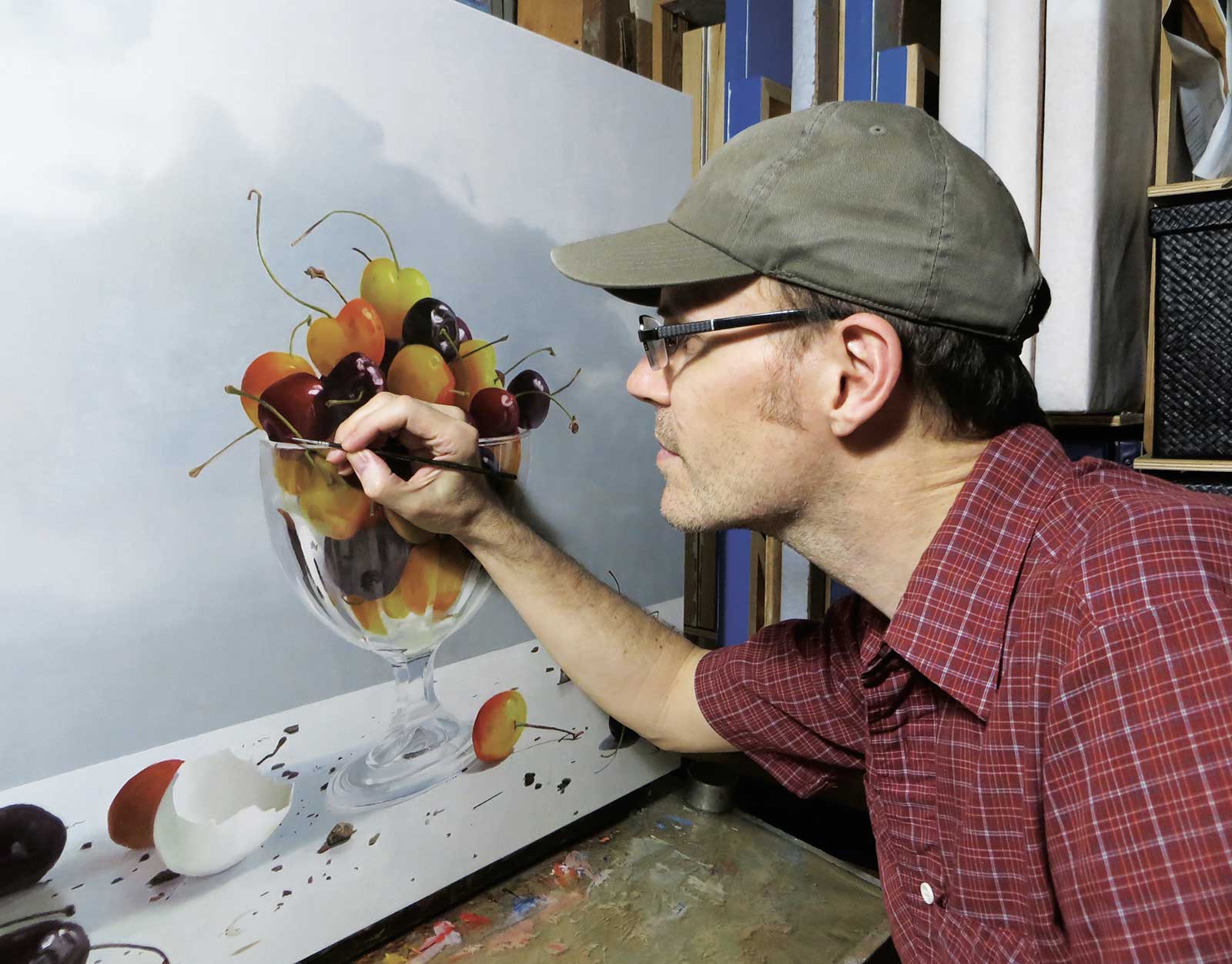 Randall W. L. Mooers in his studio.
Having hung his perfect bunch of grapes on the wall, he placed a lone grape, a pear and what I called “detritus” to balance out the composition. “I like the character of the objects” he explains. “Sometimes they’re bits of potting soil, an acorn, a piece of a cookie…small things. It’s as if someone has come by and hung these grapes and made a bit of a mess. Often the objects speak to my emotional state at the time. Sometimes there isn’t any detritus and the paintings tend to have a calmer feeling.”
The bits and pieces allow the eye to move around the panel and the reddish skin of the shallot complements the green of the grapes and the pear. Often there are dead pear leaves. He says, “I look for pears with dead leaves in the store. I’ve also collected them over the years. The leaf gives the pear some character.” He was also attracted to the oddly bent stem of the pear in Hanging Grapes and placed it as if it were looking up at the grapes. The anthropomorphic character of the pear, acknowledged by Proust, is something that hasn’t escaped him. He says, “I find with the pears it’s easy to project the form of women’s bodies. That naturally arises.”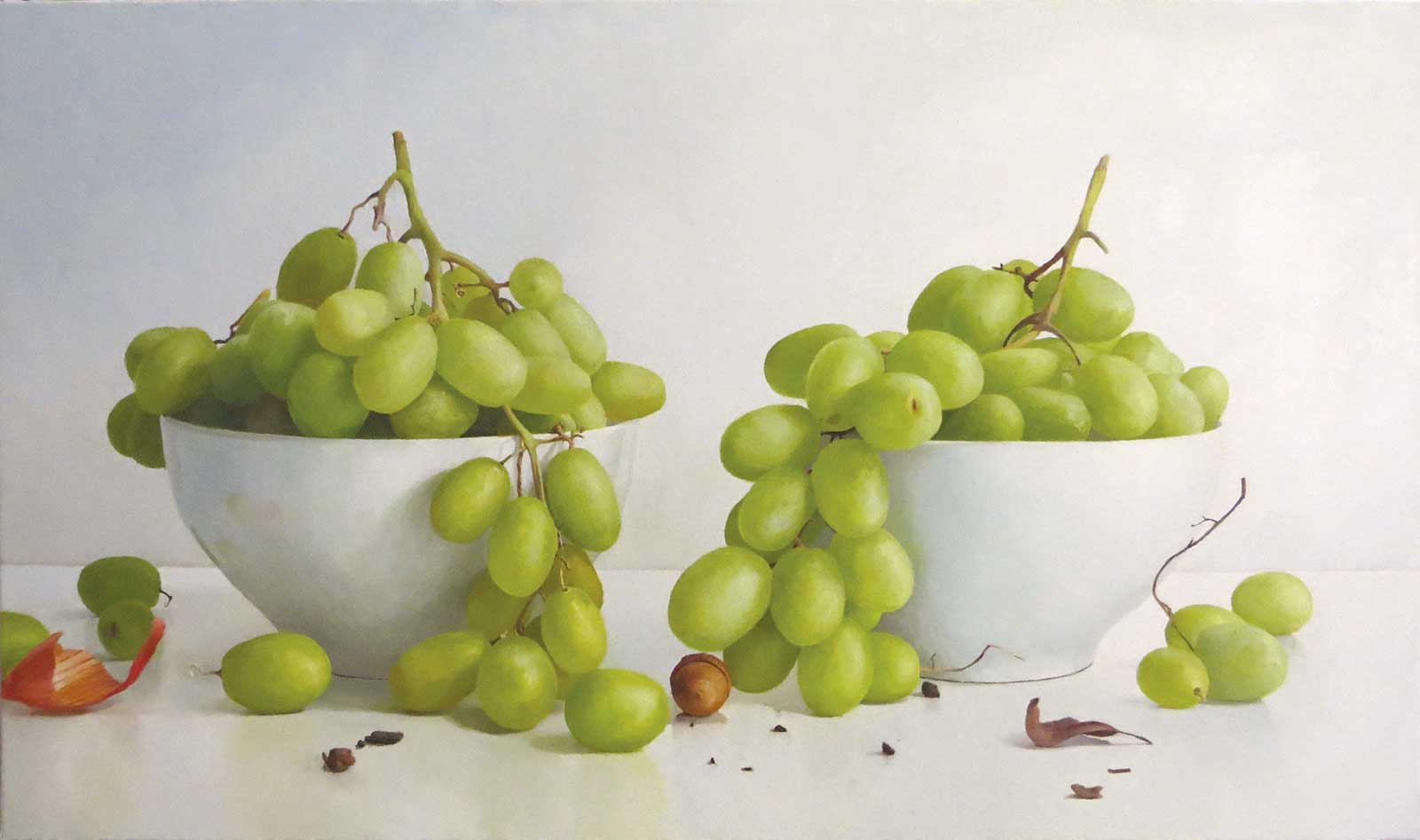 Two Bowls with Grapes, oil on canvas on panel, 20 x 34"
He used to paint from life but now assembles and adjusts his still lifes and then photographs them. He says, “There’s not much difference between what I’m seeing in life and what I’m seeing on the computer screen.” A lifetime of observing from life, however, allows him to detect those differences. Mooers explains, “I understand how light works and can interpret the distortions and can edit them if I need to. I work in series and can do many setups, take hundreds of photographs and spend weeks to develop a series of 20 to 30 paintings that I know are going to get edited down.”
He allows the viewer to bring the meaning to the compositions along with the natural tendency to project human characteristics onto the fruits and vegetables. His titles are simply descriptions (often leaving out an object). “I don’t like to impose my own projections via the title, he comments. I want people to have their own projection.”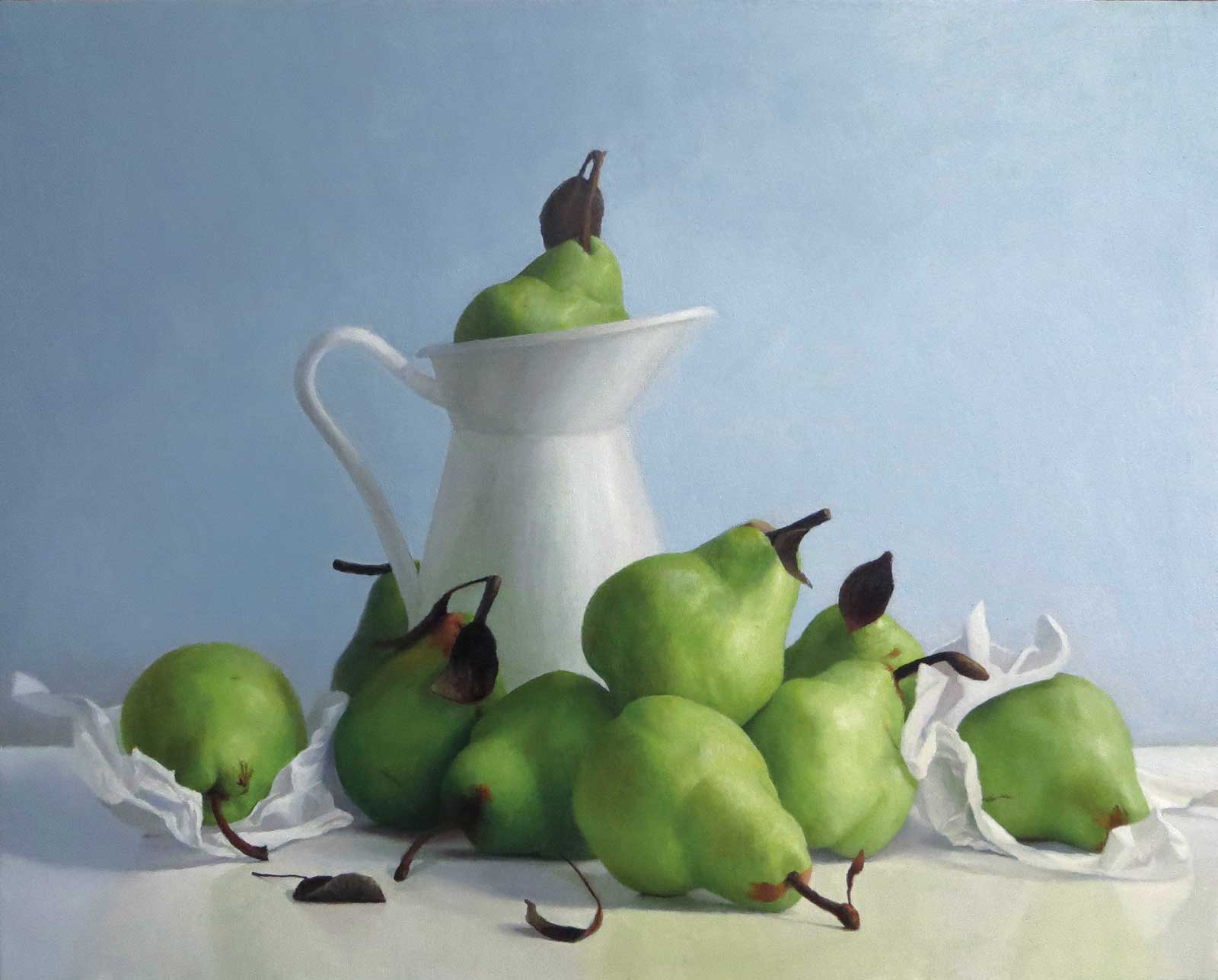 The Charge, oil on panel, 16 x 20"
The title Five Pears with Nectarine omits the grape, a pepper and a small bowl. Their absence compels us to examine their presence. The small, shadowed grape pokes quietly into the composition that ends in a crescendo with an isolated pear in brighter light. The brown bowl echoes the brown of the withered pear leaf and introduces a hollowed round form in contrast to the fullness of the nectarine. The pepper, in the same color family as the pears, offers a contrast in taste.
Chardin wrote, “Who told you that one paints with colors? One makes use of colors, but one paints with emotions.”
Mooers is attracted to the simple and sometimes quirky beauty of the objects he assembles in his compositions. Often, they reflect the state of his emotions. The fun of assembling rhythmic composition with visual interest is followed by the long process of realizing it in paint.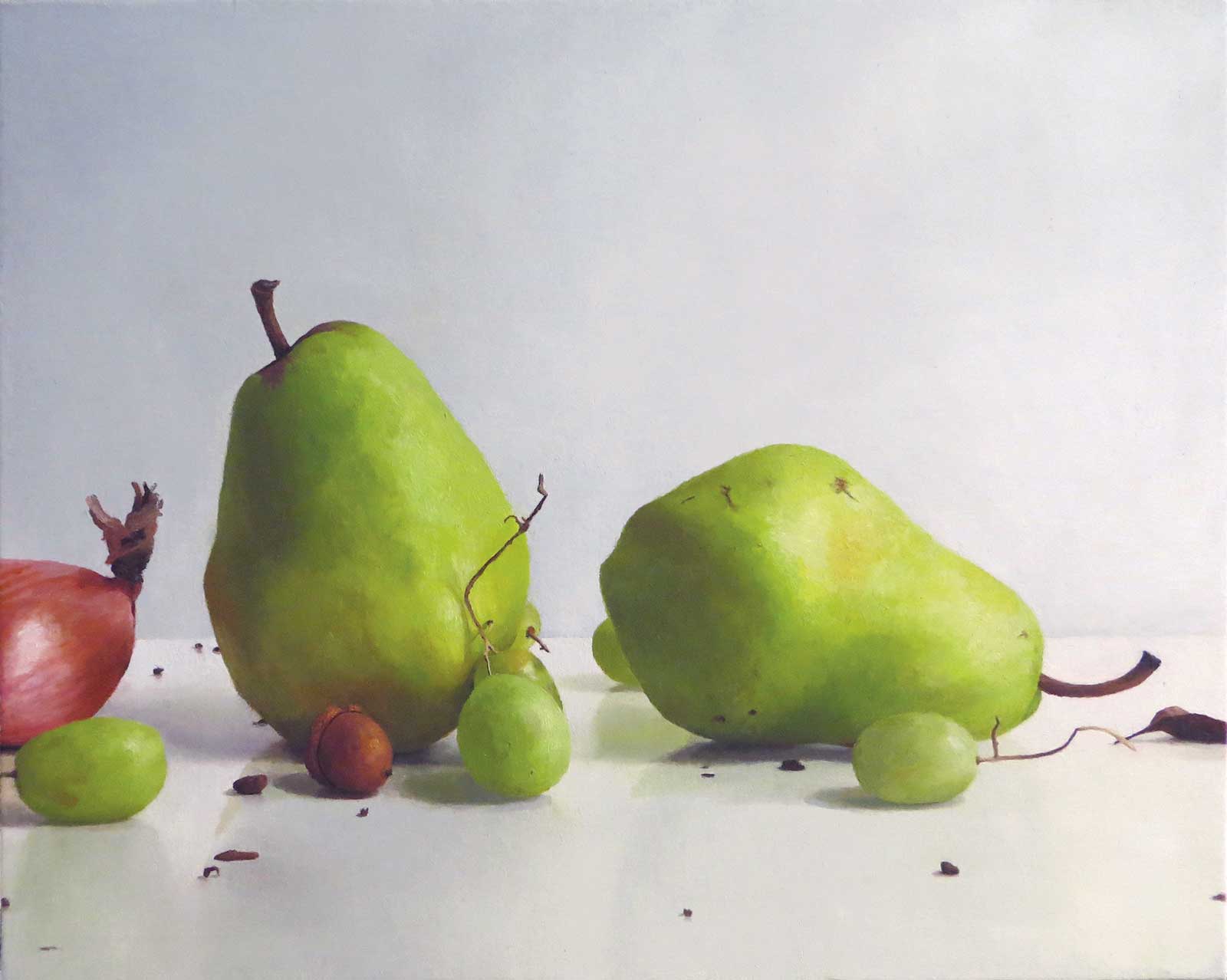 Two Pears With Grapes and Shallot, oil on canvas on panel, 16 x 20"
“Once I have my compositions the paintings then very quickly become about work,” he says, “a very labor-intensive work that forces me to focus my mind and slow things down (which I feel is relevant especially in this day and age of high-speed everything). A great amount of effort is spent on trying to get to the highest level of finish that is possible according to my current skill level.”
The result are paintings that invite the viewer to pause, to contemplate and to enjoy.
His most recent paintings will be shown at George Billis Gallery in New York through June 20. —
Randall W. L. Mooers
When: Through June 20, 2020
Where: George Billis Gallery, 525 W. 26th Street,
Ground Floor, New York, NY 10001
Information: (212) 645-2621, www.georgebillis.com
Powered by Froala Editor