Mauricio González came to the U.S. from Colombia 25 years ago. With a successful career in advertising, he has gained extensive experience in art direction, brand strategy and statistical analysis. This skillset was fundamental when he started building a collection that now contains over 350 paintings and other works.
He has applied the same “passion and knowledge discipline” he has in his career to his pursuit of artists. “In advertising, you need to understand the product, the competition and the marketplace,” he explains. “In the art world, it is important to understand an artist’s multiyear performance, his or her ranking among peers, consistency across contests, rising trends and more.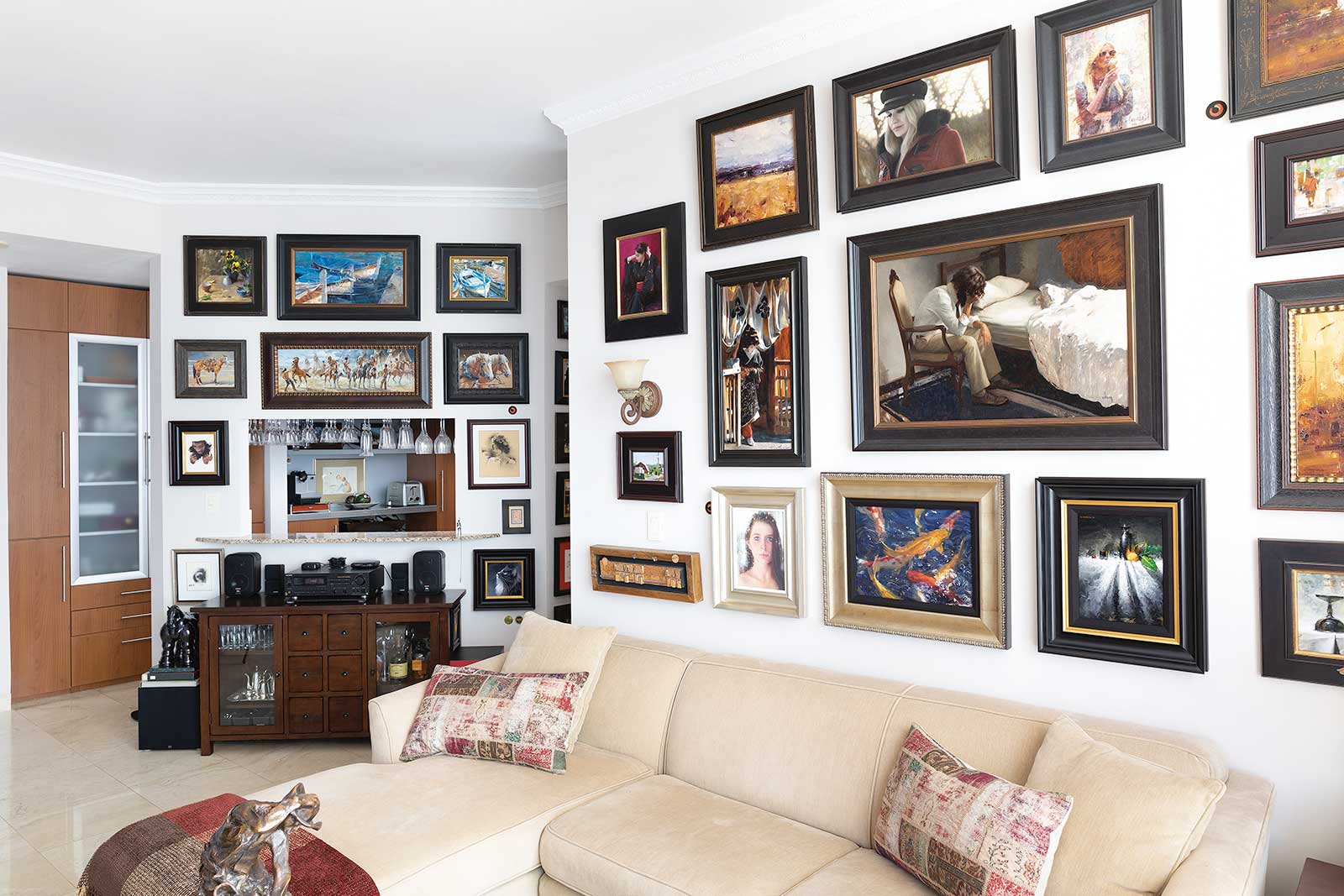 On the far wall, left to right and top to bottom, are three by Derek Penix—Flowers with Cups, Boats and Blue Boat—and three works by Charity Dakin—Working Girl, Impending Storms and Teamwork. To the left of the opening is Zarina Situmorang’s Portrait #5 and, beneath it, Victoria Steel’s Eye Study. To the right of the opening are, from top, Roman Pankov’s Slavic Beauty, Richard Bell’s Manguin, Aboriginal art and Anna Sakhanchuk’s Morphey. To the left of the cabinet is a bronze museum replica of Fernando Botero’s Caballo. Above the sconce on the right wall is Aaron Westerberg’s Rapture in Red. Beneath it are Qiang Huang’s An Alley in Durango and Talu Quintero’s Pueblito. On the top row above the sofa are, from left, Tibor Nagy’s The Land, Lee Miller’s Girl in Red Coat and James Crandall’s Pistacchio. On the next row are Phil Couture’s Emerging from a Teahouse and Ryan S. Brown’s Grief Study. On the bottom row are Daggi Wallace’s Thyself, Penix’s Koi Fish oil and David Cheifetz’s Mirage.
“I love art but I wanted to make sure I was choosing from among the great artists,” he continues. “To that purpose, I started using the power of statistics to help me discover the best living fine art artists on the planet. My statistical analyses were initially a hobby, but I began to realize I could share them with the public and help collectors and artists alike.” This was the beginning of ARTDATAintel, which now has its home on Instagram.
González says, “ARTDATAintel started as a small, yet ambitious project over 12 years ago when we began to track different art contests and competitions. Today, we have compiled a robust Art Intelligence Database that explores 350,000-plus entry submissions from diverse, high-profile competitions to identify all the award-winning artists from each competition.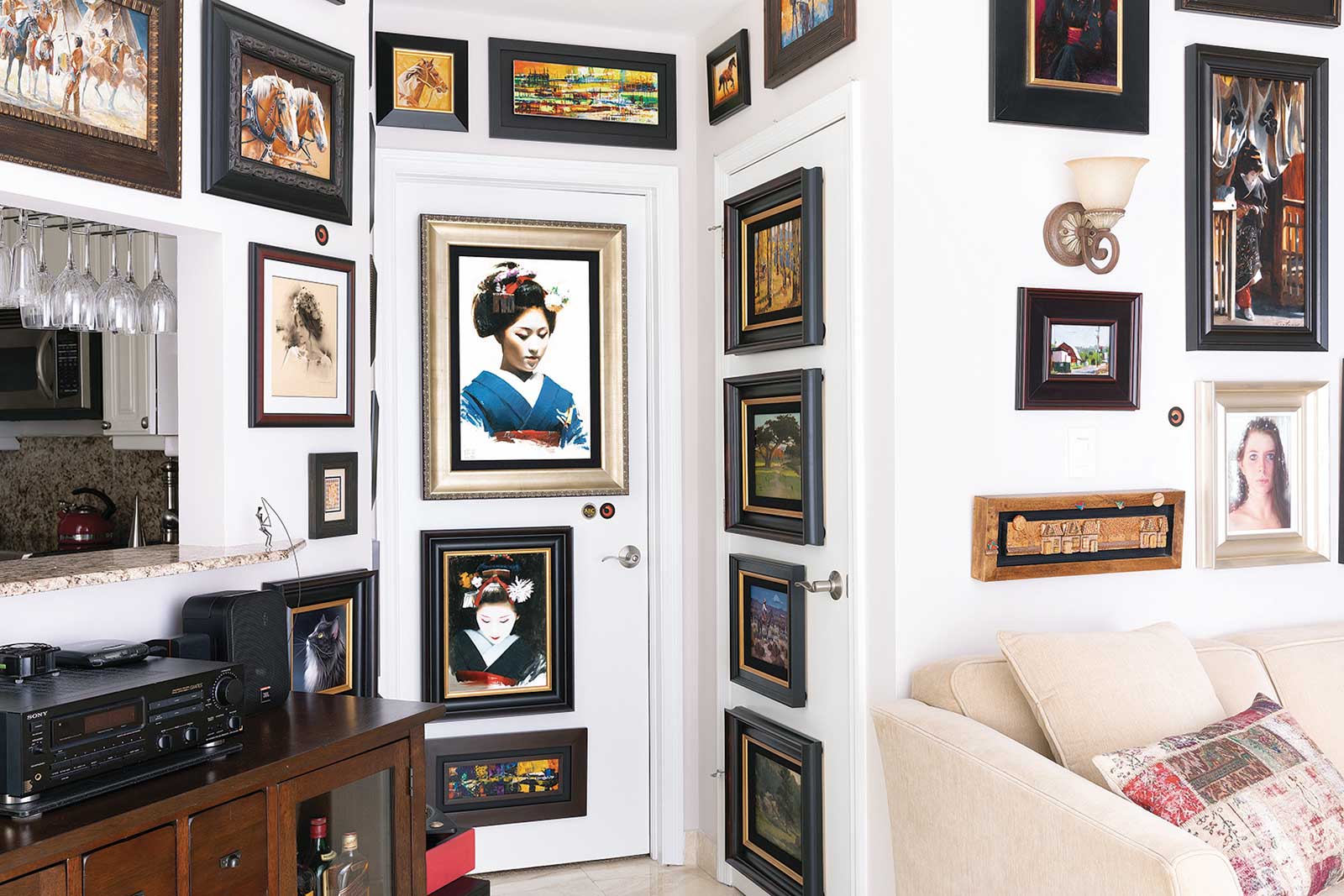 Above the opening is Charity Dakin’s Impending Storms. Next are Dakin’s Teamwork, Roman Pankov’s Slavic Beauty, Richard Bell’s Manguin, Aboriginal art and Anna Sakhanchuk’s Morphey. Above the door are Susan Ashmore’s Yellow Horse and Edith Pineros’ Ciudades Perdidas. On the door are Phil Couture’s Katsutomo and Fumino, and Fernando Oramas’ Abstract 1. Above the door on the right is Crista Forest’s Evening Fire. On the door are, from top, Jim Wodark’s Fall Study, Brian Blood’s Call to Dinner, Wodark’s Home on the Range and Blood’s Beaver Meadow. Above the sconce on the right wall is Aaron Westerberg’s Rapture in Red. Beneath it are Qiang Huang’s An Alley in Durango and Talu Quintero’s Pueblito. On the right are Couture’s Emerging from a Teahouse and Daggi Wallace’s Thyself.
“We realize that winning an award doesn’t make a great artist, but when an artist repeatedly wins more awards than others, and his or her performance is consistent across different art competitions, make no mistake—that artist is a great buy! Consistency is the name of the game in any business and statistics don’t lie…this is the power of ARTDATAintel.”
Today, the database has information on more than 5,600 artists, ranked by number of awards won across more than 10 renowned national and international competitions.
“A good percentage of the artists come from the animation or advertising industries,” he explains—a parallel that creates a synchronicity between him and his artists.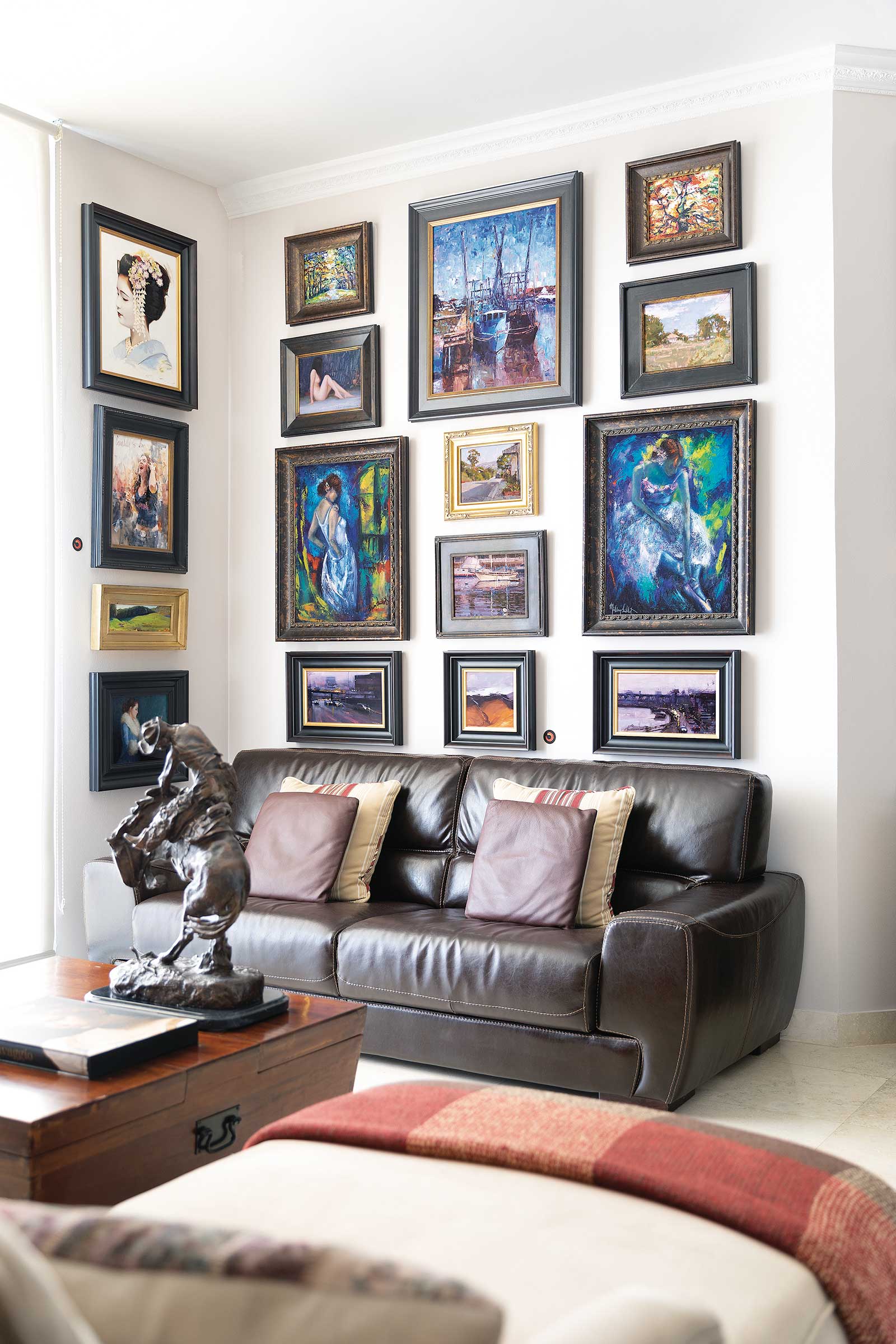 At left are Phil Couture’s Portrait of Naoai, James Crandall’s Tifosa, Paul S. Brown’s Blue Ridge Morning and Aaron Westerberg’s Sugar. Above the sofa are, from top to bottom and left to right, Stephen Kasun’s Wormsloe 23, Westerberg’s Seated Nude, Mildrey Guillot’s From My Window, Tibor Nagy’s Nightfall, Kasun’s Blue Shrimper at Shem Creek, Jennifer McChristian’s Hill Crest Drive, Jim Wodark’s Two Masted, Nagy’s Color Transition, Kasun’s Angel Oak, McChristian’s Terra Cotta Roof, Guillot’s Dancer and Nagy’s Industrial District. In the foreground is bronze museum replica of Frederic Remington’s Rattlesnake.
James Crandall, for instance, was a concept illustrator in the advertising and motion-picture industry. Michael Fitzpatrick was an art director in New York and later ran his own advertising agency in California. Both now dedicate their lives to fine art.
Visitors to González’s Miami home gravitate especially to the work of three of the artists: Crandall, Tibor Nagy and Derek Penix.
“One day I bought a painting by James Crandall in a gallery and wrote to him, ‘I’ve just bought one of your best paintings!’ James responded with the story behind [the work]: ‘The painting, Tifosa, is of part of a crowd of girls trying to get the attention of some celebrity at a hotel window in Milan.I never did figure out who it was!’ Crandall is a Master Signature member of the Oil Painters of America and a Signature Member of the American Impressionist Society.”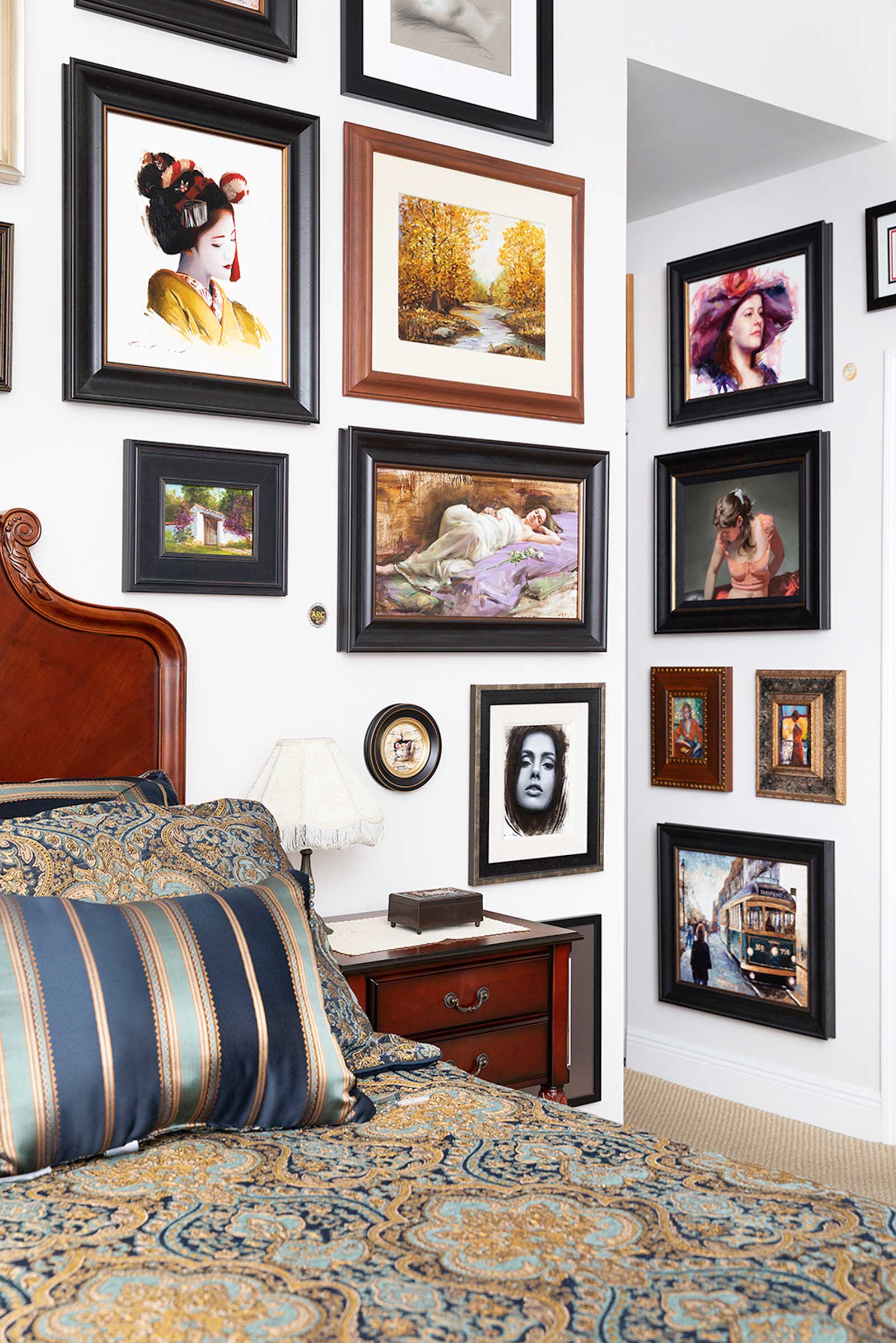 In the bedroom, top row, are Phil Couture’s Portrait of Katsuna and Alfredo Gomez’s Arroyo. The middle row has Guillermo Gonzalez’s Villa de Leyva and Mary Qian’s Reclining White with Flowers, and in the bottom row are Marina Dieul’s Petite Souris 357 and Lee Miller’s Portrait 2. In the hallway are Suellen McCrary’s Flowered Hat; Jie Gao’s Girl with Pink Blouse; two oils by Mildrey Guillot, Notebook and Waiting; and Stephen Kasun’s Riverfront Trolley.
He relates, “I first saw the work of the Slovakian painter Tibor Nagy 12 or 15 years ago. I thought, ‘Wow! Who is this guy? I need to meet him.’” At ARTDATAintel you can see that Nagy ranks No. 1, having won 40 awards between 2009 and 2018 when combining two databases: the Boldbrush and Raymar art competitions. He says, “We have been friends for the past 10 years. Recently, Tibor told me his son has helped in his correspondence, translating and proofreading. So now, his son is my friend too, and I’m proud to say that I have two Nagy friends, not one!”
Penix is No. 1 in the Oil Painters of America rankings in a 13-year aggregated data analysis, and he won its Gold Medal award in 2016. “Part of my research,” González says, “is getting to know an artist’s themes and collections. Derek had been painting boats, peaches, cityscapes, koi fish and my favorite—spadefish. I told him I wanted to see what he had in his studio of spadefish. He sent a couple of possibilities and I now have one in my collection.”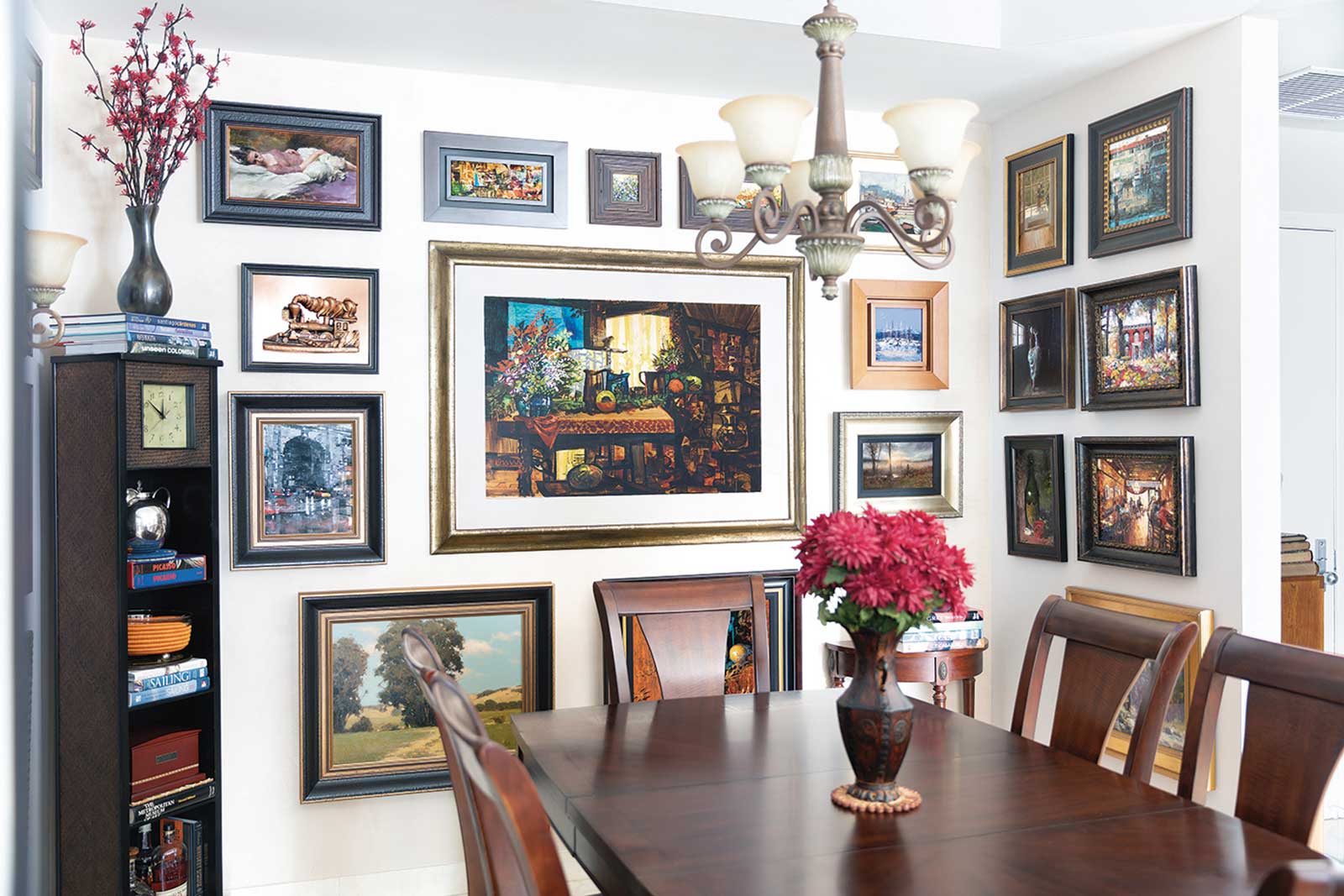 Along the top of the dining room wall are Mary Qian’s Reclining Pink and Fernando Oramas’ Abstract 2. Beneath the Qian are im Ellis’ Train Engine, Mark Laguë’s Through the Helmsley and Brian Blood’s Meadow at Bear Ranch. The large painting is Oramas’ Fabela Interior. To the right of it are, from top, Patrice Le Meur’s Port of Cannes and David Gluck’s Landscape Study. On the right are Derek Penix’s Porch, William Schneider’s He’s Late, Victoria Steel’s Keys to Love, Laguë’s San Fran Boats, and Stephen Kasun’s Azaleas at the Mercer House and his work At Lulu’s.
Sometimes, the collector is ahead of the curve. “When you become a friend of an artist,” he says, “you become part of their life. Mary Qian and I have talked many times. One day I said, ‘Hey Mary, you have a magical combination of realism and impressionism in your work. You should enter the Art Renewal Center Salon Competition. Her painting Reclining White with Flowers, in my collection, was a finalist in the 14th international ARC Salon.”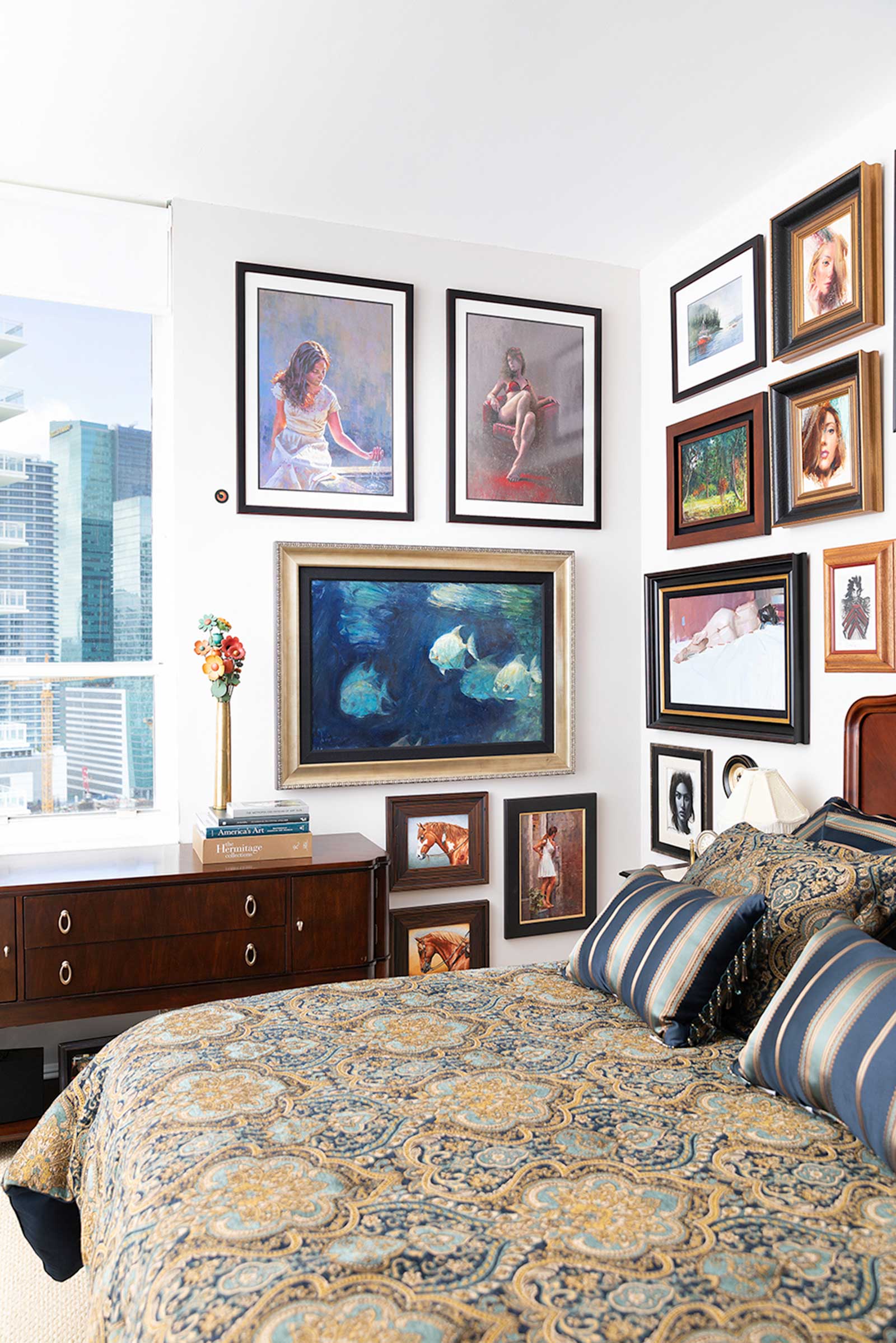 At the top in the bedroom are two pastels by Laurent Botella, Fontaine and Lilith. Beneath them is Derek Penix’s Spade Fish, then below are two oils by Crista Forest, War Pony and Precision, and James Crandall’s Woman in a Doorway. On the adjoining wall are, top to bottom and left to right, Tim Oliver’s Casey Ellen, Eduardo Jamhure’s Paisaje 21, Robert Lemler’s Sleeping Nude, Lee Miller’s Portrait 2, Clive Bryant’s Luna D and his Scribblebug, and Pedro Alcantara’s Warrior.
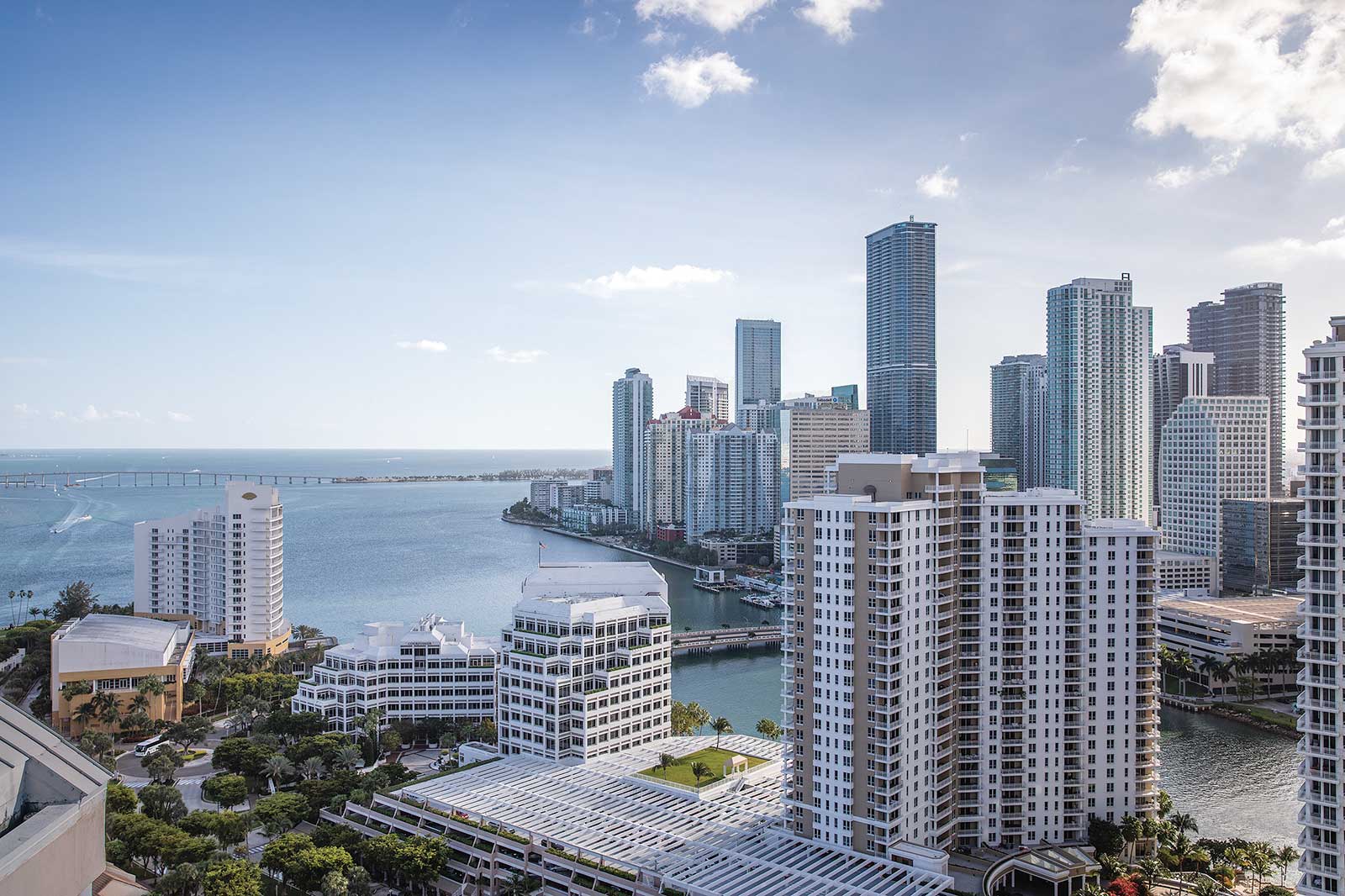 The view from Mauricio González’s home.
Other top artists in Gonzalez’ collection include: William Schneider, ranked No. 1 over the past 16 years of NOAPS awards; Fernando Oramas, described by the master Alejandro Obregon as the “best colorist in Colombian history”; Marina Dieul, ranked No. 3 across the 10-year history of the ARC Salon; and other icons such as Cheifetz, Blood, Couture, Wodark, Laguë, Westerberg and McChristian. He says, “Combining my personal tastes with accurate and unbiased art statistics has correctly guided my art collection, but when a brand-new artist stops me in my tracks, like the great Milno from Japan, I immediately included her art in my collection.
“Sometimes when I can’t sleep at night, I get up and put on the lights and I enjoy looking at all this amazing art,” he says. “It makes me so happy.” —
Powered by Froala Editor