In Alejandro Jodorowsky’s landmark 1973 surrealist film The Holy Mountain, a thief ascends a great tower on a golden hook. At the top of the tower, in a rainbow throne room, an alchemist transmutes elements from the thief’s body into solid gold. Later, on a path to enlightenment, the thief and the alchemist assemble a party that treks through a world filled with the bizarre, grotesque, profound and obscene.
Amid it all, though, is a persistent motif: Creation is not bound by the physical world. Gold can come from flesh, eternal life from holy mountains, enlightenment from the absurd. This is the backbone of alchemy, and it’s something that Brad Kunkle has been pondering for his new show at Arcadia Contemporary.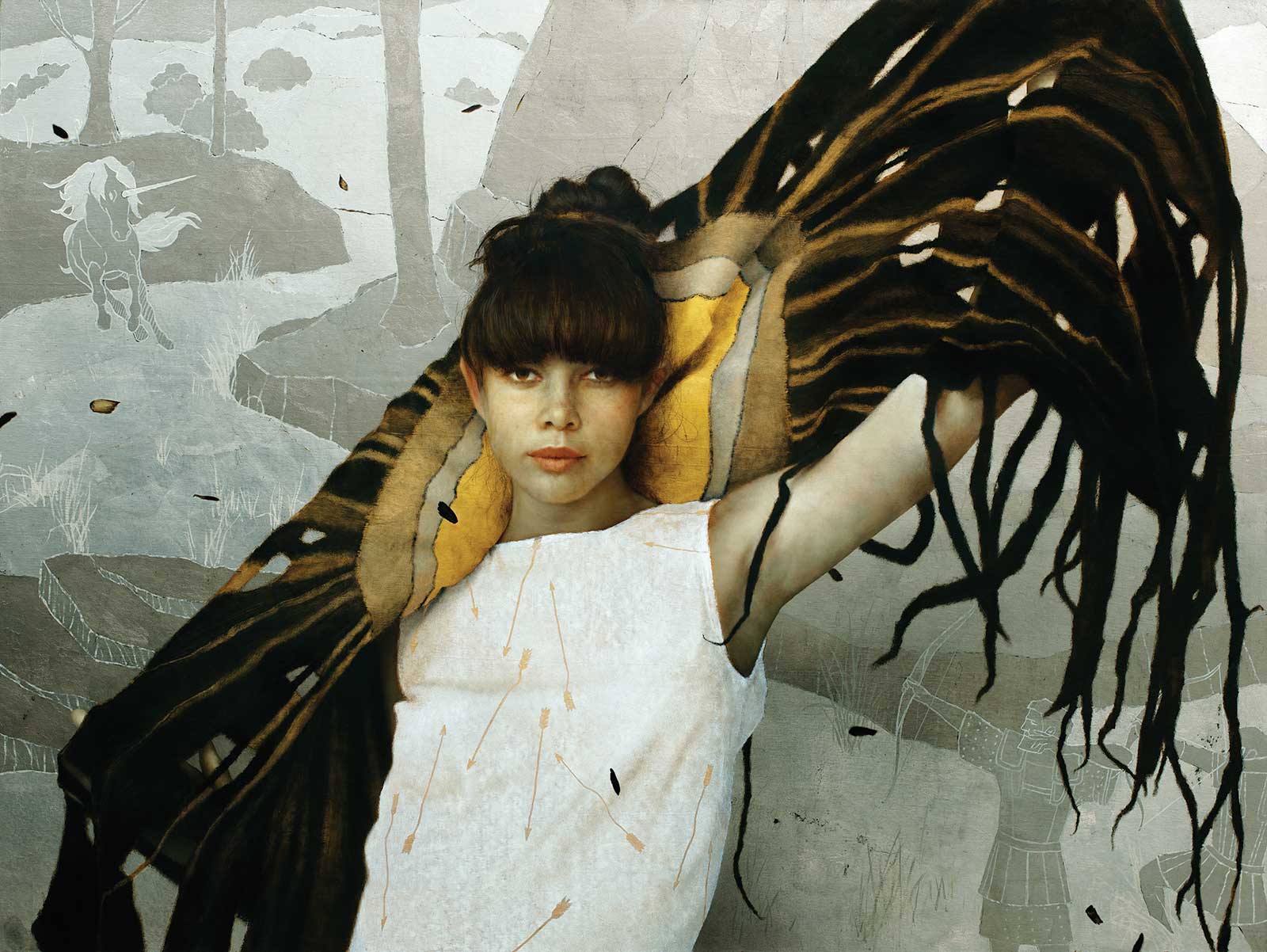 The Warden, oil, gold and silver leaf on linen panel, 30 x 40"
“The show is called alkəmē. This is how the word alchemy appears in a dictionary for pronunciation. I thought it was fitting because it’s kind of a literal manifestation of a meaning of the word. Alchemy is an ancient branch of natural philosophy—a magical process of creation and transformation with the pursuit to attain a perfected final state,” Kunkle says from his New York studio. “On a broad scope, I’ve been exploring the idea of magical thinking and alchemy, which led me to literal spell casters…the history of witchcraft, etc. And all of that looped me back to the broader initial fascination with magical thinking and alchemy. Whether someone is a practicing witch or a catholic priest, or even just someone who believes in serendipity, the commonality is that they all believe that there is an invisible world that can affect their lives. Magical thinking is a strong force that has been a part of the human story since the dawn of time, and it’s an endless source of inspiration for me.”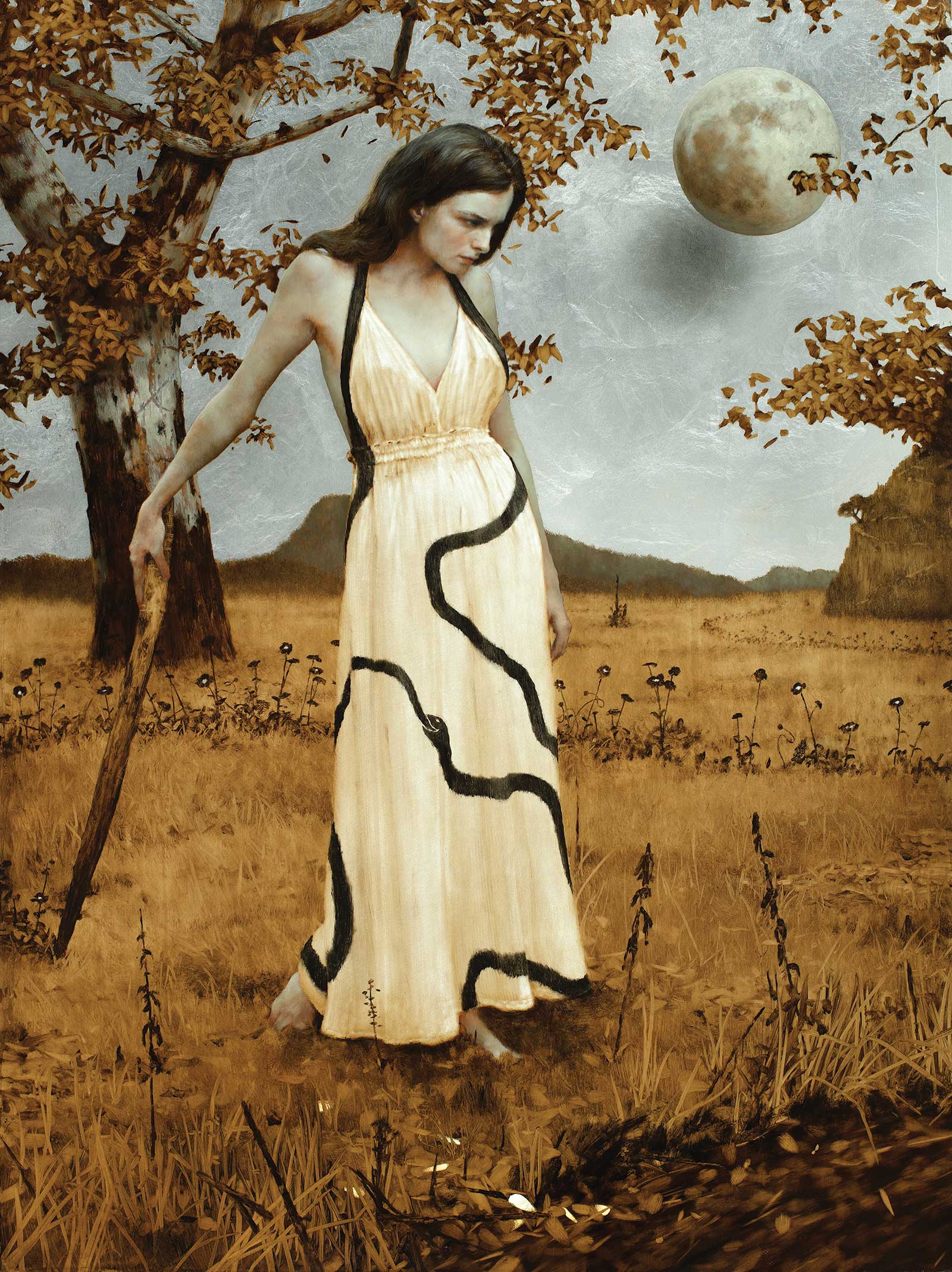 The Tilth, oil, gold leaf and silver leaf on wood, 24 x 18"
He adds: “My ancestors are German and immigrated to an area of Pennsylvania that is rich with hexenmeisters (spell masters) and hex signs on barns. I started to research this more and realized that my family was even ‘casting’ traditional folk spell remedies without knowing it. Just three generations back there are stories of rubbing a potato on a wart and saying a prayer three times to get the wart to fall off. There’s a historical tradition of casting spells in the name of the Christian Trinity. It’s called pow-wow. This crossing of ‘witchcraft’ and Christianity blew my mind…but only reinforced the initial journey I went on to explore magical thinking.”
And, of course, there is another strong connection between alchemy and the artist: silver and gold. Believers in alchemy have long thought that lead and other common metals could, through science and magic—or even potions and powders, universal elixirs and magical chemistry—be transformed into gold and silver. For Kunkle, he uses gold and silver leaf, as well as oil paint, to bring his fantasies and magical figures to life. He needs a business card that reads: “Brad Kunkle. Painter. Alchemist.”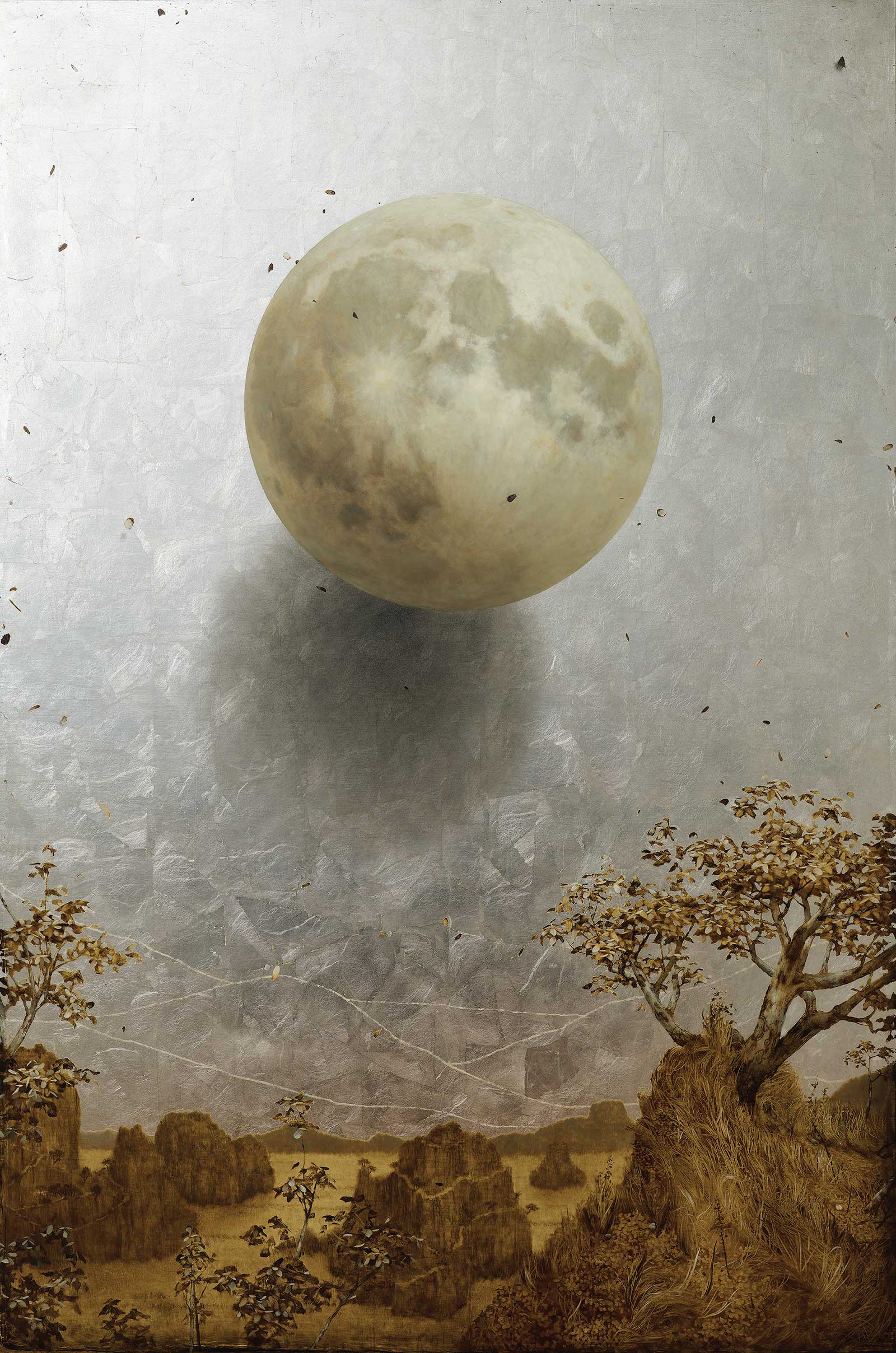 The New Moon, oil and silver leaf on linen panel, 60 x 40"
“Magical realism and fantasy are two great examples of how many artists and writers have expressed magical thinking in the past, and so it’s a way for me to express it too…” he says. “In the end, all of my work does have a purposeful strange, magical quality to it. Maybe it’s the language of mystics, but I don’t know how to speak a word of it…I just try my best to paint it.”
alkəmē, which opens April 18 in Pasadena, California, will feature The Warden, a 40-inch-wide work made with oil paint and gold and silver leaf. The painting shows a female figure draped in a delicate sun-like shawl as she stands in front of a shimmering mural depicting a unicorn and archers. The unicorn is protected from the bow-wielding predators only because the dress on the figure has seemingly captured the arrows, which tumble down her torso harmlessly. The piece went through several transformations before it was completed, which is normal for most artists, Kunkle included.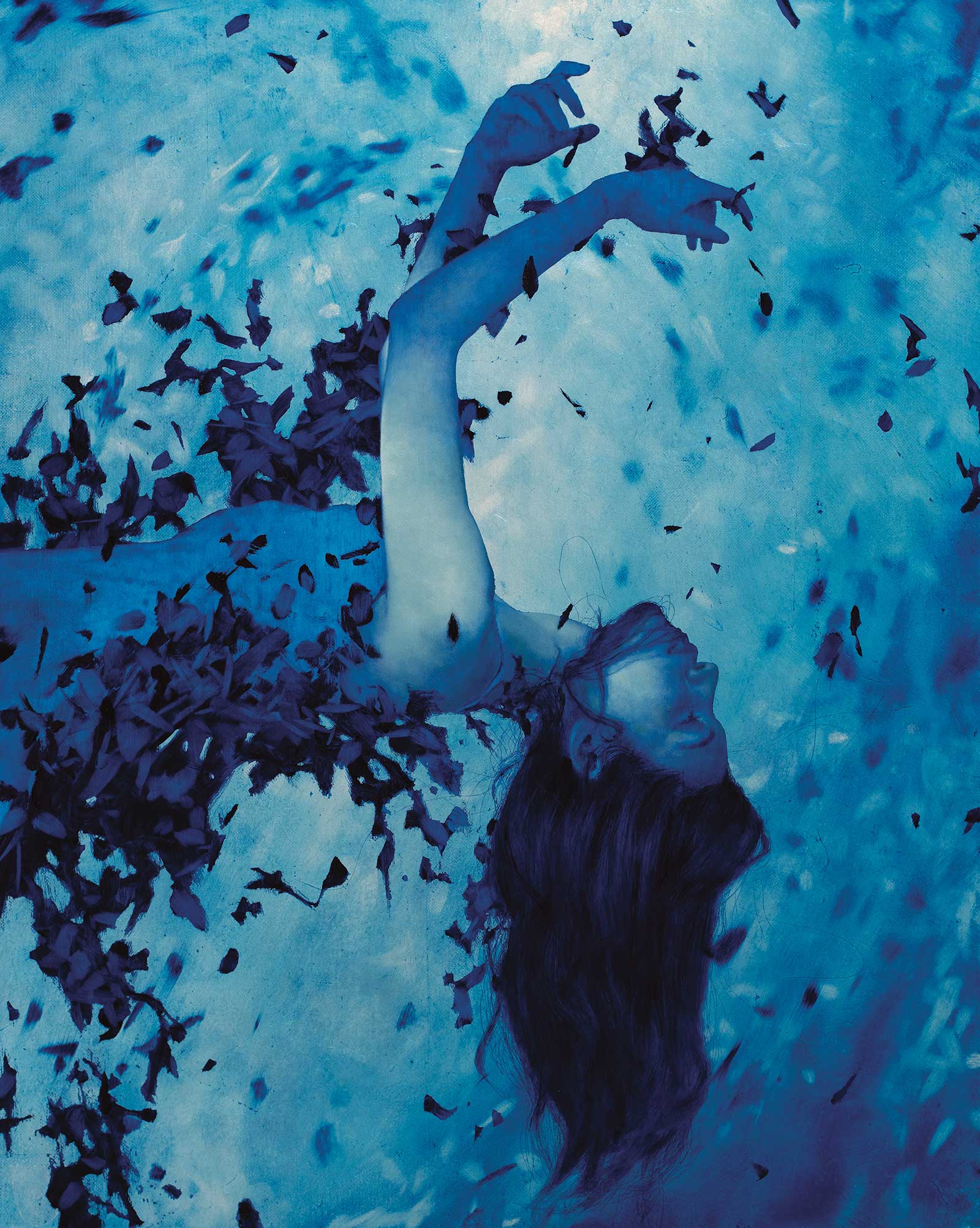 Blue Levitation No. 2, oil and silver leaf on wood, 20 x 16"
“I’ve been more conscious of embracing the process of alchemy while painting. I’m trying to marry the mental ideas with the physical action and then allowing the physical results to inform the evolution of the idea. So instead of getting the whole painting finished in my head and know what it’s going to look like before I begin, I allow each step to inform the next,” the artist says of The Warden. “I didn’t even know there would be archers in the background until the figure was blocked in and staring back at me for days. Once I got the archers in, then I needed to understand the relationship between the unicorn, the figure and the archers. So I eventually saw the arrows collecting in her shirt pattern. This is the process of alchemy for me. The colors evolved in the same way. I worked on the skin until I thought it reached its perfect final state. But many times I can’t tell until I come back the next day and see that it either has or it hasn’t.”
In works such as The Tilth and The New Moon, his exquisite application of gold and silver is more apparent and prone to probing eyes wondering, “How’d he do it?” His gold leaf has a warmer presence, sort of organic, which is a deep and satisfying contrast to the colder silver, more reminiscent of polished machinery. “I would say that I’ve mostly refined [my technique] by learning from my mistakes and taking risks. Gold and silver are challenging because they’re just so unpredictable,” he says. “Any subtle change in the surface it’s on is amplified. Painting on top of it or up against it is challenging because I paint in pretty thin layers and the gilding displays color differently than a non-reflective surface. It’s taken a decade of mistakes and evolution to get to this point and I’m still perfecting my process. I feel like I still have a lot to learn.”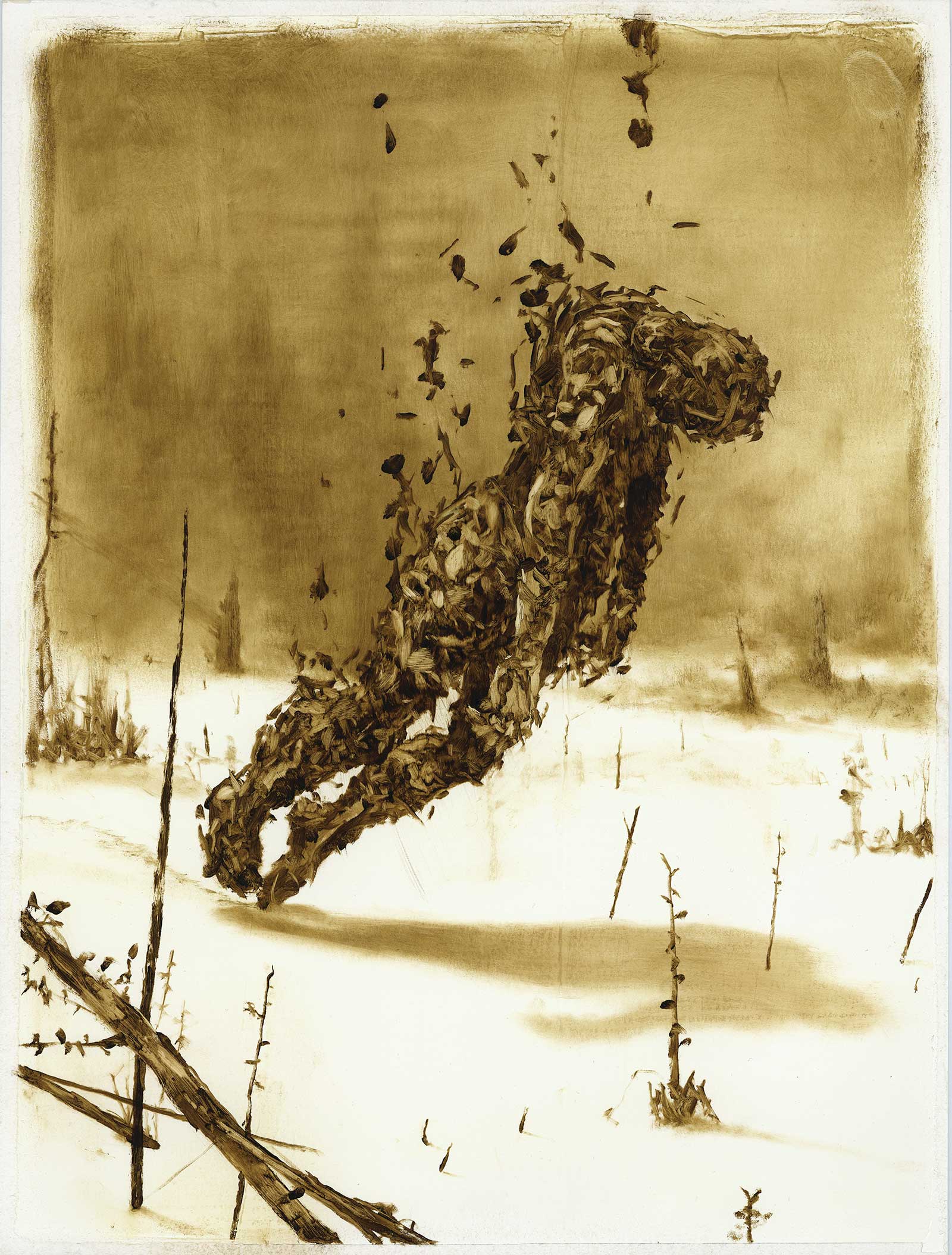 The Navigator, oil and gold leaf on paper, 16 x 12"
Other works include The Navigator, which shows a golden figure falling apart—or perhaps assembling—in a desolate wasteland, and Blue Levitation No. 2, which presents a similar motif that seems to suggest life and death, or even rebirth, amid Kunkle’s delicate brushwork.
These days Kunkle is working in a makeshift studio in his Brooklyn home. “My studio is currently what I would call a pop-up. I just needed a temporary studio to finish this exhibition close to home…so in three days I built a couple walls in our loft. Needless to say, my fiancé is the most amazing person to allow me to take half our space,” he says. “It’s only ideal in the sense that I can work late hours and walk 10 steps to the bedroom. I’ve had the most beautiful barn studio, to a 10-by-10 bedroom, and I can tell you from experience that making great paintings has very little to do with how great the studio is. I’ve been working 12-hour days for the past four months. Some nights end at 4 a.m. I consume a lot of different things in the studio. Music, talk radio, podcasts, documentaries, movies that fit a mood. It depends on what I’m trying to focus on creating. I just started curating a playlist so that I have an endless stream of good songs to keep me in a zone. I have noise-cancelling headphones that I wear most of the time while I’m listening to things. Sometimes silence is the best. An hour can go by before I realize that nothing has been on. My dog, Shadow, is sometimes the only reason I remember to go outside and take breaks. She comes in to check on me.”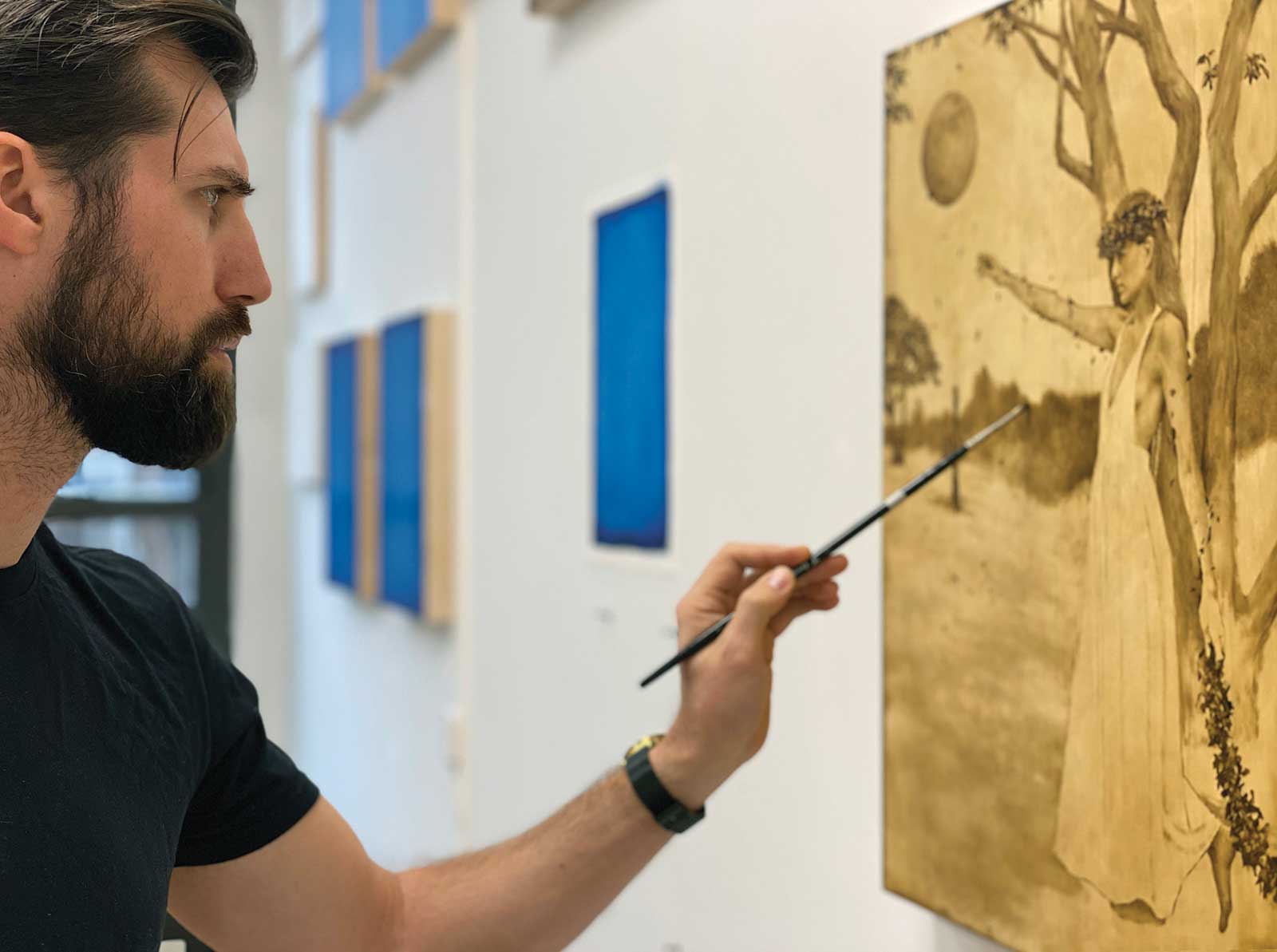 Brad Kunkle in his Brooklyn, New York, studio.
I ask Kunkle what drives him forward. What makes him want to set up in his home and push onward. Is he searching for emotional truth, holy mountains or is he still trying to figure out how to turn lead into gold?
“Emotional truth. I love that you asked if that was it. It could be the answer. I don’t know. Not knowing what I’m searching for is one of the things that drives me,” he says. “It’s like being lost in a forest and I’m on an epic quest. I have no idea what the quest is for, but I’m letting my intuition guide me. If people can see or feel that I’m trying to follow my intuition, then maybe that’s enough to remind them to follow their own.” —
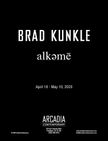
Brad Kunkle: alk∂mē
When: April 18-May 10, 2020
Where: Arcadia Contemporary, 39 E. Colorado Boulevard, Pasadena, CA 91105
Information: (626) 486-2018, www.arcadiacontemporary.com
Powered by Froala Editor