Gloucester, Massachusetts, with its deep water harbor on the Atlantic Ocean, was established in 1623 and was first a port for trade and then all things maritime, from fishing to sail-making. The harbor and coves teeming with sailing vessels and the extraordinarily picturesque landscape and seascape then began to attract artists. Gloucester and the neighboring Cape Ann town of Rockport lured artists who were or would become members of the pantheon of American painters—Fitz Henry Lane, William Morris Hunt, Winslow Homer, Childe Hassam, John H. Twachtman, John Sloan, Edward Hopper, Stuart Davis, Jane Peterson and Marsden Hartley among them.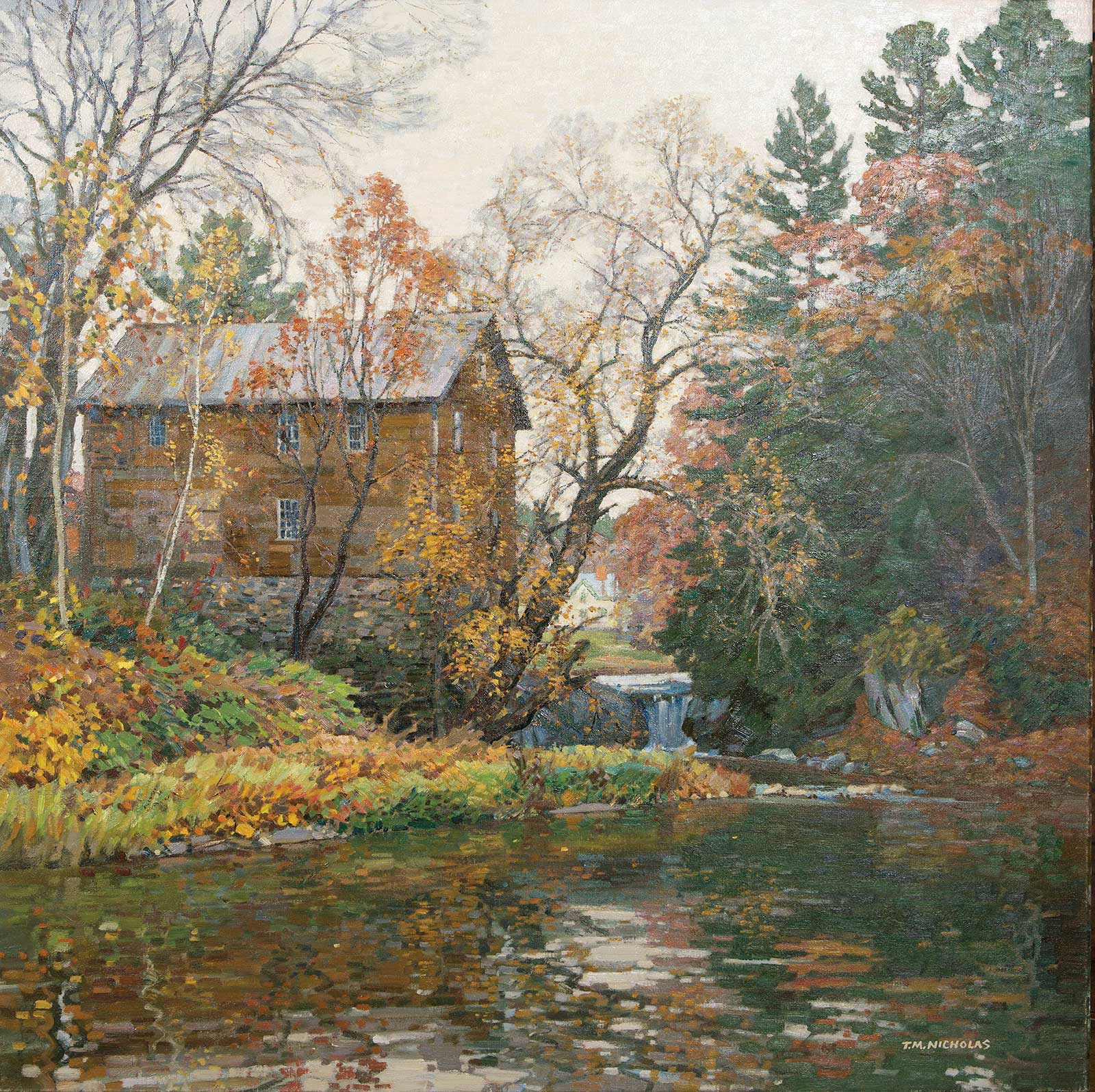 T.M. Nicholas, The Old Mill, 2015, oil on canvas, 36 x 36". Collection of Richard and Valerie Beck.
Frederick J. Mulhaupt (1871-1938) arrived for the first time in 1907, eventually settling in Gloucester in 1923. He declared Gloucester “duplicates any views I care to paint.” He was a founding member of the North Shore Arts Association, which, along with the Rockport Art Association, continues to focus and vivify the artistic life of the community. In her 2000 book, Artists of Cape Ann: A 150 Year Tradition, Kristian Davies relates, “Although he had the deepest respect of his students who recall his encouraging style of instruction, always critiquing but never altering their canvases, they also remember him as being a very quiet, perhaps introverted man who preferred painting alone to socializing in artists’ circles.”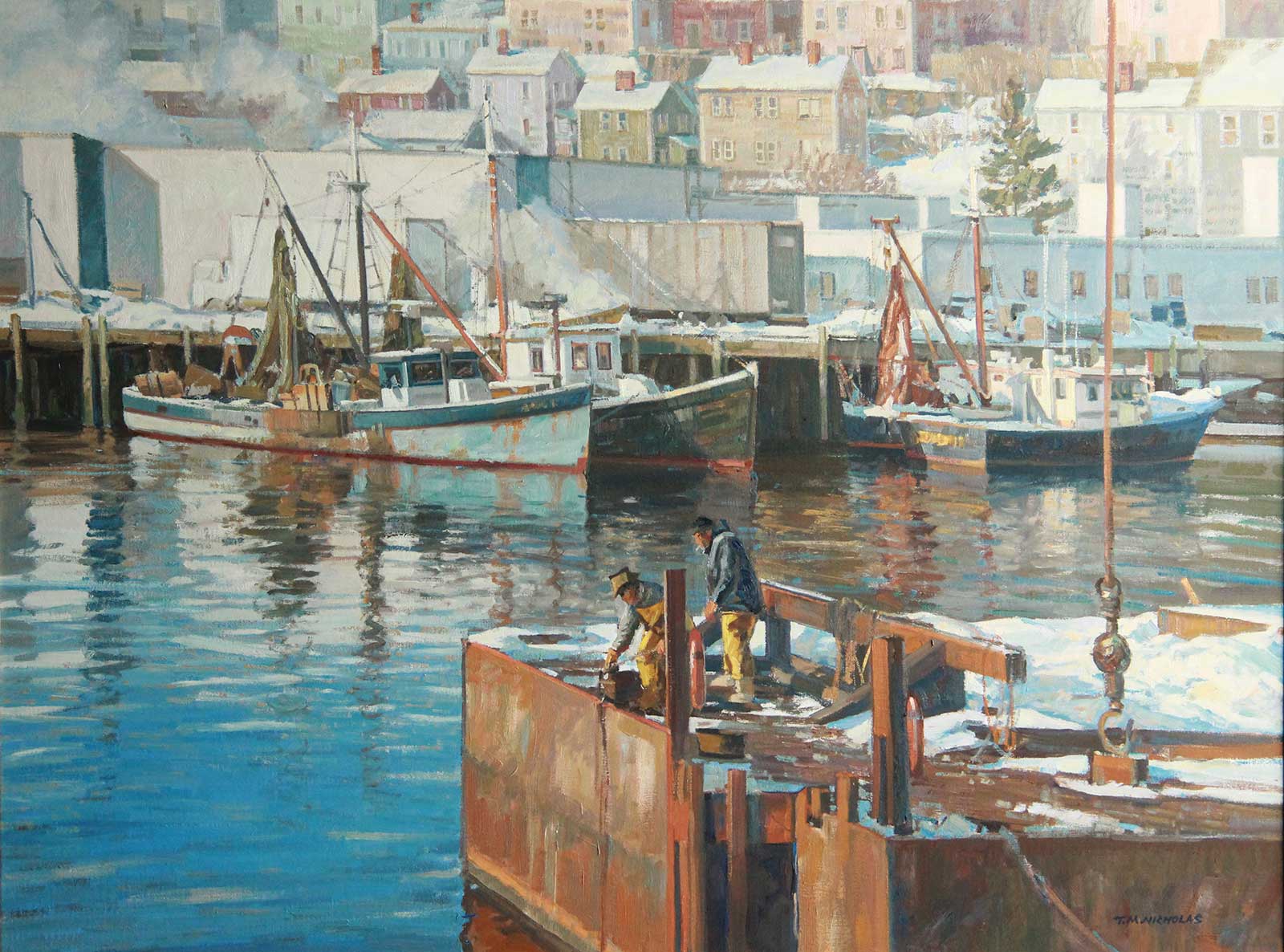 T.M. Nicholas, Gloucester Barger Workers, 2011, oil on canvas, 30 x 40". Collection of Mr. and Mrs. Thomas A. Nicholas, promised gift to the Cape Ann Museum.
Critiques are an integral part of training in the arts as they were in the training T.M. Nicholas received from his father, Tom Nicholas. Tom and his wife, Gloria, moved to Rockport from Connecticut in 1962, attracted by Tom’s interest in the Cape Ann artists. T.M. was born the following year. “I studied with my father because I most respected his work above everybody else’s,” T.M. explains. “He observed very well,” Tom adds. “It’s rewarding to see how he developed after studying with me for two years.”
The father-son team of award-winning artists are the subjects of the exhibition Tom and T. M. Nicholas: A Father and Son’s Journey in Paint at the Cape Ann Museum in Gloucester through April 12.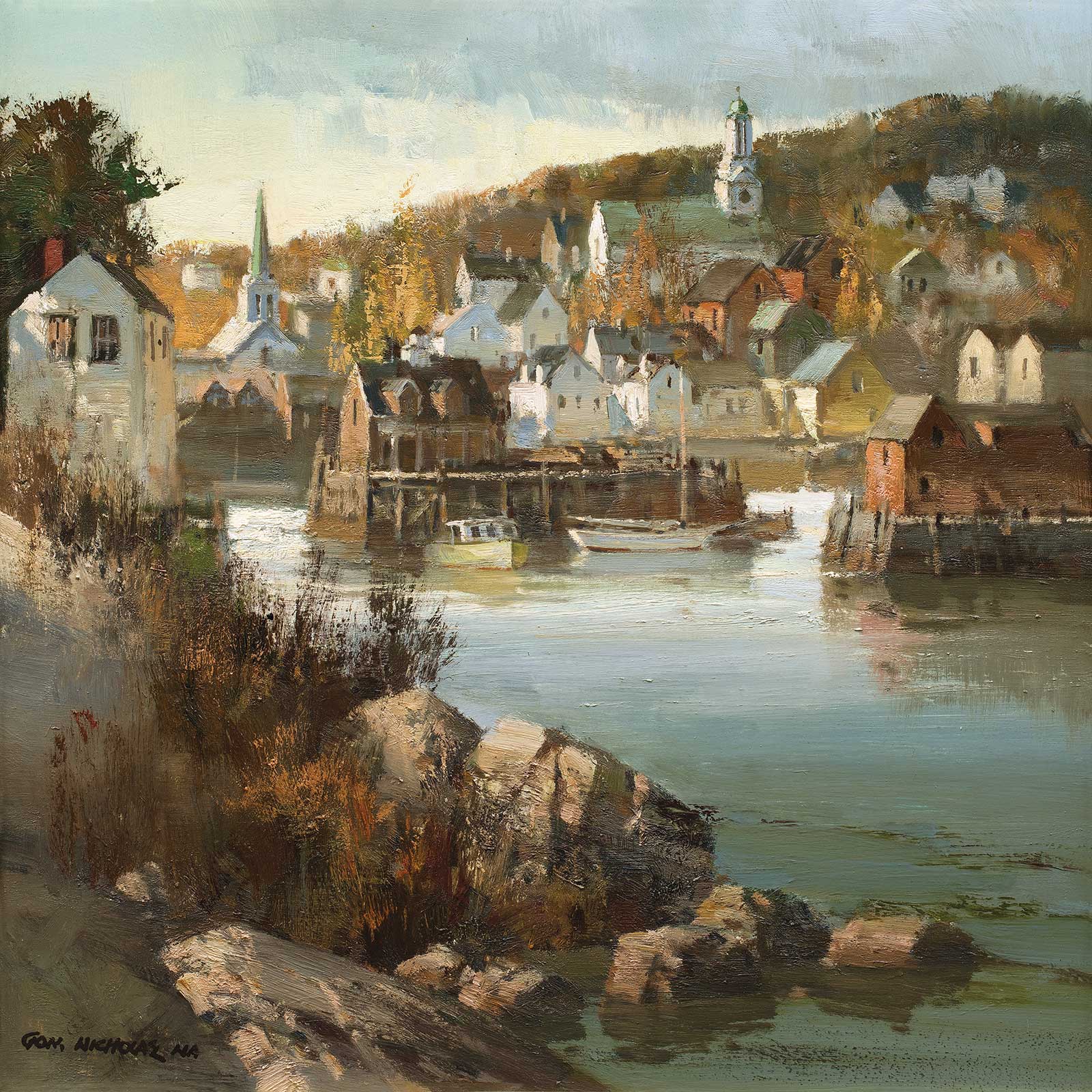 Tom Nicholas, Late Autumn, Rockport Harbor, 2006, oil on canvas, 16 x 16". Collection of Anne and William Newcomb.
When Tom and Gloria moved to Rockport they opened the Tom Nicholas Gallery. After raising their son, Gloria took over as gallery manager. The gallery is open for the season from May to October. She observes that some gallery visitors “don’t know anything about art and others are very knowledgeable. It’s very rewarding. Many artists come in to see Tom’s and T.M.’s work. Tom and I are fortunate to do what he wanted to do in art, to enjoy a good life and to have a son who is part of it.”
Tom studied at the School of the Visual Arts in New York and, in 1961, received a grant from the Elizabeth Greenshields Foundation for two years of travel abroad and in the United States. Both father and son believe in the benefit of travel as T.M. says, “for keeping yourself interested and inspired.” Tom was one of the youngest artists elected to full membership in the National Academy of Design.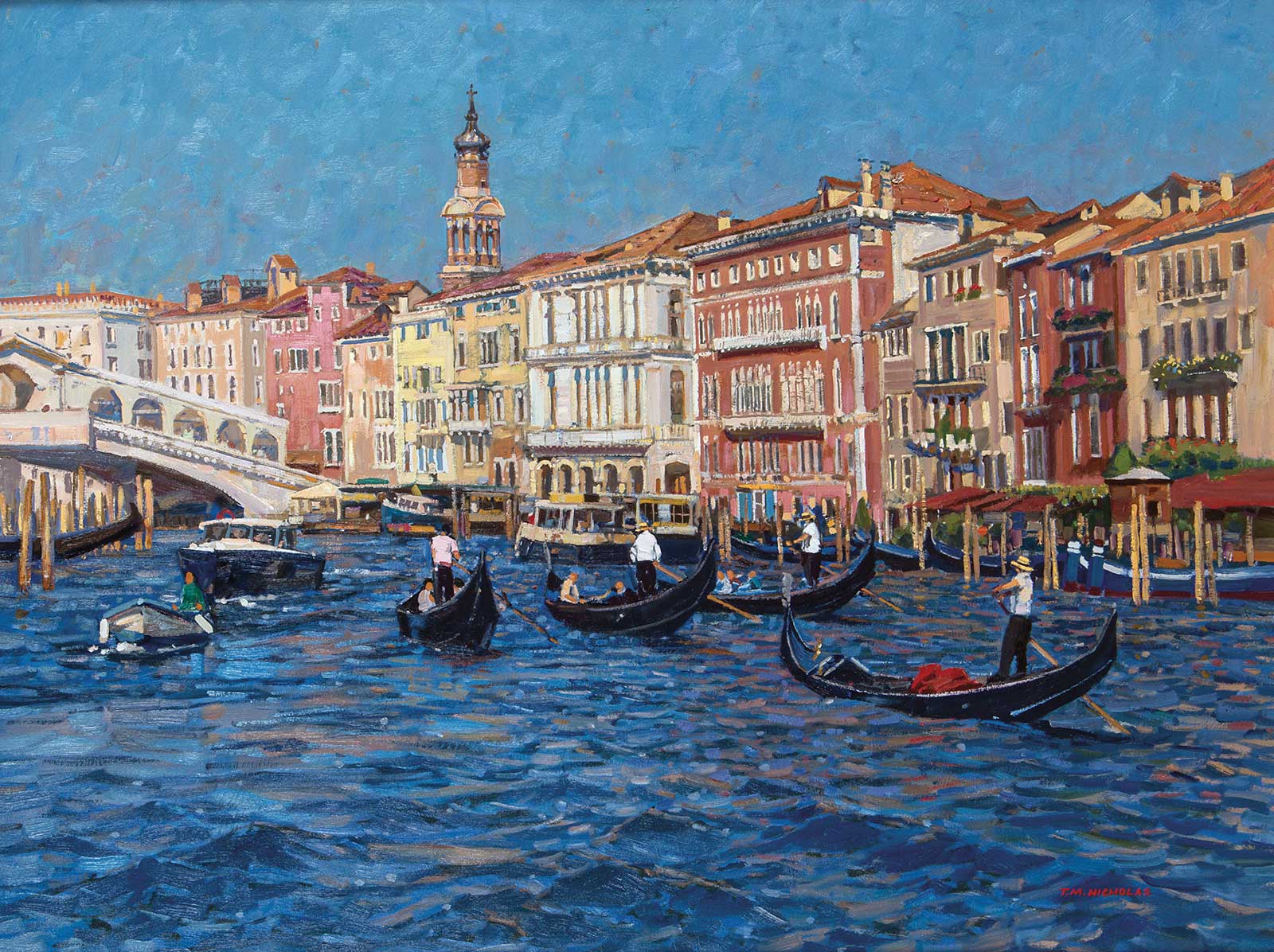 T.M. Nicholas, The Grand Canal, 2014, oil on canvas, 30 x 40". The James Collection. Promised gift to the Cape Ann Museum.
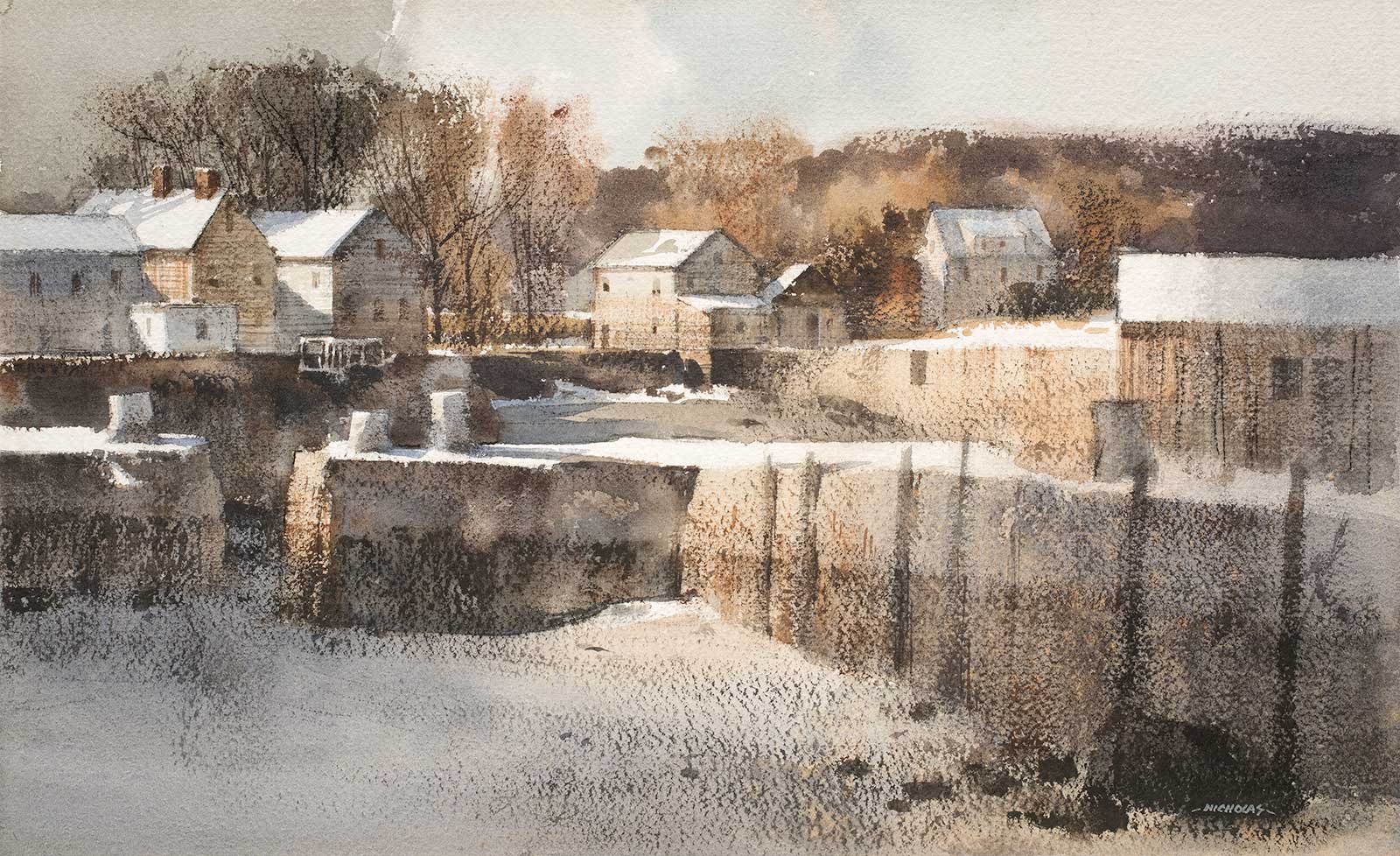 Tom Nicholas, White Wharf, Rockport, ca. 1970s, watercolor, 12 x 19". Collection of Anne and William Newcomb.
He paints in both watercolor and oil often beginning in plein air and finishing in the studio. Tom says, “Composition is the beginning of the inspiration” for his paintings. “And then I take it from there. It’s instinctive whether a subject is more conducive to using oil or watercolor. It depends upon the characteristics of the medium.”
Tom is free with what he includes in his paintings. Commenting on his painting Pigeon Cove, a powerful composition with a large rock anchoring the foreground, he says, “I don’t think that rock was there. I do like to change the subject matter when I paint. I seldom take a subject absolutely as it is. I add things and omit things to make it a more personal concept.” The dark sky contrasts with the low sunlight illuminating a lobsterman carrying a lobster trap along a lane of sunlit and shadowed snow that cuts vertically through two-thirds of the painting. Reiterating the importance of composition he says, “The subject won’t be effective unless your design is proper. Here there’s a strong foreground, middle ground and background.”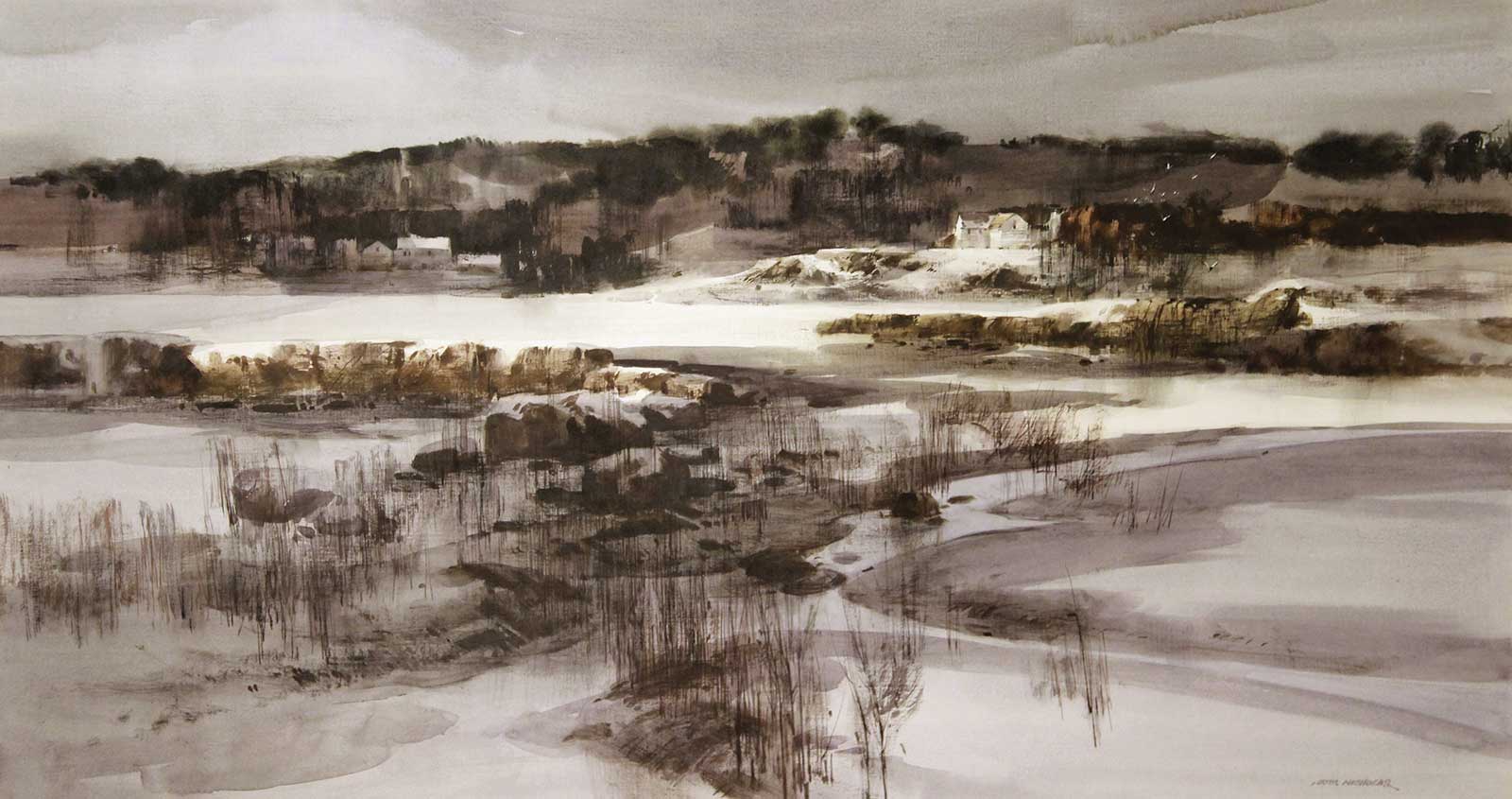 Tom Nicholas, View of the Island, late 1960s, watercolor, 20 x 36". Collection of Mr. and Mrs. Thomas Davies.
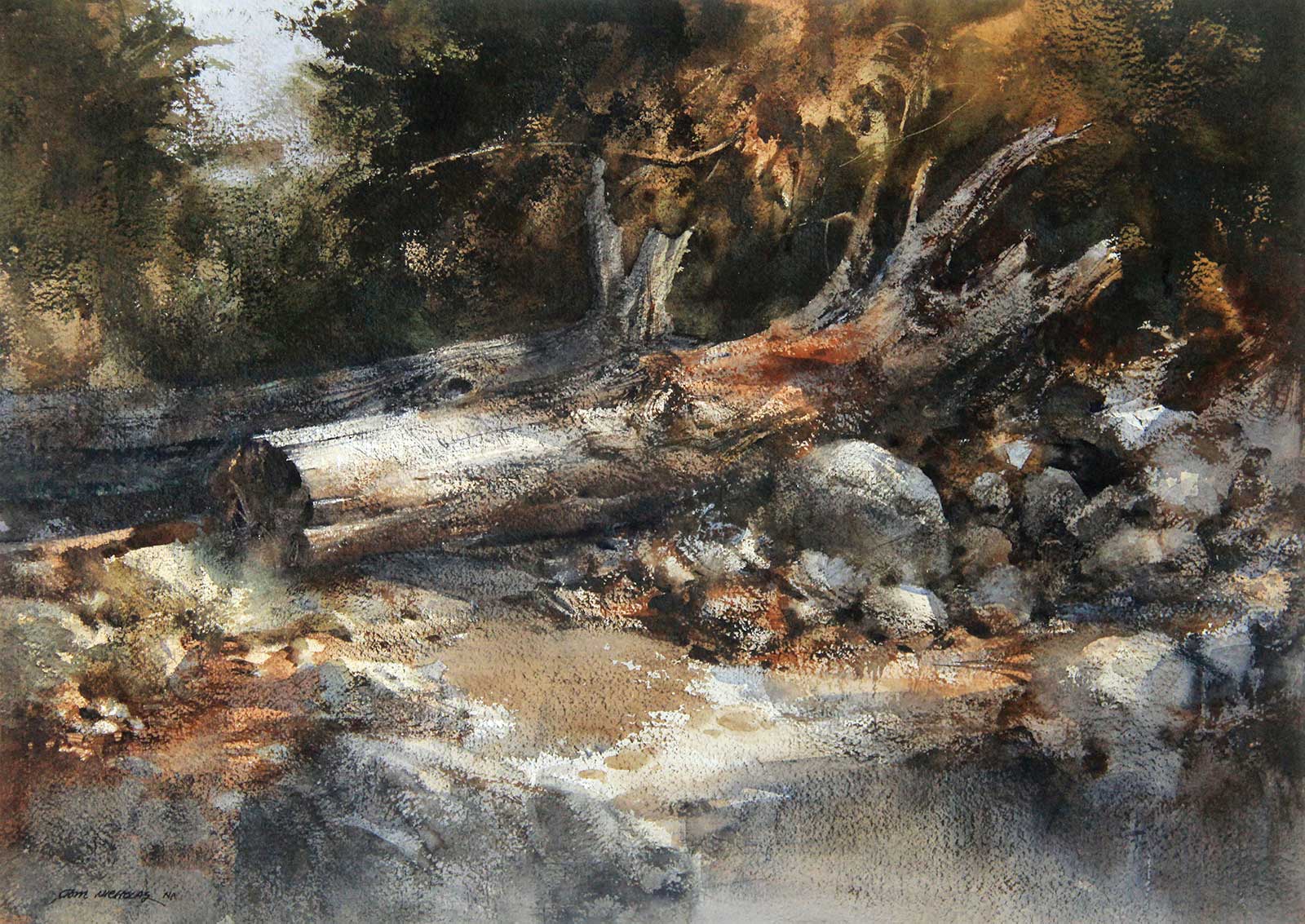 Tom Nicholas, Woodland Shadows, 2007, watercolor, 20 x 28". Collection of Richard and Valerie Beck.
T.M. painted a winter scene, Warming Up, Gloucester, on an early morning visit to the harbor and later in the studio. “I went out to paint with a friend along the docks to see what was happening. I painted the boats and the buildings and some of the smoke. Back in the studio I changed the tonality of the sky to suggest dawn and added the figures to activate the scene. That’s typical of what happens on location. You get what you can and later think of ways to improve it and make it more interesting.”
The Cape Ann artists who came before them inspire both artists. They cite Ted Kautsky, Gordon Grant, Jane Peterson, William Stevens, Willard Metcalf and Mulhaupt. “It’s important not to have just one influence,” T.M. explains. “They painted the same things we’re painting, the New England landscape. We see how they handled it and learn from it.”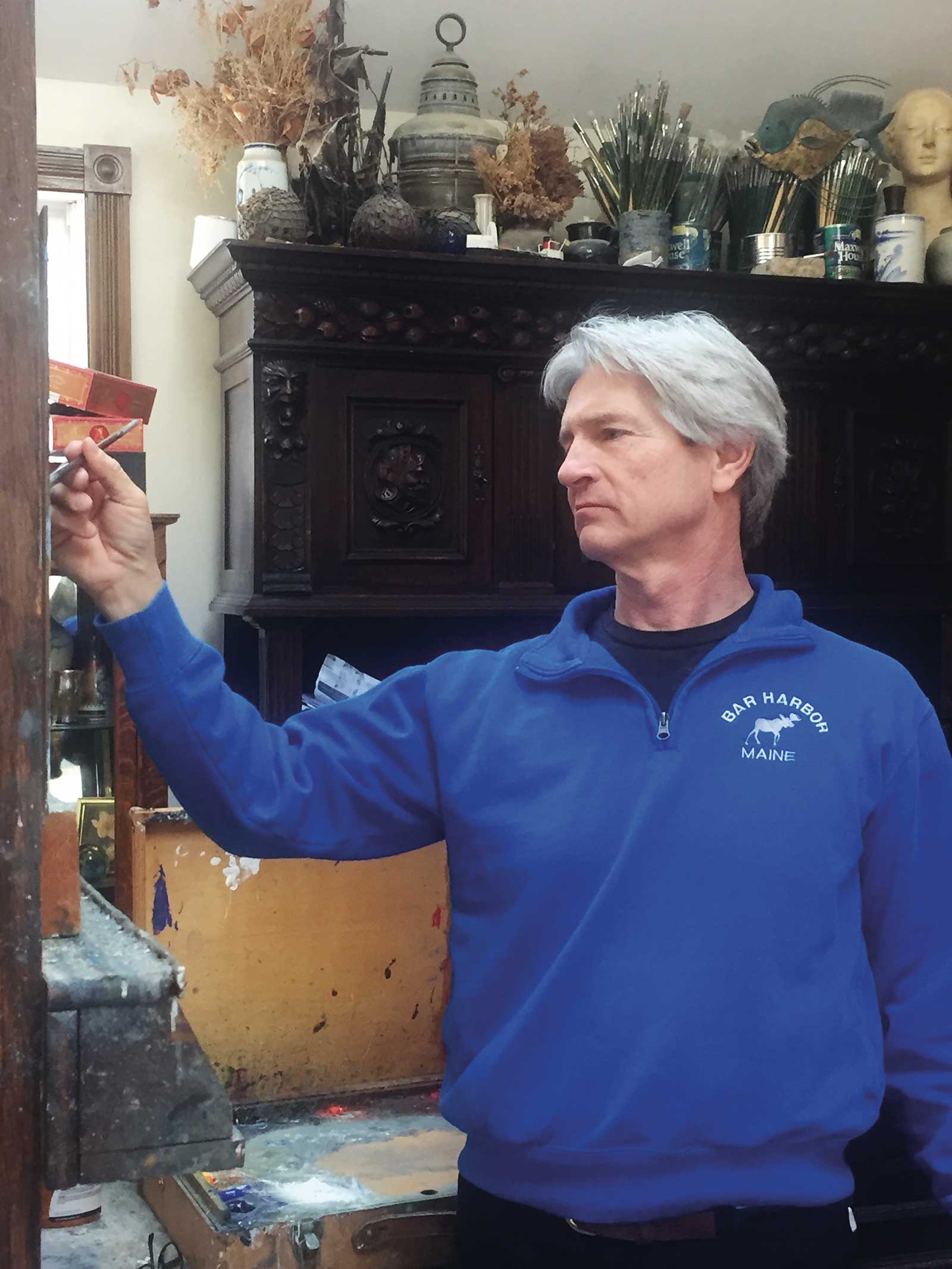 T.M. Nicholas.
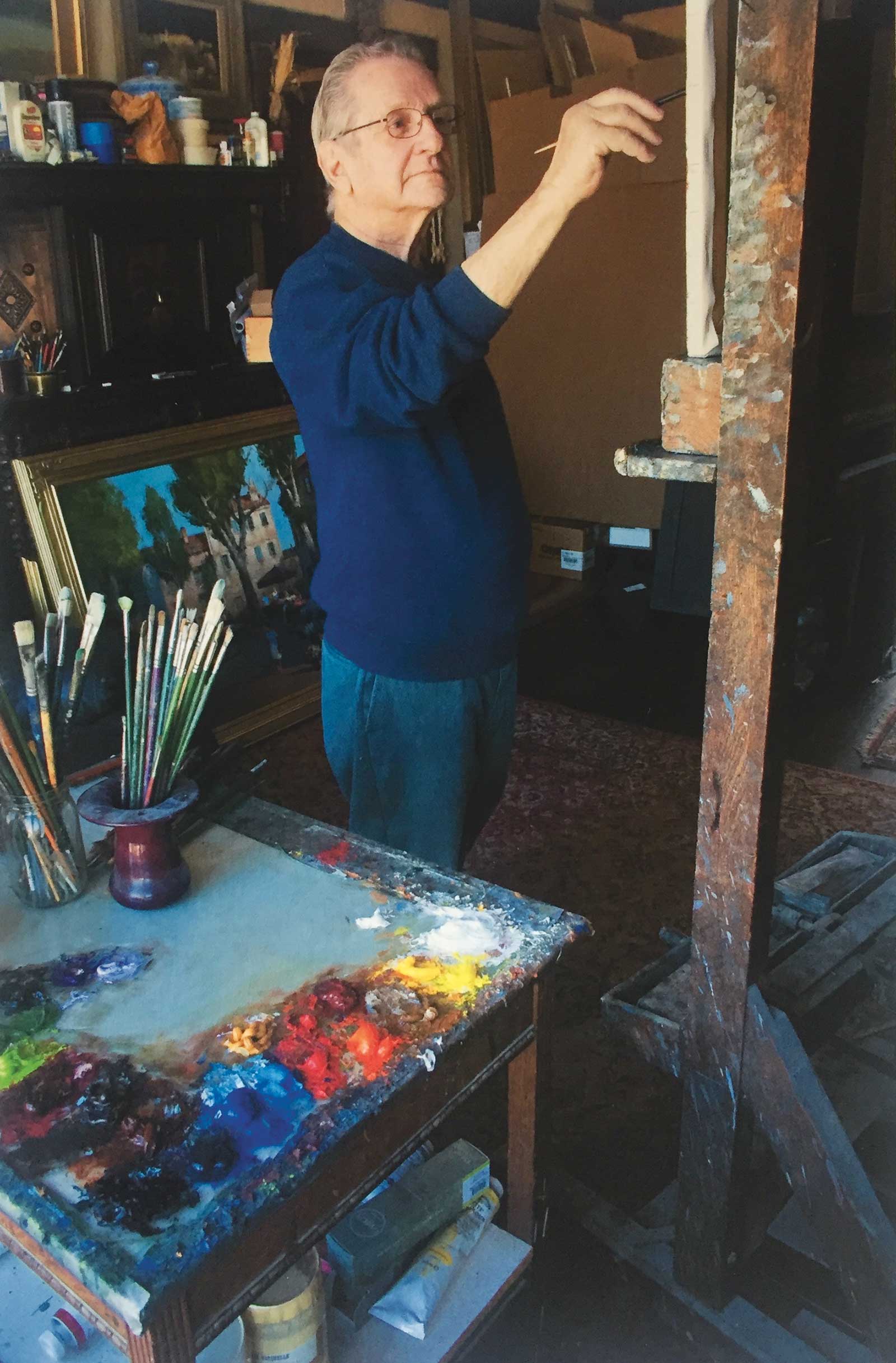 Tom Nicholas.
The artists, collectively known as the Cape Ann School, painted in a variety of techniques, perhaps the most prevalent being impressionism. T.M., who also studied with the contemporary impressionist John Terelak, notes “the subject should dictate the treatment,” painting more impressionistically at times and less so at others.
Metcalf told his students, “Paint what you see and forget your theories.” —
Tom & T.M. Nicholas: A Father and Son’s Journey in Paint
When: Through April 12, 2020
Where: Cape Ann Museum, 27 Pleasant Street, Gloucester, MA 01930
Information: (978) 283-0455, www.capeannmuseum.org
Powered by Froala Editor