
The magic realist painter Paul Cadmus (1904-1999) died five days before his 95th birthday. I knew him well and he was a friend and mentor to Michael Bergt. I had discovered Bergt’s figure drawings and egg tempera paintings of myths and the human condition while delving into Cadmus’ oeuvre. When Bergt and I first met, we commiserated over the loss of our mutual friend.
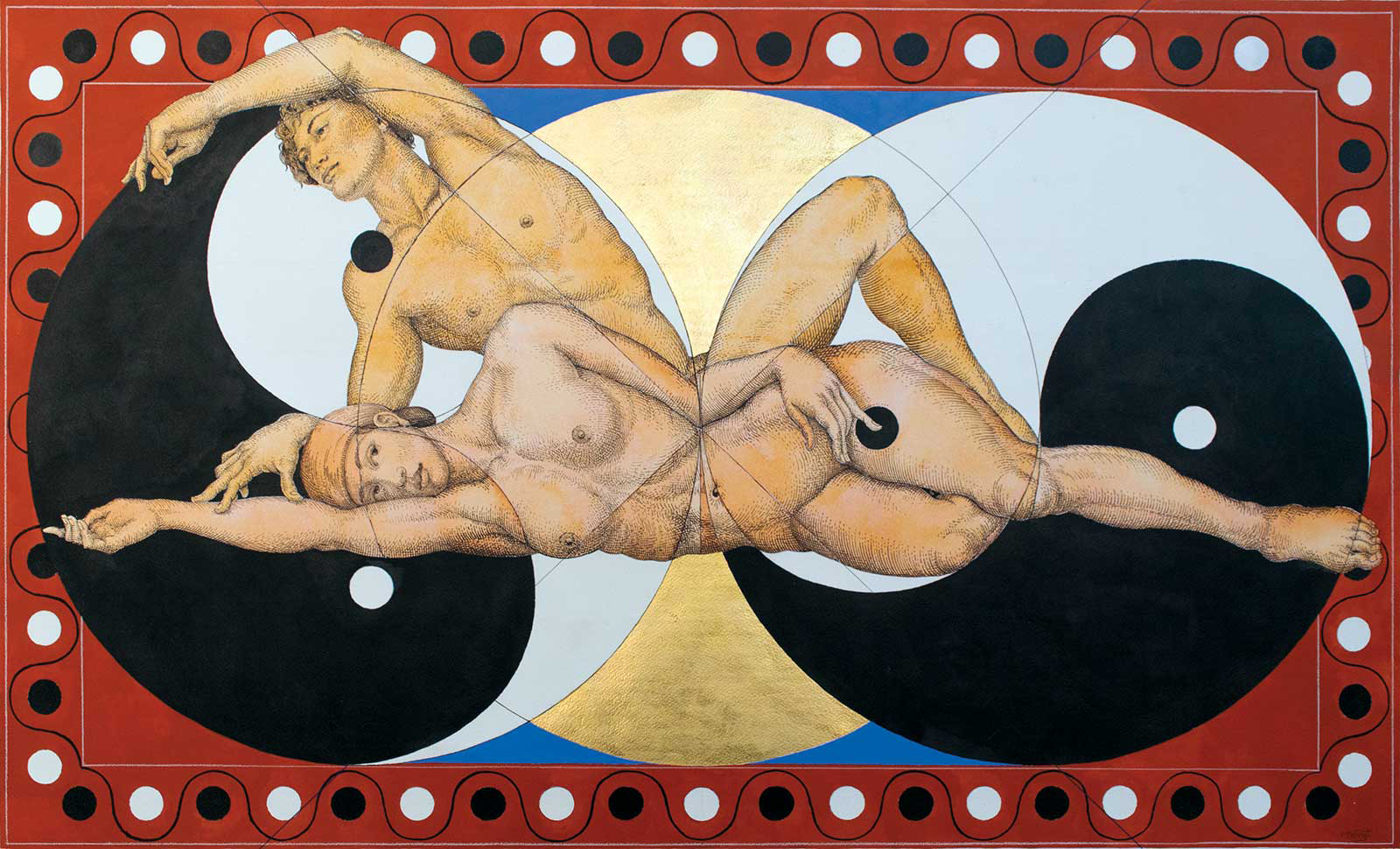
Yin Yang / Particle Wave, ink, gouache and gold leap on paper, 24 x 40 in.

In 1993, Cadmus had written an introduction to the exhibition catalogue for Michael Bergt: A Delicate Balance at Midtown Payson Galleries in New York. It began, “Michael Bergt. Here is an artist who is very serious indeed, one who believes that ART, his own certainly, should prod,
should point out, should arouse thoughts, should make the viewer cogitate. Even if unwillingly. The works must definitely not be merely decorative, merely pleasing, merely a background for an owner, nor something that can be passed by with a ‘How Nice!’, ‘How charming!’, ‘How well it fits!’, ‘What color, what pattern!’ No. He is concerned with the state of our world.”
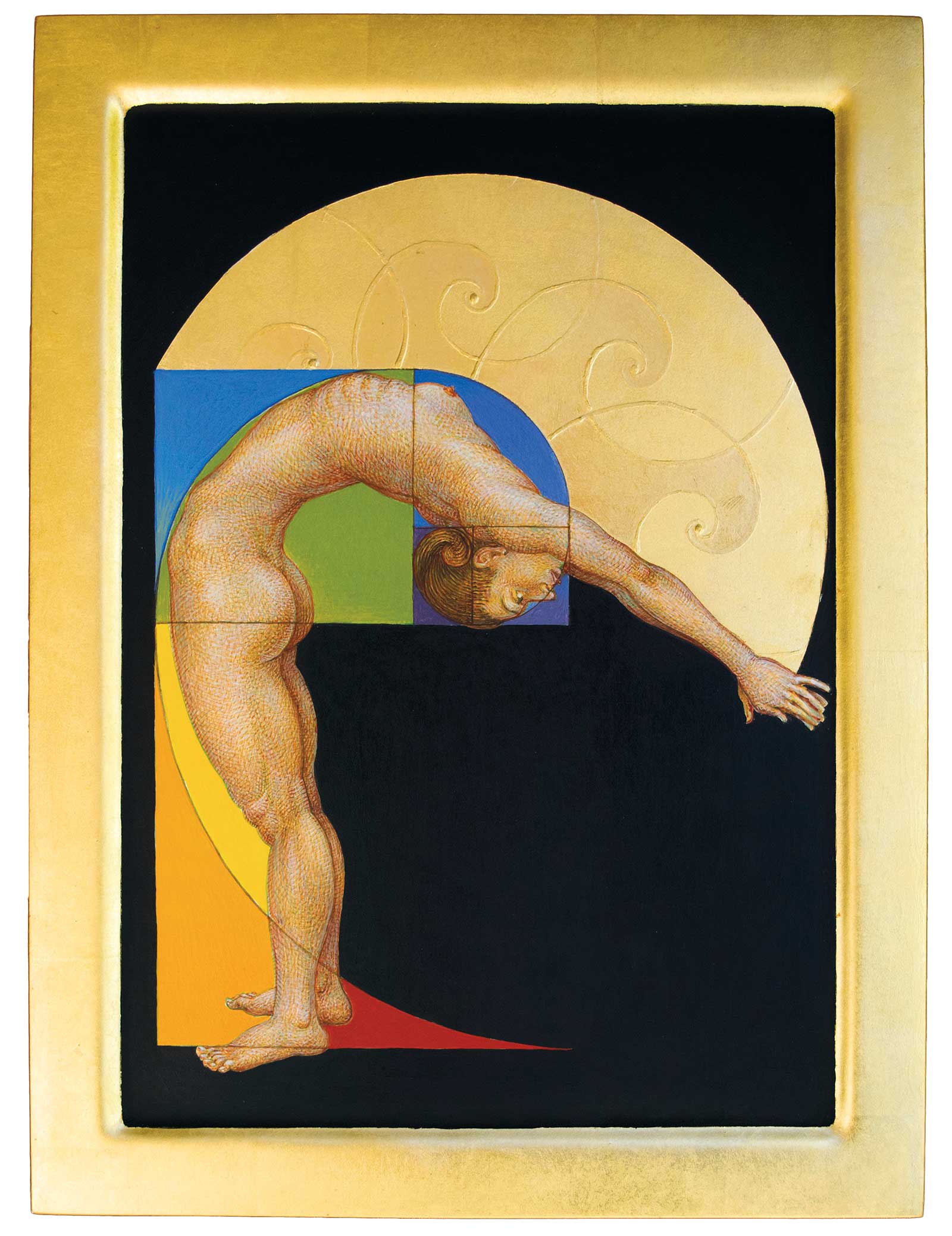
Expansion, 2026, egg tempera, gold leaf, 15 ¾ x 11 ¾ in. NüArt Gallery, Santa Fe, NM.
In 2001, I included Bergt’s work in the exhibition Re-presenting Representation V at the Arnot Art Museum in Elmira, New York, and in 2006, curated his mid-career retrospective, Crossing Lines, at the Arnot. The following year I retired from the museum world and moved into a casita on a property that adjoined Bergt’s studio in Santa Fe, New Mexico.
It’s a rare gift to be able to follow an artist’s career so closely—to watch techniques and ideas become more defined and the exploration of the inner world and the outer world grow deeper.
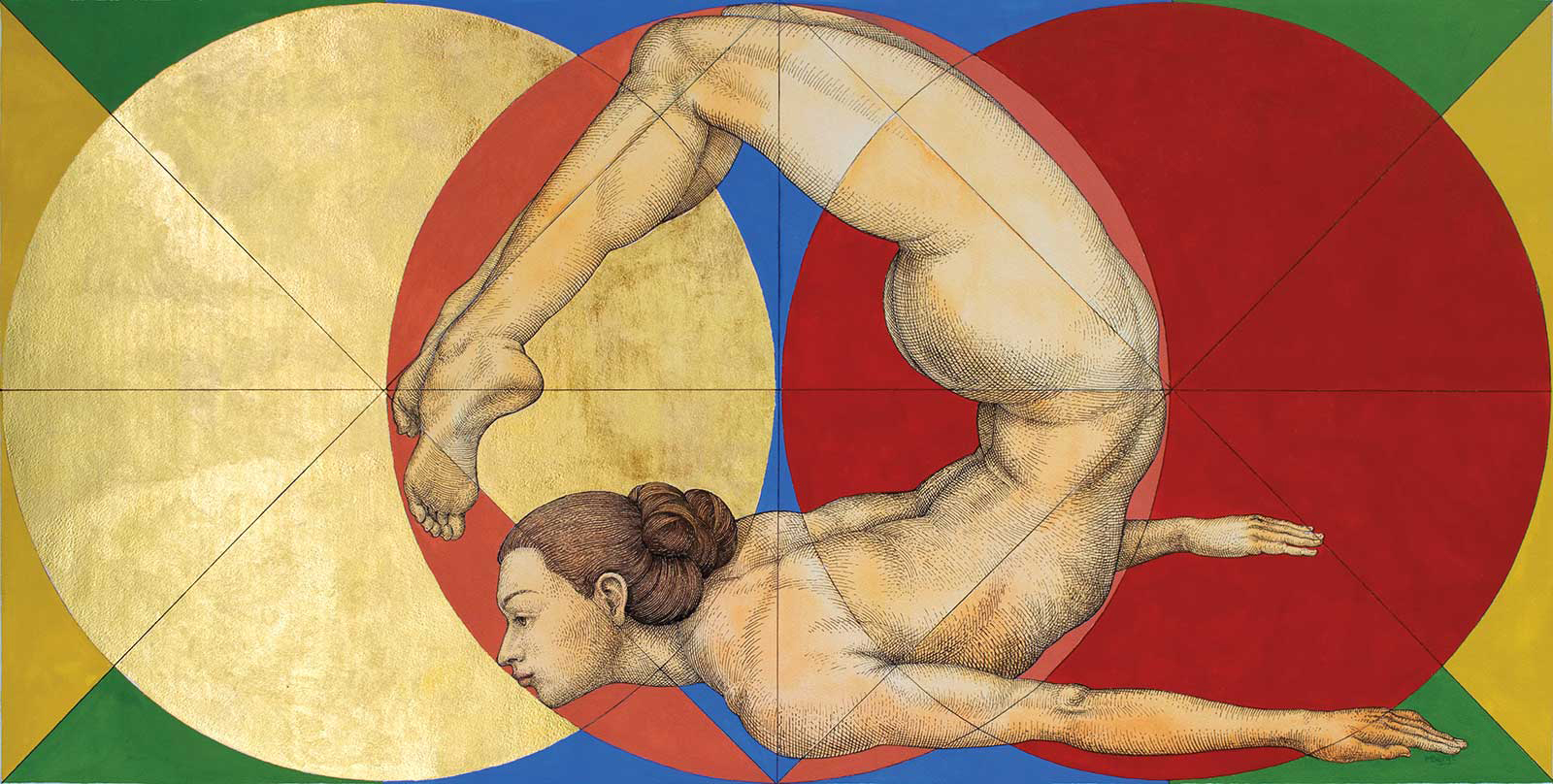
Accepting the Challenge, 2026, color pencil, gouache and gold leaf, 20 x 40 in. Courtesy NüArt Gallery, Santa Fe, NM.
He describes his career concisely. “Over the years, my work has been about recording the world around me. First, by creating stylized interpretations of that world to reflect our process of pattern recognition. Later, into archetypes and narratives that held historic references. Then, moving into more political imagery, using satire and metaphor to represent the human condition. Realizing all of that was pointing to something external, I became more interested in our own psyche, how our inner world affects how we see and interpret the ‘outer’ world.”
In 2007, he and the philosopher Ken Wilber recorded a conversation about Bergt’s art in relation to Wilber’s Integral Theory, which maps human development, consciousness and culture. The recording is available on Bergt’s website.
Bergt’s reading and research into the erotic prints of Japanese Shunga resulted in his own Shunga series. “Seen out of context,” he explains, “Japanese Shunga images have often been dismissed as simply pornographic instructional manuals. However, major artists were commissioned to produce these works to help cultivate an erotic ideal. Utilizing an aesthetic that incorporated Eastern philosophy, these artists created erotic images depicting the individual playing in a field of opposites.
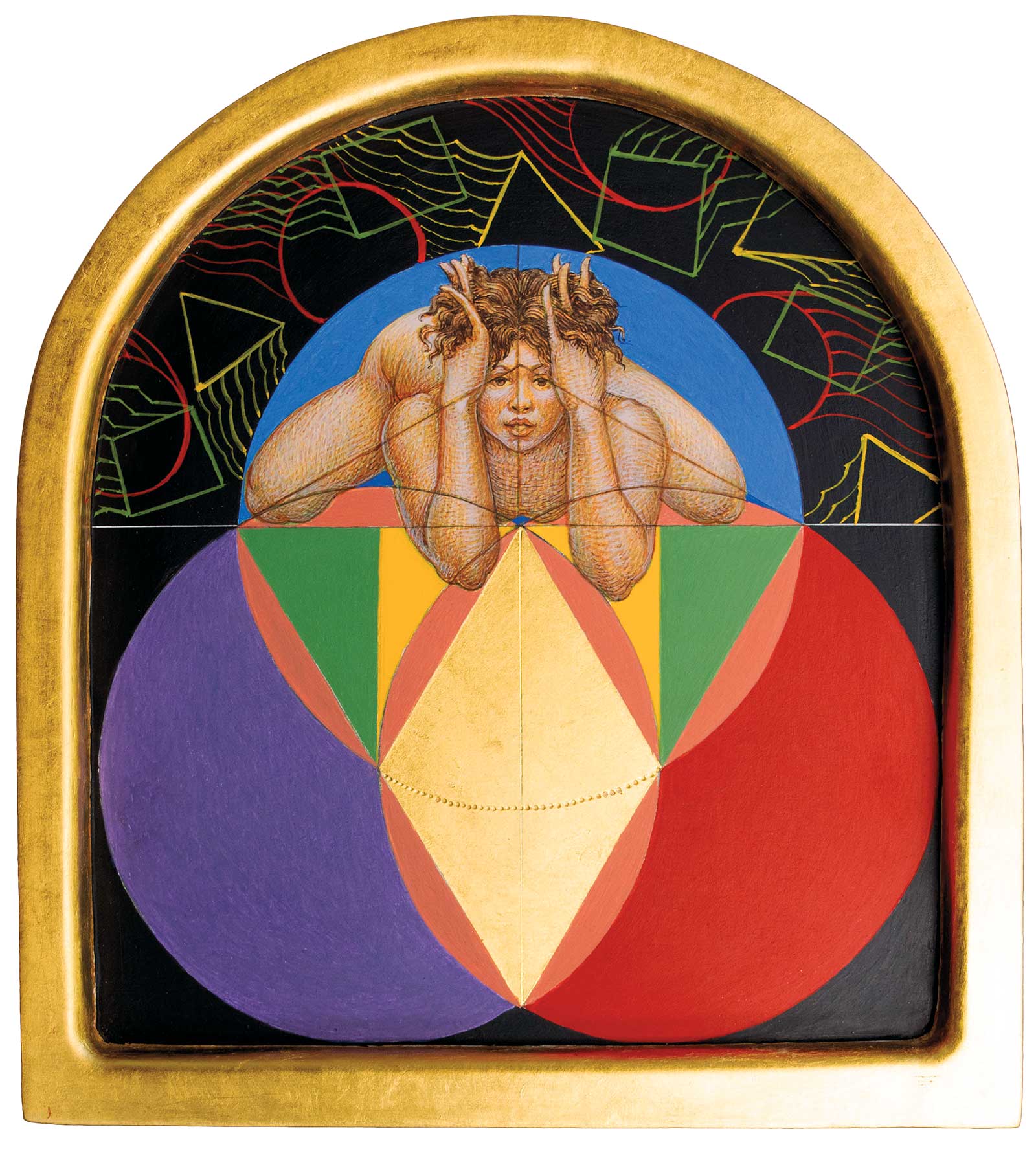
Seeking Coherence, 2026, egg tempera and gold leaf, 11¼ x 10 in. Courtesy NüArt Gallery, Santa Fe, NM.
“The play of opposites was a well-known concept throughout the East. In China, the I Ching, or Book of Changes, had taught these principles from ancient times. The symbol of yin/yang demonstrates this basic tenet through the opposition of male and female.”
His latest work will be shown at NüArt Gallery in Santa Fe, September 25 through October 17, in an exhibition titled Alignment and Frequency.Underlying the new paintings is a theory of the engineer and futurist, Nikola Tesla (1856-1943). “If you want to find the secrets of the universe, think in terms of energy, frequency, and vibration.”
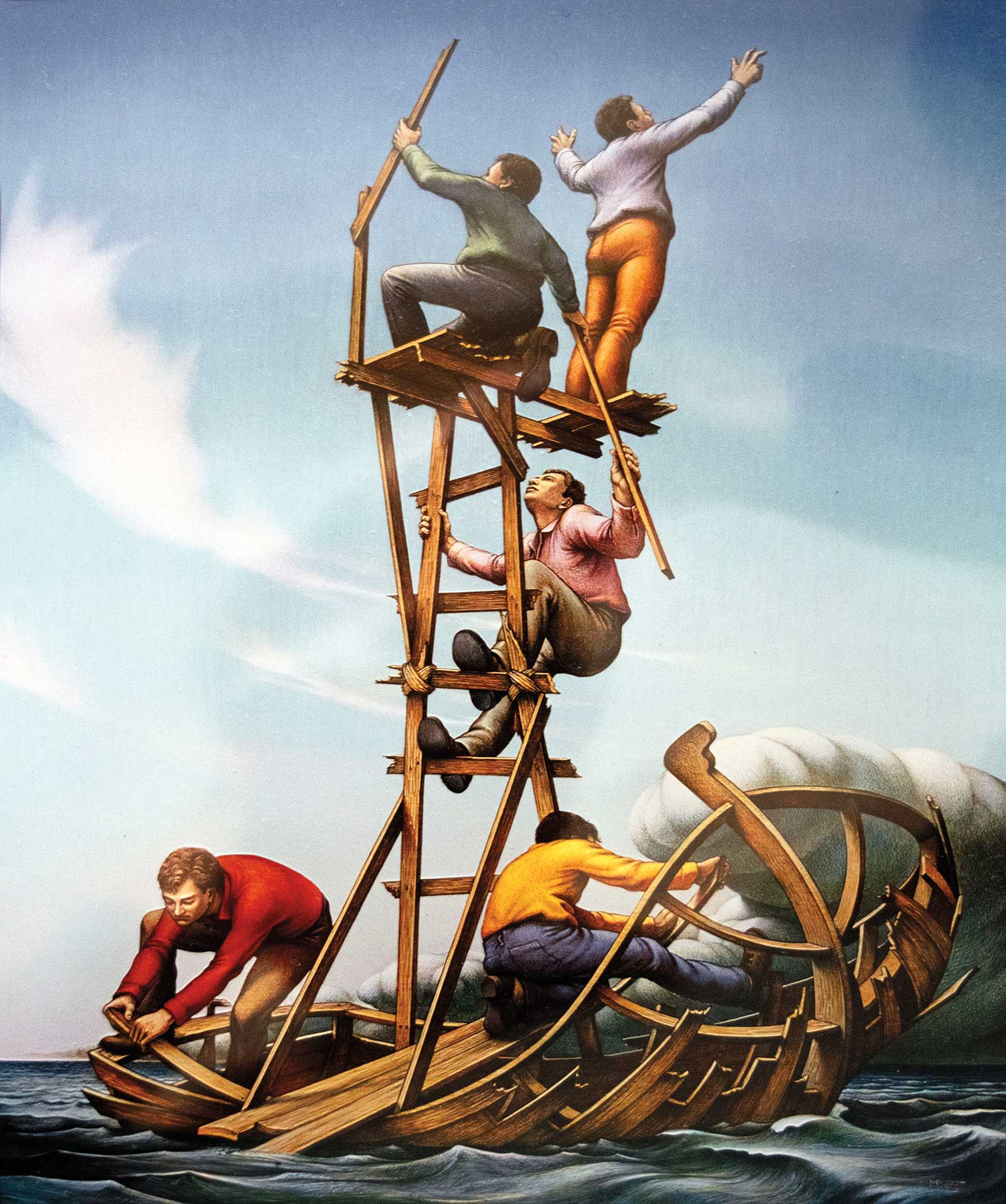
The Platform, 1993, egg tempera, 24 x 20 in. Private Collection.
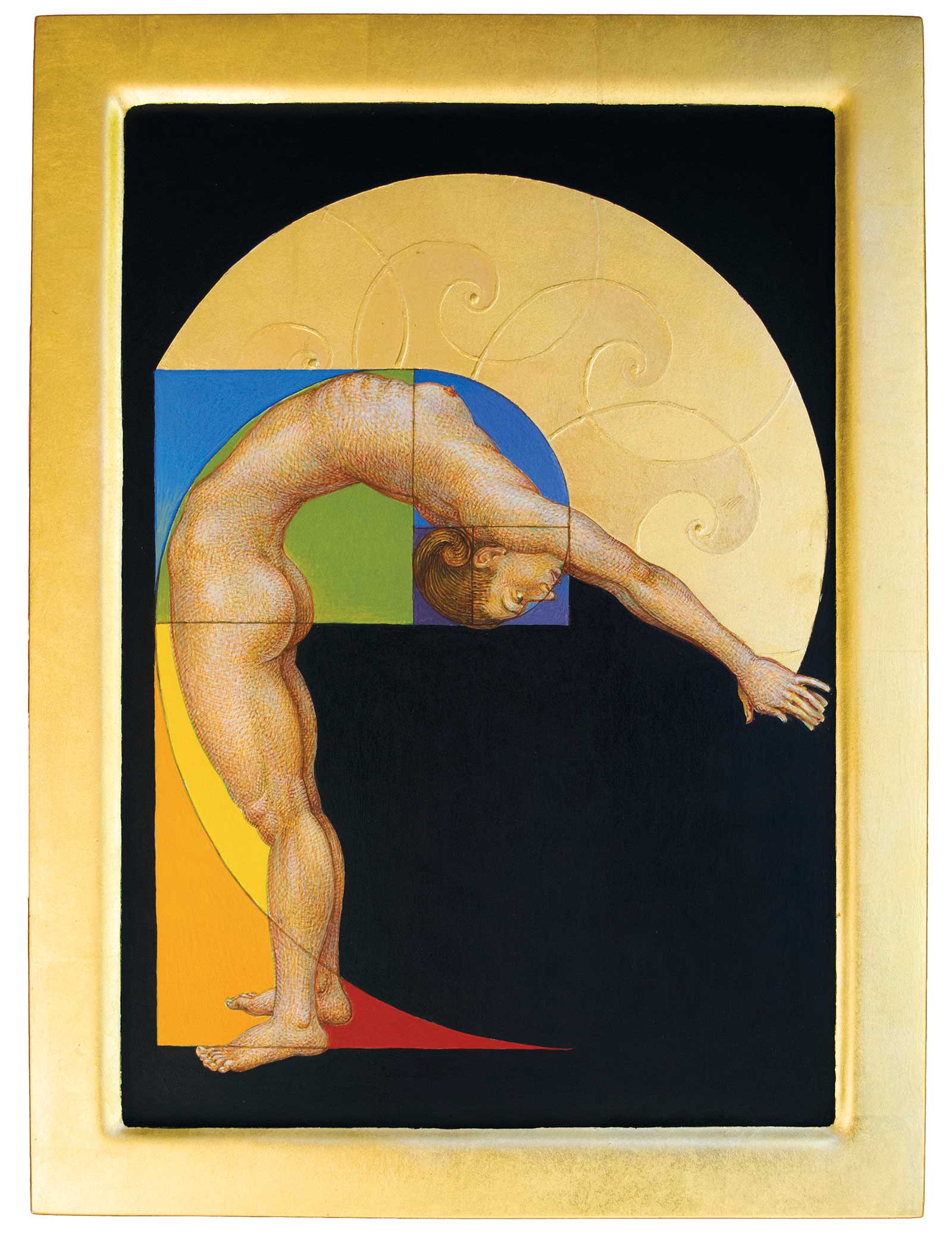
To give us a pathway into his other work, Bergt explains the elements in his recent painting, Expansion. “This is part of the series Alignment and Frequency, which presents a figure performing a standing back bend. Aligning with that figure is the spiral of the Fibonacci sequence, a mathematical pattern where each number is the sum of the two preceding numbers (0, 1, 1, 2, 3, 5, 8…). The spiral begins behind the figure and moves through the figure, tracing the form and circling around to contain the head and hair. To create the spiral in that sequence, a series of squares whose side lengths are successive numbers known as the golden ratio adjoin one another. Each square contains an arc that meets with the next square to create the spiral. That spiral is known as the pattern for growth—the nautilus pattern.
“The colors represent an alignment with frequencies of higher states of being. But the expansion doesn’t stop there. The result of this alignment is the sweep of the arm forming the gold leaf arc above the body, containing a series of raised gold spirals. The gold field represents a transcendent ethereal space, the pattern of the spirals now represent growth beyond matter, time and space.”
Higher Self, 2026, egg tempera and gold leaf, 9 x 11¾ in. Courtesy NüArt Gallery, Santa Fe, NM.
Another of the paintings in the exhibition is Yin Yang/Particle Wave combining male and female figures with the ancient yin/yang symbols and, around the edge, a reference to contemporary quantum mechanics. In the yin/yang, the circle represents the cyclical nature of the universe. The dark side (yin) is associated with shadow and femininity, among other things, and the light side (yang) is associated with sunlight and masculinity. The contrasting dots show that everything contains its opposite.
Bergt explains, “In quantum mechanics, the double-slit experiment determines the particle/wave duality—when observing and measuring the wave, it collapses into a particle. The border of this image is a wave pattern with the dots (particles) blinking in and out as the wave moves around them. The two figures are male and female touching and twisting to occupy the swirling forms of the yin/yang pattern. The fundamental structure of all manifestation is surrounding the figures, and we are the observers collapsing that potential into experience.”
In recent paintings like Accepting the Challenge,he has been “juxtaposing sacred geometry and the color spectrum with the body. What I composed in this piece is more a narrative beyond the figure simply fitting into a geometric shape. There are three circles: one gold (a higher state), the center circle (an overlapping of two circles), and the red circle (a primary color). The movement is from a primary state, through the challenge of the center circle into the higher state. As difficult and challenging as the pose is, it’s a metaphor for migrating from one state to another.
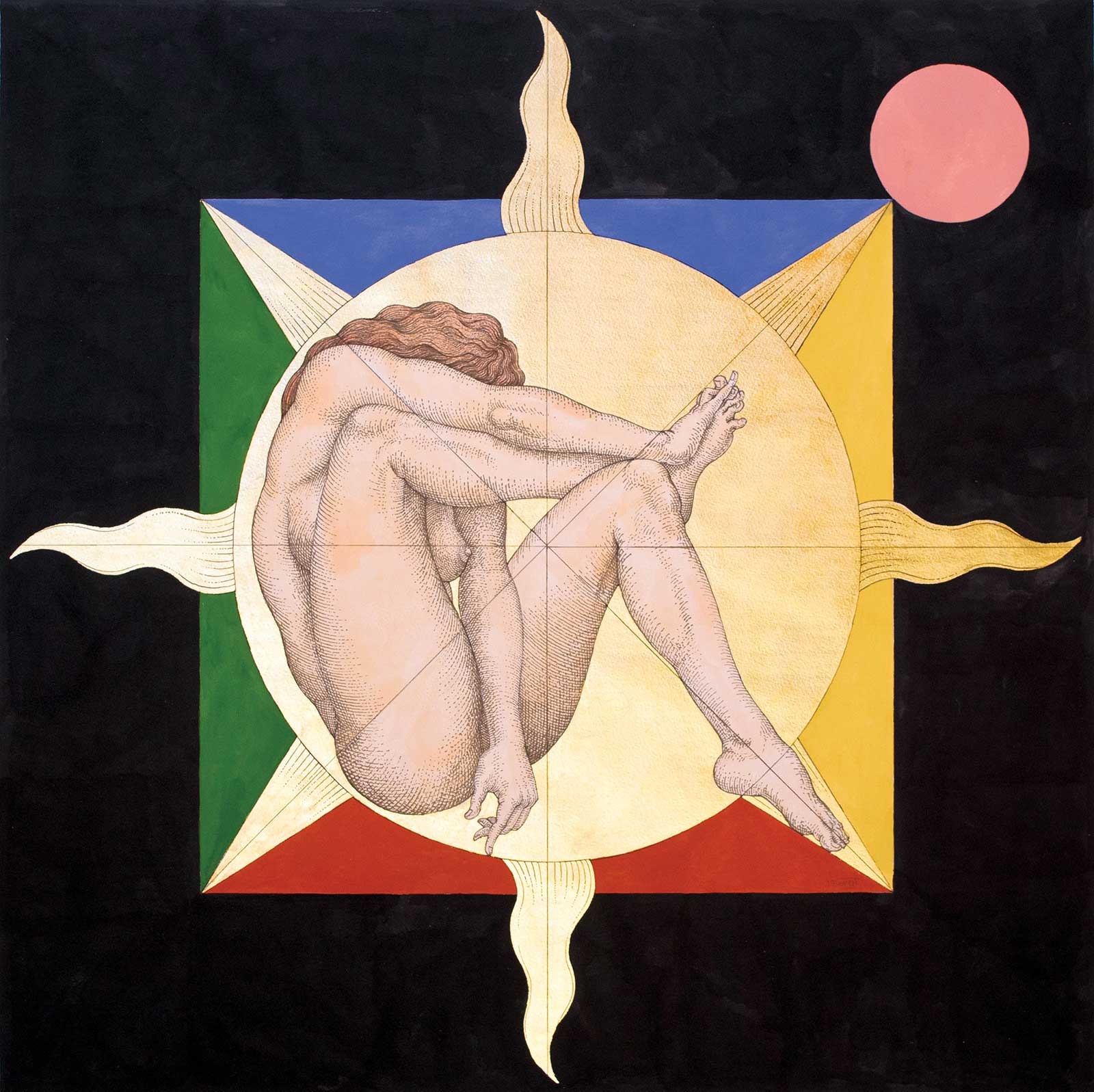
Inner Alignment, 2026, color pencil, gouache gold leaf, 28 x 28 in. Courtesy NüArt Gallery, Santa Fe, NM.
“I use the primary colors: red, yellow, blue, and the three primary shapes: circle, square, triangle as the basic elements of this journey. Accepting the challenge, is to negotiate these elements to reach a higher state. What is amazing, is how the body can fit the challenge and experience transformation.
“In my recent work I’ve become fascinated with manifestation,” he continues, “finding a way to depict how creation happens. For this, both the spiritual and the scientific are important.”
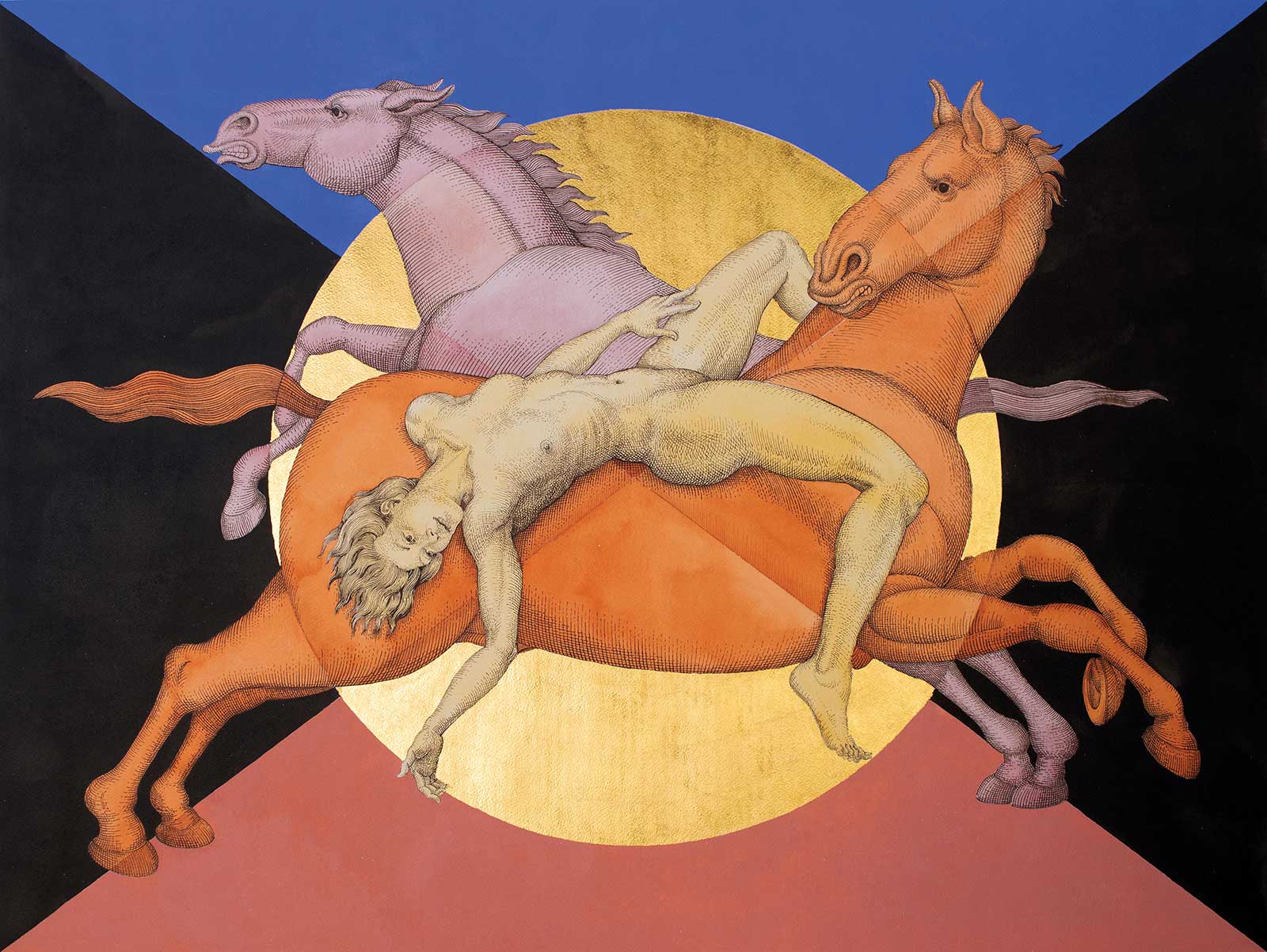
Letting Go, 2026, color pencil, gouache and gold leaf, 30 x 40 in. Courtesy NüArt Gallery, Santa Fe, NM.
Sacred geometry attributes spiritual meaning to geometric shapes, exploring the mathematical harmony underlying the natural world. “For me,” Bergt explains, “sacred geometry becomes a pattern representing the quantum leap of consciousness into matter, for example, the DNA spiral. If we could visualize a bridge from matter to consciousness, it would look like sacred geometry. That’s why so many churches, sacred sites, and mandalas are based on sacred geometry. There’s an understanding of the underlying principles that make up our world.”
When he completed his recent painting Seeking Coherence, he realized it could be a bridge to his early political imagery. “I loved creating those pieces,” he says, “because satire can be a very powerful tool for self-reflection. [I’ve included here an image of his 1992 egg tempera painting, The Platform, for reference—a painting full of hubris and ego…and humor.]
“What I realized evolved within this recent piece, was the satire wasn’t about our actions as much as our capacity for awareness—our ability to sense a greater alignment, to know we can achieve a higher frequency. But the world we confront is filled with distractions and more information than we can process so it requires a new kind of mindfulness.”
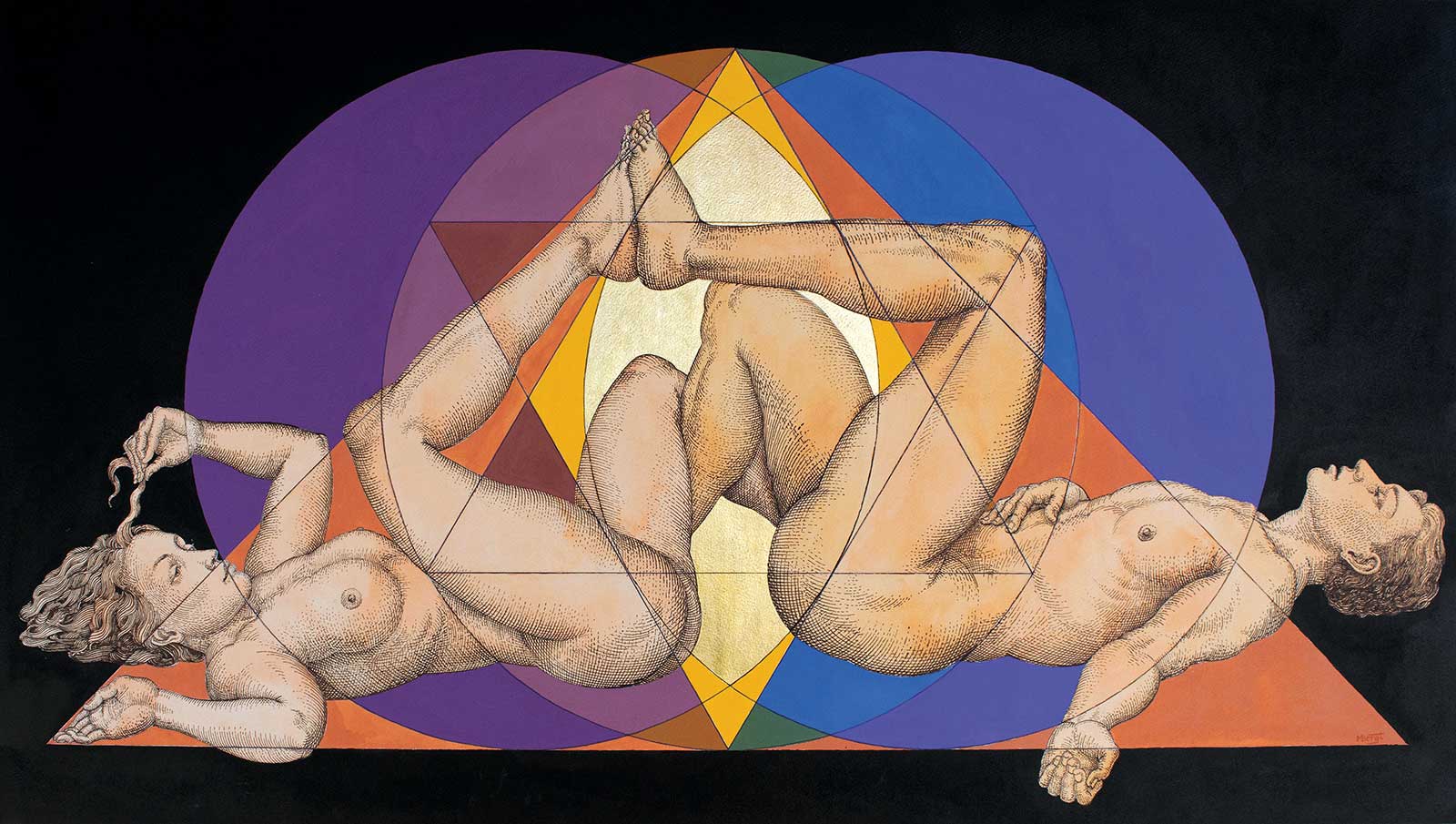
Finding Alignment, 2026, color pencil, gouache and gold leaf, 22½ x 40 in. Courtesy NüArt Gallery, Santa Fe, NM.
Over 30 years ago, Cadmus wrote that Bergt knew his art “should prod, should point out, should arouse thoughts, should make the viewer cogitate.” And he added, wisely, “Even if unwillingly.”
Bergt’s paintings, drawings and sculptures have always prodded and encouraged reflection. There has always been a throughline—one that began before him and that will continue after him. His paintings and drawings are not always “easy” although they can be admired and appreciated simply from an aesthetic perspective. It is their ability “to make the viewer cogitate” in a time when art has an important role in making us aware, hopeful and forward thinking. —
Alignment and Frequency
September 25-October 17, 2026
NüArt Gallery 670 Canyon Road, Santa Fe, NM 87501
(505) 988-3888, www.nuartgallery.com
Powered by Froala Editor