
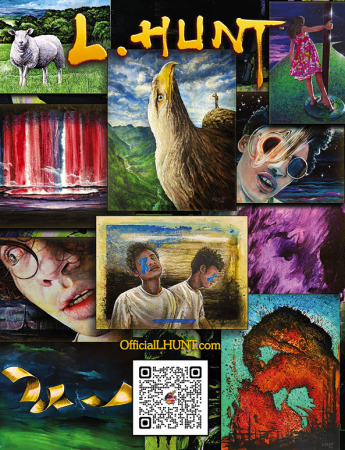
L.HUNT Gallery
7118 Twinspur Ct.Eastvale, CA 92880
951-893-7949
Email this Gallery
Visit Gallery Website
L.HUNT Gallery
9/1/2026 - 9/30/2026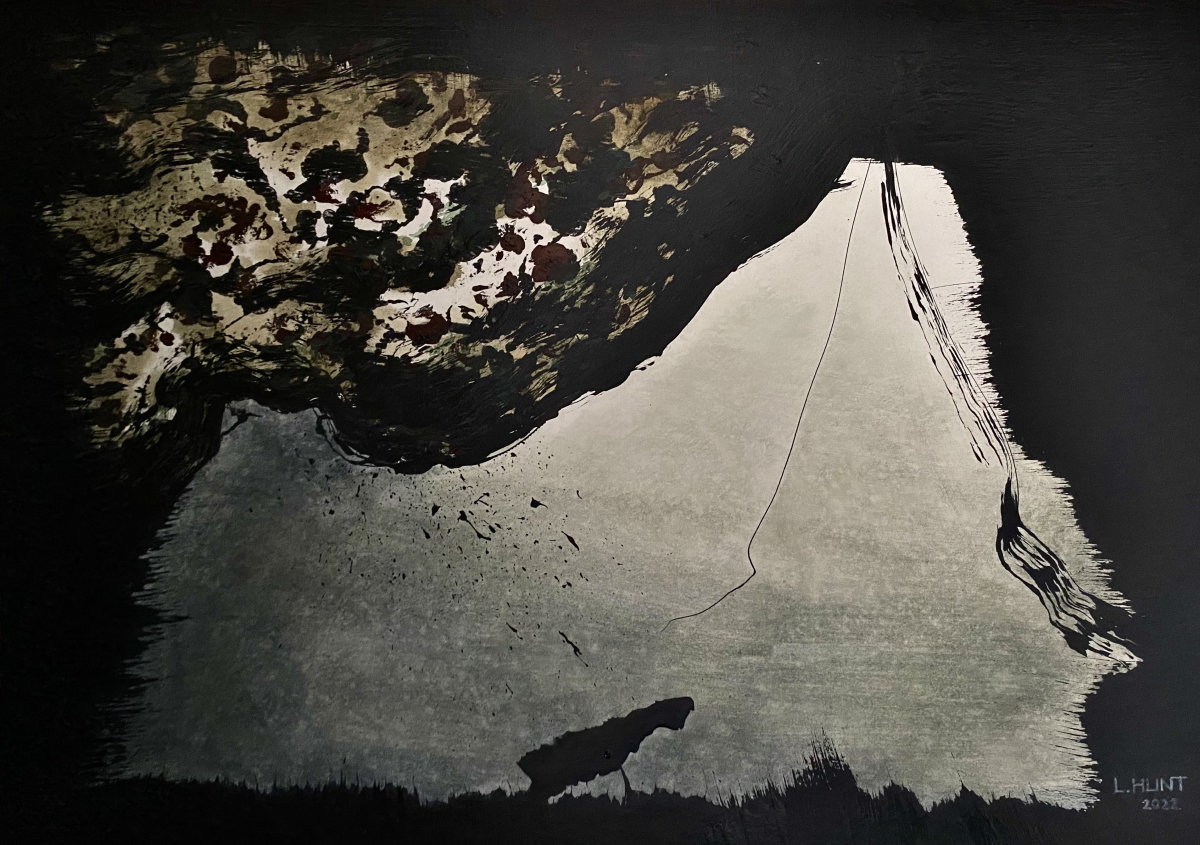
Abyss
L.HUNT
Acrylic on Paper
14 x 20 inches (L x W)
In "Abyss," the ocean becomes a realm beyond human knowledge, descending into a submerged cavern where sunlight has never reached and the familiar laws of the surface seem to disappear. Out of the surrounding blackness emerges the suggestion of a strange creature, its form only partially revealed against the pale, ghostly opening of the deep, as though we have caught a fleeting glimpse of something never meant to be seen. The rough, fractured textures above resemble ancient rock encrusted with the remnants of an unknowable landscape, while the sweeping darkness presses inward from every side, emphasizing the crushing isolation of the depths. The creature is not presented as a monster so much as a mystery—one of countless forms of life that may inhabit trenches, caverns, and abysses too remote and too dark for any human being to fully explore. "Abyss" imagines the ocean not as an empty wilderness, but as an immense hidden kingdom, filled with unseen lives continuing in silence beneath miles of water, indifferent to whether mankind ever discovers them.
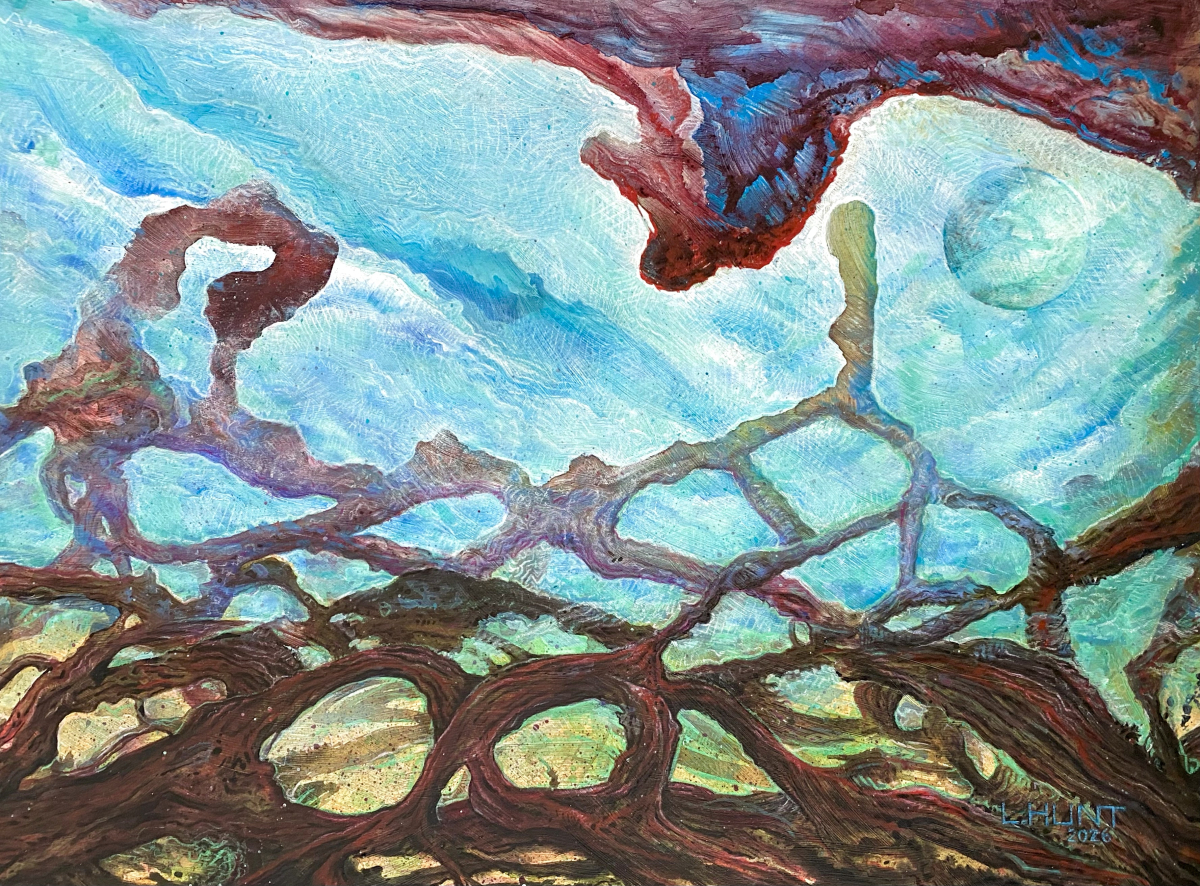
Alien Root System
L.HUNT
Acrylic and Colored Pencil on Gesso
15 x 20 inches (L x W)
In "Alien Root System," the viewer is transported far beyond Earth to an unnamed planet in another solar system, where even the atmosphere seems to possess an unfamiliar chemistry, glowing in luminous turquoise, icy blue, and pale green beneath strange celestial forms. Across this extraterrestrial landscape, enormous rootlike structures twist, coil, and interlock with a restless organic energy, spreading across the terrain as though they belong to a vast hidden organism whose true dimensions lie beneath the planet's surface. Some rise into peculiar hooked and branching silhouettes while others seem to engulf the land itself, wrapping around unknown formations and slowly claiming everything they encounter. The deep reddish browns and purples of the roots stand in dramatic contrast to the radiant alien sky, suggesting a world governed by biological forces entirely unlike our own. "Alien Root System" imagines the unsettling beauty of discovering life elsewhere in the universe—not as something recognizable or easily understood, but as an ancient, sprawling presence already deeply rooted in a world where humanity has never belonged.
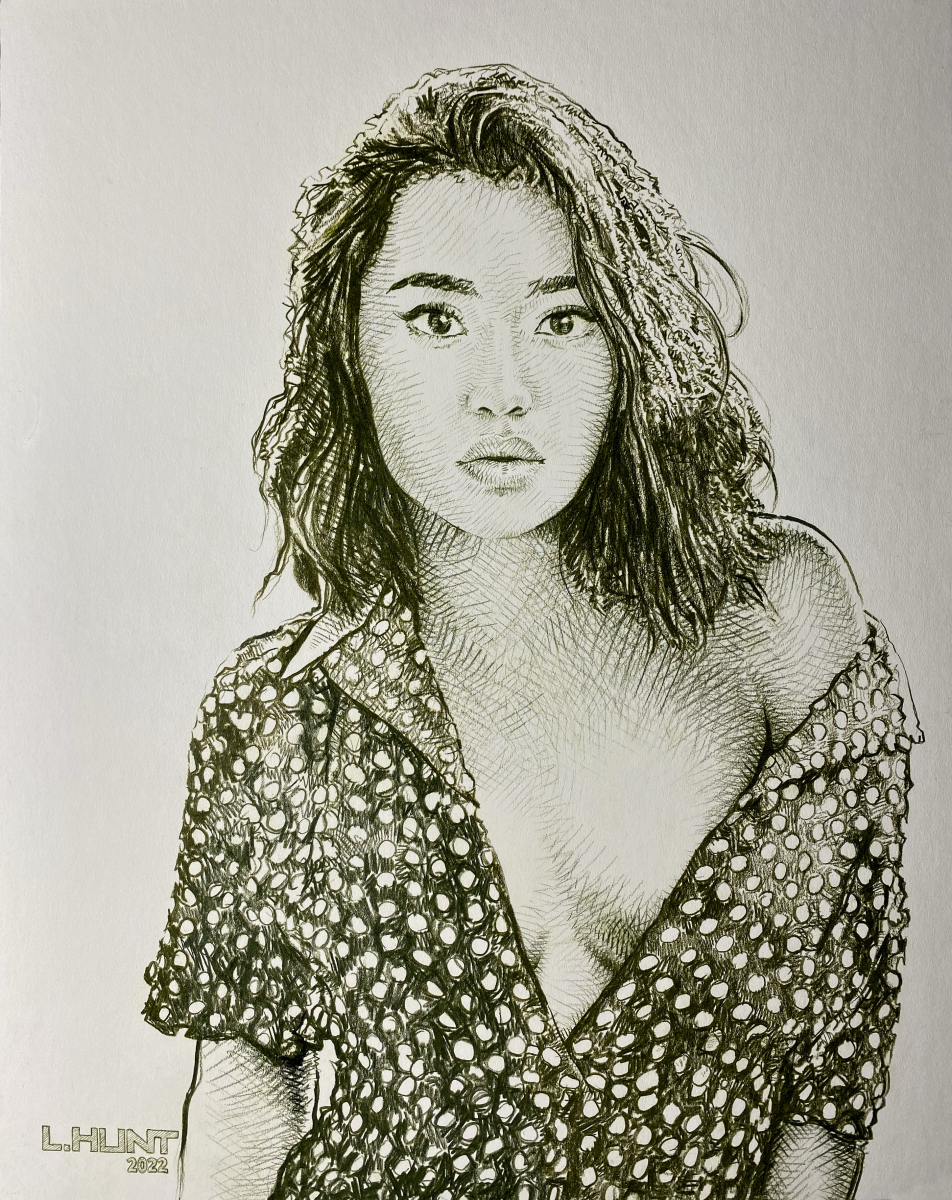
Asia
L.HUNT
Colored Pencil on Paper
20 x 16 inches (L x W)
In "Asia," an intimate portrait emerges through the disciplined precision of line, texture, and pattern, capturing a young woman in a moment of poised, unwavering presence. Her direct gaze becomes the quiet center of the composition, framed by dark, loosely rendered hair and the richly textured fabric that falls across her head and shoulders. Fine crosshatching gives subtle dimension to her face, neck, and chest, while the heavily patterned garment introduces a striking contrast between delicate skin tones and dense, almost lace-like abstraction. The open neckline and relaxed drape of the clothing lend the figure a sense of vulnerability and confidence at once, while the intricate marks throughout the drawing reward close examination. In Asia, beauty is not presented through ornament alone, but through attention—the accumulation of thousands of deliberate lines transforming a still human presence into something intricate, intimate, and quietly compelling.
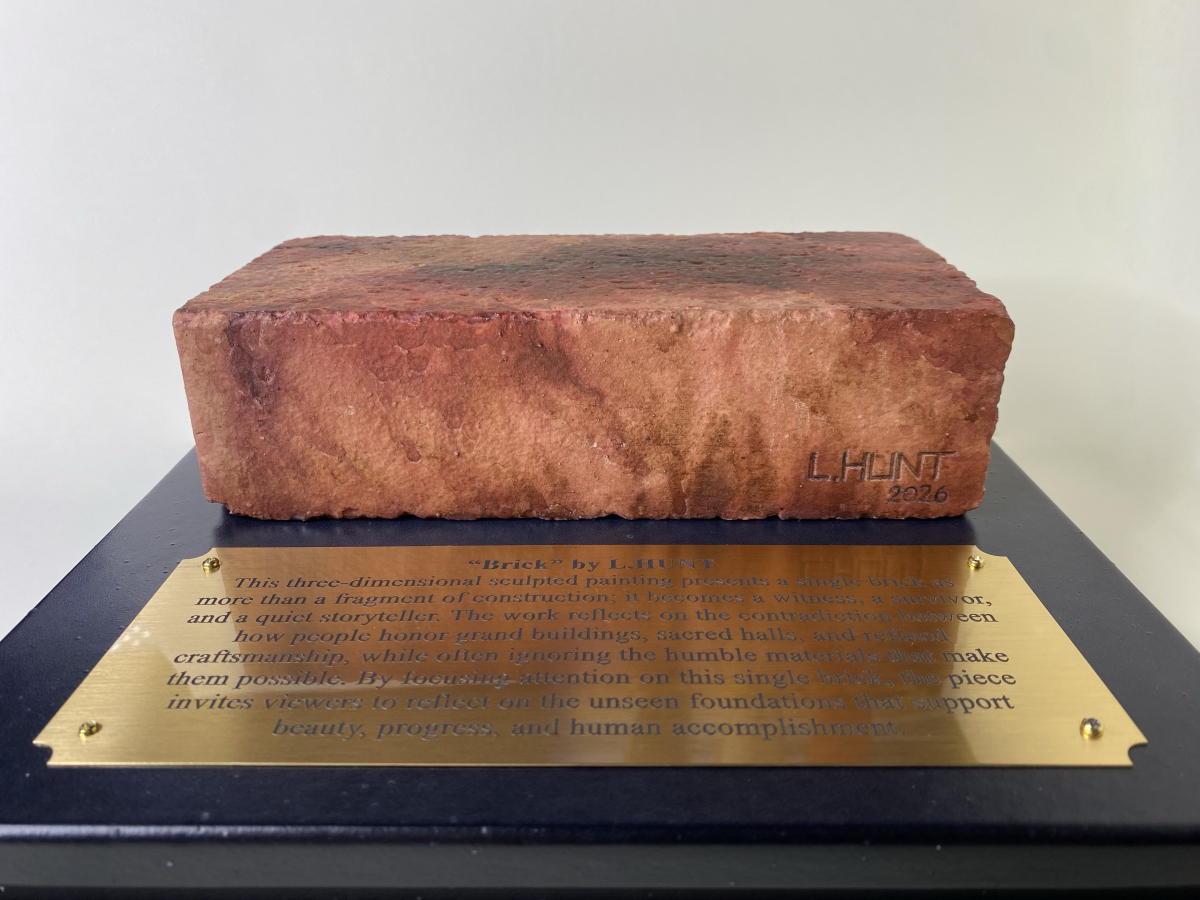
Brick
L.HUNT
Acrylic and Colored Pencil on Gesso
This three-dimensional sculpted painting presents a single brick as more than a fragment of construction; it becomes a witness, a survivor, and a quiet storyteller. The work reflects on the contradiction between how people honor grand buildings, sacred halls, and refined craftsmanship, while often ignoring the humble materials that make them possible. By focusing attention on this single brick, the piece invites viewers to reflect on the unseen foundations that support beauty, progress, and human accomplishment.
Covered Bridge
L.HUNT
Acrylic and Colored Pencil on Gesso
20 x 15 inches (L x W)
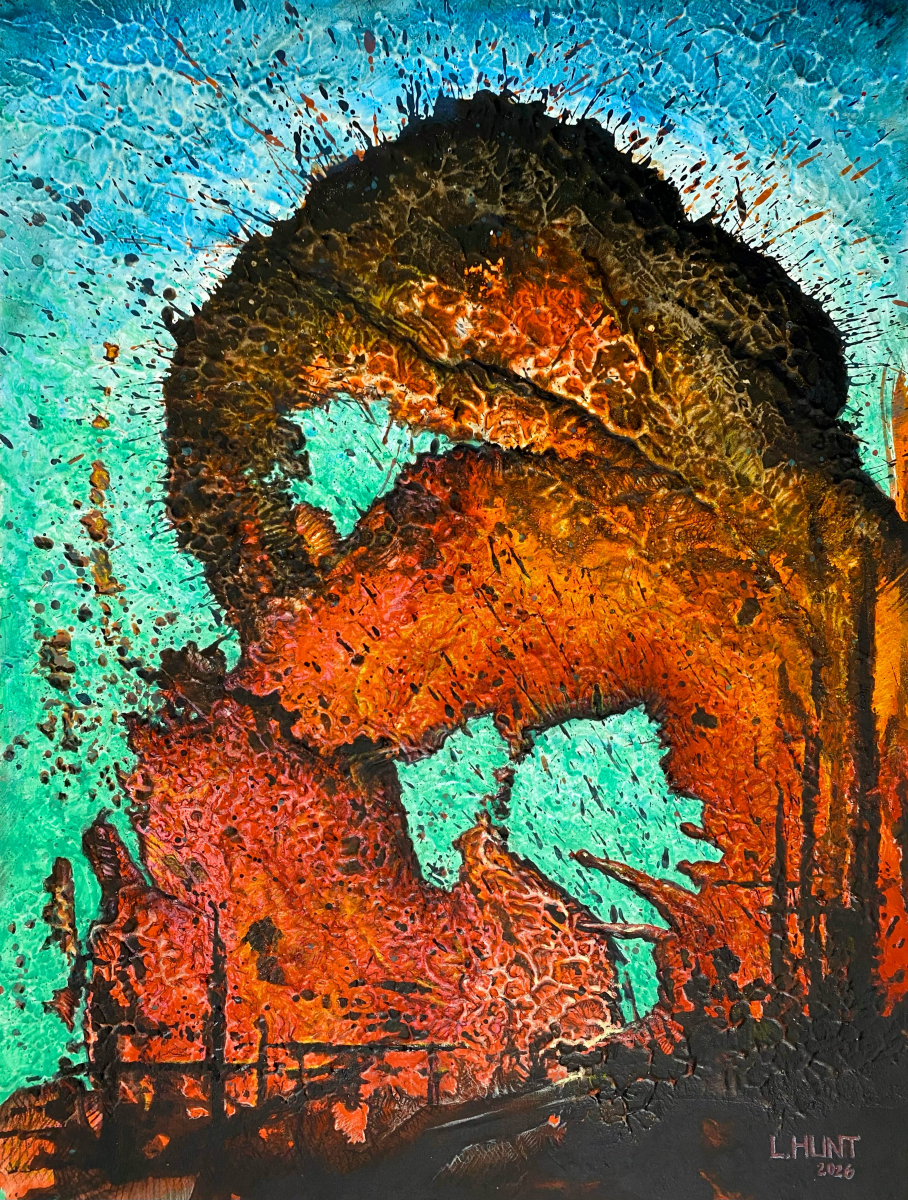
A collapsing bridge disappears beneath a spreading orange organism, its porous, blistered surface evoking both corrosion and uncontrolled growth. The structure below—fractured, skeletal, nearly consumed—suggests entropy overtaking human construction. Against the vivid turquoise background, the molten textures pulse with an unsettling organic energy, drawing the eye into clusters of trypophobic cavities and eruptive forms. The work balances beauty and discomfort, presenting decay not as silence, but as something alive, invasive, and impossible to ignore.
Crest and Trough
L.HUNT
Acrylic on Gesso
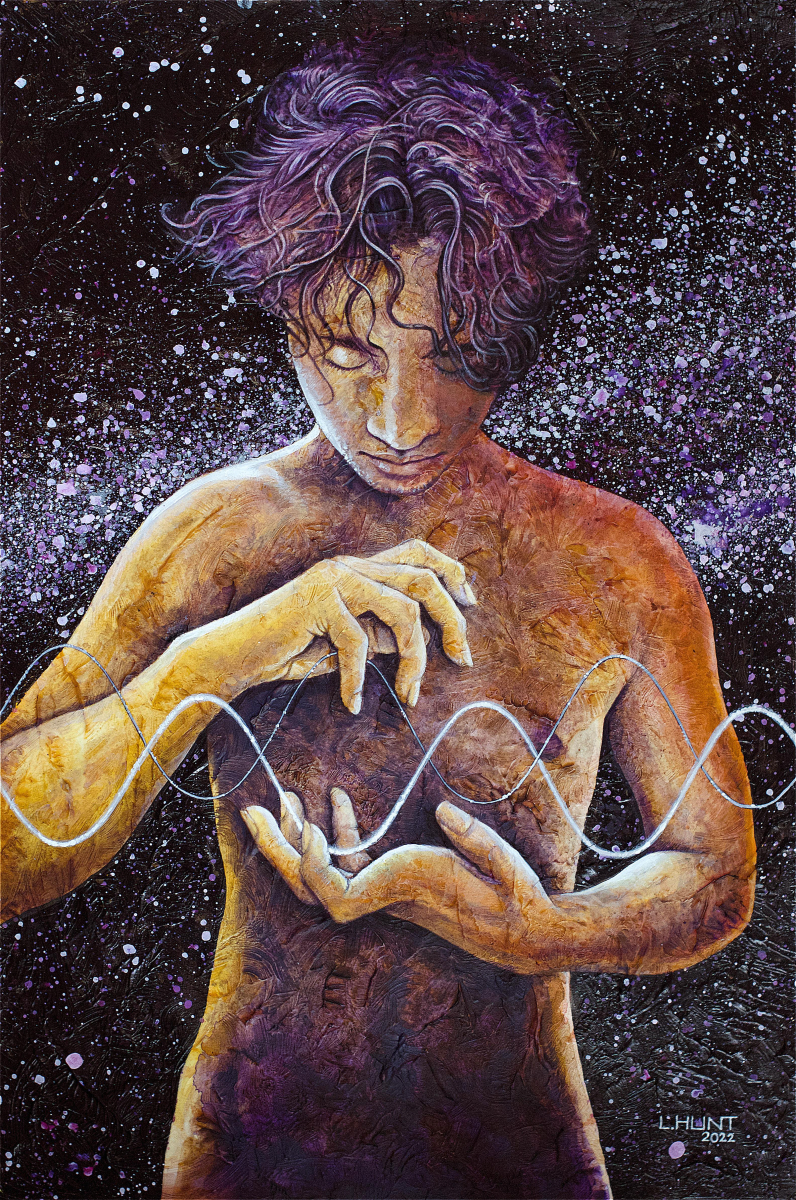
"Crest and Trough" captures a young man suspended in a private reckoning with the emotional extremes of his life, his head bowed as a luminous wave rises and falls through his hands like the visible pulse of memory itself. Its crests and troughs become the shape of existence—joy collapsing into sorrow, certainty slipping into doubt, hope rising again from loss—while his delicate grasp suggests an almost desperate attempt to understand which moments he controlled and which simply carried him along. Behind him, violet and white bursts scatter across a vast darkness like fragments of thought exploding through space, intensifying the sense that his inner life is as immense and turbulent as the universe around him. Yet the wave continues beyond his body, reminding us that no summit lasts, no depth is final, and a life cannot be measured by its highest or lowest moment alone. He is not contemplating victory or defeat, but the terrible and beautiful rhythm of being alive—the endless rise, fall, and rise again.
Eagle's Peak
L.HUNT
Acrylic and Colored Pencil on Paper
20 x 16 inches (L x W)
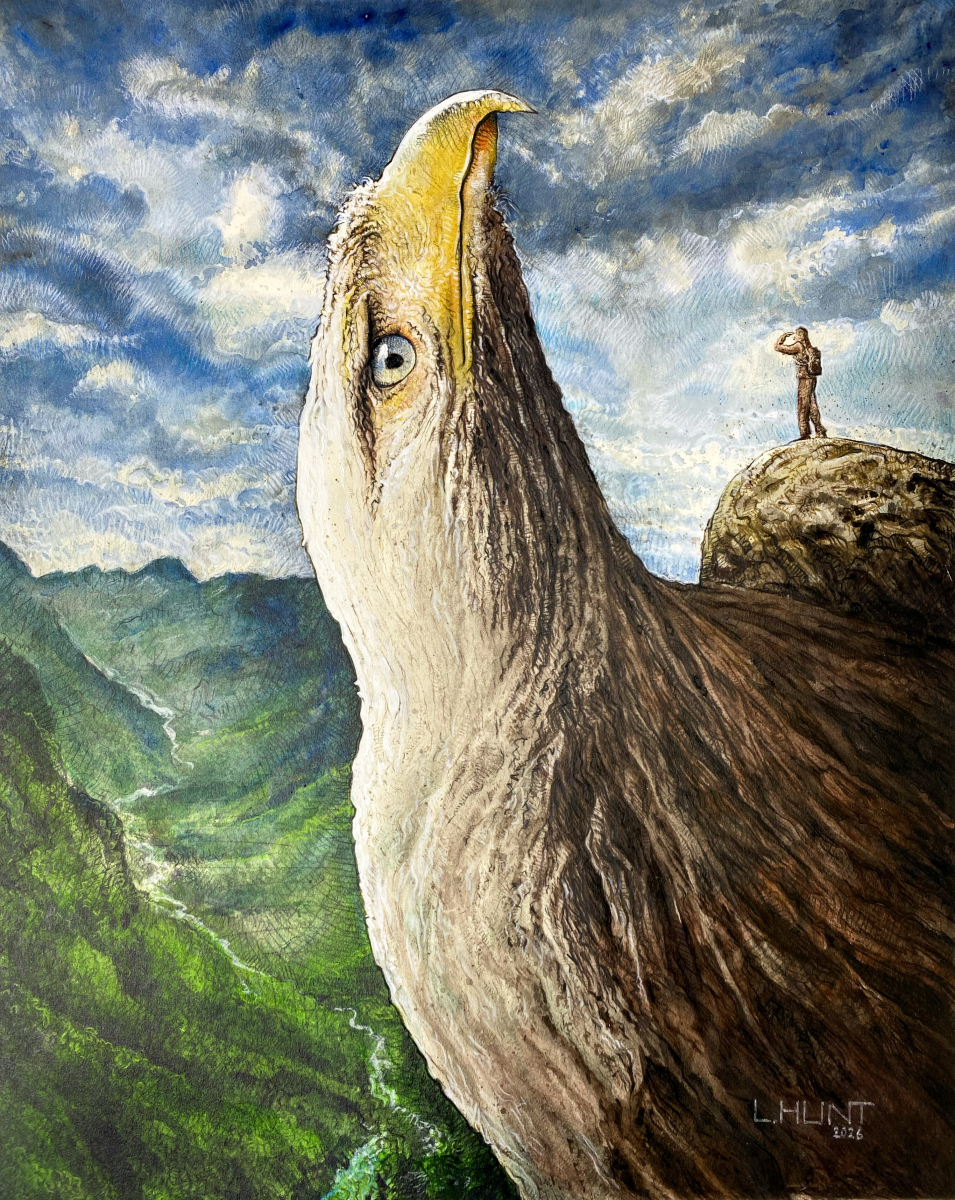
At the summit of an impossible climb, a lone man stands upon the edge of the world, having ascended to a height where the valley below no longer feels like a landscape but a vast living map of mountains, rivers, and distant horizons. From this rare vantage point, his eyes are granted something almost beyond ordinary human experience—a sweeping, panoramic view like that of an eagle high above the earth. Yet beside him, unnoticed, nature has fashioned its own silent witness: an immense outcrop of stone whose weathered contours form the unmistakable head and watchful eye of an eagle. While the man strains to see farther into the distance, the great bird appears to gaze with him, suggesting that in his search for a higher perspective, he has unknowingly entered the eagle’s realm and, for one extraordinary moment, has learned to see the world as it does.
Encounter In Tulgey Wood
L.HUNT
Acrylic on Gesso
20 x 15 inches (L x W)
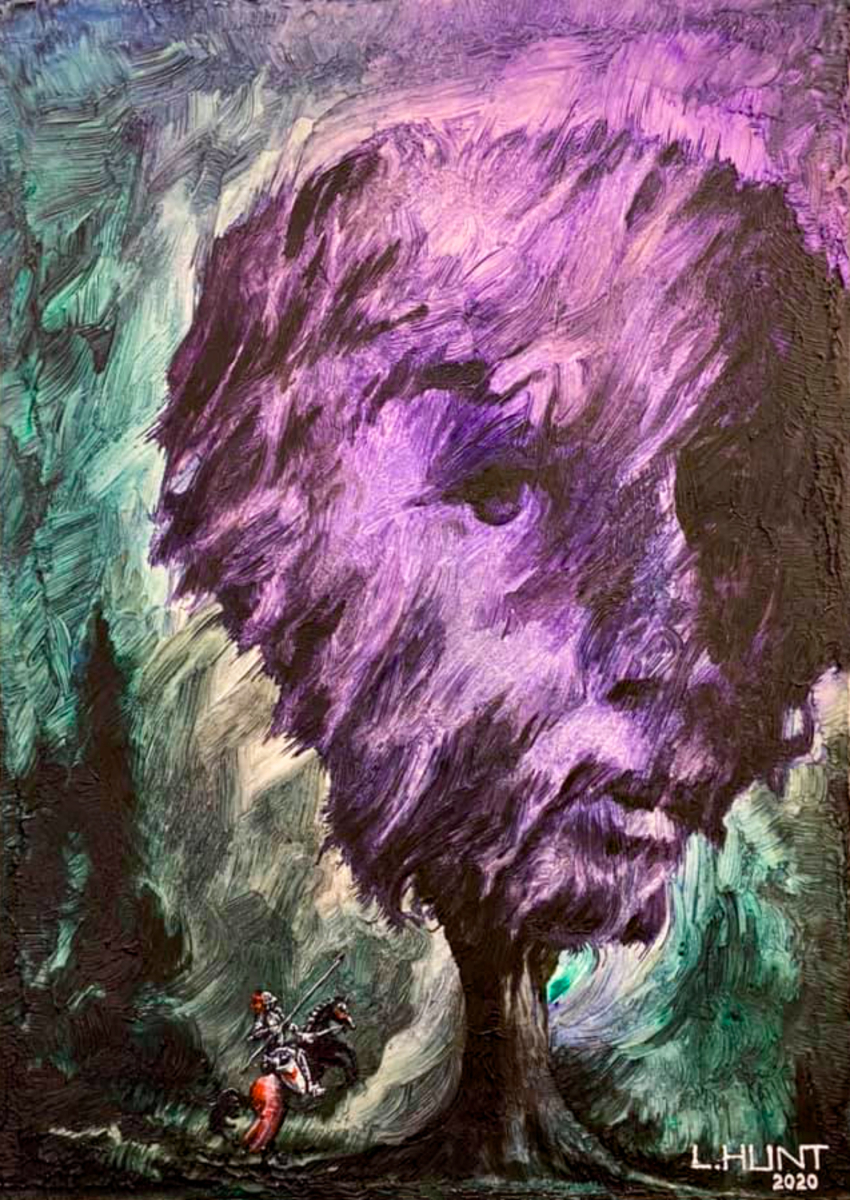
In "Encounter in Tulgey Wood," a fully armored knight rides deep into a forest where the boundary between the natural world and the impossible has quietly disappeared. His horse rears beneath him as he thrusts his lance upward, not in attack but in startled recognition: towering above them, an immense tree has awakened, its twisted trunk resolving into a brooding human face whose enormous eye fixes upon the intruder below. The fantastic scale of the apparition makes the knight seem almost miniature, transforming what might have been a heroic passage through the woods into a moment of vulnerability and awe. Violet, magenta, turquoise, and shadowy green sweep across the surface in restless, expressionistic strokes, causing the entire forest to feel charged with hidden consciousness, as though any trunk or branch might suddenly stir. The tree appears ancient rather than monstrous, a silent guardian whose penetrating gaze suggests that the knight has wandered into a realm with laws and memories far older than his own. What begins as an adventure through Tulgey Wood becomes an encounter with the unsettling possibility that the forest has been watching all along.
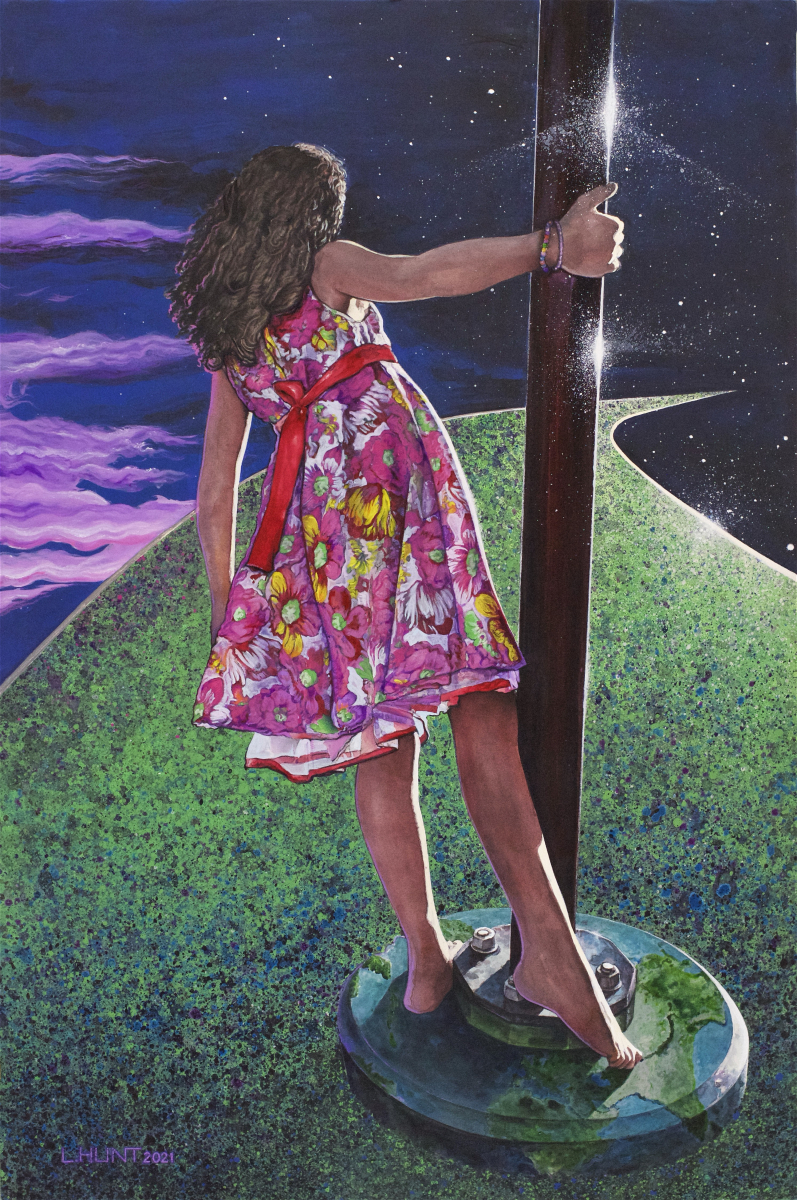
Endless
L.HUNT
Acrylic and Colored Pencil
30 x 20 inches (L x W)
In "Endless," a young girl stands at the threshold of the unknown, gazing toward a road that curves away into the vastness of the universe, its destination hidden beyond sight. Barefoot and dressed in brilliant flowers, she clings to a tall pole as though steadying herself at the very center of an immense world of possibility. At its base lies a quiet but essential detail: the structure is anchored upon the Earth itself, placing her symbolically at the North Pole, where every direction seems to lead outward. From this single point, the road stretches endlessly into space, transforming an ordinary childhood moment into a meditation on time, destiny, and the possibilities that seem as infinite as the cosmos itself.
Sold
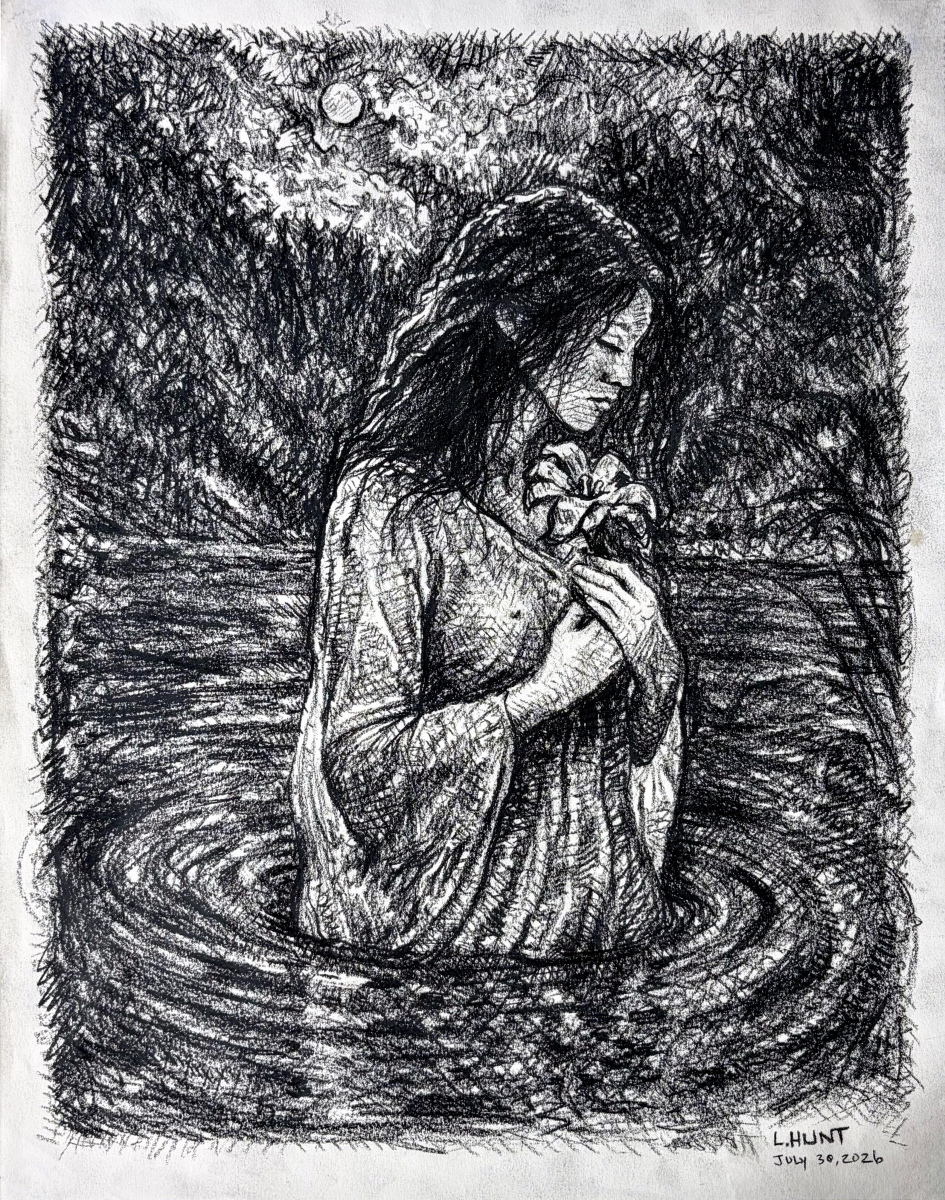
Fair Maiden, 2
L.HUNT
Colored Pencil on Paper
14 x 11 inches (L x W)
In the stillness of a moonlit forest, a young woman stands waist-deep in dark water, holding a single flower close to her heart as though it has awakened something long buried within her. The pond ripples quietly around her while the night seems to close protectively in, and for one suspended moment she belongs neither entirely to the world she came from nor to the mysterious one waiting beyond. "Fair Maiden, 2" captures the threshold where curiosity becomes transformation—the instant she begins to understand that the forest has not simply allowed her to enter; it has been waiting for her.
Preliminary drawing for the collection "The Forest Remembers Her."
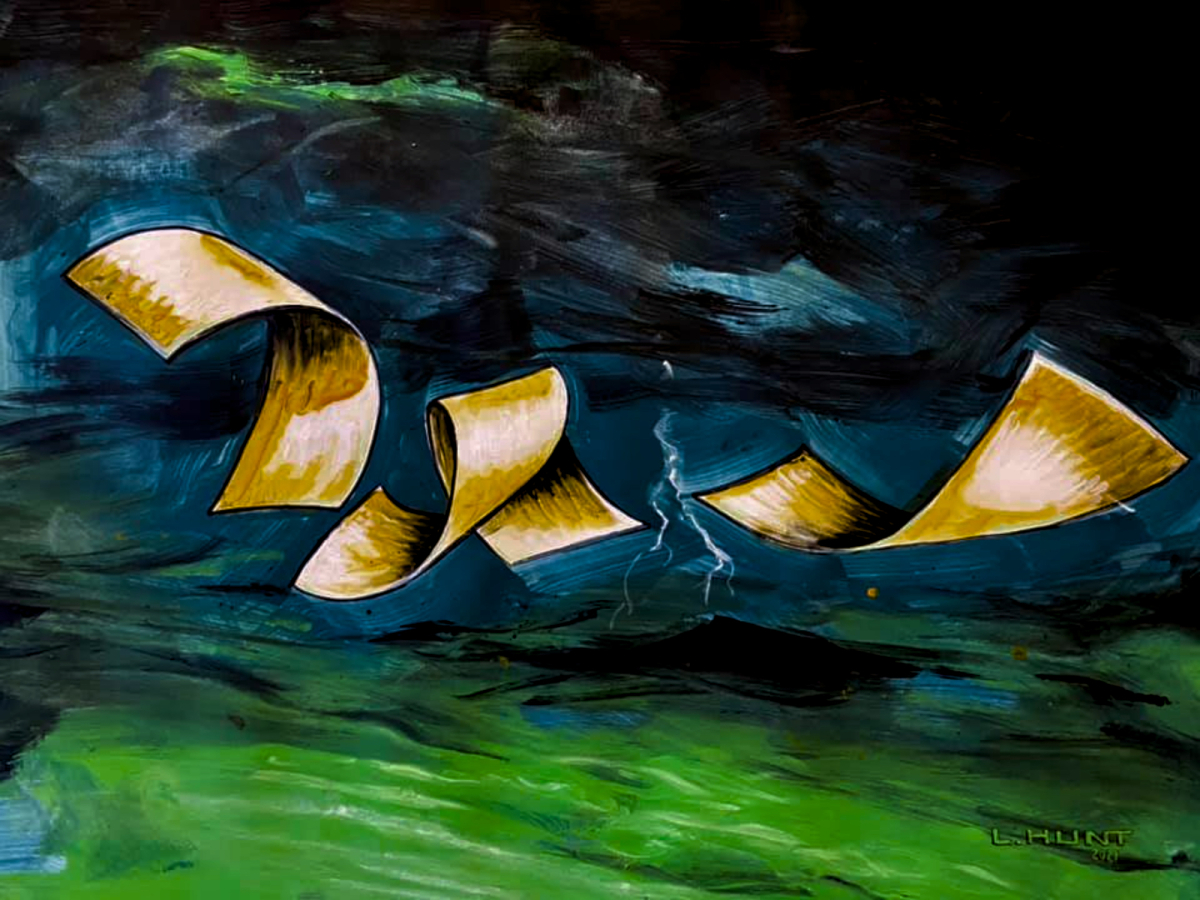
Ideogram
L.HUNT
Acrylic and Marker on Paper
22 x 28 inches (L x W)
Three independent ribbons drift above a restless sea at night, suspended against a dark, turbulent sky as if caught between motion and stillness. Each ribbon bends, twists, and opens in its own distinct way, suggesting separate paths of thought, experience, or possibility—each carrying its own direction and offering a different point of connection. Below them, the unsettled water and distant flash of lightning introduce a sense of instability, while the luminous ribbons remain strangely composed, hovering like symbols whose meaning is felt rather than fully explained. "Ideogram" becomes a visual language of relationships and choices: three separate forms moving through the same uncertain atmosphere, each seeking its own course and its own place of connection.
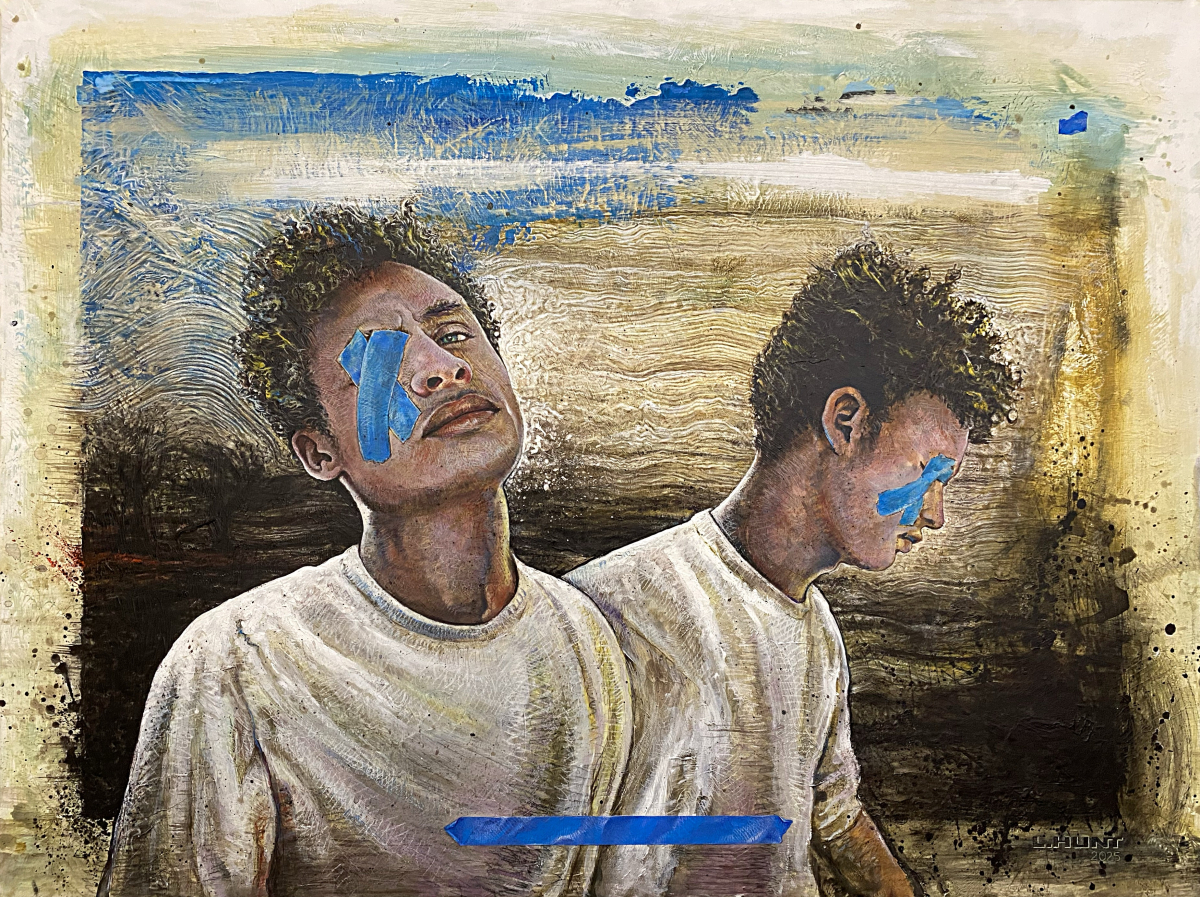
In the Land of the Blind, the Cyclops Is King
L.HUNT
Acrylic and Colored Pencil on Gesso
30 x 40 inches (L x W)
“In the Land of the Blind, the Cyclops Is King” presents two nearly identical figures inhabiting a fractured landscape of golden brown, weathered cream, and piercing blue, their shared condition expressed through strips of blue tape that interrupt their sight. On the left, subtle abstract passages ripple through the upper corner in layered strokes and scraped textures, suggesting a world that remains mysterious but still open to interpretation; on the right, the surface deteriorates into a chaotic, splashy mess of dark pigment, stains, and violent marks. The foreground figure looks upward with one eye exposed while blue tape forms a stark X across the other, leaving him, symbolically, the “cyclops” of the title—the one who can still see something in a world where clear vision has been compromised. His twin turns away, head lowered, seemingly surrendering as he moves toward the disorder gathering at the right edge. Across the lower center, a single horizontal strip of blue tape visually connects the two men, transforming their individual blindness into a shared dilemma: both are bound by the same obstruction, prevented from achieving complete focus, perspective, or understanding. The brilliant artificial blue cuts sharply through the earthy golds and browns, becoming both wound and connection, while the contrast between controlled abstraction and erupting chaos suggests the dangerous distance between struggling to see clearly and finally giving up the attempt.
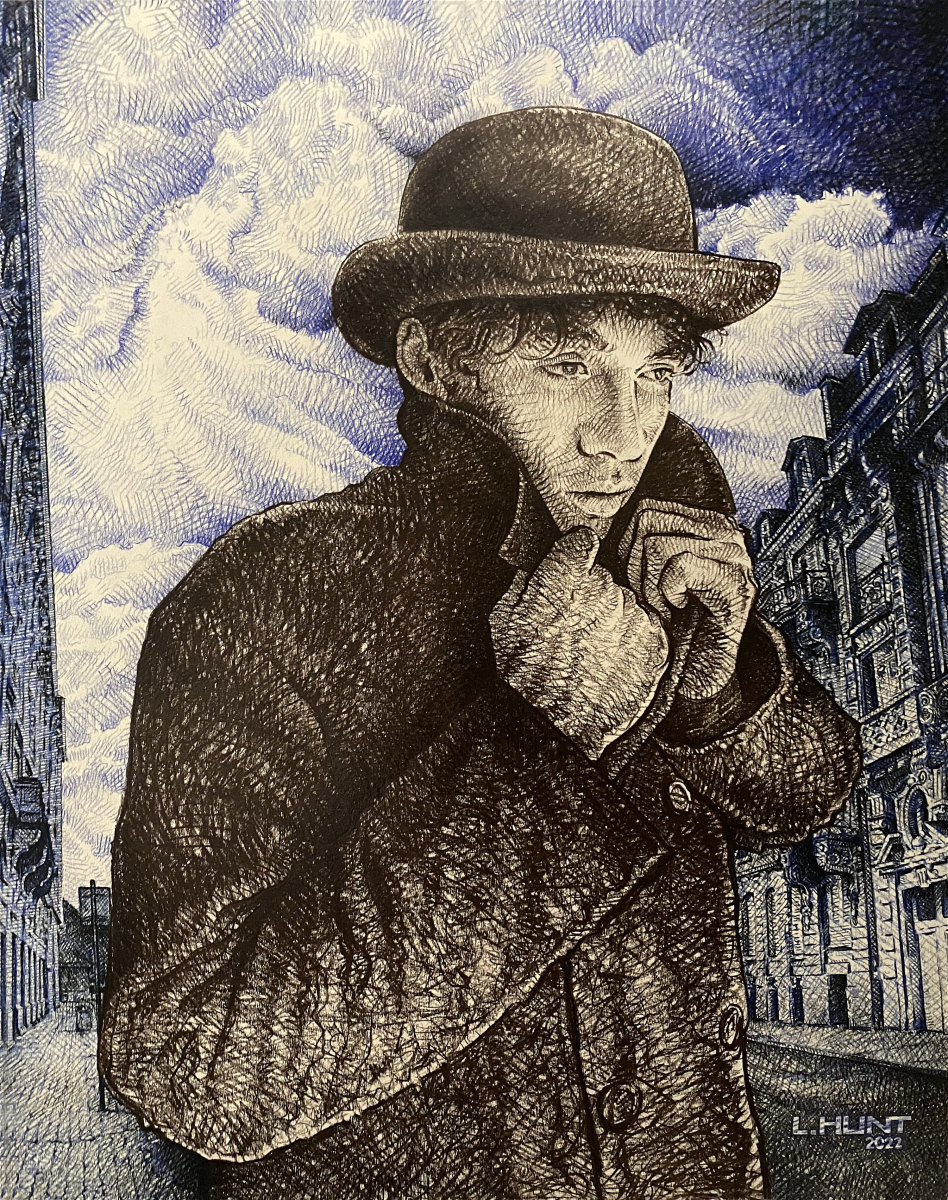
Into the Storm
L.HUNT
Colored Pencil on Paper
A young man in a bowler hat moves quickly through the streets of 1890s Paris, turning toward the shelter of a nearby pub or café as a darkening sky gathers overhead. His raised collar and guarded expression suggest a man bracing himself against more than wind and rain. In seeking refuge from the approaching storm, he is unknowingly stepping into another—the uneasy, alcohol-saturated world of the Parisian night, where crowded cafés and public houses could simmer with desperation, confrontation, and sudden violence. The immense clouds swelling behind him become more than weather; they mirror the turbulence waiting beyond the doorway, transforming "Into the Storm" into a portrait of a man caught at the threshold between the danger of the elements outside and the unpredictable tempest of humanity within.
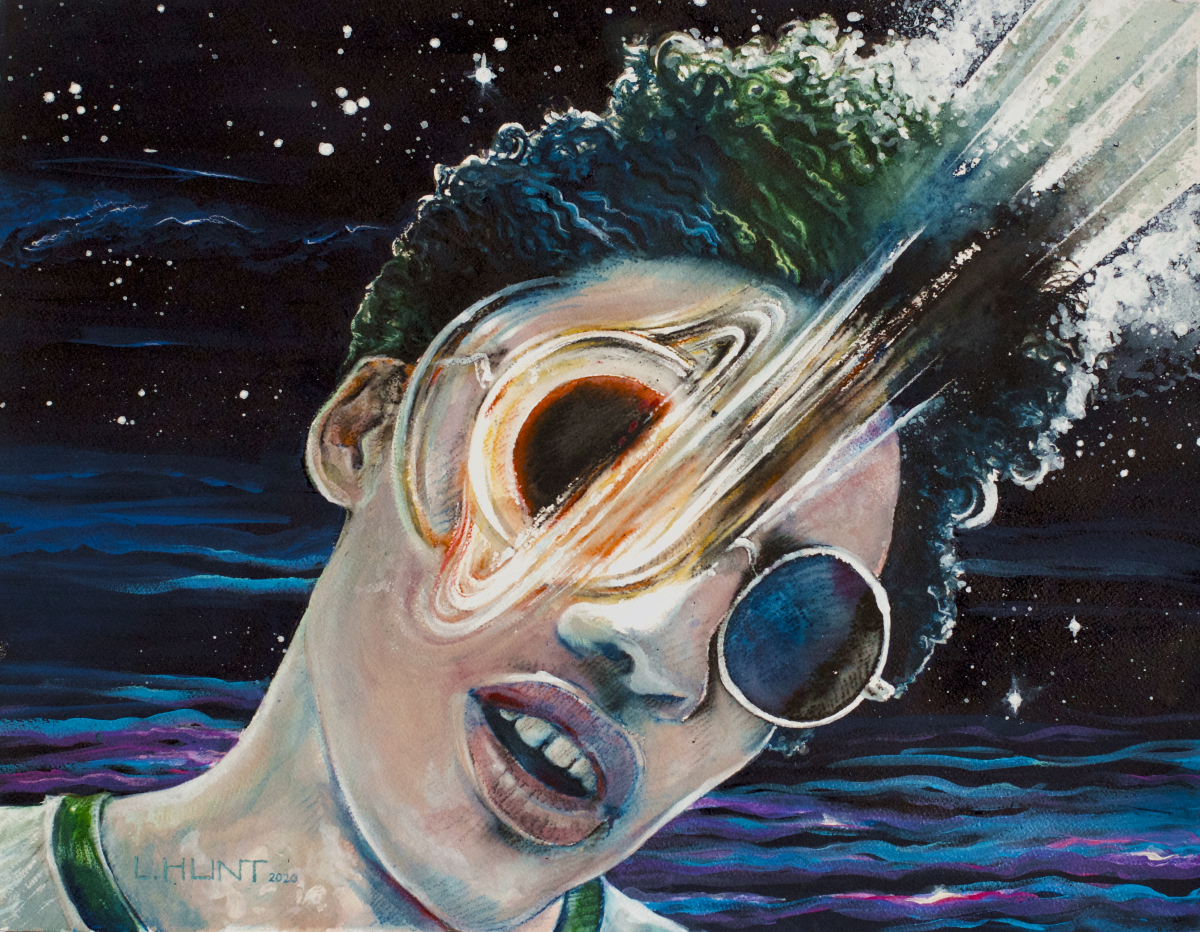
Into the Whirlpool, Where Matter Vanishes
L.HUNT
Acrylic and Colored Pencil on Paper
14 x 18 inches (L x W)
In a brilliant collision of portraiture and cosmic wonder, the familiar world gives way to something unimaginable as one lens of the man’s sunglasses transforms into a ravenous black hole, warping light, space, and perception across his face. Rings of glowing orange, white, and gold spiral around the darkness while a powerful stream of light tears through the composition, as though the universe itself has suddenly opened before him. The experience is more than something he sees—it is something that overtakes him, stretching the boundaries of thought and leaving him visibly stunned by the immensity of what has been revealed. From the top of his head, luminous energy erupts into curling waves of turquoise, emerald, and white, suggesting an explosive awakening of consciousness: a moment when revelation becomes so powerful that it can no longer remain contained within the mind. Against the deep, star-filled darkness and electric bands of blue and violet, the work becomes a vivid meditation on discovery, transformation, and the mind-blowing instant when our understanding of reality suddenly expands beyond everything we thought we knew.
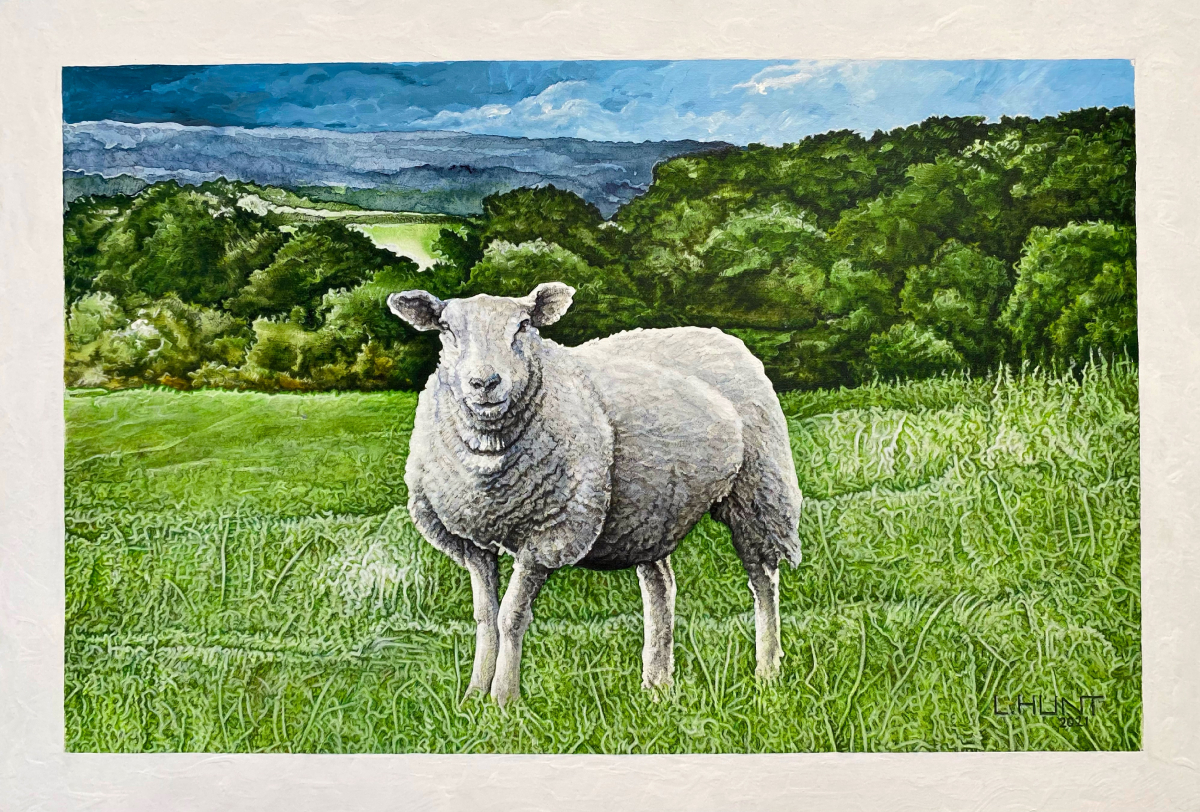
Of Wonders Wild and New
L.HUNT
Acrylic and Colored Pencil on Gesso
15 x 22 inches (L x W)
"Of Wonders Wild and New" transforms a seemingly familiar pastoral scene into something vibrant, restless, and almost dreamlike. At its center, a solitary sheep stands with an oddly direct, inquisitive presence, gazing outward as though it has momentarily become aware of the viewer, while the landscape surrounding it pushes far beyond simple naturalism. The field is especially expressive: instead of dissolving into conventional blades of grass, it is built from an astonishing network of looping, curling, etched-like marks that twist through the green surface in thousands of intricate patterns. These rhythmic lines give the earth a sense of motion, as though the field itself is alive with hidden currents, roots, pathways, and secret forms. Expressionism emerges through this deliberate distortion of texture and color—the intense greens, heavily articulated foliage, sculptural wool of the sheep, and broad, turbulent bands of blue in the distant hills and sky all heighten the emotional character of the countryside rather than merely describing it. The deeper one looks, the less ordinary the landscape becomes; the grass turns into an elaborate visual language, the trees become masses of pulsating color, and even the quiet sheep seems to inhabit a world charged with curiosity and discovery. In this way, the title "Of Wonders Wild and New" feels entirely appropriate: the painting asks us to look again at the commonplace and discover that, through imagination and close observation, even an open field can become an unexplored world.
Sold
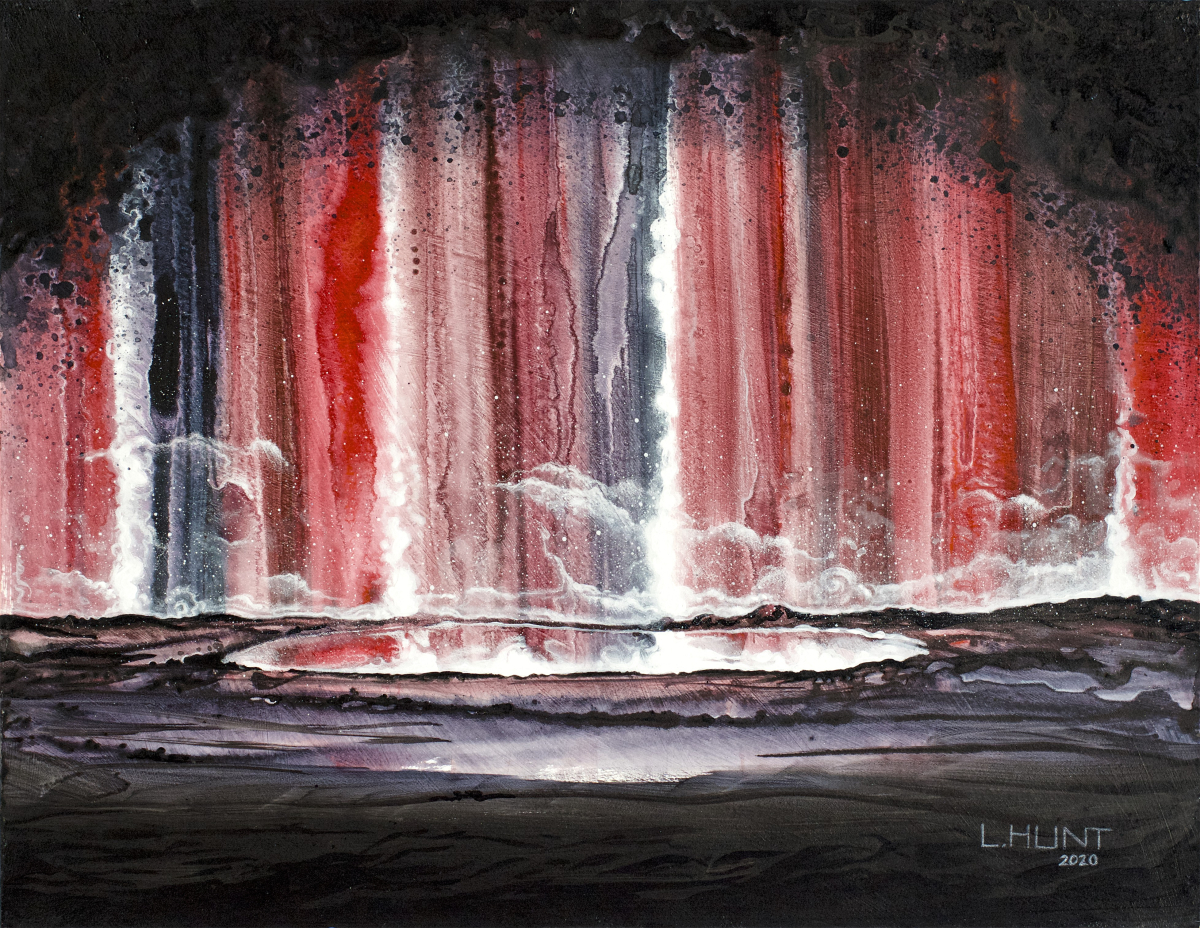
Reflective Pool
L.HUNT
Acrylic and Colored Pencil on Gesso
14 x 18 inches (L x W)
In "Reflective Pool," a still body of water rests beneath a mysterious landscape that seems to hover somewhere between forest, waterfall, and an unknown world formed almost entirely from atmosphere and imagination. Vertical passages of deep red, muted rose, smoky blue, white, and black descend through the background like distant trees or immense sheets of falling water, never fully resolving into one recognizable place. Wisps of pale mist gather along the horizon and curl through the scene, softening the boundary between earth, water, and whatever lies beyond. Throughout the painting, intricate textures, scattered marks, delicate splashes, and small unexpected details reward close examination, drawing the eye deeper into its strange environment. At the center, the quiet pool becomes an invitation—a luminous pause within the surrounding mystery—beckoning the viewer to approach, look into its surface, and perhaps discover a reflection that belongs as much to this imagined landscape as to themselves.
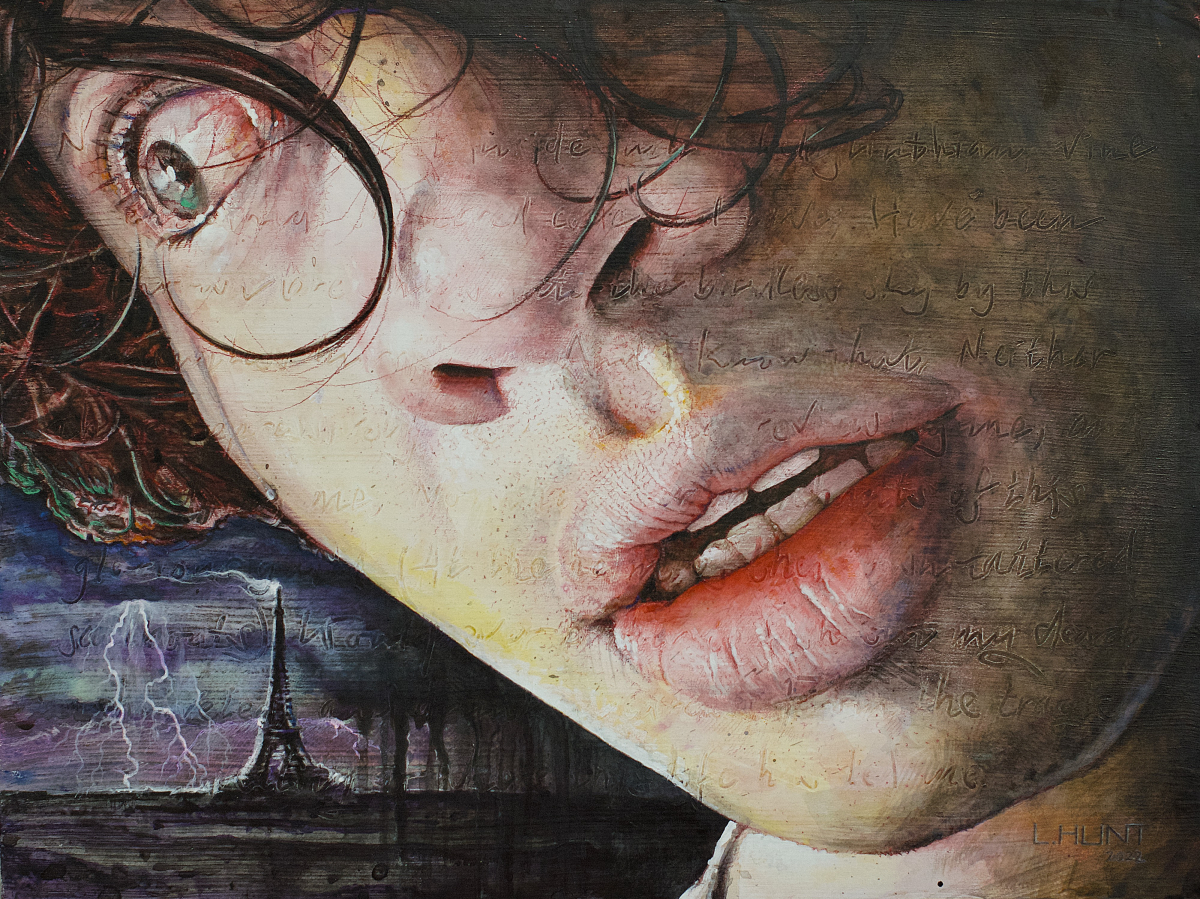
Stanza 18
L.HUNT
Acrylic and Colored Pencil on Gesso
In "Stanza 18", a young man in Paris is caught in a moment when fear has become impossible to conceal. His face fills the composition with an almost suffocating intimacy, while behind him the Eiffel Tower rises beneath a troubled sky, grounding his private anguish within the distant beauty of the city. A single tear slips from his eye, revealing the emotional weight of events unfolding faster than he can understand or control. Fragmented words and handwritten thoughts drift across his skin and through the surrounding darkness like anxious memories, unfinished questions, and lines from a life whose meaning has suddenly become uncertain. His parted lips and wide, glistening eye suggest the instant before panic turns into realization—a young man frightened not simply by what is happening around him, but by what these events may ultimately make of him.
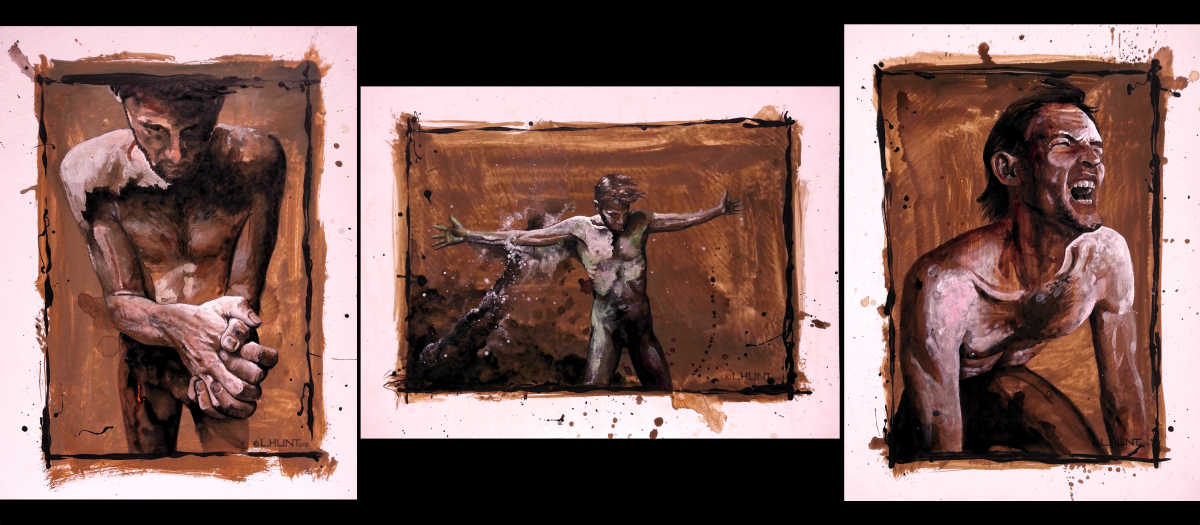
The Fight - Triptych
L.HUNT
Acrylic on Gesso
In “The Fight,” a three-part progression transforms physical violence into a meditation on conflict, triumph, and consequence. The left panel, “The Weapons,” focuses on the clenched hands and tense body of a fighter preparing for confrontation, reducing the human form to the most primitive instruments of battle—flesh, bone, strength, and will. In the center, “The Victor” stands with arms spread wide amid an eruption of dark, turbulent energy, his posture suggesting the exhilaration of conquest, yet the surrounding chaos makes the victory feel uneasy rather than celebratory. The final panel, “The Victim,” reveals the other side of that moment: a wounded figure screams in anguish as pain overtakes him. Painted in raw earth tones, blacks, bruised reds, and flashes of pale flesh, the triptych moves from anticipation to domination to suffering, forcing the viewer to experience "The Fight" not as a single dramatic act, but as a complete human cycle in which every victory is inseparably connected to someone else’s defeat.
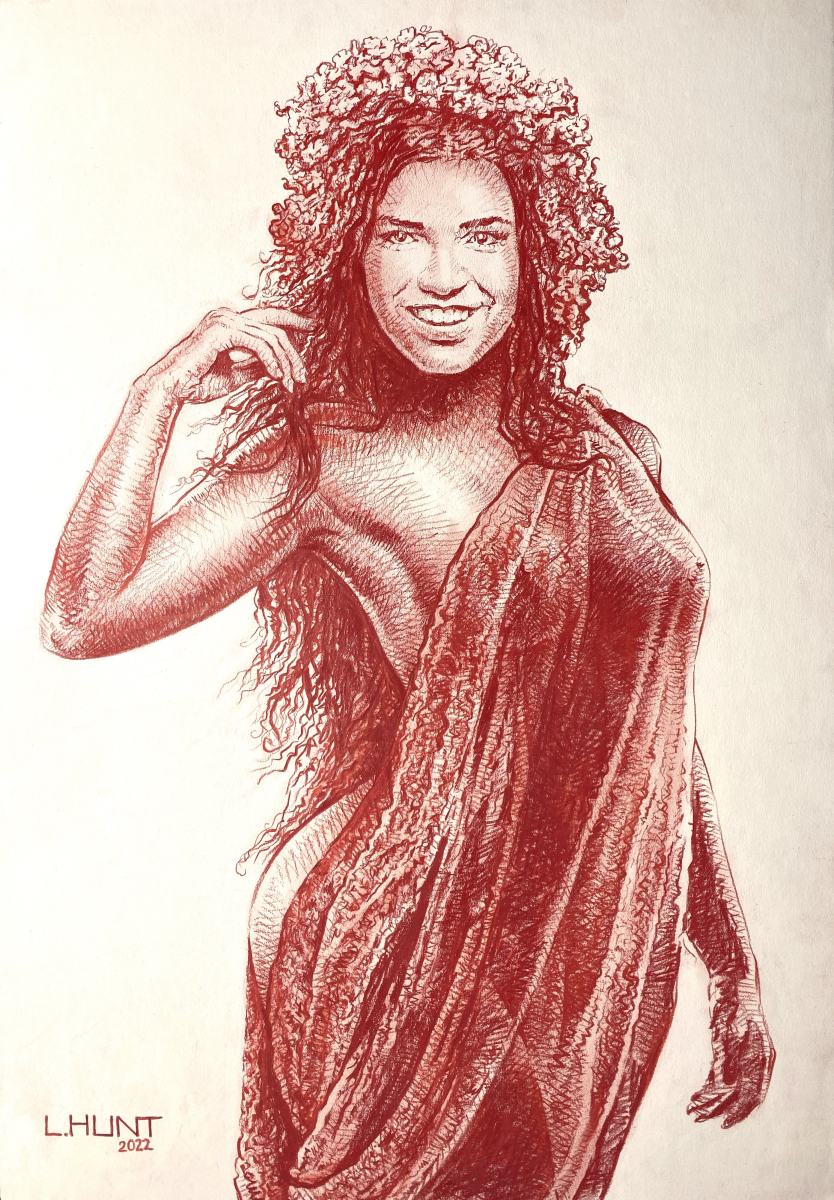
The Woman In Red
L.HUNT
Colored Pencil on Paper
20 x 16 inches (L x W)
In "The Woman in Red," confidence and vitality emerge through the immediacy of a single color, as the entire figure is constructed in rich red linework that gives the drawing both warmth and intensity. The woman meets the viewer with a direct, radiant smile, her expression open and self-assured, while the intricate curls surrounding her head create a floral crown of texture and movement. Fine crosshatching models the contours of her skin, arms, and clothing, shifting from delicate passages of light into dense, velvety shadows that make the draped fabric feel substantial and tactile. Her relaxed hand, flowing hair, and sweeping garment give the composition an elegant rhythm, balancing the precision of the draftsmanship with an unmistakable sense of personality. "The Woman in Red" becomes more than a portrait; it is a celebration of presence, femininity, and the magnetic energy of a woman completely at ease within her own self.
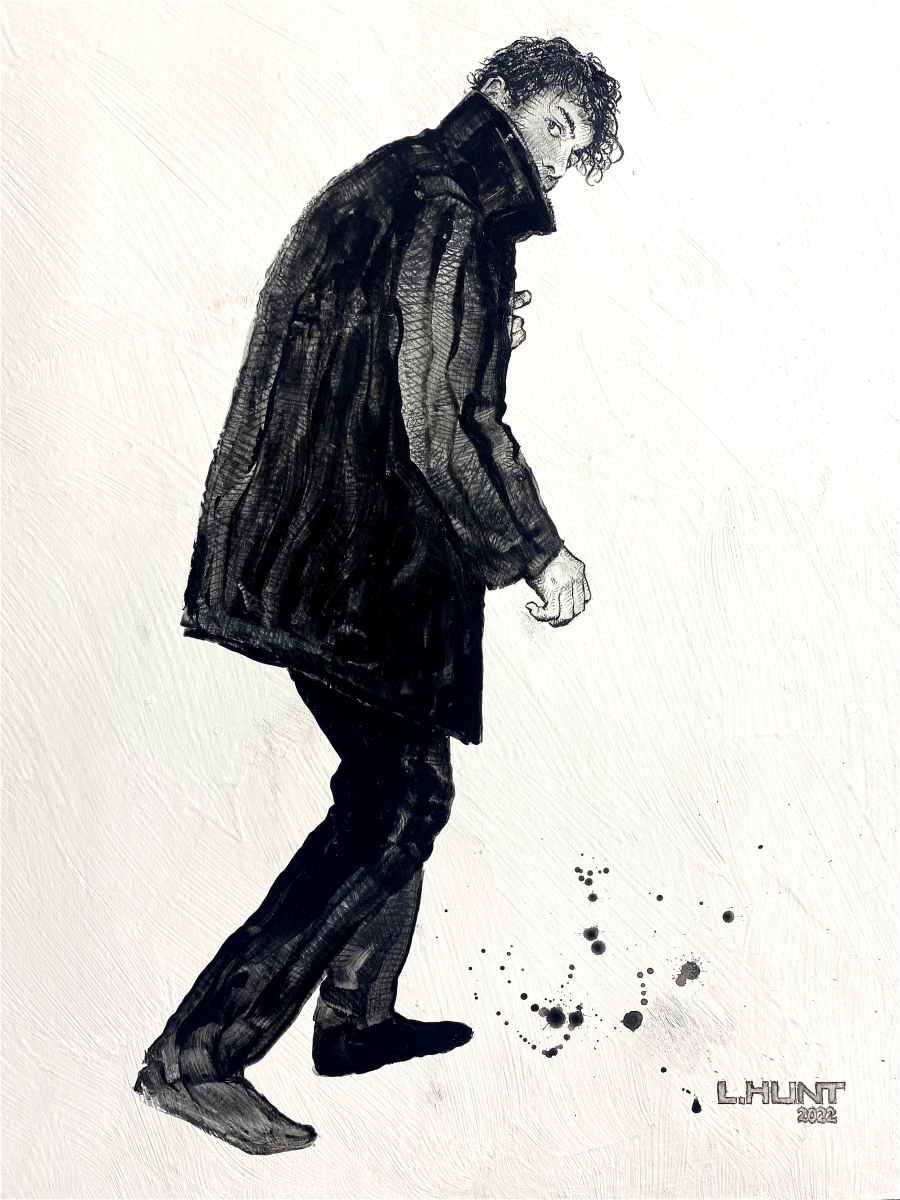
Tweed
L.HUNT
Acrylic and Colored Pencil on Gesso
20 x 16 inches (L x W)
In "Tweed," a solitary young man moves across an almost empty world, his body leaning forward while his face turns back with a wary, searching glance, as though something behind him has interrupted his journey. The dark coat dominates the figure, its heavy folds and densely worked crosshatched textures giving the tweed an almost architectural presence, transforming ordinary clothing into a kind of protective shell. Against the pale, roughly brushed ground, the figure appears suspended between departure and hesitation, caught in the instant before he decides whether to keep walking or turn around. His dark clothing, tangled hair, and guarded expression create a sense of restless youth and private uncertainty, while the scattered black droplets near his feet introduce a sudden note of disorder into the otherwise restrained composition. With much of the surrounding space deliberately left unresolved, "Tweed" focuses attention on posture, texture, and expression, suggesting a young man carrying more beneath the surface than his quiet passage initially reveals.