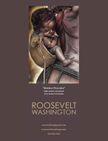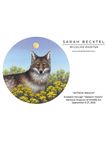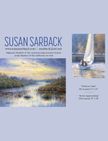
The hypnotic presence of Ojai Bloom, Alexey Steele’s visionary portrait of an orange tree, dominated the gallery at the Ojai Valley Museum last month, where it shone with a preternatural and sunny radiance, leading viewers to the end of the space and luring them into the exhibit. A luminous nimbus of magical golden light seems to radiate from within the image of the tree which is rendered in a delicately balanced palette of pale lime greens and viridian, with sparking dashes of orange fruit popping among the leaves, surrounded by a symphony of carbazole and cadmium in the background. It is an extraordinary evolution of Californian landscape painting, which has been bound for too long by convention. This dramatic masterpiece is set in the light and landscape of the holy magic hour, a dream and revelation set at the golden end of a citrus grove somewhere near the blue and violet shadows of Sulphur Mountain, where the Indian spiritual master Meher Baba once stepped on the snaking path of river stones among the old oaks and sat sheltered beneath the spread arms of their boughs.
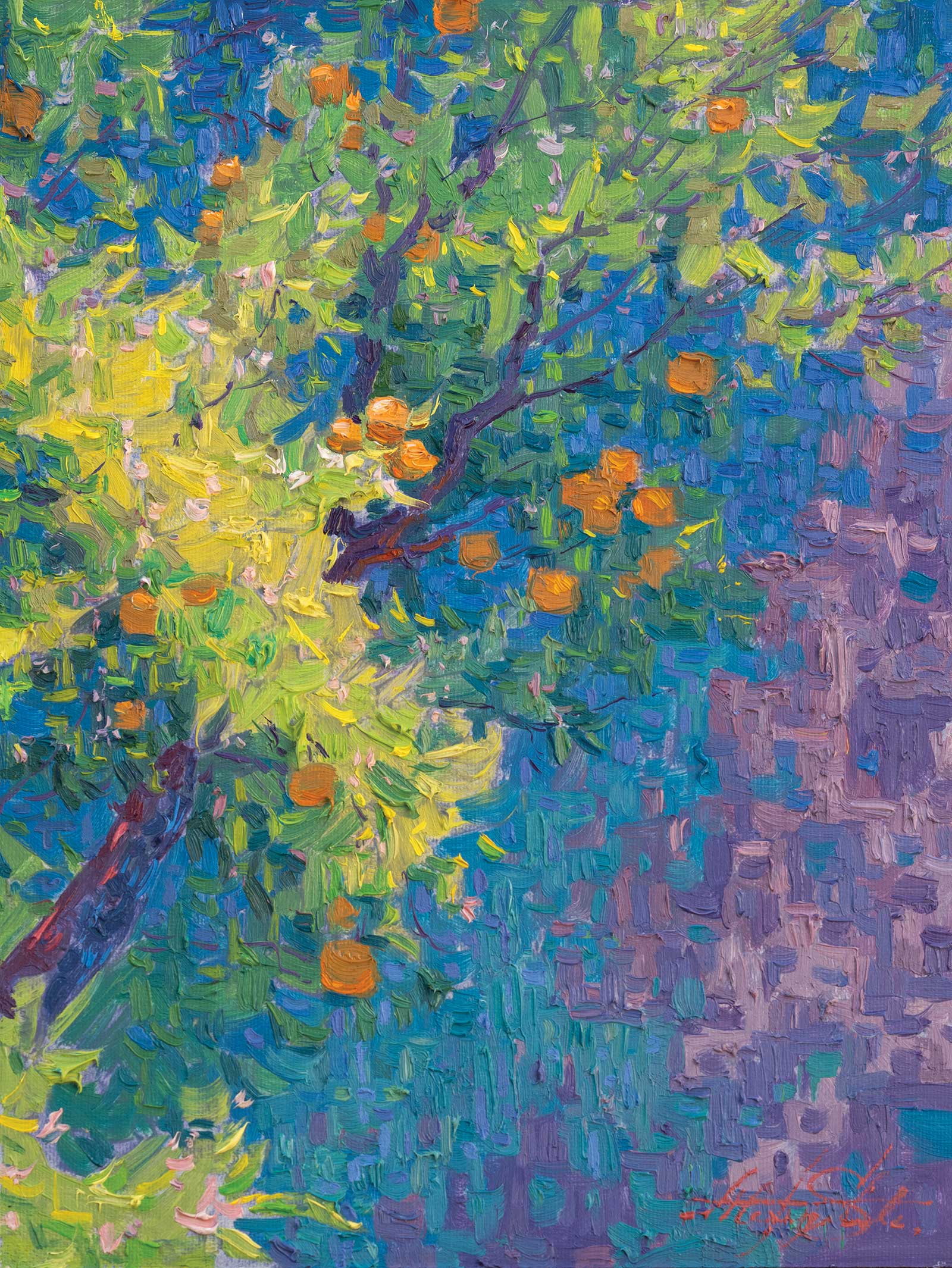 Orange and Blue, oil on linen, 12 x 9 in.
The painting’s entrancing rule over the gallery was challenged only by Steele’s sharp blue eyes and the intensity of his tone as he speaks of his encounter with the scene. Being in the same room with Alexey can be like being in the illuminated presence of an impassioned Eastern prophet of painting caught in the flood and flow of a tsunami of fiery rhetoric. Born in Ukraine, but raised in Moscow, and an immigrant to California in 1990, shortly after the fall of the Berlin Wall, and the beginning of the disconcerting re-ordering of the contemporary world into its new order, he is accustomed to living on the liminal threshold between states of being.
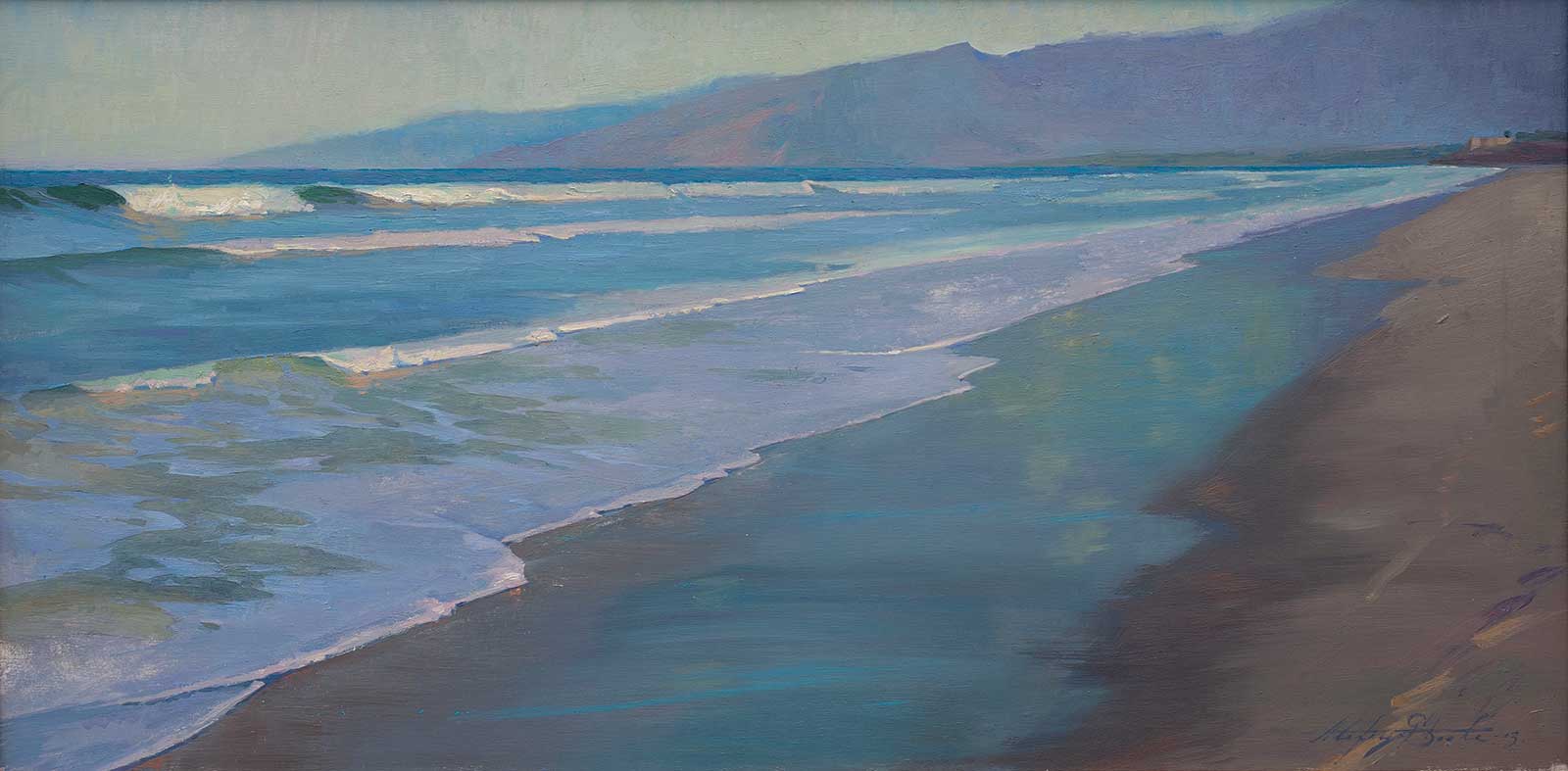
Serene Hour, Santa Monica Bay, 2013, oil on canvas, 24 x 48 in. Private Collection.
His accented voice modulated between hushed and intimate tones of sincere and poetic prose, and grew to a pitch of passion as he explained the picture’s profound genesis, describing how it emerged from a terrible period of his life as he watched the diminishment of his beloved father-in-law Gennady Sinitsa passing through the dark valley toward the shadows of death. Balancing the discipline of painting from direct observation with caring for Sinitsa, Steele explored the landscape around Ojai. “Suddenly I came upon that tree,” he quietly says, “and I broke down completely. I disintegrated in my physical being when I saw it…this young orange gleaming in contre-jour in the midst of this...against the light…I loved [the] contre-jour, I loved this.”
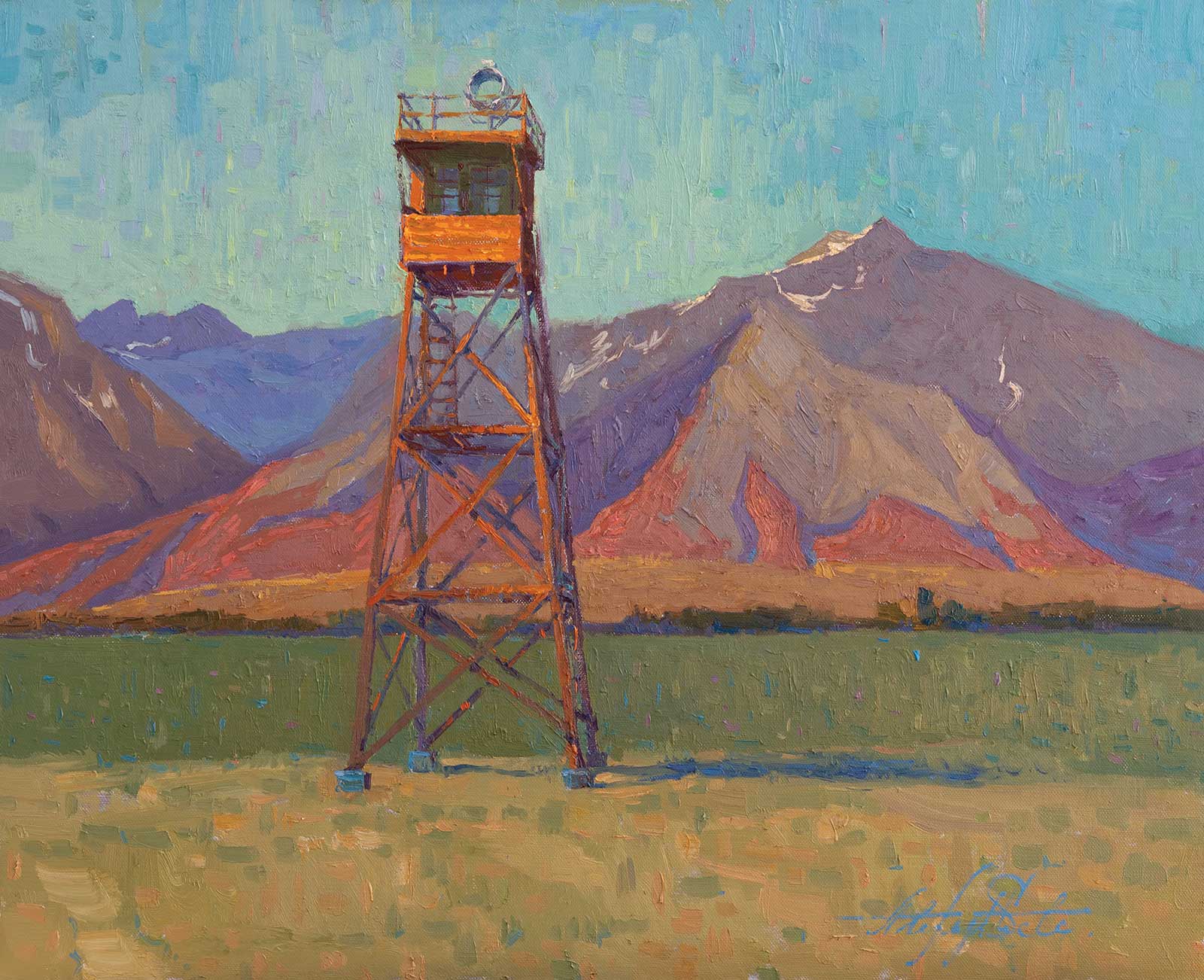
The Witness, oil on linen panel, 17 x 21 in.
Inspired, Steele barely met the deadline for the exhibition, and the painting went onto the wall wet, but the consequences of his emotional response to the visionary tree are a profound fusion of his emotional state with his presence as an observer in the beautiful Ojai orange grove. Steele continues, with gradually rising voice, “Another thing that absolutely struck me in this image, just imagine this…[was how] the flowers of orange are on the same tree as the fruit. Both sides of life are evident in presence in this moment. So, to me, at this split second, [as] I’m processing the termination of life, literally within the process of seeing an end of life…it was both torture and the greatest gift that was given to me. This painting came as a direct result. I never felt and thought of the terror of the beautiful that way, ever in my life, until I faced it in Ojai in front of that young orange tree. And at that point, it dawned on me that, these fruits, they come down and they disappear in the terrain. Just as those two birds are just there, and they’re not vicious, they’re not violent. They just don’t care.”
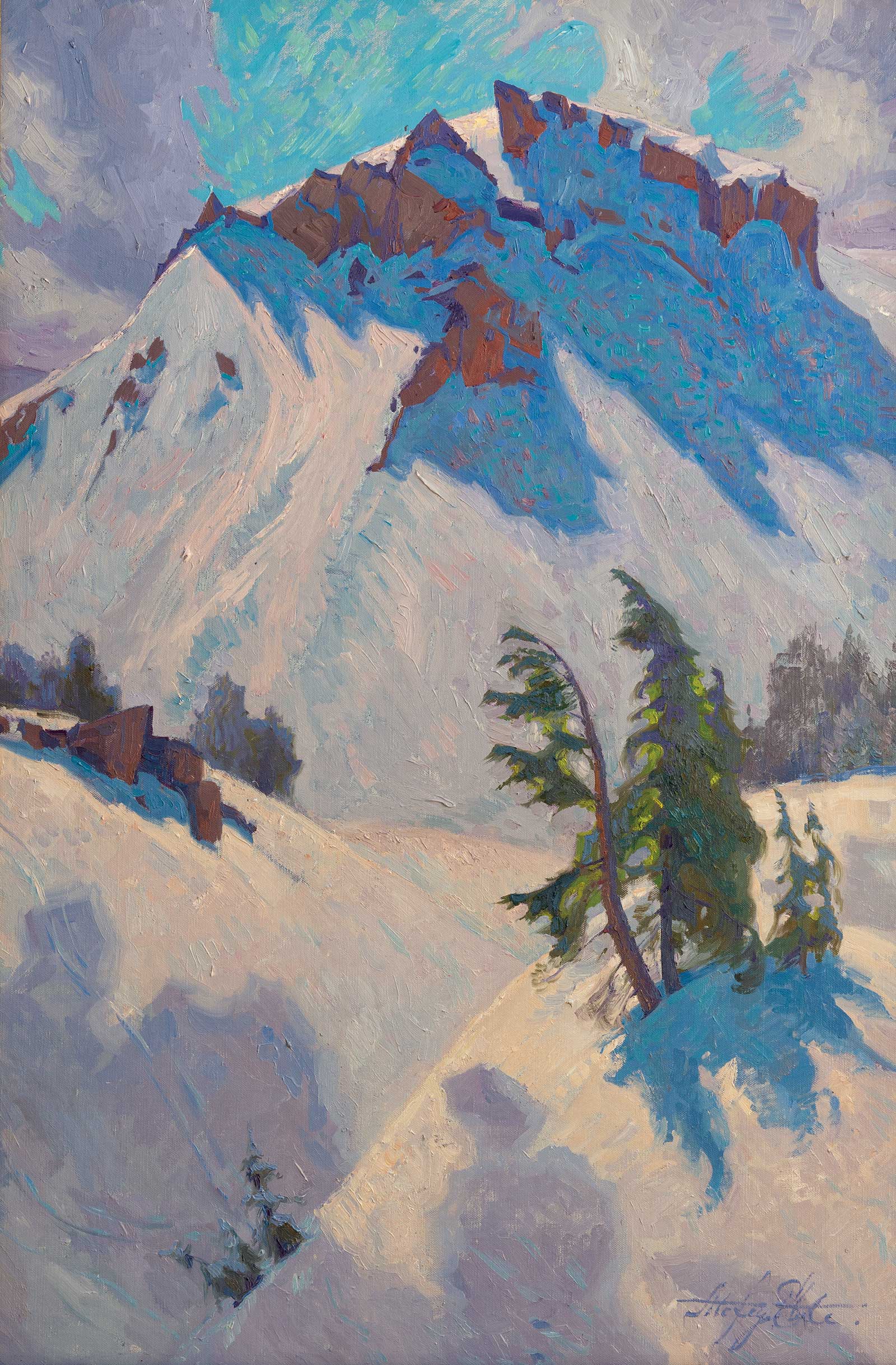
Top of the World Mammoth, oil on linen panel, 40 x 30 in.
In the face of this seeming nihilism, Steele is resolute in the search for beauty as a source of satisfaction for humanity—not because it provides answers to the mysteries of mortality, but because it allows us to appreciate them. Backlit by the golden sun, Steele’s illuminated tree offers more than sweet fruit and juice. In the biblical Eden of the Genesis account, Adam and Eve ate from the forbidden tree of knowledge of good and evil, and the scripture tells us that mortality was the punishment for their wicked pursuit of wisdom, and their newfound appreciation of ethics. But the Tree of Life was at the center of the garden, too, and offered them immortality, and God knew that if Adam and Eve ate that fruit they would become like gods, so he expelled them from the garden, and guarded it with supernatural entities, cherubim and a flaming sword that turned in every direction. Forged from the crucible of suffering, Steele’s orange tree is cast as a symbol of mankind’s perennial desire to return to Eden, but it is a reminder that this desire is eternally thwarted by unfathomable mysteries.
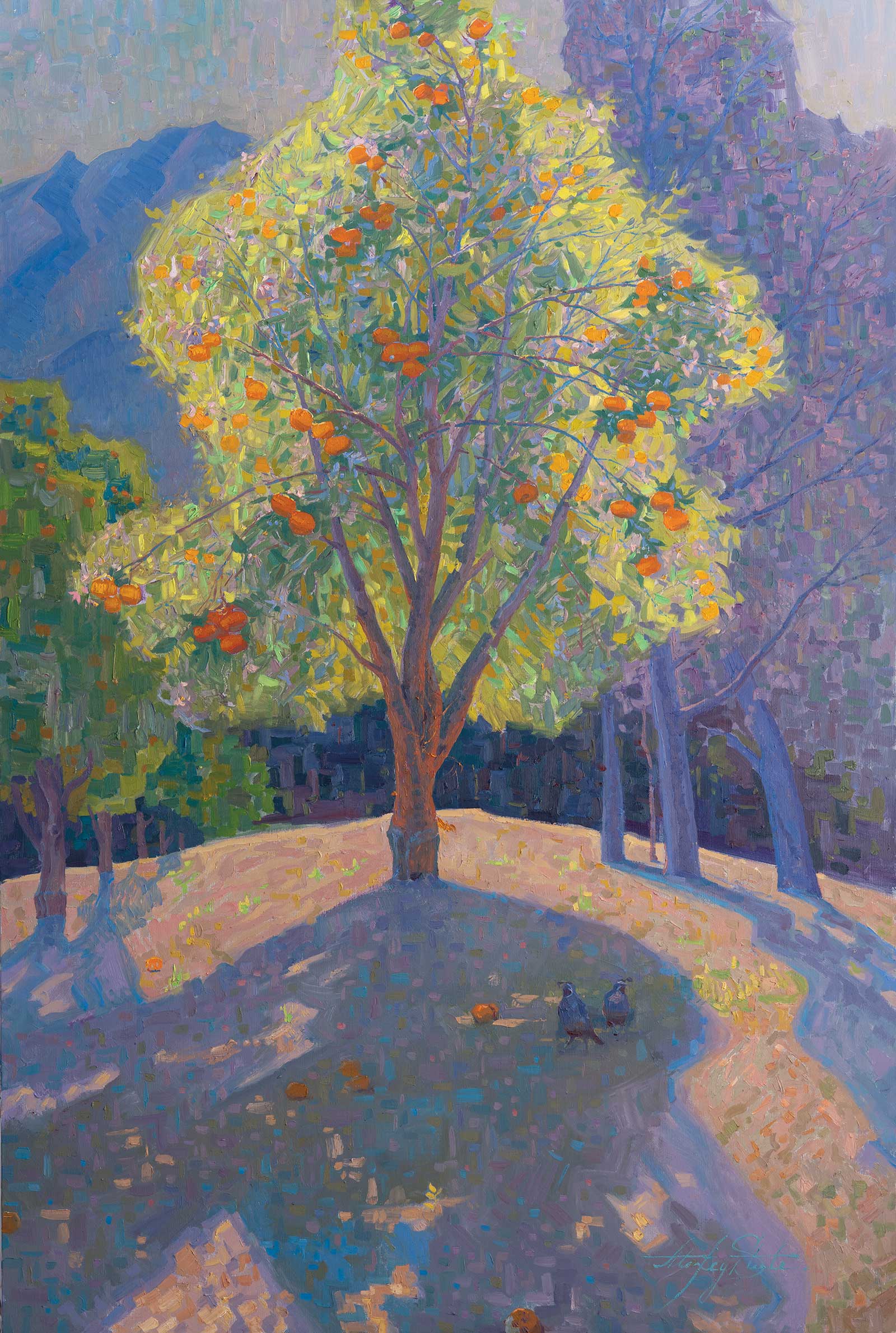
Ojai Bloom, oil on linen, 60 x 40 in.
To Steele, painting is an approach to those mysteries. These recent paintings are a contrast to his long study of the human form in his Love my Neighbor series, but he doesn’t think of them as landscapes, more as portraits of the unknown. He has written an essay on beauty and the Augenblick (the moment of facing the unfathomable) which he considers an essential companion to the painting. In it, he powerfully declares, “Art deals with the unknowable—not to make it known, but to make it experienceable. To create encounters with what exceeds comprehension. How to show the unknowable? Not by explaining it—that would make it known, which it isn’t. Not by ignoring it—that would be denial—but by constructing conditions for encounters with it.”
His painting The Wave is another superb triumph of his encounters with the sublime, with a backlit spectacle of brilliant pink foam flung skyward as the rushing tide of turquoise waves crash against sharp rocks at the Pacific tideline. It is a magnificent meeting with the eternal, found in the tidal ebb and turn of water, as it slaps and shapes the shore with elemental strength, and though the processes of these geological mysteries may have been explained by science, human intellect is dwarfed by the supreme gravity of their ancient rhythms, which surpass the fragile brevity of little human lifespans. All nature is sublime to us.
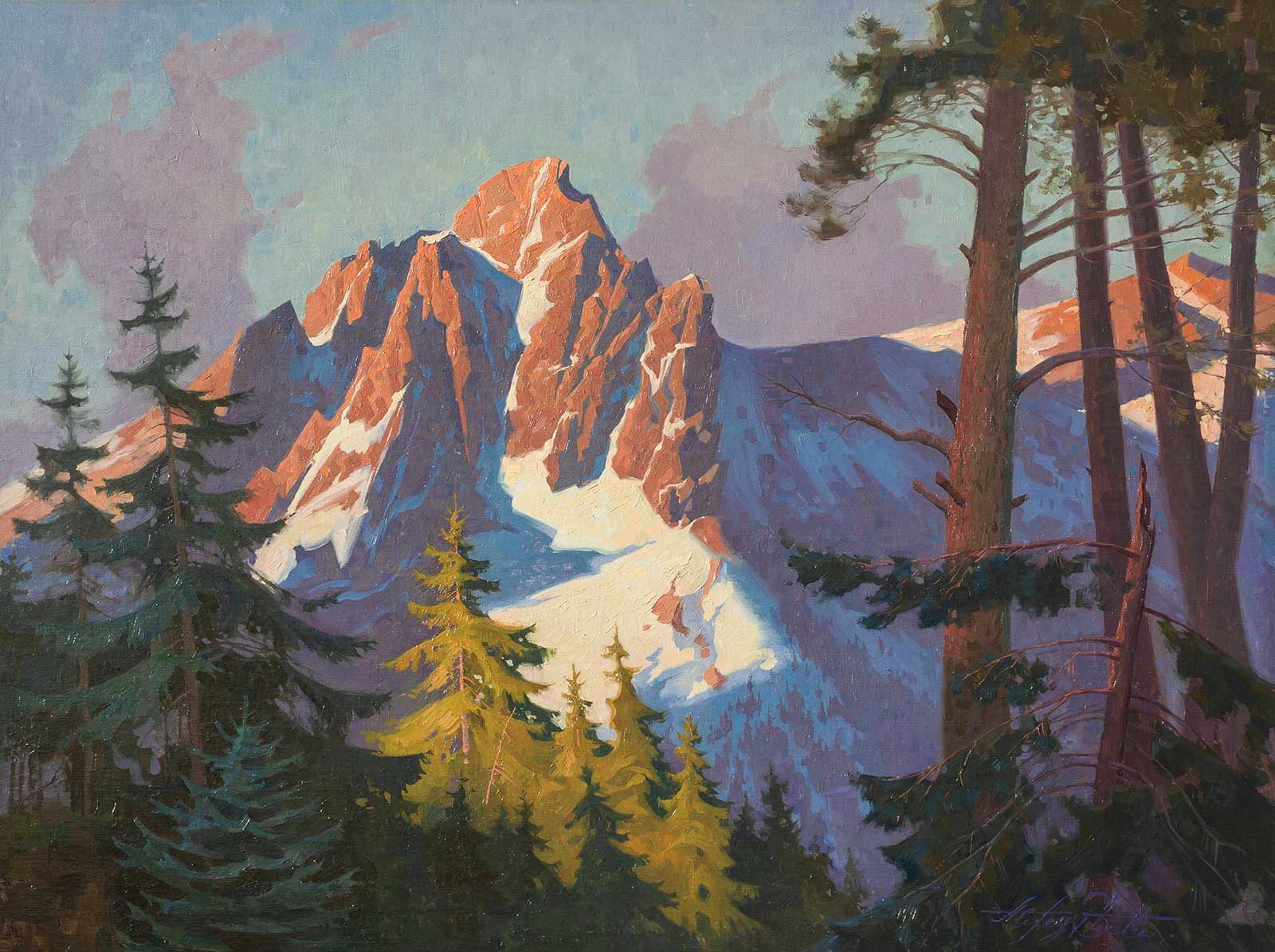
Sunrise at Carson Peak, oil on linen panel, 36 x 48 in.
He finds the temporal sublime in his calmer paintings, too. His Serene Hour, Santa Monica Bay is set at the serene beach near Point Dume in Malibu, where breakers roll in steady and soothing rhythms over the shoreline, a scene gently receding across the width of the composition. The horizon is high, and we are watching the moment of recession as seawater sinks into the sand, the silvered mirror of its surface sinking into the darkened space between land and sea. It is the timeless threshold of the elements. Steele explains, “I never painted the landscape for the scene. As a matter of fact, the scene is the most destructive thing in the landscape. I paint landscape for the sensation of presence in the moment and what nature whispers to you, when it tells you something important that words cannot capture…when the words cease to be useful…when words cease being functional. When the philosophy stops, the image keeps moving. The image prevails and just happens to be. This is what painting is.”
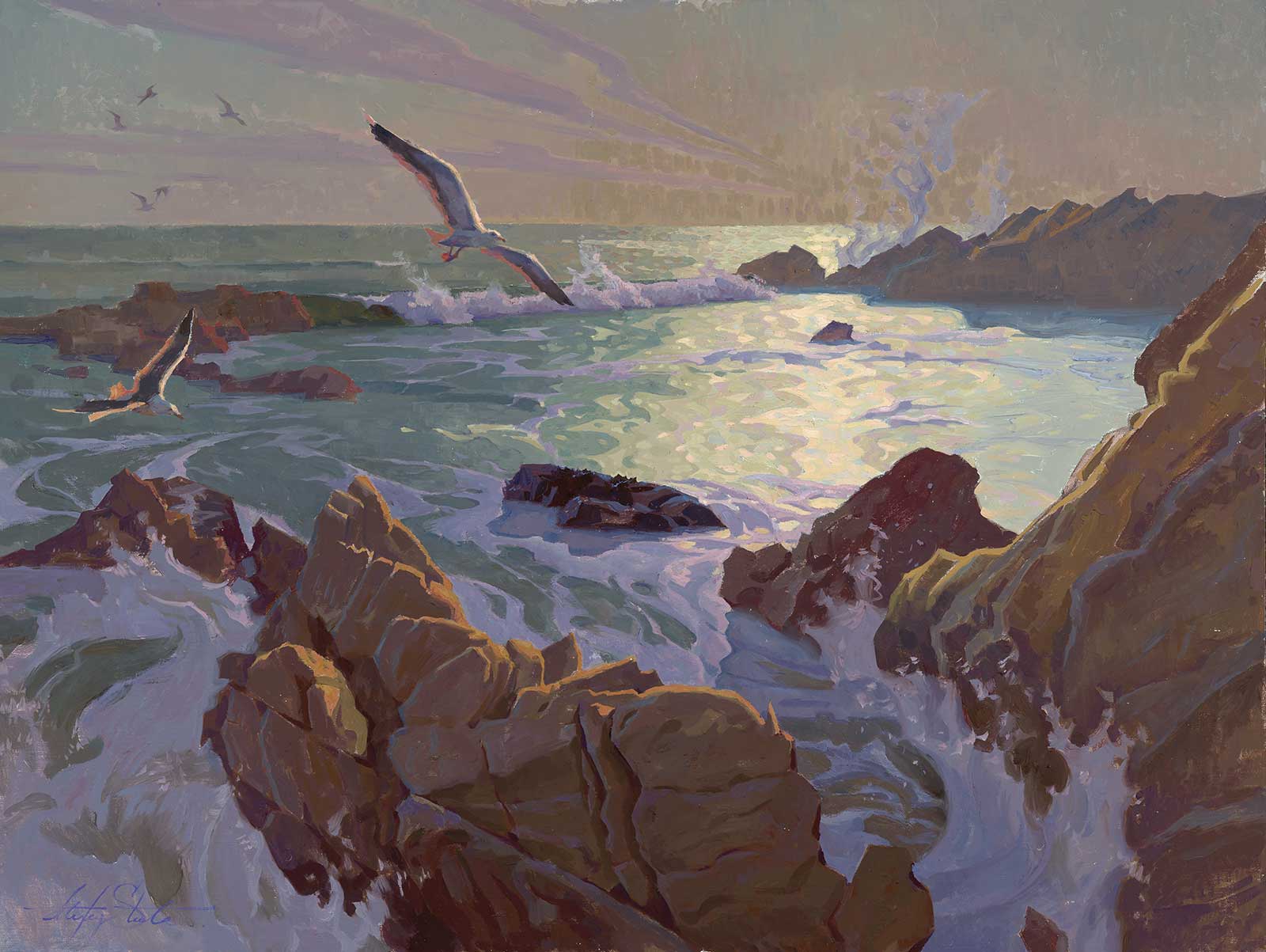
Gust and Glow, oil on linen panel, 30 x 40 in.
There it is in Gust and Glow, with the seagulls swooping over the surging sea, and there in Rocks and Horizon at Leo Carrillo, where the diminutive angler casting his hopeful line beyond the wave balances on the arch of schist, its strong structure pounded by the break, but even this mighty natural architecture is surely set to shatter one day under the ocean’s relentless assault. Steele’s hard-edged rocks are brittle and destined to break and one day crumble into sand, but the frail fisherman risks swift and jagged destruction—his story and his strength tiny compared to the colossal span of stone. And yet there is courage in his stance, and the sensations of his experience are the same as those of the painter, who Steele sees as a heroic figure facing the overwhelming power of the sublime, seizing, and sharing the awesome strength of beauty. In the essay Steele wrote for Ojai Bloom, he said, “Beauty, I have come to believe, is not a quality that resides in objects. Beauty is the bravery of facing what could overwhelm us.”
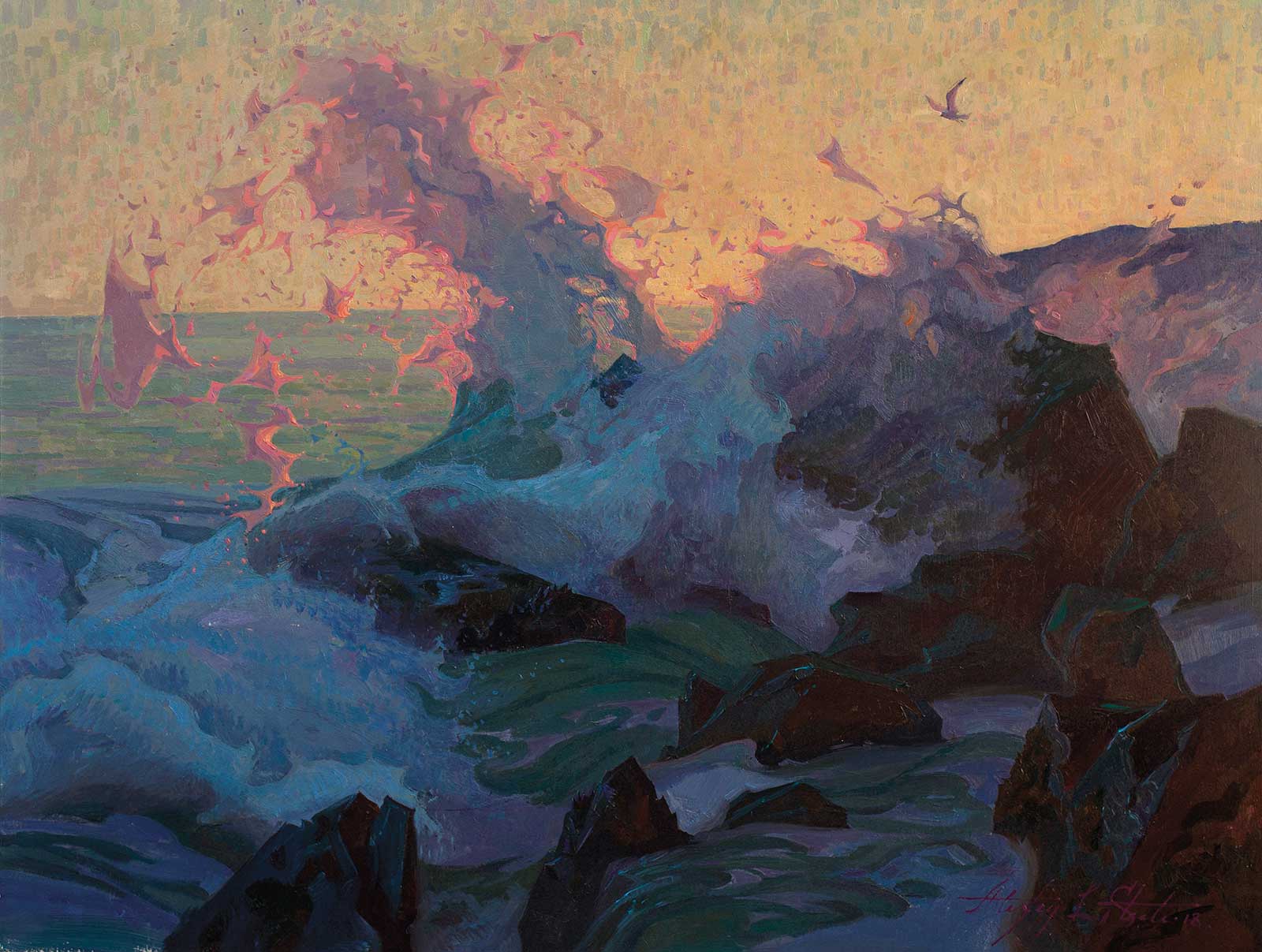
The Wave, oil on linen panel, 30 x 40 in.
In the Ojai Valley Museum gallery, Alexey and I are looking at his sparkling little study of the tree titled Orange and Blue, with tingling pink blossoms vibrant against lime green leaves and crackling contrasts of purple and cobalt dashed into psychedelic shadows. His narrative is gradually rising from his hushed tones to a crescendo, filling the hall with the cracking percussion and echoes of his voice as he becomes increasingly fervent, but within the escalation and emotion of his oratory there is a profound expression of great clarity. It is a declaration of the reason and fire of his faith, his creed for being a painter, and he is preacher and a prophet in a fever of passion as he declares: “To be under the pressure of time and the pressure of everything, under the pressure of life disappearing from you, from under your hand, you are in the moment of death in the moment of painting. [Yet] you depart. You really do…And then your method of abbreviation comes, because what is it that you take that is so vitally significant for you in this moment, if you die in 25 seconds? Your painting is done. Your stroke that you laid is an answer. I’m dying! I’m dying! I’m dying! I’m still dying! Bam! Bam! Bam! Bam! Bam! Bullets flying! That’s your painting! Because then you’re surpassing your death through the actual fact of laying the picture. Another split second. And then you want to relive it.” —
Powered by Froala Editor