When Auguste Rodin exhibited his sculpture The Age of Bronze at the Salon des Beaux-Arts in 1877, he was accused by some of having cast the model from life. He produced photographs of his model in the same pose to prove that the sculpture was the result of his skill at modeling in clay and casting in bronze.
Today, Carole Feuerman casts from life and her sculptures are exhibited and praised around the world. Casting is only the beginning of her creative process, however.
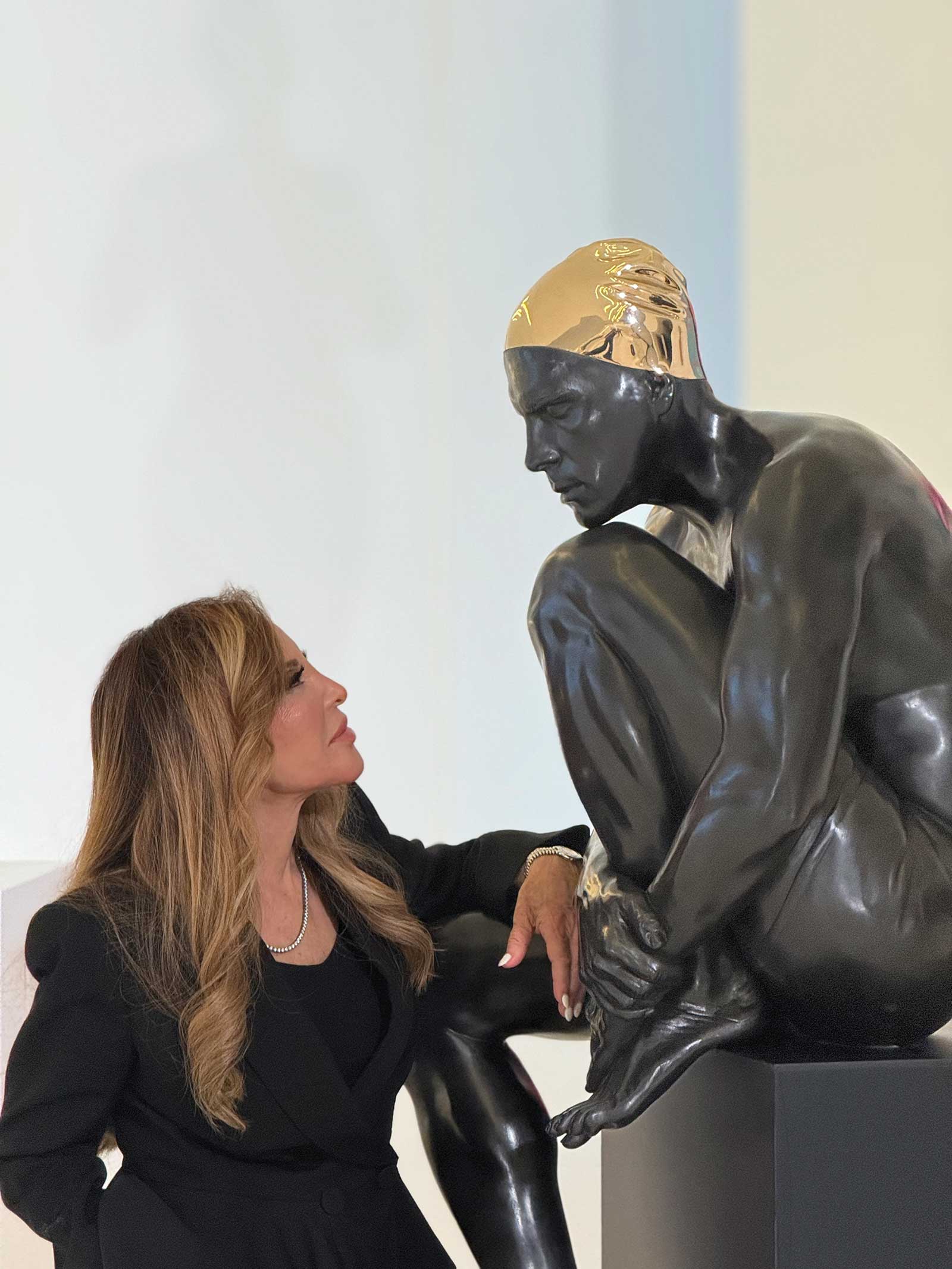 Carole Feuerman contemplates her sculpture The Thinker.
 The cast “is not the finished artwork,” she explains. “What many people don’t realize is that even after the casting or scanning is completed, an enormous amount of artistic work still takes place. The surfaces, proportions, composition, engineering, patinas and emotional presence of the figure are all carefully developed over time. Especially in monumental works like The Golden Mean, there is also a tremendous architectural and structural component that requires collaboration with fabricators, engineers and foundries.
“For me, life-casting is simply one tool among many, much like a photographer uses a camera or a painter uses sketches. It allows me to capture a moment of human presence with extraordinary precision, but the sculpture itself is created through countless artistic decisions afterward. The work is ultimately about what I bring to the figure psychologically, emotionally and conceptually.
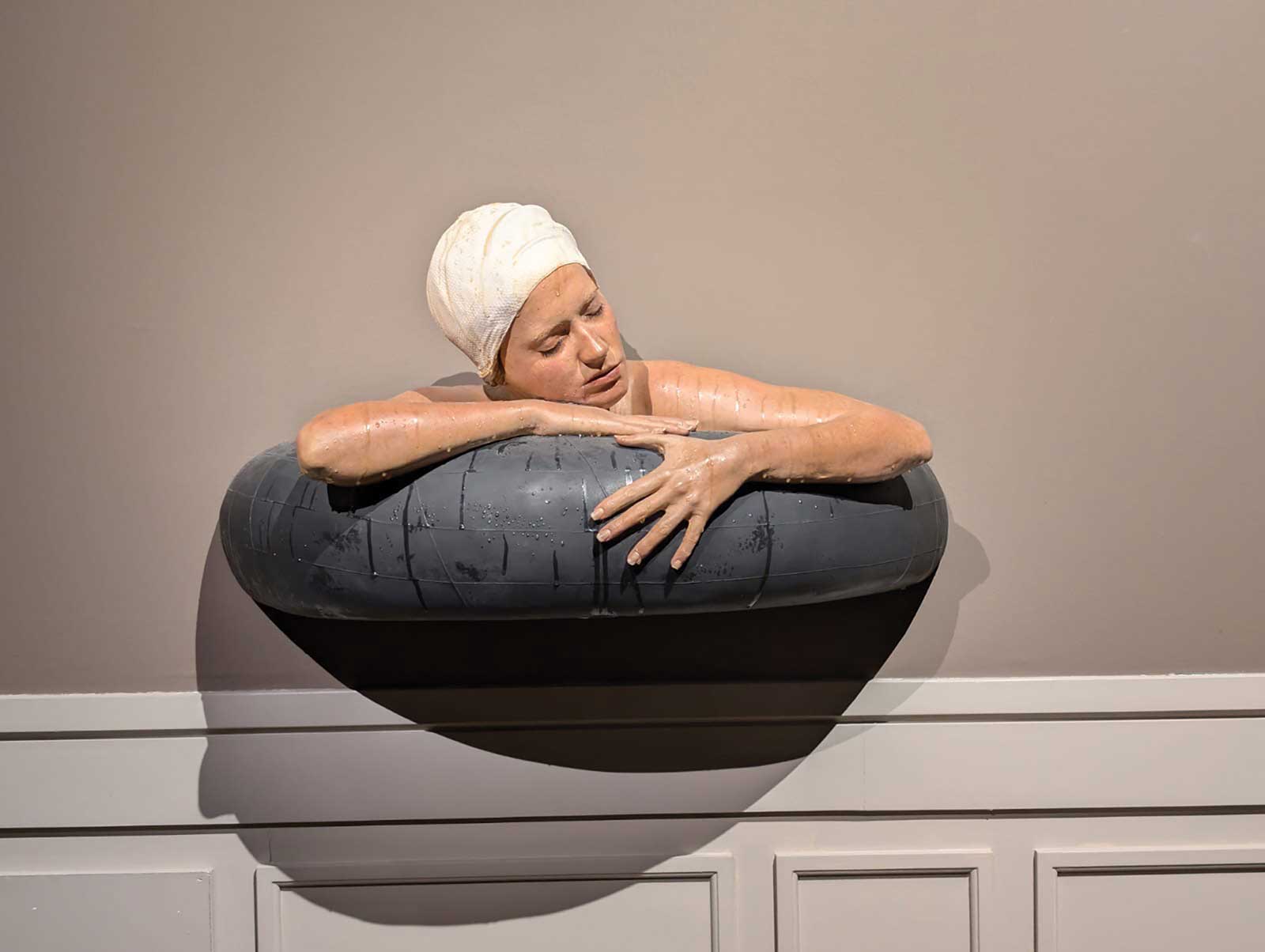 Innertube, oil on resin, 17 x 32 2/5 x 15 in.
 “I also think the conversation around casting has changed dramatically since Rodin’s time,” continues Feuerman. “Today we understand that contemporary art is not defined by one technique alone. Artists use technology, fabrication, digital scanning, photography and many other processes as part of their practice. What matters is the vision behind the work and whether the final piece has emotional and artistic power. In my case, realism is never the end goal. The surface accuracy draws the viewer in, but what I hope remains with them is a sense of stillness, humanity, vulnerability or transcendence. That is where the art truly exists.”
An exhibition of her work from the 1970s to the present, Reborn into the Water,is installed at the iconic Heydar Aliyev Center in Baku, Azerbaijan, through September 2027. The center was designed by the Iraqi-British architect and designer Zaha Hadid (1950-2015). Hadid was the first woman to win architecture’s highest honor, the Pritzker Architecture Prize.
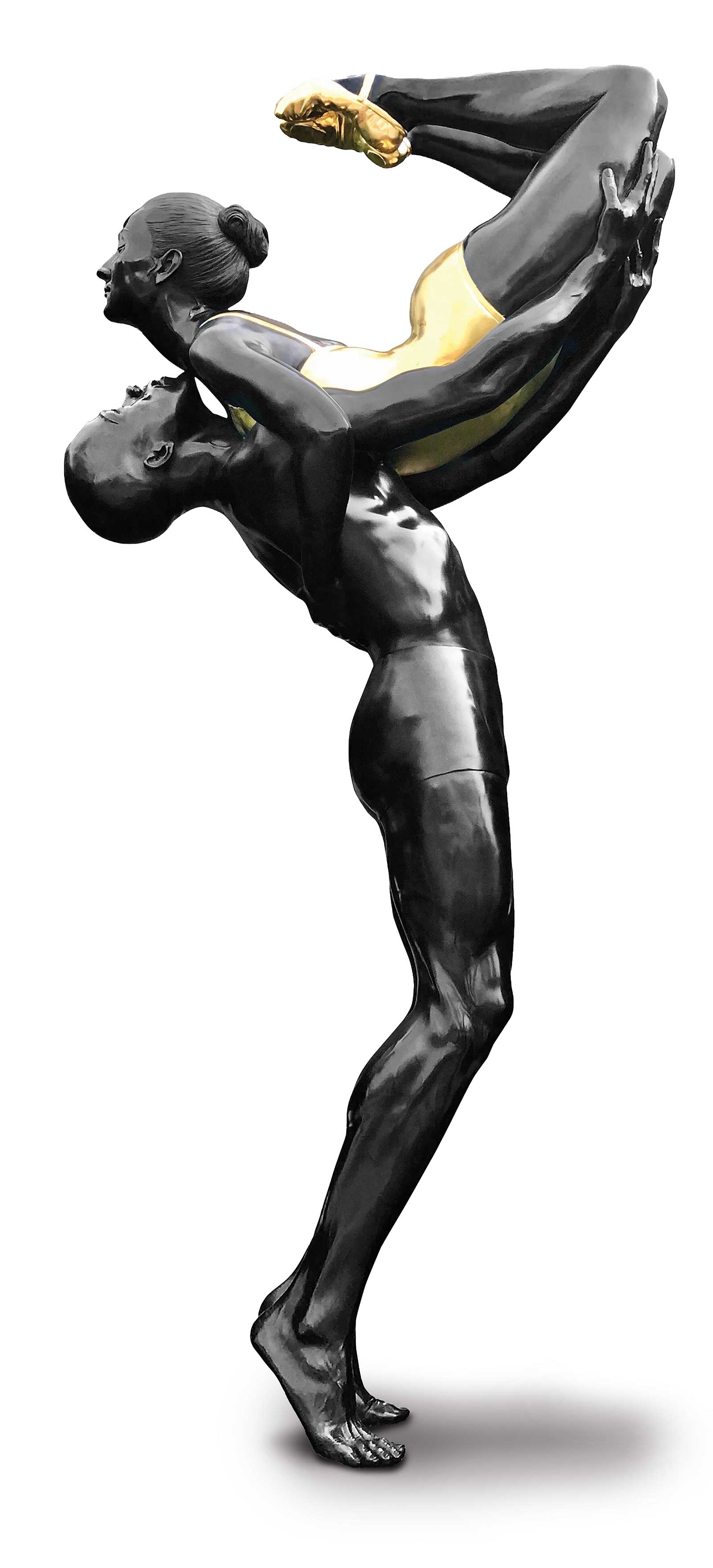
Strength, patinated bronze with gold leaf accents, 1431/3 x 48 x 48 in.
“Showing Reborn into the Water at the Heydar Aliyev Center has special meaning for me because the building itself is such a powerful symbol of innovation, courage and imagination,” Feuerman explains. “Zaha Hadid completely redefined what architecture could be. “She created forms that feel fluid, human and almost impossible, yet they exist with extraordinary confidence and strength. I feel a natural dialogue between her architecture and my sculptures because both are rooted in movement, balance, vulnerability and human presence.
“What is especially meaningful to me is that both of us built our careers in fields that were historically dominated by men. When I began my career in the 1960s, there were far fewer opportunities for women artists to be taken seriously, especially in sculpture, which was often associated with physicality, monumentality and traditionally male ideas of authorship. I was told more than once that I should abandon my ambitions and ‘go home and have babies.’ Zaha Hadid faced similar resistance in architecture, yet she persisted and transformed the field globally.
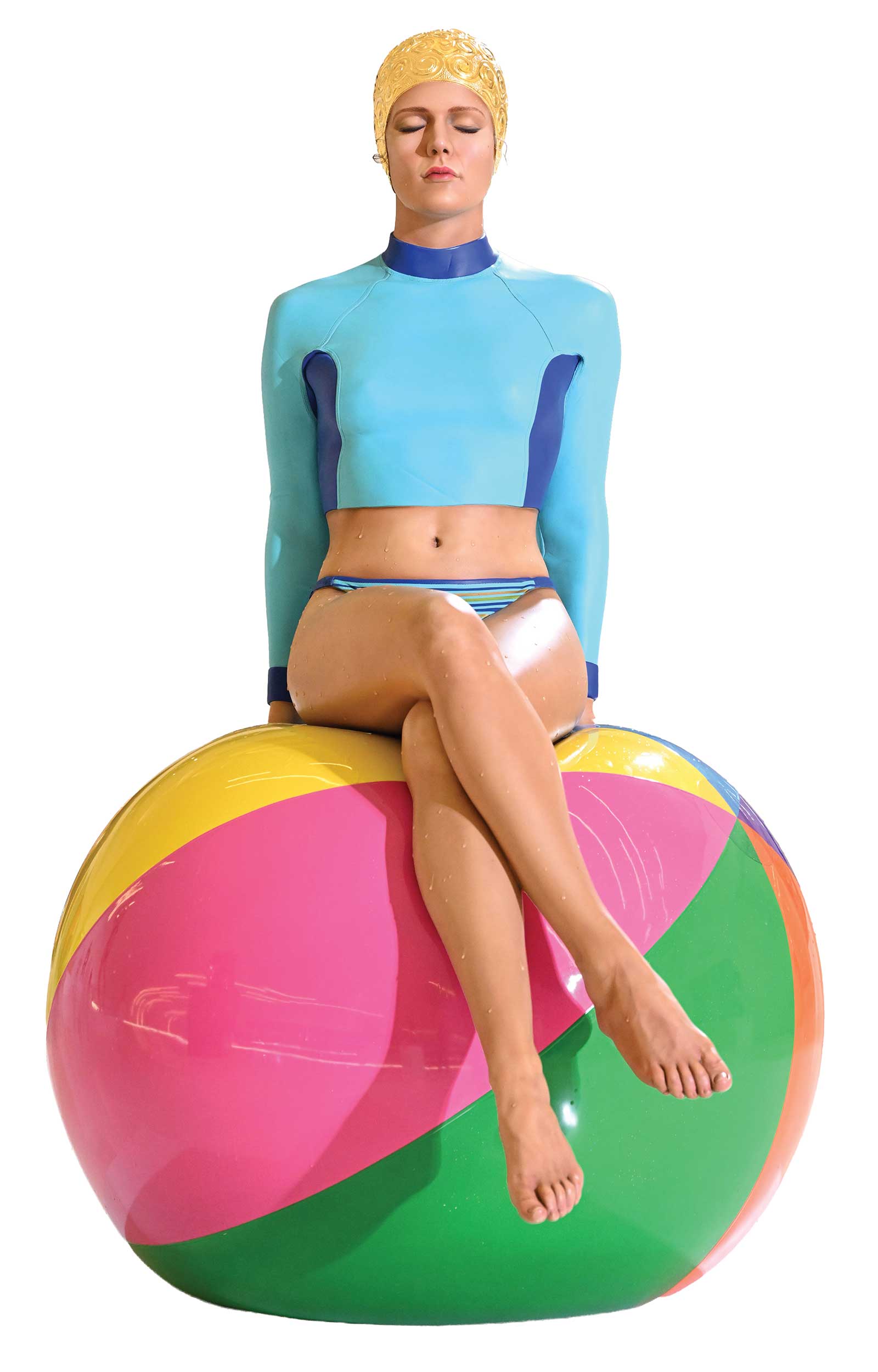
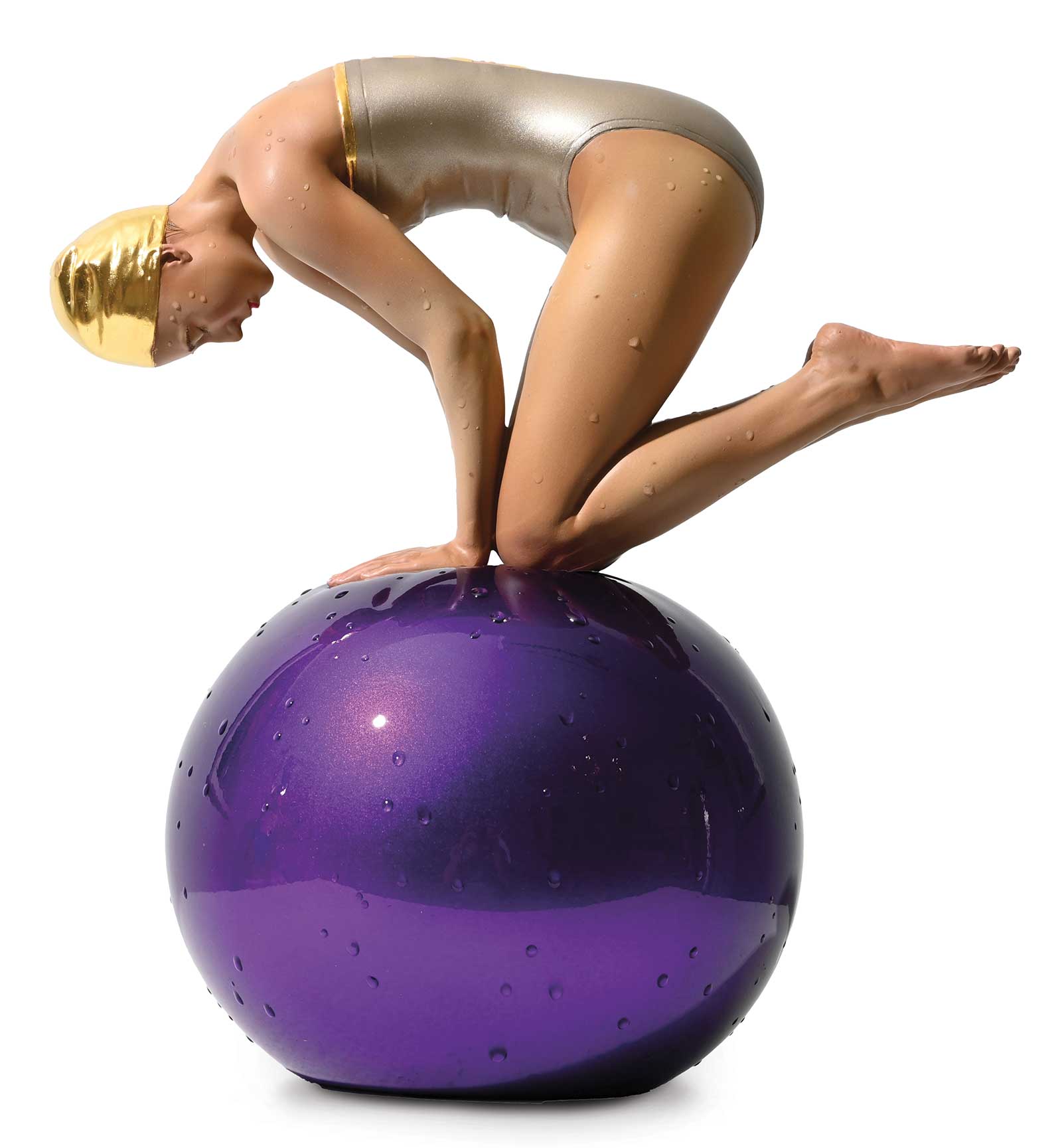
Bibi on the Ball, lacquer on resin and gold leaf cap, 64 x 46 x 33¾ in.
“Over the course of my career, I’ve seen an extraordinary change in the role of women in the creative world. Women are no longer standing outside the conversation asking to be included—they are shaping institutions, leading museums, designing cities, building collections and redefining culture itself. That shift has been profound.
“To exhibit my work inside the Heydar Aliyev Center feels symbolic of that evolution. It represents two women from different disciplines and generations who each believed in pursuing an ambitious vision, regardless of obstacles. For me, the exhibition is not only about sculpture within architecture; it is also about the growing visibility, influence and lasting impact of women who dared to change the language of their fields.”
In Reborn into the Water,the soft contours of her predominantly female bathers and swimmers echo the sinuous forms of Hadid’s organic architecture. Opened in 2012, the center is a departure from rigid Soviet architectural design. The plaza on which it sits rises to join seamlessly with the exterior wall. Its flowing lines are derived from the calligraphic and ornamental designs of Islam.
Mini Quan, oil on resin, 11 x 11 x 7 in.
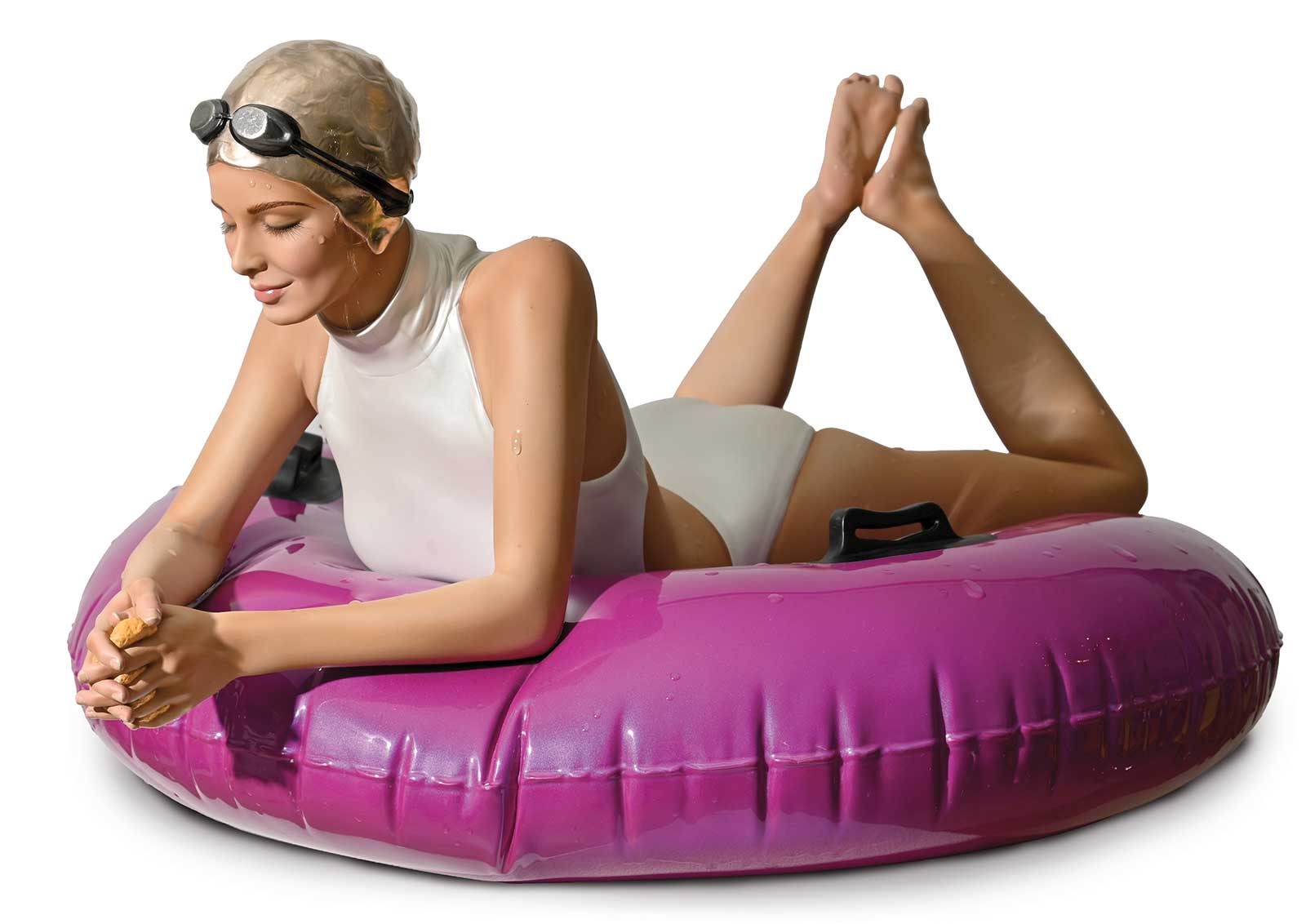
Next Summer, oil on resin, 14 x 21 in.

Balance, oil on resin and clear crystal cap, 19 x 18 x 10 in.
“When I began making sculpture,” Feuerman says, “women were very often depicted through a male gaze or reduced to symbols of perfection. I wanted to approach the figure differently. My women are self-contained; they are not performing for the viewer. They exist in moments of stillness, reflection and inner strength. Even in works that appear serene, there is usually a deeper psychological tension underneath. At the same time, some of my most iconic works are male figures, including The Double Diver, The Golden Mean and The Thinker. Those works allowed me to explore athleticism, balance, contemplation and monumentality through the male form, just as the female figures allowed me to explore emotional and psychological presence. I’ve never thought of the body in terms of gender alone—I think of it as a vehicle for expressing the human condition.
“I also think my relationship to the figure evolved alongside my own experience as a woman artist navigating a field that was historically male dominated. Sculpture requires physicality, ambition and persistence, and I had to fight to claim space within that world. In many ways, the figures became extensions of endurance and survival.
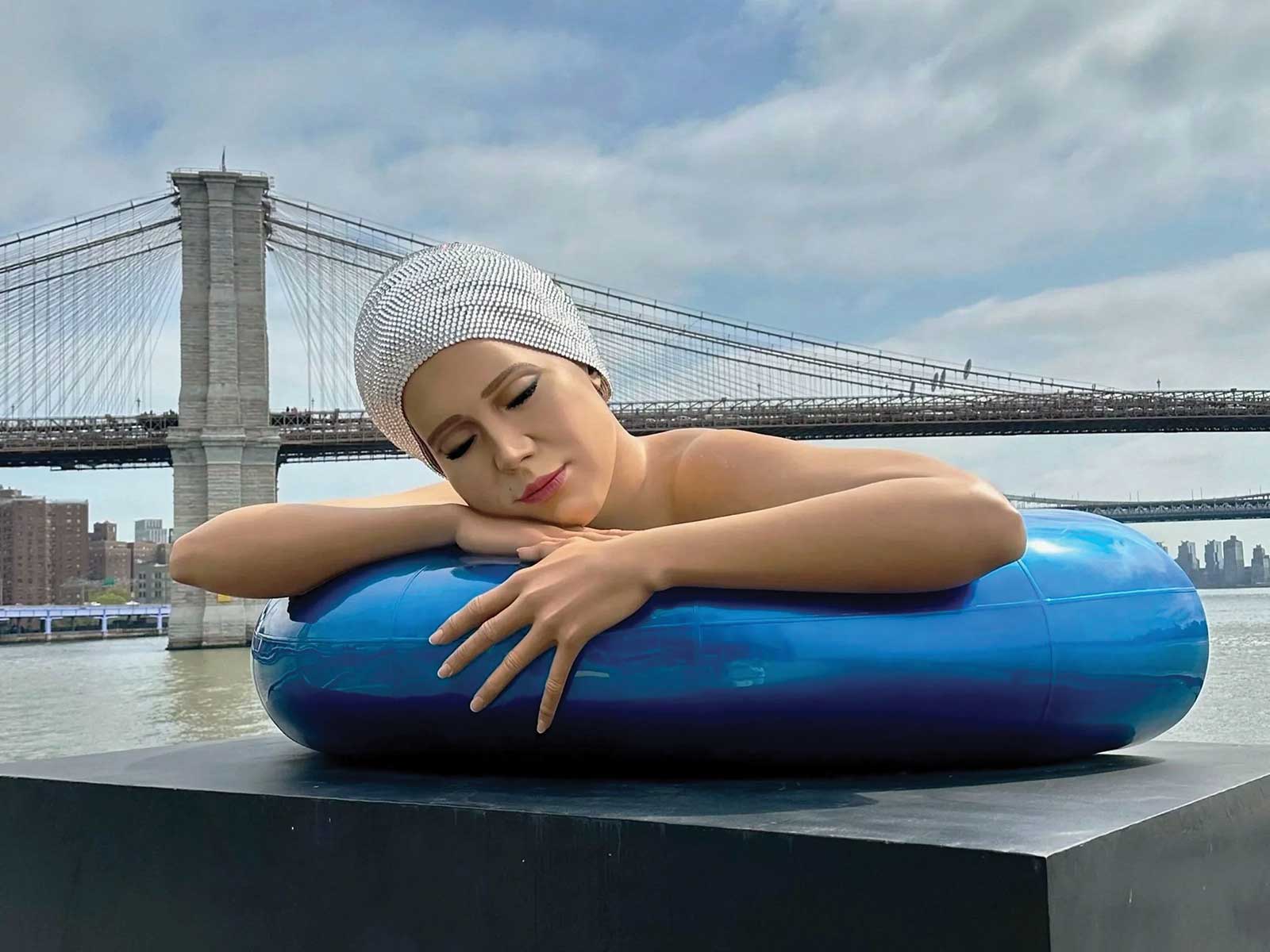
Survival of Serena, lacquer on resin with crystal cap, 44 x 81 x 36 in. Installed in the exhibition Sea Idylls, 2024, at The Seaport, New York City.
“Over time, the work has expanded beyond portraiture into broader ideas about identity, mythology, memory and transformation. The newer tattooed and fragmented figures especially explore how the body carries history, symbolism and layers of meaning. So while the female form remains central to my work, the work itself is ultimately about humanity, vulnerability, strength and transcendence.”
In her work, sculptures of serene beauty can evolve from moments of horror. Survival of Serenaappears today in various, often brightly colored, versions of a woman resting on an innertube. “In 1981, I was moved by the immigrants that I saw floating on life rafts from Cuba into Key West,” Feuerman explains. “These shocking images led me to make my most iconic sculpture, a contemplative woman resting peacefully on an inflatable tube.” The sculpture didn’t always look like a serene and peaceful woman.
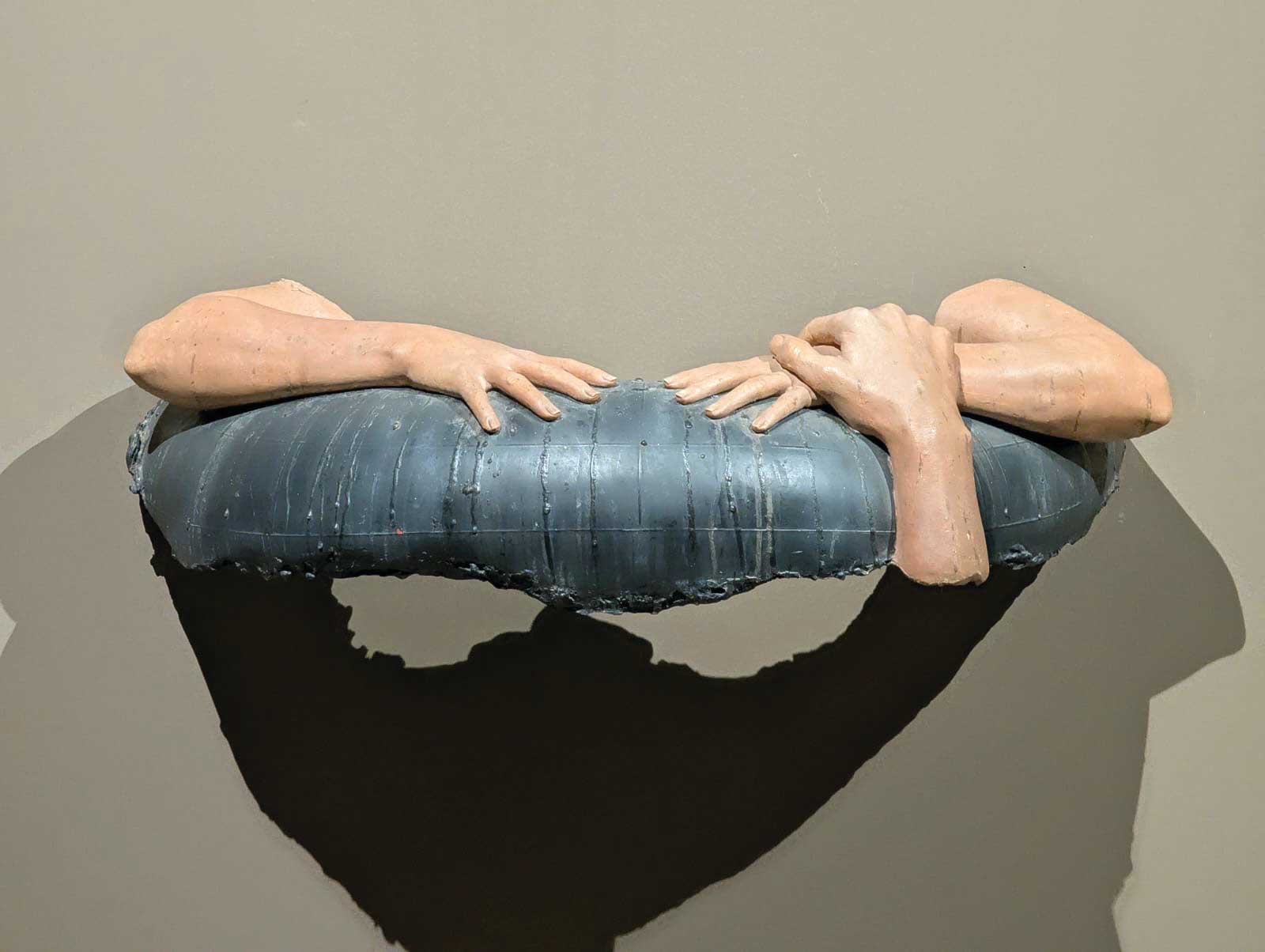
EN 2-078, oil on resin, 9 x 33 x 15 in.
Her 1981 sculpture EN 2-078 was succeeded by Innertube in 1984. “It was the same sculpture as EN 2-0278,” she says, “but now the man’s clinging, drowning hand was gone, and I added a woman’s face. In 2007, John T. Spike, an art critic, historian, museum curator and author, invited me to exhibit in Venice at the In Paradiso Art Gallery, an exclusive venue for temporary art exhibitions and hosted by the Concilio Europeo dell’Arte. It is located right outside the gates to the Venice Biennale. He asked me to make Catalina and Innertube in monumental size. He said, ‘If the pyramids were small, no one would go to Egypt’. I enlarged the Innertube sculpture to 8-feet wide and exhibited it. The sculpture was so well received that people waited in line to see her up close. She was renamed Serenissima after the serene island of Venice.”
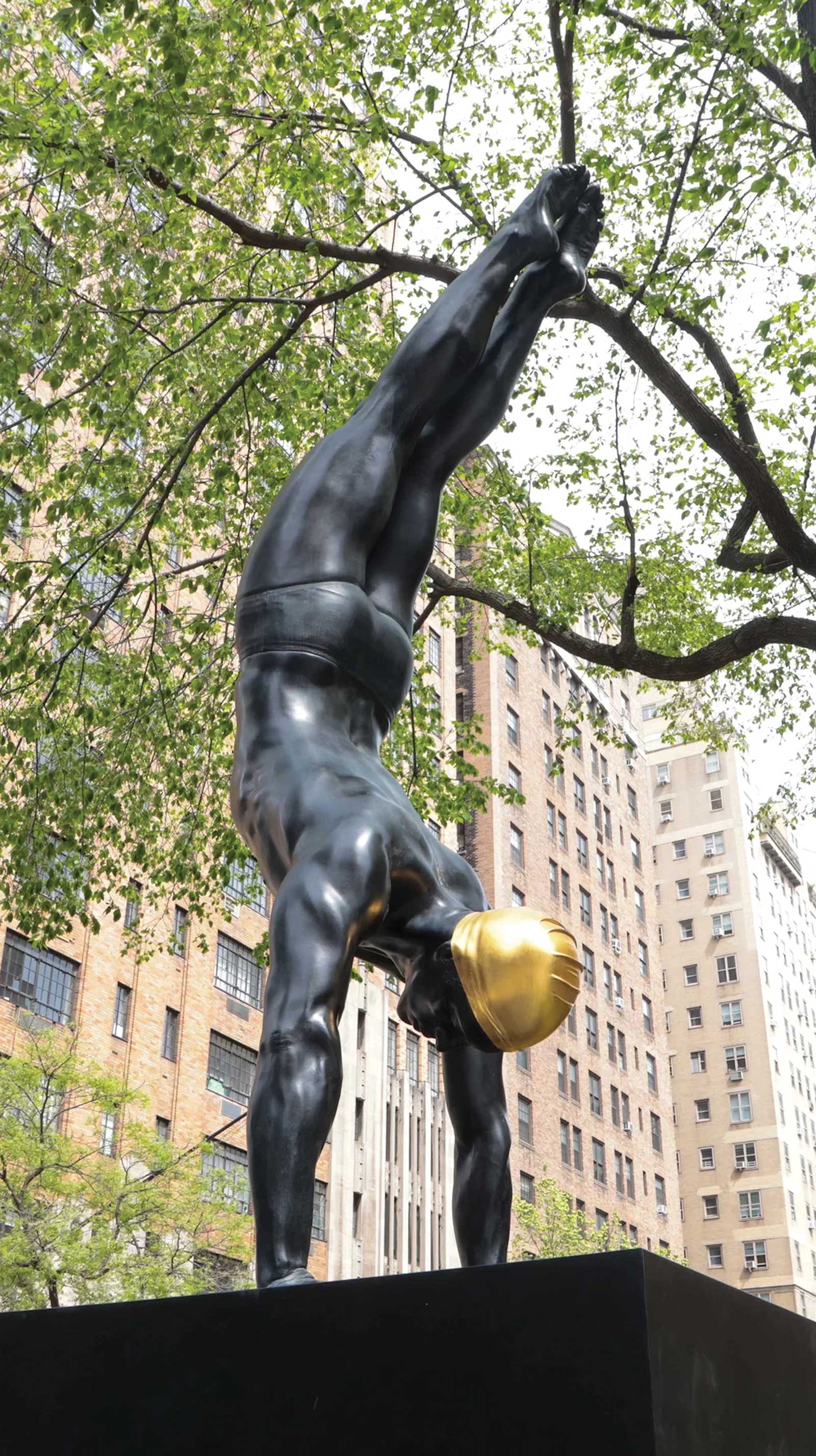
The Golden Mean patinated bronze with gold leaf accents, 150 x 54 x 38 in. Installed in the exhibition Sea Idylls, 2023, Park Avenue, New York City.
Commenting on the title of her current exhibition, she says, “After more than 40 years of creating swimmers, I continue to be fascinated with the figure in the water and with water on it. My subjects are swimmers. My medium is water. I love the mechanics of water and its presence as an enduring symbol for life. It is essential to our very existence. Its symbolism is extremely far-reaching and profoundly deep. Water connects one land to another, uniting the world and connecting us all. It touches all people, animals and things. I will observe, photograph and sculpt swimmers for as long as water and the human form captivates me.
“Spiritually, I think of the figure as a vessel. The finished sculpture is no longer just about the model; it becomes a reflection of collective human experience. That transformation is important to me. By the end of the process, the sculpture belongs less to the individual and more to the viewer’s emotional response and interpretation.
“Afterward, many of the works continue to evolve in meaning for me over time, especially when placed in public spaces or museums. Once the sculpture leaves the studio, it begins its own relationship with the world.”
With their eyes closed, the figures inhabit their own worlds as well as the physical world they and the viewer share. We observe, not as voyeurs, but as participants in the same moment, admiring and identifying with their calm as in Survival of Serena, awestruck by their balance as in The Golden Mean or Strength.
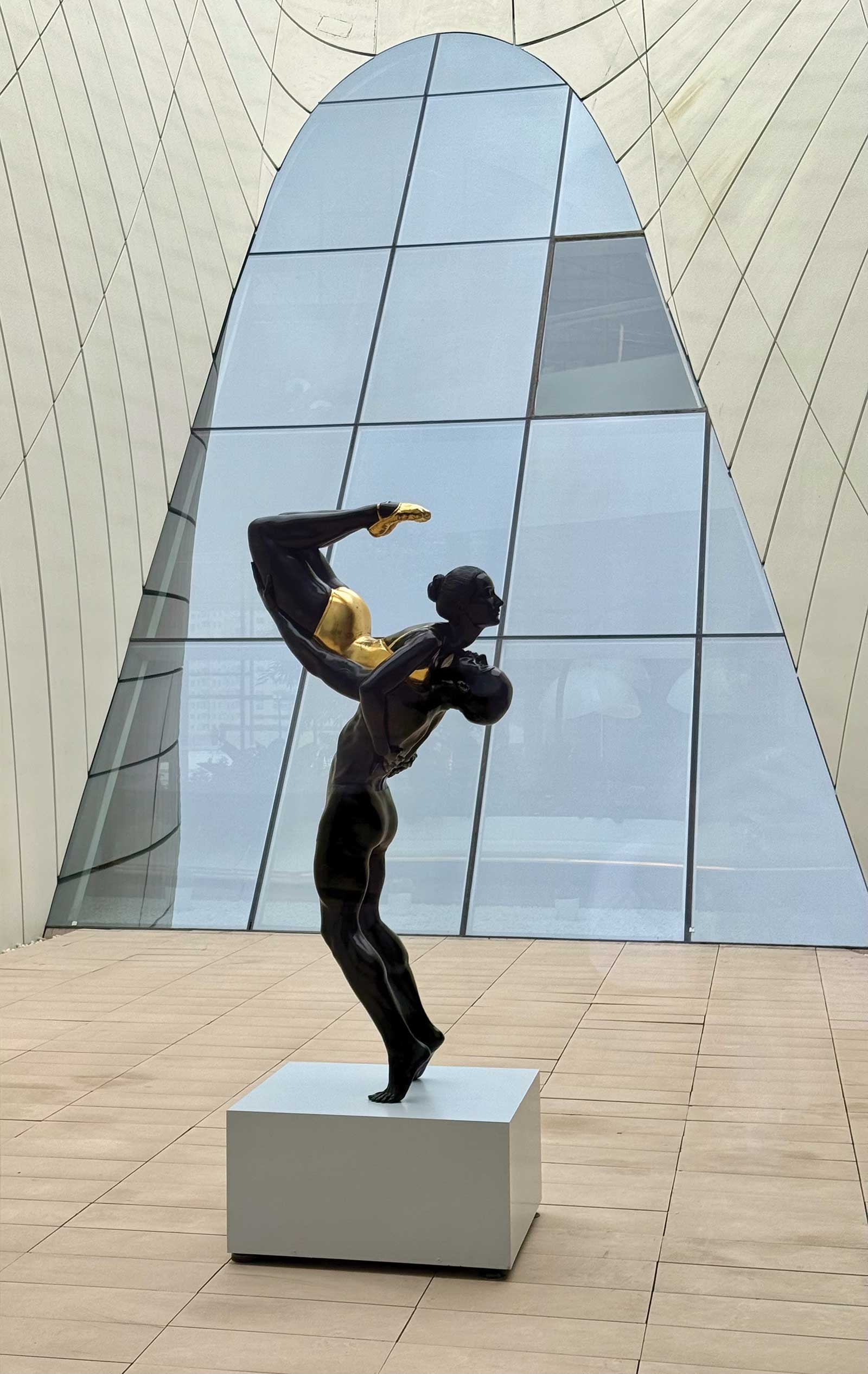
Strength, patinated bronze with gold leaf accents, 1431/3 x 48 x 48 in. Exhibited in Reborn into the Water at the Heydar Aliyev Center in Baku, Azerbaijan.
Feuerman boldly stuck with the figure in the early part of her career despite the plethora of “isms” that dominated the art world—from minimalism to abstract expressionism. She persevered, honoring the traditions of figurative art and evolving those traditions into the 21st century. Her figures are of today, personalities inviting interaction rather than cold impersonal bodies to be viewed unemotionally. —
Powered by Froala Editor