Sculpture, often referred to as three-dimensional work, is considered one of the oldest human expressions, harkening to ancient Greece and Rome, and even pre-history—with artifacts made of stone, ivory or wood. One such piece, the Venus of Hohle Fels (35,000 to 40,000 years old) found in Germany—depicting the exaggerated form of a woman—is considered to be the oldest human figurine, and is made from a woolly mammoth tusk.
More often than not, the human form was the focus in sculpture across history, as was the case for artist Edmonia Lewis (1844-1907), the first sculptor of Afro-Caribbean and Anishinaabe descent to achieve widespread international acclaim. The Peabody Essex Museum, which hosted the recent retrospective exhibition Edmonia Lewis: Said in Stone,notes that Lewis was orphaned as a child, and was raised by maternal aunts who profoundly inspired her as an artist, teaching her how to work with birch bark and porcupine quills, craft textiles and moccasins, and use a range of materials to tell stories.
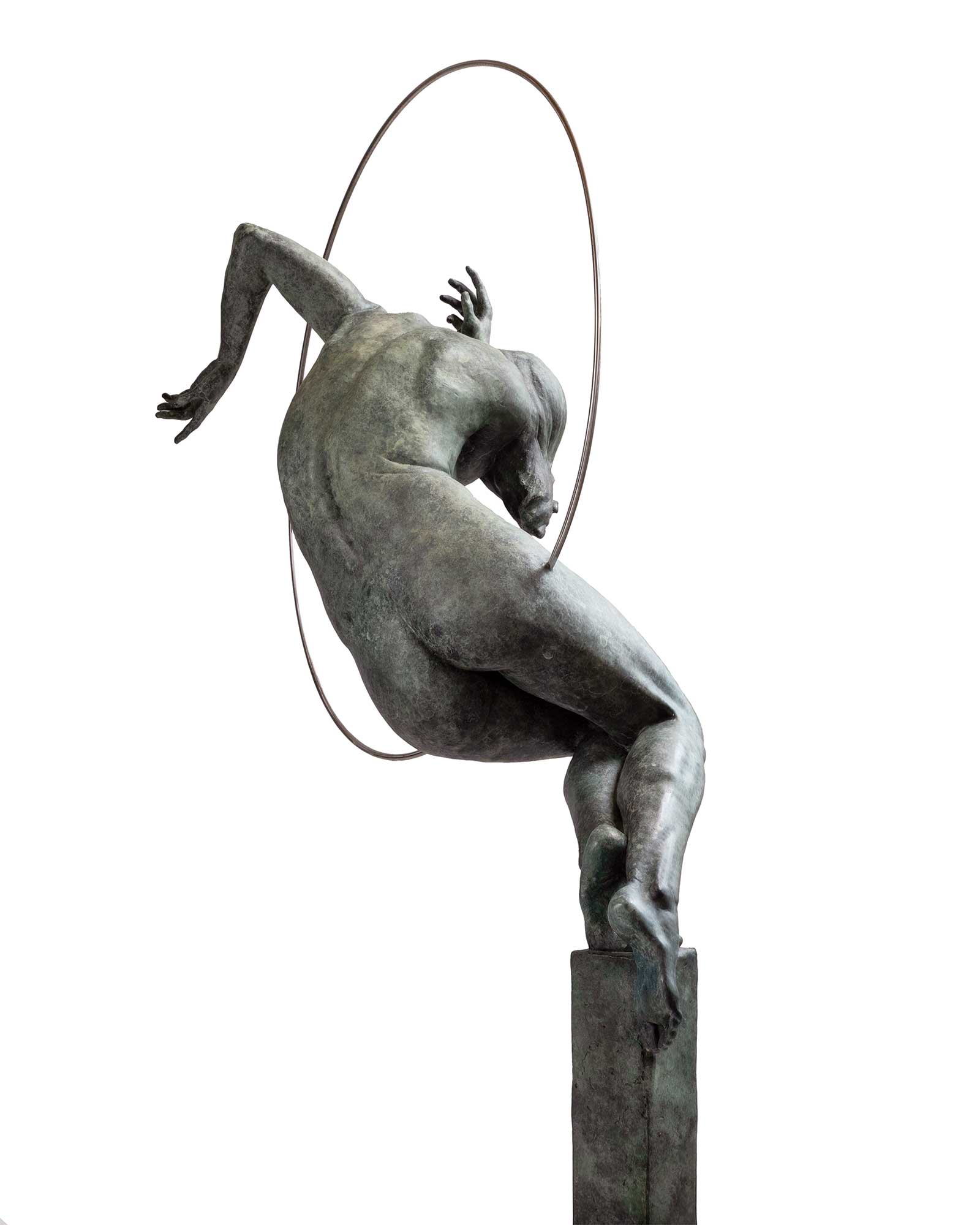
Kevin Chambers, Dusk, bronze, ed. 1 of 10, 42 x 32 x 18 in.
“At age 19, Lewis met the abolitionist Frederick Douglass at Oberlin College in Ohio,” the museum continues. “He recognized her artistic talent and encouraged her to ‘seek the East.’ She began her artistic career in Boston, which was a hotbed of antislavery activism when she arrived in 1863…” Her initial artistic successes came from creating small portrait medallions of famous American abolitionists, artworks that were popular during the Civil War.
Lewis traveled to Rome in late 1865 to join the leading American sculptors of her generation. “There, she continued her commitment to the antislavery cause with works like Forever Free, the first sculpture by a Black artist in the United States to celebrate emancipation,” says the Peabody. “Her plaster portraits and vivid, naturalistic stone sculptures depict powerful women, social reformers, Native individuals and religious figures. Through these classically inspired sculptures, Lewis elevated contemporary stories of emancipation, Indigenous sovereignty and religious liberty.”
In contemporary sculpture work, we see a lot of exploration at play. Artists use an array of materials and subjects, while even implementing elements that border on installation art.
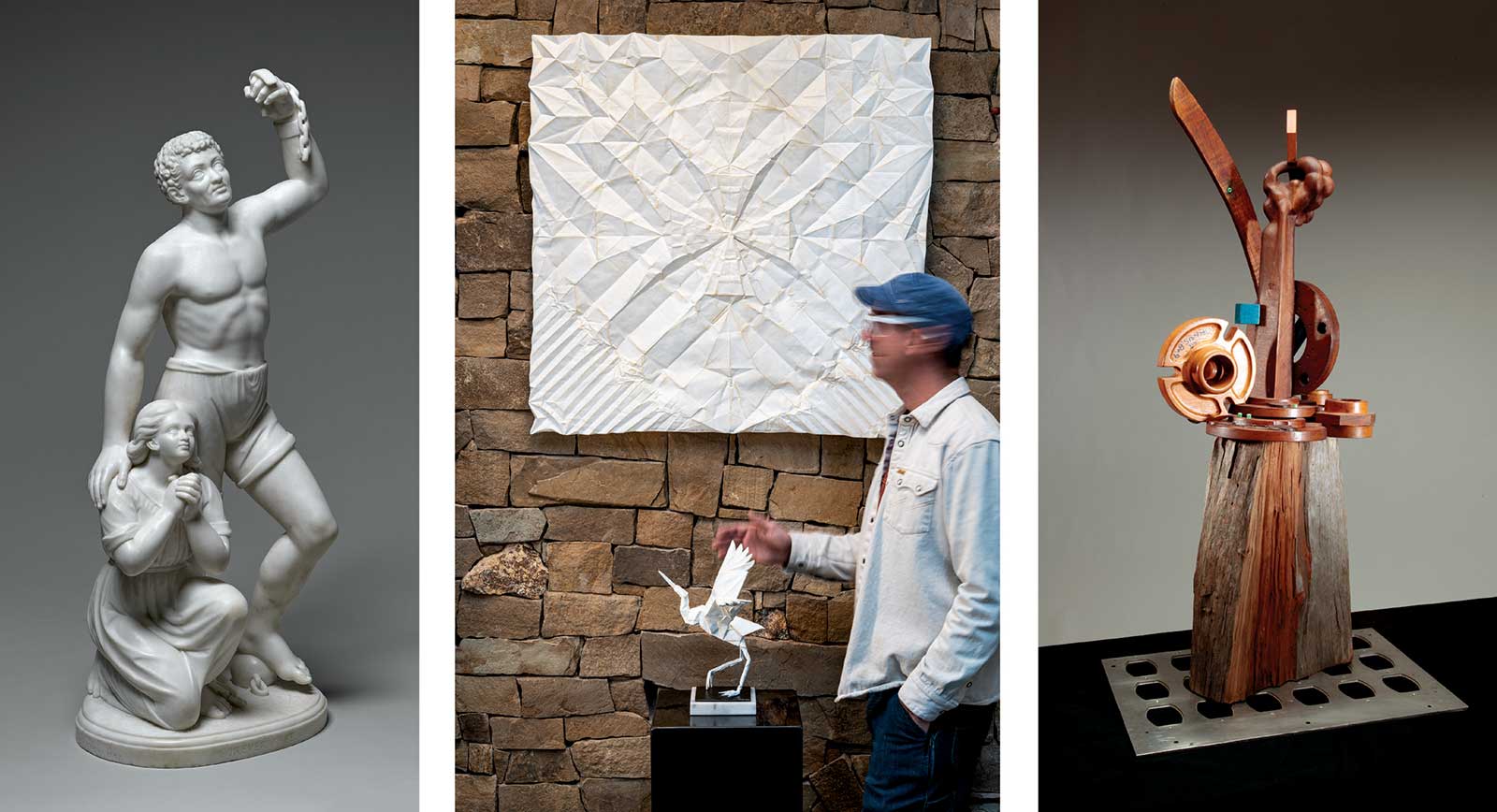
Edmonia Lewis (Mississauga, 1844-1907), Forever Free, 1867, Carrara marble. Howard University Gallery of Art, Washington D.C. / Licensed by Art Resource, NY. Photo: The Metropolitan Museum of Art; Kay Contemporary Art, Dancing Crane & Dancing Crane Unfolded, by Kevin Box and Dr. Robert J. Lang; Fay Wood, Overachiever, found wood, carved walnut, cherry wood and found metal, 35½ x 19 x 12 in.
However, much like Lewis, artists still refer to the human form as a major influence, as is true for Kevin Chambers, who has a gift for expressing emotions, gestures and personal stories in his figurative sculptures. He says, “I am constantly inspired by everything around me and try to bring that to my work.” His signature pieces are nuanced with sensuality, rhythm and motion.
As for powerful pieces like Dusk—a scene involving a female figure surrounded by a metal orb—Chambers says, “The simplest answer is that nature inspired this sculpture because it began with a live model session. Rodin once said, ‘There are unknown forces in nature…when we give ourselves wholly to her, without reserve, she lends them to us.’ This piece actually started as a semi-reclining, classical pose, but as I rotated the sculpture to work on different areas, it pulled me in a completely different direction. That’s what I love about sculpting from life; you may think you have a plan, but the sculpture almost always tells you where it wants to go. My job is to listen.”
Continuing reading through this section to hear additional stories and insights about the world of sculpture today.
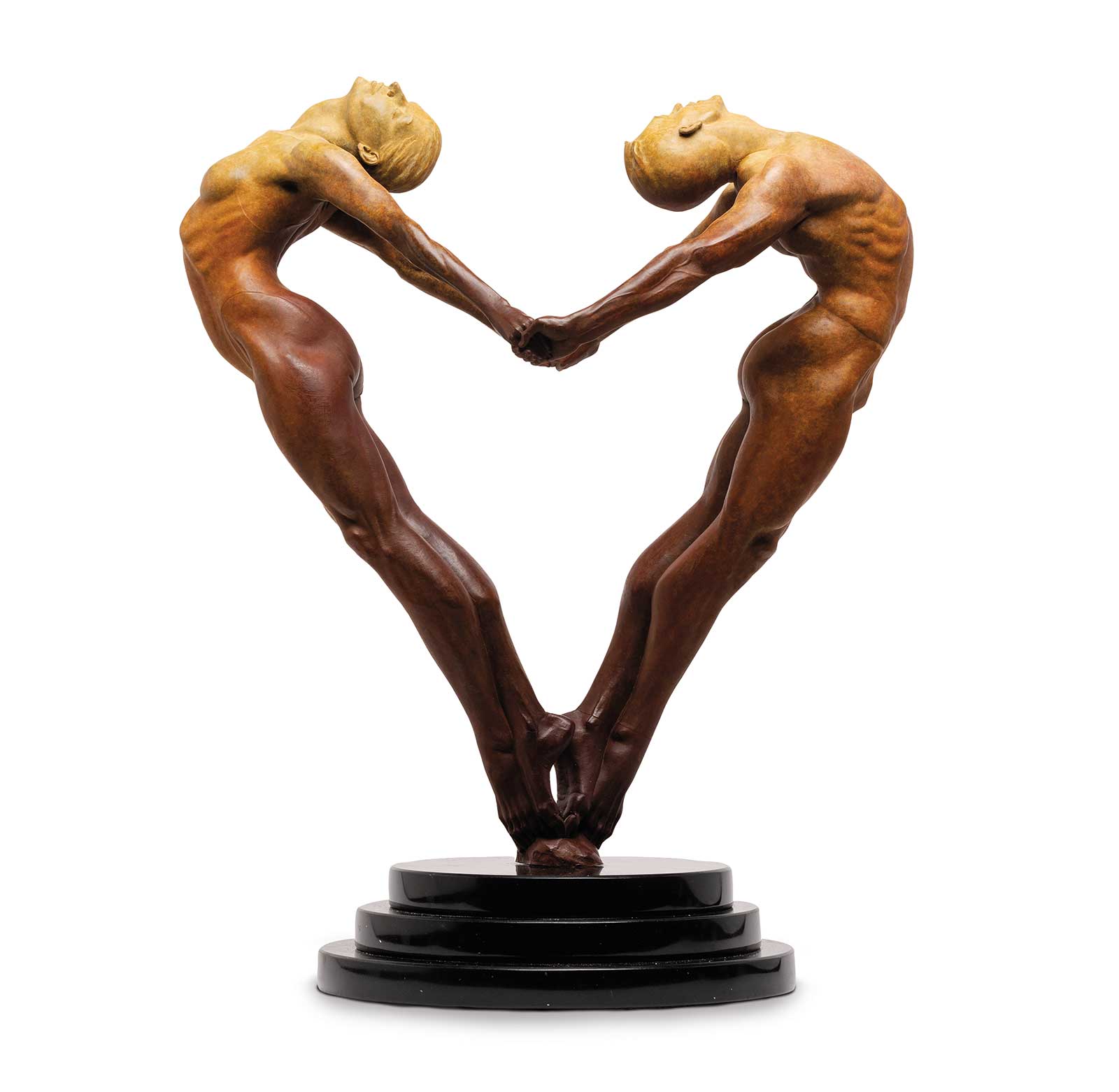
Kevin Chambers, Convergence, bronze, ed. 1 of 10, 27 x 24 x 16 in.
Artist Kevin Box, represented by Kay Contemporary Art in Santa Fe, New Mexico, creates masterful sculptures that endure the test of time, withstand weather conditions and bring life to the home environment. Created out of museum quality metals, Kevin Box sculptures celebrate the delicate nature of paper through nostalgic storytelling. He then solidifies its lasting quality via the lost wax method, a complex 32-step process bringing the artwork to life in bronze.
Inspired by the art of origami, each sculpture is profoundly architectural. His art begins with folding a single uncut sheet of paper. Each fold takes planning, practice and intent, resulting in the consequence of either symmetry or chaos. The meaning of his sculptures reveal symbolism; some are ancient, and others are personal to Box and his artistic collaborator and wife, Jennifer Box. These symbols of peace and togetherness span across cultures, bringing a familiar levity to all who view them.
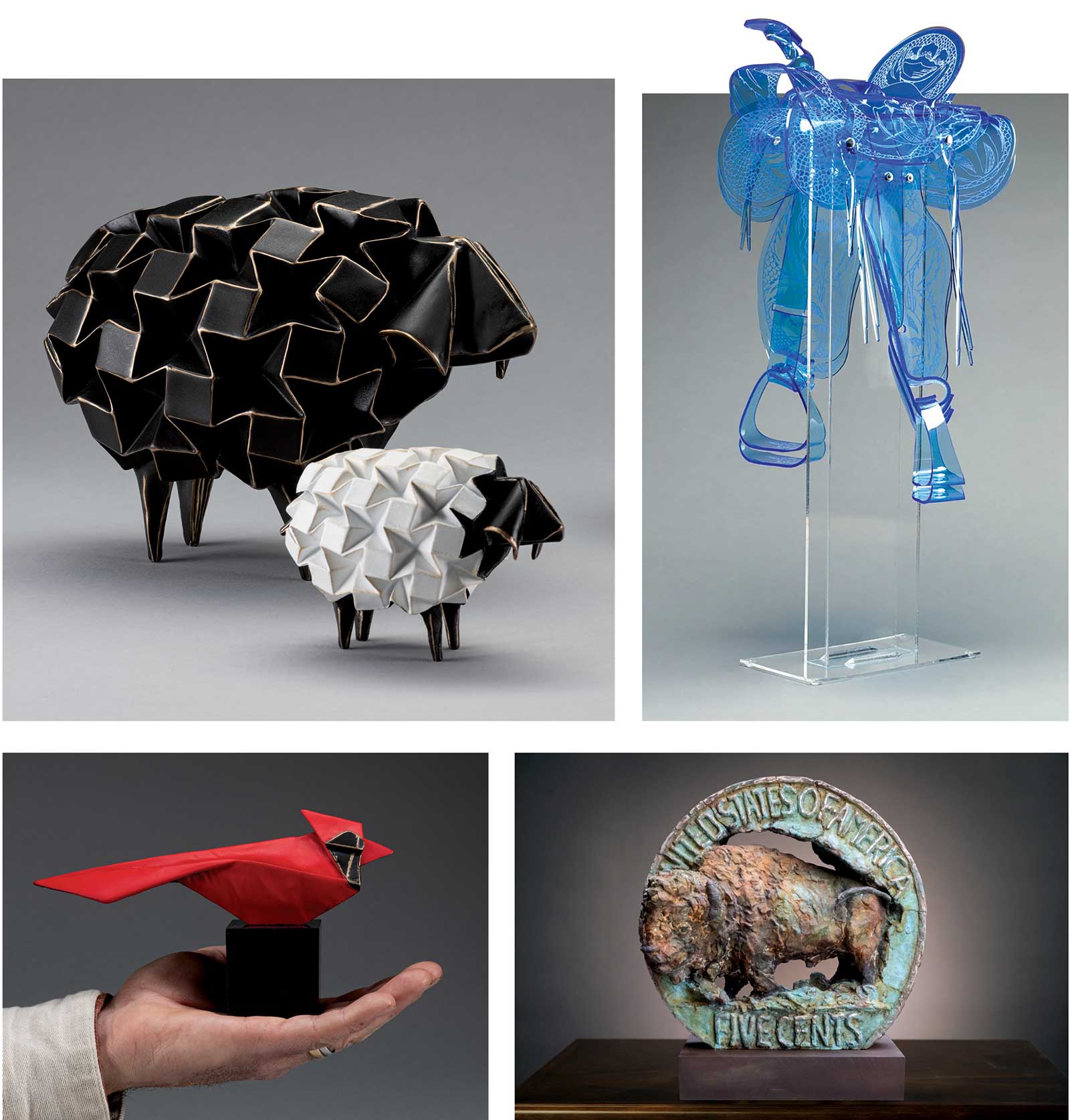
Top row: Kay Contemporary Art, Ewe & Me, desktop/mini, bronze, by Kevin Box and Beth Johnson; Altamira Fine Art, Some Kind of Blue, hand etched and formed acrylic, 26 x 13 x 11 in., by Maeve Eichelberger. Bottom row: Kay Contemporary Art, Crease Cardinal, mini, bronze on granite, 4½ x 8 x 2 in., by Kevin Box and Michael G. LaFosse; Altamira Fine Art, Buffalo Nickel, bronze, AP/21, 20 x 18 x 9 in., by Greg Woodard.
Represented by Altamira Fine Art, Maeve Eichelberger, Greg Woodard, and Stephanie Revennaugh each bring a highly distinctive voice to contemporary sculpture, and together they show the breadth of what makes the medium so compelling for collectors today. Sculpture has a unique ability to hold space physically and emotionally. It changes as you move around it, as the light shifts, and as the material reveals itself.
Eichelberger’s work is immediately recognizable for its use of layered Plexiglass, transparency, pattern and light. She takes familiar forms and transforms them into contemporary objects that feel architectural, playful and refined. Woodard brings a deep sensitivity to bronze, surface and patina, creating work that feels rooted in history while remaining very much alive in the present. Revennaugh’s equine forms are powerful and expressive, balancing strength, movement and vulnerability with a remarkable command of structure.
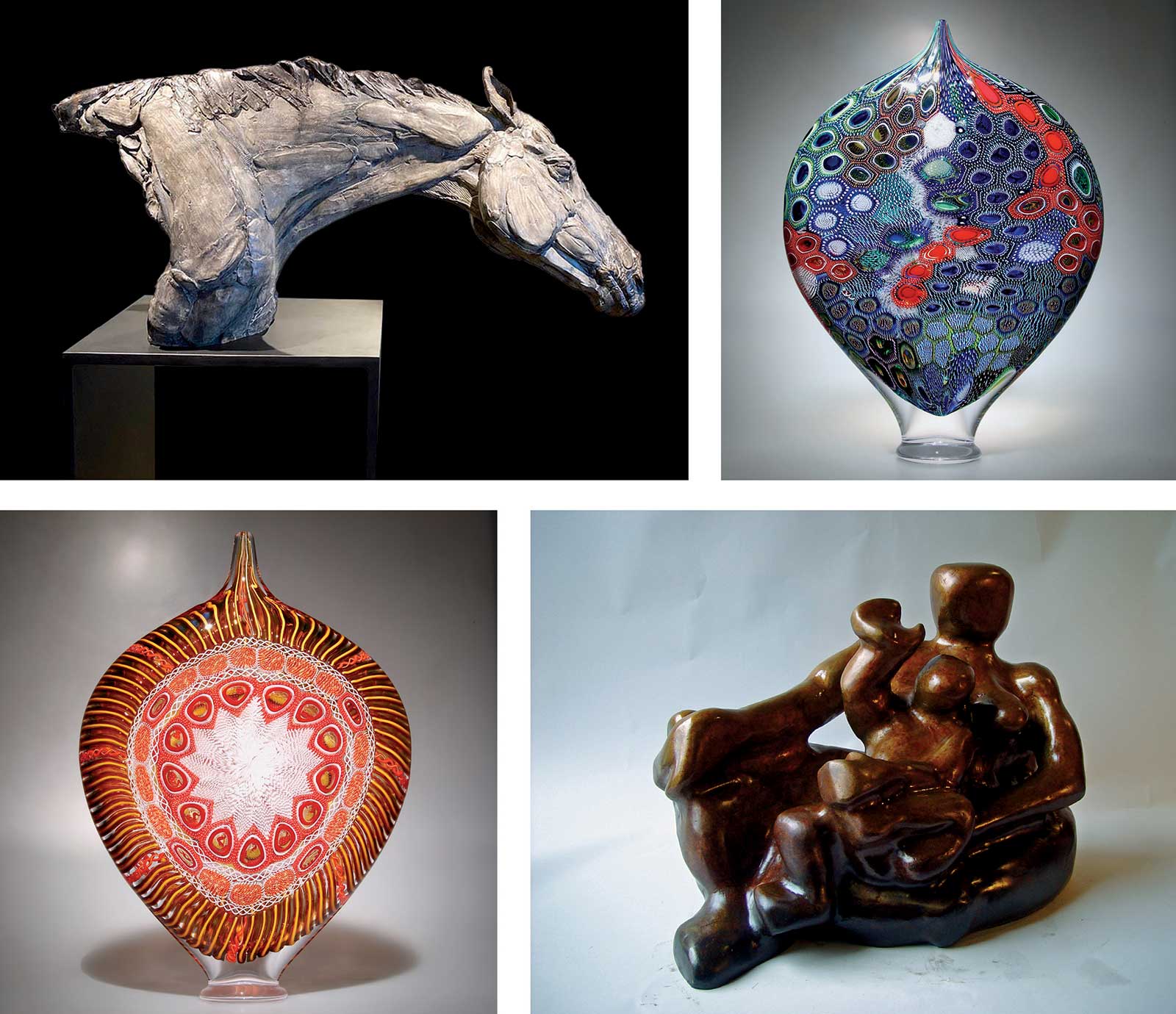
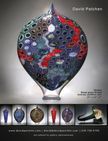
Top: Altamira Fine Art, Mo, bronze, ed. 6 of 33, 63 x 44 x 13 in., by Stephanie Revennaugh; David Patchen, Mixed Murrine Ellipse, blown glass, blown glass; murrine, zanfirico cane, 18 x 13 x 4 in. Bottom: David Patchen, Gold Ellipse, blown glass; murrine, zanfirico cane, 17 x 13 x 4 in.; Larry R. Rankin, Mother & Son, bronze, 23 x 13 x 12 in.
“What connects these three artists is not a single subject, but a shared commitment to craftsmanship, innovation and emotional presence,” says Jason Williams, owner of Altamira Fine Art.
David Patchen’s glass sculptural work explores hue, transparency and pattern to create objects with an individual vitality. “I’m especially drawn to secondary tones and the nuance found in their subtle variations, building them into intricate patterns that may harmonize, contrast and resolve,” says Patchen. “Translating these layered mosaics into graceful forms in molten glass is a continual challenge; one that I approach with equal parts discipline and curiosity. Capturing a ‘vibe’ for each piece is contrasted with the technical challenge of blowing glass—all in pursuit of work that feels both remarkable and joyful.”
Music always accompanies Patchen’s design process, and he approaches each piece more like the composition of a song than the design of an object. “A dominant pattern may function as a verse: steady, familiar and grounding, while interruptions and variations act as bridges, interludes or riffs that introduce movement and tension,” he says. “The ‘chorus’ frequently emerges at the center, where threads converge and intersect in a way that continually draws the eye.”
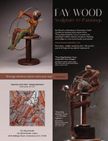
In 1966, upon crossing the San Francisco Bay Bridge, Fay Wood saw the large, found-object sculptures lining the shore. “These works of detritus, left in my mind, have never been replaced,” she shares. “When I [returned] to work in my studio, the influence was profound. To use found materials in sculpture allowed me to ‘play’ with odd shapes, broken pieces, colors and textures that would not exist with other techniques in sculpture. It satisfied a strong desire to ‘rescue’ interesting pieces that would otherwise go in the landfill, as well as satisfying my sense of humor and feelings about the work women have done for centuries.”
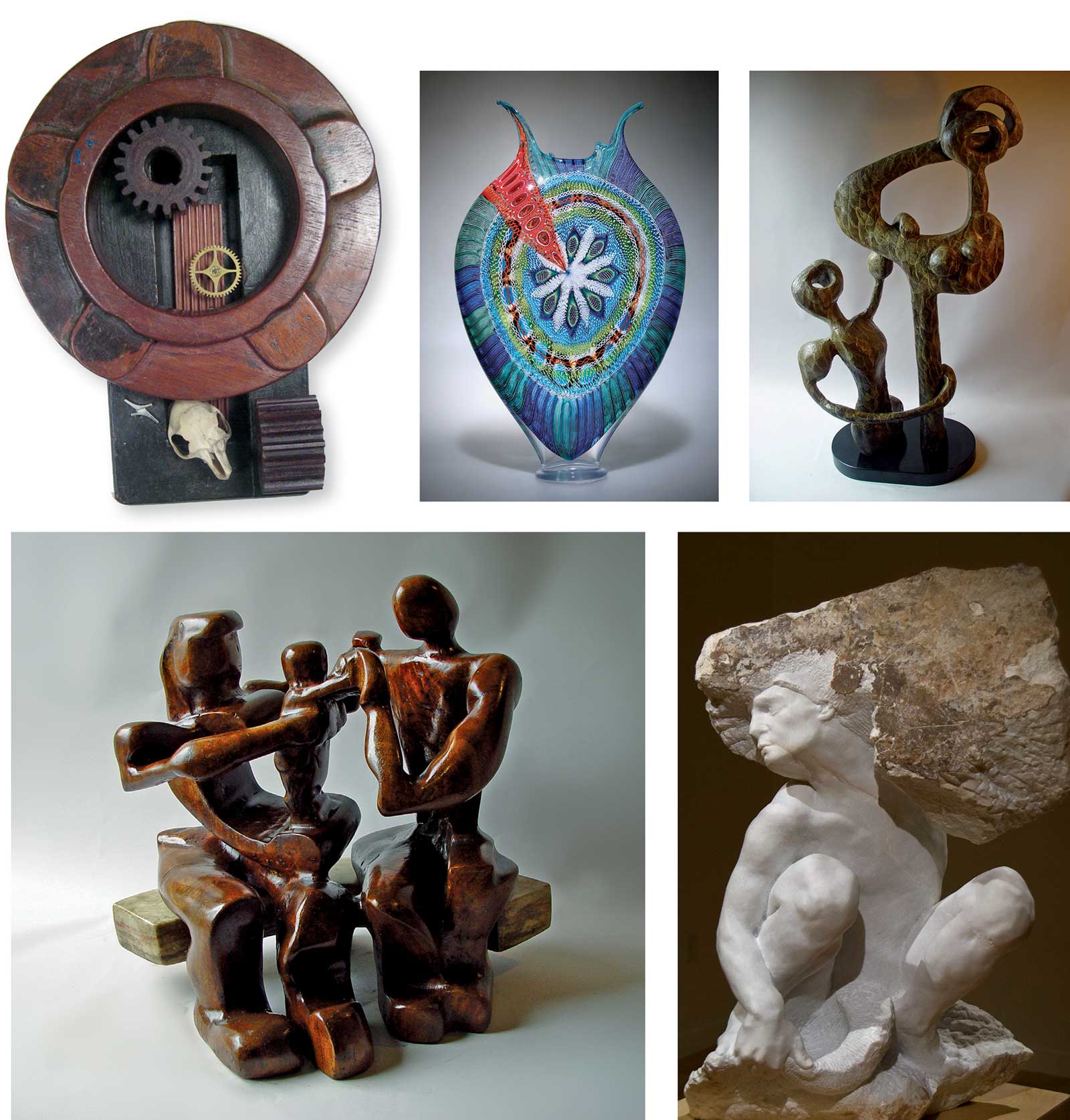
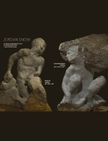
Top: Fay Wood, Time Piece, found objects, metal, wood and bone, 10 x 8 x 4 in.; David Patchen, Foglio, blown glass; murrine, 21 x 12 x 4 in.; Larry R. Rankin, Family Photo, bronze with granite base, 44 x 25 x 14 in. Bottom: Larry R. Rankin, Family, avocado wood on alabaster bench, 22 x 25 x 18 in. ; Jordan Snow, Crouching Figure, marble, 40 x 27½ x 21½ in.
Wood continues, “As I worked, representations of family, music, men and more began to emerge and achieve a presence in which I delighted. I also thrived on learning how to attach each piece; each object requiring thought and sometimes new techniques to achieve the desired result.”
Today, we find Wood’s impressive found-object sculptural pieces and assemblages Overachiever, Time Piece and Hand, Apples, Snake =Eve.
Jordan Snow places emphasis on the contrasting elements in his sculptures, and oftentimes that includes the tool marks or imperfections within the stone. “I approach this work directly and without plan, maquette, drawings or markings in order to free myself of restrictions in the search of form,” he shares. We see this take shape in Snow’s marble pieces Crouching Figure and Neptune.
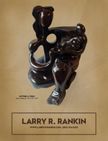
Artist Larry R. Rankin’s artistic journey is deeply intertwined with his personal history, including his service in the U.S. Army during the Vietnam War. These experiences profoundly influence his work, serving as both a catalyst and a canvas for emotional expression. His sculptures made from stone, wood and bronze, are a therapeutic outlet through which he navigates the complex tapestry of his post-war experiences. The intrinsic motivation and self-expression that drive his art are evident in every piece he creates, offering both artist and viewer a pathway to understanding and emotional connection.
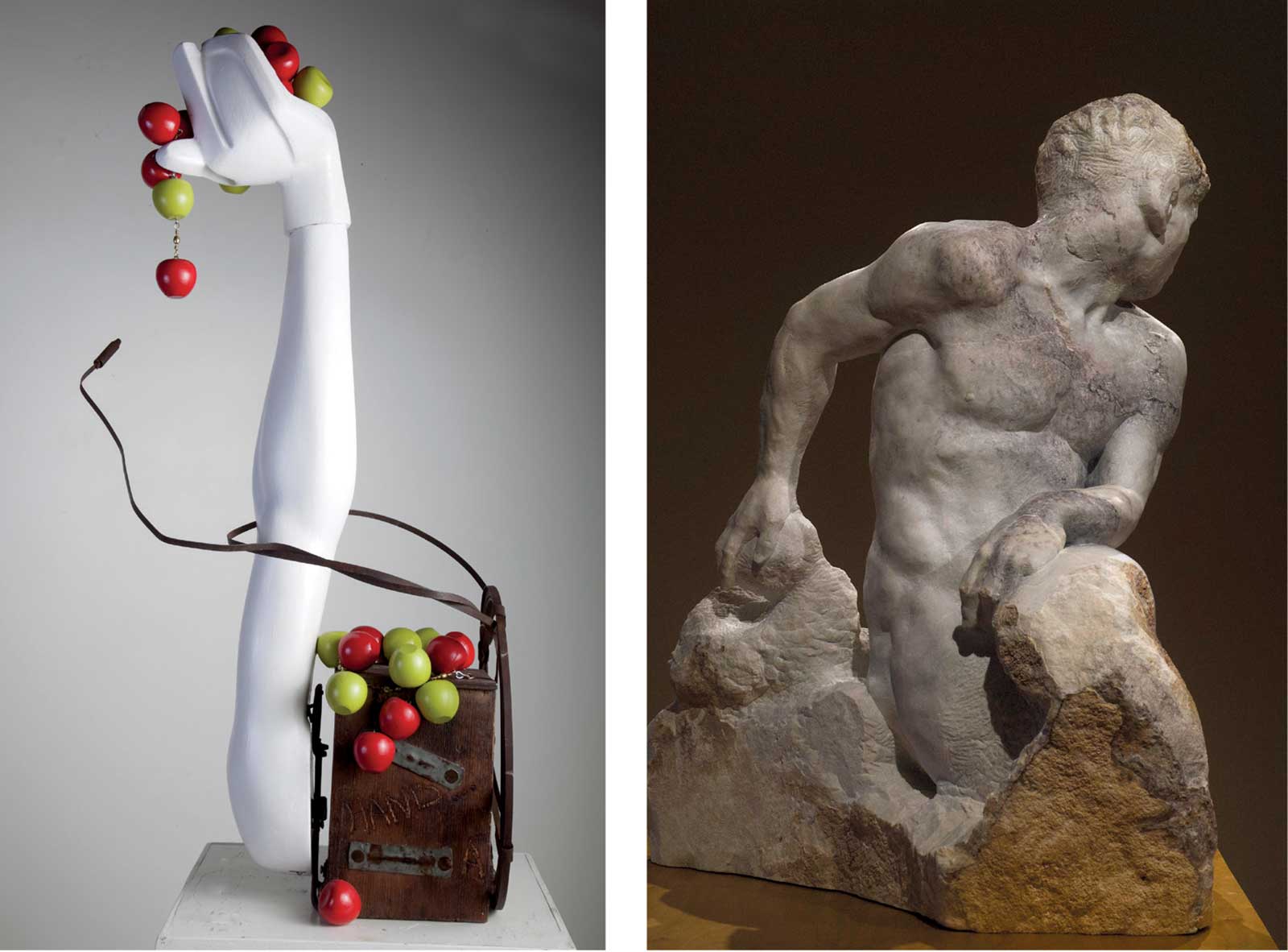
Fay Wood, Hand, Apples, Snake =EVE, found object assemblage, 31 x 12 x 14 in.; Jordan Snow, Neptune, marble, 42 x 32 x 28 in.
A graduate of Northern Arizona University with a Bachelor of Fine Arts, Rankin has consistently pushed the boundaries of sculptural form and meaning. His pieces are celebrated for their powerful and unusual designs, reflecting his profound love of family, humor and an intricate understanding of abstract and non-objective forms. Rankin’s sculptures grace both public and private spaces, from sculpture gardens and corporate settings to family homes, each piece imbued with the strength and warmth of its creator. —
Featured Artists & Galleries
Altamira Fine Art
172 Center Street, Jackson, WY 83001
(307) 739-4700, connect@altamiraart.com
www.altamiraart.com
David Patchen
(650) 740-9794, david@davidpatchen.com
www.davidpatchen.com
Instagram: davidspatchen
Fay Wood
www.faywoodstudio.com
Jordan Snow
jordansnowart@gmail.com
www.jordansnowart.com
Instagram: jordansnowart
Kay Contemporary Art
600 Canyon Road, Santa Fe, NM 87501
(505) 365-3992
www.kaycontemporaryart.com
Kevin Chambers
sculpture@klcstudiosinc.com
www.kevinchambersart.com
Larry R. Rankin
(805) 944-8259, art@larryrrankin.com
www.larryrrankin.com
Peabody Essex Museum
161 Essex Street, Salem, MA 01970
(978) 745-9500, www.pem.org
Powered by Froala Editor