Lee Price’s paintings have a unique perspective that delicately urges further study of her often-anonymous subjects. Call it the “God’s eye view.” But where God offers judgment, and then salvation or damnation, Price offers instant exaltation. No judgment required.
Price, who lives in New York’s Hudson River Valley, has been painting these views for much of her career. They invite careful scrutiny, the way a detective might examine crime scene photos, all of them neatly and objectively shot from a top-down view to capture as many details as possible. The paintings are meticulously detailed and staged, and they relinquish their secrets easily and without hesitation: Woman in bath. Woman eating. Woman at table with cakes. Woman in bed with junk food. It doesn’t require a Ph.D. in psychiatry to make connections to obsession, compulsive behavior and eating disorders. Price, who has been very open about her past difficulties with food and compulsive binge eating, is showing you one story. But she isn’t showing every story.
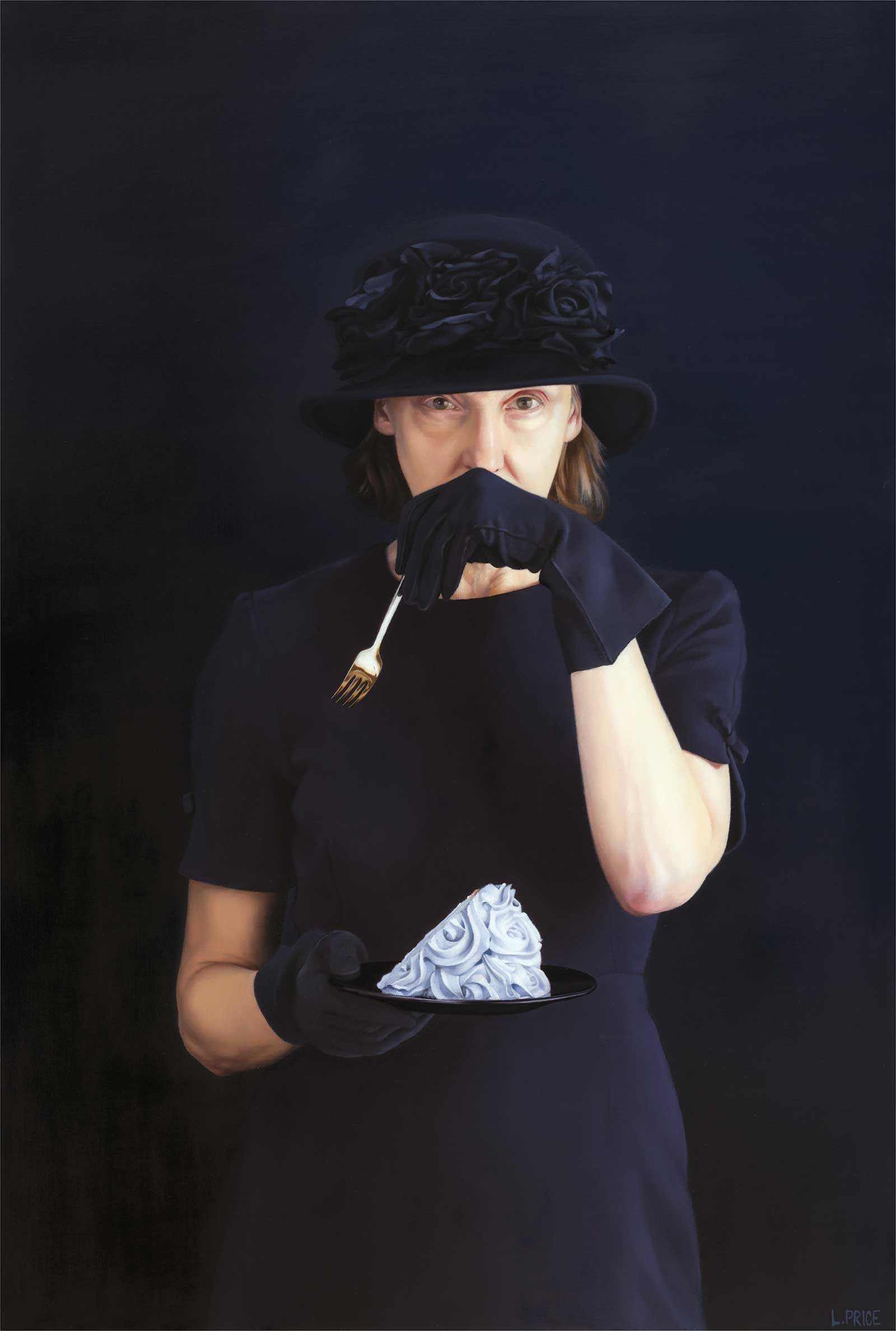 Self Portrait in Blue Room, 2025, oil on linen, 37 x 25 in.
“I’m never trying to force the viewer to see anything specific. I want people to take it however they take it. This is my own experience,” she says from her home in Beacon, New York. “I know that I have people seeing them in their own ways. They are very colorful and vibrant and, at first, when you look at them it may look like a happy afternoon tea party. But then you see something a little bit darker. If that’s not your experience, then you might not take that second step.”
In a solo show last year at Evoke Contemporary in Santa Fe, New Mexico—the show was titled simply Cake—Price tweaked the formula. The top-down view was still there, but instead of bathrooms, bathtubs and junk food, she focused on those transitional periods between party and clean-up, when the food and decorations linger on a festive table, their time in this world soon coming to end.
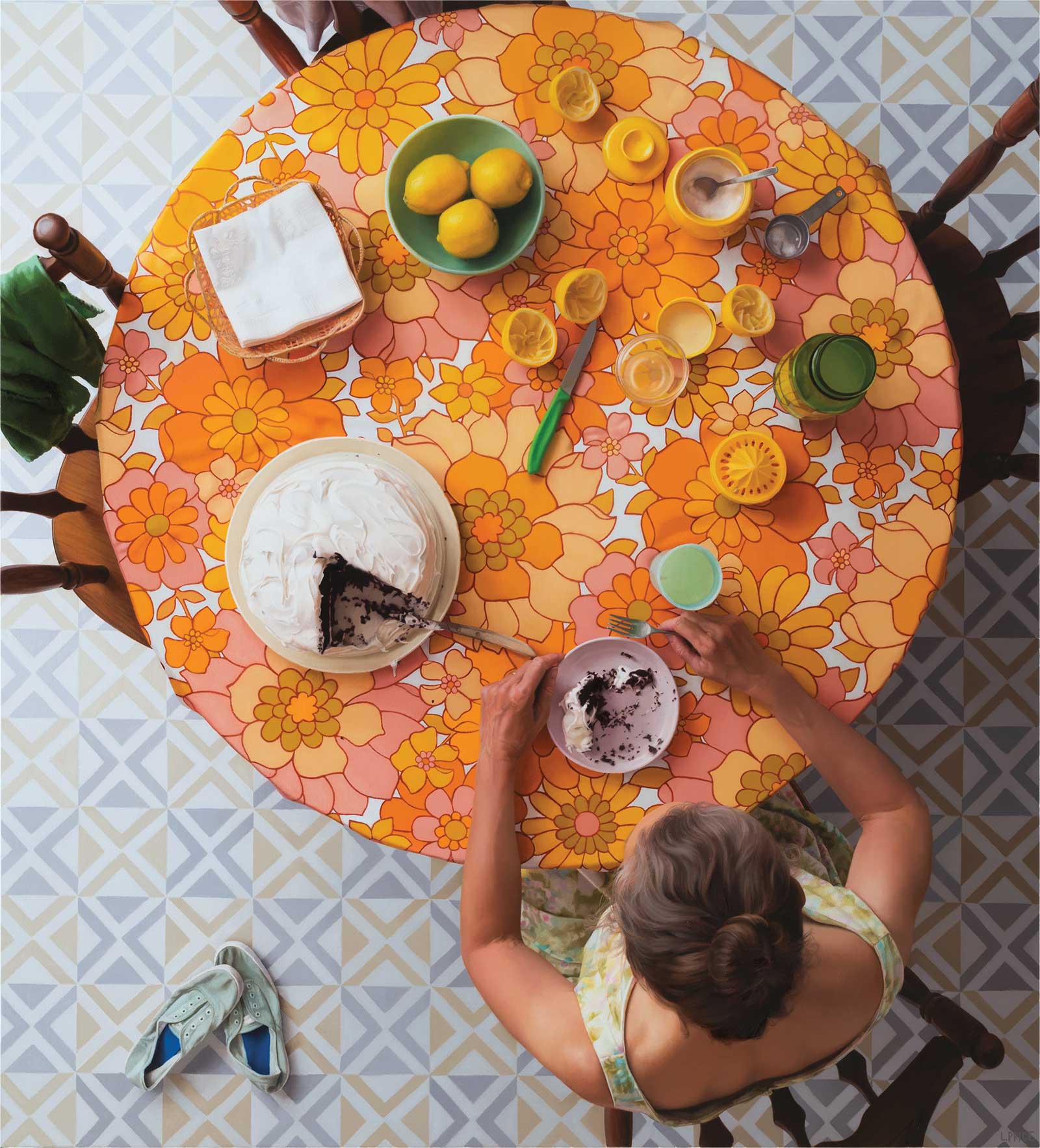 Summer, 2024, oil on linen, 42 x 38 in.
“They are scenes of the aftermath of events. Food is still there because that’s what events are. The aftermath is the cake on the plate that is left uneaten. It’s over. I think the work talks about how transient life can be. It’s about memories and time passing,” she says. “I paint food because I never tire of the subject. We all eat food. It’s part of our lives. And it’s shared during important ceremony and rituals. Here, food is the theme and the passage of one thing to another.”
Some may see a sadness in the subject. Consider Winter, which suggests friends and family were once seated at a table, enjoying dessert and celebrating life. And then it ended and they parted ways, leaving a wrinkled tablecloth and uneaten cake. But others might see a more transitory pause between two events. Maybe the guests had another event to attend. Maybe they left the table to dance elsewhere at the party. Hell, maybe everyone was tired, the party ran too long and the company wasn’t that great, so leaving the table and ditching the cake was an ideal end. There are many narrative opportunities in dirty dishes on a table.
A kernel of this idea came from Price’s niece who was traveling in Hong Kong as part a high school volleyball team. The niece returned from the trip with a photo of a similar table scene after one of the dinners. “It formed this idea that made me want to paint tabletops,” Price says. “Then Covid hit, and what these images meant started to change. That’s when I became more serious about the tabletop paintings.”
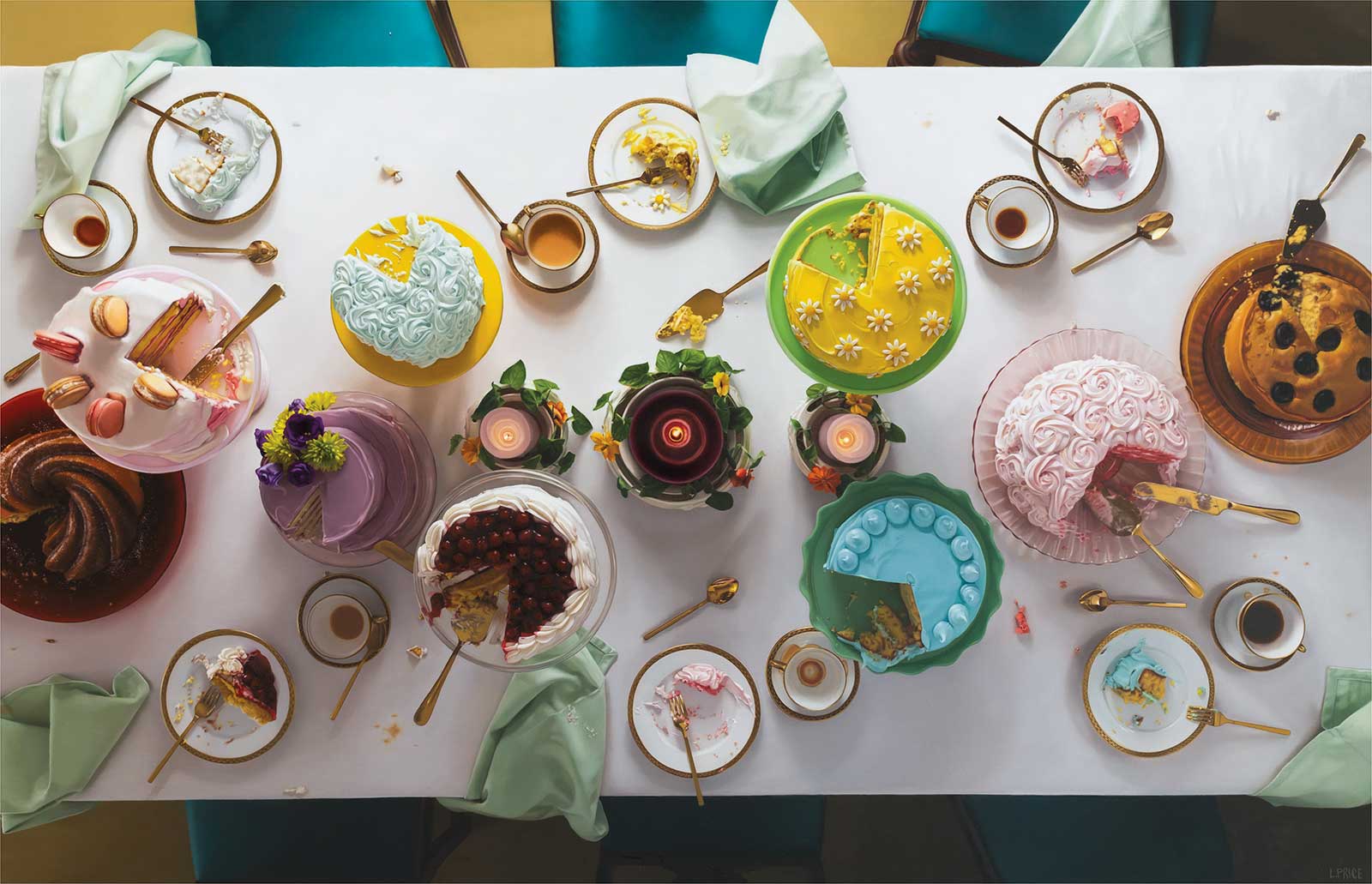 Cake, 2025, oil on linen, 40 x 62 in.
Before Cake opened at Evoke in 2025, Price crammed two year’s worth of work into one year of studio time. It was grueling and even agonizing. Once Cake opened, the show was a critical hit, but the works failed to sell, which may have been linked to extreme market volatility at the time related to national political issues that shouldn’t get brought up at the dinner table, even one with crusty dishes. The show may have felt like a setback—one key work was purchased and donated to the Arnot Art Museum for its permanent collection—but Price saw it as an opportunity to push forward and drill down into her ideas further.
She notes that her paintings take a long time. She buys props, makes dresses, chooses all the fabrics, draws out sketches and plans meticulous shoots with her photographer, Tom Moore, who uses an elaborate scaffold system to get perfectly stabilized top-down views. With Cake over, there is time to exhale and walk away from the table, leaving all that remains and looking ahead to what is next. Sound familiar?
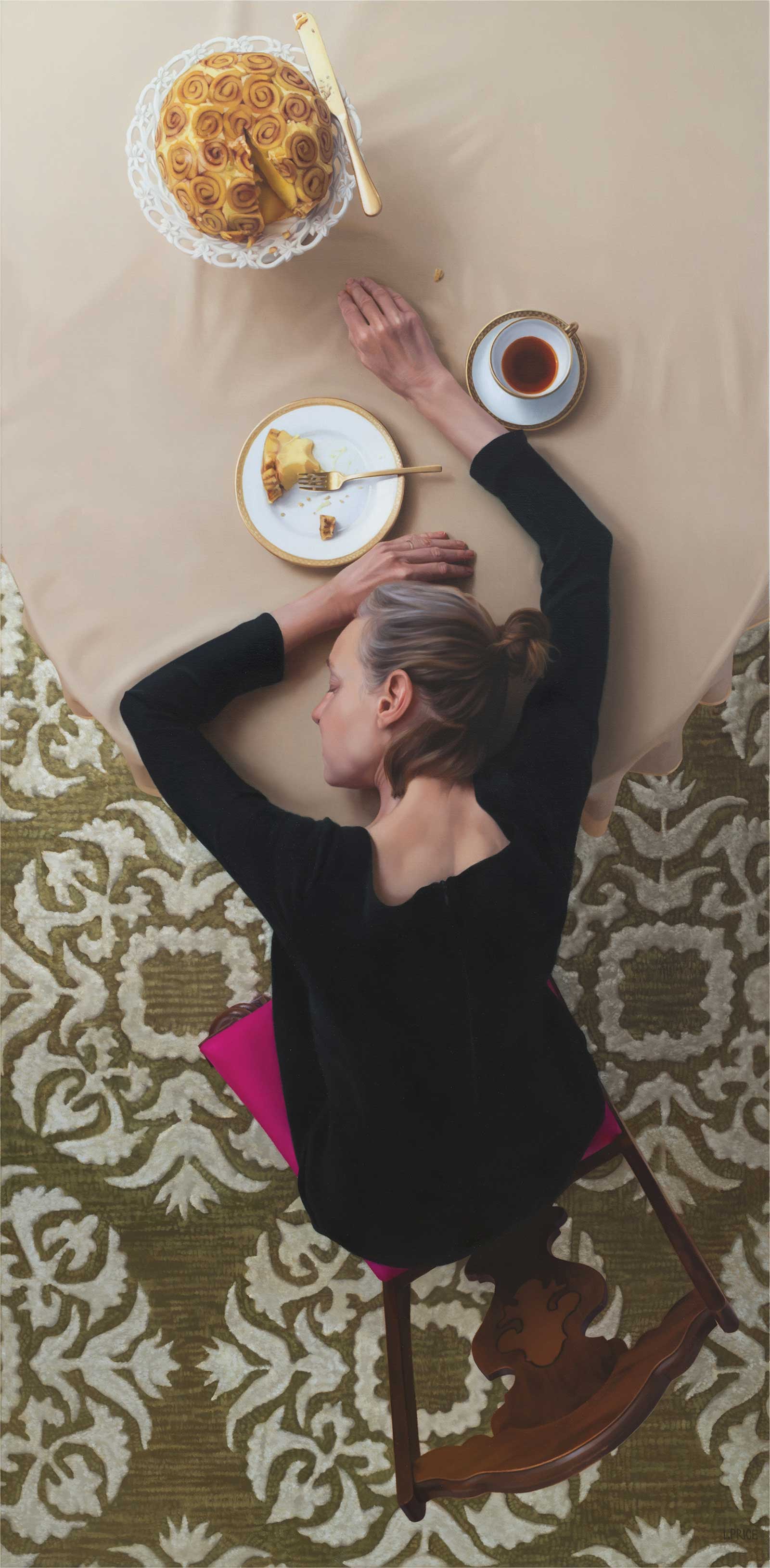
Autumn, 2024, oil on linen, 55 x 27 in.
“Cake felt harsh. It was a hard pill to swallow. I was very happy with those paintings,” she says. “I’ve gone through really long periods of my career when I did not know what I would paint next. And I’ve found my way through. I have faith in the work I’m doing. That’s important to me.”
Price points to some of her new self-portraits, which are not shot from above, but are straight-on paintings of the artist interacting with food. In the older work, Price painted a smorgasbord of sweets. But these newer pieces often feature only a single treat or snack. That seems like emotional progress. “I started to imagine a whole room filled with me in paintings. All of them with me in clothing that matches the background. I started thinking about painting myself over and over again. It became this valid thing for me to do. There was validity in me as a worthy subject,” Price says. “If I can do that again and again, I felt like it said something about my self worth.”
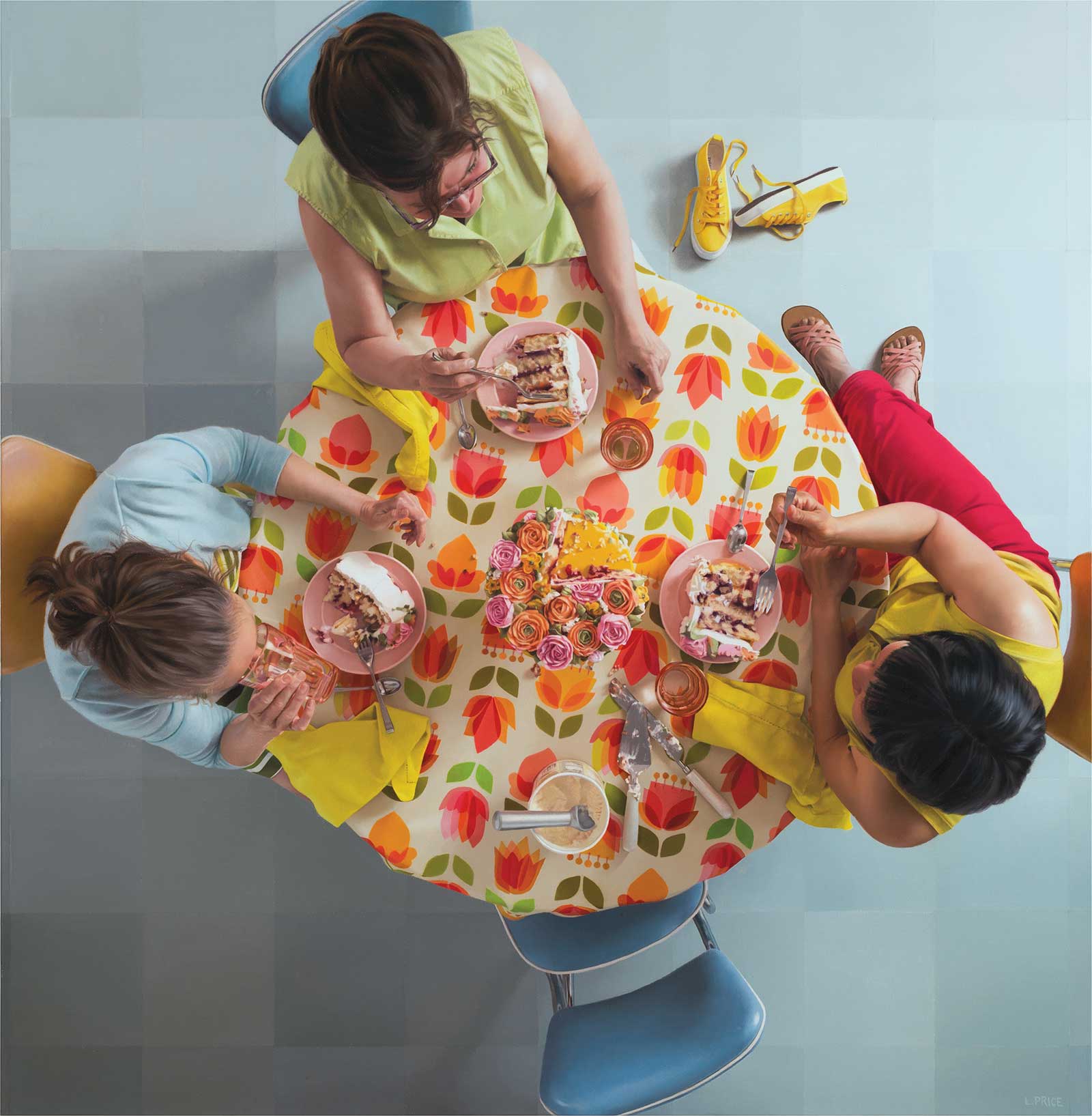
Spring, 2024, oil on linen, 42 x 41 in.
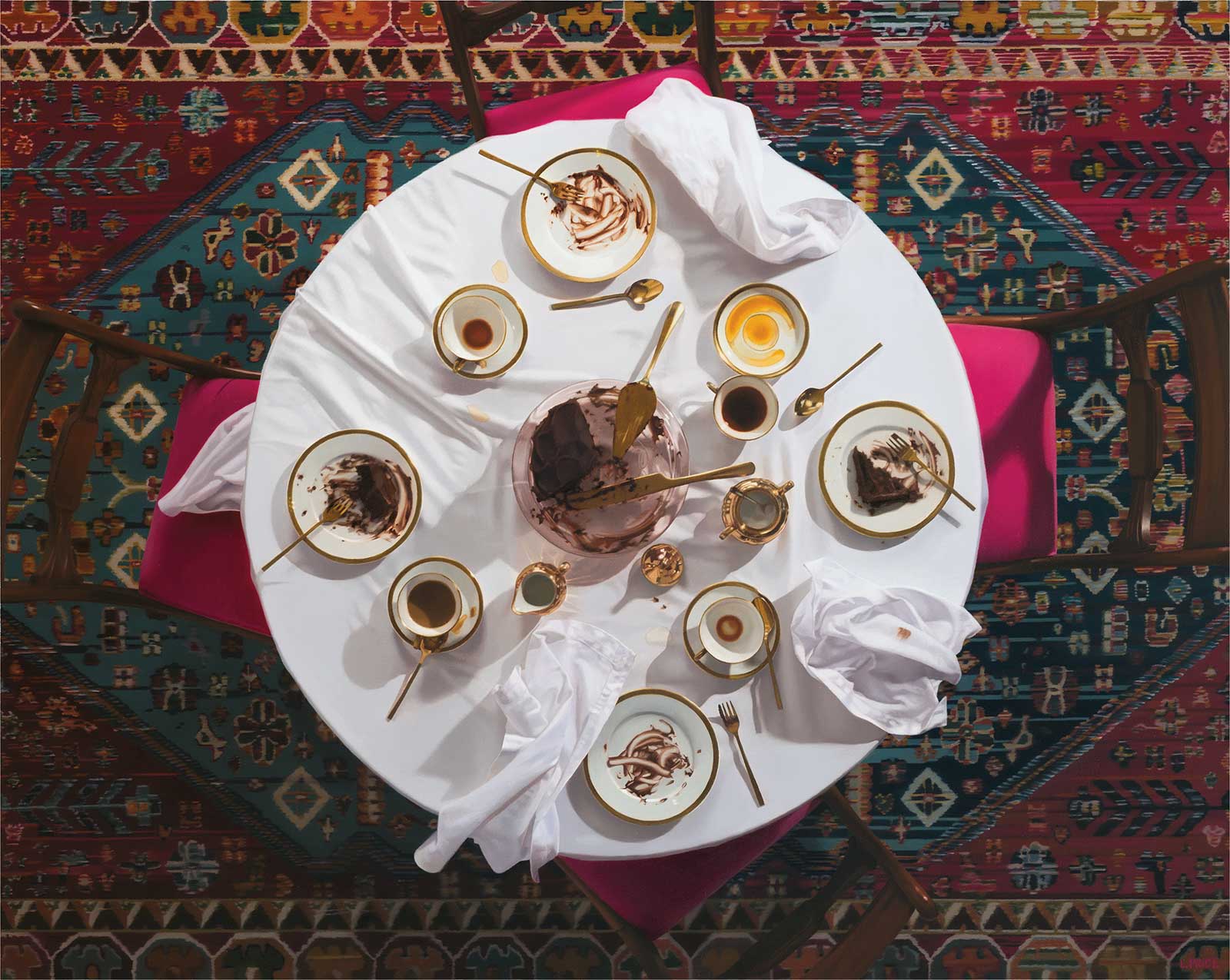
Winter, 2024, oil on linen, 39 x 49 in.
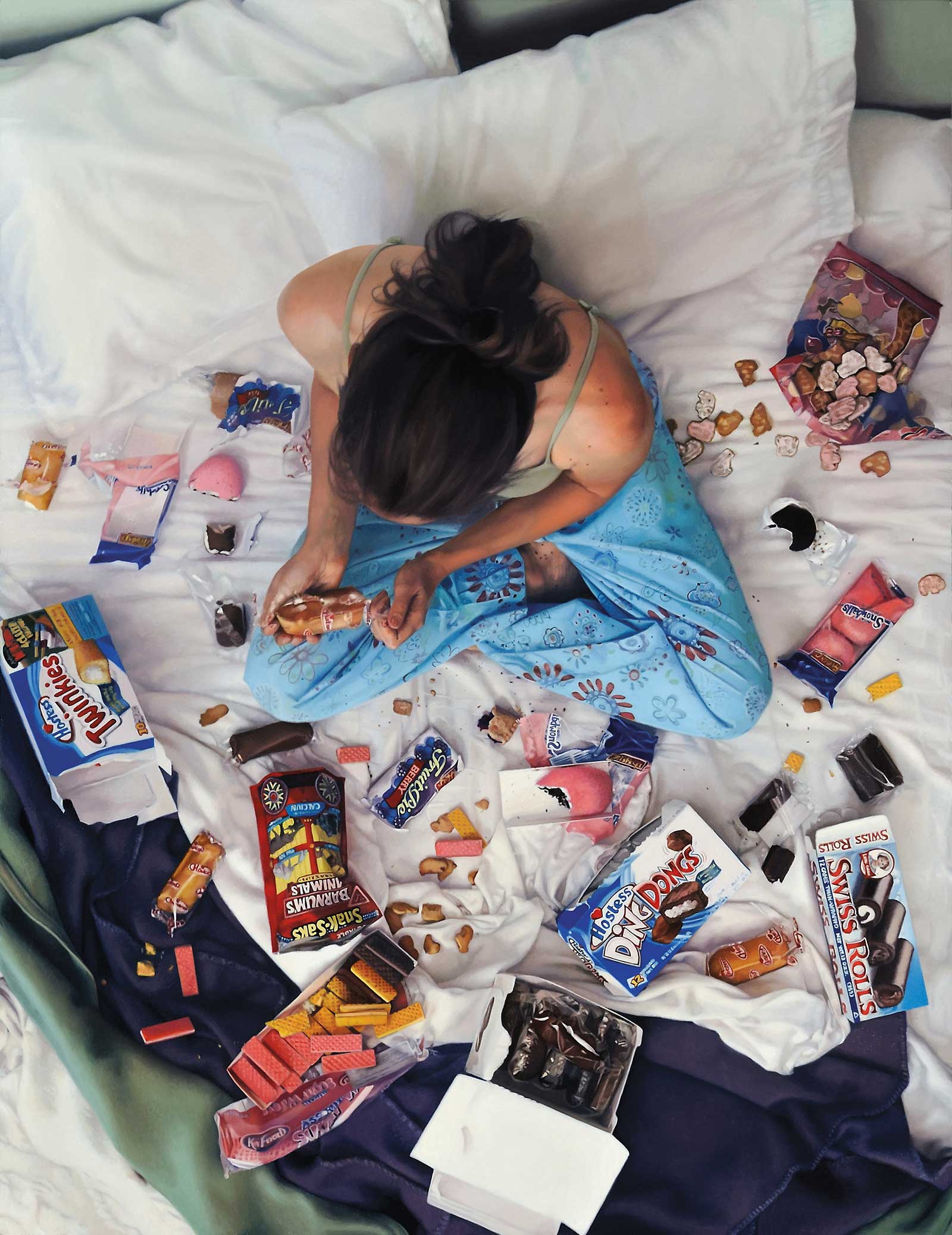
Snack, 2009, oil on linen, 52 x 40 in.
Price admits she has learned a great deal about art from painter and friend Alyssa Monks, who initially helped Price fine tune some of her artistic choices that led to the top-down perspective. Price also brings up Monks when discussing the kinds of artists there are in the world. “There was an artist who told me that every artist is either [John Singer] Sargent or Vermeer, but never both. Alyssa Monks is one of those rare artists who can do both,” she says. “But I’m totally a Vermeer. I can’t change that. I’ve made peace with that, even as I’ve tried to loosen up like Sargent.”
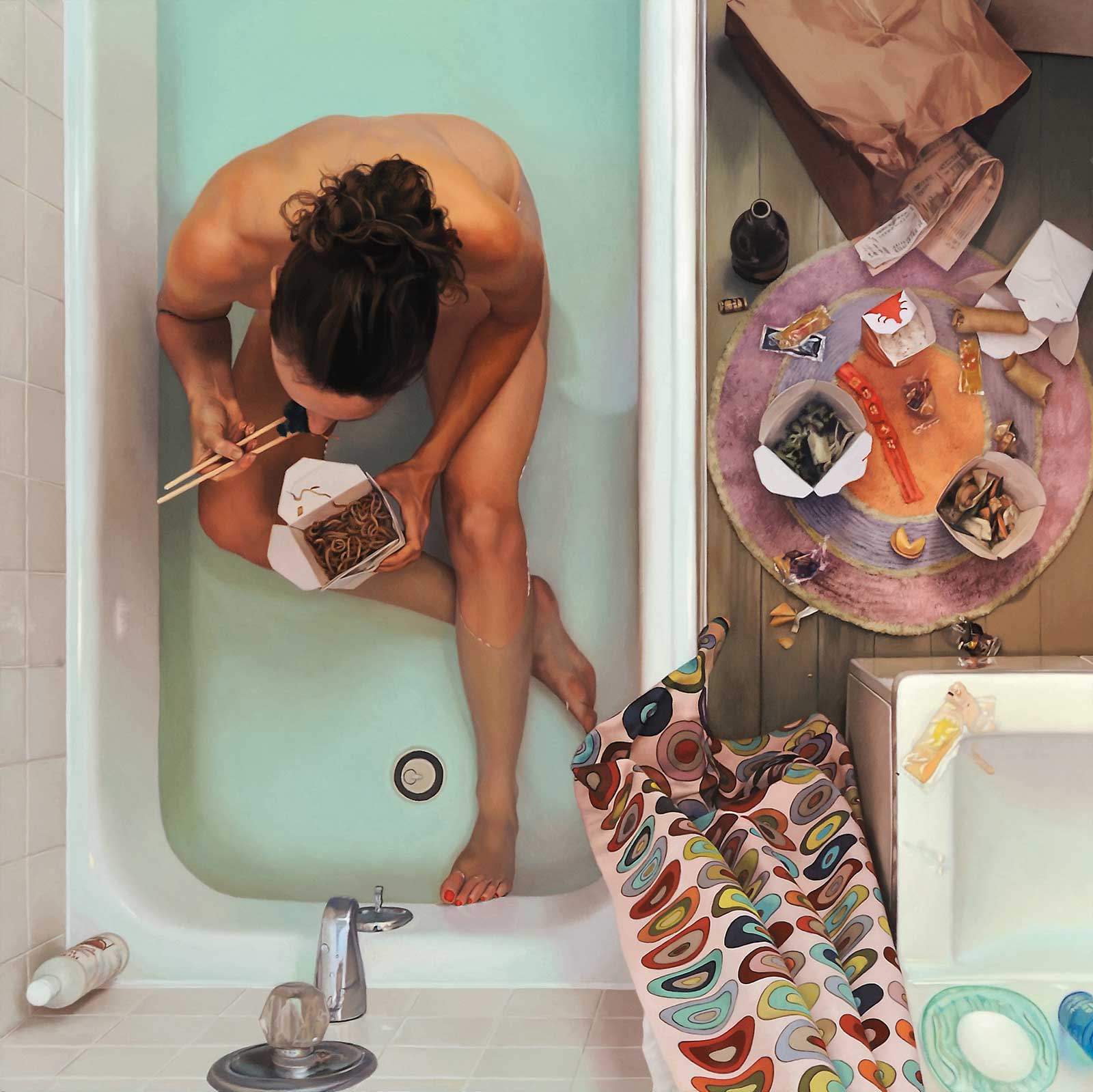
Self Portrait in Tub With Chinese Food, 2009, oil on linen, 44 x 44 in.
In a recent interview with Monks on our art podcast, I referred to her own bathroom nude paintings as “vulnerable,” a word that she pushed back on. She argued that the bathroom is the one place that people aren’t vulnerable. It’s there, behind a locked door, where a person has total freedom—of judgment, of prying eyes, of expectations from the world. I mention this exchange to Price, who agrees with Monks about vulnerability. But where Monks paints a bathroom setting, Price is using the painting itself as her private place to exist. She is not more vulnerable by painting herself, her past struggles or her fears. By opening up and spilling out her secrets into the oil paint, she is less vulnerable. She is also more honest, open and free. And there is a confidence in her work that pours out of every Hostess cupcake, every self-portrait, every table setting and every bathroom scene. It’s the kind of confidence that makes her art so refreshing and pure. And it’s the kind of work that pushes her forward.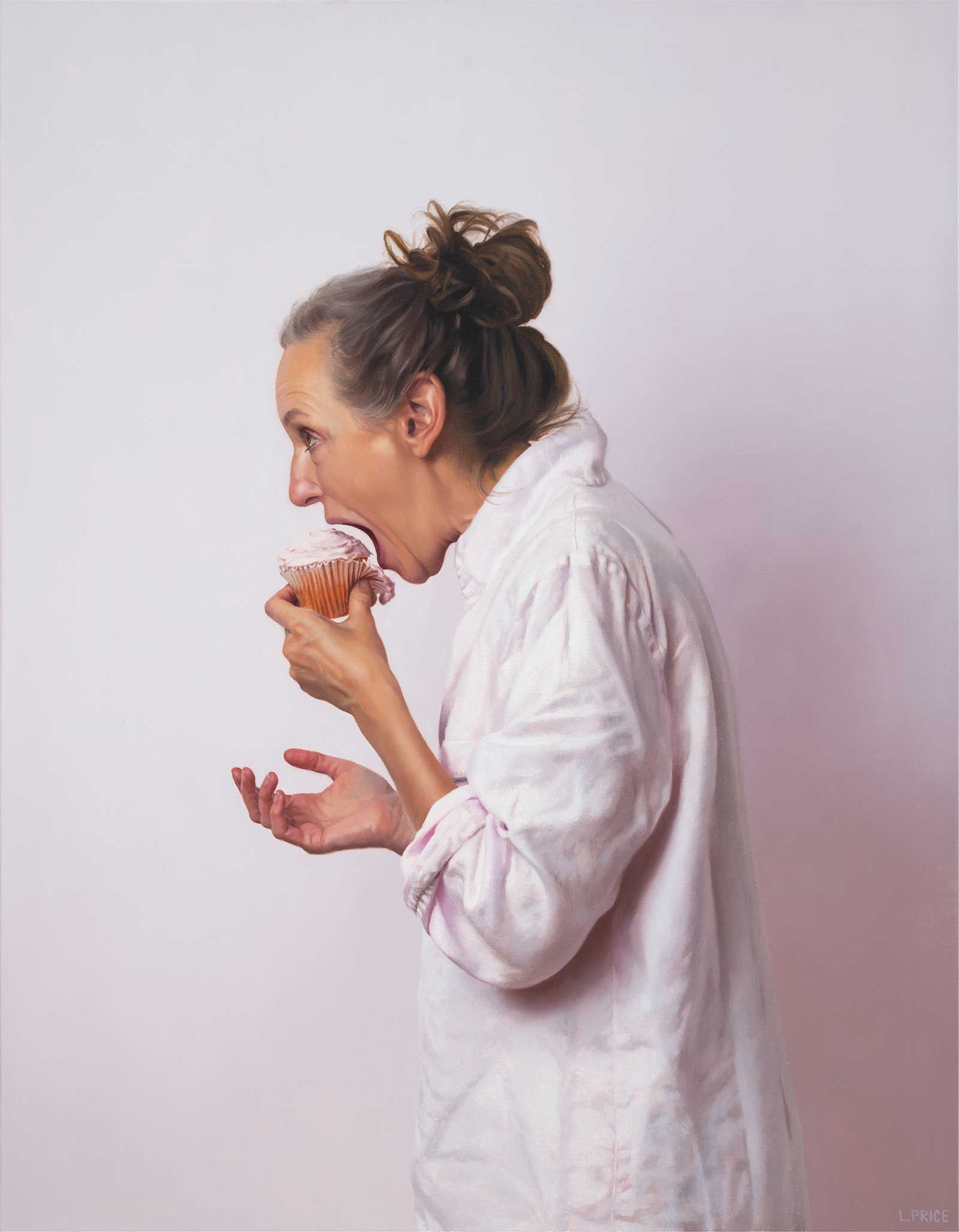
Self Portrait in Pink Pajamas, 2024, oil on linen, 36 x 28 in.
“I’ve done the wrong thing before. I’ve done things that I thought would sell, or things a gallery has told me to do. It does not work,” she says, adding that she has recently started painting still lifes from life, which is not something she has shown before, anywhere. “I’ve been at this a long time. I’m not a young artist anymore. So I have to paint what I want. And that makes me feel more confident in what I should be doing.”
To see more of Price’s work, visit her website, www.leepricestudio.com, or see her work at Evoke Contemporary in Santa Fe, New Mexico. —
Powered by Froala Editor