
Katie O’Hagan loathes spiders. She says, “The problem with painting spiders is I have a terrified, horrible fear of them. I am deathly afraid. So it means that whenever I’m painting [them]…I can only do it in five-minute increments before my heart rate speeds up so much that my hands shake, and I have to stop. It takes ages to do them.”
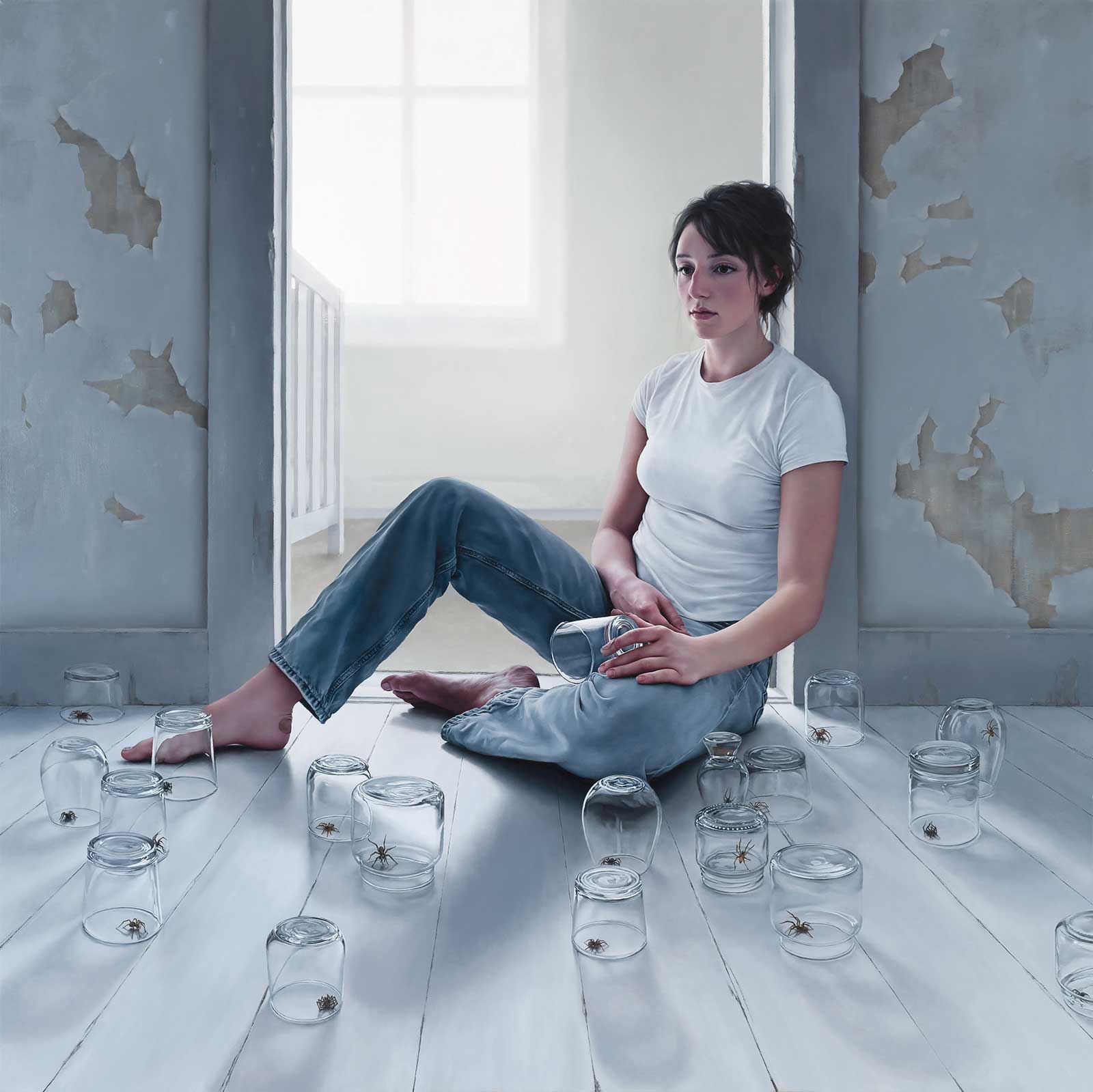
Vigil, 2026, oil on canvas, 58 x 58 in. Collection of Chad Williams.
The mother muse in her new painting Vigil traps the invading creatures beneath jars. There are many of the biting horrors to contain at the threshold to her quiet nursery, and though she is phobic and frightened of the silent creatures creeping stealthily through the door into the brightened room behind her, she wears her maternal obligation as her child’s guardian and domestic protector. The doorway she defends is set upstairs in a Highland home and lit in bare northern light recalled from the memory of O’Hagan’s childhood on the west coast of Scotland, where she was raised in her family’s pub serving a community of 100 souls in a village with three churches, and where the old magic and weathered elements of the land met austere faith and fading history. Her own girls are grown now and have left home to live their own lives, and learn their own stories, but a mother’s anxiety for her children can cross oceans. “The constant worry of it never ends,” she says, “and she’s waiting with another jar because another spider is about to show up. I guess I’m always going to be neurotic and worried about them.”
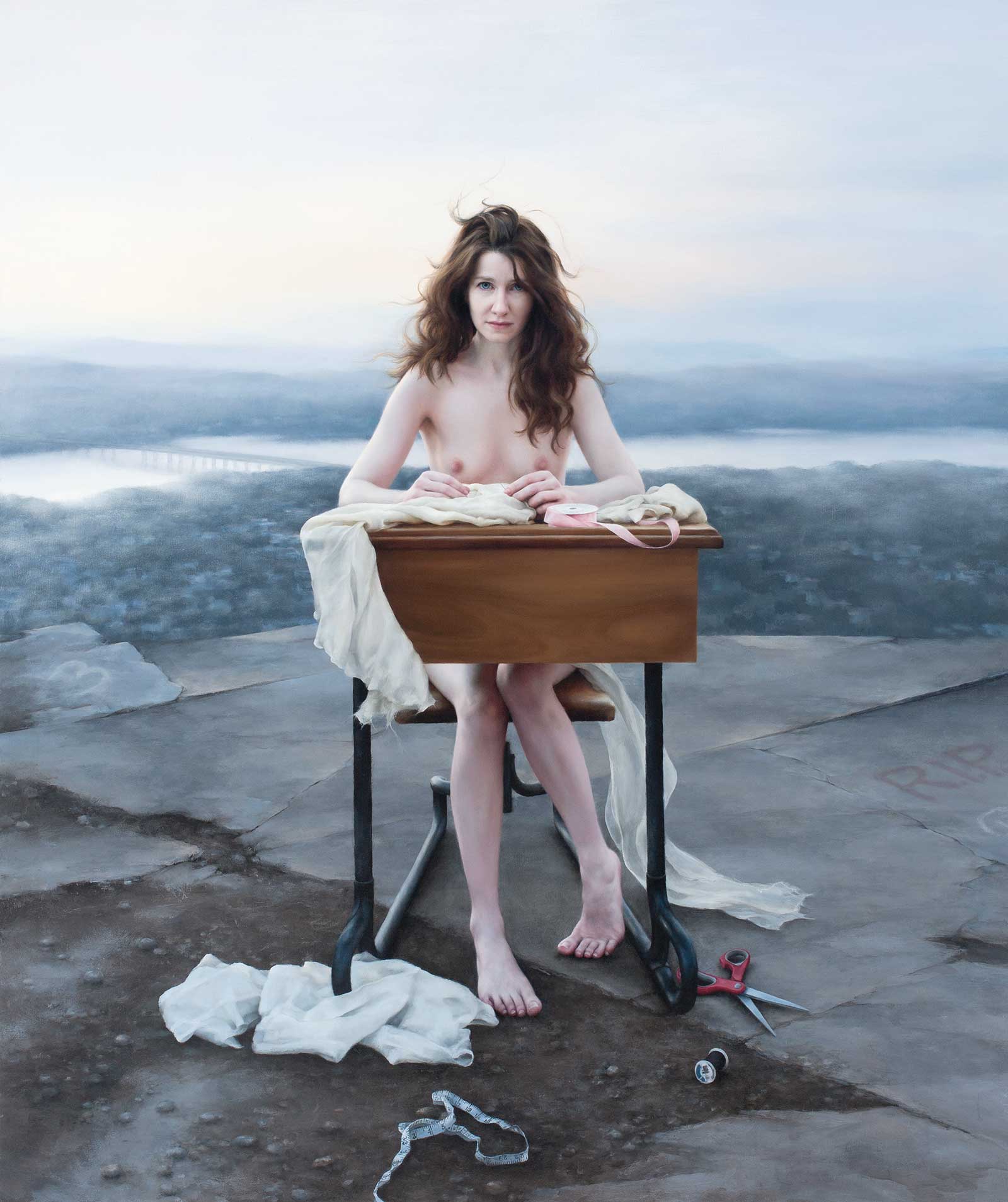
Alteration, 2027, oil on linen, 64 x 54 in. The Bennett Collection.
This year marks a new and nuanced era for the beloved muse who inspires our brothers and sisters of the studio and brush to imagine what visions they must find, for 2025 was a historic milestone in the advancement of women in the art world. The Art Basel & UBS Art Market Report 2026 described a seismic shift in primary market galleries, with representation of female artists reaching 50 percent—and it is in the primary market where the future of art history is formed. This is where the engaged American art collector belongs, in this unexplored and open space, for this is a new era of the muse, and it is women who are leading the way to her future in fine figurative art, with a new eye to the way women are perceived. O’Hagan reveals the muse in a refreshing light, literally, in a delicate high value with little color, but also by representing her models as real people, expanding their roles beyond the idealized goddesses, objects of sexual desire, and brides of rich men that dominated the long history of art.
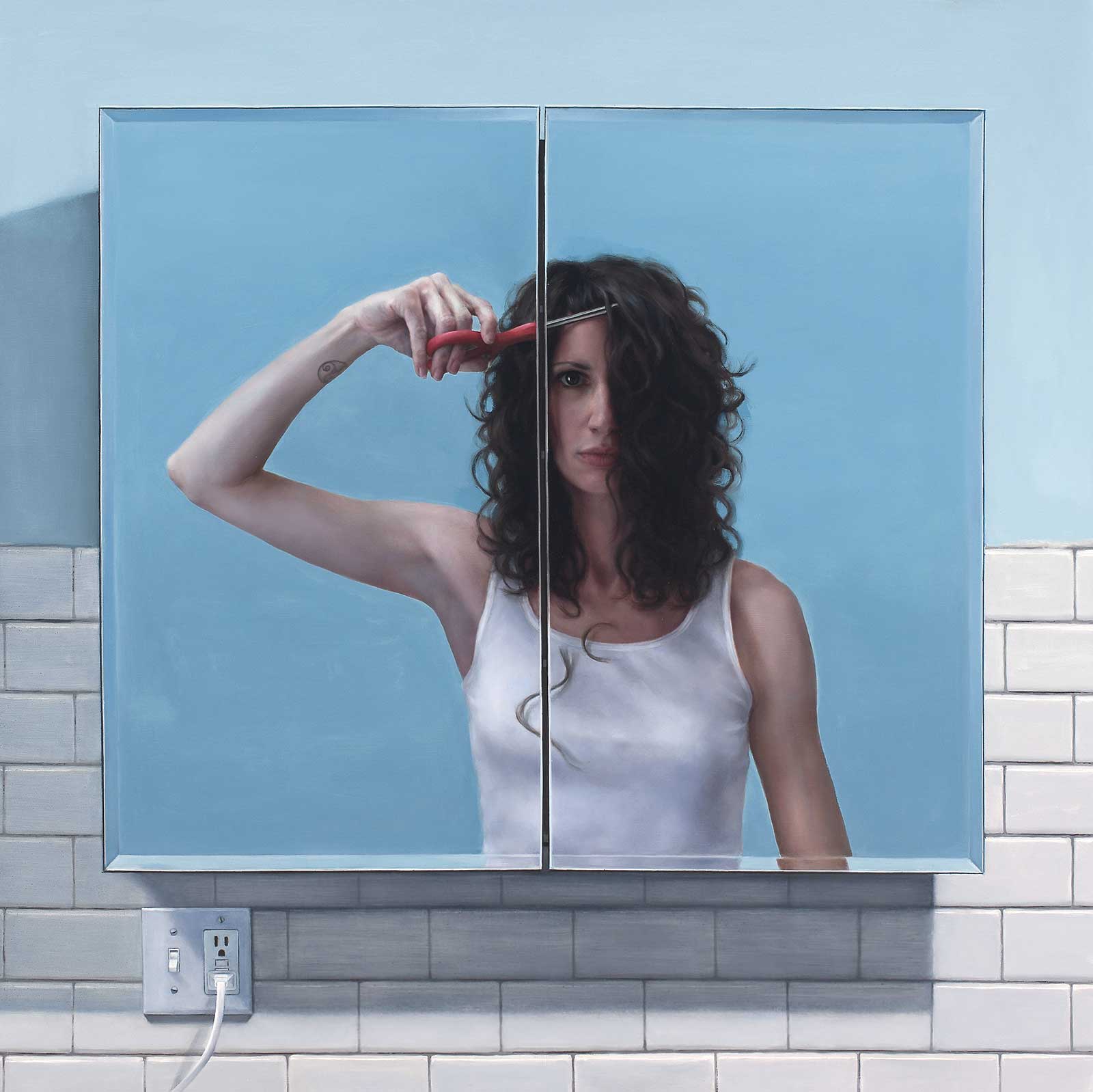
Reflection, 2014, oil on linen, 39 x 39 in. The Bennett Collection.
The spirit of reinvention rules the work. In Alteration, the naked and resolute muse has ascended to the peak of Mount Beacon, high above the Hudson River overlooking O’Hagan’s adopted American home-town on the edge of the Catskills, working with needle and thread to transform her once-worn and bleached-white wedding dress as she sews herself a new role from old cloth. A discarded tape measure is at her bare feet, beside the dropped red scissors, for surely this must be an open and imaginative beginning made after the sharpened slice of an ending. The acronym R.I.P. is a discrete graffito sprayed in blood-red ochre onto the faded slab, an admonition to leave behind the events of the past. It is a divorce. The red-handled scissors appeared in an older painting, Reflection, too, where the reflected muse is held within the frame of a bathroom mirror—it is satisfying to imagine her white shirt was tailored from Alteration’s wedding dress. But wearing the re-made dress leaves her transformative mission incomplete, and now she must reinvent herself. The symbolic gesture of cutting her hair is the emblem and entrance to a ritual of personal change, an acknowledgement that new life is not as it was. O’Hagan’s muse dares to enter the future alone.
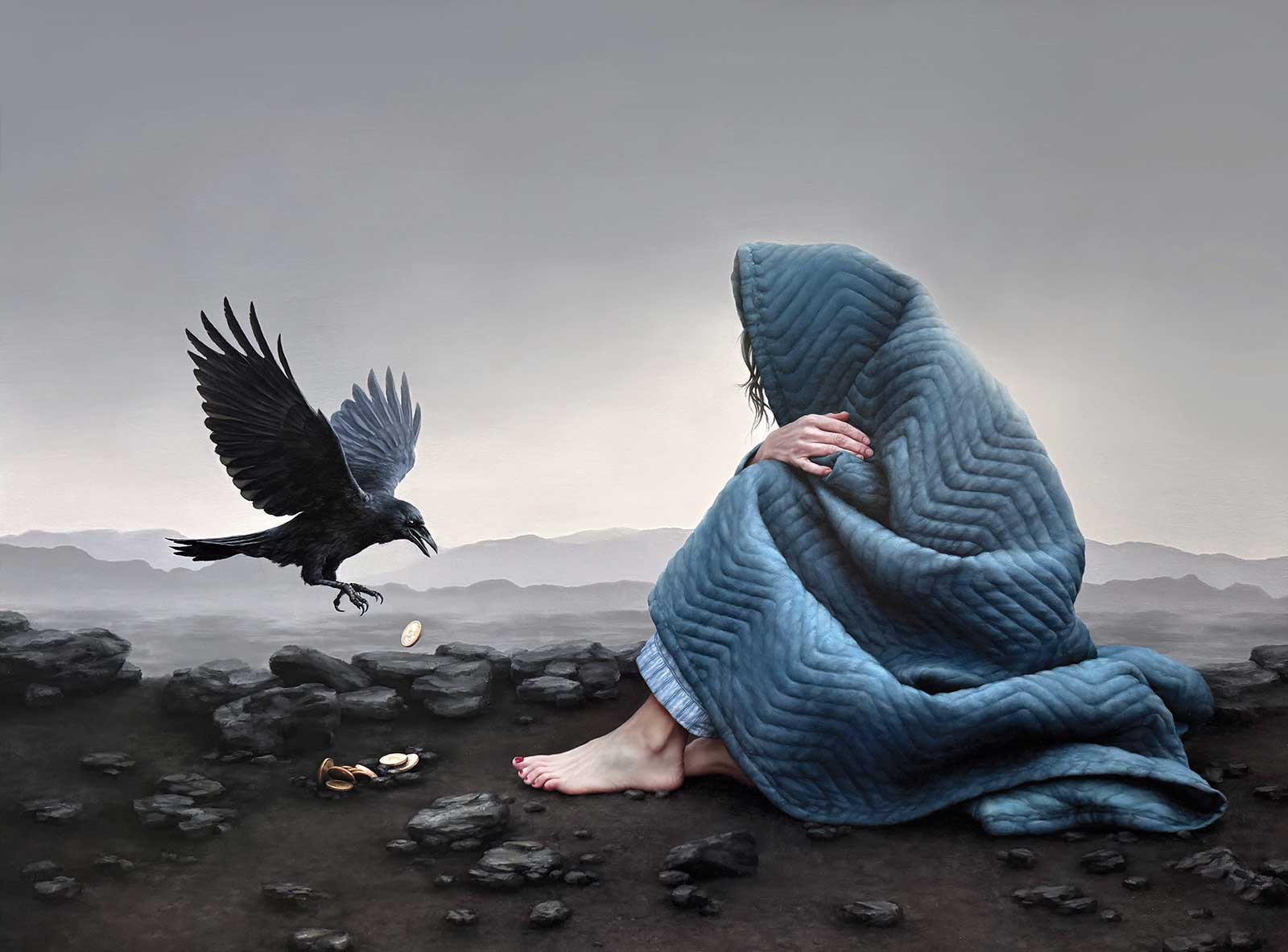
Blue, 2026, oil on canvas, 35 x 47 in. Collection of Graham Lewis.
O’Hagan is keenly aware of dangers of the expanding void between men and women in the present era, and pragmatic about the weight of the problem. “There’s a lot of negativity in general about men,” she says. “The whole culture seems to be taking great delight in demonizing everything a guy does and really just being punitive and harsh about absolutely everything. It became really tiresome for me to see. This is not how I want my girls to see men. But portraying that is really hard. So, I thought, I’m just portraying what I see as the mood, the slightly bleak, hopeless mood of this moment. If I were a guy, how I would feel? Maybe a little adrift.”
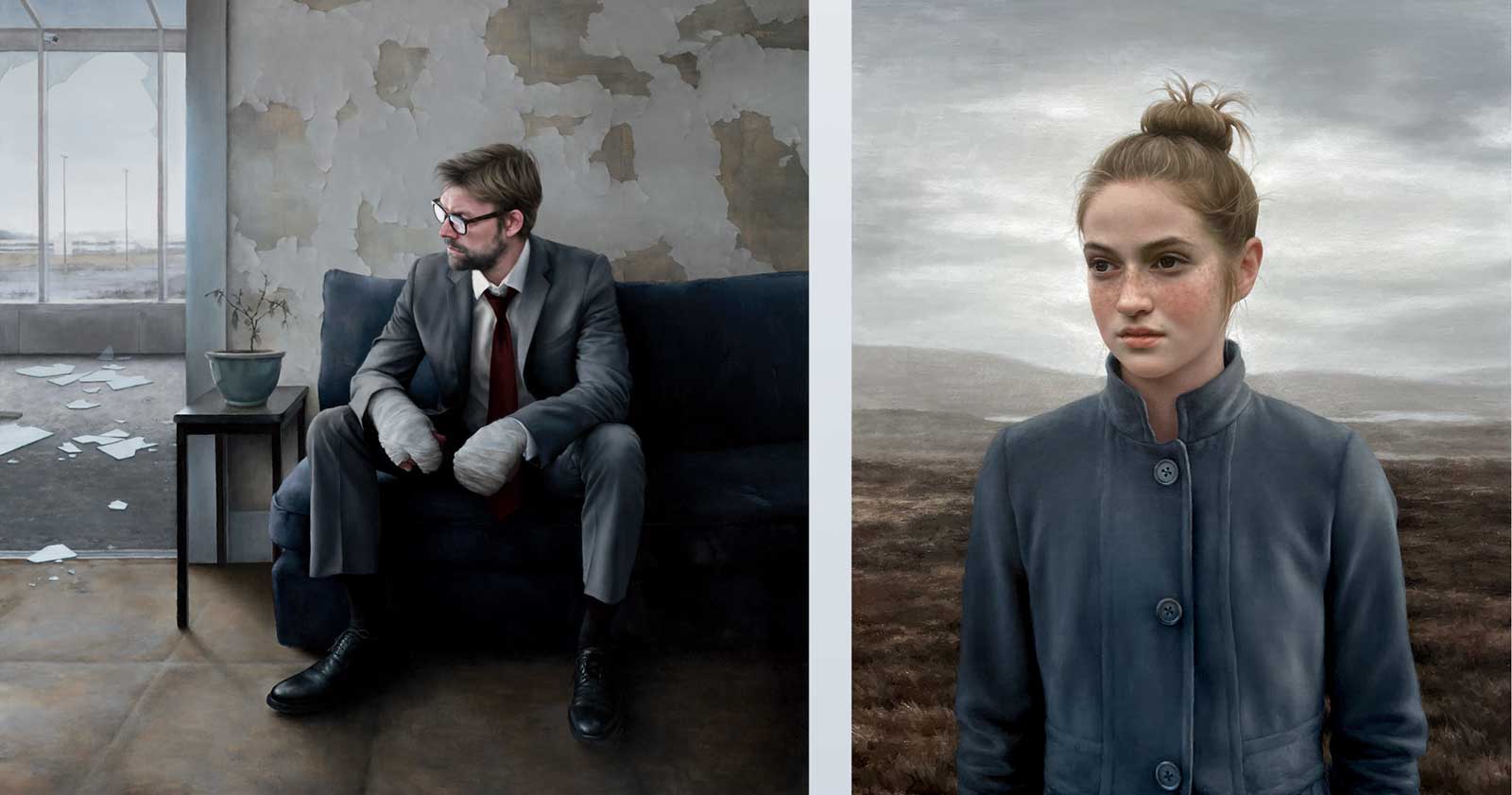
Severance, 2021, oil on canvas, 52 x 52 in. Courtesy Sanders Galleries, Tucson, AZ. Legacy, 2024, oil on canvas, 72 x 54 in. Collection of Peter Durant.
O’Hagan’s pictures belong precisely to the zeitgeist of this moment. “I just began to see all these desolate men wandering around in my head,” she says, and she painted them, producing an unprecedented series of images. A man with bandaged hands on a couch waiting for a casting call within the wasted ruins of an office building where the seminal spill of Weinstein’s exploitation withers a potted plant. A solitary man gazing at a fire in an abandoned industrial wasteland, a man sprawled alone and exhausted among the blood and loss of a feathered cockfight. They lack agency. These are the last men, then, lost and alone. O’Hagan continues, “And I thought, well, a man could never paint that…it would be dismissed as self-pitying. But in this moment, I can, and this is how I’m seeing it.”
In Requiem,an empty watchtower stares with empty eyes over weedy concrete in the early days of ruination. The painting spells out the catastrophe in a shred of newsprint drifting from the flames reflected in the last man’s spectacles, the words “hope… alliance… fading…” surviving the fire like a message from another dimension.
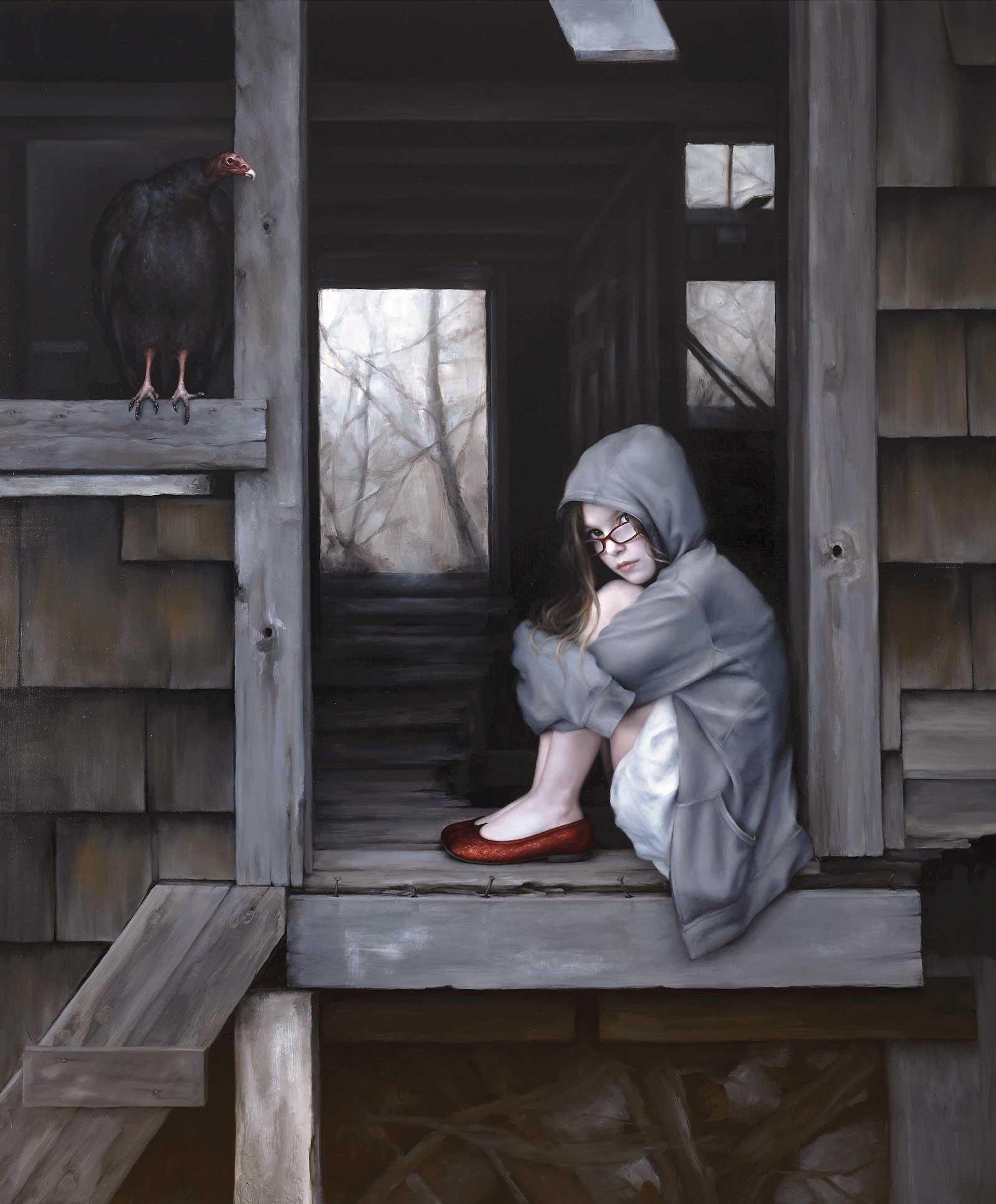
Figment, 2014, oil on linen, 80 x 44 in. The Bennett Collection.
And if these last men are not explicit enough, here is O’Hagan’s sublime diptych The Tectonic Shift, a picture of the peak of alienation. In a flat landscape of crumbling gray rock gradually vanishing into a close vague fog, a man and woman are divided by the austere fault of an ancient split of fractured earth—a black space breaking into the depths of darkness beneath their dangling feet. The broken walls of the rock faces are battered by hammered blows, for this appalling emptiness was not born of nature but broken by heavy, leaden tools swinging in the clench of knuckled fists. And if you listen hard, you might hear the muffled sounds of percussion, the orcish thuds and cracks of malevolent subterranean undermining, and the groans of the terrible rending of the earth’s own body and feel its trembling as the cracked chasm expands.
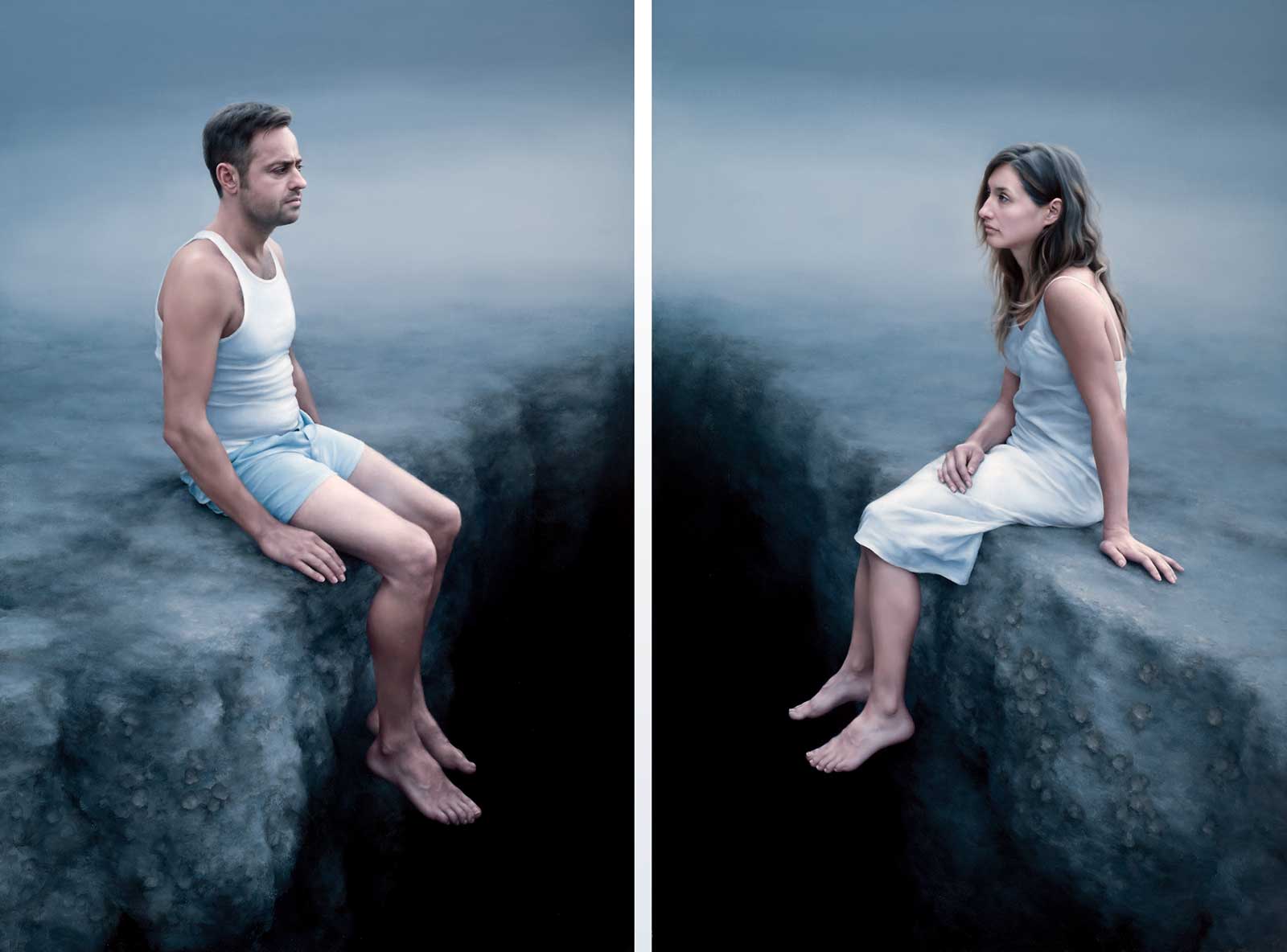
The Tectonic Shift (diptych), 2017, oil on linen on panel, 60 x 98 in. Courtesy Sanders Galleries, Tucson, AZ.
The two figures are ordinary people. He is no beefcake hunk. She is no catwalk model. The couple are exposed in their underwear, not naked, and they are made honest and asexual by his shorts and tank top, and her slip, mostly stripped of the coded garments of everyday life, and we are limited to speculation on their private selves. They are us. Yes, there is still a subtle semiotic message of warning and reproach—his shirt is known as a “wife-beater,” and it is a reminder that the hardened edge and threat of violence is always present in the heart of man, that un-exorcised beast lurks within.
The painting is a terrifying warning, for the ghastly distance grown between man and woman is an existential void. O’Hagan comments, “If I was a young person now contemplating having kids, I would be very worried about it.” Unless men and women can reach across that bleak emptiness to find unity in the ancient balance of love between male and female, humanity is destined to fall into the darkness of grim nihilism. Without the dance and joy of love, that void gazes back into the heart of mankind. Men must take responsibility for the emptiness and gravity of this crack in the world for their abusive misdeeds, magnified recently by the repulsive actions of the lost: Jeffrey Epstein, Bill Cosby and Harvey Weinstein. The Tectonic Shiftis an austere emblem of mistrust. Men must be better.
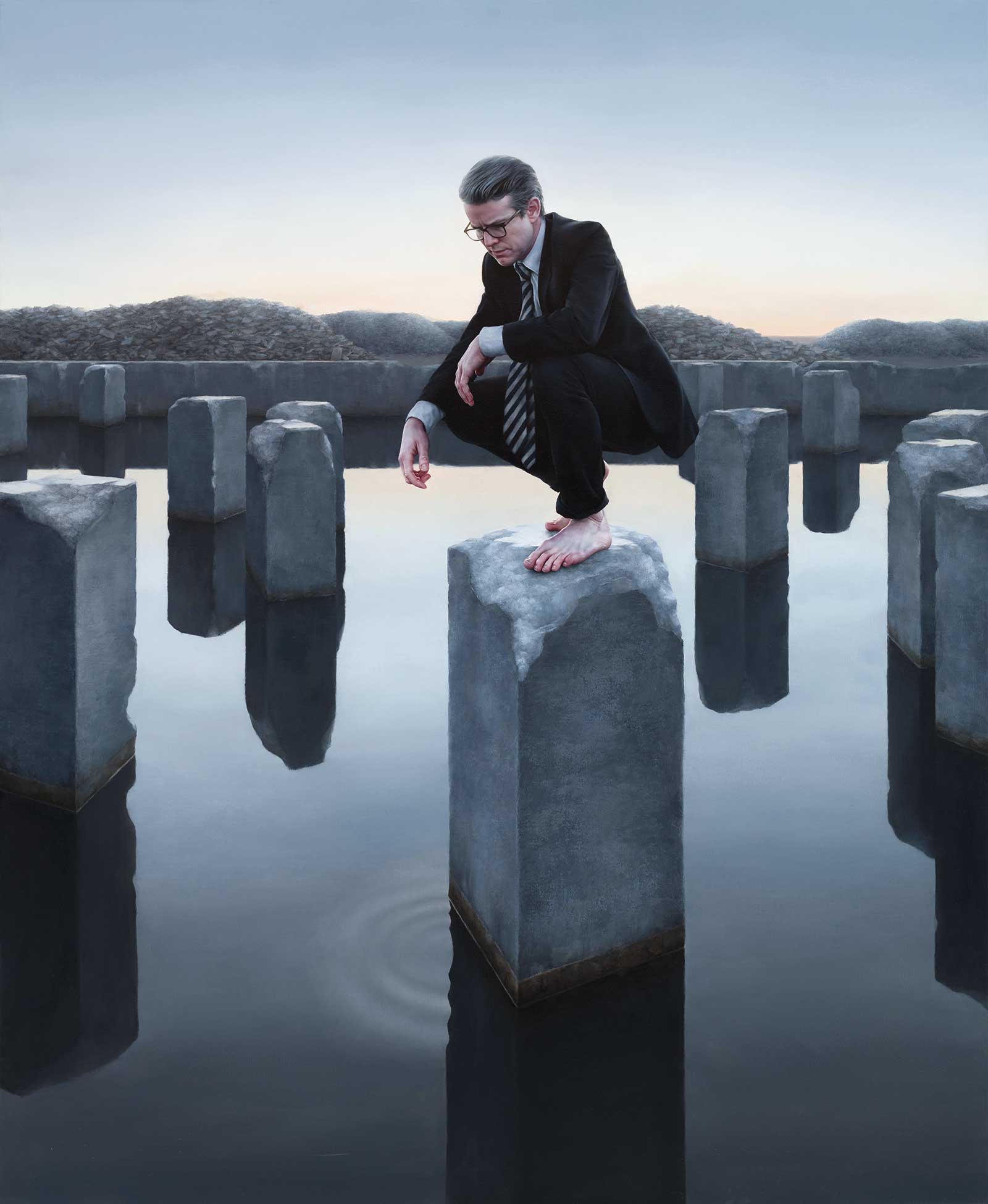
Exile, 2023, oil on canvas, 66 x 54 in. Courtesy Sanders Galleries, Tucson, AZ., 2023
O’Hagan draws from the well of ancient memory for a solution, perhaps discovering it in memories of the ancient megaliths of the Scottish coast, where the pinnacles of Callanish pierce the grey sky with their primordial magic. Her Exile is marooned on a phallic pillar rising from a depth of stagnant water, but his standing stones are battered foundations of masculinity, still standing even after the demolition of his house. This new man’s only answer to the bleak nihilism he faces is to learn to fly; to escape like brother Apollo and sister Artemis by making the heroic leap from the solid grounding of ageless fundamentals; to be carried on the wings of will, wresting confidence from the diluvian wreck by abandoning the actions and infamy of the lost men of the recent past.
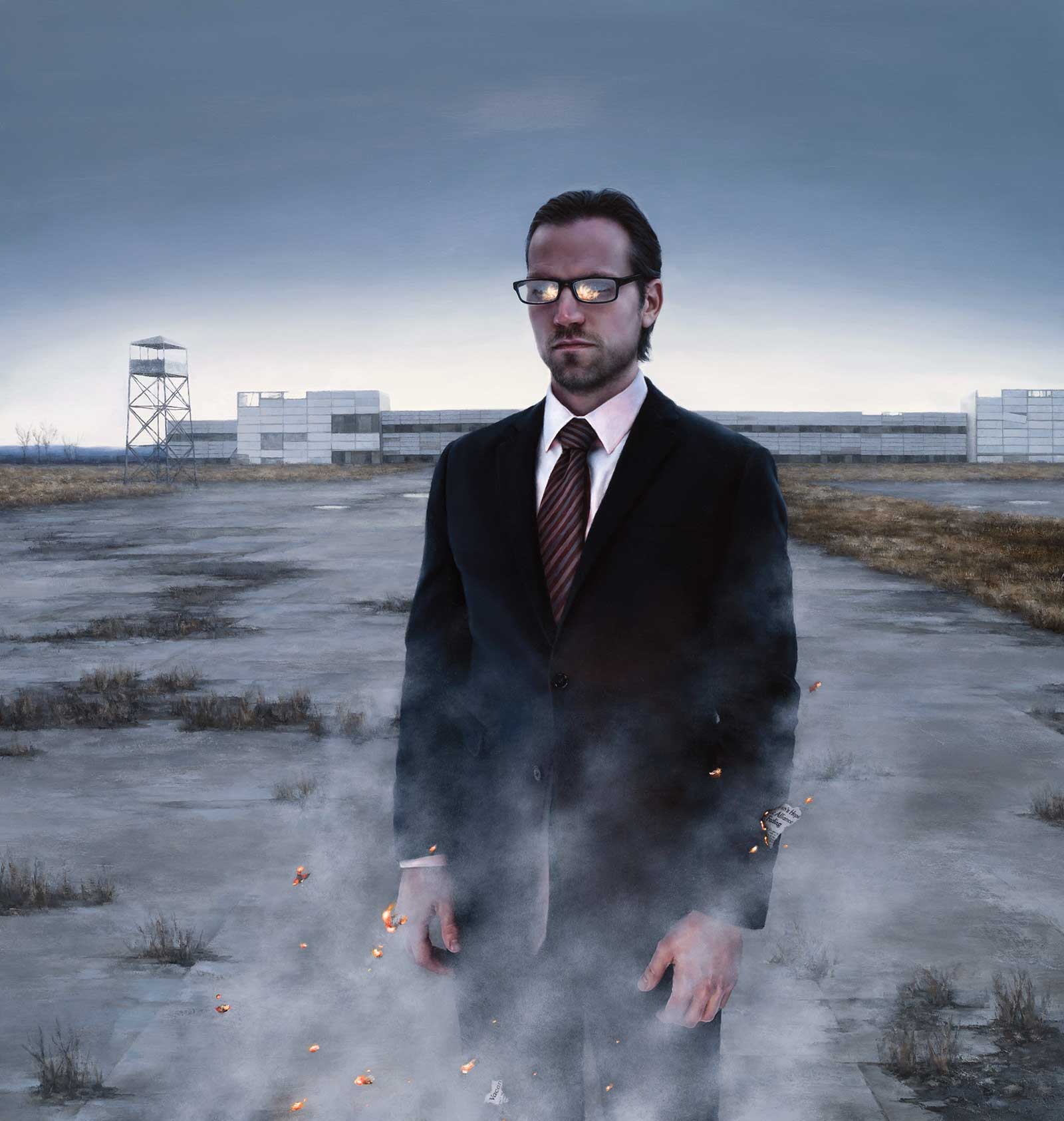
Requiem, 2023, oil on canvas, 42 x 44 in. Courtesy Sanders Galleries, Tucson, AZ.
In Vigil, the mother muse does her best to protect her children, yet her home is deteriorating. It is becoming a cold and uncomfortable place where exposed plaster sheds a skin of pale paint. In Figment the solitary muse’s bare house has been reduced further, almost to the edge of ruin, and the child, wrapped in her absent father’s jacket sits in the dry doorway dreaming of clicking her ruby heels to return to the family past. There’s no place like home. Take heart, red hope—a daughter needs a dad—and though the last men wander blasted ruins, the new men have their destinies to fill, and there are many spiders still to kill. —
Powered by Froala Editor