Gary Erbe first painted his first American flag in 1971. The motif has reappeared in his trompe l’oeil compositions ever since, amid a myriad of other subject matter chosen for its capacity to express the diversity of ideas that are fundamental to the artist’s work and purpose.
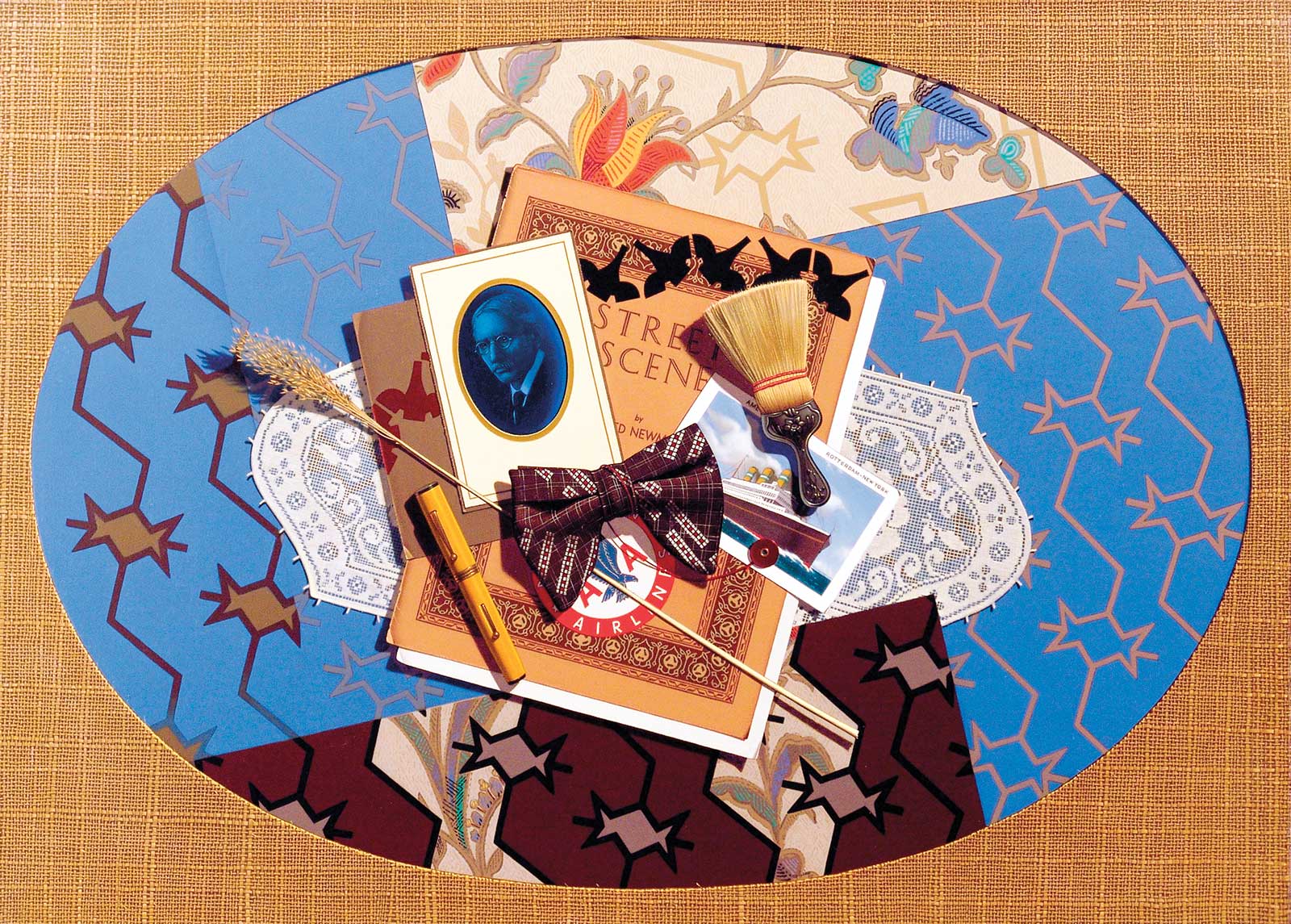
The Brown Bowtie, 1998, oil on canvas, 23 x 32 in., Reading Public Museum, Reading, PA.
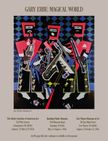
Erbe created two of his most significant flag paintings during the lead-up to America’s bicentennial in 1976, which he saw as his personal contribution to that historic moment in time. Fifty years later, as Americans ring in another milestone anniversary of the signing of the Declaration of Independence, the monumental canvases anchor Gary Erbe: Magical World, a retrospective of the 81-year-old artist’s work that is currently on view at the Reading Public Museum through August 2. It is the first showing of these works in more than 30 years.
Composition in Red, White and Blue, measuring 72 by 112 inches, and Pieces of Time, at 65 by 100 inches, were purchased before he even started working on them and each took a year to complete. Erbe creates multi-media, three-dimensional assemblages of his compositions—works of art in and of themselves—before beginning the painting process. The exhibition, which features around 50 pieces in total, includes examples of these constructions alongside the finished paintings.
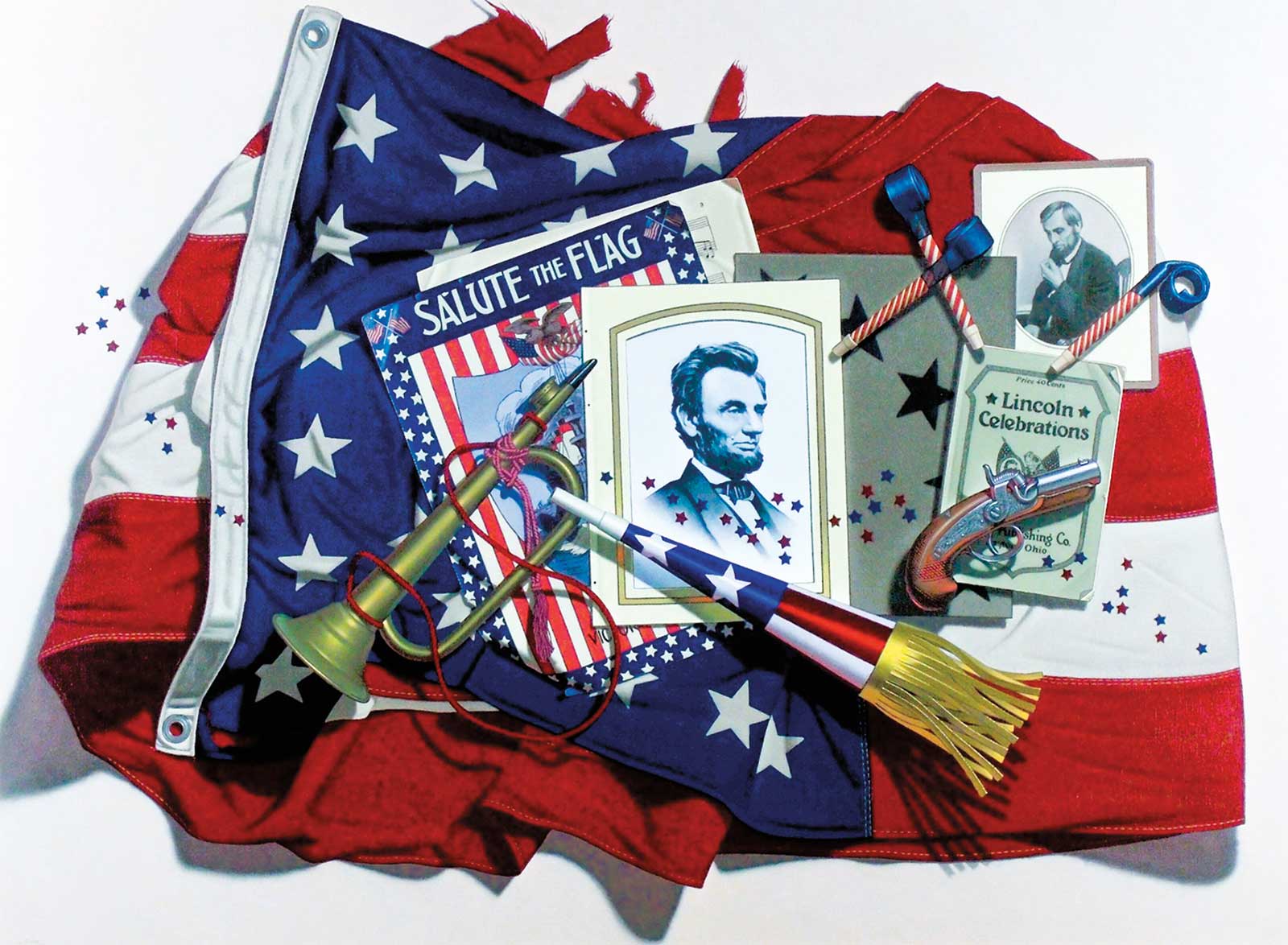
Celebrating an American Patriot, 2014, oil on canvas, 30 x 40 in., Philadelphia Museum of Art, Philadelphia, PA.
Part of the allure of Erbe’s paintings lies in the layers and details that may not be immediately apparent. At first glance, Composition in Red, White and Blue looks like a patchwork swath of American flag stars and stripes. Look closer and you will find a peace symbol and the portraits of 37 presidents that Erbe has concealed within the very fabric of the composition. Visually, Pieces of Time is a collage of iconic imagery from American history: an Uncle Sam Poster, Howdy Doody propped up on a 1950s-era television, and allusions to baseball, Hollywood and the early days of aviation, to name a few.
In the 88-page color catalogue that accompanies the exhibition, Erbe writes, “This painting also recalls my own childhood growing up in the 1950s when television made a big splash and had a profound impact on society. I also thought about the plight of Native Americans, a dark chapter in American history. The satyr-like devil’s head in the lower center of the composition challenges the viewer for self-interpretation. As always, content, composition and color is paramount in this and all my work.”
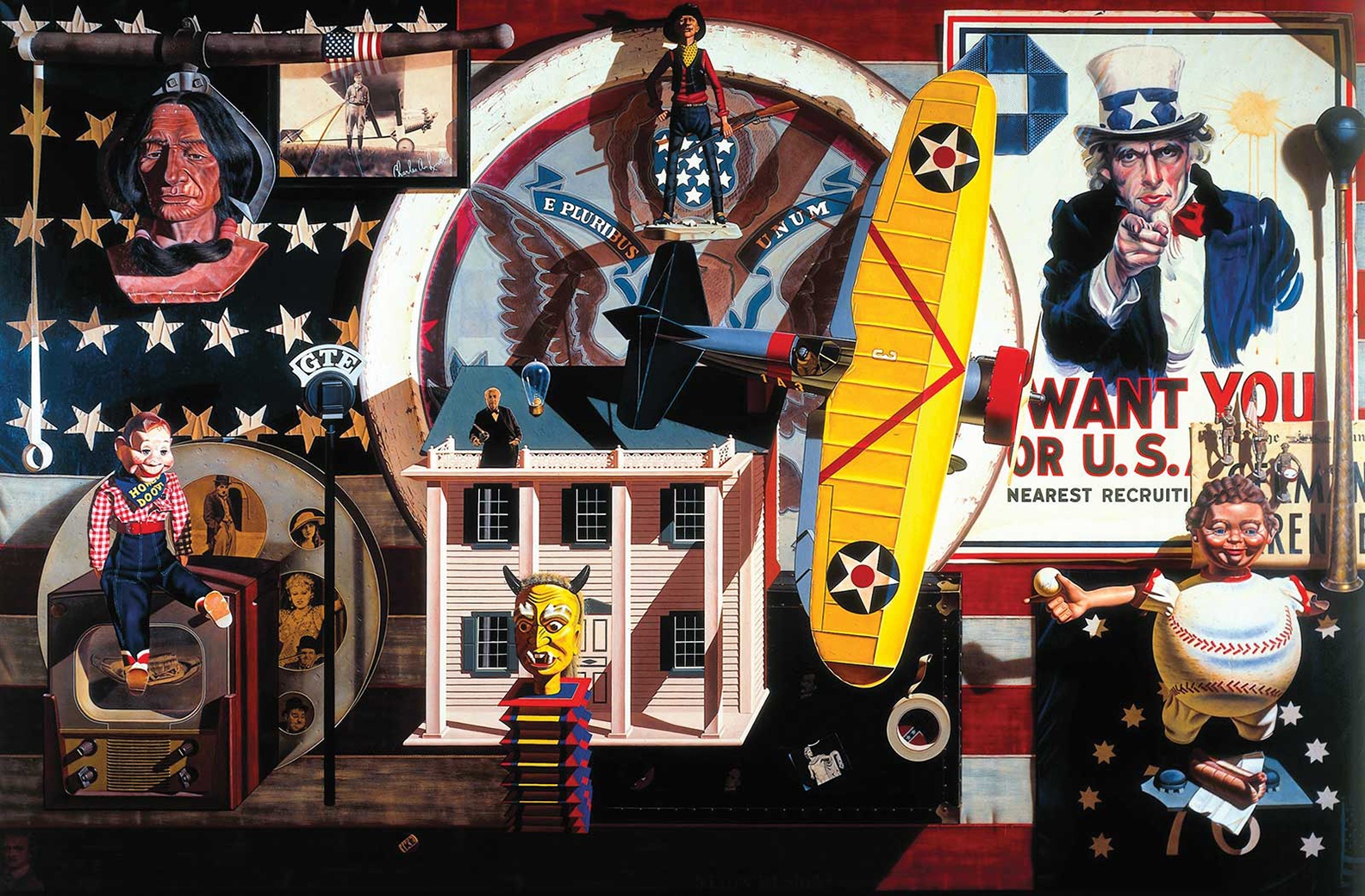
Pieces of Time, 1976, oil on canvas, 65 x 100 in., Butler Institute of American Art, Youngstown, Ohio.
Pieces of Time is a prime example of “Levitational Realism,” a term Erbe coined in 1969 to describe his early style of trompe l’oeil painting which emphasized an illusory floating effect. Although his style and focus has evolved and shifted over the decades, Erbe has never strayed from trompe l’oeil, a genre rooted in the tradition of 18th- and 19th-century realism that was so real it could “trick the eye.”
“I discovered trompe l’oeil in 1967 and it absolutely fascinated me,” says Erbe, who is entirely self-taught. “It was a genre I felt I could express ideas with, and I never wanted to abandon it. I’m a very disciplined, detail-oriented man. Everything I do I have to do just right, and that’s what trompe l’oeil requires. It required patience, discipline and a mastery of technique. It was kind of a happy marrying for me.”
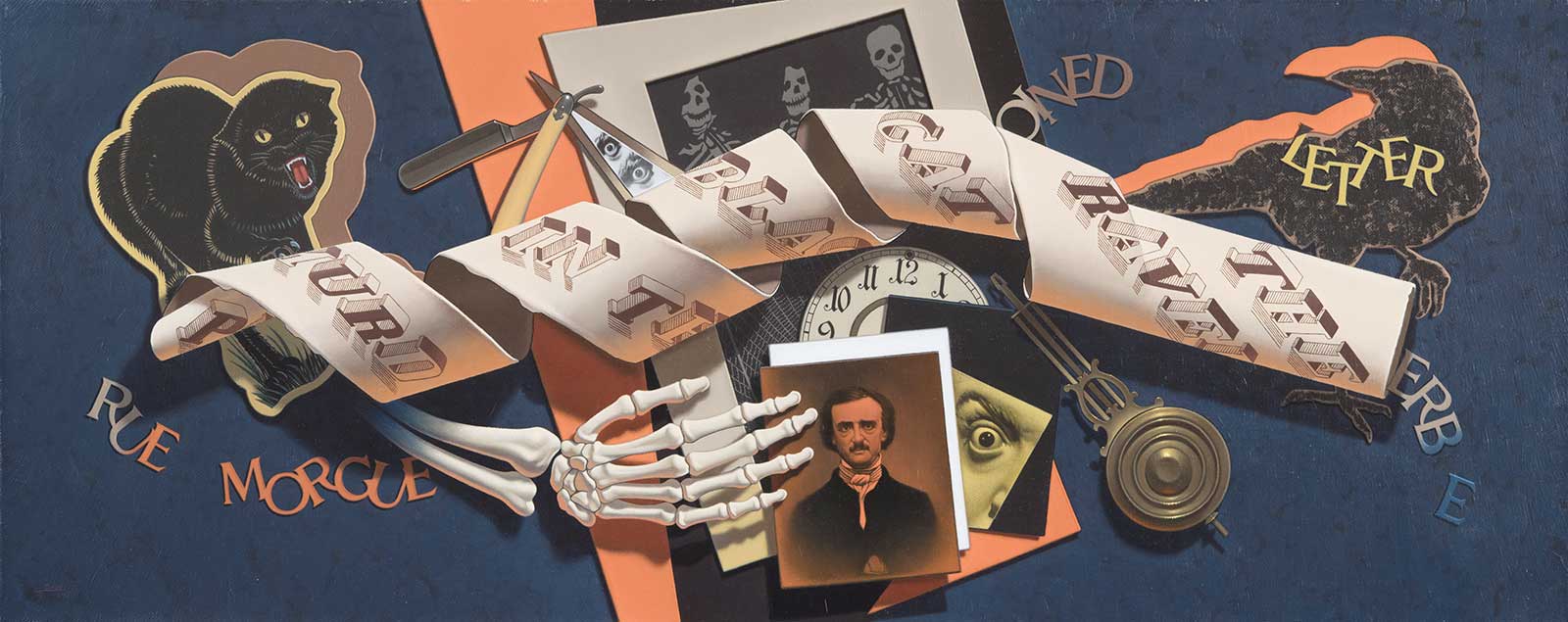
Master of the Ruptured World, 2015, oil on canvas, 16 x 40 in. Courtesy the artist.
The flag paintings are timely, and impressive, but they represent a small fraction of the hundreds of works Erbe has created over the years. Musical subject matter has been a favorite of the artist’s, allowing him to experiment more heavily with abstraction.
“I’m trying to bring trompe l’oeil into the 21st century,” says Erbe. “In music-related paintings, like Take Five,I can get into a more modern approach to trompe l’oeil—it’s about the shape of the instruments, the texture. And while you can’t usually put a human in a trompe l’oeil, I can create the illusion of them through shapes and silhouettes.”
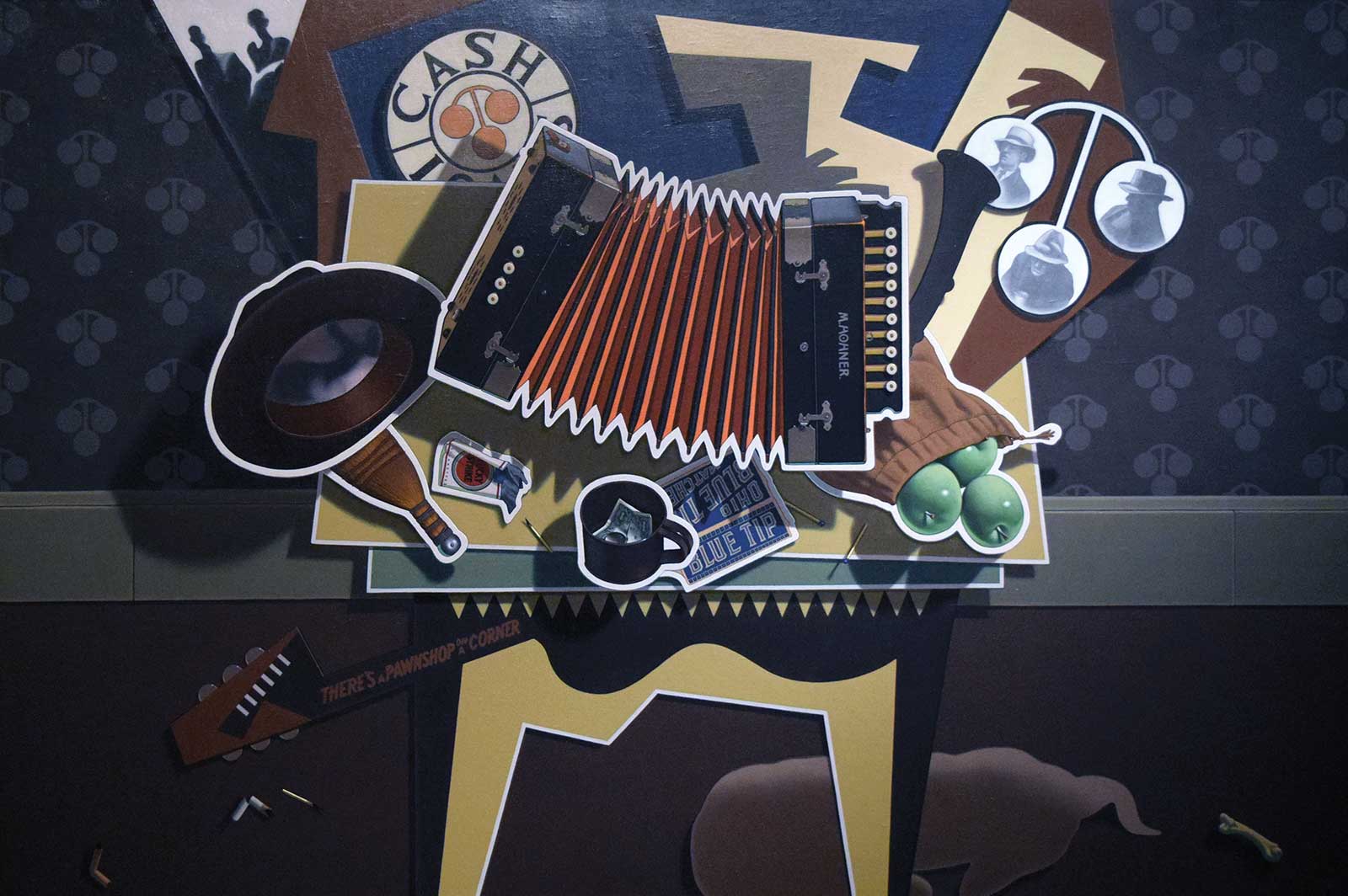
Pawnshop Serenade, 2017, oil on canvas, 40 x 60 in. Courtesy the artist.
The Brown Bowtie, which is part of the Reading Public Museum’s permanent collection, is another composition informed by the principles of abstraction, cubism in particular.
“Over the years, I have explored the idiom of abstraction and cubism and how these modern principles can be integrated into trompe l’oeil,” Erbe has said. “I welcome the challenge of bridging the gap between modern art and realism without abandoning technique. I believe I have found ways of circumventing the so-called rules of trompe l’oeil in favor of originality, inventiveness and creativity. I have underscored the point that my work has less to do with the tenets of trompe l’oeil and far more to do with the creative process of discovery.”
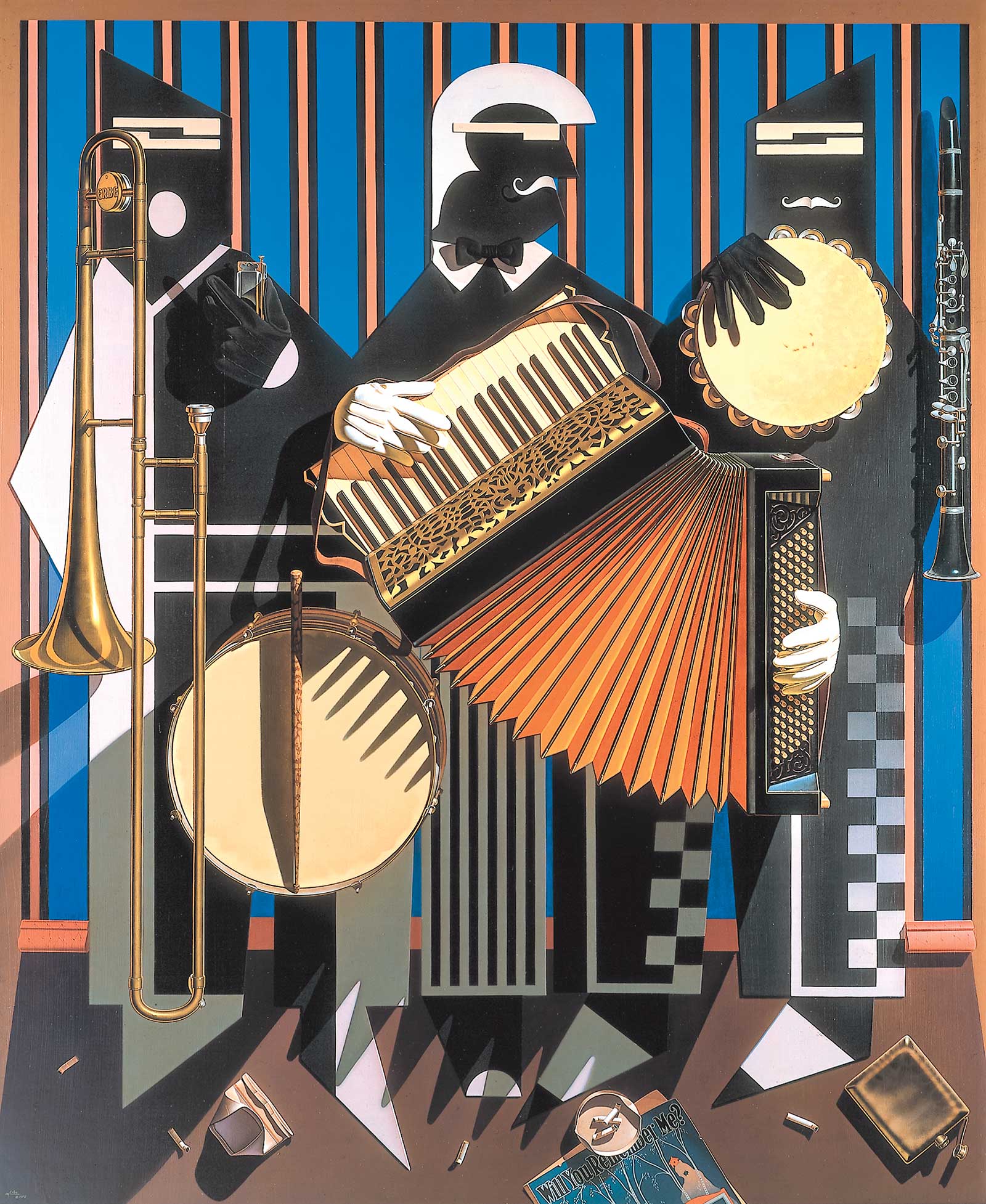
Take Five, 1982, oil on canvas, 64 x 54 in. Private collection.
Gary Erbe: Magical World debuted at the Butler Institute of American Art in Youngstown, Ohio. After closing at the Reading Public Museum on August 2, it will travel to the Fort Wayne Museum of Art in Indiana where it will run from August 22 through October 25. —
Gary Erbe: Magical World
Through August 2, 2026
Reading Public Museum
500 Museum Road, Reading, PA 19611
(610) 371-5850, www.readingpublicmuseum.org
Powered by Froala Editor