Within the art world, one will find a plethora of gorgeous floral and botanical artworks created by artists who are greatly influenced by the natural world. However, the history of the genre first began as a way of documentation—combining both art and science. Illustrating flowers, herbs and plants in great detail once served as botanical study, disguised as stunning works of art.
It all began with temple and wall motifs of plants in Egypt and in Mesopotamia. The genre of floral and botanical art crawled its way through history, finding a place in one of the oldest surviving illustrated manuscripts titled the Codex Vindobonensis,now in the Austrian National Library in Vienna.
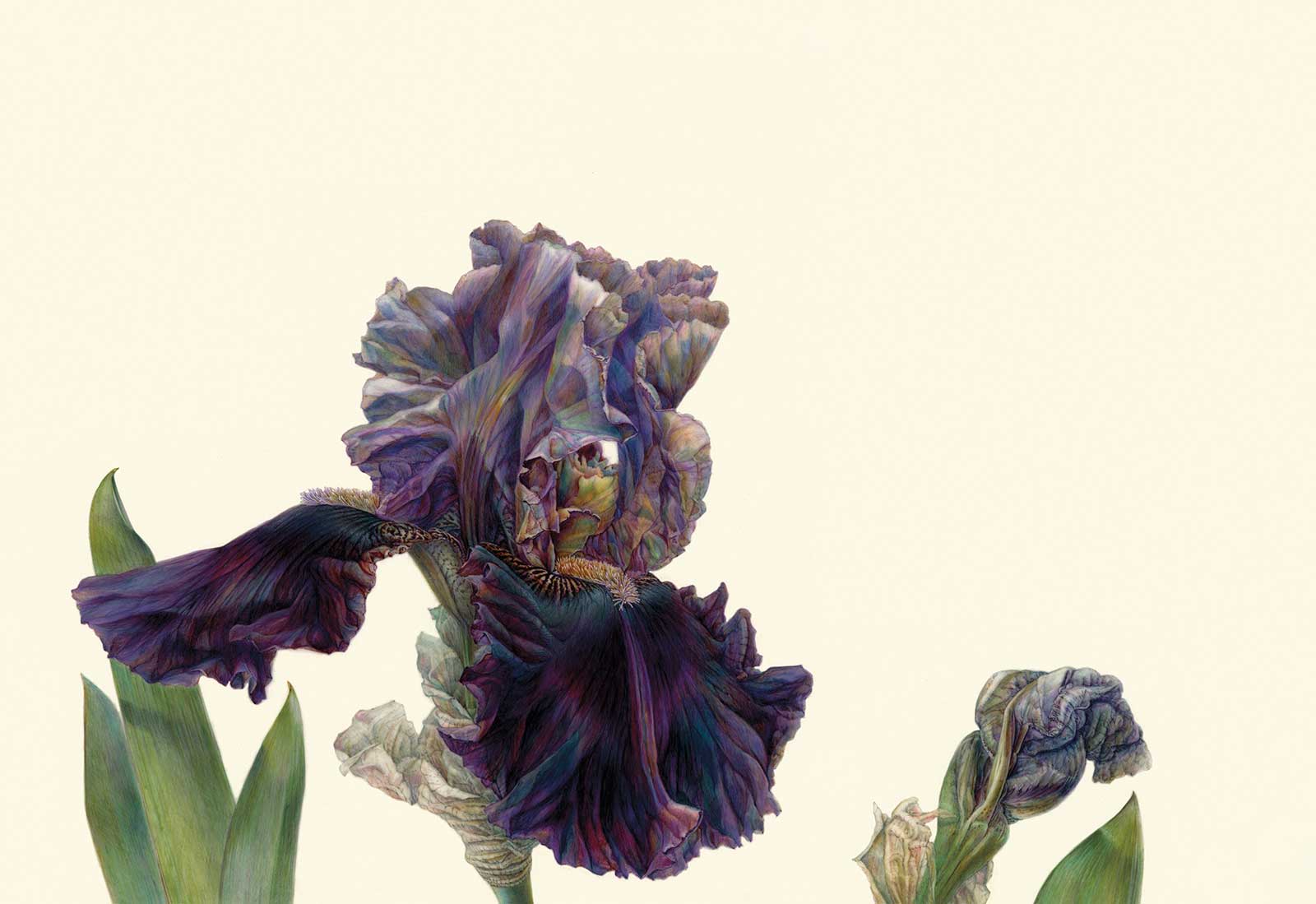
Jean Emmons, Iris ‘Full Tilt Boogie,’ watercolor and gouache on vellum, 12 x 10 in.
“This magnificent example of botanical art exhibits a standard in plant drawing unsurpassed for nearly a thousand years,” write Jutta Buck and Cynthia Rice in A Brief History of Botanical Art, a series of articles created for the American Society of Botanical Artists. “The Codex was made in Constantinople for Juliana Anicia, the daughter of Flavius Anicius Olybrius, Emperor of Byzantium in 472. The work is mainly a copy of De Materia Medica compiled in Rome about 60 AD by the Greek physician Dioscorides. The illustrations in this Codex are considered exceptional for their naturalism.”
Later, at the end of the 15th century, naturalism became more prominent, with stellar manuscripts and books emerging in France, Germany and Italy, that also included garden flowers. During the Renaissance, a dramatic change took place “when both scientific precision and artistic sensibility were introduced by Leonardo da Vinci (1452-1519) and Albrecht Dürer (1471-1528),” explain Buck and Rice. “Dürer also made drawings of plants, birds and animals, which he later used in paintings. Their studies of flowers and plants displayed a rare genius for depicting both plant structure and habit, and their works are considered to be the first modern botanical illustrations.”
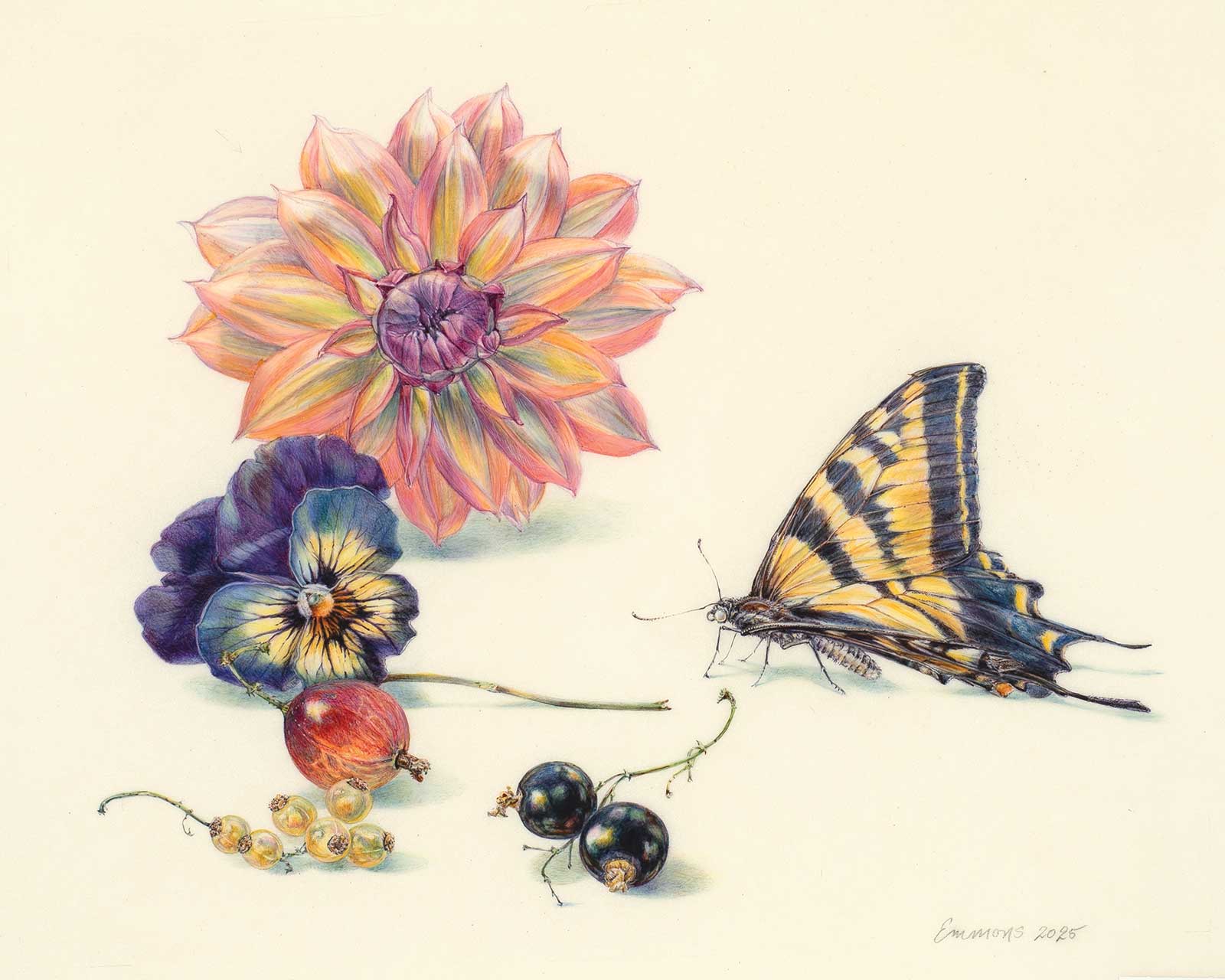
Jean Emmons, Western Swallowtail, Dahlia, Gooseberries & Currants, watercolor on vellum, 12 x 14 in.
Years and centuries following saw botanicals and florals highlighted through printmaking, etchings and paintings, showing up in books, manuscripts, scientific journals and on gallery walls. Today, we see artists like Jean Emmons, who came to botanical art through a love of gardening and a career in horticultural book and magazine illustration. Here, we see works like Iris ‘Full Tilt Boogie,’ and ‘Western Swallowtail, Dahlia, Gooseberries & Currants.’ Emmons explains, “when writing plant names, anything in Latin/Greek is italicized, while cultivar or hybrid names are not italicized, but they are in single quotes.”
She continues, “The history of botanical art probably began on the walls of ancient Egyptian tombs. Yet in recent years, botanical art has become increasingly relevant to the challenges facing our world today. In particular, the ecologically themed shows organized by the American Society of Botanical Artists have raised awareness of heirloom crops, endangered plants, pollinators and the complex symbiotic relationships of plants, lichens, fungi and algae.
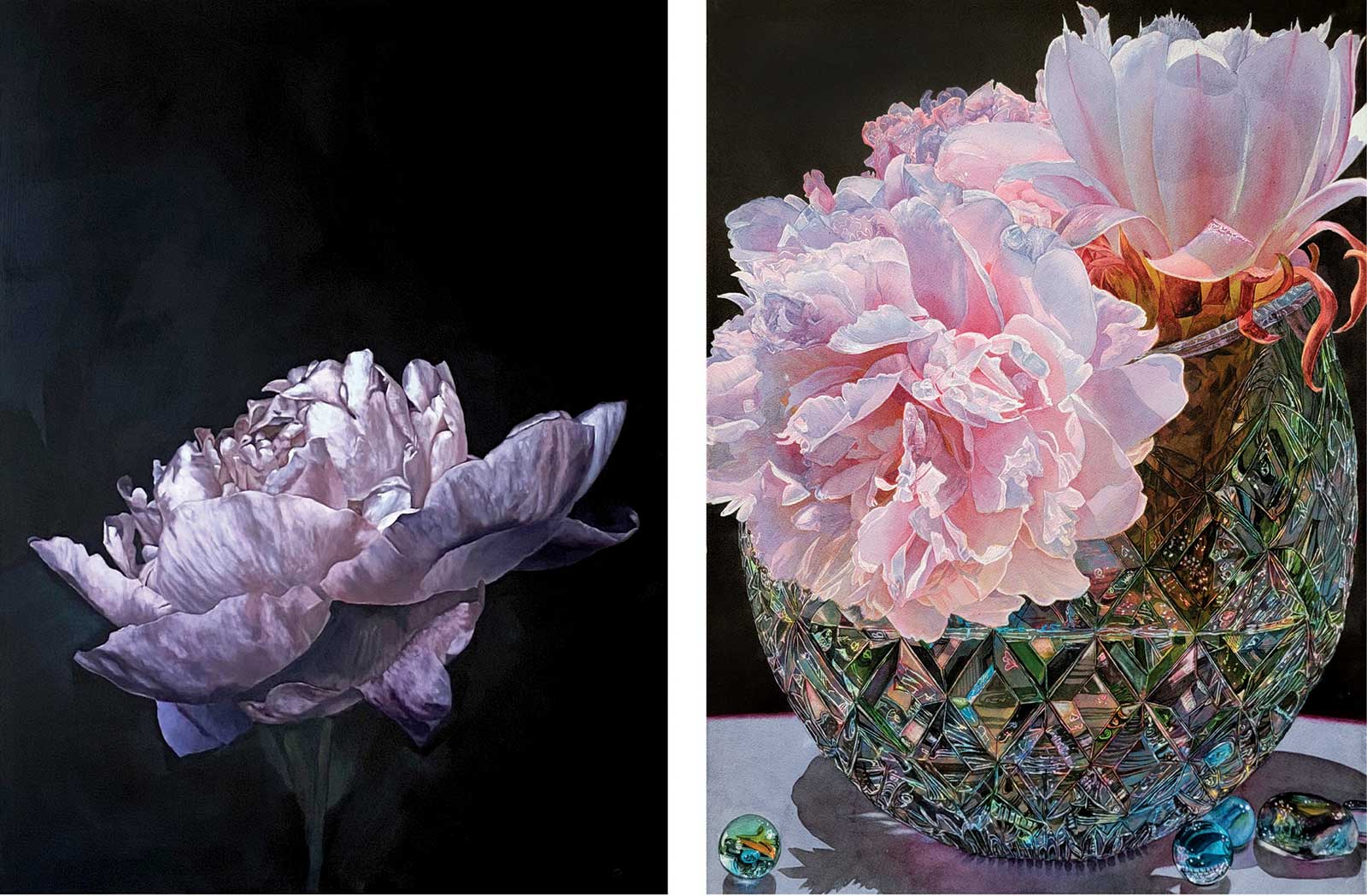
Anne Neilson Fine Art, Peony, oil on canvas, 48 x 36 in., by Ani Kinyon; Soon Y. Warren, Pink Peony and Cactus Flowers in Crystal, watercolor on paper, 30 x 22 in.
Botanical art techniques are time consuming, yet the process can be extremely soothing and restorative.”
Other contemporary artists working in the florals genre include Ani Kinyon. Represented by Anne Neilson Fine Art, Kinyon presents works like Peony, featuring a single purple and white peony silhouetted against a dark background. Soon Y. Warren showcases her watercolor Pink Peony and Cactus Flower in Crystal. She shares, “These two beauties show countless petals—pink peony and simple, tubular cactus petal that harmonize beautifully. How great that nature creates these flowers. No matter how different, they still beautifully [come] together.”
Whether you enjoy the science or the pure artistic nature of a floral or botanical piece, we all get to witness the worlds greatest muse—mother nature.
Continuing reading to hear more insights from artists creating botanical and floral pieces in their own vision and style.
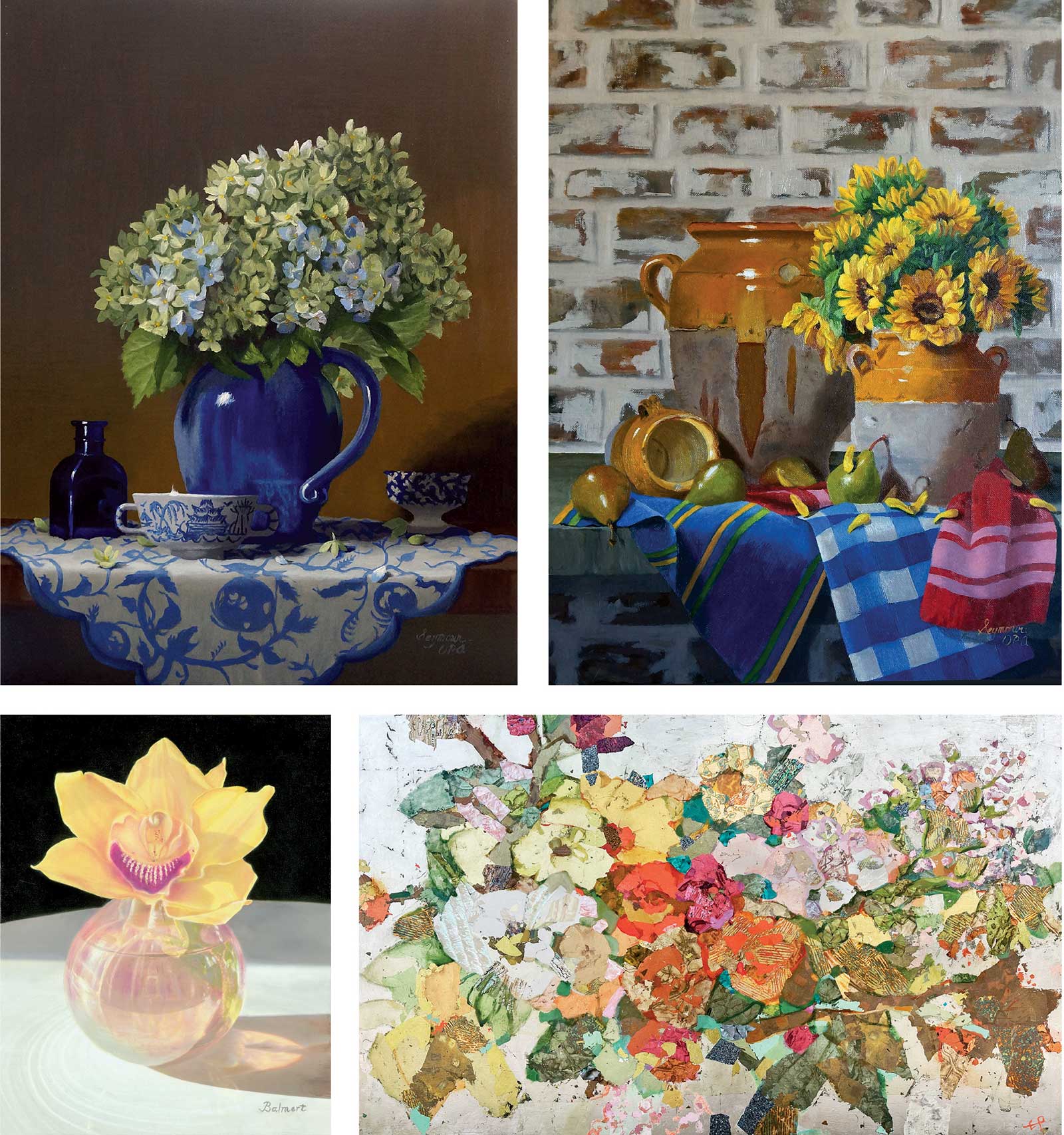
Top: Claudia Seymour, Summer Blues, oil on linen panel, 16 x 12 in.; Claudia Seymour, Sunburst, oil on linen panel, 16 x 12 in. Bottom: Nancy J. Balmert, Reflections at the Plaza, oil on canvas, 14 x 11 in.; Elizabeth Page, Rest on My Shoulders, mixed media, 36 x 60 in.
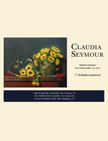
Claudia Seymour is a painter working primarily in the still-life and floral genres. Her elegant, award-winning realist paintings in oil and soft pastel are widely collected throughout the U.S. and England. She incorporates not only every day and natural objects, but also rare antique ceramics and textiles. Seymour treats light almost as another object in her paintings to emphasize the timeless aspect of her subjects, which are often flowers. An example is Summer Blues, in which an antique ceramic pitcher holds vivid blue hydrangeas aside a vintage blue bottle, an old spongeware cup and a printed blue-and-white cloth. Sunburst uses an old painted brick wall as the backdrop for three antique French confiture pots containing brilliant sunflowers; also included are vintage cloths and fresh pears.
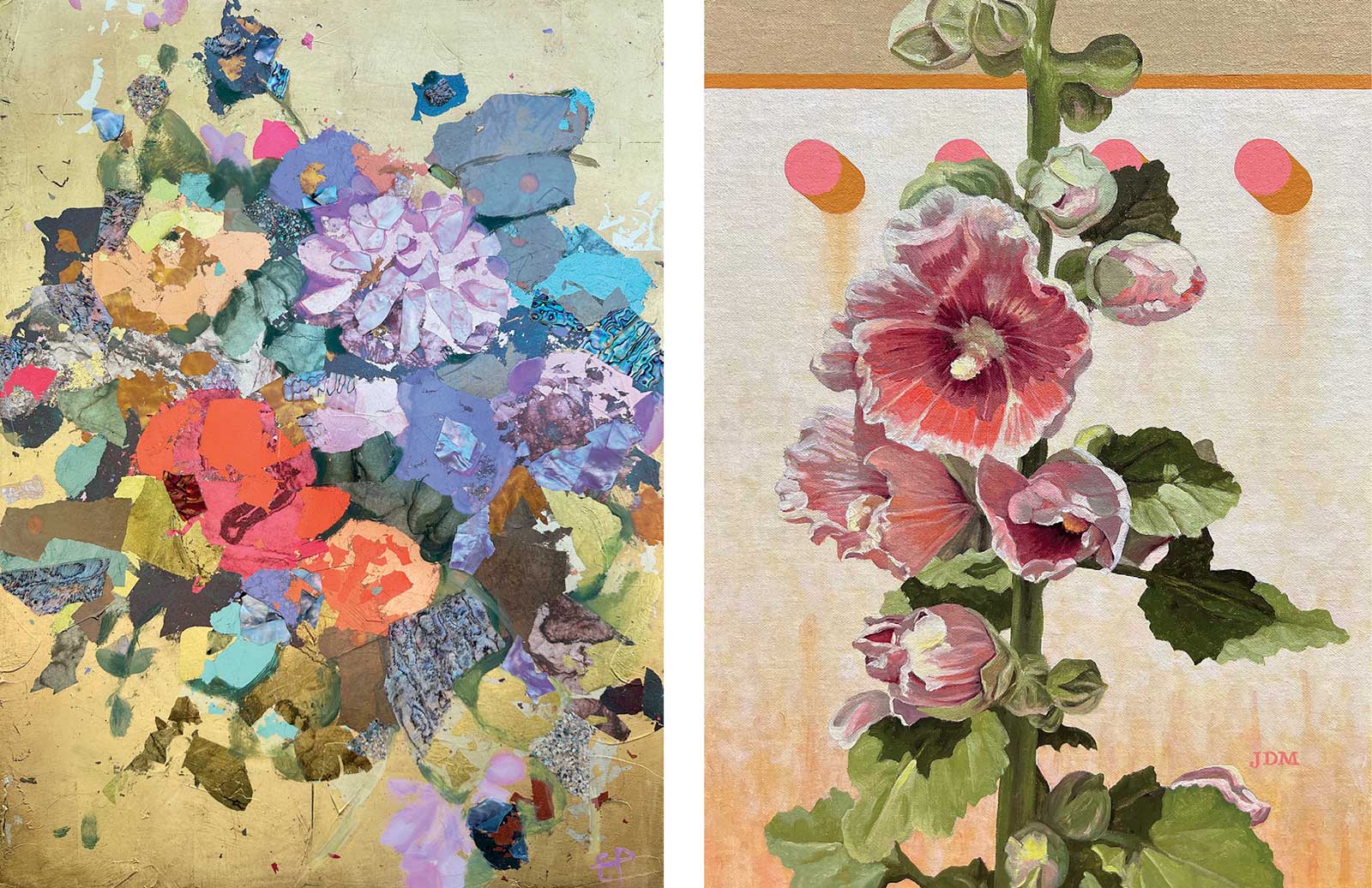
Elizabeth Page, Dahlia Dreams, mixed media, 24 x 18 in.; John Meister, Pink Vigas, oil, 16 x 12 in.
Seymour is currently in a two-person show at J.M. Stringer Gallery in Vero Beach, Florida, and planning is in place for a May show at Great Brook Gallery in New Vernon, New Jersey.
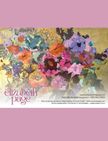
Elizabeth Page’s floral inspiration is simple: “How do I see myself as part of nature? How do I feel held by nature? Those are my guiding lights,” she shares. “I spent seven years mastering florals in realism—strategy, theory, all of it. Now I don’t theorize it. I see a color and act. Beyond the beauty of the flowers and the compositions I know by heart, I’m asking what it means to move in rhythm with creative flow; the same flow that runs through us, creates and blooms the flowers, and makes our hearts beat. It’s the intelligence of nature, in flowers. The pieces hold that energy—the one that keeps flowers blooming—and I hope they hold you, too.”
For pieces like Dahlia Dreams and Rest on My Shoulders,Page explains, “you watch as the light changes throughout the day—mother-of-pearl and gold leaf shifting the surface, asking you to look, pay attention.”
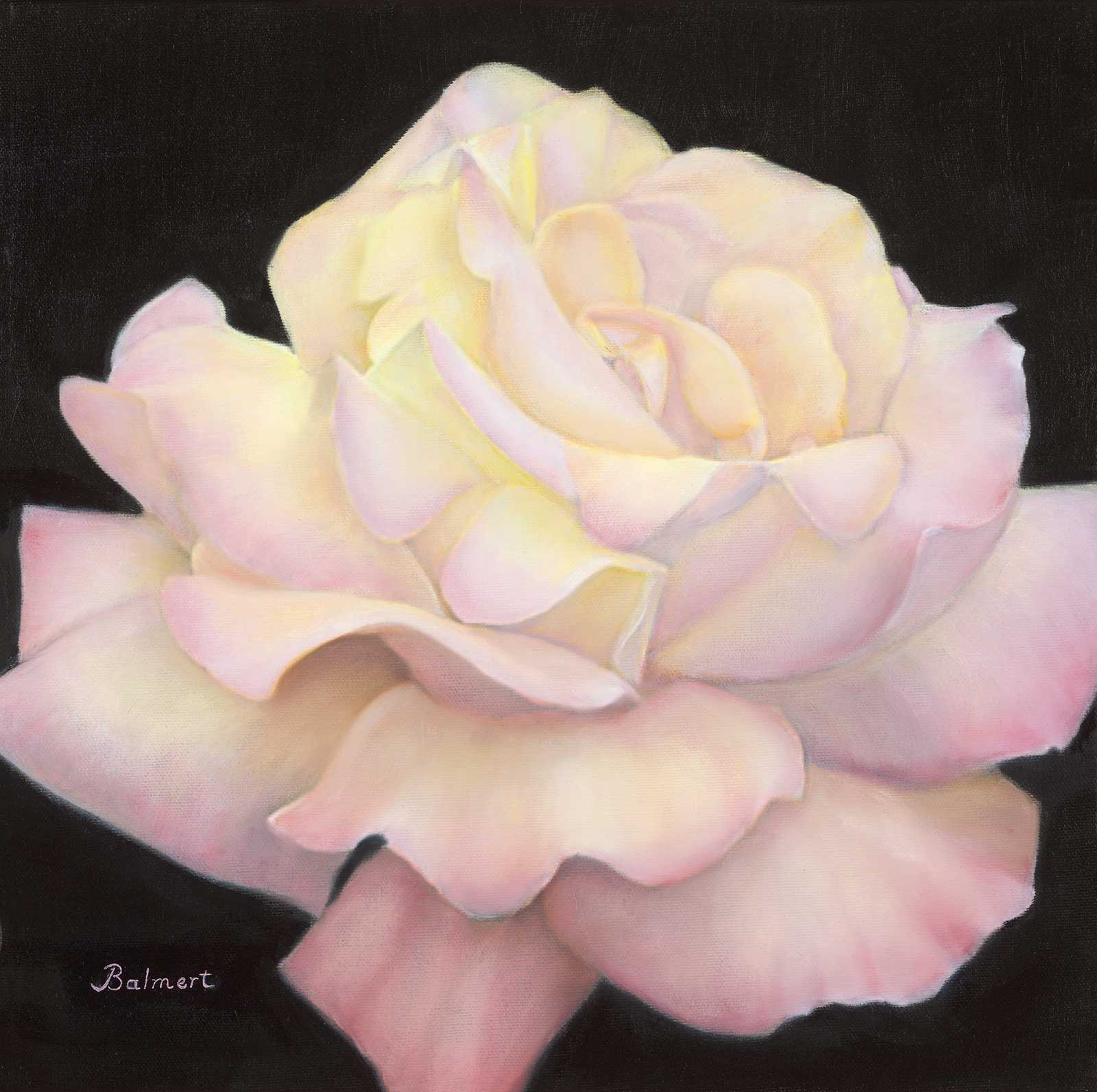
Nancy J. Balmert, Golden Rose, oil on canvas, 14 x 14 in.
You can find Page’s work at Carlos Page Gallery in Cave Creek, Arizona, and Celebration of Fine Art, on view in Scottsdale, Arizona, through March 29.
John Meister is known for featuring light and color in his paintings of Southwest botanicals. Living in New Mexico, he appreciates the unique aesthetic of life in all its forms, and gravitates toward more intimate aspects of nature to allow the viewer a detailed study of the structures. His recent series places the subject front and center like a character “onstage” before a colorful graphic backdrop. Collectors often share the same passion for the plants that he paints and find them vibrant additions to their other collected works.
Meister splits his art production between his studio and painting in open air, seeing the New Mexico landscape as the perfect “classroom.” He is represented by Legacy Gallery in Scottsdale, Arizona, and Santa Fe, New Mexico; and Manitou Galleries also in Santa Fe. Some of his works are also currently on view in a Southwest botanical show in the Four Corners Gallery at the Tucson Desert Art Museum.
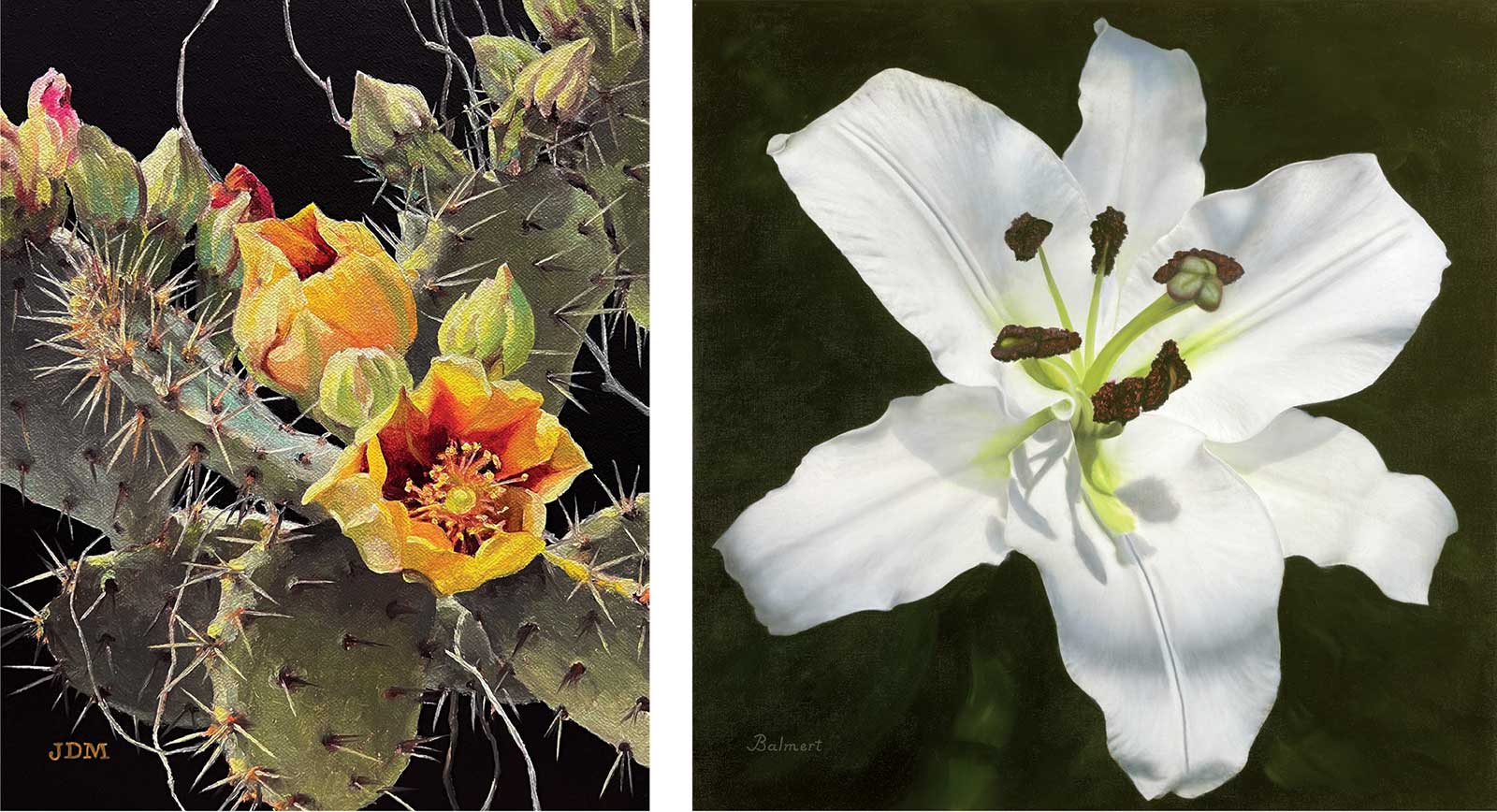
John Meister, Star of the Show, oil, 10 x 8 in.; Nancy J. Balmert, Casa Blanca, oil on canvas, 24 x 24 in.
Flowers are fascination for artist Nancy J. Balmert, who feels that cut flowers brought into a home add warmth and cheerfulness. “I love having orchids in my house, as they bring a touch of elegance to whatever room I set them in,” she adds. “As for my subjects, I paint in the Old Master method—the style that describes the works of Renaissance artists like Rembrandt, Leonardo da Vinci, Michelangelo, Caravaggio and Vermeer. One of the most notable techniques of Rembrandt was his use of light. There are so many different sources of light that can embellish the beauty of a flower, and it can be as simple as light coming through a window.
To create works like Casa Blanca, Golden Rose and Reflections at the Plaza, Balmert says she will set an alarm early to capture the early morning sunlight as it shines on a flower or glass vase on a dining room table. “There is either partial or dappled light, enhancing the blooms, and there’s a graceful look as flowers gently sway in the wind,” she says. “Full, sunlit blooms with shadows can look resplendent. Backlighting flowers is a wonderful way to show off the beauty of their petals.” —
Featured Artists & Galleries
Ani Kinyon
www.ahkdesigncreate.com
Anne Neilson Fine Art
721 Governor Morrison Street, Ste. 180, Charlotte, NC 28211
(704) 496-9181 www.anneneilsonfineart.com
Claudia Seymour
claudiaseymour@aol.com
www.claudiaseymourfineart.com
Elizabeth Page
(480) 440-2806
hello@elizabethpage.art
www.elizabethpage.art
Jean Emmons
www.jeanemmons.com
John Meister
(505) 235-3213
john@meistergraphics.com
www.johnmeisterart.com
IG: johnmeisterart
Nancy J. Balmert
www.nancybalmert.com
Soon Y. Warren
www.soonwarren.com
Powered by Froala Editor