John Alexander believes in the saying, “Paint what you know.” But even one of his great influences, J.M.W. Turner, said, “My business is to paint what I see, not what I know is there.”
Alexander and Turner use different meanings of the word “know.” Turner, undoubtedly, was referring to knowledge of facts and Alexander refers to experience and awareness. He says, “I like to paint a landscape I know. I know what it sounds like at night and I know what it smells like, how frogs sound, what’s harmless and what can kill you. My love and familiarity for nature gives me tremendous inspiration for imagery. I have a better understanding of what I’m doing…because I know.”
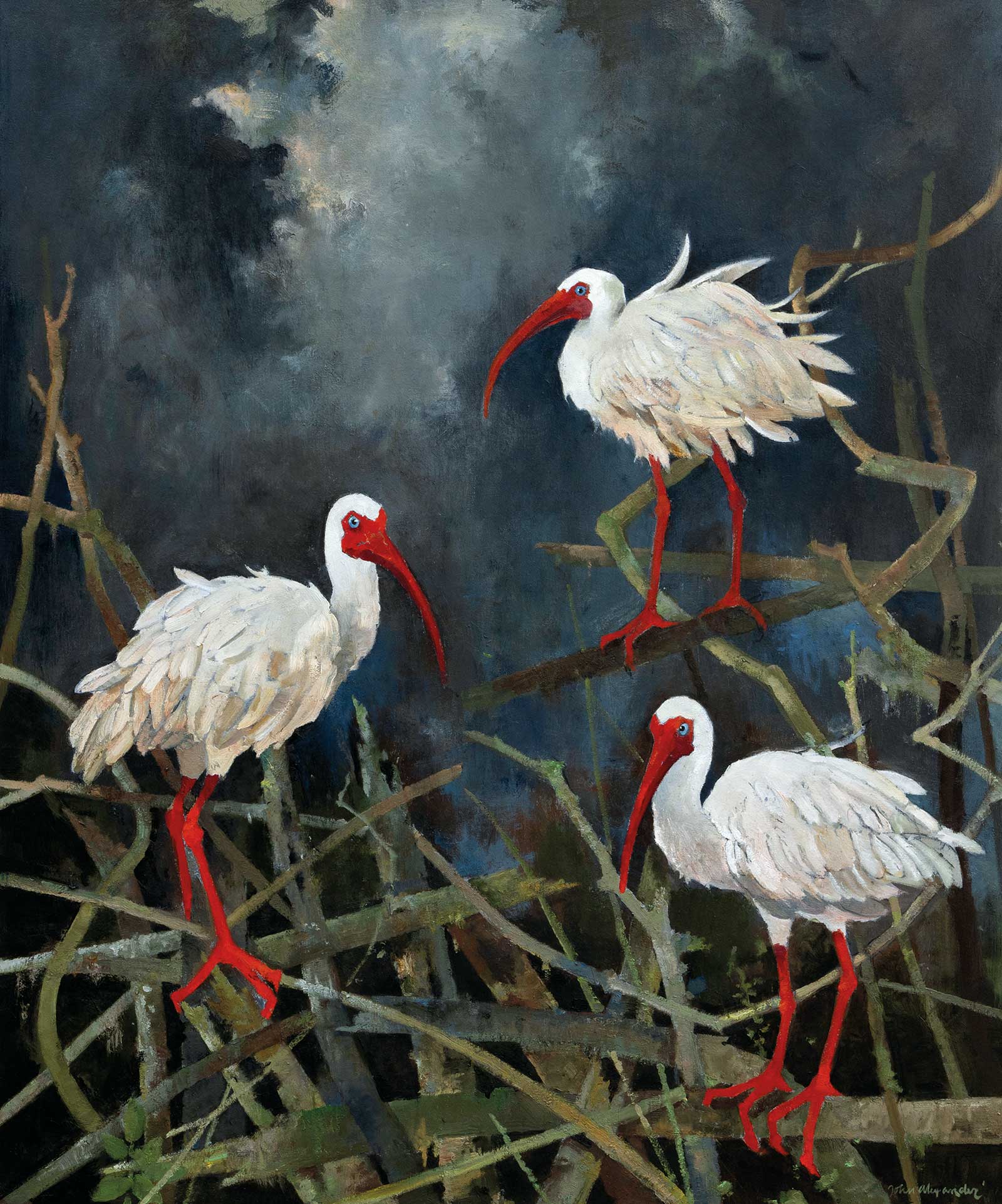
Three Wise Ibises, 2025, oil on canvas, 48 x 40 in.
His first New York exhibition had been at the American Academy and Institute of Arts and Letters in 1977. When he moved to SoHo in Manhattan in 1979, it was a wild and wooly place. In 1974 I had a meeting with Weston Naef, who was curator of prints and photographs at the Met and lived in SoHo. The taxi driver wouldn’t let me out of the car until Weston came to the door and let me in. Alexander relates seeing a car parked across the street from his loft which became little more than a chassis when much of it was stripped away by thieves.
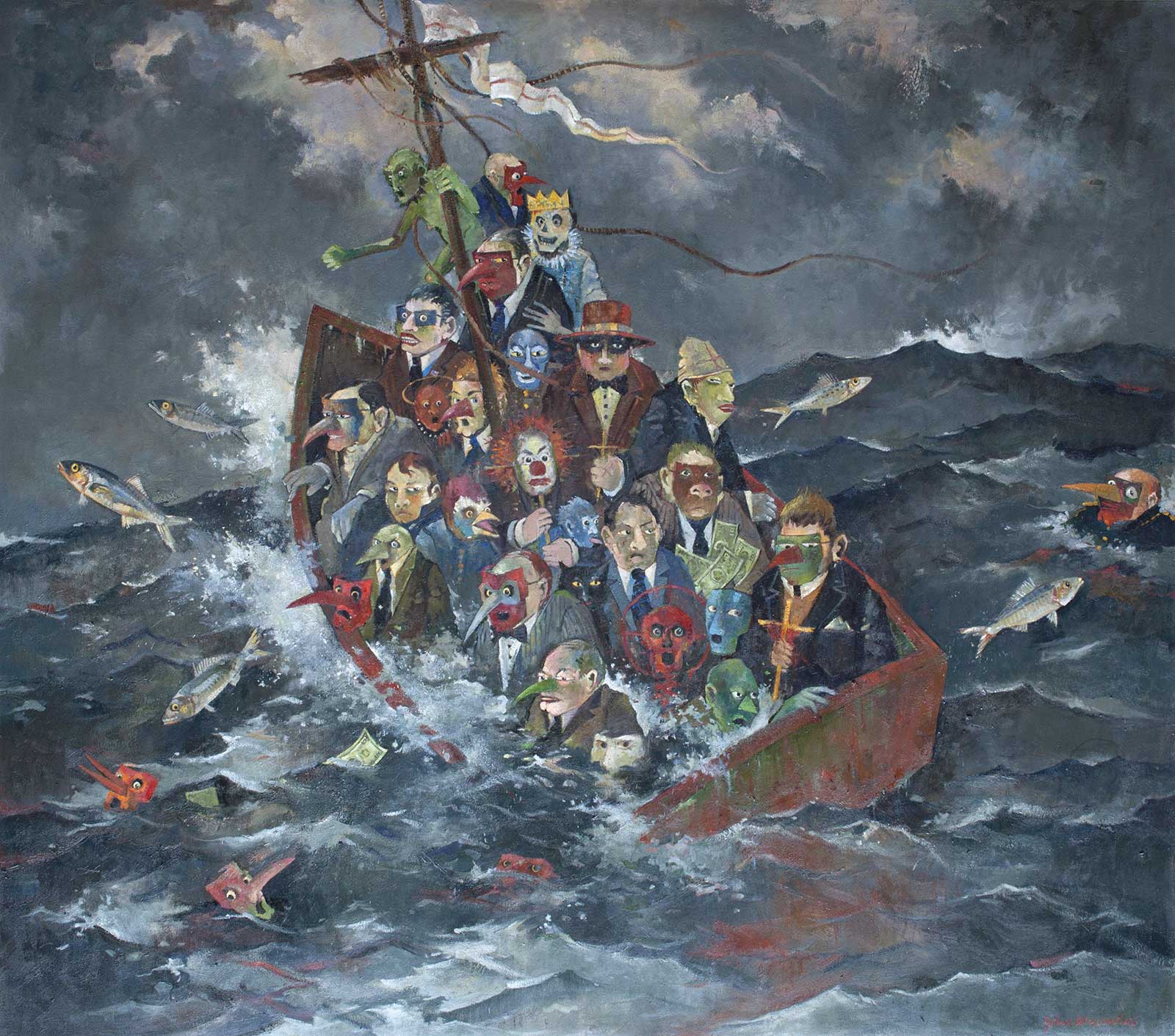
Sailing On the Edge, 2014, oil on canvas, 76 x 86 in.
But, SoHo had a brighter side. “Everyone” lived or had a studio there. When Alexander first moved there, he made it a point to go to galleries and to get to know the older artists such as Robert Rauschenberg, Jasper Johns and Willem de Kooning. He once said, “I got to know people far, far, far above my paygrade. To me, as a young pup from Beaumont, that was a big deal. I made a point of learning. I used to say, ‘It’s not what you know. It’s what you know they know.”
Alexander’s association with de Kooning had begun earlier when he was teaching at the University of Houston. He was invited to a dinner party where de Kooning was the guest of honor. His hostess had a home in Springs, East Hampton, on Long Island where de Kooning had his home and studio. De Kooning had never been to Houston and their hostess asked Alexander to take him around. “He was a hero of mine! He showed up at my studio and I took him to a barbecue place, walked the beach in Galveston, and took him to the Rothko Chapel. He was so moved by the chapel, I went outside and left him to be on his own. As we were driving around, de Kooning loved the billboards because he had been a sign painter in the Netherlands. We talked a lot about them because I had done sign painting in college. He even used sign paint in some of his major paintings. He insisted I visit him in Springs.”
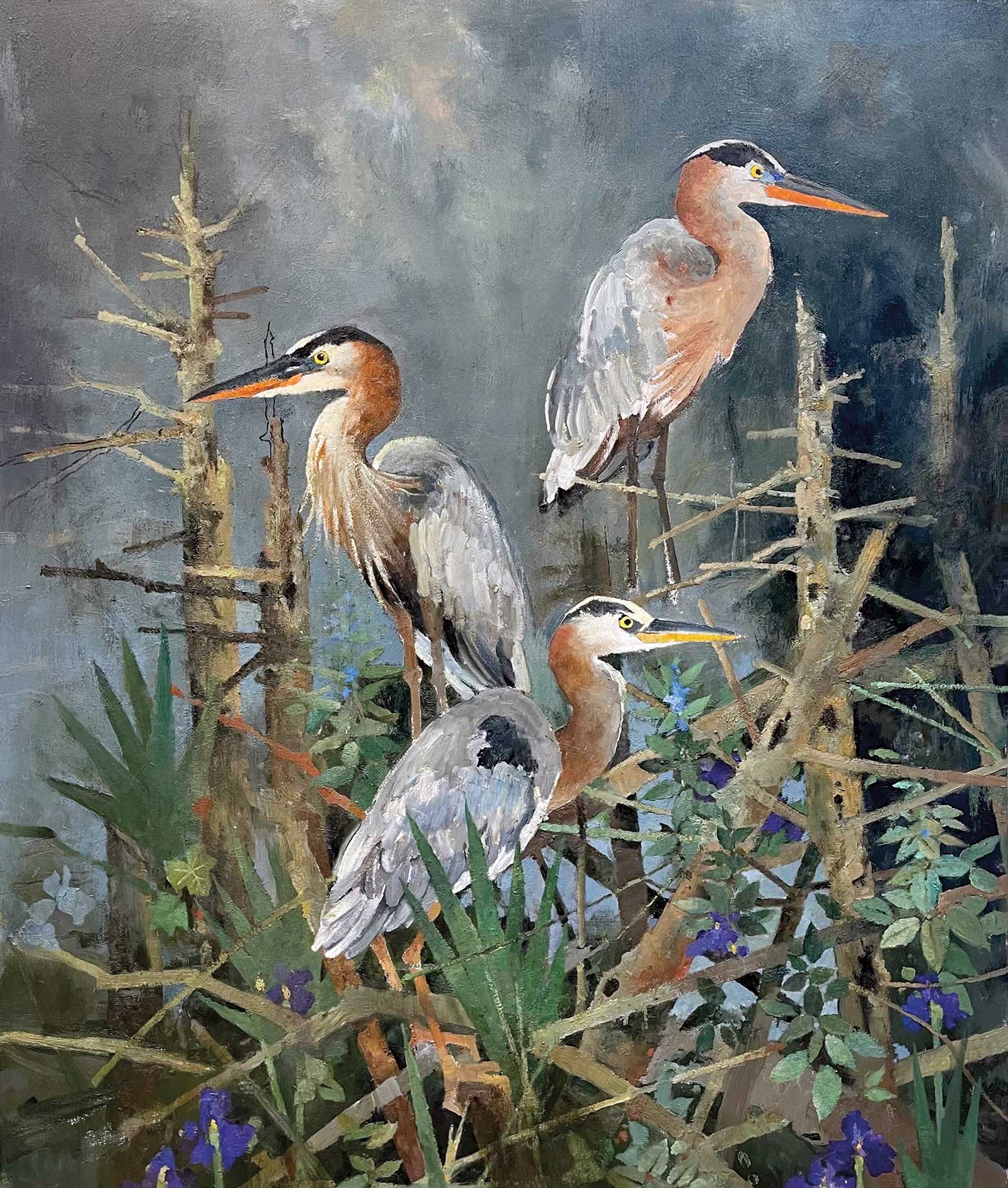
Searching for Something, 2025, oil on canvas, 50 x 42 in., 127 x 106.7 cm
When Alexander drove up to East Hampton, long before it became “The Hamptons,” it was a place of “farmhouses, artists, writers and fishing village types. It was an extraordinary place,” he recalls. “When I was showing with Marlborough in the ’80s we rented houses in East Hampton in the summer. In about ’85/’86 we bought property in Amagansett with a pond and trees and began planting gardens. I had been painting demons and things and all of a sudden nature came back into my work. I painted with de Kooning-like strokes and by the end of the ’80s the demon stuff went away and nature began to take over. The great actress Helen Hayes once said, ‘All through the long winter, I dream of my garden. On the first day of spring, I dig my fingers deep into the soft earth. I can feel its energy, and my spirits soar.’ Being close to the earth defines me as an artist.”
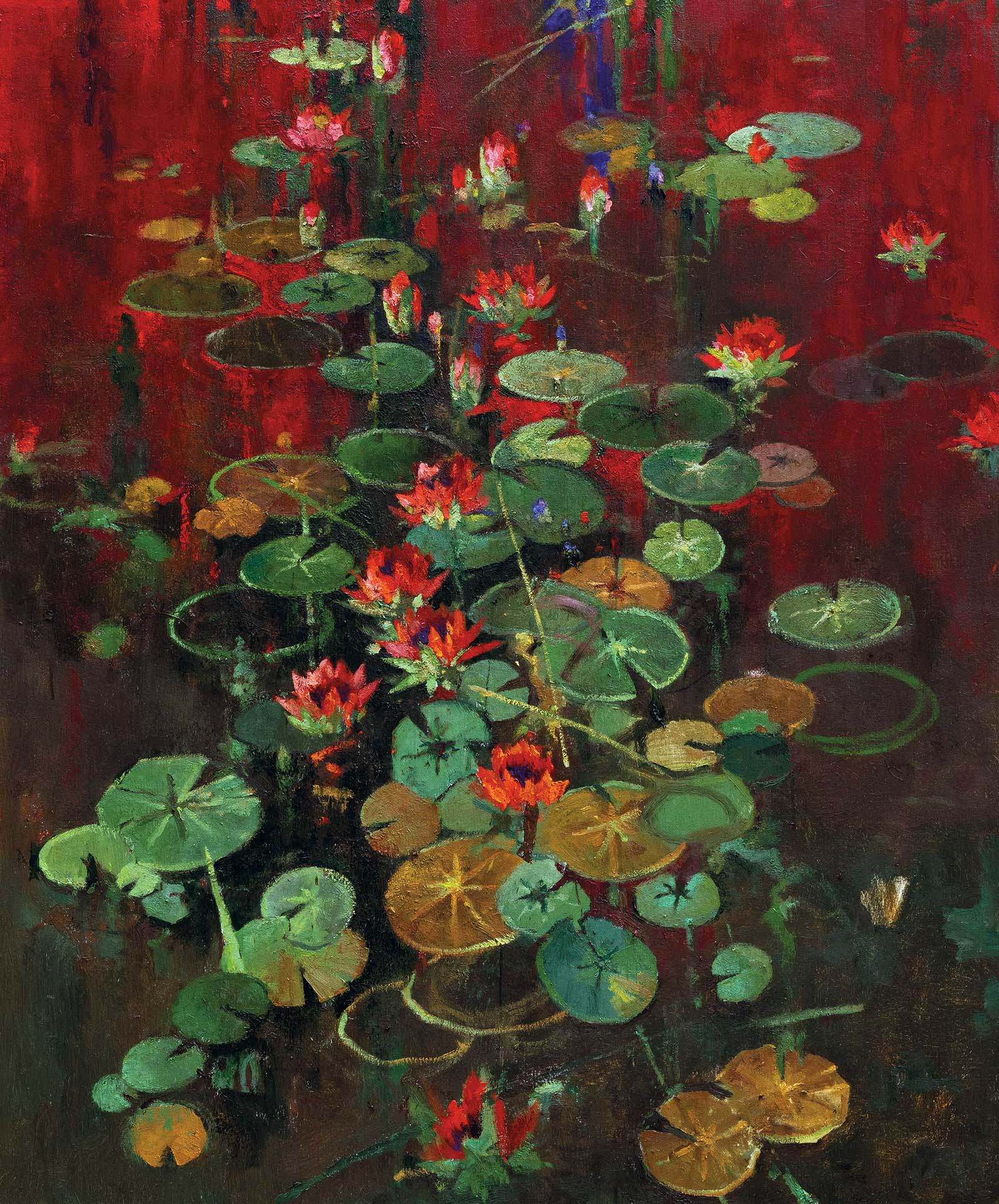
Crimson Spring, 2025, oil on Canvas, 48 x 40 in.
His heroes and influences were not just the masters of his time. As a student at Southern Methodist University, he frequented the university’s Meadows Museum with its collection of works by Goya. “Goya dealt with the grandeur of nature every—kind of emotion you can conjure up,” he comments. In London he visits the Tate Britain to see the Turners, “an inspiring epic hero of mine.” In New York he can visit one of his Renaissance heroes, Giovanni Bellini, whose St. Francis in the Desert (or St. Francis in Ecstasy) is in the Frick Collection. “That staggering blue,” he remarks. “The structure and composition go back to infinity.”
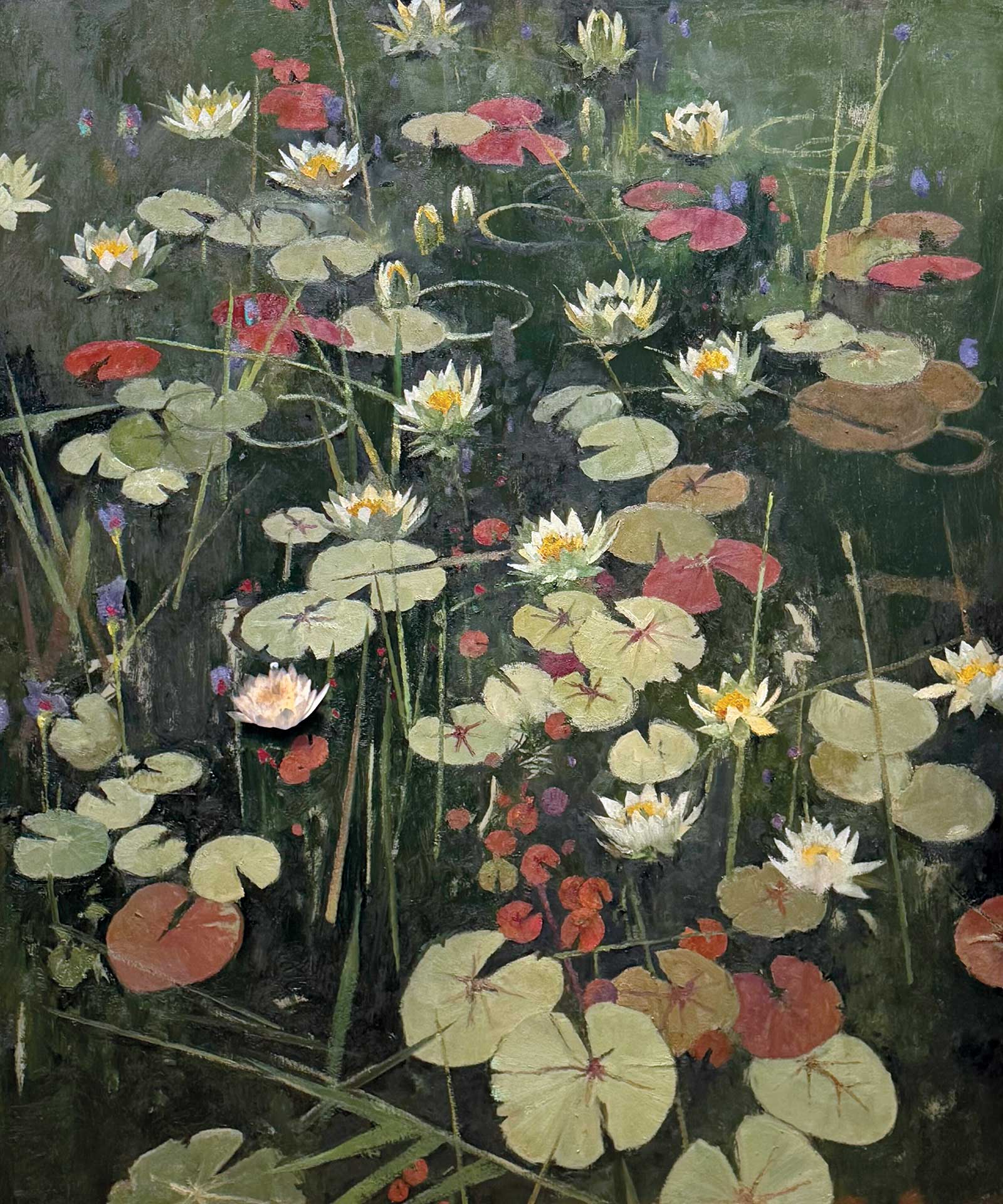
Untitled, 2025, oil on canvas, 60 x 50 in.
Born in Beaumont, Texas, fishing and camping with his father in the bayous and forests of East Texas are the key to Alexander’s knowing nature. The influence of those experiences is so strong that he says, “Even if I paint the seacoast in Maine it ends up looking like the bayous of East Texas.” His father was a product of old Texas, 68 when Alexander was born, and was around for the first gusher of the Texas oil boom in 1901. His father was a construction engineer working in the oil industry. Yet, he was an environmentalist and was aware of the impact of development on the environment. He would point out a new housing division and comment that “wolves and bears used to live there.”
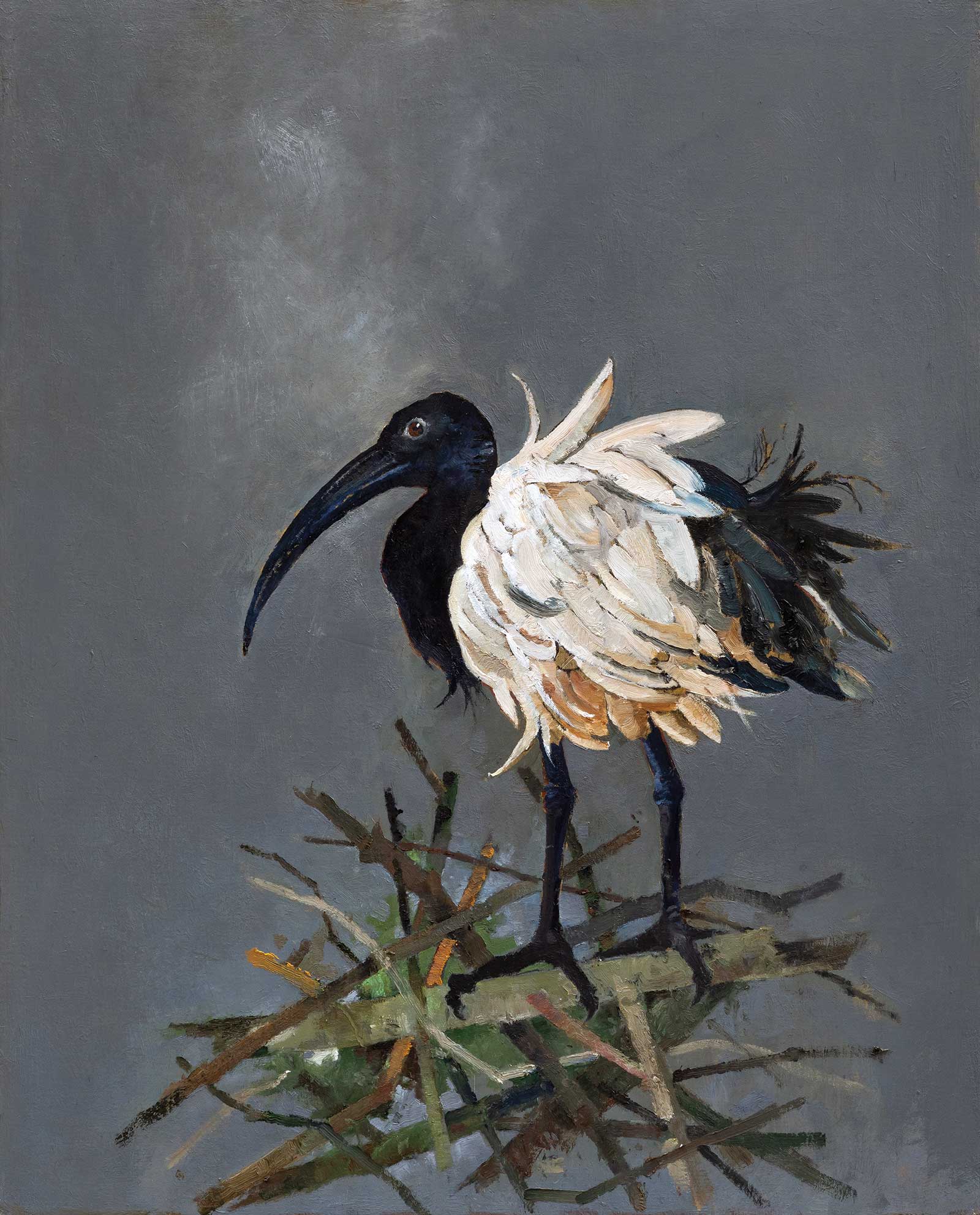
Sacred Ibis, 2025, oil on Canvas, 30 x 24 in.
“So much of my work is about the demise of natural resources, man’s encroachment on nature,” Alexander says. “You see a lot of birds in my work. Nothing else is alive in the painting. The birds are sitting on bare limbs. I paint the extremes—Nature at its grandest and man at his worst.”
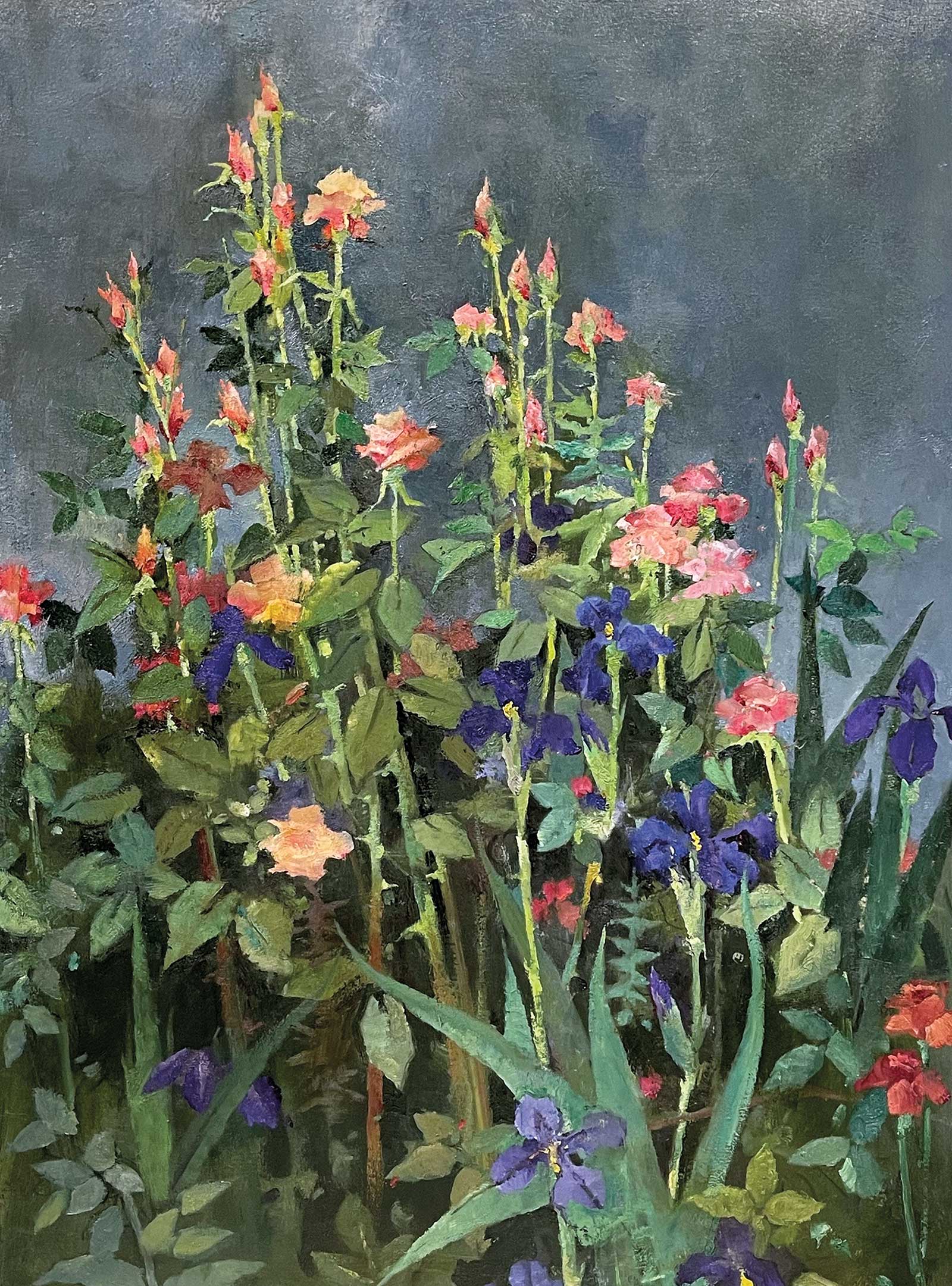
Garden Secrets, 2025, oil on canvas, 40 x 30 in.
In a recent painting, Searching for Something, three herons stand among dead trees with nature, palms and purple iris, rebounding beneath them. “Three” is often a compositional element in Alexander’s paintings echoing an artistic theme throughout history. Three can also set up conflict. In this instance, two birds face in one direction and one in the other, perhaps left out or, perhaps, ready to go off on its own. “The birds are looking out judgmentally,” he says. “It gives them a personality.”
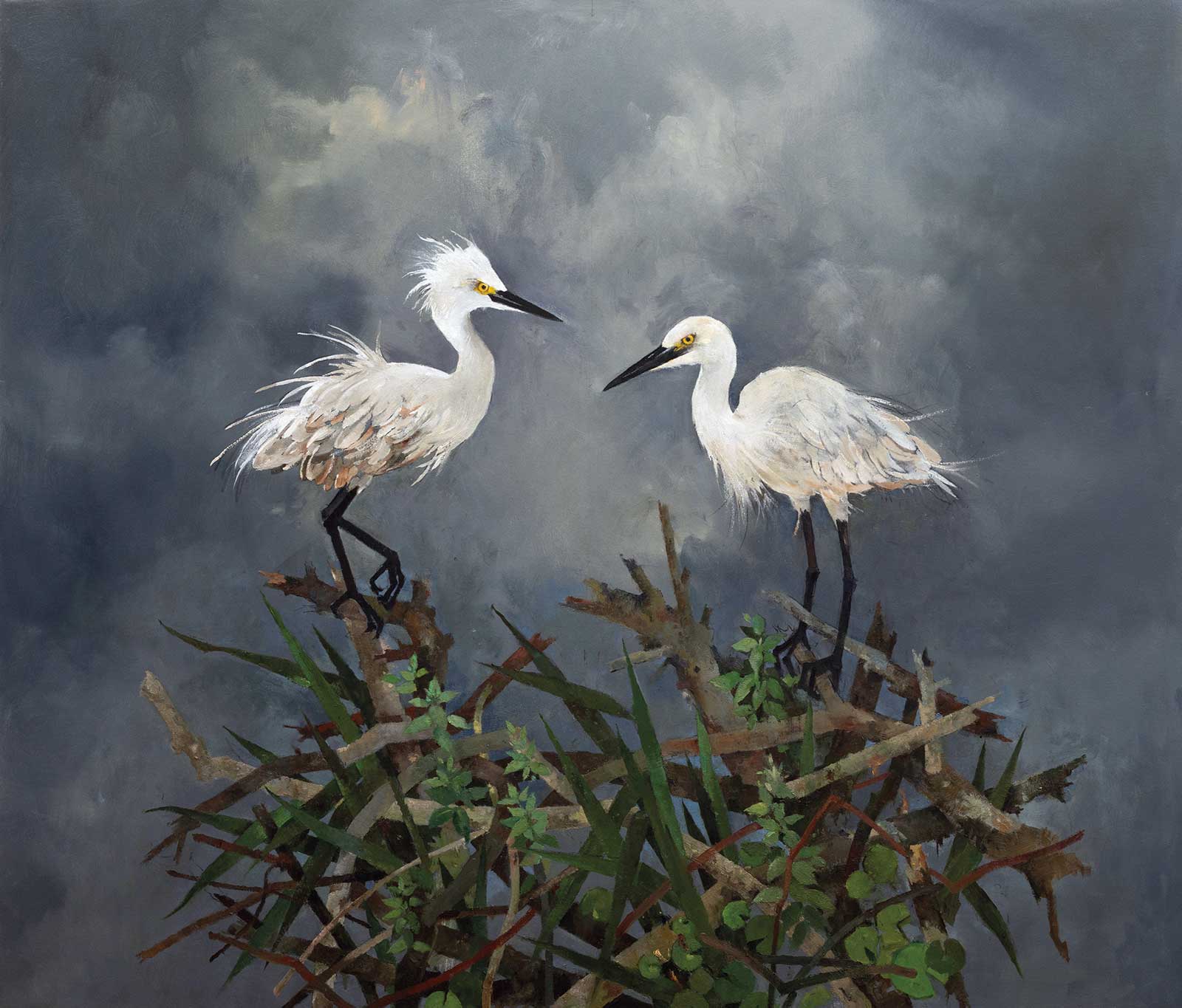
Courtship, 2025, oil on canvas, 70 x 60 in.
The structure of his compositions is an important element in his work as is his point of view. “There are two distinct schools in landscape painting,” he explains. “You are here looking out a window of a building or a car, and the landscape is over there. I made the conscious decision being up in the bayou and walking around in the woods that I wanted to paint the landscape you see when you’re 10 feet away. You’re in the bird’s space…We try to be unique with all the skill we can muster up. We have to be ourselves. What I create on canvas is my world.”
Quoting James Thurber, he says, “It’s my world and welcome to it.”
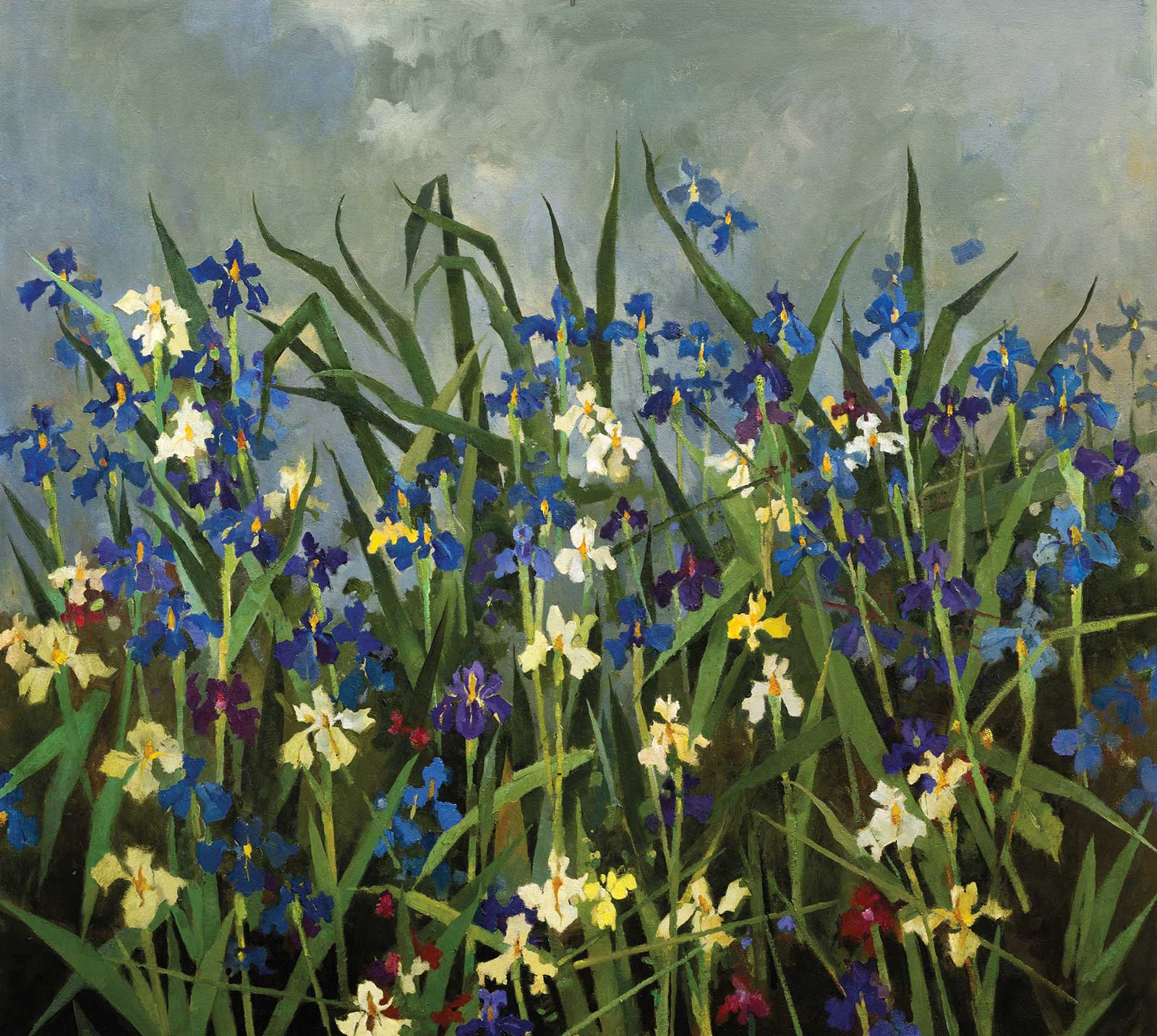
Dolly’s Playground, 2025, oil on canvas, 54 x 60 in.
His recent paintings will be shown in the exhibition John Alexander: Nature Observed at Berggruen Gallery, March 12 through April 30. —
John Alexander: Nature Observed
March 12-April 30, 2026
Berggruen Gallery
10 Hawthorne Street, San Francisco, CA 94105
(415) 781-4629, www.berggruen.com
Powered by Froala Editor