

One of the first plants to emerge through the snow in marshy areas of the eastern United States is the aptly named symplocarpus foetidus. The fetid odor of its flowers earned its common name, “skunk cabbage.” Its scent attracts pollinators, however, and its appearance is a sure sign of spring.
Jeremy Miranda lives in southern Maine along the Salmon Falls River, bordering New Hampshire. After Maine’s long winter, skunk cabbage is a welcome harbinger. “It’s so green, so ahead of everything,” he says. “There’s a divine energy to the stained glass effect of the sunlight shining through its leaves in contrast to the context of its surroundings.”
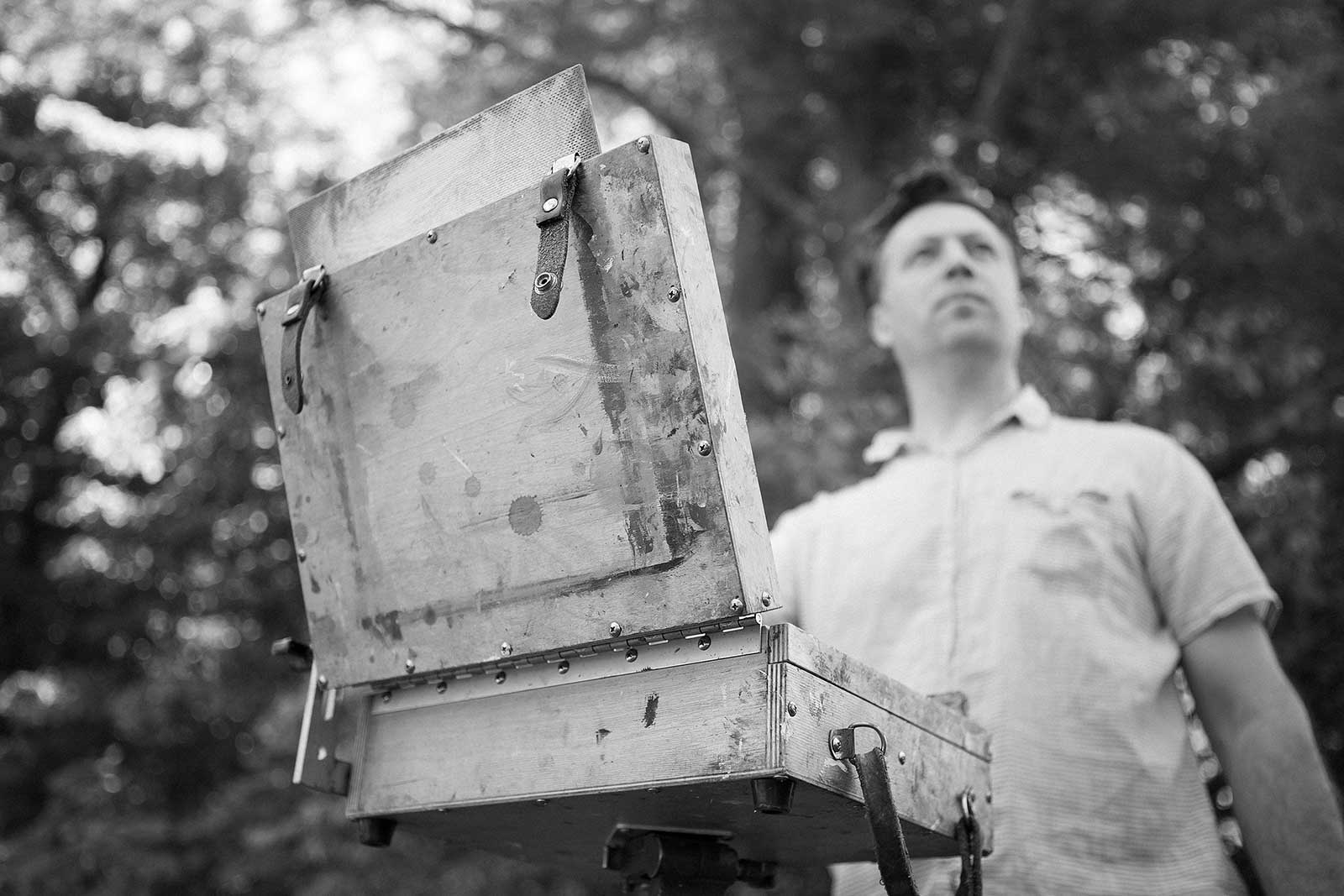
Maine artist Jeremy Miranda painting in plein air.
Miranda’s still life paintings often feature the plants that his wife, painter Michelle Morin, grows in their garden. His studio window frames a view of the garden as it comes to life in the spring and dies back at the end of the growing season. Morin places vases of cut flowers throughout their home that also progress from firm lushness to a soft, wilted sensuousness. “Michelle grows the plants from seed,” he explains. “She has the knowledge. I’m more of the labor end. In late winter the whole garden exists in miniature in the house.” Future Island depicts the nascent garden emerging under a grow light.
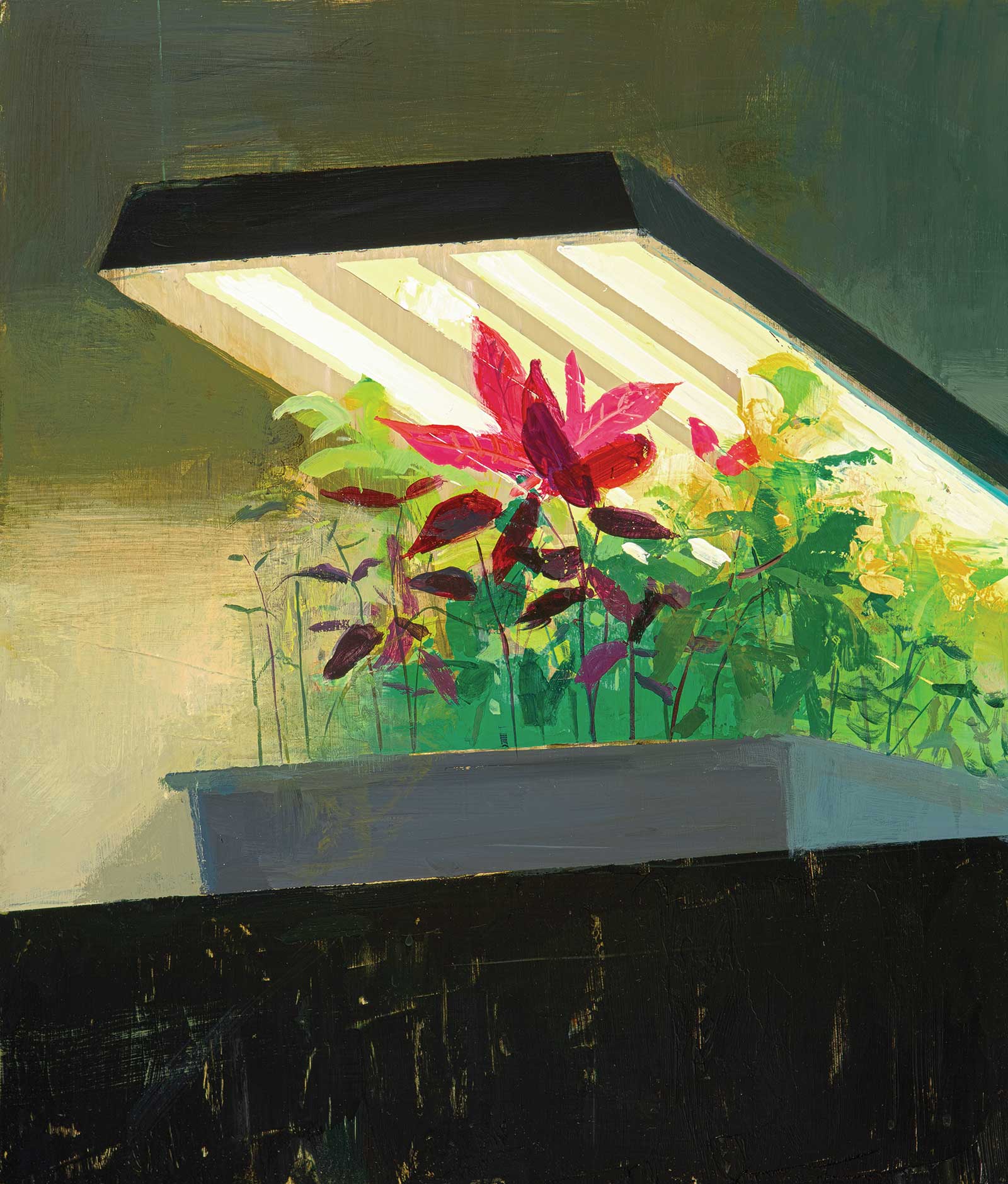
Future Island, acrylic on panel, 20 x 17 in. Courtesy the Artist and Evoke Contemporary, Santa Fe, NM. Photograph by Brett Wiese Saunders.
There is a wildness to the garden when it is in full bloom. About Electric Garden Summer Hum, Miranda comments, “The rigidity of the casement window in my studio frames this wildness. It’s kind of a dance happening.” He mentions how the French post-impressionist painter Pierre Bonnard was fascinated by how a window frames a view and a painting itself is a window.
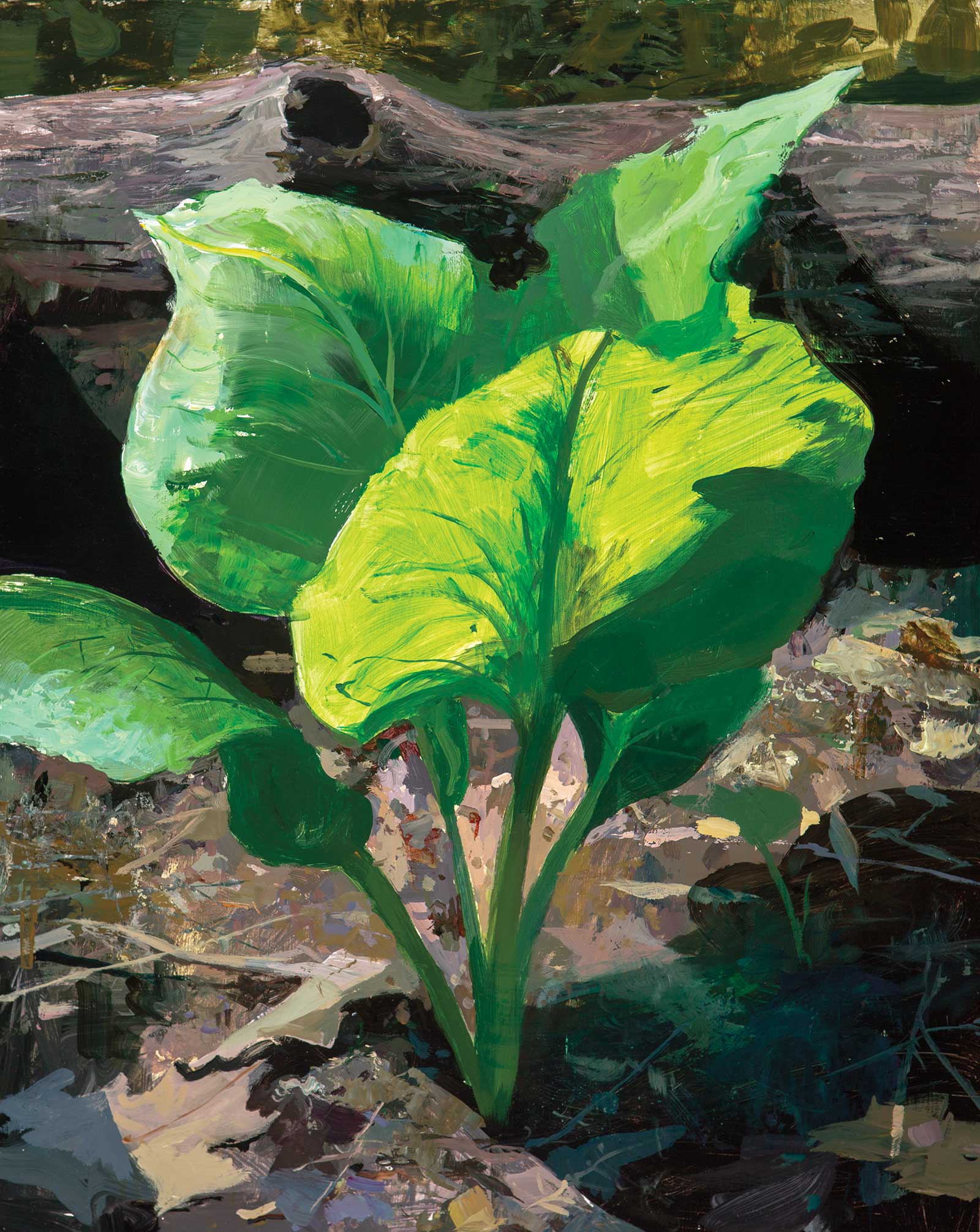
The First Skunk Cabbage, acrylic on panel, 20 x 16 in. Courtesy the artist and Evoke Contemporary, Santa Fe, NM. Photograph by Brett Wiese Saunders.
Through the window he sees not only the shifts of green through the seasons and the colors of August when he says “the volume gets turned up,” but also the wildlife—deer, wild turkeys and birds that the garden attracts.
Amaranth seedlings provide a punch of color in Future Island and appear in full fettle in Electric Garden Summer Hum. One of Morin’s bouquets appears past its prime in Collected Color,some blossoms dried and the amaranth wilted into soft mushiness but maintaining its expressive color.
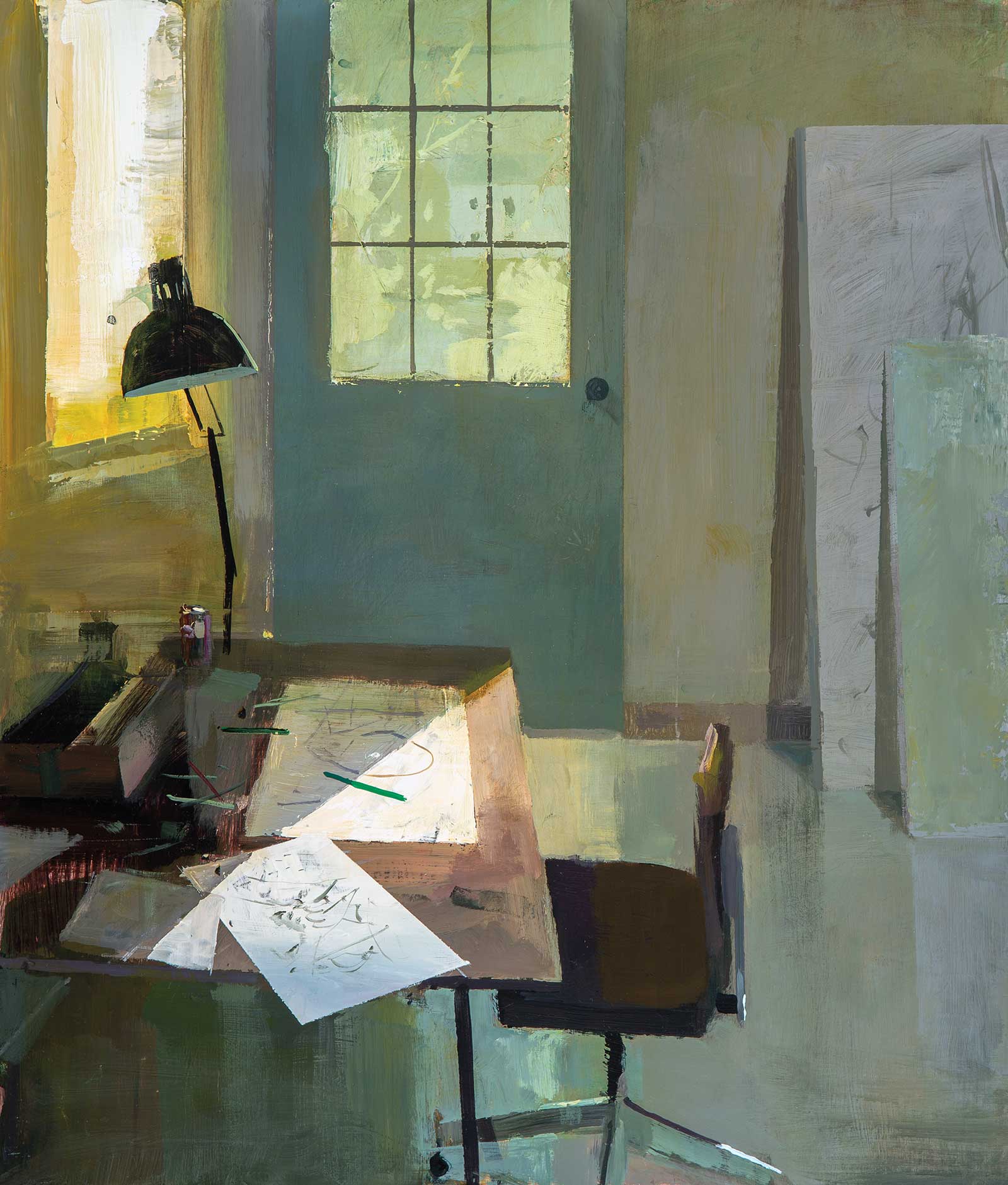
End of Day, acrylic on panel, 20 x 17 in. Courtesy the artist and Evoke Contemporary, Santa Fe, NM. Photograph by Brett Wiese Saunders.
The garden at night has its own subtle beauty, which he paints in A Part of the World Not Yet Broken. “It’s a painting about a certain kind of light,” he says. “It’s more about darkness and what happens to all the color in the dark. There’s not a lot of contrast. I’m not in the pursuit of accuracy but, rather, the weirdness of the night. You can almost hear it. It’s a sensory moment beyond the visual.”
He observes not only the changes in color and form of the garden and Morin’s bouquets but the way sunlight pours through the windows of his home and studio at different times of the day and year—defining objects. In End of Day,the light angles across his desk and is almost blinding on the wall while a Bonnard-like view appears through the glass panes of the door. Miranda says, “My preoccupation with light revolves around how it creates and defines space. The shifting light changes space. It illuminates your experience of the world and the experience of shapes working together. I’m interested in the spaces and don’t include figures. I want the viewer to be the figure and I’m interested in how you feel in it. A shaft of light migrating around a room is endlessly fascinating.”
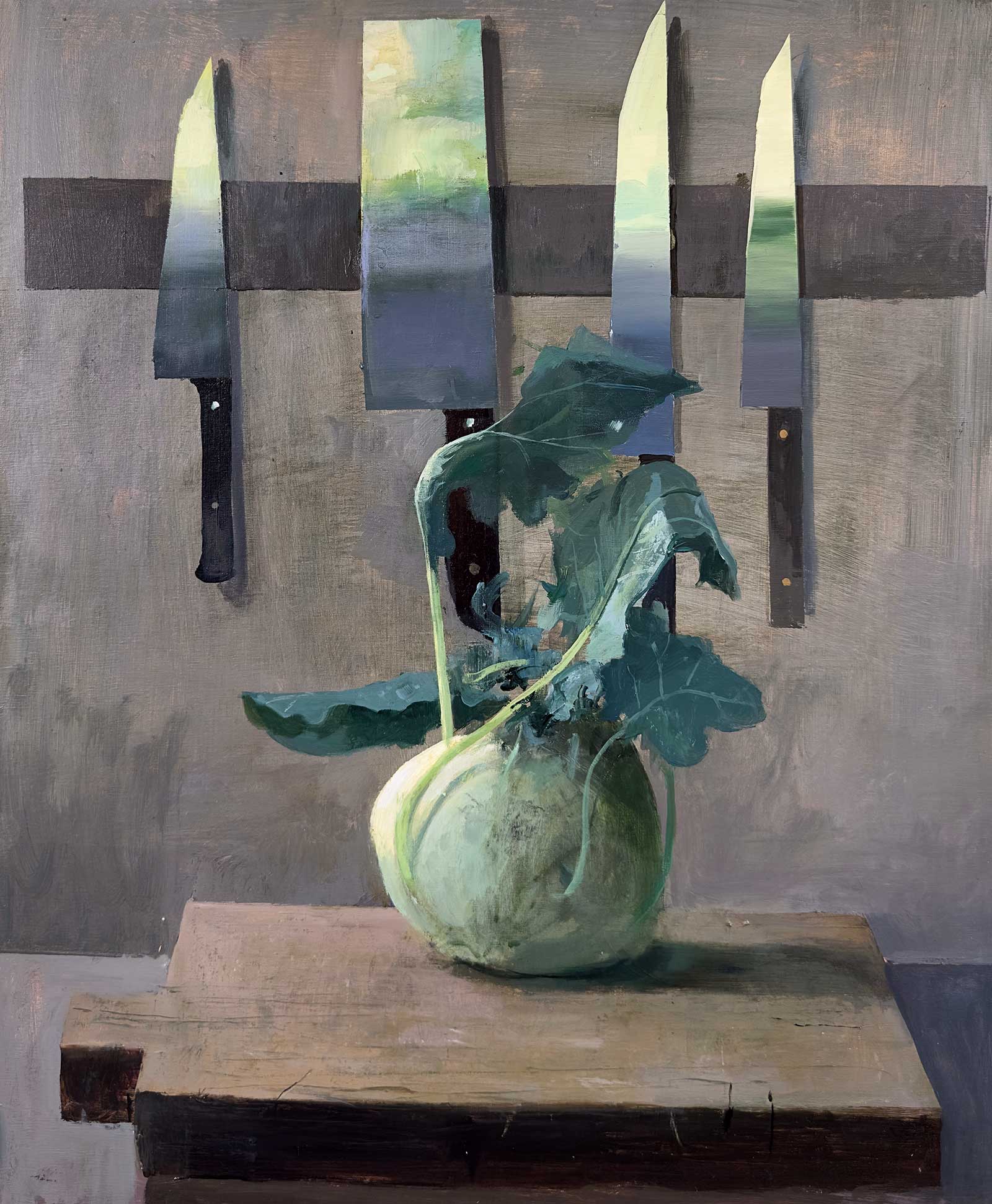
Approach With Fierce Grace, acrylic on panel, 24 x 20 in. Courtesy the artist.
He is, perhaps, less interested in the thing he represents than the way light behaves. When I spoke with him last year for the first of my regular online “Looking and Seeing” essays for Evoke Contemporary in Santa Fe, he said his paintings are “an attempt to capture brief run-ins with the sublime that are buried in the everyday…The work is, in a way, an attempt to slow the world down and experience it with all the senses on a level that sort of feels otherworldly.”
I also quoted Camille Pissarro who wrote, “Blessed are they who see beautiful things in humble places where other people see nothing.” A few years earlier, Thoreau had commented, “The question is not what you look at, but what you see.”
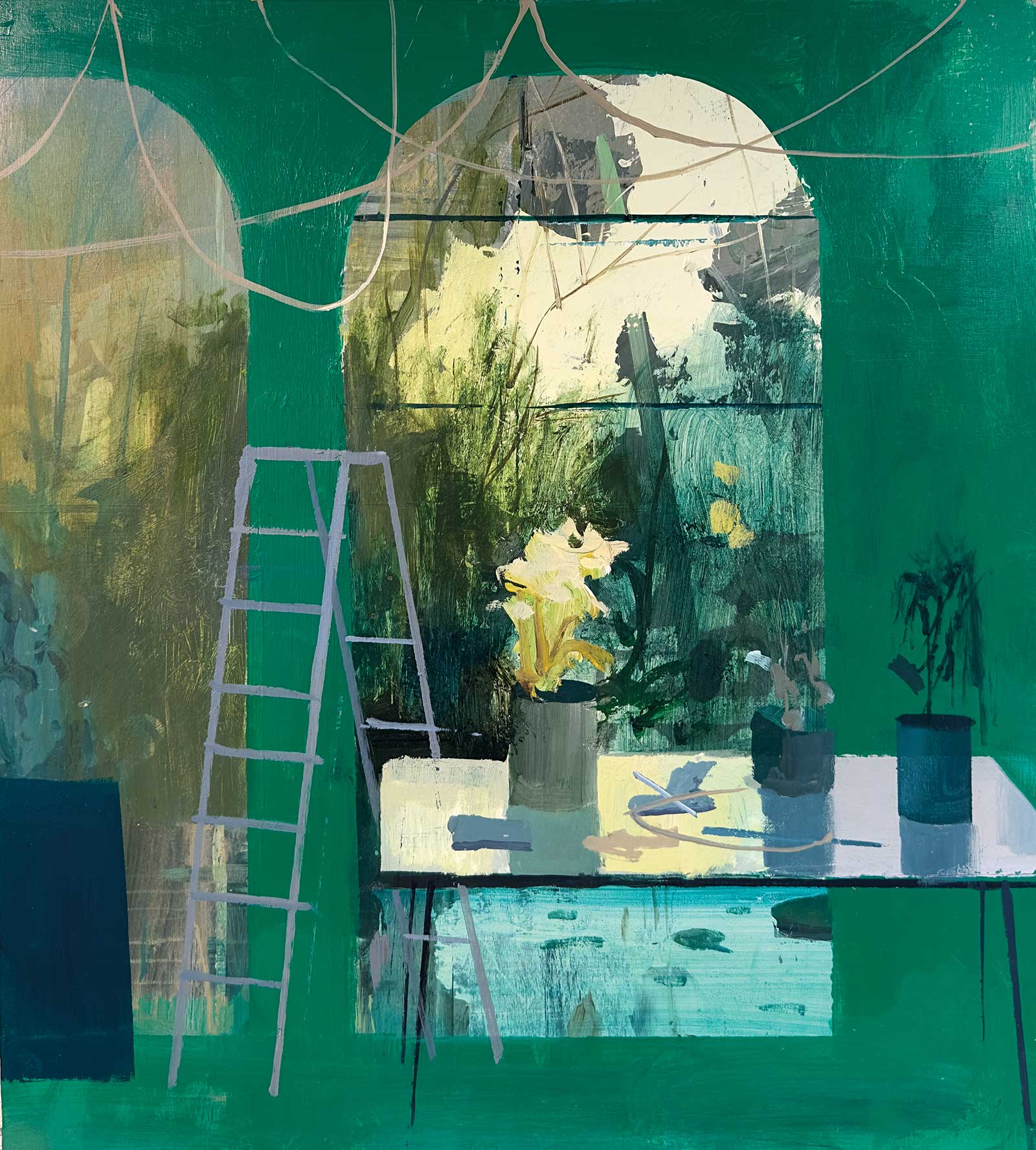
Minus World 12/Bathhouse, acrylic on panel, 18 x 12 in. Courtesy the artist and Dianna Witte Gallery, Toronto, ON.
Fascinated by the decaying bouquet in Collected Color descending into a nearly amorphous state, he experiments with depth and precision in Approach with Fierce Grace. “I was playing with space, wondering how shallow a depth of field I could get and still have a sense of space. The knives reflect the world behind you. It’s a painting about sound and texture and tenderness, cold sharp precision and alchemy.”
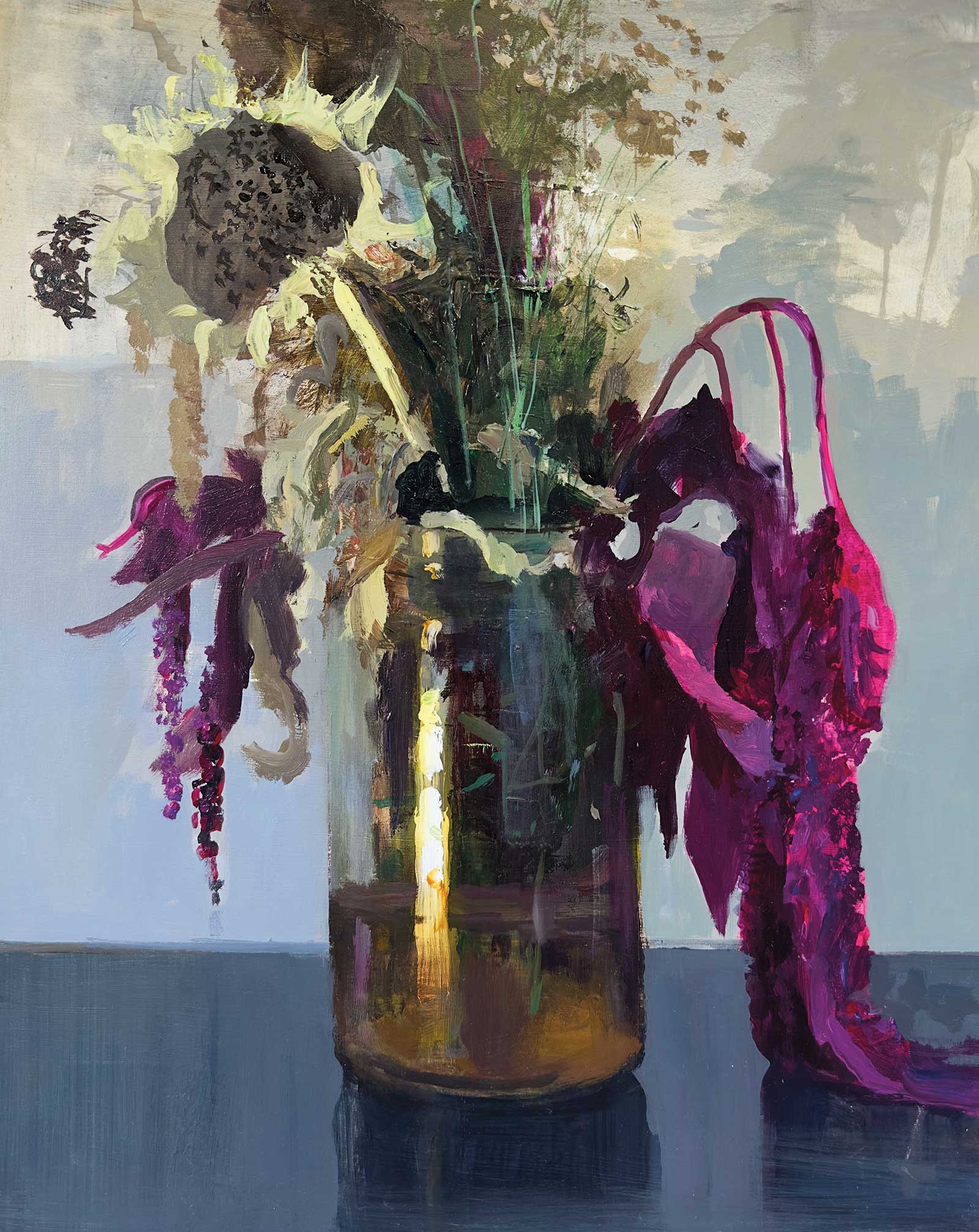
Collected Color, acrylic on panel, 20 x 16 in. Courtesy the artist.
From time to time he goes beyond his 20-by-18-inch panels and paints with acrylic on a canvas that’s 50 by 42 inches, as in False Refuge. “It’s so different in terms of brush movement, using your shoulder rather than the wrist,” he explains. “It’s a different use of the body. Certain images need to take up your entire vision. It could have been even larger. It’s related to A Part of the World Not Yet Broken, focusing on lower contrast. It’s about more subtlety and a relaxed atmosphere, sacrificing excitement. Visually, it gives a nice environment with a few little chips of light.”
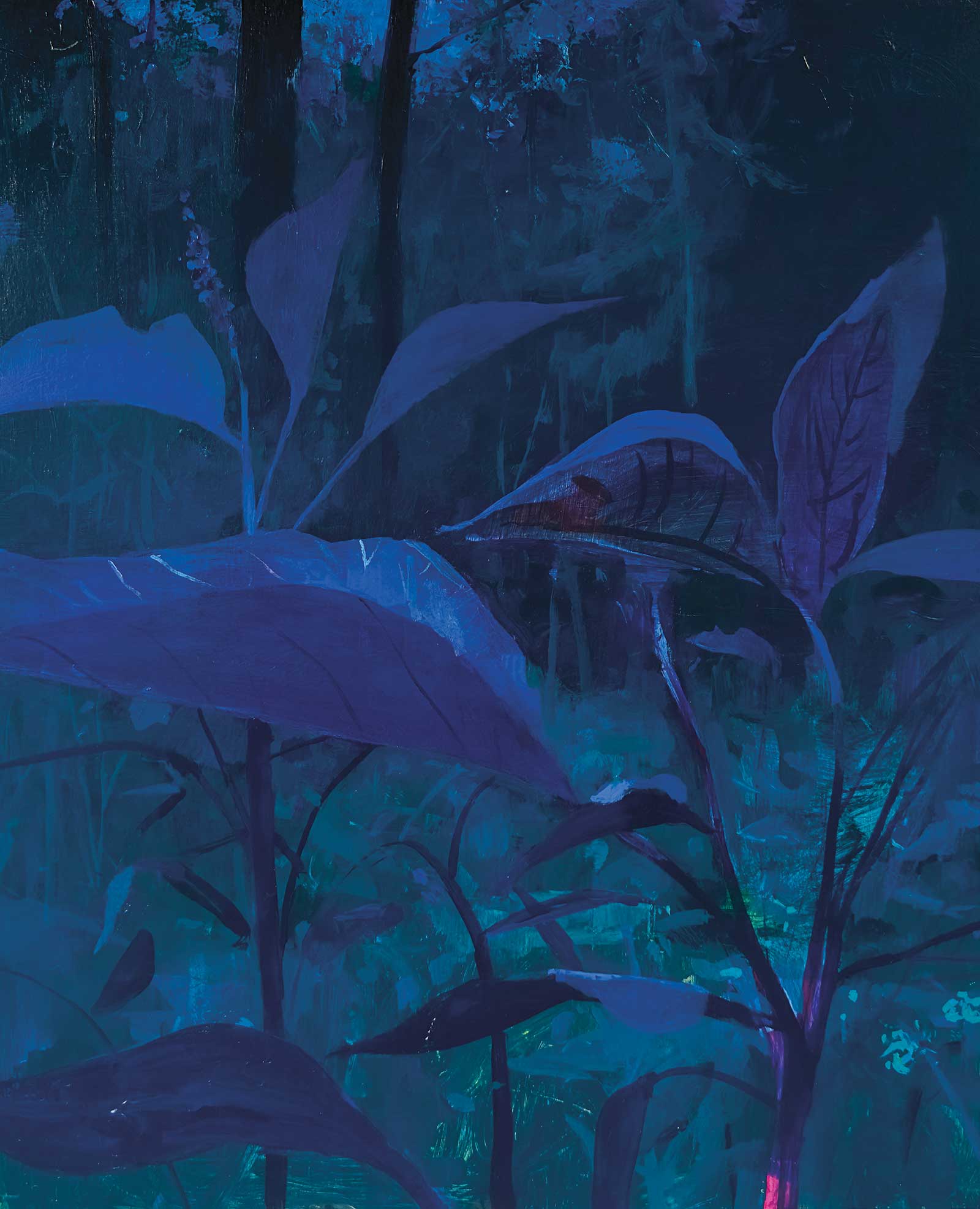
A Part of the World Not Yet Broken, acrylic on panel, 24 x 20 in. Courtesy the artist.
He explains that he uses acrylic “because I require so much editing. I don’t know it until I see it.”
Minus World 12/Bathhouseis part of a series the intention of which “is to create an opportunity to be as intuitive as possible and paint leaving things up to chance. They’re about spaces and environments and get away from the work I do on a daily basis where things are grounded in reality. I need this as an excuse to experiment and not be in control. My daily work resists pure experimentation. I find myself doing this kind of work after a long stretch of painting depictions. But they feed off each other.”
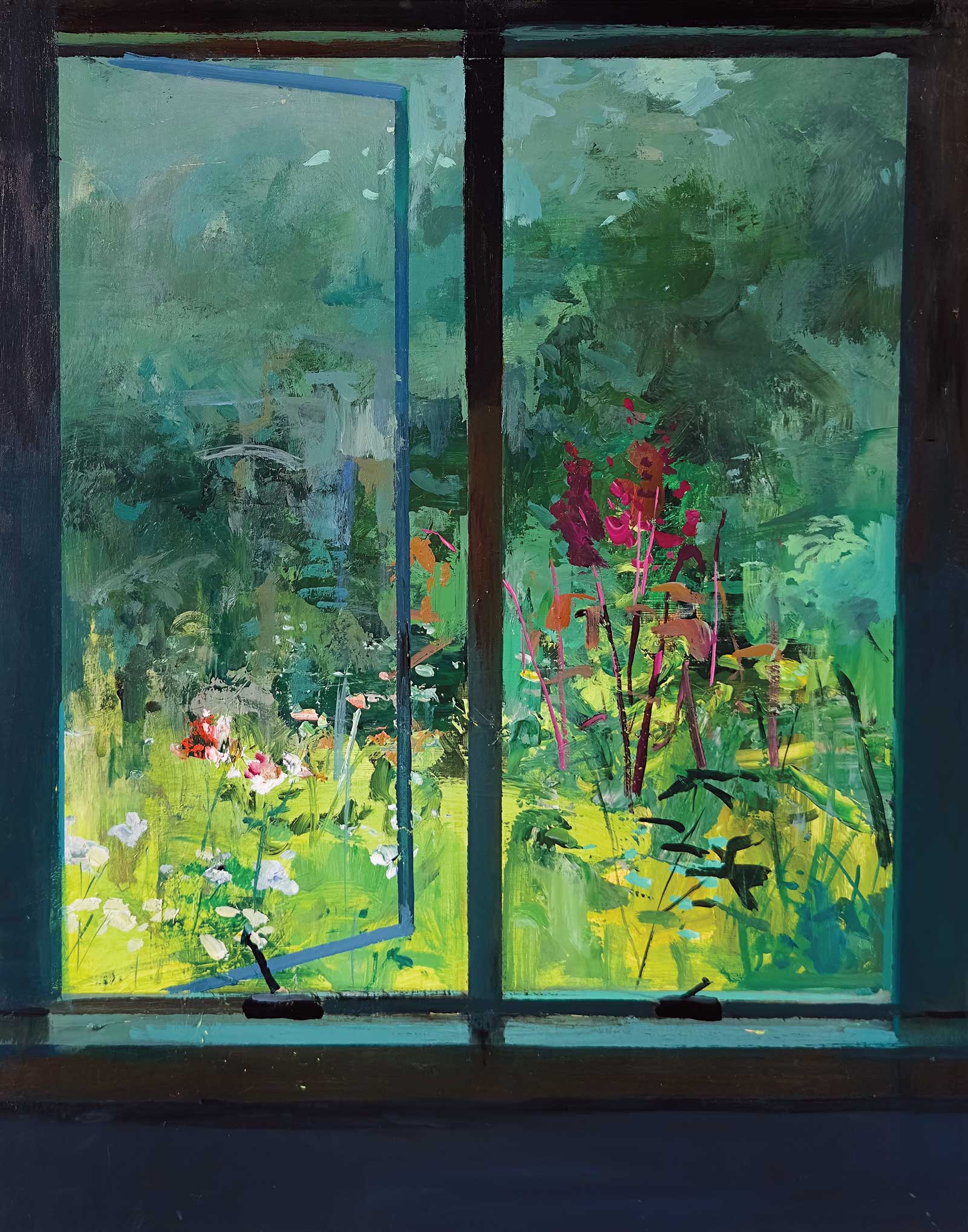
Electric Summer Garden Hum. acrylic on panel, 20 x 16 in. Courtesy the artist.
He continues, “I oftentimes feel I’m using too many words—crowding a painting with too much information. What constitutes a readable image? What can I get rid of and still maintain the feeling? The best moments are when it feels like you shepherd this thing into existence, shepherding this moment that hangs between intention and surprise. If it’s not rooted in play it starts to become one-dimensional, and if it’s only intentional you lose a sense of wonder. You have to leave enough space for accident. In my more grounded work I can be timid about the level of abstraction. I think I’m going after ambiguity, not abstraction. Ambiguity allows people to have their own experience with things which, I think, is a weird way of replicating the artists experience of the mystery behind the every day.” —
Powered by Froala Editor