Eric Fischl: Stories Told, on view at the Phoenix Art Museum through June 14, 2026, is the first major survey of the artist’s work in more than a decade, despite his position as one of the foremost American figurative painters of his generation.
Guest curator Heather Sealy Lineberry has organized the exhibition in four sections devoted to Fischl’s treatment of the human body singly, in a couple, as part of a family, or in a crowd. She says, “For more than 45 years, Eric Fischl has used figurative painting to examine the defining social issues and current events of our time. Eric Fischl: Stories Told is a timely opportunity to recontextualize the artist’s work within our contemporary moment as figure painting experiences an international resurgence, and as Fischl continues to examine the possibilities and promises, the disparities and contradictions of the American experience.”
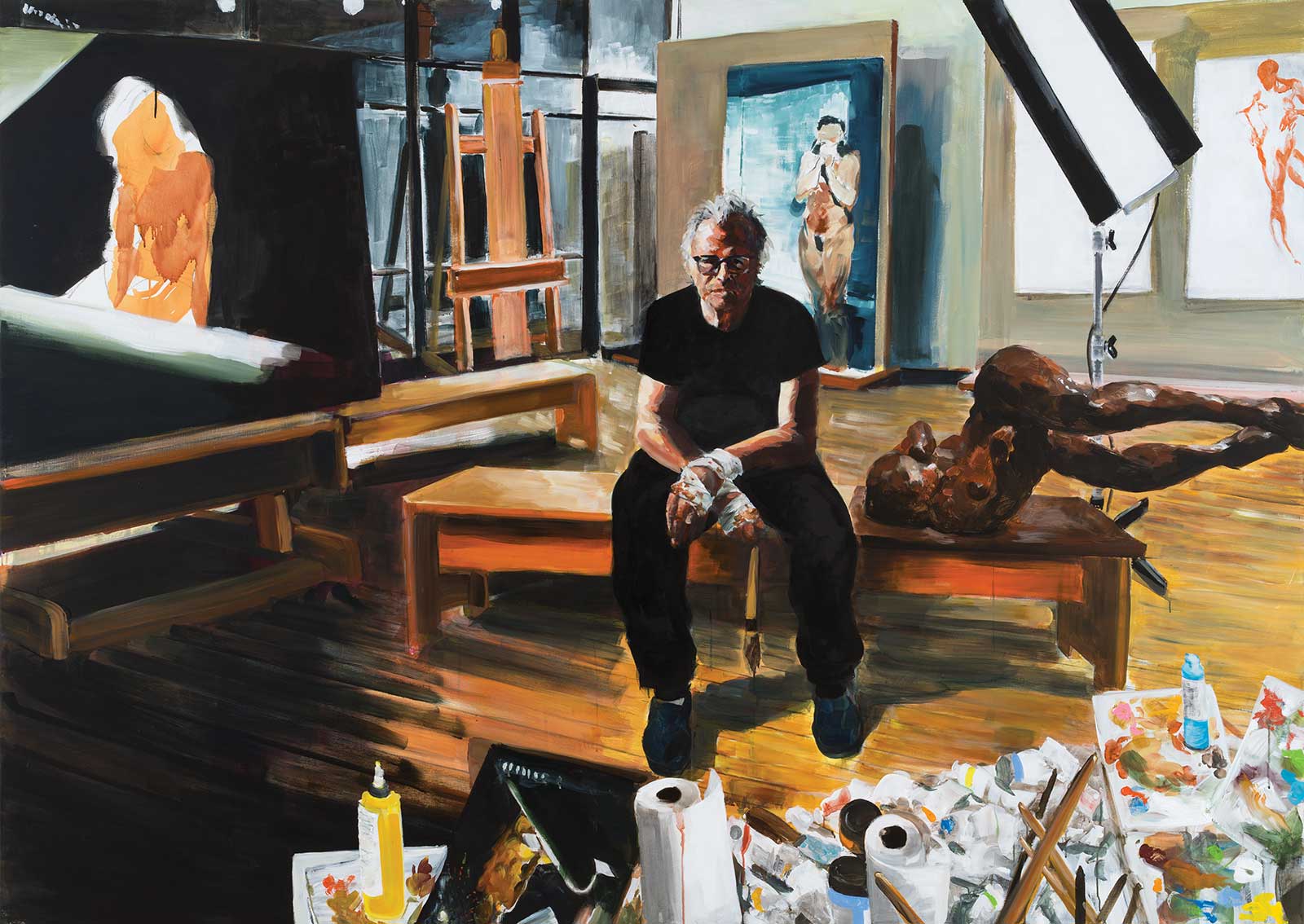
Broken Hallelujah (Self Portrait), 2023, acrylic on linen. 68 x 96 in. Arora Collection, UK. Image courtesy of the artist. © 2025 Eric Fischl
Fischl’s first solo exhibition was in 1975 when he showed his abstract paintings which received praise while his figurative work did not. Lineberry explains, “So, it may come as a surprise that a minimalist work by contemporary artist Elizabeth Murray was a key factor in Fischl’s shift from abstraction to figuration. While teaching at Nova Scotia College of Art and Design—a hotbed of minimalism, conceptualism and new media—after leaving art school, Fischl often visited New York to see galleries and exhibitions. On a 1976 trip, he saw a show of Murray’s new work including a deceptively simple composition of a circle pushing against the confines of a square. The metaphoric and formal subversion of allowing that circle to break from rigid geometries struck Fischl: ‘[Murray] had taken on a minimalist trope that was…very connected to a kind of elevated geometry of proportion and precision. She hand-painted it in a way that the circle didn’t fit the square. It bulged…It was one of those unexpected revelations…suddenly, I see the way forward.’”
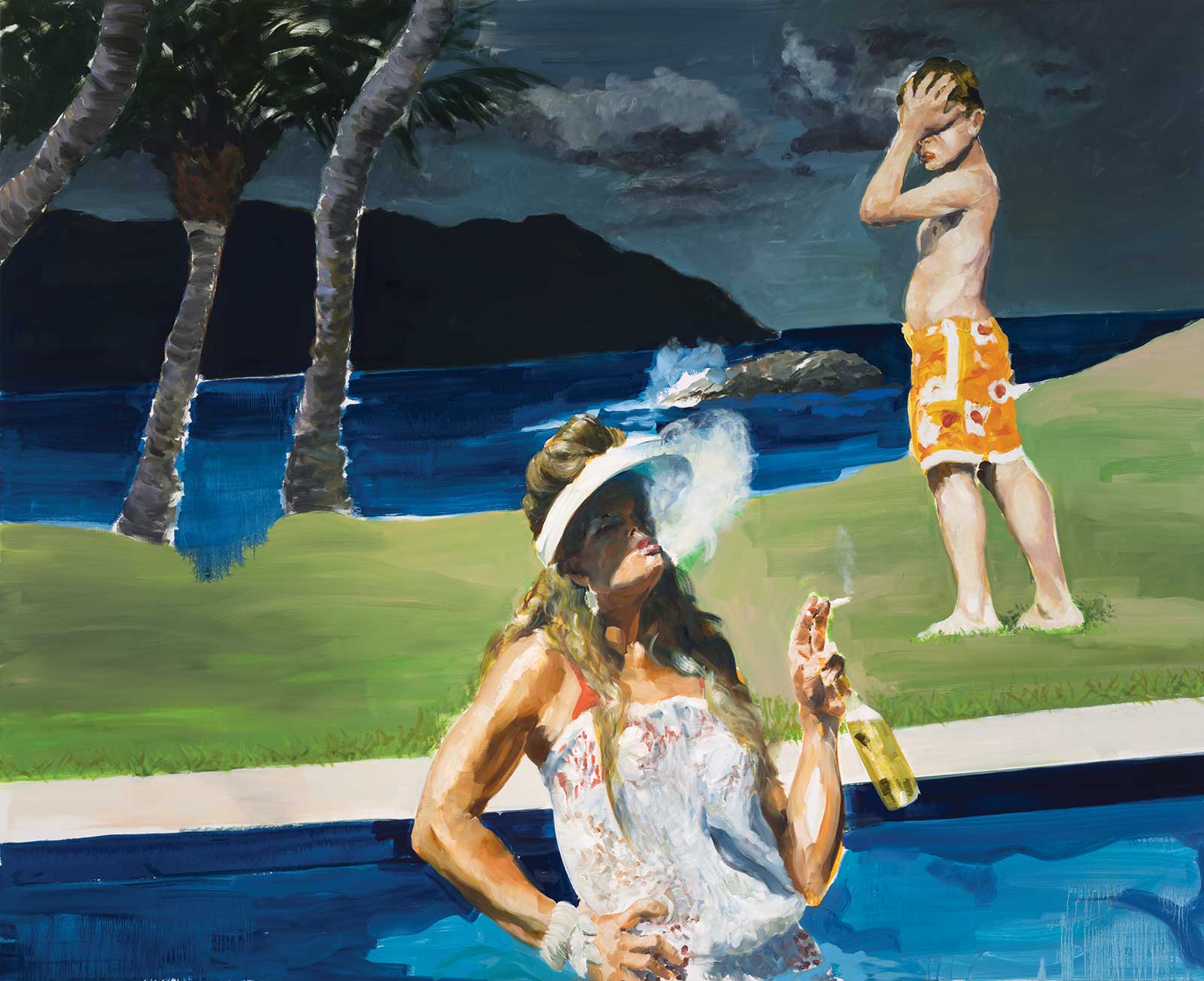
Island of the Cyclops: The Early Years, 2018, oil on linen. 80 x 98 in. Lenhardt Collection. Image courtesy of the artist. © 2025 Eric Fischl
He turned to painting his life in the New York and Phoenix suburbs—idyllic locations that often didn’t live up to their expectations. In her book essay, “After the Fall,” art critic and historian Eleanor Heartney observes, “These planned residential neighborhoods were to be the place where nature was tamed and domesticated and residents came together in a supportive community. But while all seemed well on the surface, the suburbs were also sites of racial and class exclusion, prefeminist suppression of women, and a stultifying social conformity that masked pathologies of depression, alcoholism, sexual frustration, and invisible violence. In his breakthrough paintings, Fischl explored a world informed by his own experiences as a child of the suburbs, living with an alcoholic mother whose disease was tearing his family apart.”
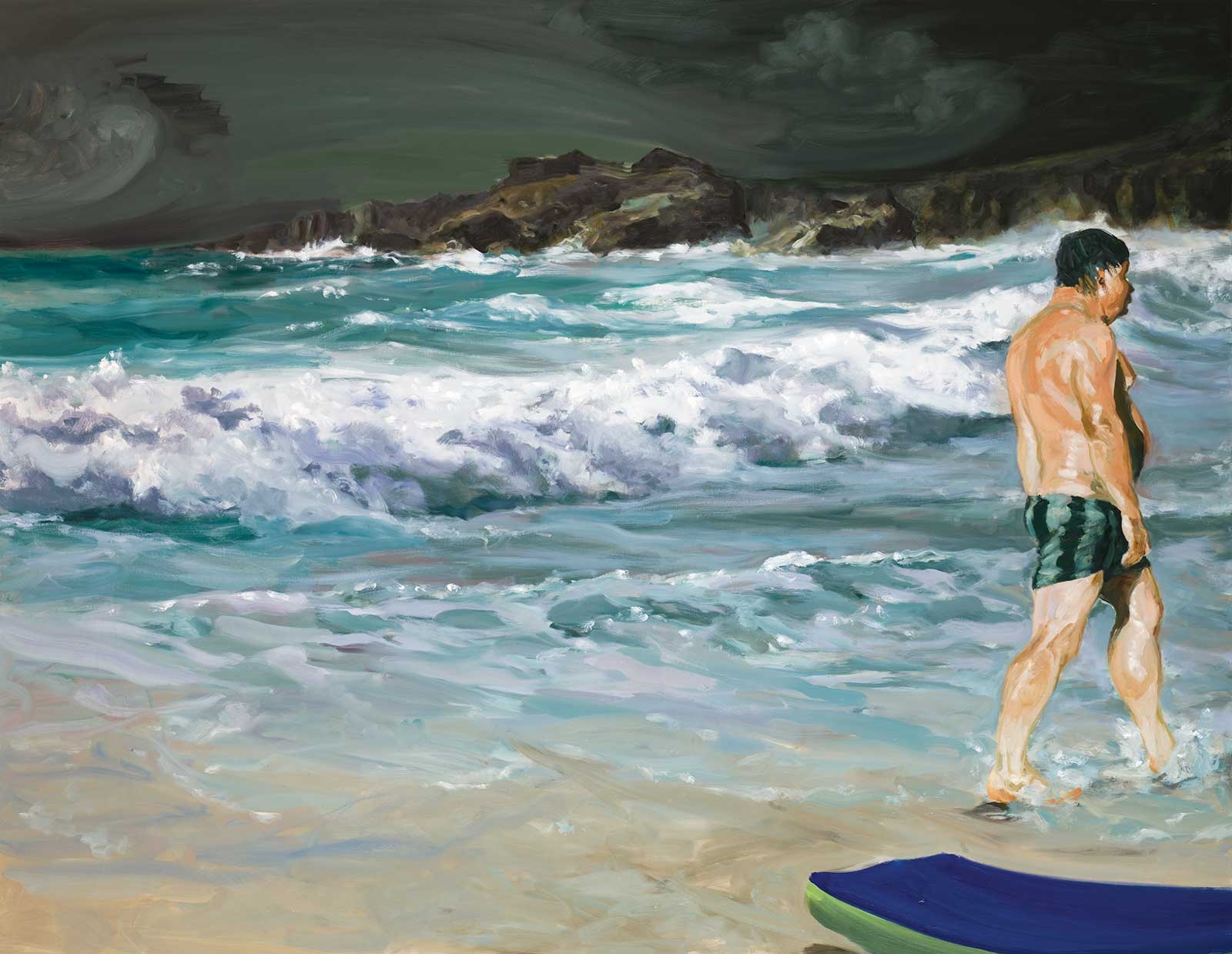
Scenes from Late Paradise: Stupidity, 2007, oil on linen, 84 x 108 in. Hall Art Foundation. Image courtesy of the artist. © 2025 Eric Fischl
In paintings such as Barbecue, 1983, which Lineberry describes as an “off-kilter backyard family gathering,” a boy blows fire while his father tends to the grill and his family splashes in the pool. Fish out of water lie mysteriously in a glass bowl on the picnic table.
A parade in the idyllic Long Island community of Sag Harbor where Fischl lives with his wife, painter April Gornik, is decidedly weird. In The Parade Returns,2022, a drummer boy in Revolutionary War costume thinks he is leading a motley crew down the main street. His unconforming paraders sport crutches and canes and an old man appears to have wandered obliviously through the procession. Fischl comments, “There are moments when the body becomes awkward and difficult and betrays your internal life. I’m interested in things that look like one thing and then become something else and flip back and forth.”
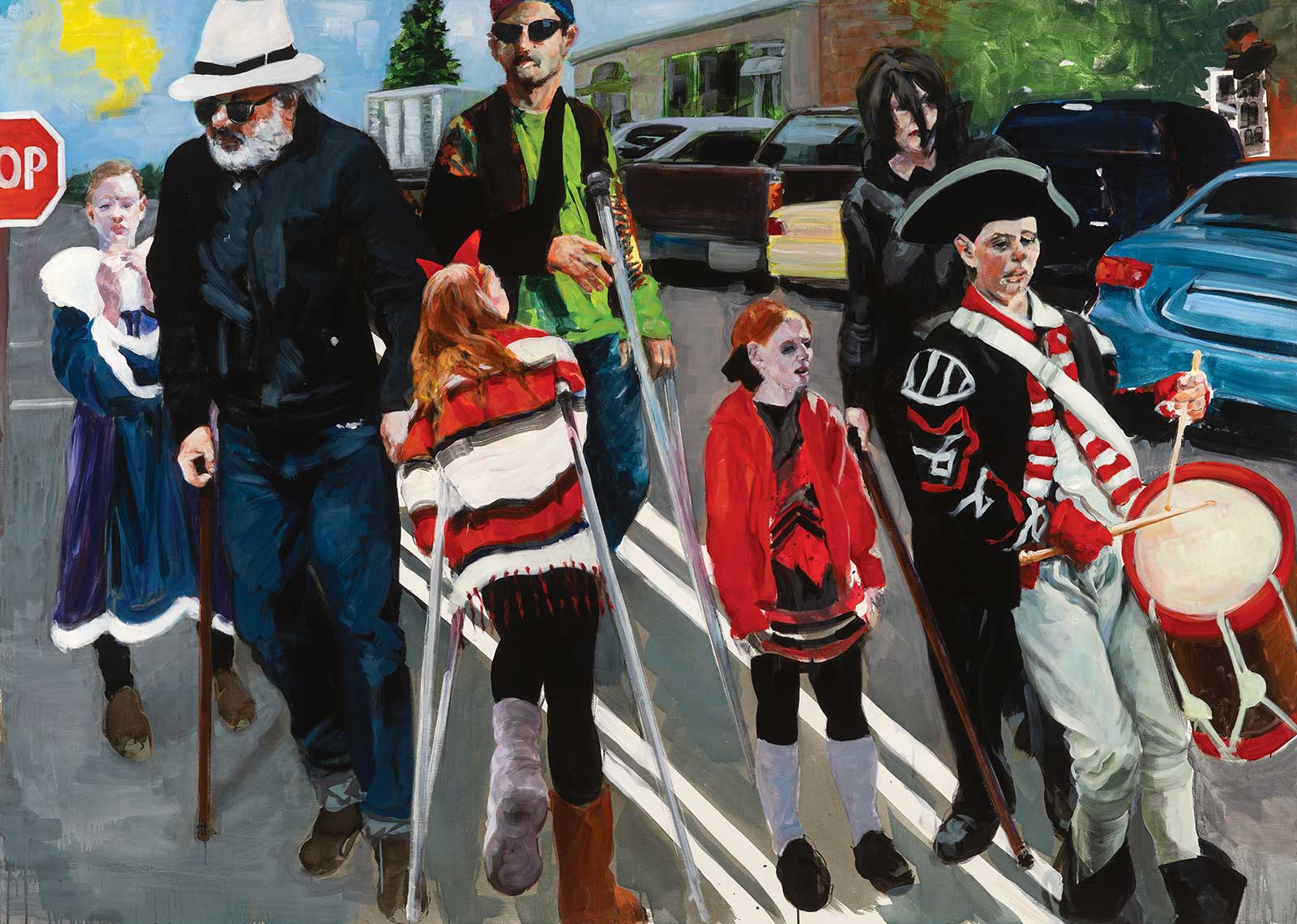
The Parade Returns, 2022, acrylic on linen. 68 x 96 in. Collection of Lise and Michael Evans. Image courtesy of the artist and Skarstedt Gallery, New York. © 2025 Eric Fischl
Contrary to the denigration of the past in midcentury art schools and among the critics of the time, Fischl studied the work of European modernists like Cézanne and Degas. Degas was a photographer and used the characteristics of photography in his paintings.
In a conversation with painter Arcmanoro Niles, Fischl commented, “Degas understood photography as a way of liberating painting by introducing whole new compositional possibilities. You couldn’t get at it through the language or history of painting. Photographers accidentally click something, or a hand is in the frame, and because they’re looking for a pure image, it is a mistake. Degas understood that you can have things entering and leaving the rectangle that are controlling compositional focus, but they’re incidental. Instead of painting a portrait of a woman where she’s at the center, the vase of flowers next to her was at the center. It was brilliant. And his sort of deep voyeuristic sense, especially with the dancers. He would create a scene in which you were seeing the whole moment, but you also were seeing through the crooked arm of this dancer to this other dancer who’s tying her shoe. That becomes the real focus of the painting. Those kinds of inventions I find incredibly profound in terms of visual language.”
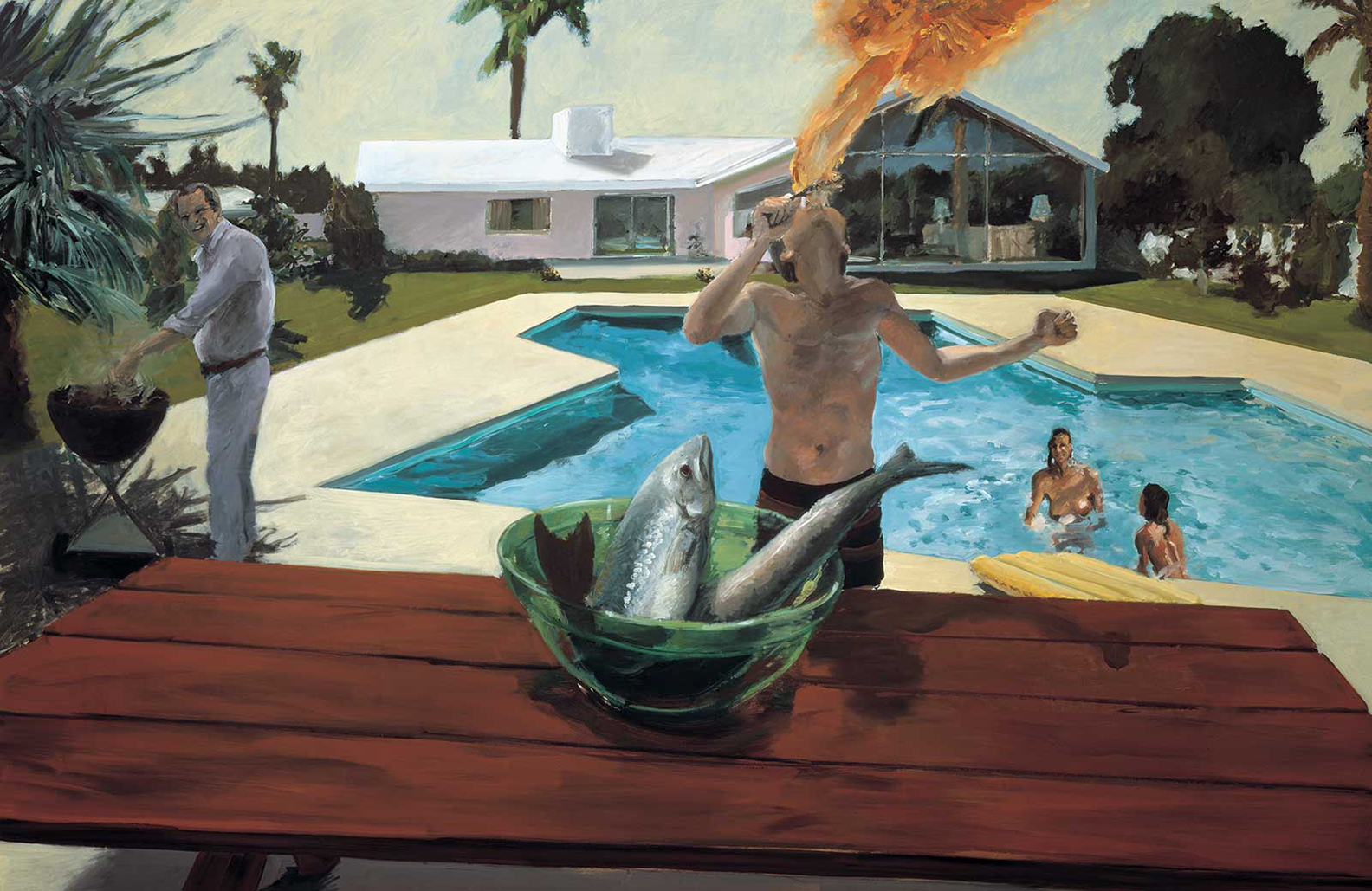
Barbeque, 1982, oil on canvas. 65 x 100 in. Steve Martin and Anne Stringfield. Image courtesy of the artist. © 2025 Eric Fischl
Fischl continues to observe keenly and to explore the oddities of today’s world in a series titled Presence of an Absence. He and Gornik have restored an old church in Sag Harbor to celebrate the continuing rich artistic life of Long Island. They explain, “The church strives to be a creative asset for our East End communities, sharing our facility and inviting the public to experience diverse events, from the expected to the unexpected, highlighting the work of writers and dancers as well as inventors and artists.” —
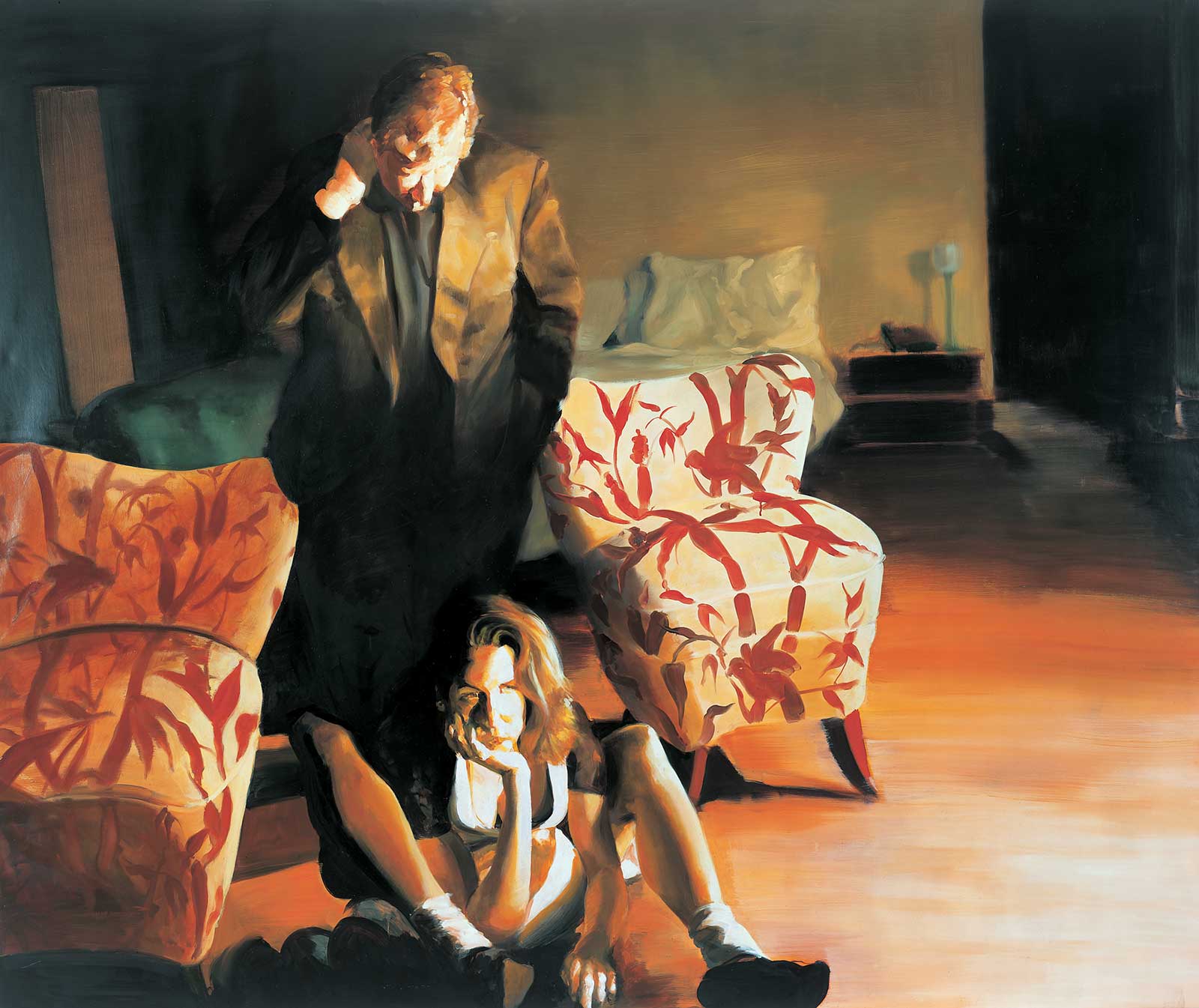
The Bed, The Chair, The Sitter, 1999, oil on linen. 78 x 93 in. Private Collection, New York. Image courtesy of the artist. © 2025 Eric Fischl
Eric Fischl: Stories Told
Through June 14, 2026Phoenix Art Museum, 1625 N. Central Avenue, Phoenix, AZ 85004
(602) 257-1880, www.phxart.org
Powered by Froala Editor