Secrets to the bright cheer of Chad Little’s paintings are hidden in the light choreography of their composition as a slow dance of colors and nuclear age nostalgia. Beautiful women are posed against stripes, spots and candied patterns, or under floating shadows cast by the midday sun in the golden 50s. Many of them are pleasant, gently erotic fantasies of female figures isolated against simple, photo-studio cycloramas or patterned backgrounds, never naked, but always sensual. These artificial spaces create a mood of simplicity and safe confinement, a mood of swimsuits, sex and sedatives.
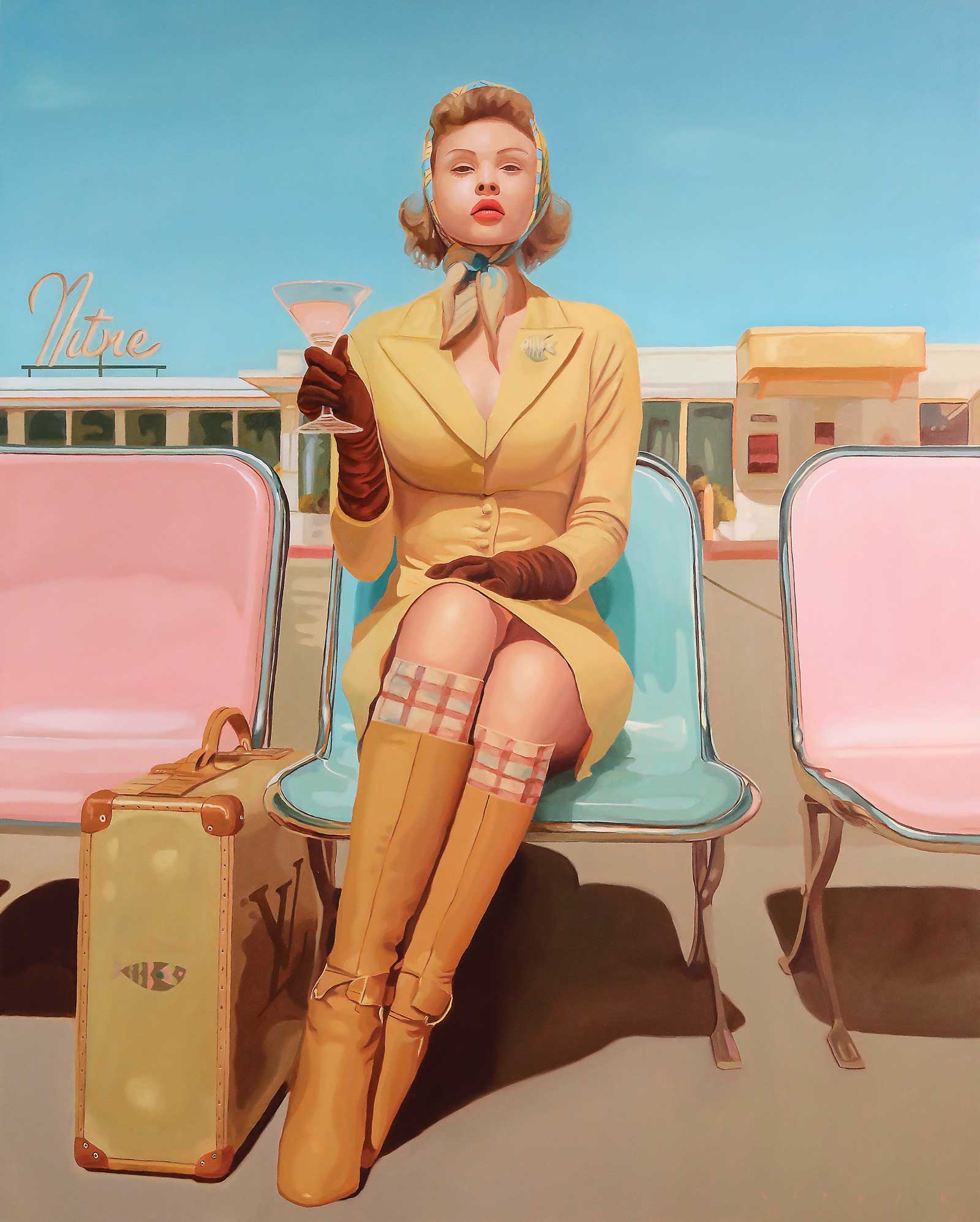
Emotional Support Valise, oil on linen, 60 x 48 in. Courtesy Julie Nester Gallery, Park City, UT.
Until recently, Little has limited his subject to vintage photos, preferring pictures of a slim model’s body, often wrapped in a skintight costume and set in empty space, sometimes decorated in the polka dots and patterns of papered walls. He puts new life into old and long-faded beauty. His newer work is expanding into complexity. He says, “I’m being more literal in my narrative… and I’m really happy with the decision. When I was painting found vintage photos that spoke to me, I was constantly creating a story of what was happening there—who was taking the photo, what was the family situation; they’re all laughing and having a great time, which felt foreign to me, but I loved them.” These slight figures are dressed in more than reminiscence, then. Witness how they move toward insight. Here is a study of golden introspection in a light summer dress, and here are paintings speaking deeply of the distinction between the tantalizing erotic allure of partially-clothed concealment compared to nudity.
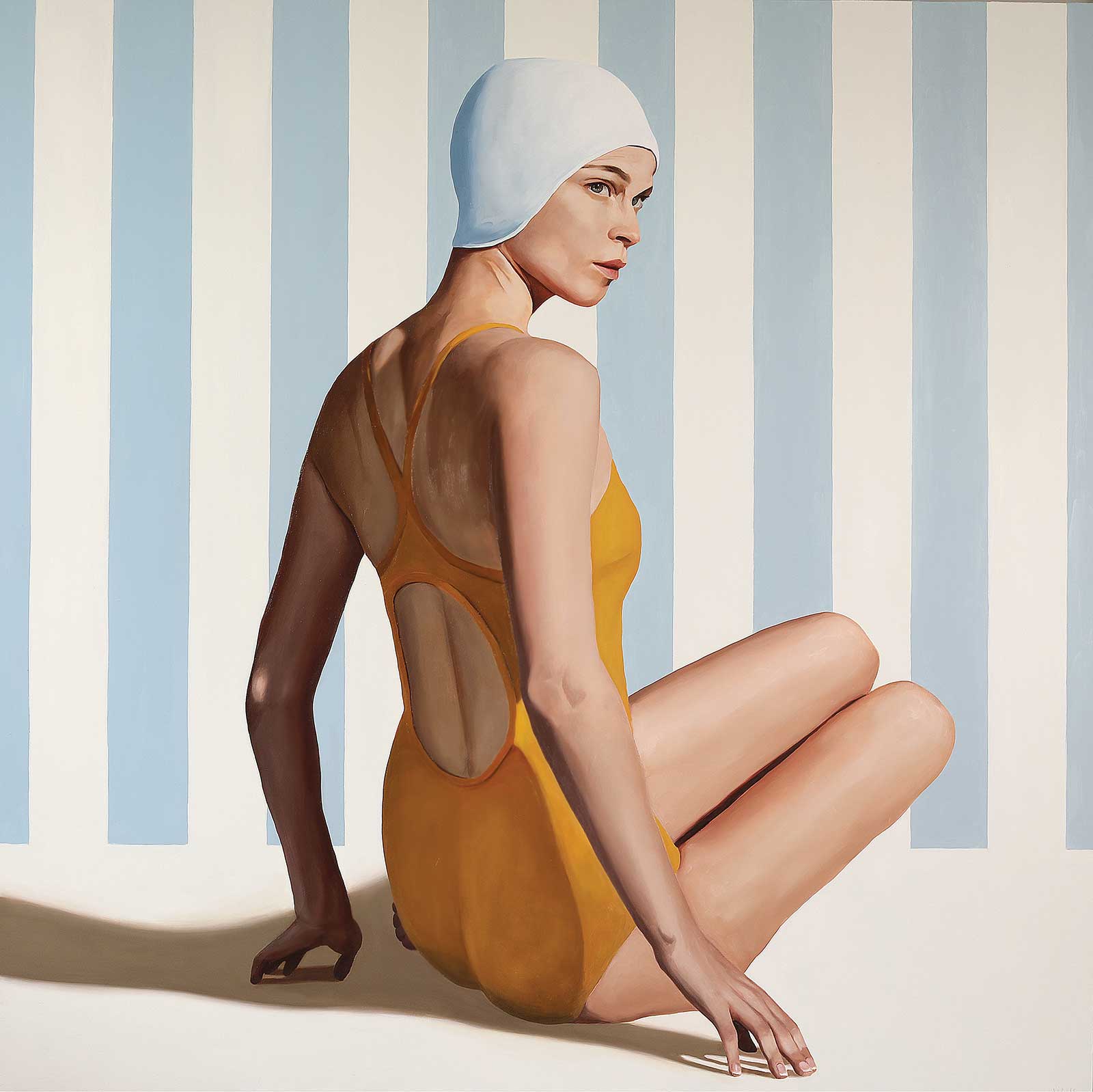
Lines of Sight, oil on canvas, 60 x 60 in. Courtesy Julie Nester Gallery, Park City, UT.
Little trained as a designer, and he enjoys well-done abstraction and other genres of art. He admires the isolation and the central figures, and the flat and cheerful simplicity of the surfaces in paintings by David Hockney. In his own work, he feels compelled to focus on the figure. He explains, “I can’t get away from it. When I started trying to figure out the ‘hows’ of this, I never would have thought…that I’d be doing figurative, representational art. I heard artists say ‘don’t worry about your style, it’s in you, you’ll find it. If you just keep doing the work.’ I thought, ‘that’s not true, I’ve got to figure it out, it’s somewhere out here,’ but all the times I’ve tried to explore any kind of other style, it pulls me back. It wasn’t a conscious decision—it was more of allowing myself to go there. That feels right.”
He is preoccupied with women as the central subject of his paintings, especially when they’re dressed in the costume of the post war period. “I’m drawn to that era,” he says, “The Eames era, everything that was going on during that time, mid-century modern anything, I love all of it. The propaganda poster, the graphic design of the atom bomb, the photos of the kids beneath the desk, the future of the Jetsons, it’s exactly what I’m doing.”
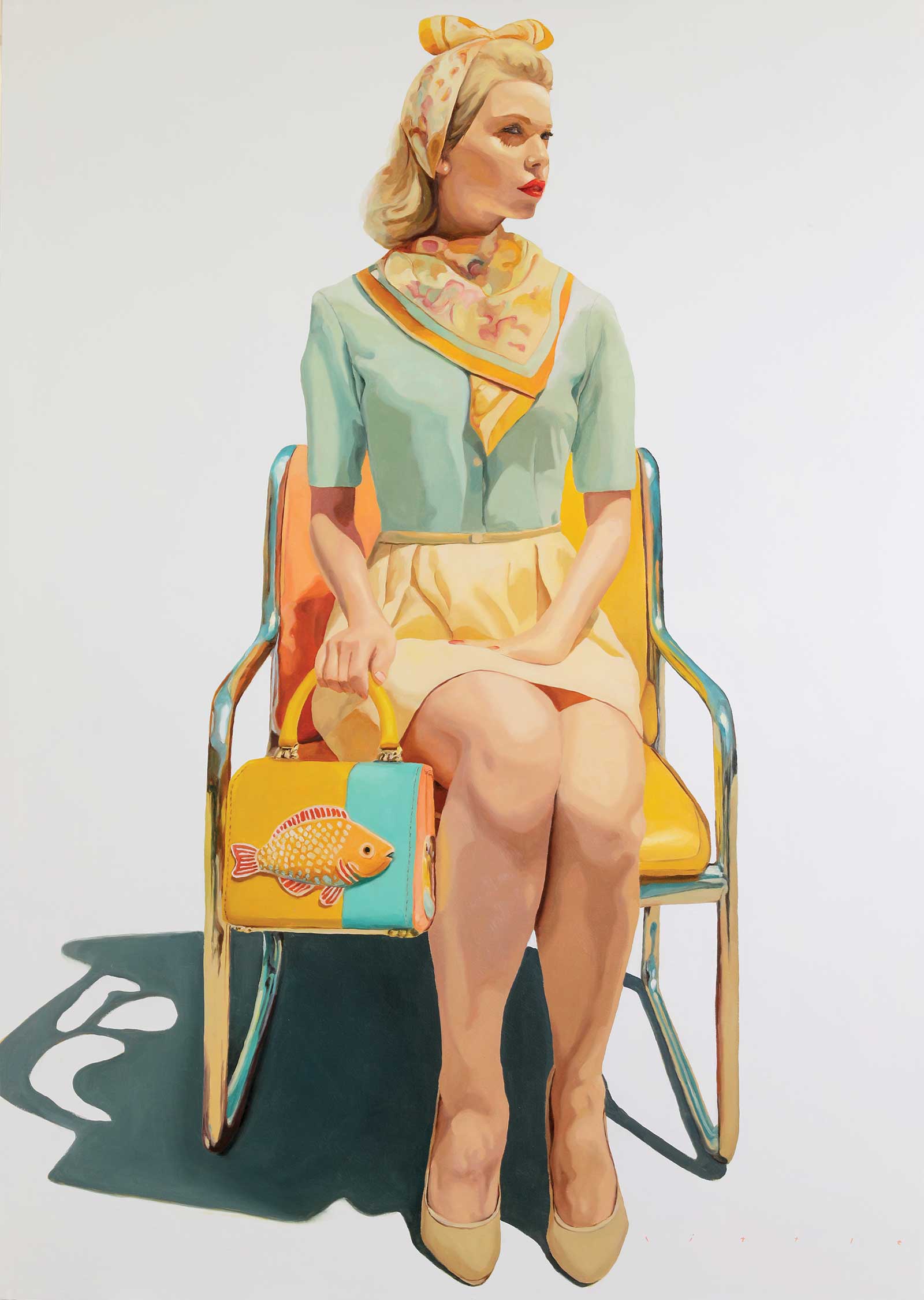
It Wasn’t Just a Purse, oil on linen, 48 x 38 in. Courtesy Julie Nester Gallery, Park City, UT.
It was endless spring, a golden time of light and luxury, yet nuclear winter seemed to be the coming season. Joyous victory had lifted America into triumphant prosperity, yet fear crushed individuals into the mold of uniformity. Furniture was beautifully designed in a calm palette of pastels, yet industrial plastic factories generated mountains of cheap, trashy consumer goods one small step from the dump. It was a time of simplicity, and a time of paradox; a time of wonderful transformation and a time of stagnation. Little continues, “I think I would have loved to have grown up in it. It feels very free, or innocent. But that said, I’m looking at it through the lens of a white male. If I try to look at it as a female, or a person of color, or someone gay at that time, that’d be pretty awful. Those rosy glasses apply to how I view it. That’s part of the contradiction for me—trying to address that.”
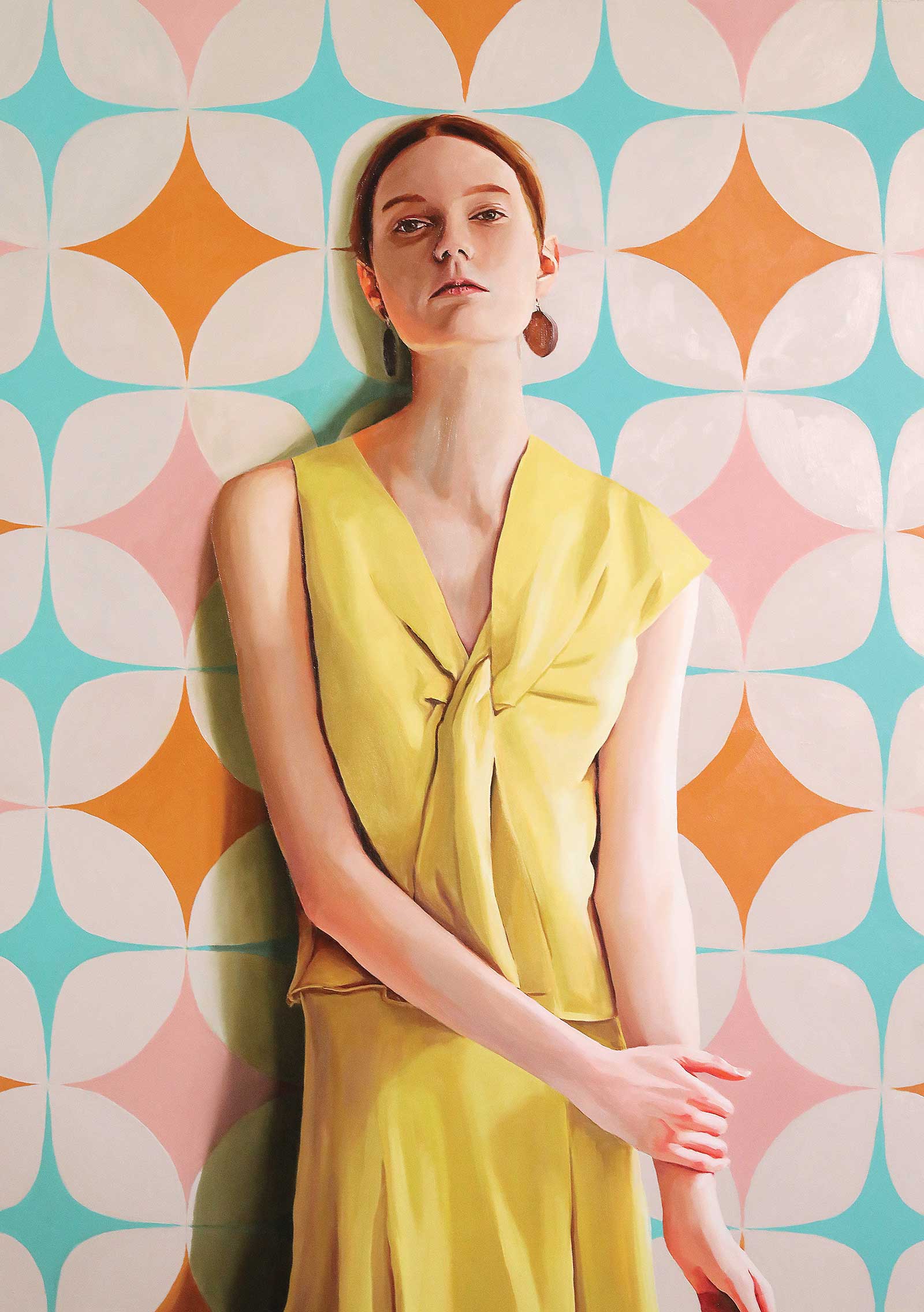
Enough, oil on canvas, 48 x 30 in.
The figures in two of his recent paintings are fully realized in three-dimensional space, and shaped to express the contradictions of the 1950s. In It Wasn’t Just a Purse, chroma is a key to opening the composition. Little mixed that lovely Chevy turquoise at its brightest on the purse, but gave the woman’s parted lips the heat and scarlet of a stop sign. Both proudly pop against a pastel palette of matching mustard and aquamarine and pale ochre tripled in her scarf, in the mirror and chrome frame of her wide Naugahyde chair, and in the trim and button of her tailored blouse and pale skirt. Discretely facing away from her audience with painterly depth in her costumed figure and ambiguity in her sidelong eyes, this blonde beauty is a choreographed arrangement of the confusing contradictions of erotic play, with her compressed knees and discrete left hand shielding her from tight-lipped and prurient complaint, while her right shows off that cleanly designed and decorated clutch.
Little enjoys writing free verse to accompany his paintings, and composed these lines for It Wasn’t Just a Purse:
She sits in chrome & vinyl resistance,
a relic reupholstered, not reclined.
The purse in her lap bears
a quiet fish—
stitched by her own hands,
each thread
a small revolt.
She made it after reading the
etiquette books,
the ones that warned women
not to stand still,
not to let their hands hang
like dead fish by their sides—
as if lifelessness
were always just one posture away.
So she gave the fish a new meaning.
Not shameful.
Not a warning.
But bold, deliberate, and carried on her terms.
A symbol of movement,
even in stillness.
Fond of wordplay, Little is a conspirator of clever meanings, and has dropped a clue into the painting’s name to guide its interpretation. The title It Wasn’t Just a Purse directs us to its focal heart, that handbag positioned on the careful and measured third of the composition. Objects in paintings are inescapably signs and symbols, and this pocketbook, and pink and orange fish, is weighed with meaning and sending an ambiguous signal. It is a mixed image of two kinds of seduction—the symbol muddled as both the ancient ichthus of Christ and the vaginal vesica, and the symbol of the eternal fertile impulse of duality to become a trinity. There are plenty of fish in the flirty sea, but few like this evangelist, this eros, this child of God.
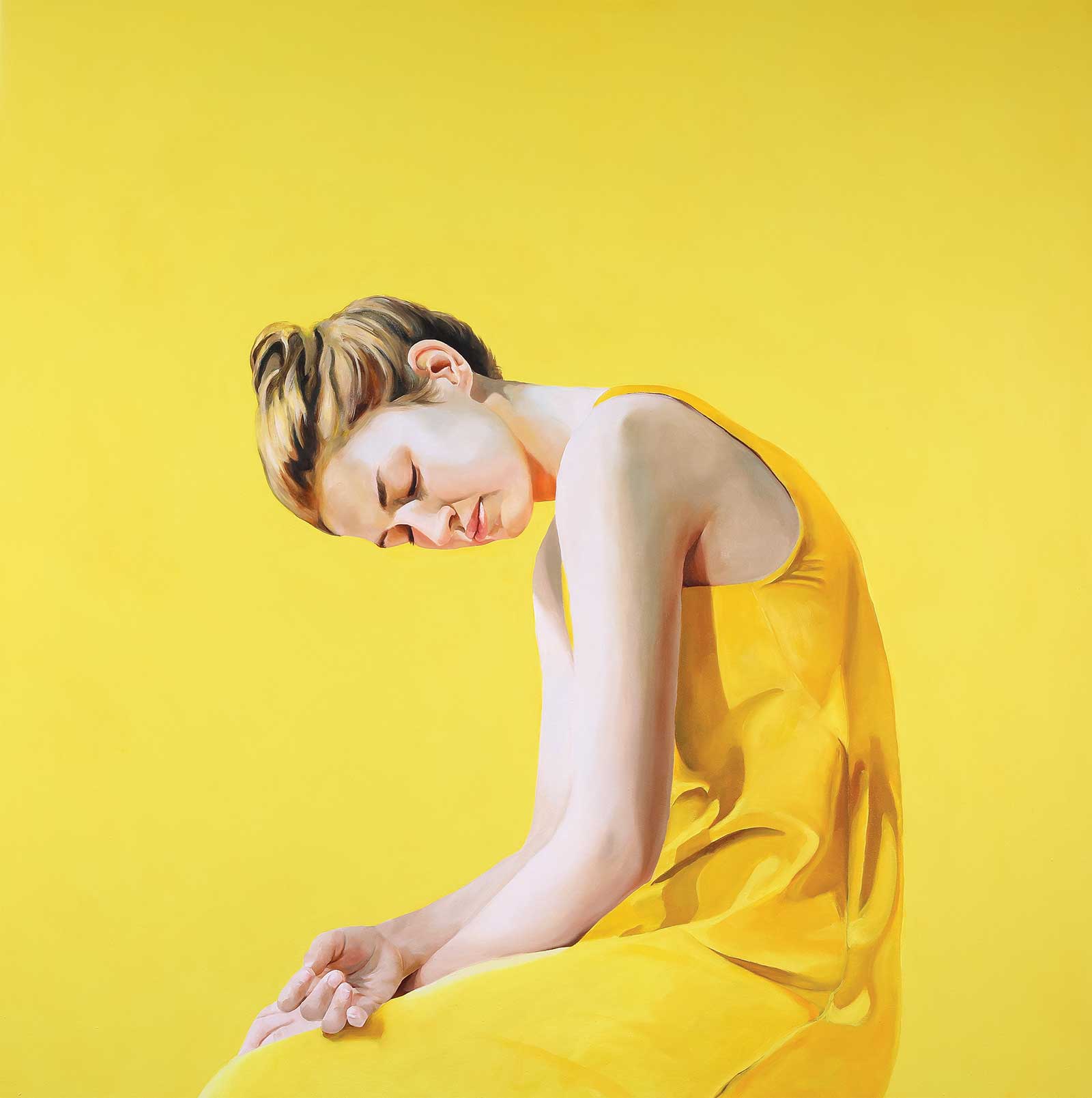
Aurulent Reveries, oil on canvas, 40 x 40 in.
Fully developed in form and setting, Emotional Support Valise is another coded image outstanding in its completion. The subject is a head-scarfed beauty painted in the costume and color of 1950s Florida pastels. She sits in bright sunshine, and the peach and yellow of her tailored couture, centered in a tidy chain of smooth Bauhaus bus station chairs, waiting for a journey while arming herself with liquid courage from a martini. The droll title of the painting is as dry as her cocktail. The comforting suitcase is a pristine and expensive Louis Vuitton built in raw linen and leather, a classy icon of retail therapy packed with irony and the weight of the past. Behind the aura of pastel and Polaroids, there is a hint of the glow of crackling radioactivity.
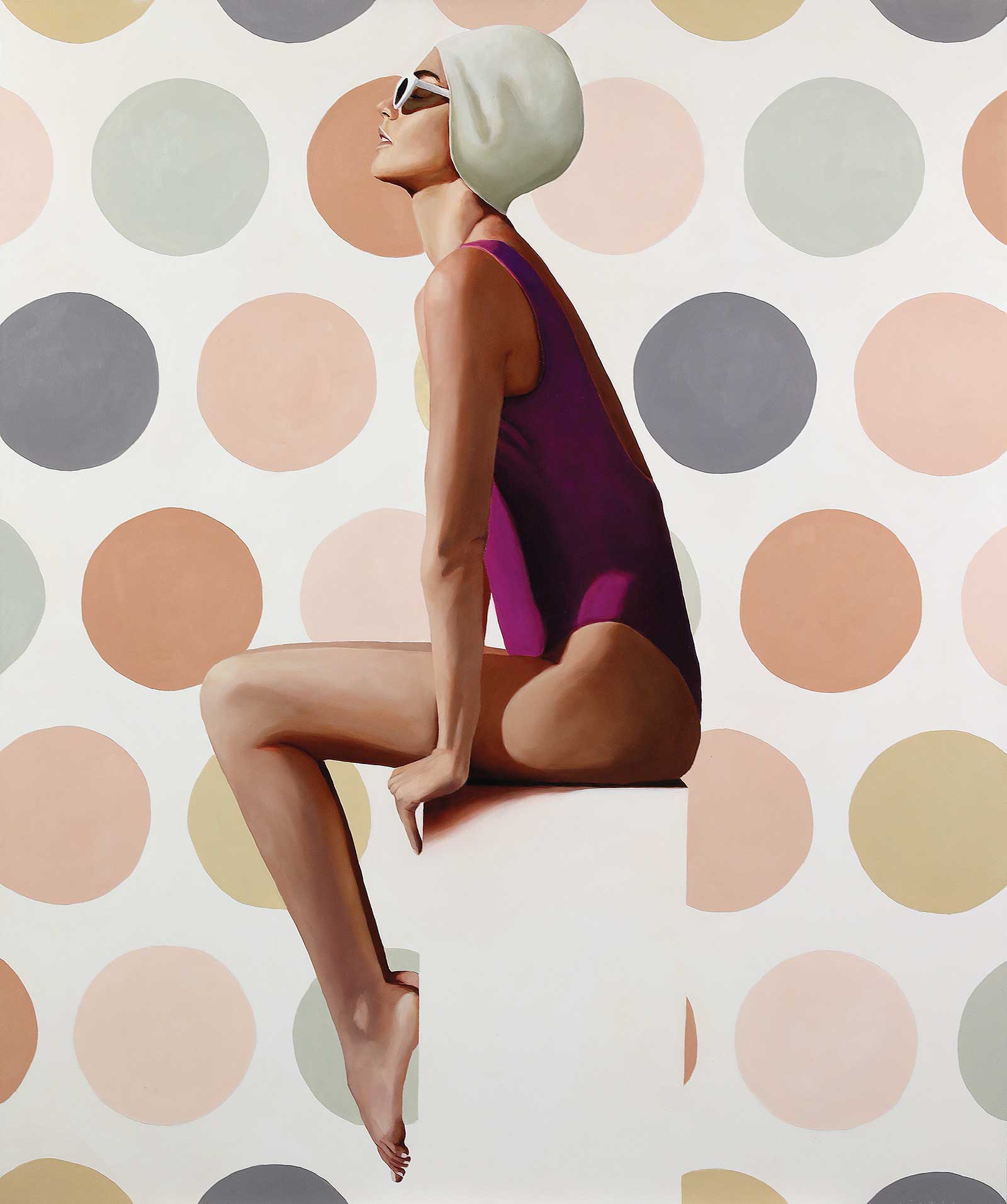
Shades n Dippin Dots, oil on canvas, 48 x 40 in.
It is a picture of sexual longing, but although she has the sensual pout of Norma Jean, and although the traveler has the image of a desired woman, she is seeking freedom, for surely her journey is an escape. Little’s subtly erotic and evangelical messaging of the sign of the fish is there again, this time on her lapel as a brooch, acting as a symbol of her eternal and inescapable longing for something more than physical desire. Though she sits with the conventional tuck and fold of leaning legs, learned from a girls’ guide to manners, our eyeline is at the height of her modest hand resting on the center of her arranged skirt. If ours is a voyeur’s view, hers is the returned gaze of a gorgeous woman uncomfortably aware of unwanted and erotic scrutiny. There is an implied threat of coming violence here too, for Little has placed another word clue as bus-station signage in the background designed in the classic 1950s font that reads “Nitre,” one of the ingredients of the explosive known as black powder. The painting seems to tell the story of an unfolding narrative of this woman’s actions and to advertise the destructive violence that is to come, surely an inevitably envious and angry reaction to her departure. This is cunning artifice. Her freedom has a price, but the cage would cost her soul.
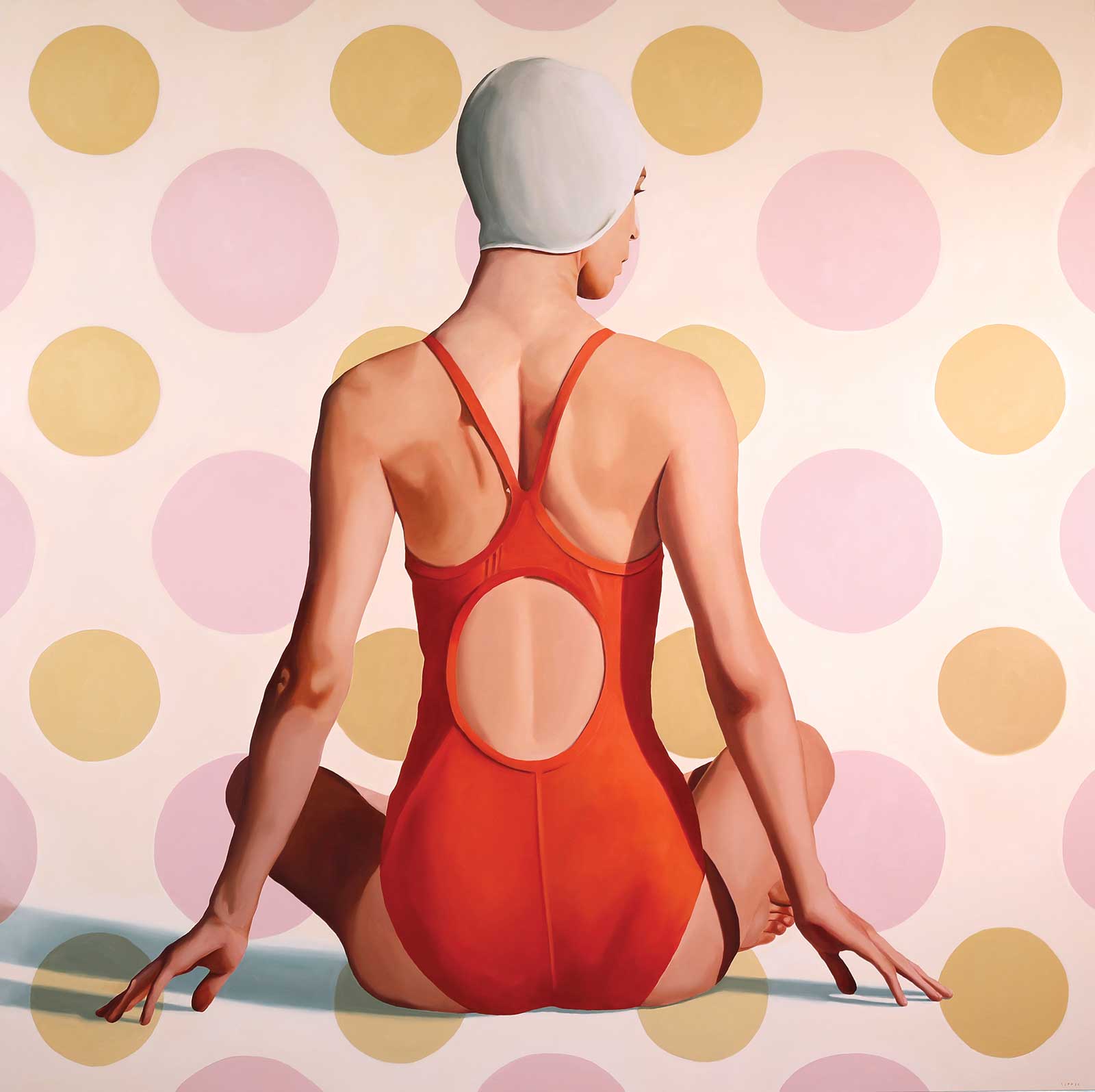
Sittin Dippin Dots, oil on canvas, 70 x 70 in.
Her headscarf, hairstyle and made-up mouth are an unapologetic disguise, a mask concealing her personality. They are not themselves, these women. They are shielding themselves from an abusive world. Surprisingly, Little sees the women as a mobius strip of personality. He explains, “I know what it’s like to be on the wrong end of the stick, and lower on the food chain. I was on my own by the time I was about 14.” He understands the asymmetry of violence, continuing, “I was raised by abusive women, which put me, as a male, in a really bogus position.” His experiences infiltrate his paintings. To some degree, the isolated figures are both himself and the women who hurt him. “I am presenting the isolation of loneliness,” Little says, “a bit of them finding themselves and being okay, but still not happy, or jovial. Going back to the Gen-X thing, I’ve been through my shit, but I’m okay—yes, I might be a little bit lonelier, but I’m fine. Hopefully not unapproachable, but also not a victim. Some of the pieces that I wish I still had were the ones that gave me something back—not a victim; a much better situation; I’m okay now; this is awesome. I like to live with that, and I hope that somebody else would want to live with that as well... Yes, they are self-portraits in a lot of ways.” —
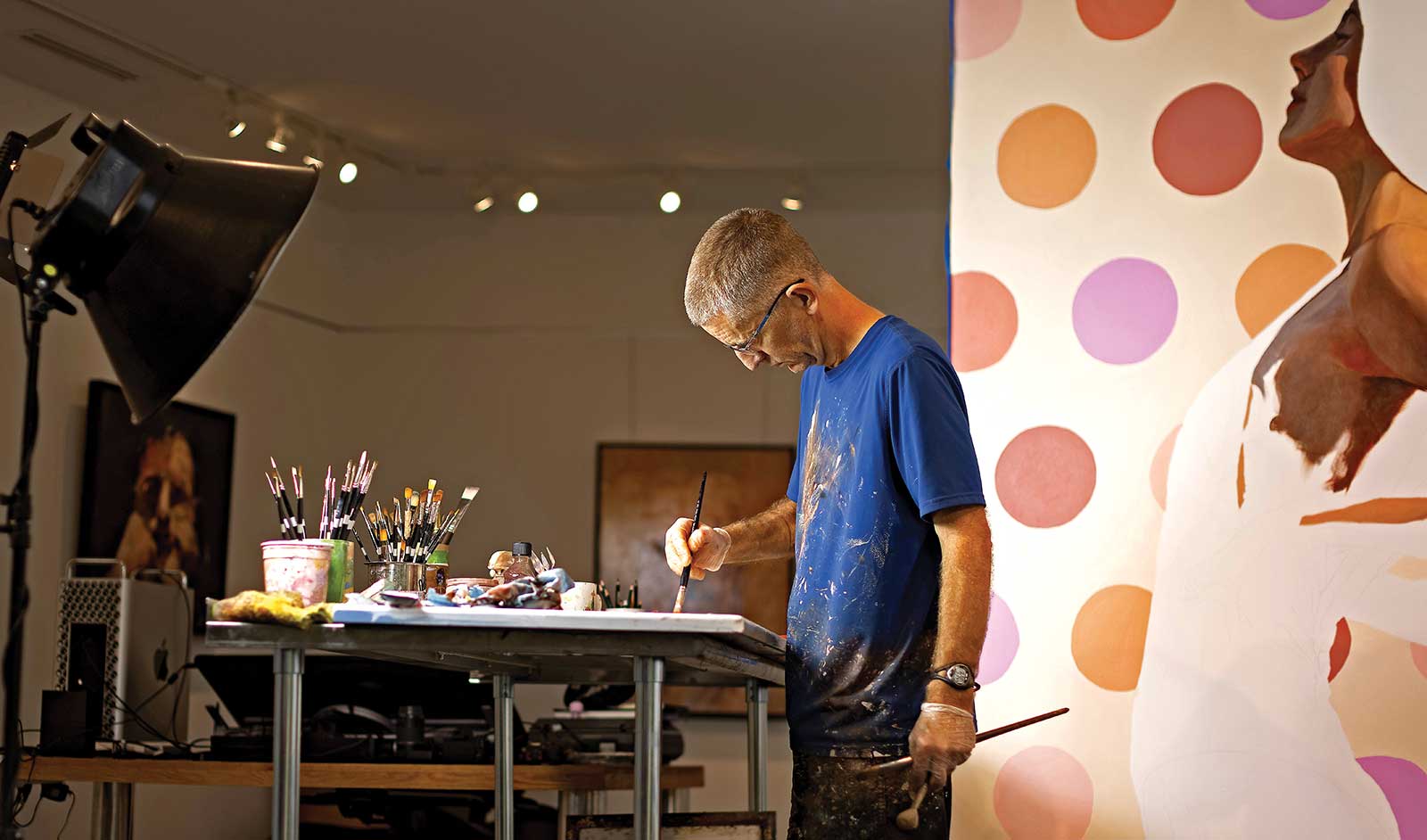
Artist Chad Little in his studio.
+++
Michael Pearce is a dynamic writer, curator and critic, and a champion of art that emerges from popular culture and shapes the spirit of the age. He has published dozens of articles about art and artists, and is author of Kitsch, Propaganda, and the American Avant-Garde.
Powered by Froala Editor