The view from a tractor is a long one. It’s a vista that endures. When the prolific American painter William Beckman (b. 1942) was growing up on a Minnesota farm, he recalls riding his family’s tractor “thousands of times” into the fields of corn, beans and sugar beets. “When you grow up on a farm, you memorialize it, have it locked into your brain, what you’ve looked at so often,” he says from his home and studio in New York’s rural Dutchess County, some 85 miles north of New York City.
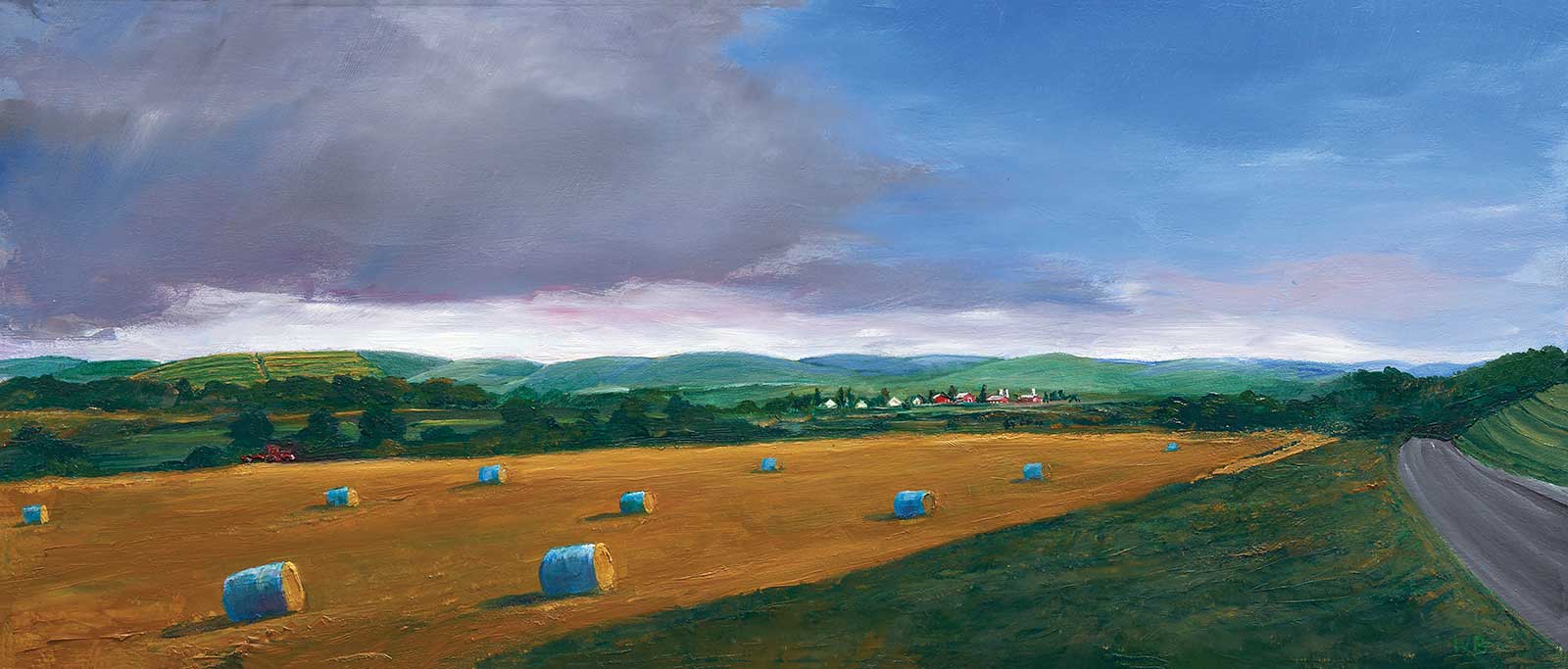
Bel Air Farm Summer, 2020, oil on panel, 9¾ x 23¾". © William Beckman. Courtesy of Forum Gallery, New York.
Even though his boyhood tasks on the family farm, situated on the Minnesota border near South Dakota, were performed decades ago, Beckman clearly remembers the flat, seemingly infinite landscapes so well that he paints them still from memory. Many of his bucolic scenes of green fields punctuated with rolled bales of hay, all overseen by explosions of white clouds, are featured in a solo show of 22 of his works, William Beckman: On the Horizon. The exhibition, presented by the University of Arkansas at Little Rock and on view through June 30, was first suggested and organized by Beckman’s longtime dealer, Forum Gallery in New York City.
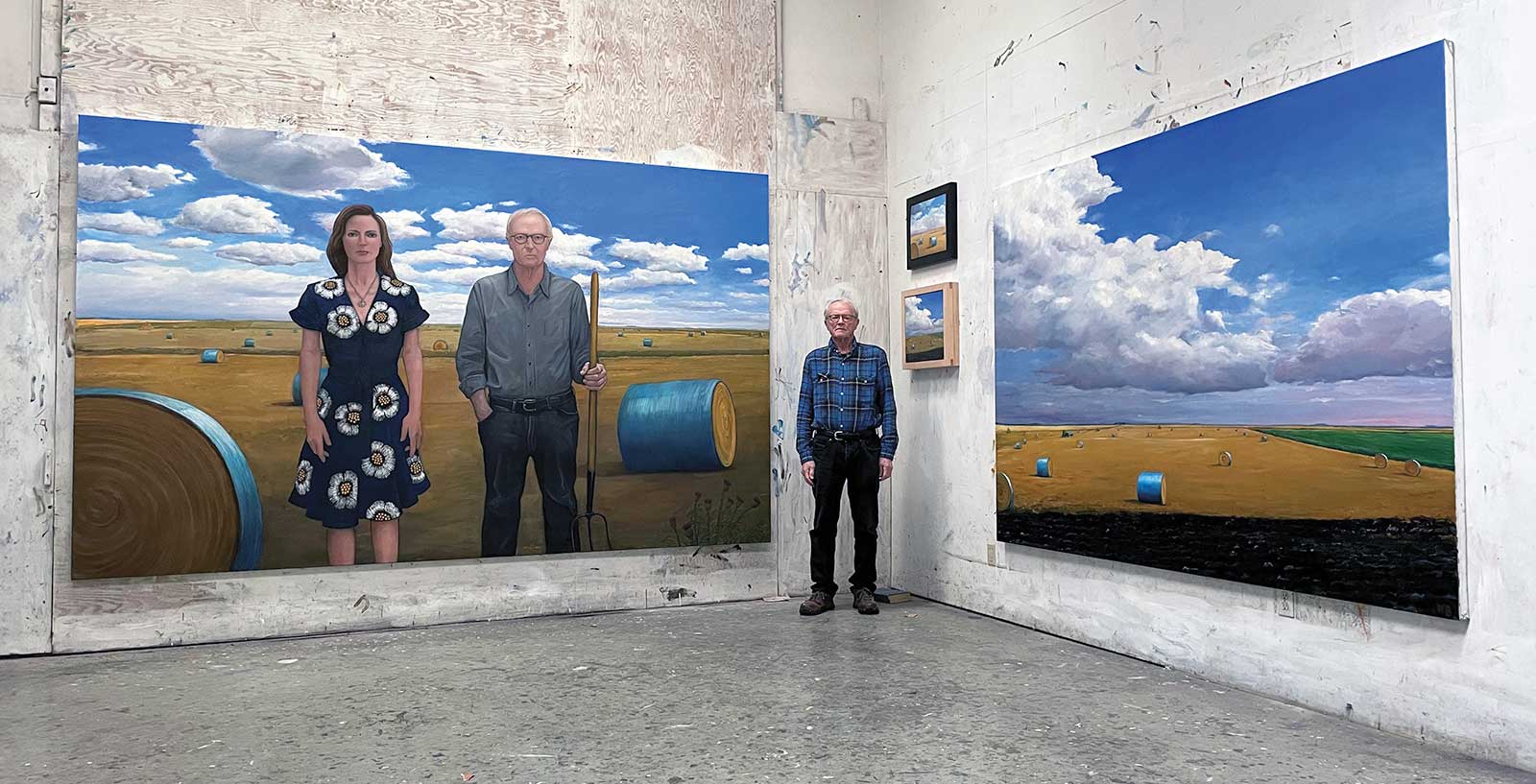
Installation view of William Beckman: On the Horizon.
While Beckman has long been known for his arresting painted and charcoaled portraits of people, often depicted amid vast farmland expanses, this show, in particular, includes numerous works that reveal his focus over the last six years—the landscapes of his youth, along with others that depict his Upstate New York locale and elsewhere in America. “Most of the landscapes are ones that are simply right out of my head,” he explains. “I don’t photograph at all. Photography is too still. I like movement. When you’re in a landscape, there’s always movement. Photography actually sterilizes images. I work all from my head. Photography locks things too much into place and I’m interested in discerning movement and action.”
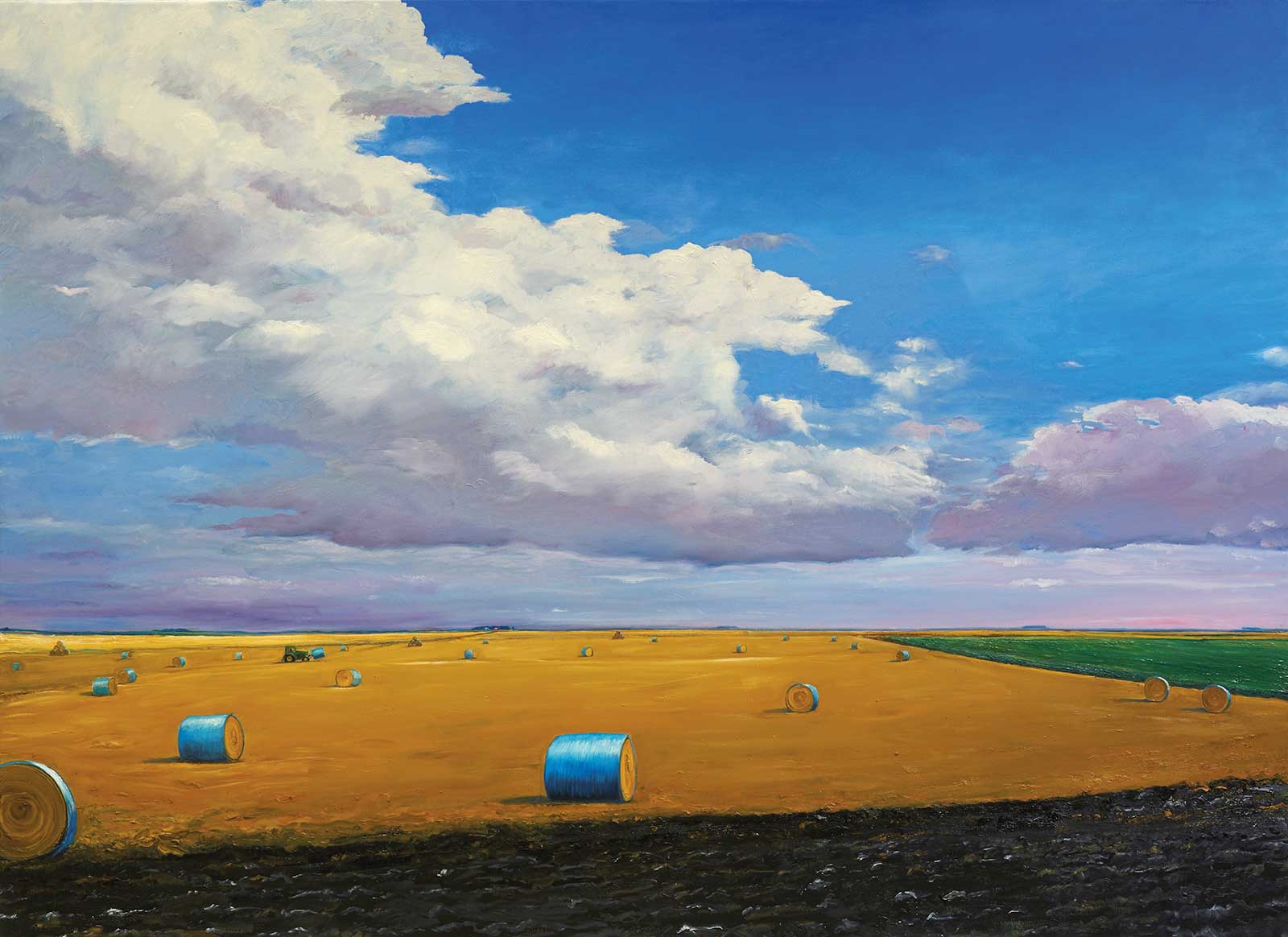
Blue Straw Bales and Plowed Field, 2024, oil on canvas, 72 x 99". © William Beckman. Courtesy of Forum Gallery, New York.
Among the more striking aspects of Beckman’s canvases, is not just their massive scale (some measure as much as 11½ feet by 7 feet), but also the very scale of his figures and their placements in the scene. Most of the people we see in his landscapes, or what are his signature double-portraits, usually include himself and his wife. “Because the figures are most often larger-than-life, they confront the viewer when you stand in front of a canvas,” explains Nicola Lorenz, Forum Gallery’s executive director, who has worked with Beckman for more than 20 years. “There is something very magnetic about his characters. As you look at them, they look back at you, making you wonder what is going on in their minds. And, psychologically, when he paints couples, there is this discernible tension between them. The female figures are usually his partner or wife—William has had a few different wives over the years, and you can tell the period of his life by the female figure positioned next to him.” Such is the case with the most conspicuous, and newest, work in the show, Straw Bales (Overcoat Series), 2024, which shows him with his novelist wife, Dianne Warner.
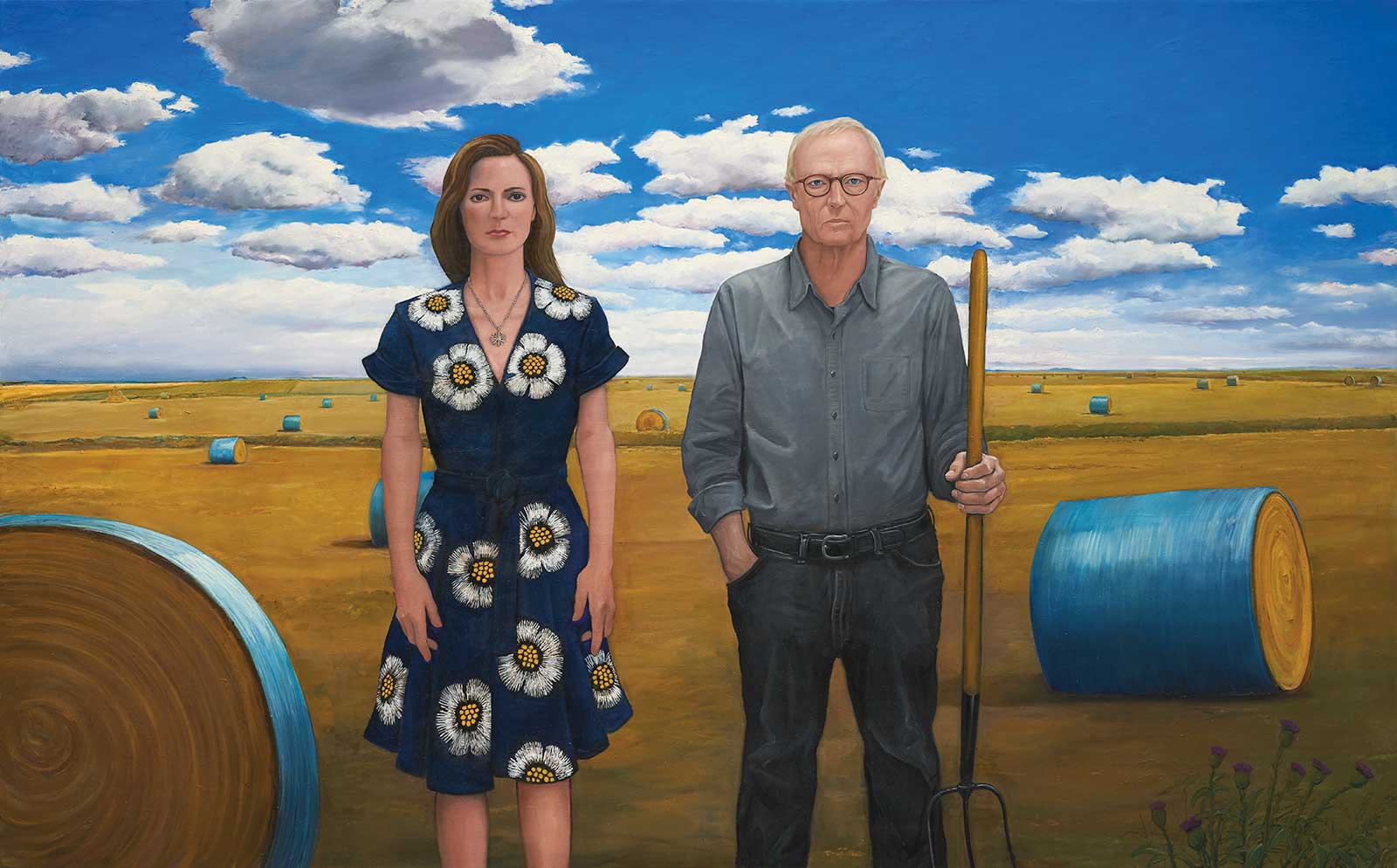
Straw Bales (Overcoat Series), 2024, oil on canvas, 86 x 138". © William Beckman. Courtesy of Forum Gallery, New York.
Beckman explains that early on he learned to paint figures larger than life-size. When he moved to New York City in the 1960s to begin a career as an artist, far away from the planting fields of his beloved Minnesota, he would visit the Frick Collection, noted for its array of Old Master paintings. “When I first saw the self-portrait of Rembrandt that’s in the Frick, I put my hand up to his hand and realized that he was making everything 15 or 20 percent larger than it was in real life,” says Beckman. “When you are up close to the painting, it looks to be life-sized, but I realized that as the voyeur, something shown as life-size will actually look smaller than that. There is also a great portrait by Bronzino [of Lodovico Capponi] in the collection, and even back in the Renaissance they were taught to make figures slightly larger than life size for a greater effect.”
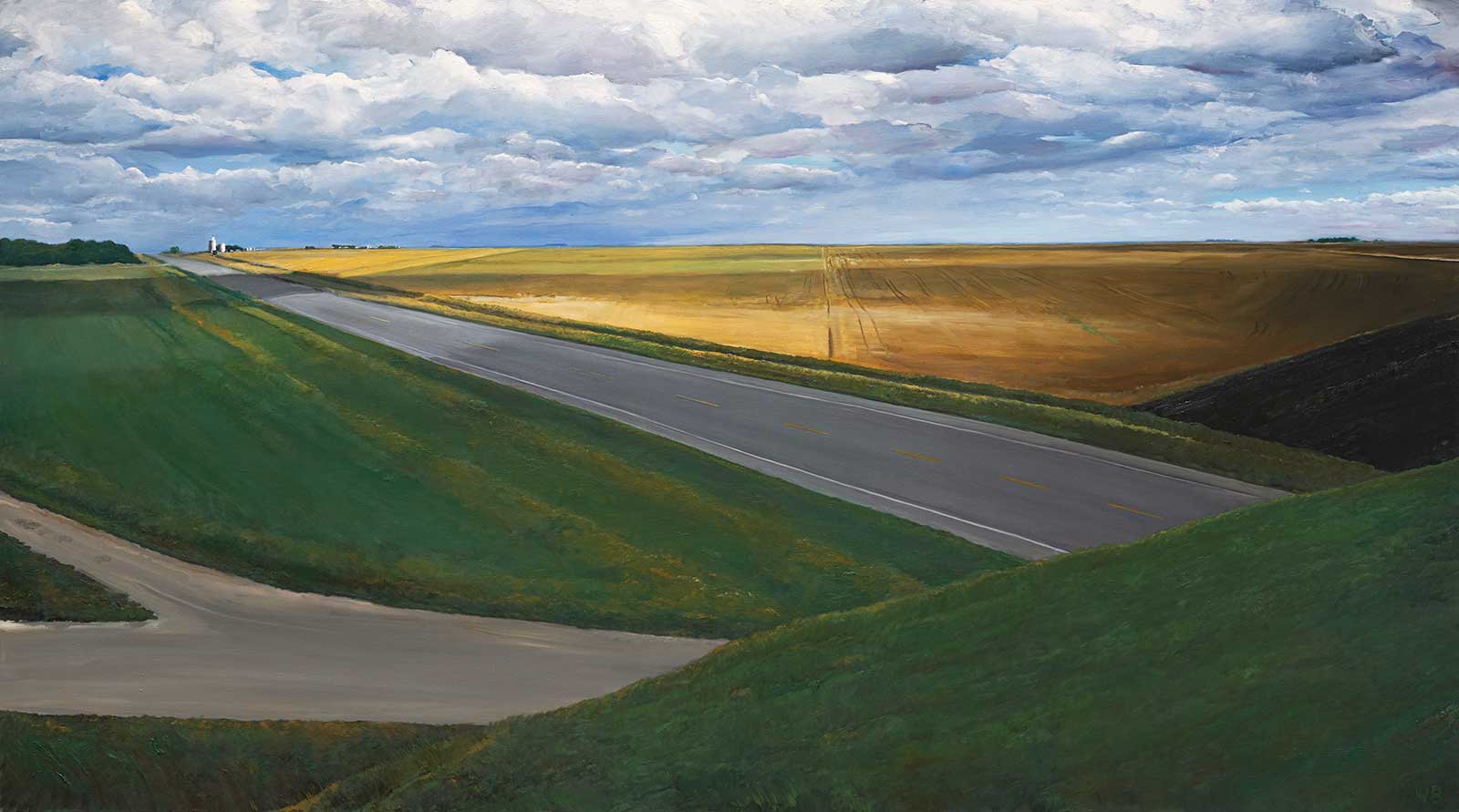
Montana, 2020, oil on canvas, 58 x 104". © William Beckman. Courtesy of Forum Gallery, New York.
While Brian Young, gallery director for the Windgate Center for Art + Design at the University of Arkansas, has long admired Beckman’s canvases and drawings (he worked on a exhibition of Beckman’s three decades ago at what is now the Arkansas Museum of Fine Arts), he had many particular goals for the show in the gallery he now oversees. ”One area that I wanted to emphasize to our students,” he says, “is the idea that an artist working in large-scale is something that is really hard to do well.” Young also wanted to emphasize the importance of drawing and painting as degree disciplines to pursue. The school is well regarded for its embrace of multiple mediums—printmaking, ceramics, metalworking, graphic design and furniture making, but Young wanted to ensure that painting and drawing on paper, especially with charcoal, for which Beckman is well known, remain celebrated and acknowledged.
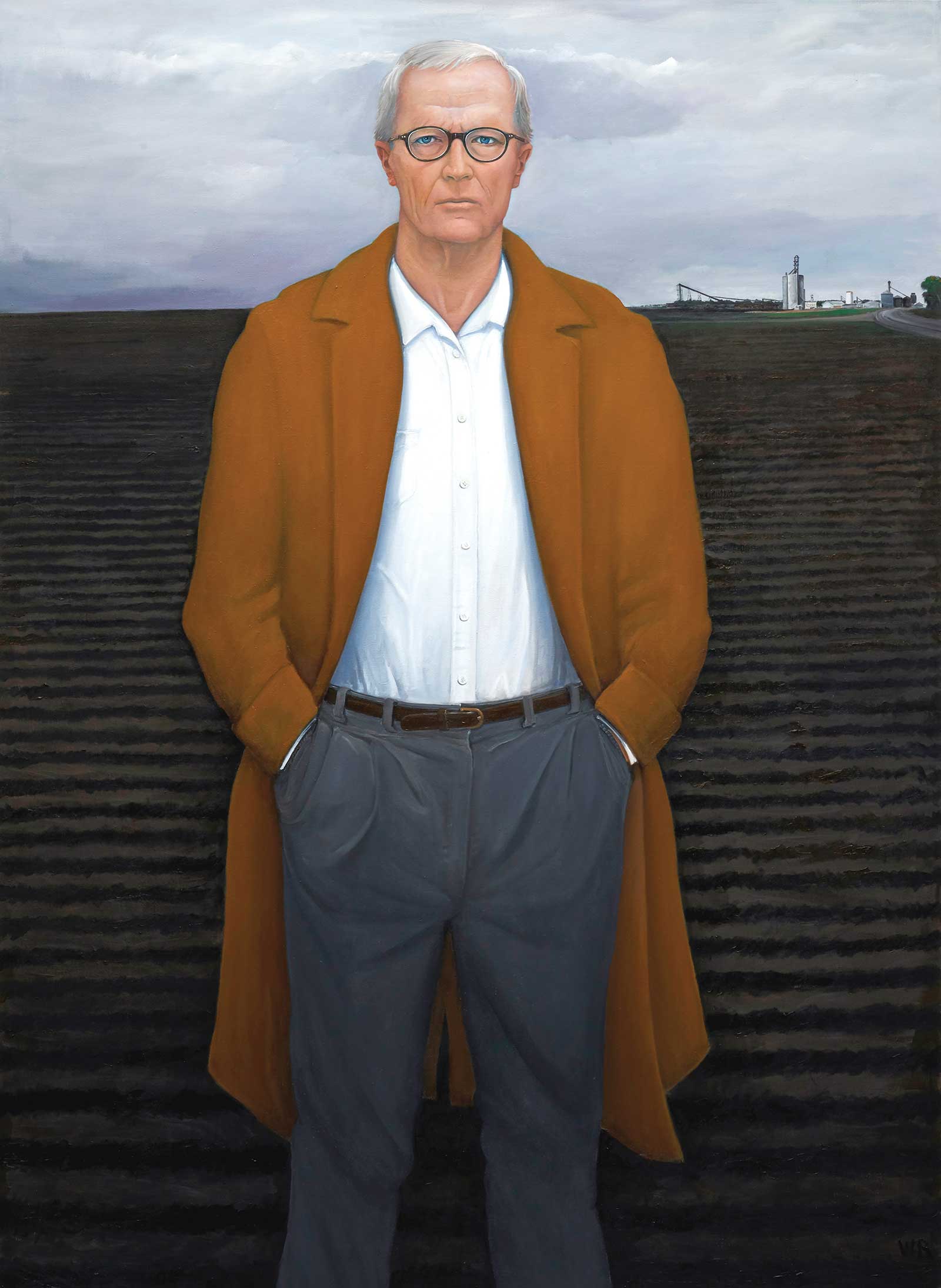
Overcoat with Plowed Field, 2018-21, oil on canvas, 100 x 73". © William Beckman. Courtesy of Forum Gallery, New York.
“Another angle of the show that I hope reaches both our students, as well as others who visit our museum, which is free and open to the public, is that this show allows you to see how William Beckman has been working over the decades, from the 1990s into the present year…So much of it is about the celebration of process. What we don’t often see about photorealistic artists like William Beckman is that there is a real process behind what they do. Finding that out is a wonderful discovery about this exhibition.”
Not only do the farmland landscapes of Beckman’s boyhood endure for him, but also the very habits of working the land. “I’m up by 5 o’clock and I work every day,” says the soon-to-be 83-year-old artist. “I love to work in the morning. I did all of my chores on the farm before heading to school. My best hours are still in the morning. If it’s going well, I will work in the afternoon, too. I don’t like artificial light and never paint with it. So I use natural light when it’s available to me.”
There is also something about the work ethic inherent in the farming life that has continued to determine Beckman’s output and ultimate success and fame. He recalls how his mother would make their own cheese and butter, collect eggs from their chickens, and use the meat from their pigs. “The farm, 80 acres, was homesteaded by my grandfather,” says Beckman, “and the arrangement back in those days was that if you built up and worked the land properly, you could turn those 80 acres into 160 acres.”
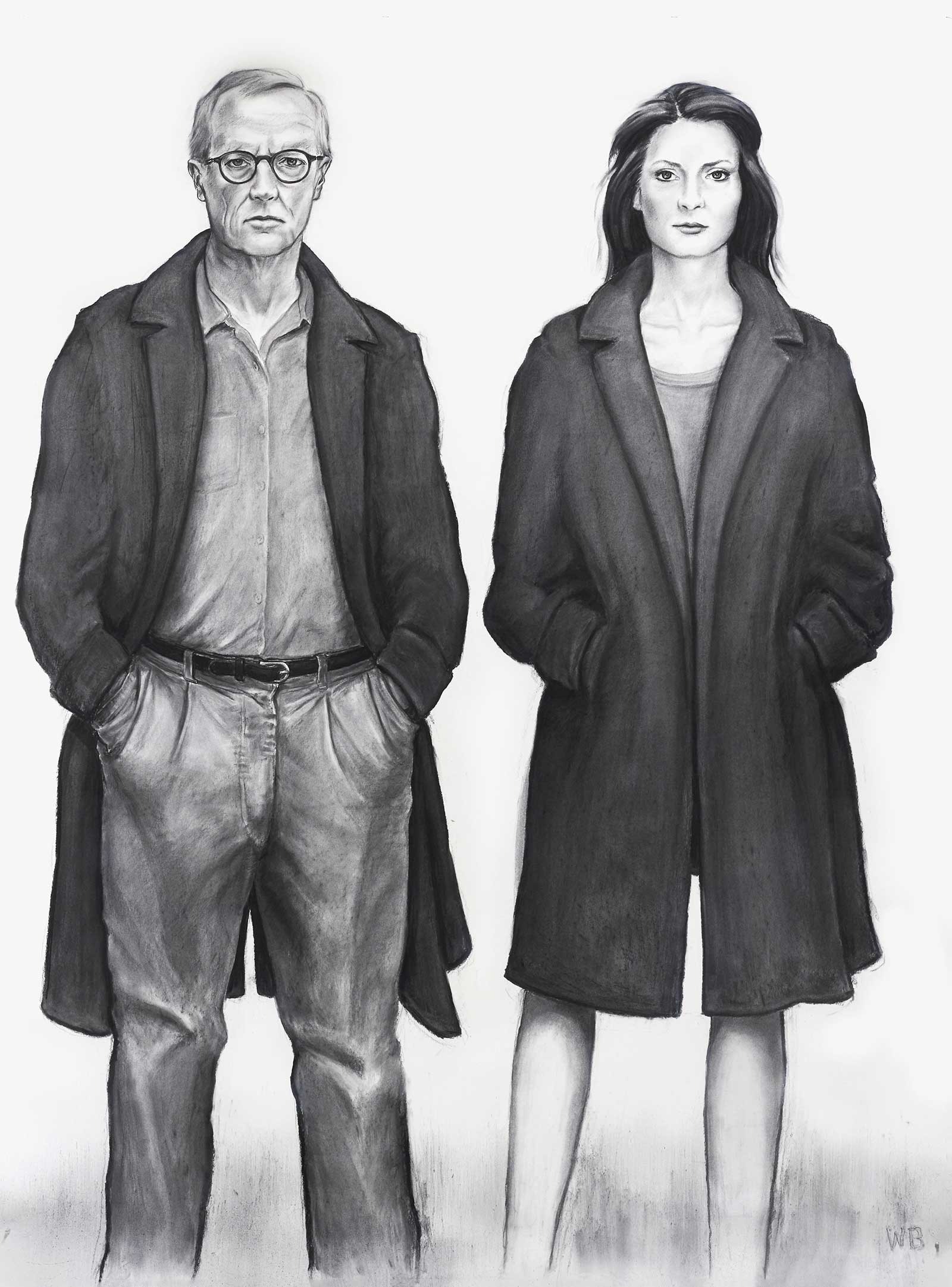
Overcoat 4, 2020, charcoal on paper, 96 x 72". © William Beckman. Courtesy of Forum Gallery, New York.
How refreshing and inspiring it is that a painter at this later point in his life and career is continuing to produce new works, new scenes and new themes. Beckman has a large and devoted retinue of private collectors, but his works are also featured in the permanent collections of many notable museums—including the National Portrait Gallery in Washington, D.C.; the Whitney Museum of American Art; the Art Institute of Chicago; the Carnegie Museum of Art; and Vienna’s Museum Moderne Kunst.
“There is something distinctly American about his art,” Lorenz emphasizes. “Another aspect that defines him is that his figures never touch but remain independent of one another. There are multiple layers of meaning in his works, but they draw you in in various ways that tug at the consciousness and collective memory, especially if you are American.” Lorenz points to works in the show that reflect this idea—works, perhaps, that are destined to become American painterly icons, such as Bel Air Farm Summer and Montana, both from 2020, and the 2024 work Blue Straw Bales and Plowed Fields(2024). The show reveals, too, that Beckman has always worked with a variety of materials and mediums—oil on canvas, oil on panel, pastel on paper, charcoal on paper.
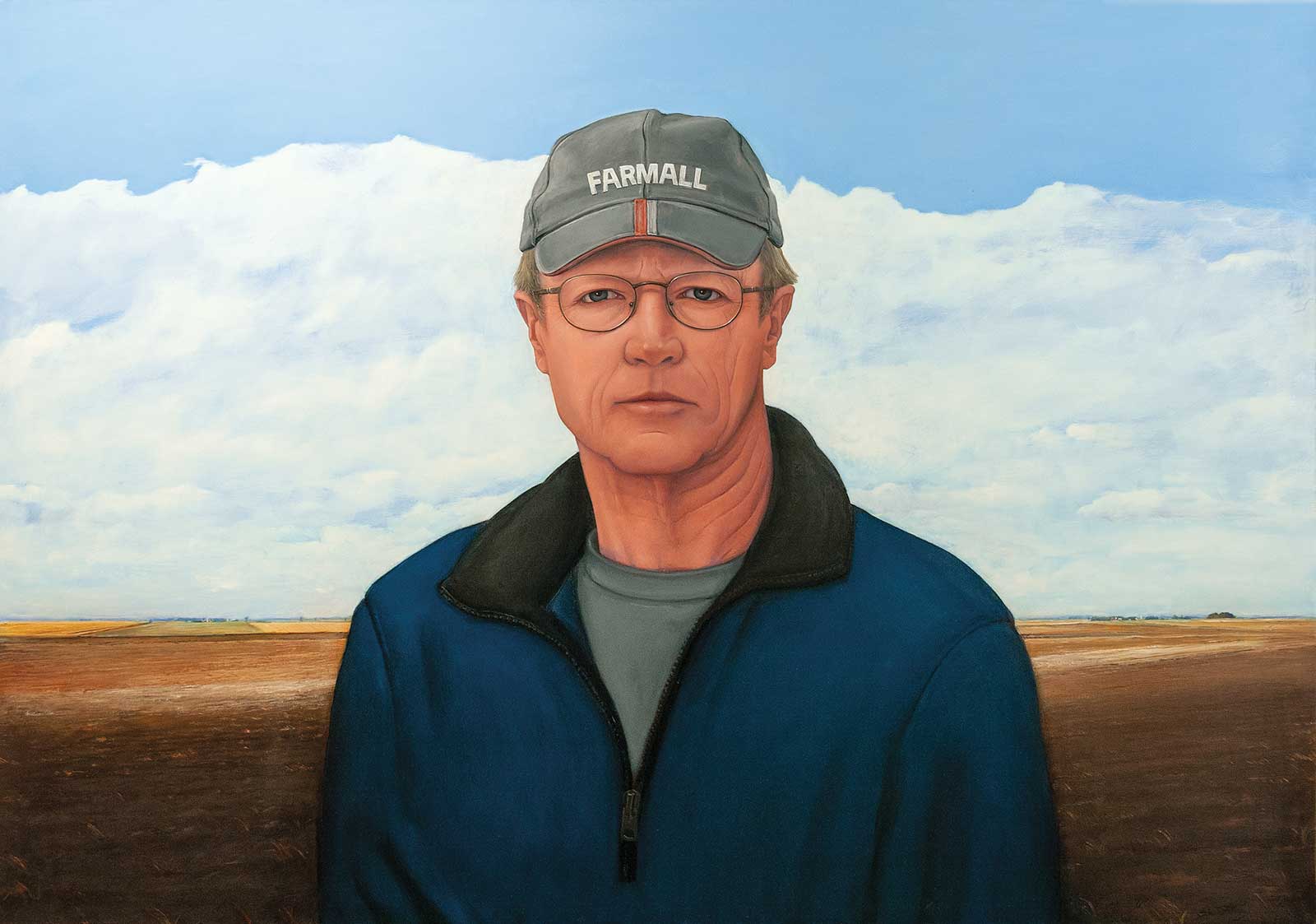
Self-Portrait with Farmall Cap, 2009-15, oil on panel, 34½ x 49¼". © William Beckman. Courtesy of Forum Gallery, New York.
Beckman is a decided realist painter, but there is still an enigmatic, mysterious current that infuses his scenes. Yes, they show real things and real people, but there is a storyline not quite discernible or fully told. His Home, which he began in 2011 and worked on for over a decade, is a somewhat somber, peopleless landscape, is among the most moving of the works in the show, and the most minimalist in composition. The viewer can’t help but conclude that he is reimaging his home of youth and metaphorically depicting, from foreground to background, the course of his life. All of his works are thematically accessible, no matter whether they are massive or diminutive in scale, and outright beautiful. What he paints is like no other painters.’
Without even trying to be a revolutionary of sorts, Beckman began painting at a time when abstract expressionism and Pop Art prevailed. Upon his arrival in New York in the 1960s, figurative and realistic artworks were often shunned, if not reviled. “One of the reasons he became, and remains, an important American painter,” says Young, “is that William always veered off the path of what was just popular.” Fortunately, Beckman fell into a large crowd of fellow artists, many of whom would congregate once a month on a Friday evening at the downtown loft of Alfred Leslie, a painter who had begun as an abstract expressionist, but quickly changed his course to realism. Beckman, too, soon acquired such a Manhattan loft where he lived and worked for several years.
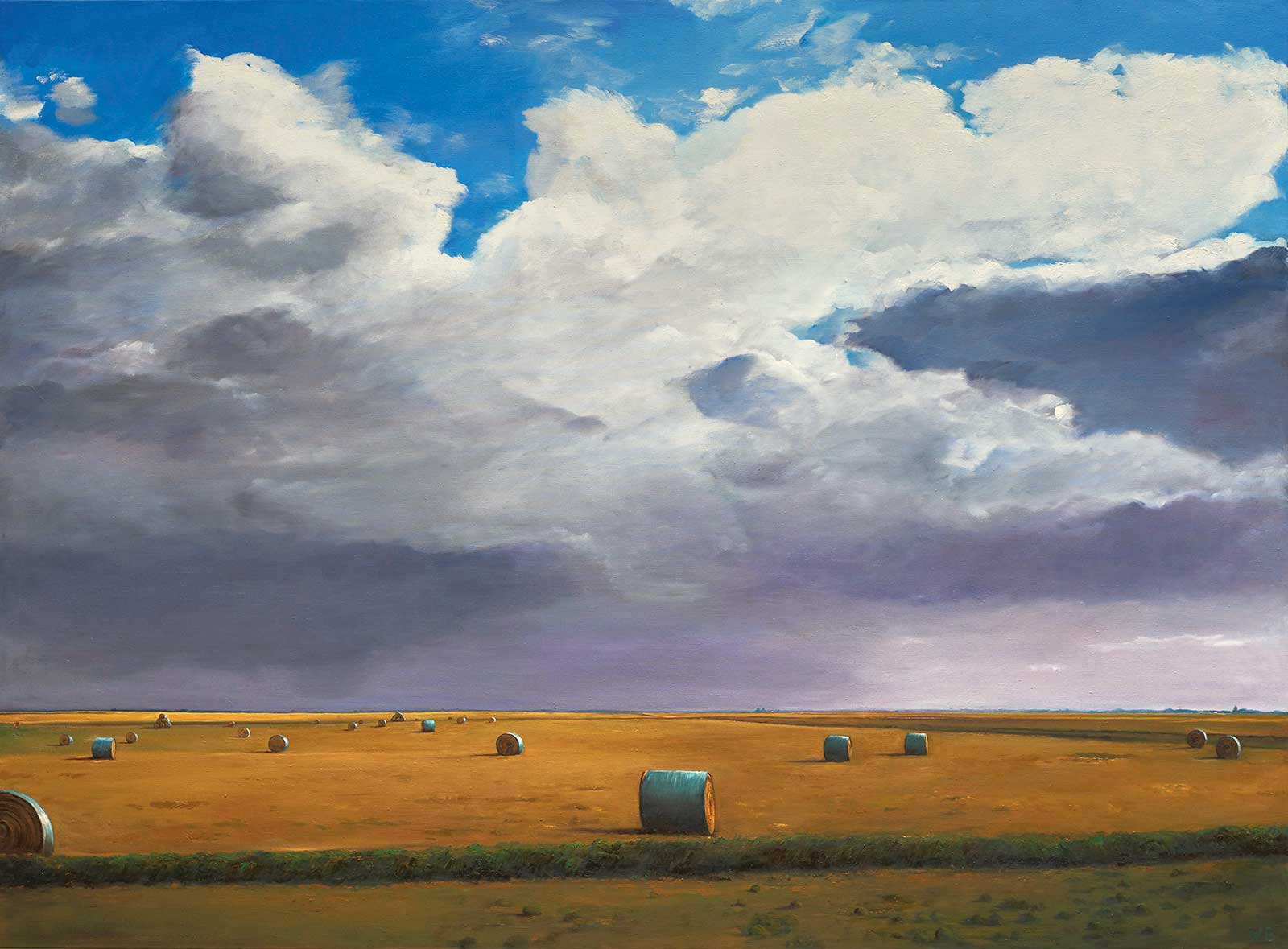
Bales #4, 2018, oil on canvas, 73 x 99½". © William Beckman. Courtesy of Forum Gallery, New York.
“That crowd of fellow figurative painters got so large that we started meeting on most Friday nights, rather than just once a month,” he recalls. Even though Beckman was part of that A-list crowd of painters, one of the charismatic young men involved in the life of the city at that time, he admits to eventually wearying of Manhattan. ”I missed the country. I’m not a big person for crowds and people. I’m not a city kid. I like meeting people, all kinds of people, but I missed big, large open spaces.” In 1978, he found a spread of land in Dutchess County where he has lived ever since, adding on to the circa-1870 main house and creating a dedicated working studio.
Beckman understands perfectly not only how to create a scene on canvas or paper but also why he does so as he does. “There’s always a reason for realism,” he says. “You quickly understand and can relate to what is shown. And when you are dealing with the figure and realism, clearly you can make, and convey, a message. We are humans and we relate very quickly to seeing other humans.” —
William Beckman: On the Horizon
Through June 30, 2025
University of Arkansas at Little Rock
Fine Arts Building, Gallery One
2801 S. University Avenue, Little Rock, AR 72204
(501) 916-3000, www.ualr.edu
www.forumgallery.com
Powered by Froala Editor