Wayne Thiebaud (1920-2021) wrote, “I believe very much in the tradition that art comes from art and nothing else. Art for me simply means doing something extraordinarily well. And doing it in such a way that it becomes rare, a tremendous achievement and a human experience symbolically reduced to an essential prime number or example.”
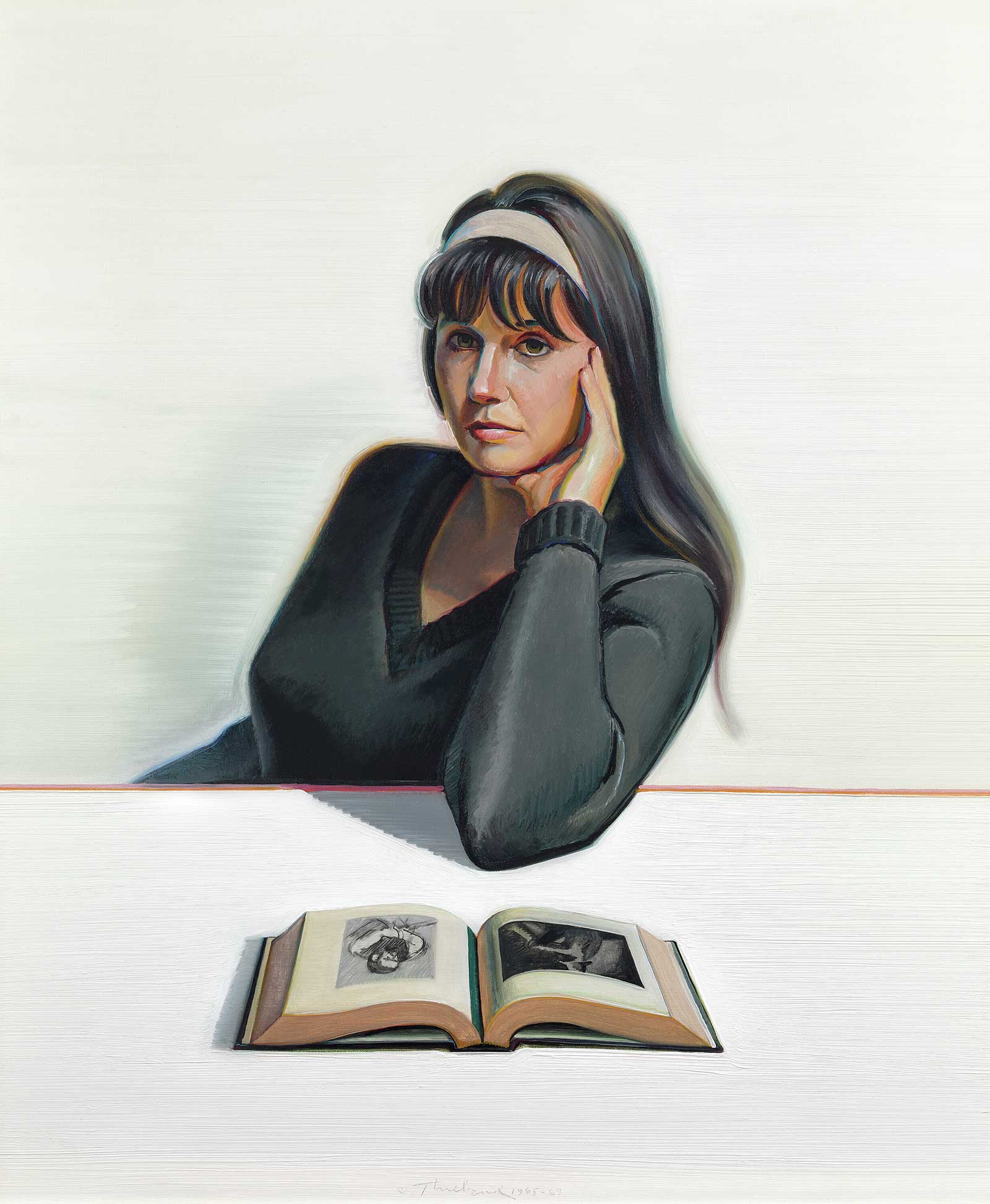
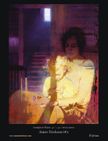
Wayne Thiebaud (1920-2021), Betty Jean Thiebaud and Book, 1965-1969, oil on canvas, 36 x 30”. Crocker Art Museum, Sacramento, CA. Gift of Mr. and Mrs. Wayne Thiebaud, 1969.21.
We’re all familiar with his “revelatory paintings that depicted a quintessentially American cornucopia of delectable—or dubious—diner and delicatessen foods,” writes Timothy Anglin Burgard, senior curator at the Fine Art Museums of San Francisco. “His abstracted renderings, often mistaken for realism, transformed his prosaic subjects into poetic visions that mingle the sociological with the surreal.” Burgard is curator of the exhibition Wayne Thiebaud: Art Comes from Art which will be shown at the Legion of Honor through August 17.
The extraordinary exhibition features not only Thiebaud’s familiar work but also much that is less familiar. It includes 37 works from his personal collection by artists from Jean-Auguste-Dominique Ingres to Henri Matisse to Joan Mitchell. The exhibition also includes Thiebaud’s paintings inspired by other artists. Thiebaud defines “inspired” in a surprising way. “It’s hard for me to think of artists who weren’t influential on me because I’m such an obsessive thief. One thing I’m cranky about is that people don’t realize painting is all one tradition. I hate dividing it. It’s like saying there’s something called California mathematics. The conventions of painting have always been the same, and they’re the same with abstract and realist painting.”
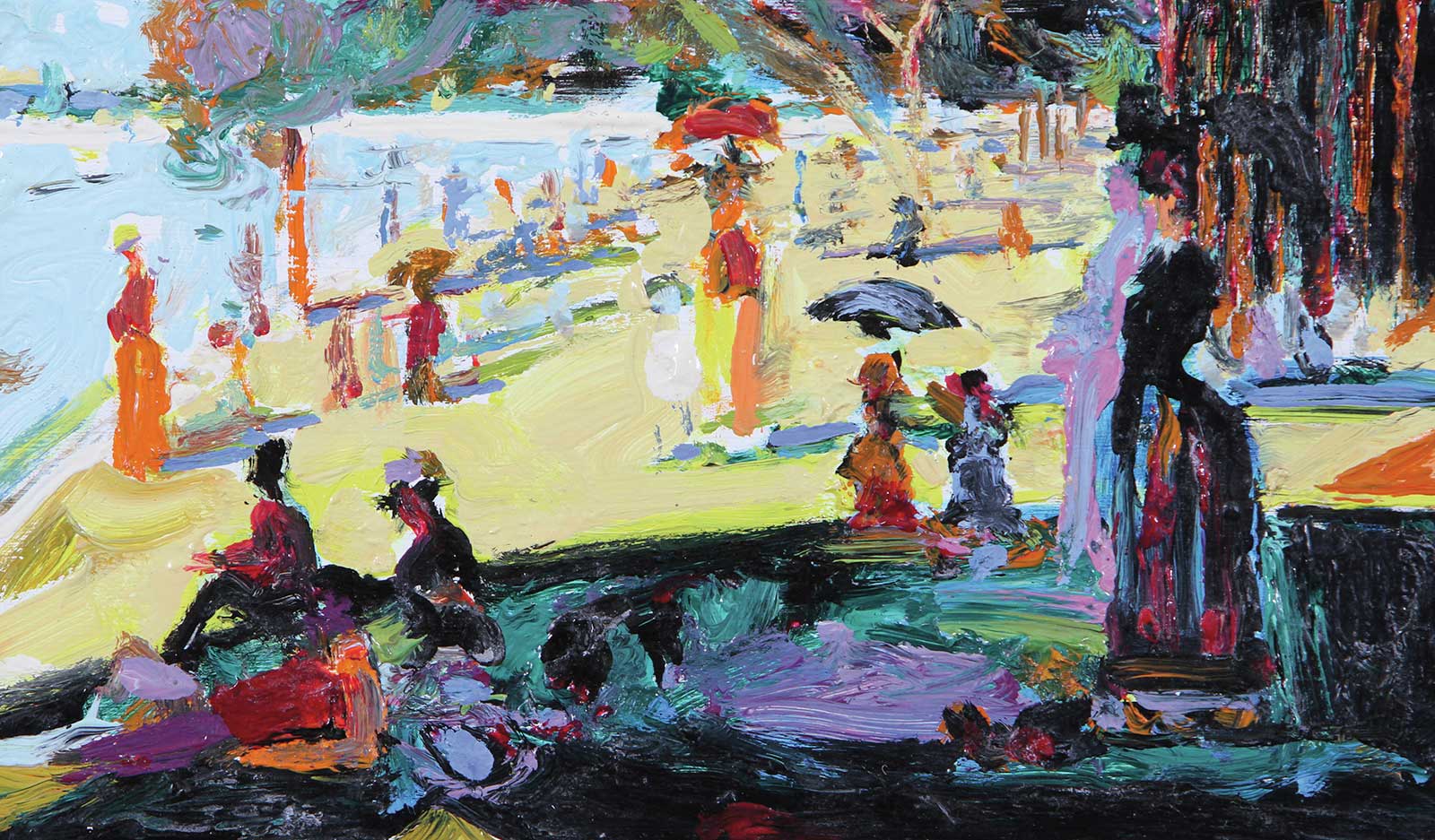
Wayne Thiebaud (1920-2021), A Sunday on La Grande Jatte (after Georges Seurat), 2000, oil on board, 611/16 x 113/8”. Collection of the Wayne Thiebaud Foundation.
Copying was an integral part of his own work and in his years of teaching at the University of California, Davis, he wrote, “My world is one of crime. I steal from every artist around the world. I steal from the Japanese; I steal from the Chinese; I steal from de Kooning; I steal from Diebenkorn—and try not to insult them at the same time. I don’t want to copy them. It’s just that their works come with a useful tool of generating possibilities as a painter…Your ambition is to try as best you can to create a little different visual species. Museums are the bureau of aesthetics and physical achievements. You go to the museum in order to check yourself against those standards.”
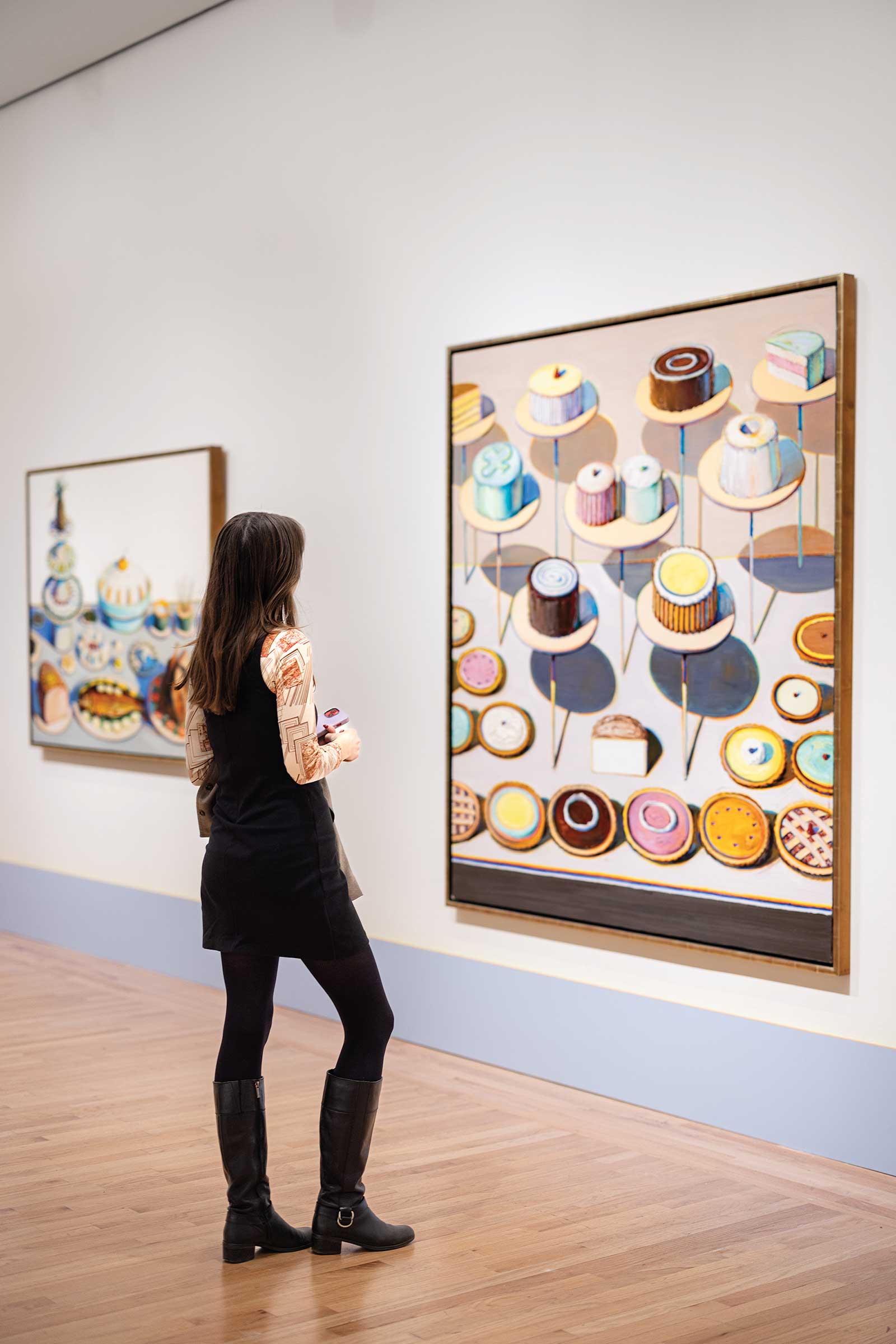
Installation view. Photograph by Gary Sexton.
Thiebaud was modest about his own accomplishments. “It isn’t humility so much as itis a recognition that you’re in a world of tradition which is so rich with such supreme accomplishments. It’s almost audacious: pick up a brush and you’re in the same business as Rembrandt? That’s overwhelming. But it’s also terrific because then you’re responsible not to ignoble that tradition.”
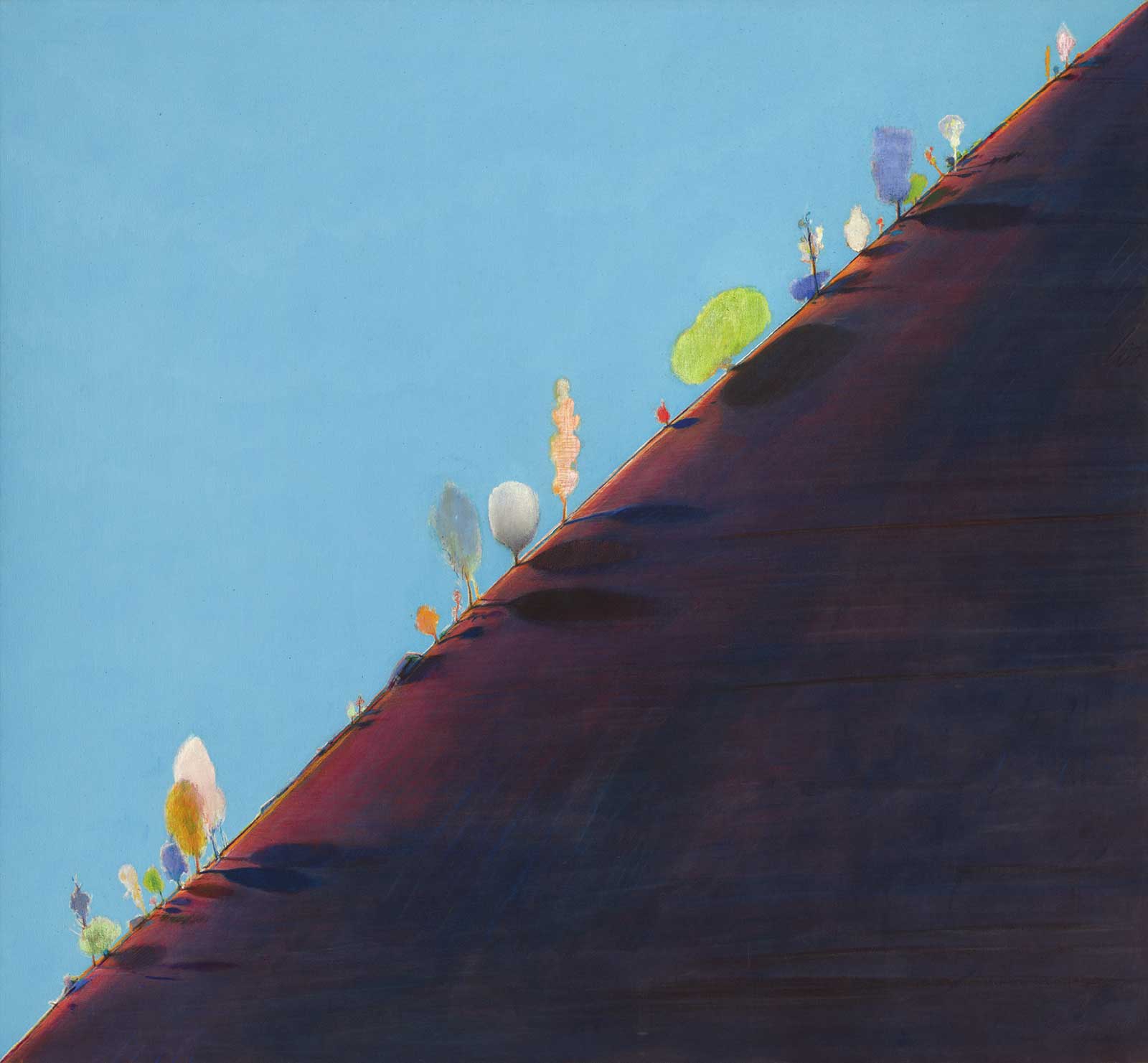
Wayne Thiebaud (1920-2021), Diagonal Ridge, 1968, acrylic on canvas, 77¾ x 84”. Private Collection.
Eve Aschheim was Thiebaud’s teaching assistant at UC Davis. She recounts that his course, Art 148: Art Theory and Criticism, “was centered on the work of painters Thiebaud admired and was delivered as an engaging mix of art history, formal analysis, criticism, poetry and social history. He gave students a glimpse into the minds of his personal pantheon of artists, including Jean-Siméon Chardin, Jean-Auguste-Dominique Ingres, Rosa Bonheur, Édouard Manet, Edgar Degas, Paul Cézanne, Berthe Morisot, Henri Matisse, George Herriman, Giorgio Morandi, Willem de Kooning, and Agnes Martin.” She continues, “Copying was essential both to Thiebaud’s own working method and to his conception of art history as a series of borrowing…Through copying, one enters into the artist’s process and learns how a painting was made. In his painting courses, assignments included: paint a copy of a reproduction, extend a small reproduction on a larger canvas, duplicate in paint a small abstract-looking section of a figurative painting, and draw a copy of each other’s work.” Thiebaud continued teaching until he was 100.
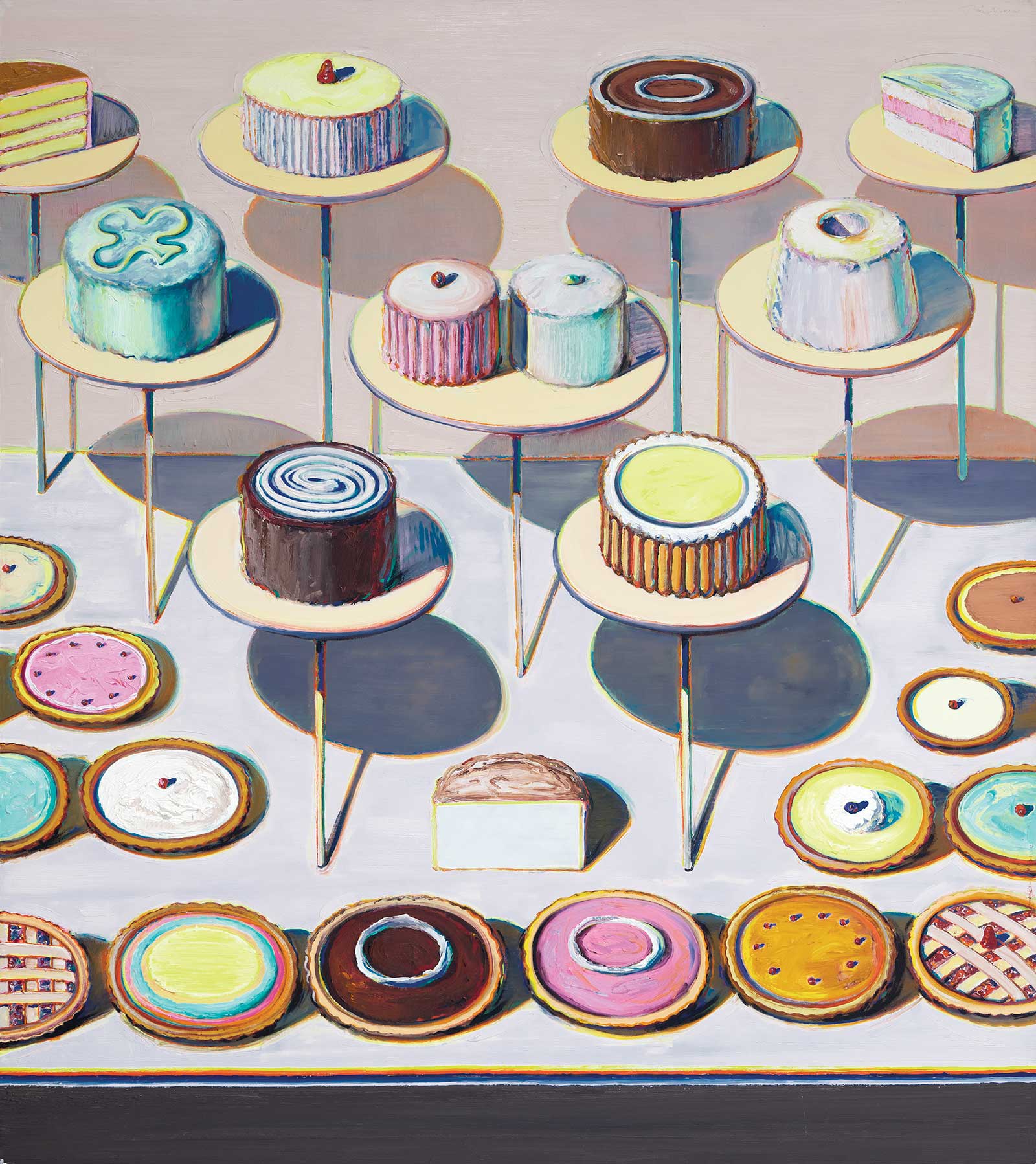
Wayne Thiebaud (1920-2021), Cakes & Pies, 1994-1995, oil on canvas, 72 x 64”. Collection of the Kemper Museum of Contemporary Art, Kansas City, MO. Bebe and Crosby Kemper Collection. Gift of the Enid and Crosby Kemper Foundation, 1995.100.01.
His own paintings often contained references to the paintings of other artists—some recognizable and some obscure. Degas’ painting The Millinery Shop depicts hats on stands. Burgard notes, “Unlike art historical comparisons where the subjects of the source image and Thiebaud’s reinterpretation are similar, some of his most interesting appropriations obscure their original sources through a process of intuitive transmutation. These more elusive connections underscore the absolute artifice of his still-life paintings, which were created rather than observed…” In Display Cakes, 1963, Burgard observes that Thiebaud “has transformed Degas’s circular hats on stands into a trinity of circular cakes that also hover and gravitate toward the two-dimensional picture plane.”
His paintings of pastries were also influenced by his working in diners and bakeries when he was a boy and drawing the sweets on display. The simplicity of Display Cakes evolved into the more complex Cakes and Pies,1994-1995.
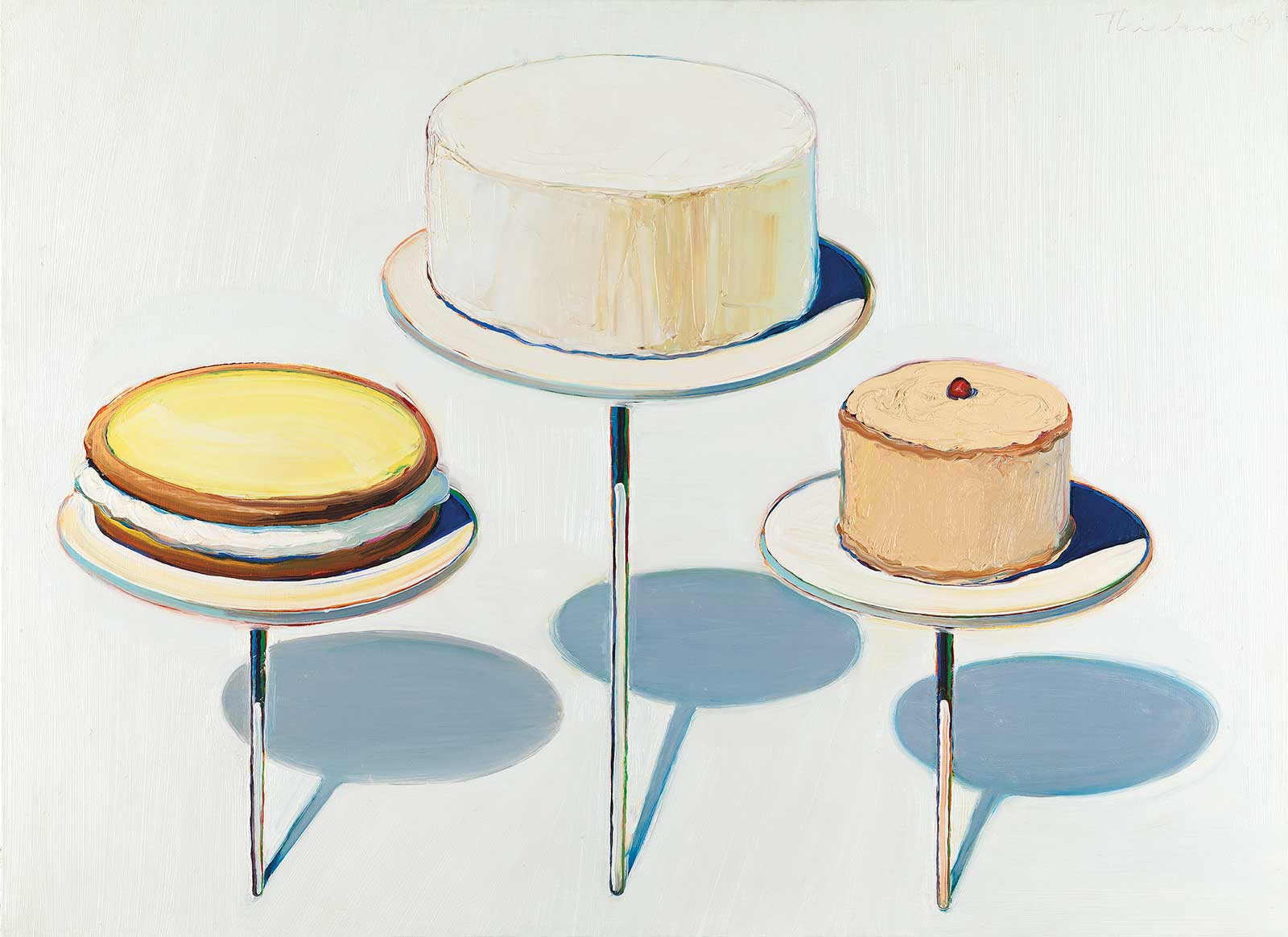
Wayne Thiebaud (1920-2021), Display Cakes, 1963, oil on canvas, 28 x 38”, San Francisco Museum of Modern Art, San Francisco, CA. Mrs. Manfred Bransten Special Fund purchase.
His Day Streets from 1996 recalls Richard Diebenkorn’s Ocean Park paintings, vertical abstractions of the Santa Monica, California, neighborhood. Comparing the painting to one of Diebenkorn’s series, Burgard explains, “while not necessarily a specific match for Diebenkorn’s Ocean Park #30 of 1970 similarly asserts the two-dimensional picture plane through structural lines, while evoking space through large color planes. Both paintings are divided into vertical rectilinear blocks that are crossed and connected by strong diagonals. Amplifying Diebenkorn’s simultaneous sensation of compression and spatial ambiguity by transposing these elements onto an ostensibly representational cityscape. Thiebaud’s vertiginous use of isometric perspective fosters both physical disorientation and psychological unease, underscoring humankind’s ambition and hubris in replacing natural topography with such precarious artificial constructs.”
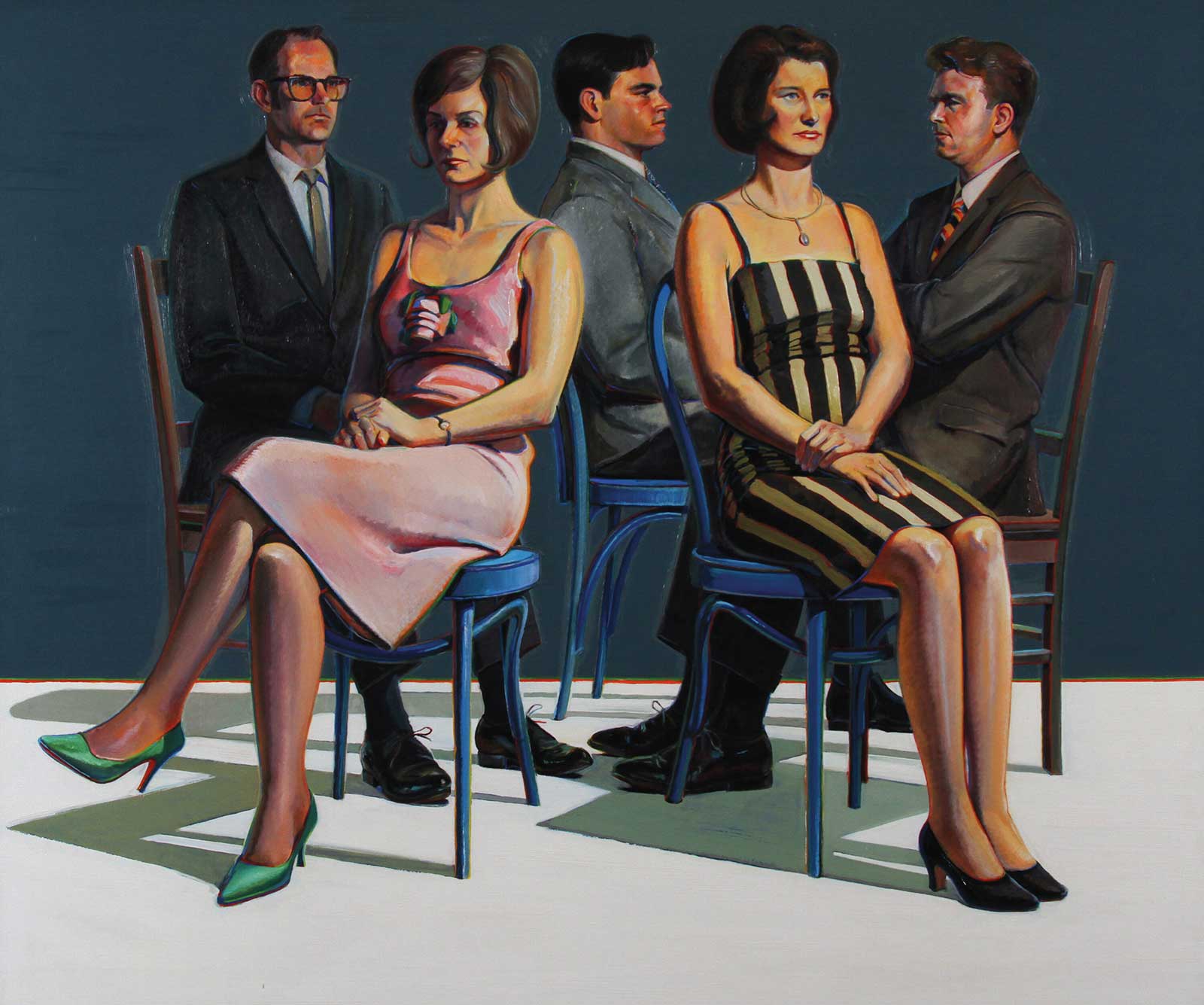
Wayne Thiebaud (1920-2021), Five Seated Figures, 1965, oil on canvas, 60 x 72”. Collection of the Wayne Thiebaud Foundation.
Diebenkorn influenced Thiebaud with his own influences. Thiebaud commented, “I knew so little about color. It was only when I fell in love with some of the things that Dick loved, like the color in Persian and Indian miniatures, which also influenced artists like Matisse and Bonnard—that tradition was amazingly helpful. But I really got that through Dick. Looking at his painting is what really excited me about going more into color.”
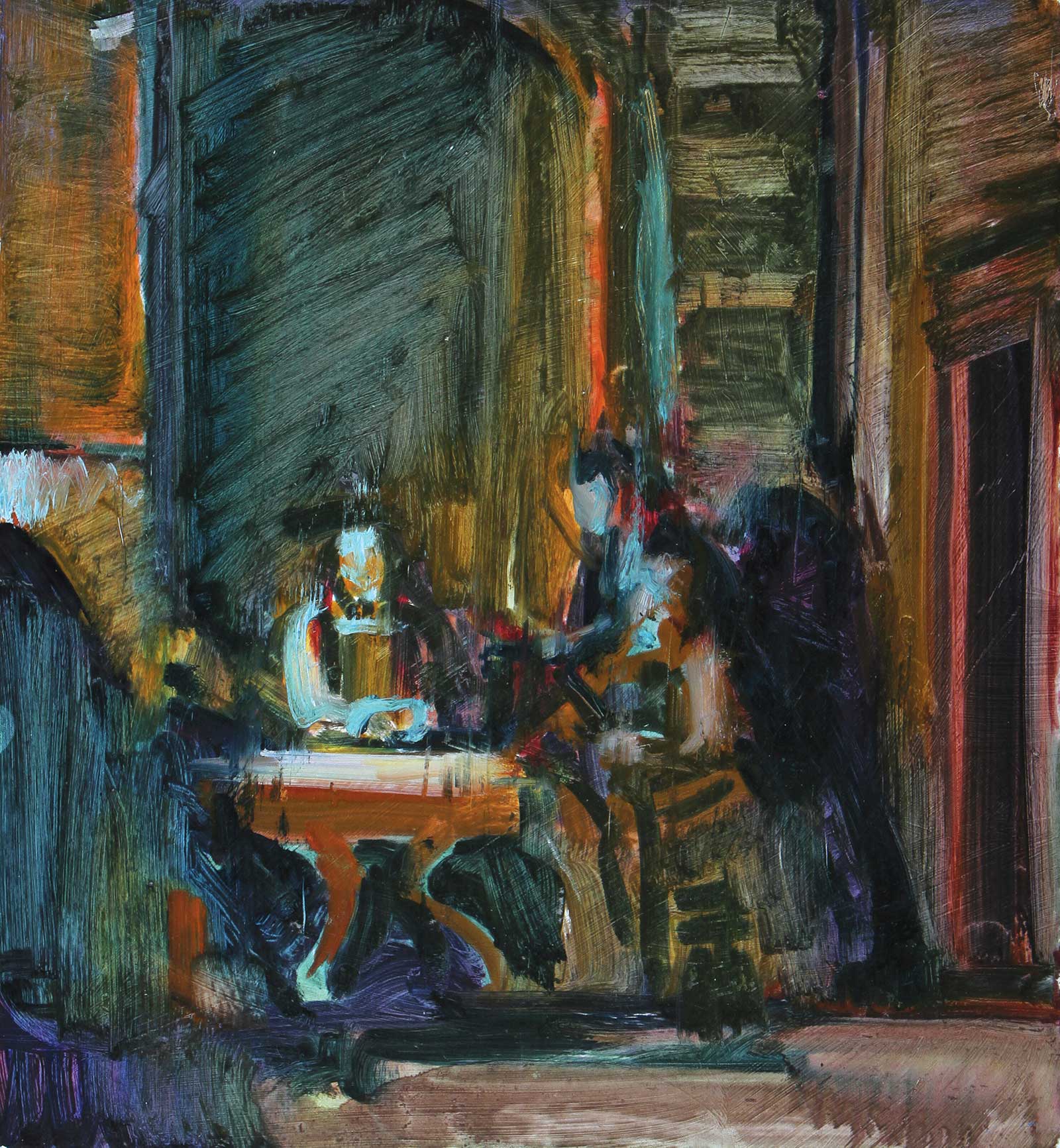
Wayne Thiebaud (1920-2021), Supper at Emmaus (after Rembrandt van Rijn), oil on Masonite, 1513/16 x 143/16”. Collection of the Wayne Thiebaud Foundation.
I worked with Diebenkorn on a catalogue for the then Albright-Knox Art Gallery. Visiting a friend in Santa Monica, we went to Ocean Park and I immediately went “Aha!” Thiebaud had a similar experience and recounted, “Diebenkorn tends to have in his work what Proust says about memory. You don’t quite know where everything comes from. In the Ocean Park series, for instance. But, if you go down, see his studio, walk along the beach and see the ocean, concrete bunkers, freeways, even a little transom window you look out of—he gets that into his work. He takes something and essentializes it in an oblique way.”
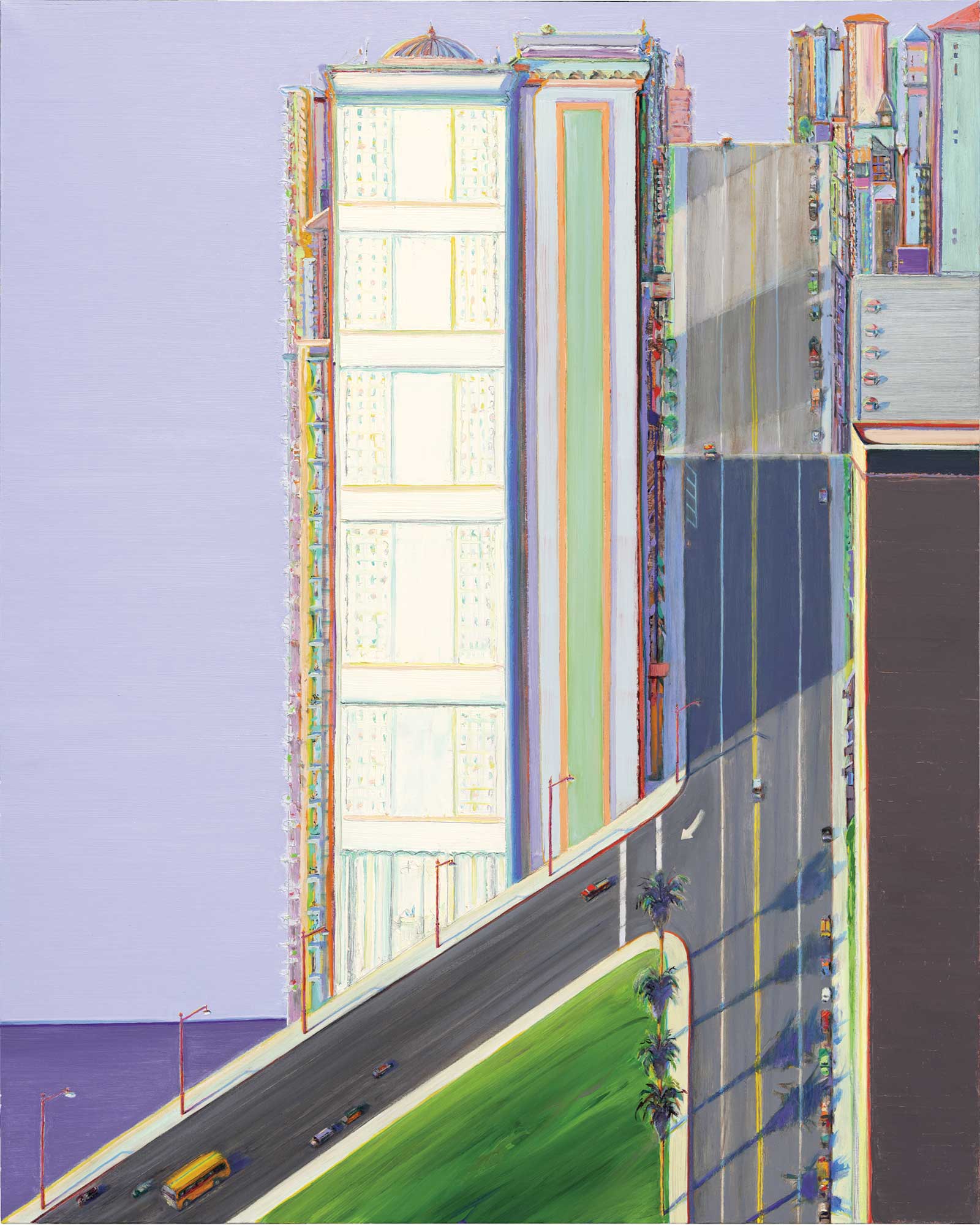
Wayne Thiebaud (1920-2021), Day Streets, 1996, oil on canvas, 59¾ x 48”. Collection of the Kemper Museum of Contemporary Art, Kansas City, MO. Bebe and Crosby Kemper Collection. Gift of the Willian T. Kemper Charitable Trust, UMB Bank n.a., Trustee, and the R. C. Kemper Charitable Trust, 1996.69.01.
Thiebaud also painted the figure. Aschheim recounts that he “seemed to think of the figure as the highest subject, and its complexity demanded the most from the artist in terms of attention and ability. Drawing the figure involved learning the coordinates of human physicality and acquiring a nuanced pictorial vocabulary….”
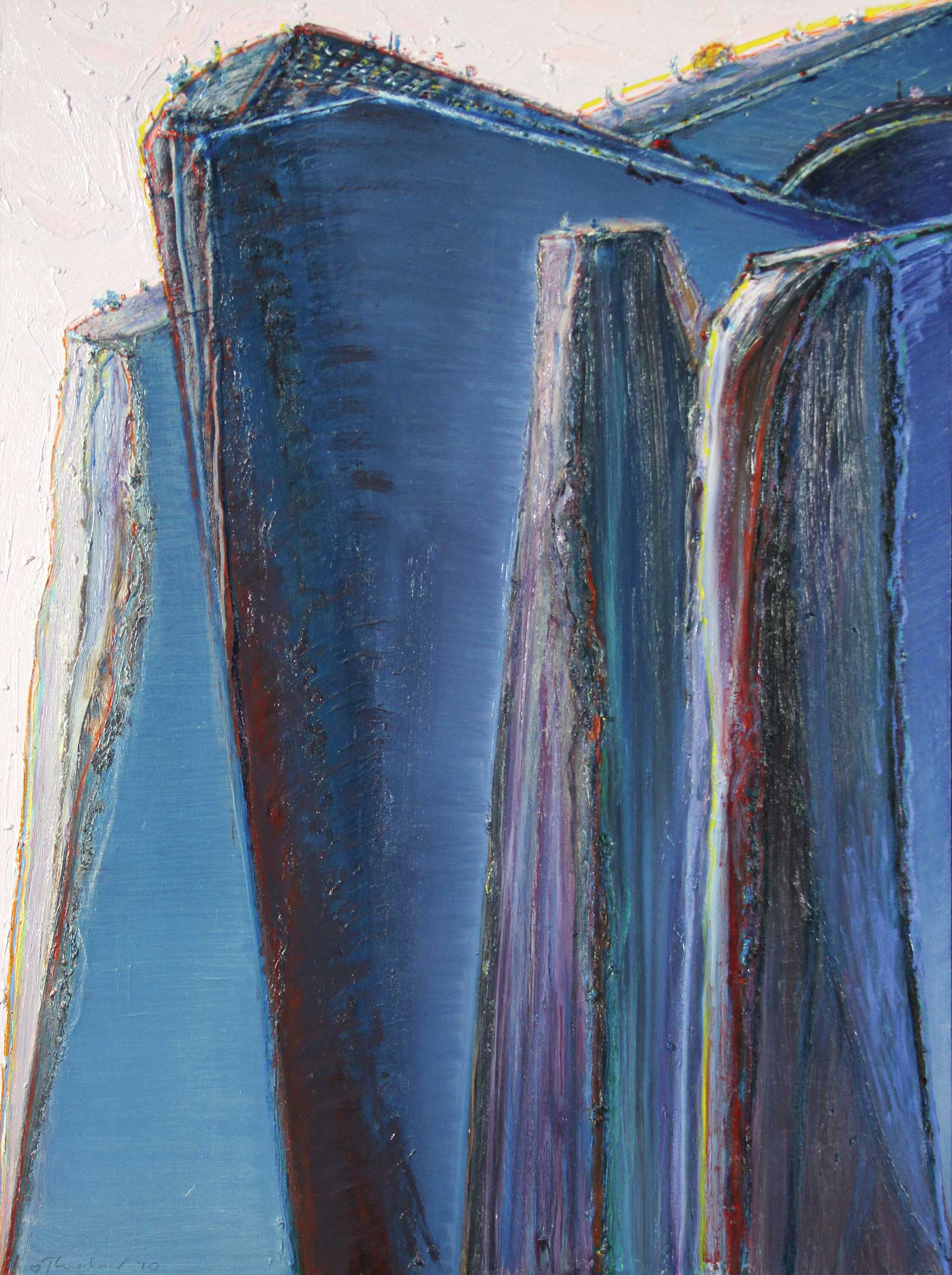
Wayne Thiebaud (1920-2021), Blue Ridge Mountain, 2010, oil on canvas, 481/8 x 357/8”. Collection of the Wayne Thiebaud Foundation.
Burgard explains, “Betty Jean Thiebaud and Book, a painting that balances ostensible realism with startling visual incongruities, is perhaps Thiebaud’s most eloquent visual ode to art, art history, and appropriation. A model of understatement, it depicts the artist’s wife seated at a table near an open art book with two black-and-white reproductions. She holds her left hand to her cheek, seemingly without pressing upon it, and rests her left elbow near the book that she ignores while staring off into space, deep in thought. Disconcertingly, the distance between the white tabletop and the white wall appears to be no wider than the opening in an envelope….”
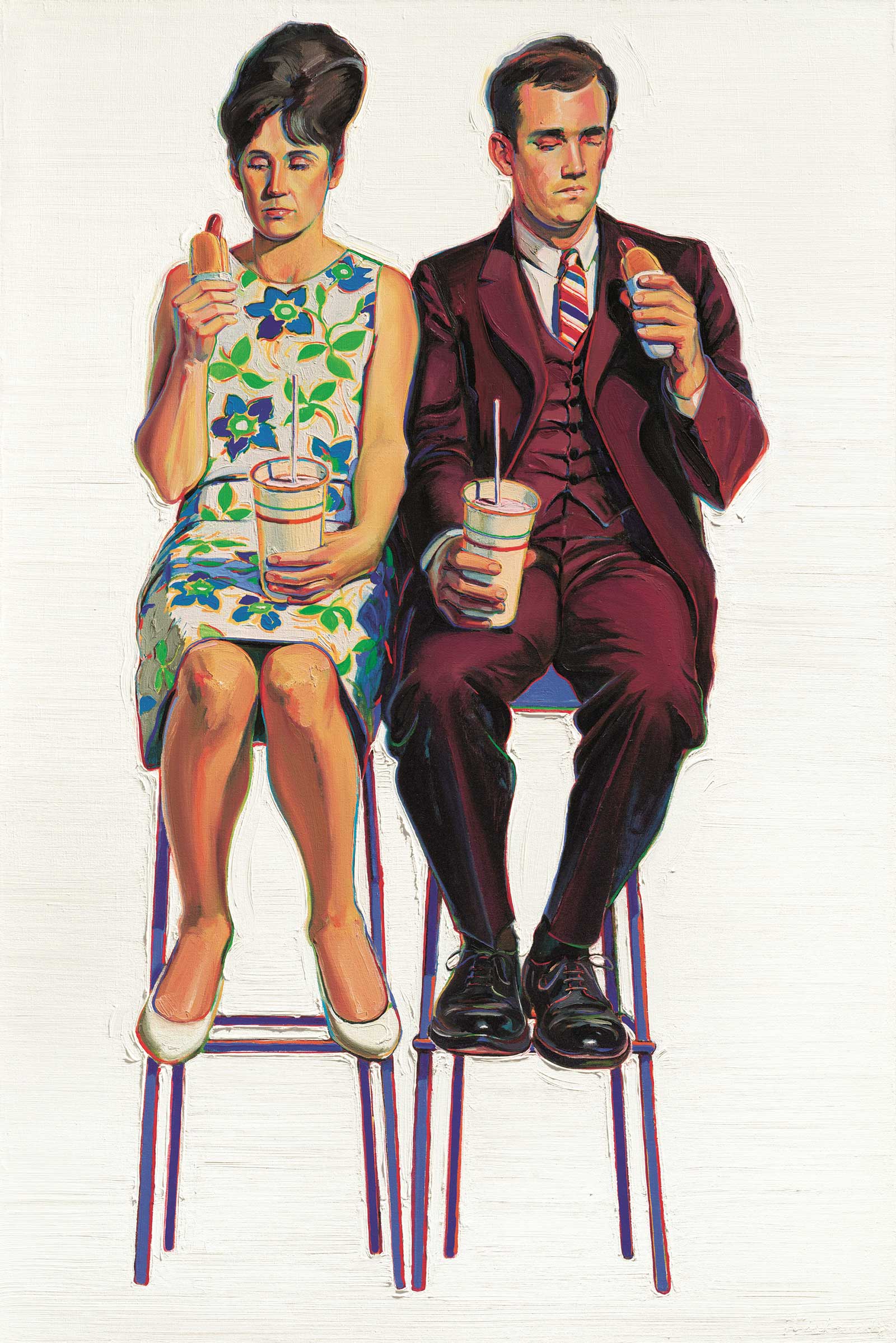
Wayne Thiebaud (1920-2021), Eating Figures (Quick Snack), 1963, oil on canvas, 71½ x 47½”. Private Collection, Courtesy Acquavella Galleries, New York, NY.
Aschheim quotes Thiebaud from his Art 148 class: “Our bodies, that’s how we measure things and feel distances, spaces, balance…This is the whole origin of life drawing classes. That’s the most basic thing we have: our heels, our shoulders, our muscularity. Our sense of ourself, enabling us to see ourselves in other people and forms…And that’s why we spend so much time drawing the human figure…That kind of information is what academic painting does…It’s your vocabulary, your dictionary of forms…Not that you ought to do this, but what might you do with it.” —
Wayne Thiebaud: Art Comes from Art
Through August 17, 2025
Legion of Honor, Fine Art Museums of San Francisco
100 34th Avenue, San Francisco, CA 94121
(415) 750-3600, www.famsf.org
Powered by Froala Editor