A walk along a certain stretch of Manhattan’s Park Avenue has become an art experience. From 46th Street northward to 57th Street, the lobbies of giant block-long, 1960s-era corporate skyscrapers feature artworks that beckon not only to passing pedestrians, but just as importantly to the people who work in the buildings every day.
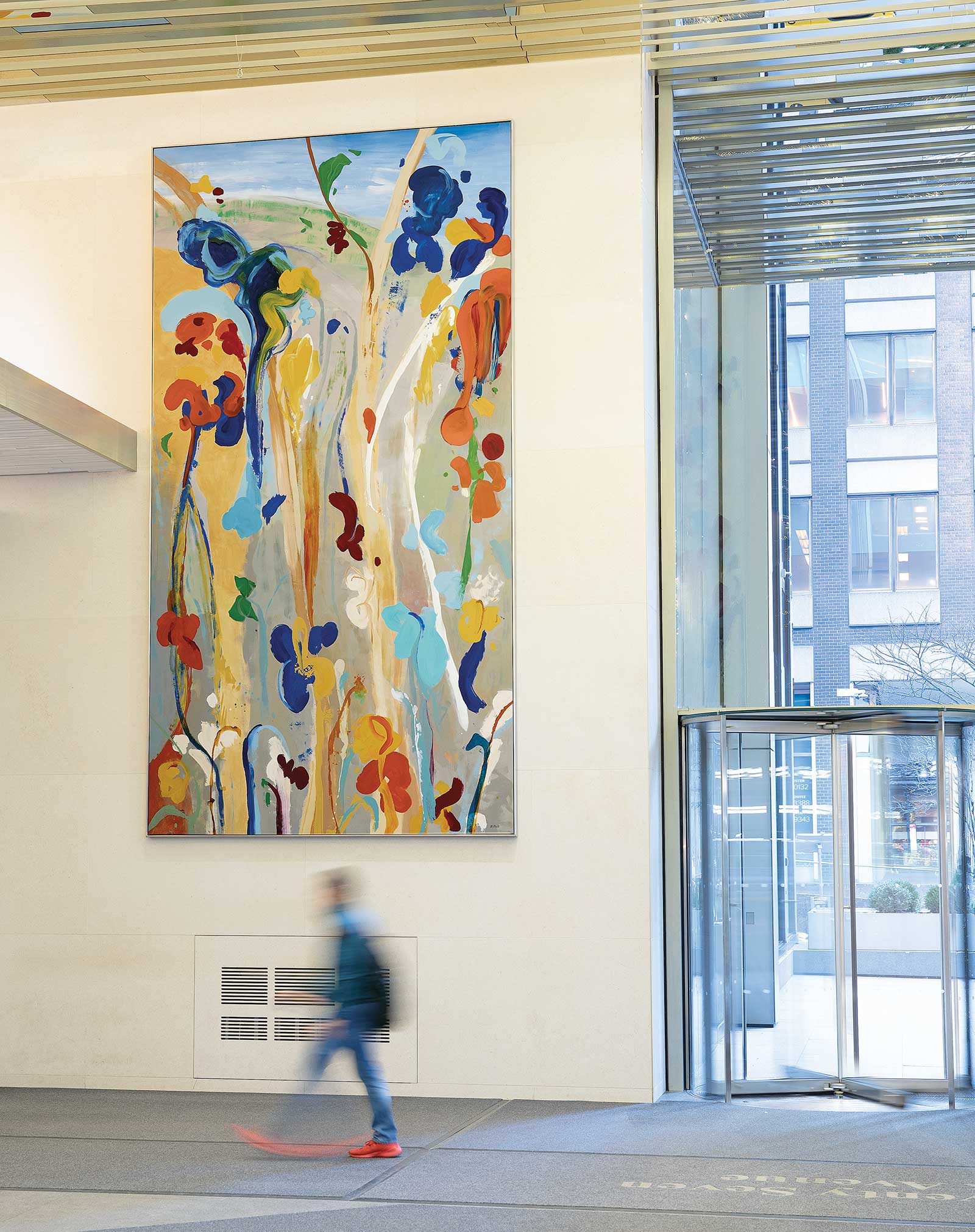
Positioned on the south side of the Park Avenue lobby of the building is Anthesis, acrylic on canvas, by Daniel Phill.
For those 11 city blocks, passersby experience a variety of mostly flashy, digital artworks through tall, glass lobby windows. The ceiling, for instance, at 250 Park Avenue, presents a constantly changing digital scene by David Niles of birds in flight, views of the solar system and the sole perspective of a basketball player’s strides, an effect that acts almost like a kinetic Sistine Chapel ceiling. Up the street at 280 Park Avenue, a 20-foot pink sculpture, BFF, by Brian Donnelly (aka KAWS), with its eyes marked as Xs, appears to look out over the street, a work so startling and kitschy that tourists regularly stop to be photographed with it. Even the lobby of the venerable Seagram Building sports Jeff Koons’ series of inflatable sharks in innertubes. At 56th Street, the Phillips auction house features a window that looks into a subterranean gallery space of works soon to go on sale, while Aston Martins are parked in a window next door as if they are decorative objects. And a portion of the lobby at the new 425 Park Avenue building (at 55th Street) is devoted to a changing gallery of works, a space known as Space2Curate.
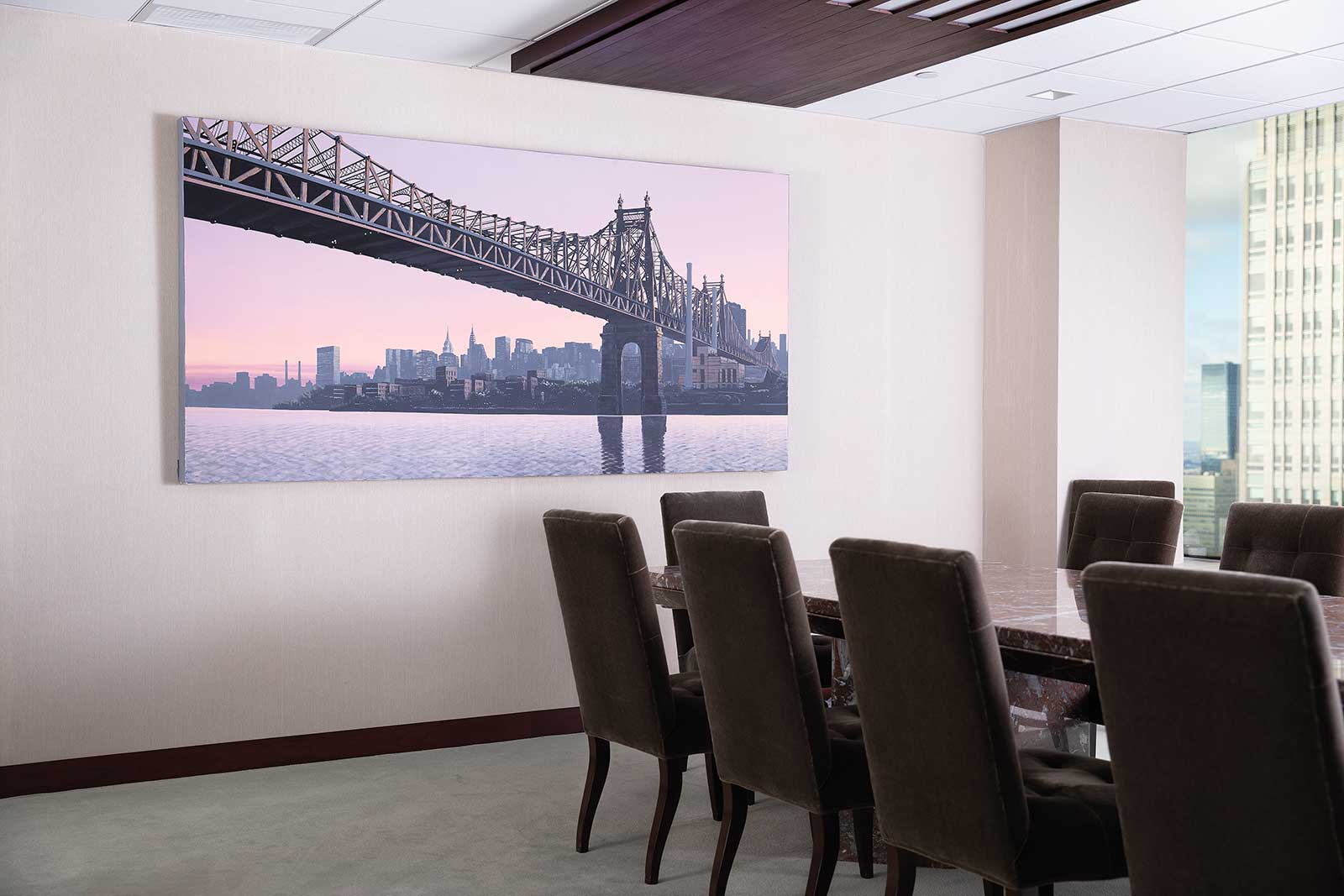
A conference room wall features View From Long Island City, oil on canvas, by Stephen Hannock.
But, perhaps, the most appealing artworks now on public display in the otherwise privately-owned buildings are found at another structure along the stretch. Suddenly, an array of painted colors and forms emerge from what is mostly a gray corridor of undistinguished skyscrapers, apart from the masterpieces of the 1958 Mies van der Rohe Seagram Building (east side at 53rd Street) and the 1952 Lever House (west side at 53rd Street). Two expansive canvases which are affixed to opposite walls in the space are so alluring that people pause on the sidewalk, a rare occurrence in midtown Manhattan where uninterrupted purposefulness is the agenda.
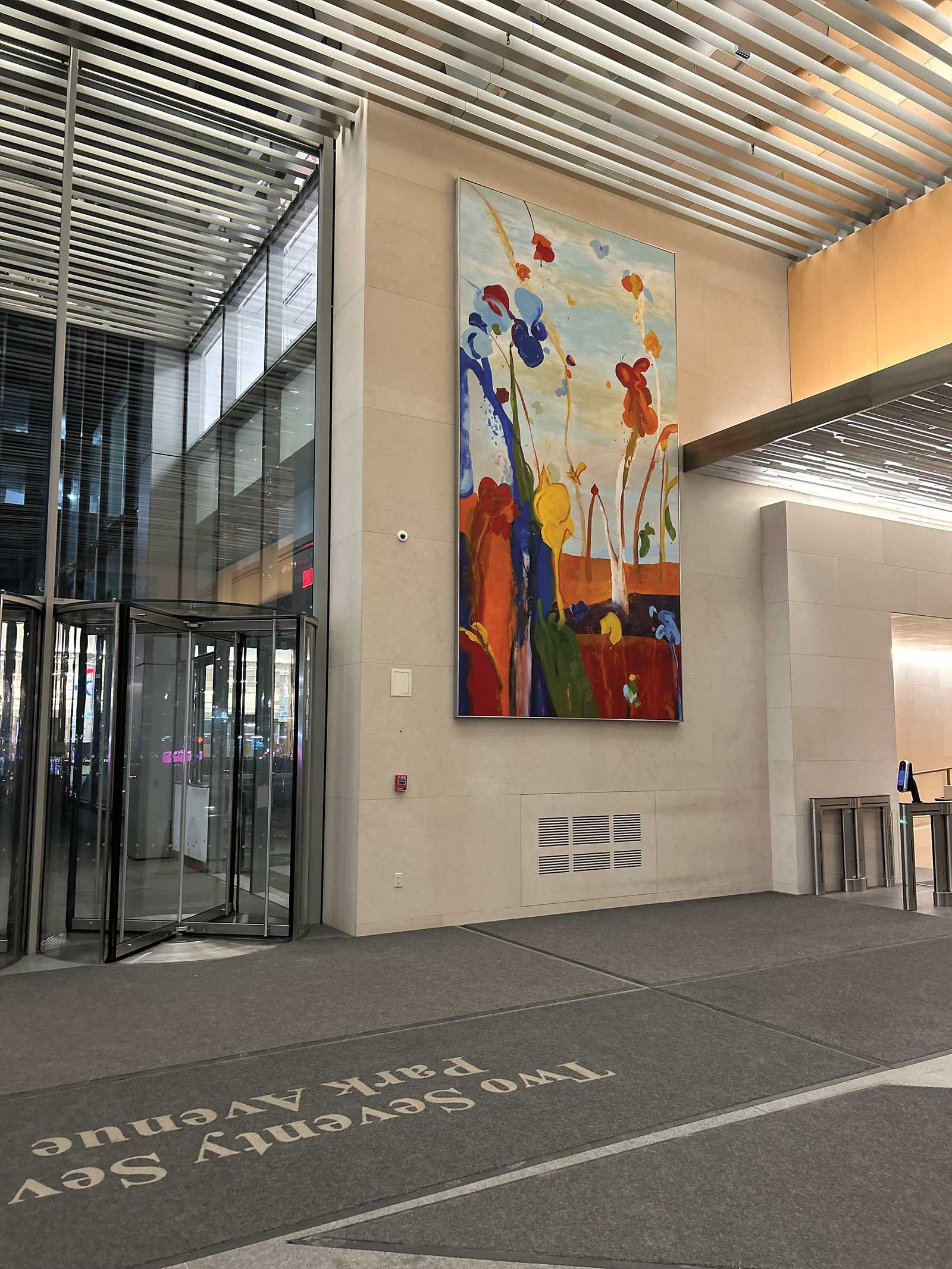
Phill’s Tellus Tall, acrylic on canvas, is situated on the north side of the lobby.
Unlike all of the other digital artworks and freestanding sculptures along the avenue, here two sizeable canvases (each 17 feet by 9 feet) evoke floral motifs. The artist for the paintings, the San Francisco-based Daniel Phill, refers to them as “abstract botanicals.” He adds, “They’re both abstractions and representations, and I’ve long been working in that place between those boundaries.” Phill entitled one of the paintings Tellus Tall, which refers to the Roman goddess of the earth. The other painting, Anthesis, is named for the process of the flowering of a plant or bud. “I like using words that people aren’t always familiar with,” he says. “When you use them in the titles of works, it stimulates a conversation, but the words I choose fit the paintings.”
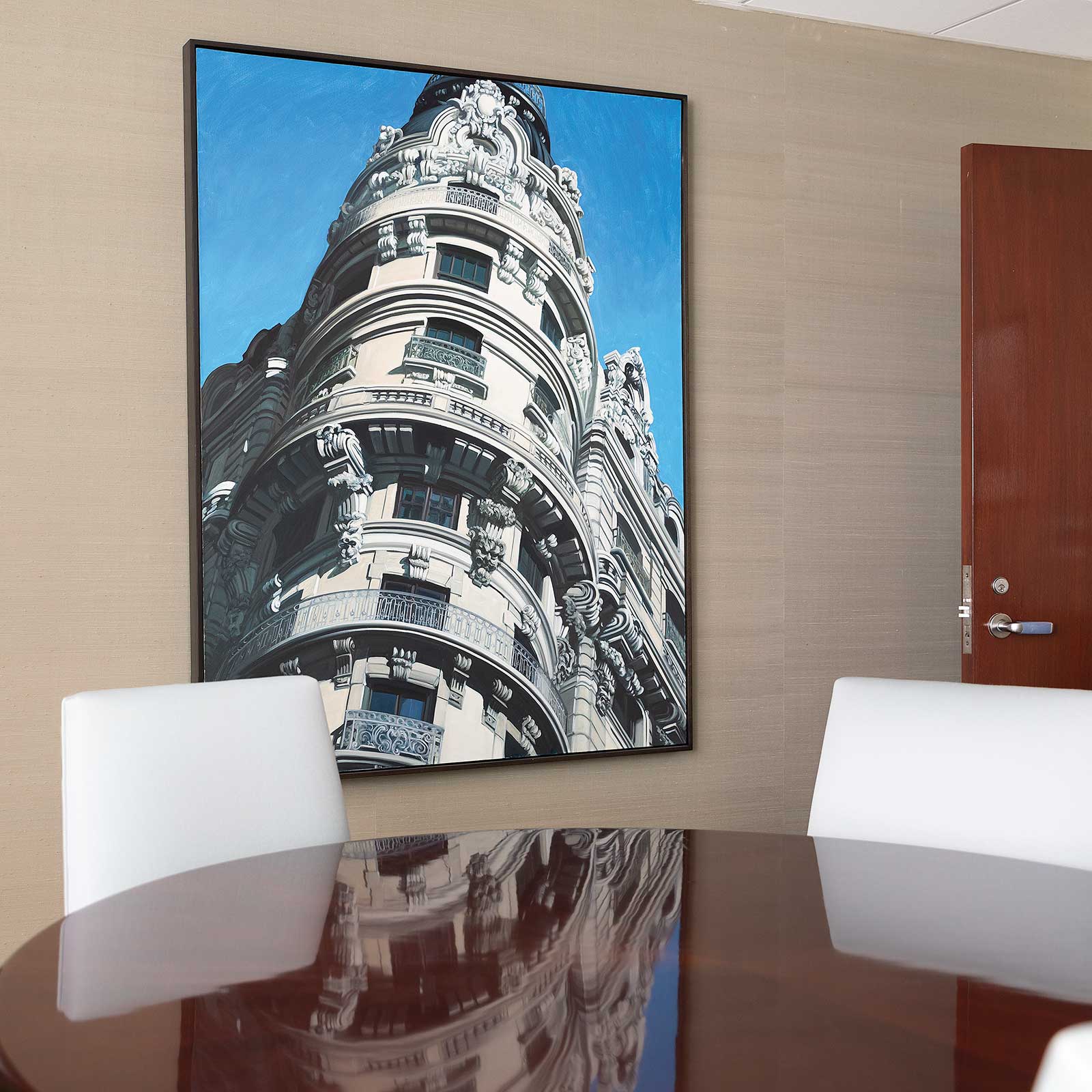
On a conference room wall is The Ansonia, oil on linen, by Stephen Magsig.
The owners of this particular Park Avenue building are enlightened art collectors, filling their lobbies and upper corporate floors with notable artworks by working artists, Phill among them. Yet another artistic conversation piece of theirs is on the backside of the square-block high-rise, on Lexington Avenue. There, upon whooshing through revolving doors and heading to a bank of escalators is a 9-foot-high exclamation point affixed to a support column. As one of the owners of the building remarks, “We wanted an artwork for the space that would be sufficiently engaging, that people wouldn’t be bored with after two trips up and down the escalators.”
So arresting is that whimsical sculpture, On Point, by the South Carolina artist Tim Yankosky, that people halt on the sidewalks and in the lobby to take note of the giant punctuation mark that everyone understands as symbolizing something to take special notice of. “Tim and his gallerist, George Billis, who we have worked with for many years, had initially proposed a giant question mark instead of the punctuation mark,” says one of the building’s co-owners, “but we were thinking this was even more effective. George agreed.”
Billis, who is one of New York’s most prominent gallerists, with a major presence in the city’s Chelsea art district, as well as having another gallery in Fairfield, Connecticut, and a namesake space in Los Angeles’s Culver City Art District, knew that the works by Phill and Yankosky, artists he has long represented, would be perfect for the lobbies of the building. Yankosky is noted for creating sculptures out of recycled metal measuring tapes. “I enjoy the challenge of repurposing vintage measuring tapes for a journey for which they were never intended,” the artist says. “I create a new environment for these objects to live in a new form as contemporary works of art.”
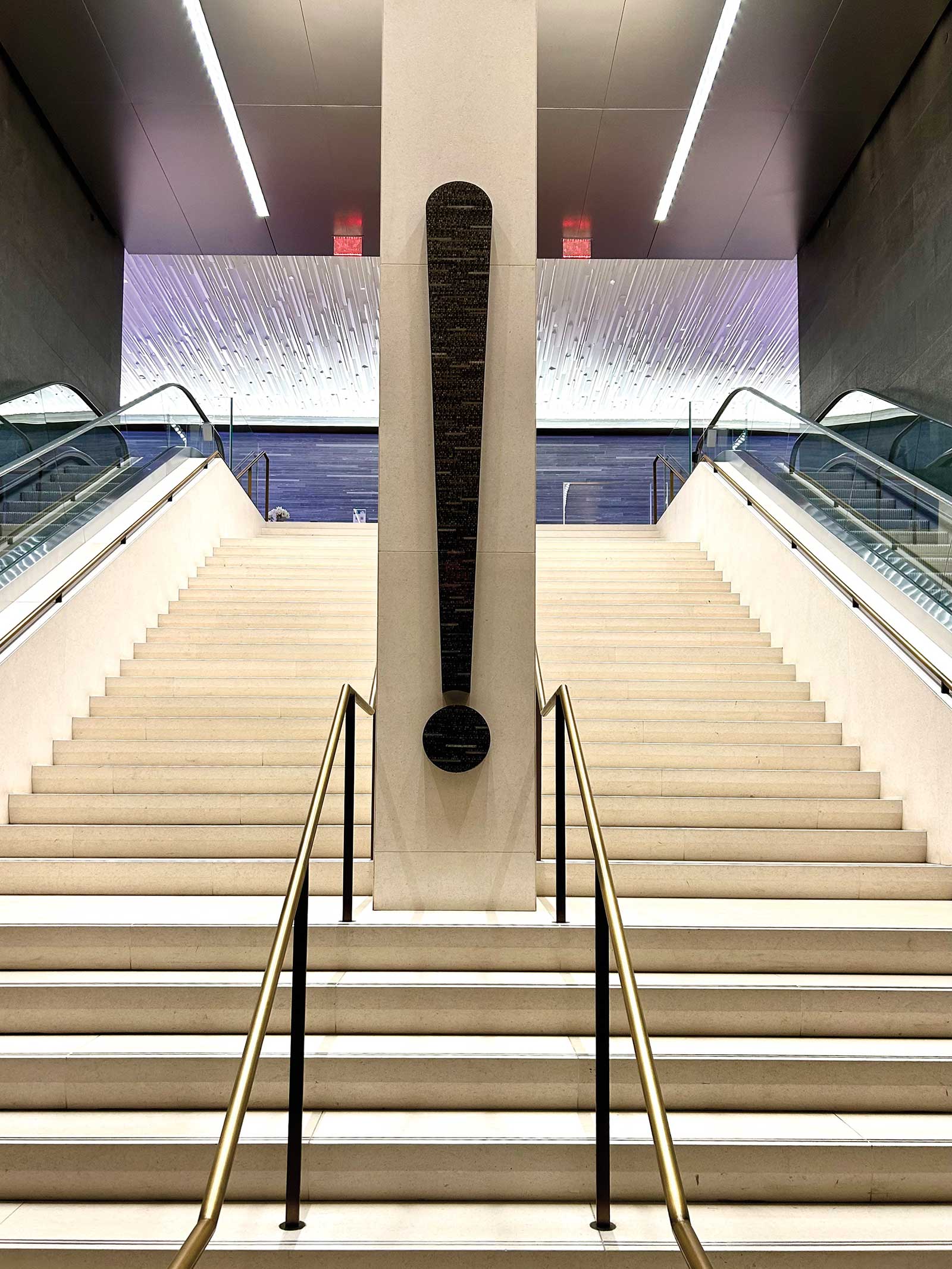
On the Lexington Avenue side of the building, a column at the escalator bank features On Point, vintage metal tape measures, by Tim Yankosky.
Office life, which can be a decidedly static experience (though an increasingly endangered one given the new ways many people work from home), can be transformed, indeed animated, by seeing works such as Yankosky’s and Phill’s. As Yankosky says of his intent for this particular work, which has already assumed an iconic presence on Lexington Avenue, “I thought about creating an artwork large enough, made of an unexpected material, that is a punctuation work that literally can be used to emphasize surprise.”
The co-owners of the building concur about the effects they want these newly acquired works to achieve, both to those on the street and those doing business in their 50-story edifice. A highly reflective metallic, mirrored ceiling on the Park Avenue side—a feature of Bohlin Cywinski Jackson Architects' renovation—captures the floral tones in the Phill works, further animating their abstracted scenes that few would confuse for anything other than flowering plants. “Daniel’s use of colors really gives this lobby a lot of life,” says one of the owners, “and they provide a different perspective when you come in in the morning and when you leave at night.” When the lobby is lit by evening, the artworks emerge in full relief on the streetscape, while in the morning light the effect is one of a softer immersion in floral hues.
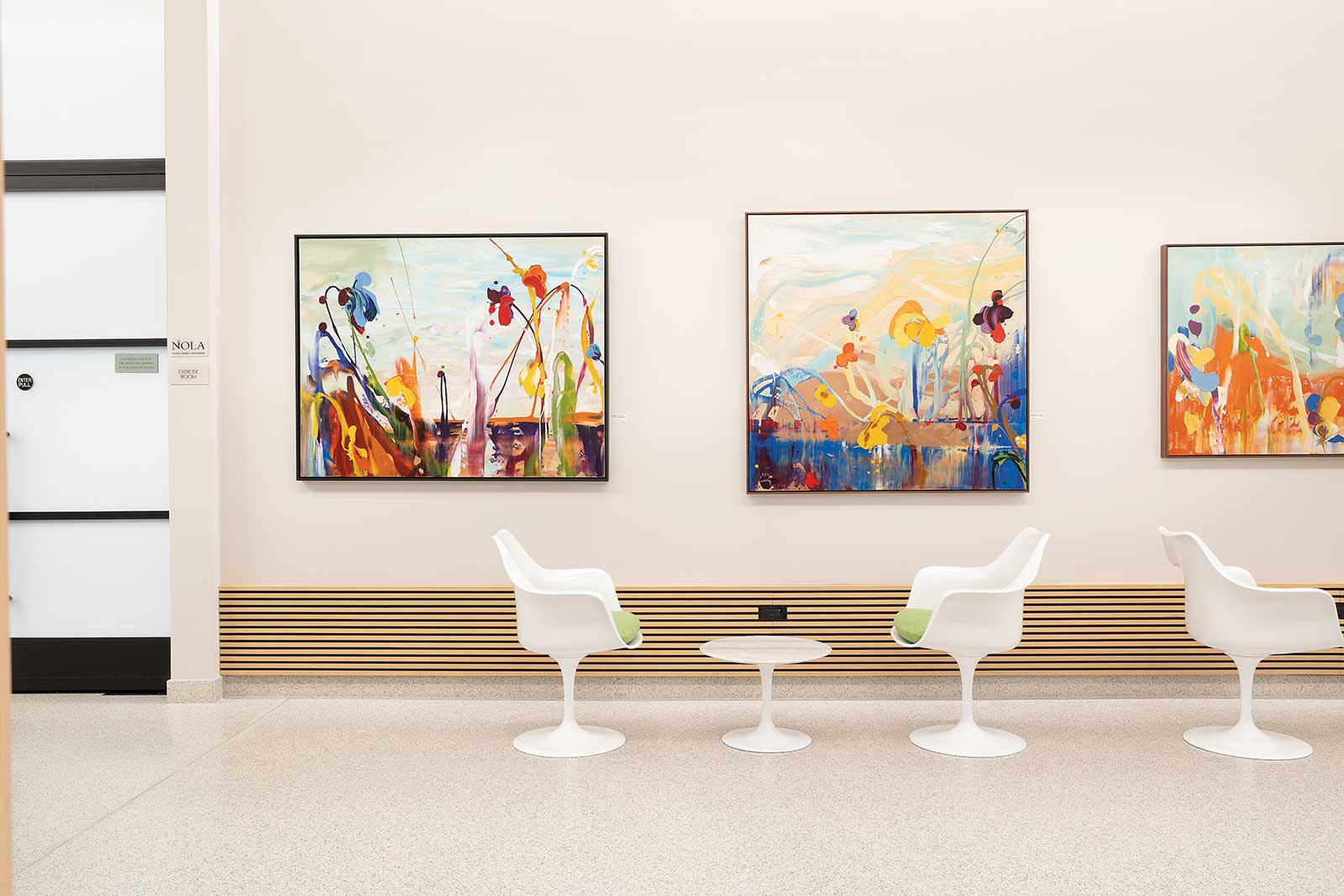
A wall of a ground-level space that is reserved for tenants of the building is filled with three canvases by Daniel Phill, each acrylic on canvas (left to right): Tellus, Deodar, Portfiro.
Amy Zoller, a director at George Billis Gallery, points out that the very overhang on the building acts as its own installation piece. “That mirrored surface that vaults from the entrance captures light and colors on its own, such as the yellow of passing taxis. And it literally brings the colors of the Phill pieces right out onto the street.” Billis himself adds, “Daniel’s works are so effective here, so memorable, that it helps people realize exactly where they are located, in this very building. They don’t forget.” Billis also notes that upon Phill receiving the commission, his paintings took one day shy of a year to be realized—from start to finish.
The building’s owners have also commissioned depictions of other properties in their portfolio, many of them venerable New York landmarks buildings. Shortly after the events of 9/11, when all of New York (indeed, the nation) went into a period of mourning, the owners commissioned one of their favorite artists in the George Billis stable for the project. Stephen Magsig has long made a reputation for his large portraits of buildings—particularly late-19th-century cast-iron structures in New York’s SoHo.
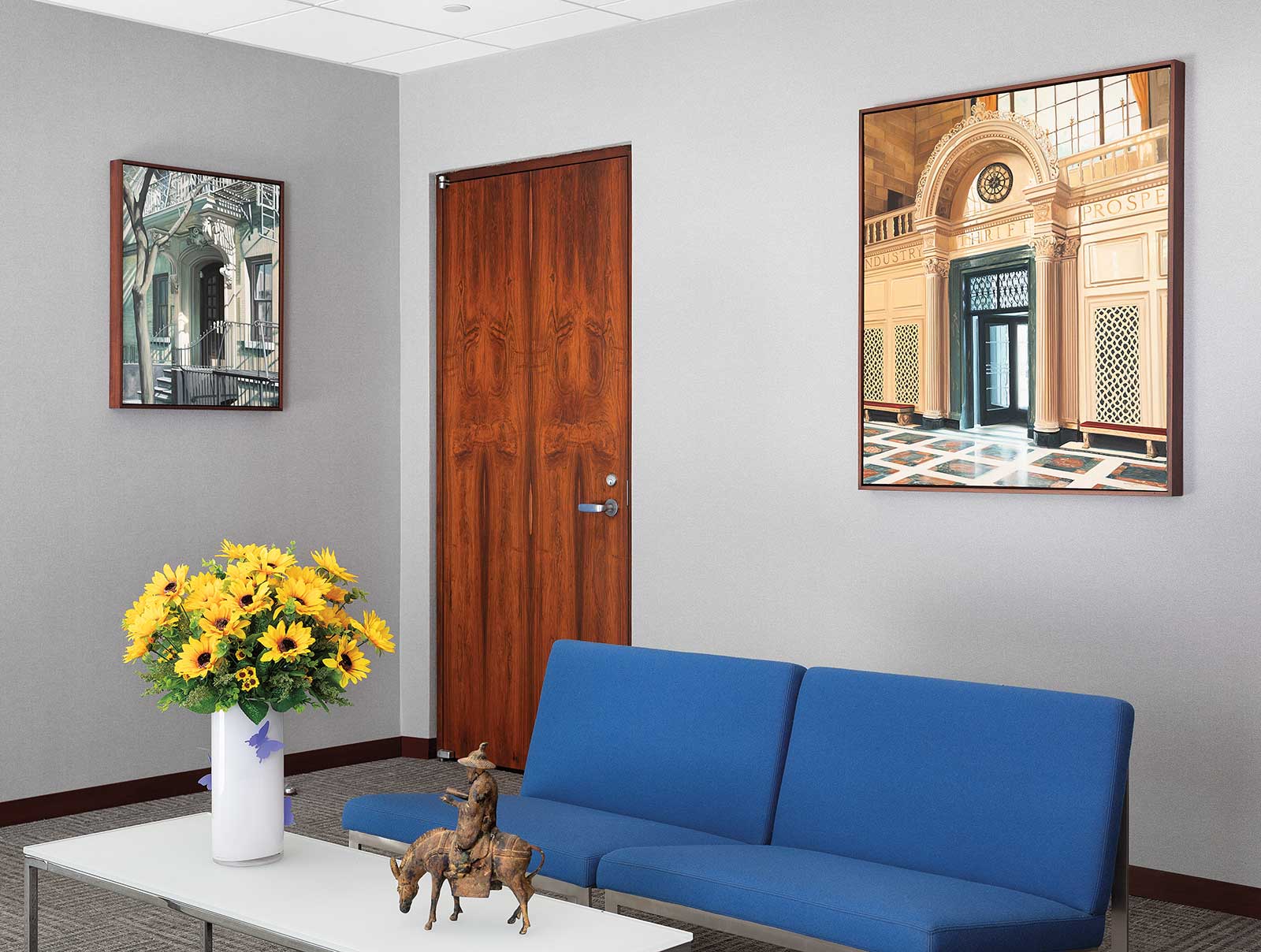
The walls of a reception area on a corporate floor feature (left to right) Rockefeller Apartments and Central Bank, both oil on linen by Stephen Magsig.
With a camera and sketchbook, Magsig flew to New York and visited the properties, which included the Lunt Fontaine, a noted beaux-arts style Broadway theater; the Ansonia, a fanciful 1904 apartment building on the Upper West Side; the Italian palazzo-like Apple Savings Bank across the street; the art deco-era Chanin Building on 42nd Street; and the Rockefeller apartments across the street from the Museum of Modern Art. “I paint buildings just as if they were portraits of people,” says Magsig. “Buildings have stories to tell, and these buildings in particular, given their age, have, historically, been through a lot.”
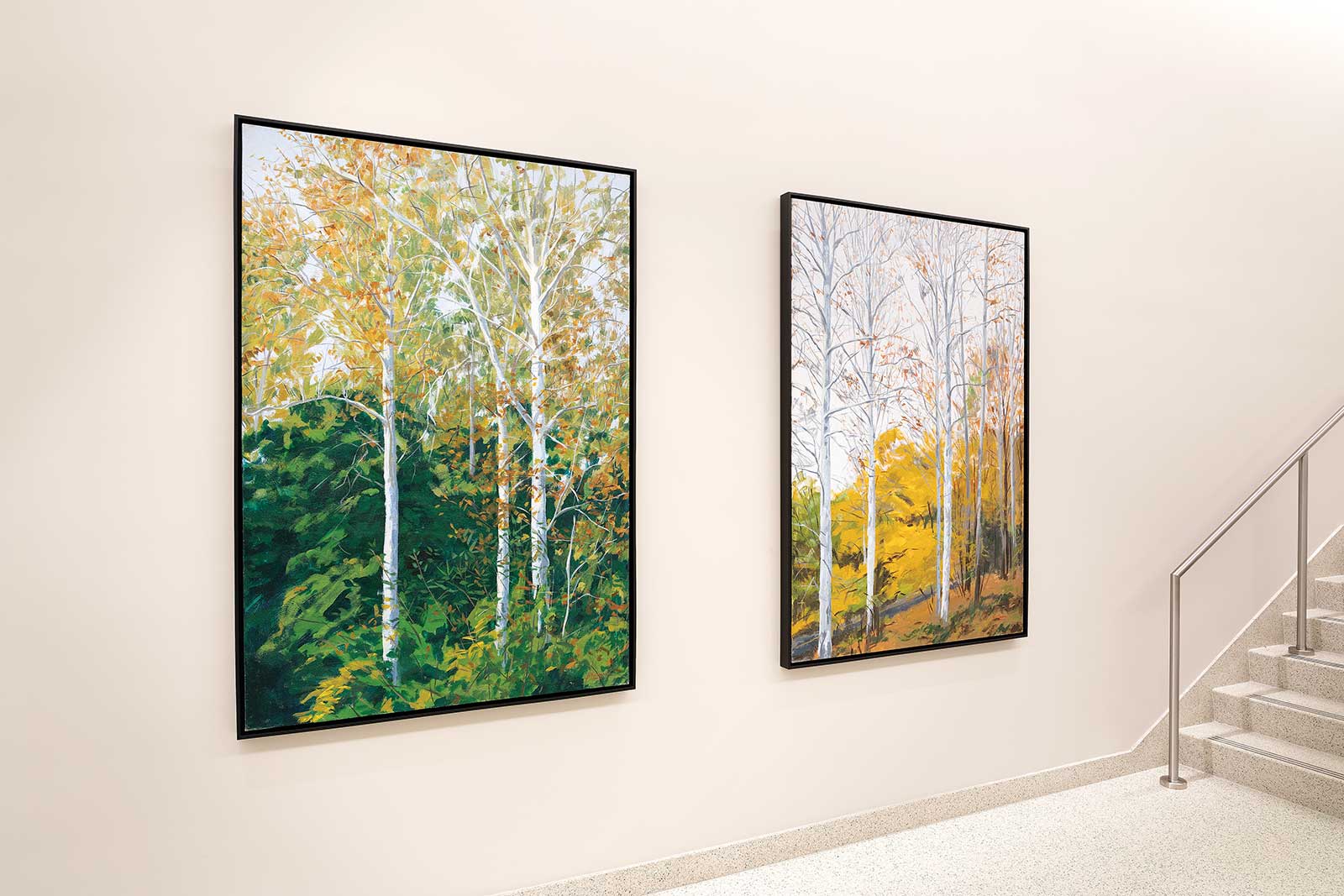
At the base of a stairway leading to a tenants’ lounge area are (left to right) White Trees Spring and White Trees Fall, each acrylic on linen, by Susan Stillman.
Within a six-month period, Magsig had completed the works in oil on Belgian linen, with the largest measuring 60 inches by 50 inches, and the smallest 30 inches by 24. Two of the works—the Apple Bank and 60 Hudson Street, the latter a 1928 Art Deco masterpiece that had been the former headquarters of the Western Union Telegraph Company—showed interiors while the other works were exterior depictions of buildings. All seven portraits hang prominently on the 47th corporate floor of the building, from where views are so expansive it’s possible to pick out some of Magsig’s subjects amid the dense cityscape below. “Rather than going for a head-on look at a building, Stephen focuses on the details that really make it a landmark. He knows the key features to highlight and he knows the angle at which to show off the building,” says one of the owners, pointing to the Ansonia portrait in the conference room, with its detailed look at the building’s Juliette balconies and fanciful sculpted art nouveau-esque motifs that define its facades.
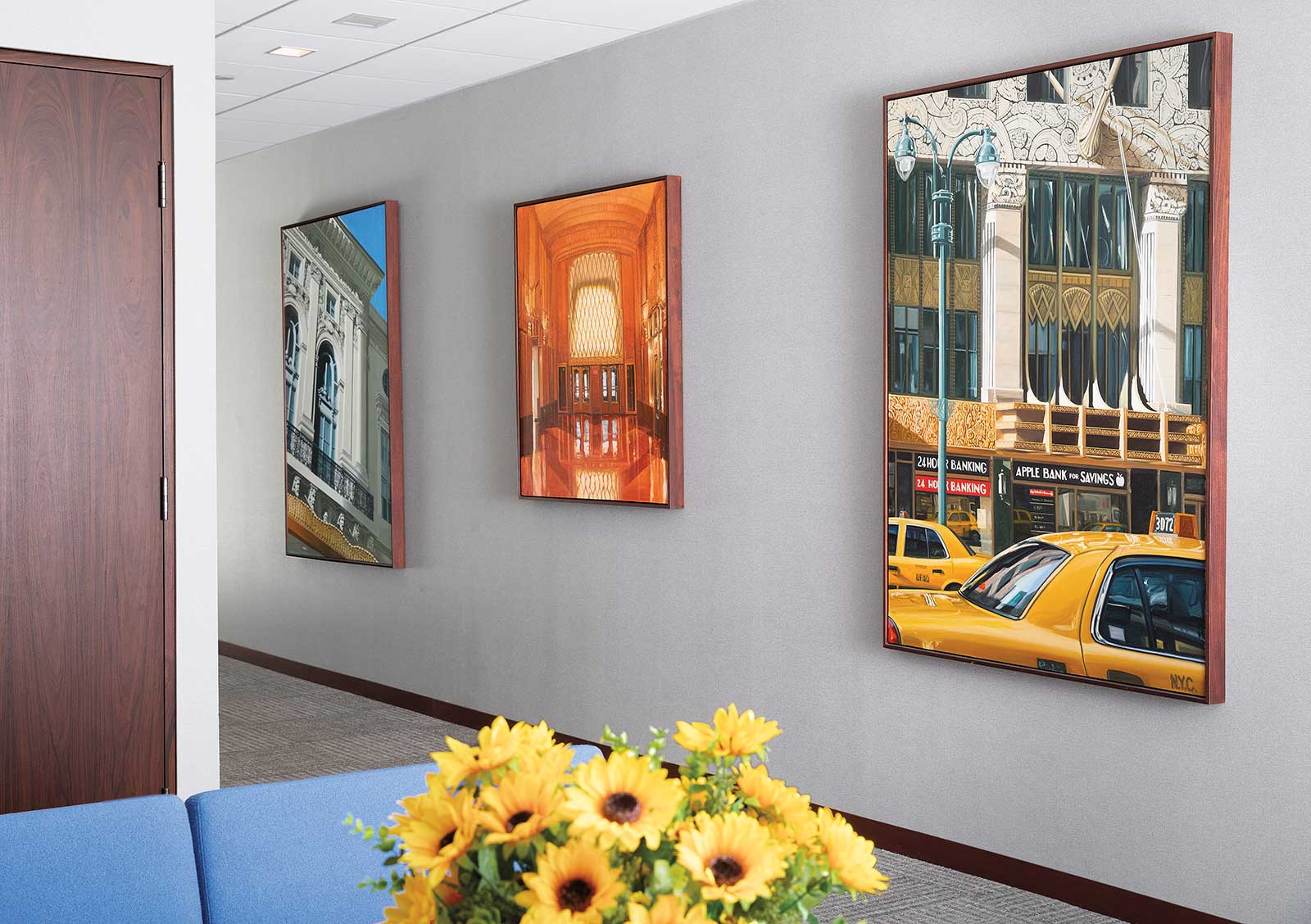
A hallway on a corporate floor contains (left to right) Lunt-Fontaine Theatre, 60 Hudson Street, Chanin Building, each oil on linen, by Stephen Magsig.
Custom commissions, while often welcomed by artists for their creative rewards, also often come with certain reservations, but not in this case. About these owners, Magsig says, “They were very relaxed and respectful of what I do. Sometimes when you’re commissioned to do a painting, you can’t help but feel the presence of that other person in the room as you’re painting, but that wasn’t the case with these works.”
Phill, too, felt no creative restraints when making his large canvases for the lobby. The owners had already purchased nine of his other works that now hang in the building’s “amenity center” for its tenants, a communal lounge area. As Billis explains, “Daniel already used the color scheme that the owners wanted in the works and it was a matter of just scaling up from what he had already been painting to something larger. The same with Tim, in terms of adaptability. All three of these artists are seasoned professionals and they know how to handle special working situations, and they know how to best respond to spaces in which they know their work is going to be shown.”
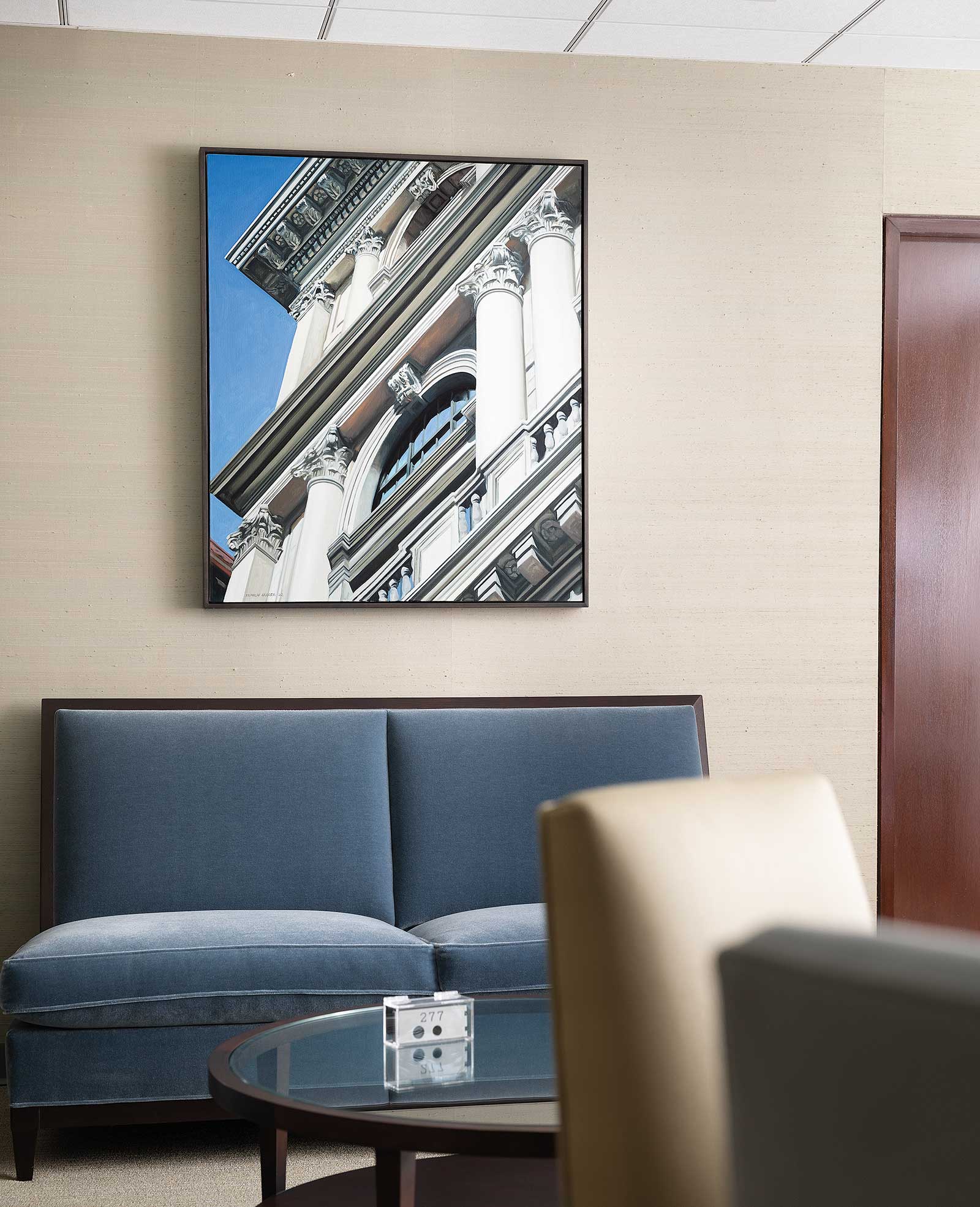
Hanging on a reception area wall is 401 Fifth Avenue, oil on linen, by Stephen Magsig.
While many of the works in the permanent collection at the building are by artists represented by George Billis, other artists are featured throughout the building, including works on paper by the late photo realist Richard Estes. To walk this new evolved and ever-evolving portion of Park Avenue is to experience public art in private spaces. “I suppose every building wants to distinguish itself from another,” says one of the building’s owners. “The effort to do so accelerated post-pandemic, but I can say that I never get bored looking at Daniel’s work or Tim’s when I come to the office, and I think they engage others who even just pass by on the street.” —
+++
David Masello writes about art and culture. He is Executive Editor of Milieu, a magazine about design, architecture and art. He is the author of three books about art and architecture, and many of his short one-act plays have been produced by companies in New York and Los Angeles.
Powered by Froala Editor