

The retrospective exhibition Fleeting Presence: The Liminal Art of Daniel Sprick,at the Madden Museum of Art of the University of Denver, is more than an exhibition of one of Denver’s and the world’s most prominent figurative artists. It is the result of the combined efforts of 15 graduate and undergraduate students at the university’s School of Art & Art History who had the extraordinary opportunity to work with local curators and art professionals, as well as the artist himself. They assembled 54 works from over four decades, representing the breadth of Sprick’s career. In the winter of 2023, the students were enrolled in Curatorial Practicum under the supervision of Dr. Geoffrey Shamos. The museum notes, “This collaboration highlights formal and thematic tensions in Sprick’s paintings such as light and dark, interiors and exteriors, absence and presence.”
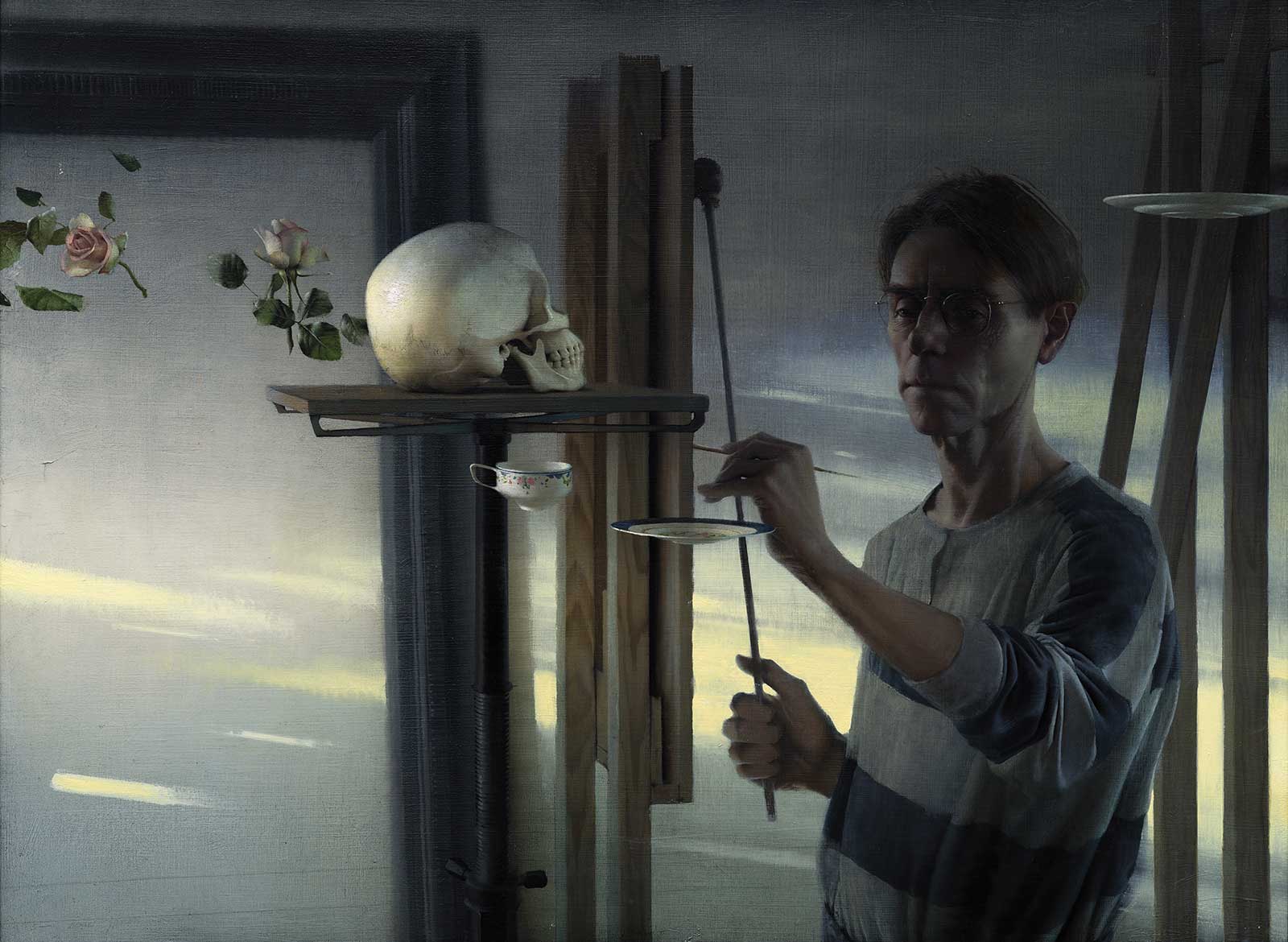
Self Portrait (Speed of Light), oil on board, 36 x 48"
The exhibition’s curators are Lauren Anuszewski, Sydney Barofsky, Alex Blom, Seb Brady, Lexi Ferenzi, Morgan Fleetwood, McKenna Gale, James Grau, Allene Leak, Patrick Lucas, Sydney McCain, Anna McDonald, Claire Motsinger, Andrew Nadeau, Emily Oxford-Pickeral and Jordan Reed.
In 2016, John W. Madden, Jr. and his wife Marjorie donated 133 works of art to the university. Prominent among their collection were works by Sprick, which served as the springboard for the current exhibition. The museum is “dedicated to advancing the knowledge and passion for art through the presentation and preservation of works of art in the collection,” a fitting mission to explore Sprick’s knowledge and passion.
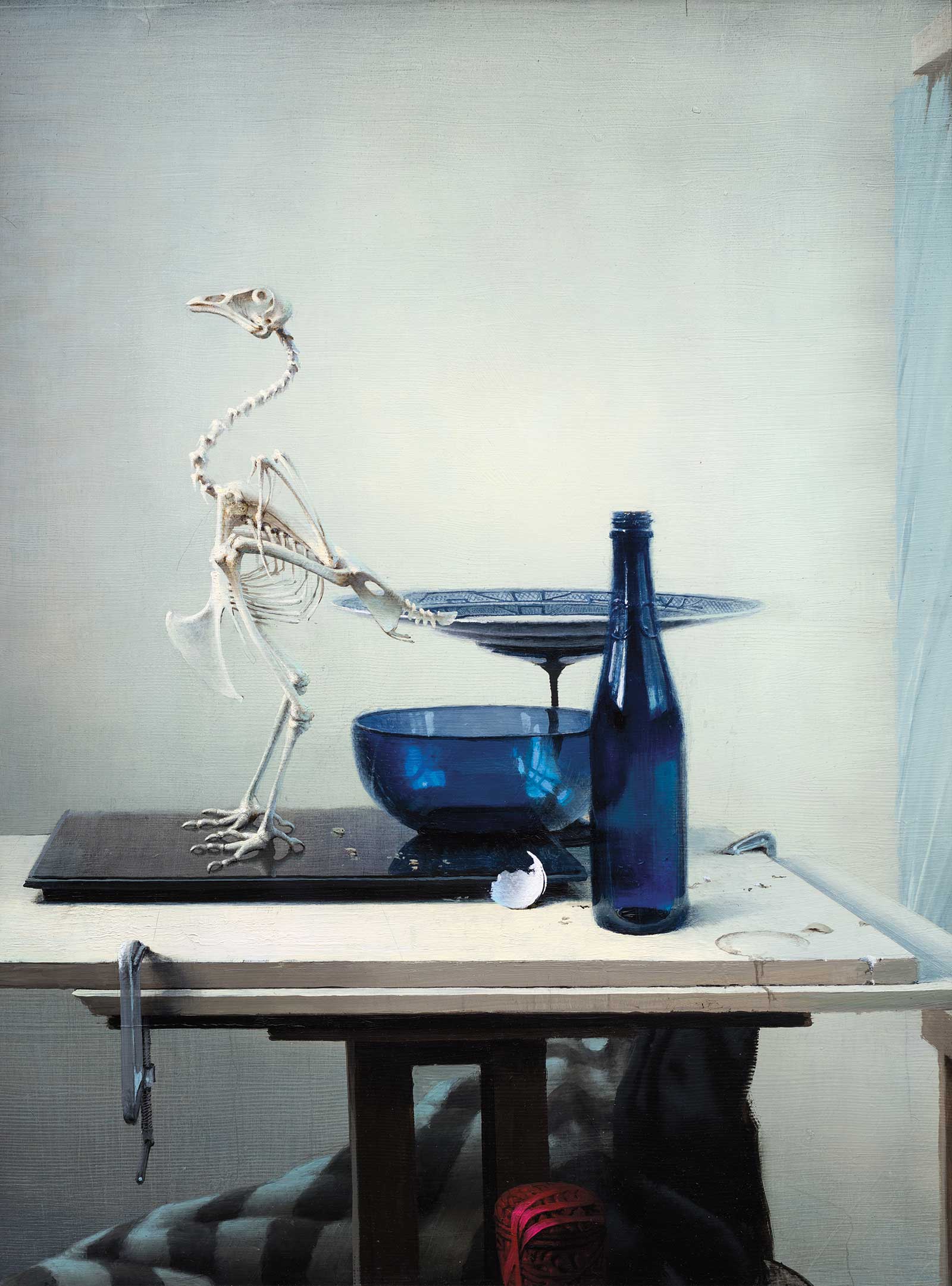
Bluebird, oil on board, 24 x 20"
Prominent in the experience of the exhibition, in addition to the extraordinary presence of the paintings themselves, are podcasts of the artist commenting on his work, accessible through QR codes. The podcasts were recorded under the auspices of Rose Fredrick and Olive Witwer of ArtSol in Denver, “empowering collectors through connection to artists, curators and fellow enthusiasts.”
The students have divided the work into still lifes, portraiture, landscapes and interiors, selecting important works from his prolific output.
They comment that his portraiture “explores duality and asks questions of life, emotion and time.
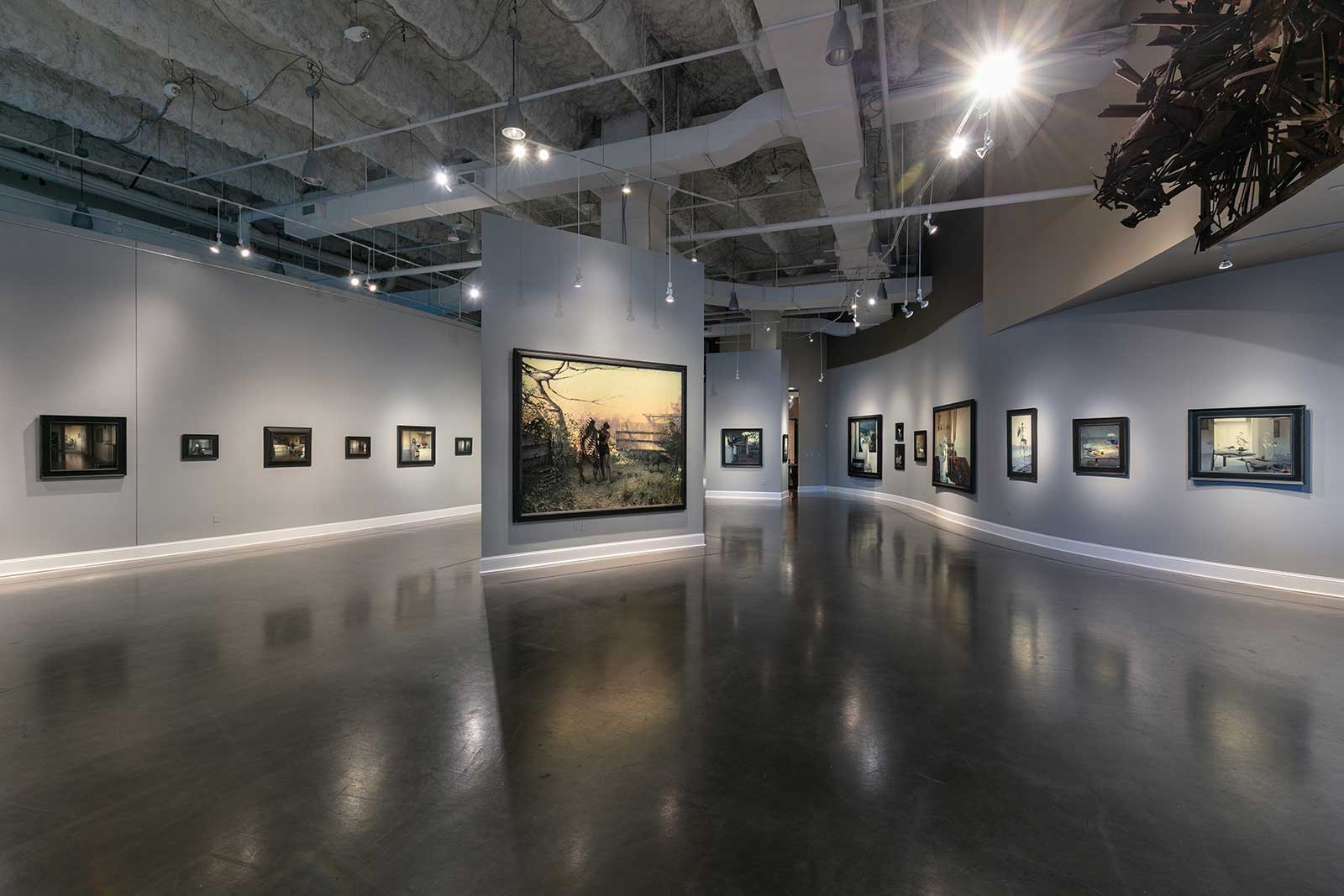
Installation view of Fleeting Presence: The Liminal Art of Daniel Sprick at the Madden Museum of Art.
“Sprick’s work has an ephemeral quality that highlights the temporary nature of existence. His intentional use of grays and blues instill an overarching sense of melancholy, and his utilization of light instills a ghostly and transient feeling in his portraits.”
Commenting on his self-portrait, Speed of Light,Sprick says—in his amusingly self-effacing way—“This particular painting, I started about 19, 20 years ago, and it was in my parents’ house all that time. I think it had been on exhibit, but it looked completely different. I thought it was confident, it was well painted, but it wasn’t very interesting. And so, what I wanted was to make the composition more interesting, so I darkened the top of it, darkened the picture dramatically, and put in this raking light that’s kind of like with leafy tree shadows….”
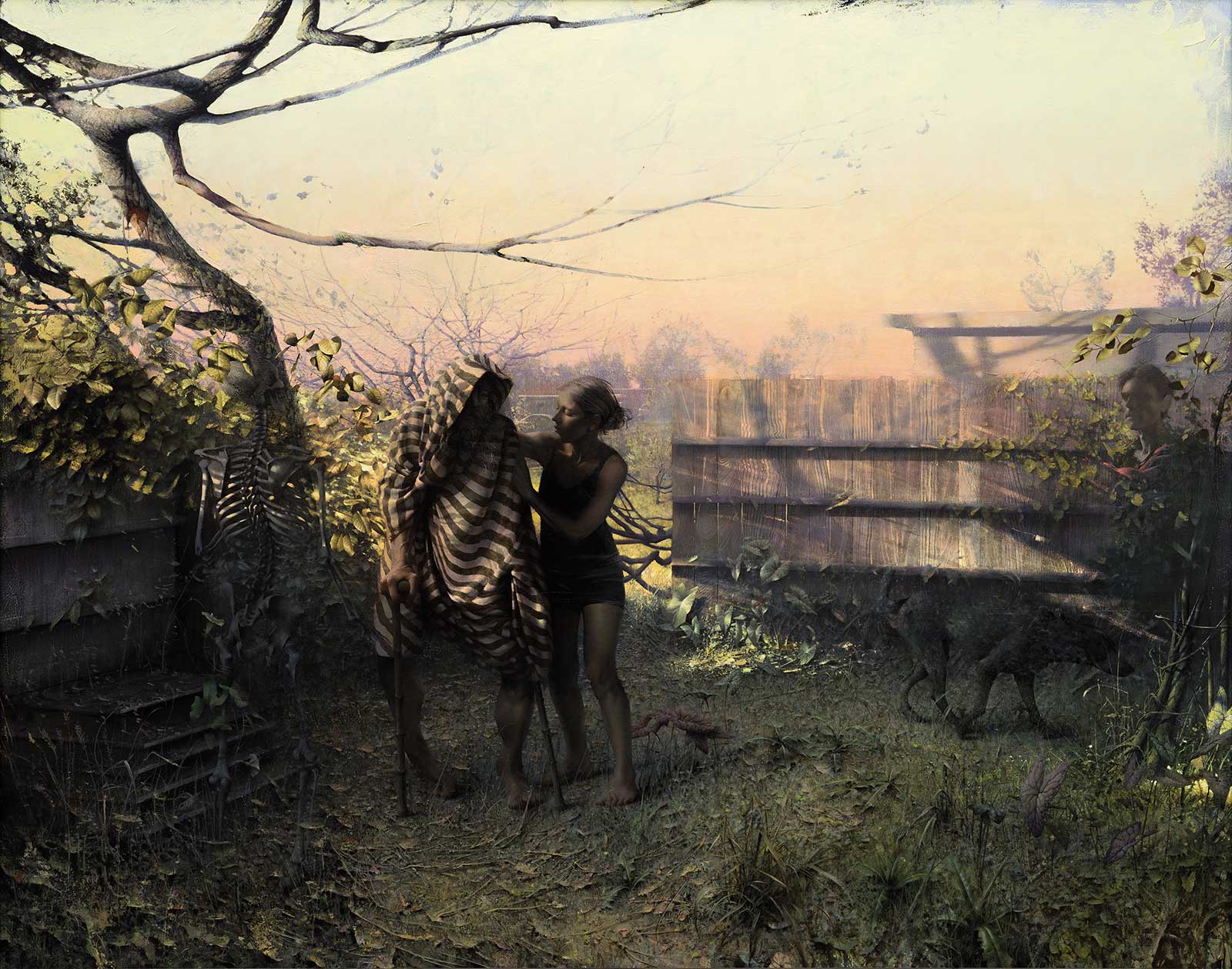
In Search of an Honest Man, oil on board, 76 x 96"
Floating objects had become something of a trademark of his work, giving him more flexibility in placing objects in his compositions. “Now I know that’s such an uninteresting answer to the question why all the floating things,” he comments.
“It’s the real reason. But a much more interesting reason would be that, I don’t know, the world’s unhinged. Things are floating, and their spinning saucers can defy gravity with their sort of gyroscopic precession. Flowers, they’re light enough to float, so I usually only float things that would have some reason to float.”
Among the works in this section is the 8-foot wide painting, In Search of an Honest Man, based loosely on the story of the cynic philosopher Diogenes, who lived on the streets and is traditionally shown looking for an honest man as he carries a lighted lantern in broad daylight. The central composition was inspired by Rembrandt’s drawing, Blind Old Man Guided by a Woman.
While we’re all probably driven to read into the presence of the skeleton on the left, Sprick explains, “So why the skeleton, the real reason to paint the skeleton? The real reason’s nowhere near as interesting as a sort of fable reason. I wanted to have those sharp stripes in the cloak to be repeated, and I wanted to find a way to do it, and the ribs were a way to do it, and that was the real incentive for doing it.”
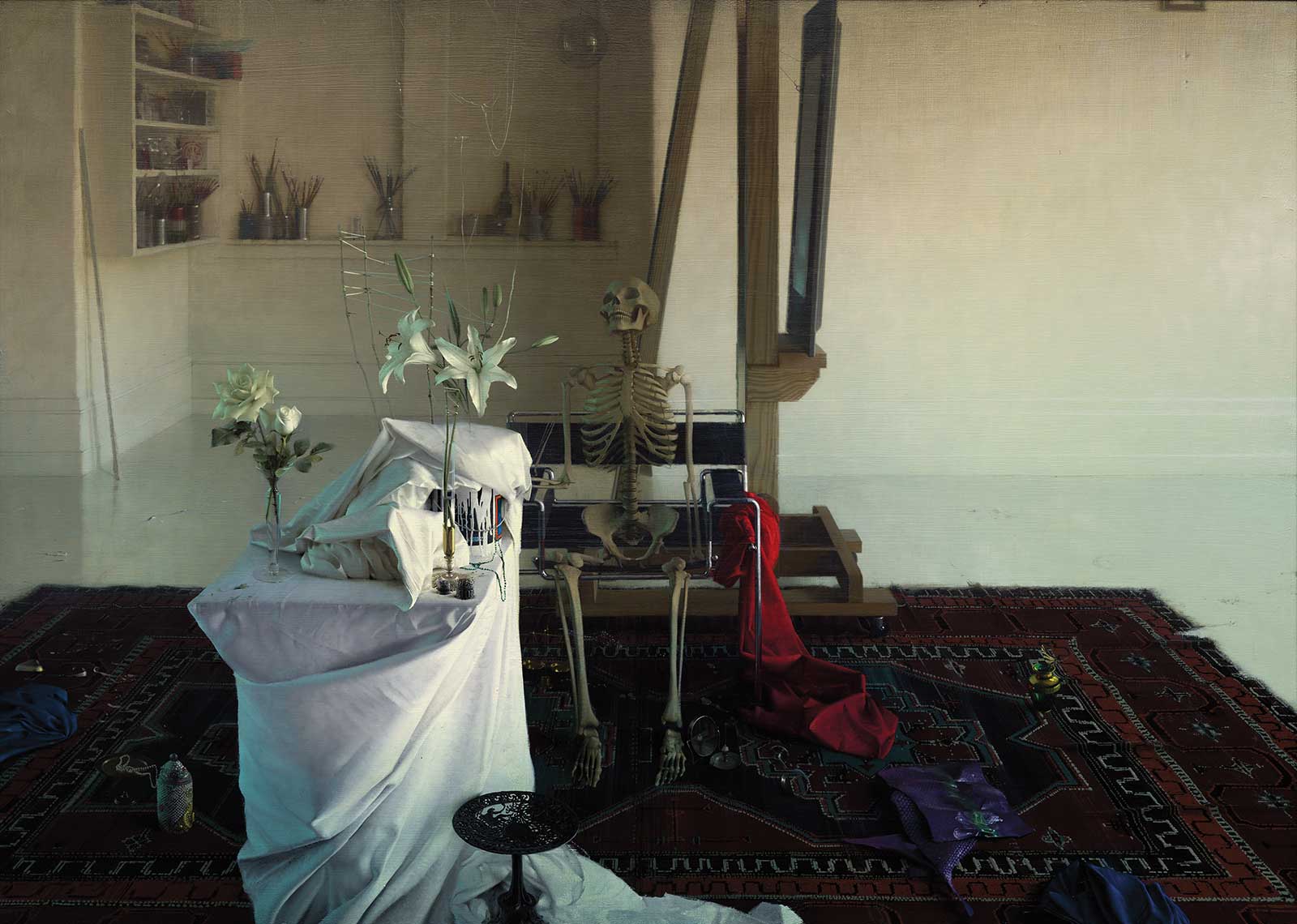
Sleeping Flowers (Vanitas), oil on board, 72 x 96"
The curators for the section on still life write, “Sprick explores the contrast of deep shadows and light, (chiaroscuro), the tension of real versus unreal, and memento mori, the reminder of death and contemplation of mortality. Darkness exists within each work; large swathes of light create a sense of melancholy that highlights the emotional impact of the works. Each skeleton, dead flower, and half eaten fruit reminds us of the fragility of life and the existence of death. Using his skills as an oil painter, Daniel Sprick’s still life paintings encourage viewers to meditate on the beauty and fleeting essence of life, and the staged quality of our own personal realities.”
Sprick’s Sleeping Flowers (Vanitas) is in the tradition of paintings reminding us of the shortness of life. It is loaded with symbols. He comments on the candle at the foot of the skeleton: “The candle, a burnt-out candle that’s all the way to the bottom, symbolizes a long life lived. A blown-out candle that’s tall is a short life which is a tragedy, a long life that comes to an end.” But there is also the joy of painting: “the dripping paint on the paint can, part of the reason I did it was because it was fun to do. See if I could make it look like it was real paint dripping down there. But the other reason was that I’ve got all these verticals, you know, the vertical lines of the metal chair, the vertical lines of the leg bones, and then they tie right into the vertical lines of the paint and then the vertical lines of the flowers. That was the real reason I did it. It just had more to do with this repetition of verticals that’s going from left to right through the painting, the paint brushes in the distance.”
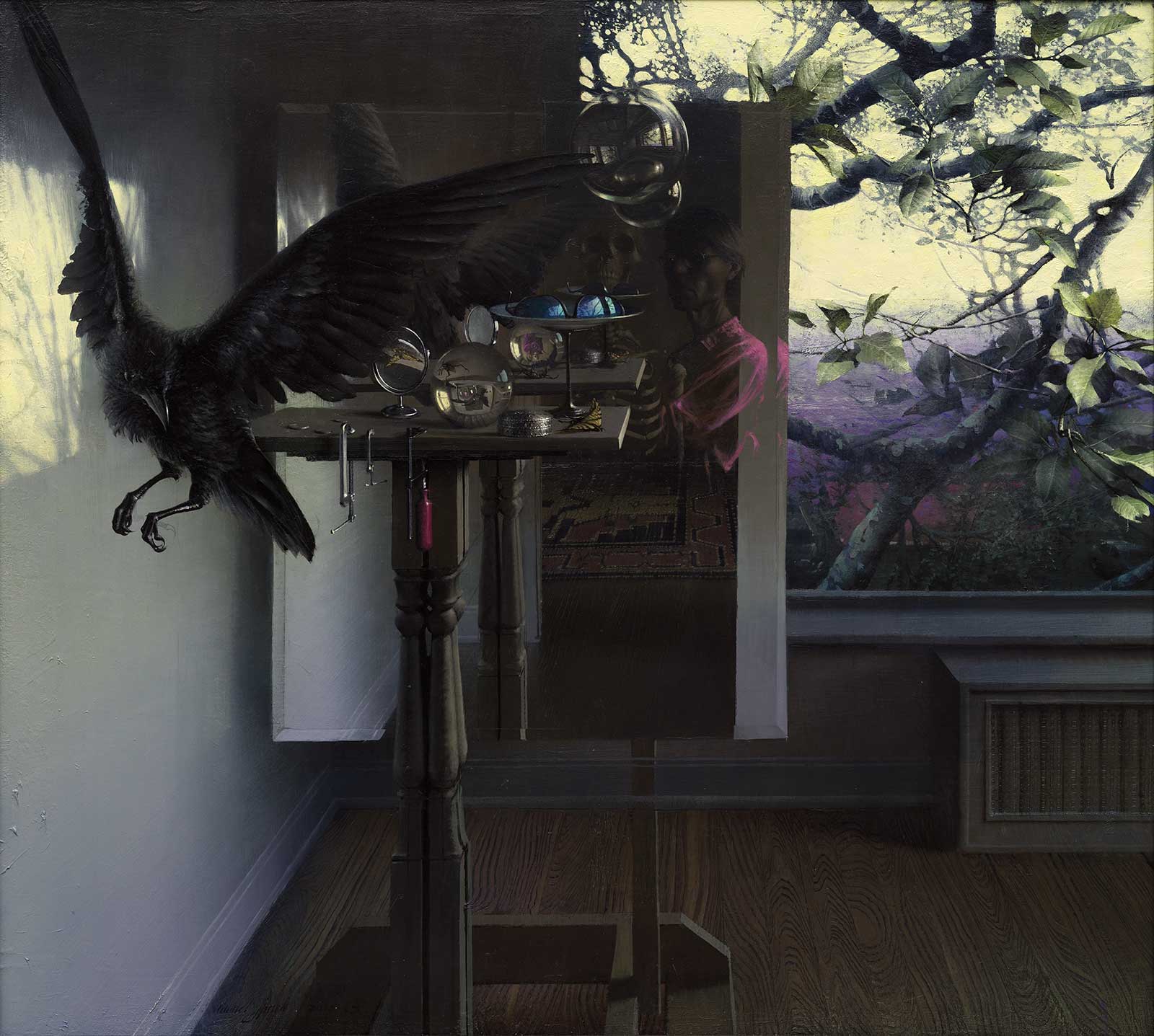
The Raven, oil on board, 36 x 48"
In the section on interiors, the curators note, “‘Home’ can evoke a multitude of feelings. Daniel Sprick’s interior scenes capture the complexity of emotions felt in the spaces most familiar to us. His paintings balance opposing concepts: rest and unrest; familiar and unfamiliar; freedom and constriction. They synthesize the themes presented throughout this exhibition, representing interior landscapes of Sprick’s daily life and artistic vision….Daniel Sprick’s interior scenes compel us to question our relationship to our homes. His paintings draw out our feelings and memories. Just as the Sprick’s paintings reveal something of the artist, our homes reflect us as well.”
He comments on My Interior Life, shedding light on his use of perspective. “My mom looked at this painting and she said, ‘Dan, your apartment’s not that big.’ And she was quite correct, and I give her credit for her perceptiveness. The reason I painted it, that way, it was because it would be a super wide angle and there would be a much steeper two-point linear perspective, which is unnatural to me.
“So I widened two point linear perspective. Just has to do with vanishing points, you know, like the railroad tracks everybody’s familiar with. That would be single-point perspective and two point as the vanishing points are off the picture and you see it all the time in your daily life. Well, I put those vanishing points much farther apart than they really were, and that’s what made the room look good.
“I don’t like the look of wide angle pictures, but that’s what I would have had to do to get both couches in there. And so I changed the angle of perspective, making it much more natural looking, as far as I’m concerned.”
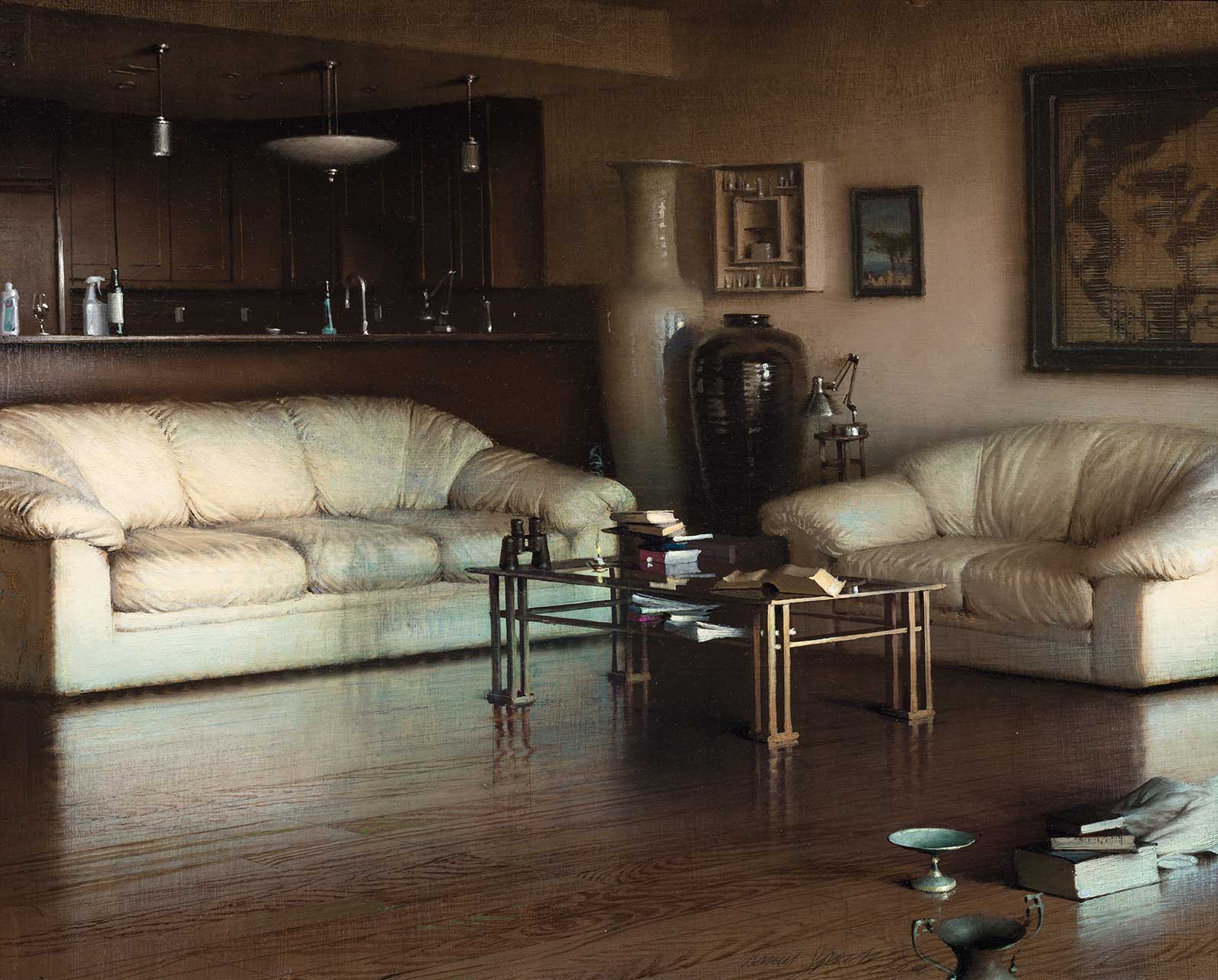
My Interior Life, oil on board, 16 x 20"
The curators of landscape comment, “From urban cityscapes, to exquisite sunsets, to dry riverbeds, Daniel Sprick crafts unique views of the world around us that emphasize an element of transience. Landscapes capture fleeting moments of nature, forever preserved in these paintings, whether it’s a car driving by a gas station or the glowing pink clouds of a sunset. With these images, Sprick provides the viewer the opportunity to look a little closer at these temporary moments, demonstrating the same principles of beauty, composition, color and introspection found in his portraits, still lifes and interiors.”
Sprick reveals more of himself in his comments. “Part of the reason I love to paint on location, and part of the reason that I like to keep the paintings rather than sell them is they’re a diary of my life.
“And when I was painting that, you could see the gas stations and the stationary things hold still, and even a parked car holds still, and the other cars were whizzing by. And so I painted them as a blur, because that was the best I could do, given the fact that they were just, you know, moving at high speed.
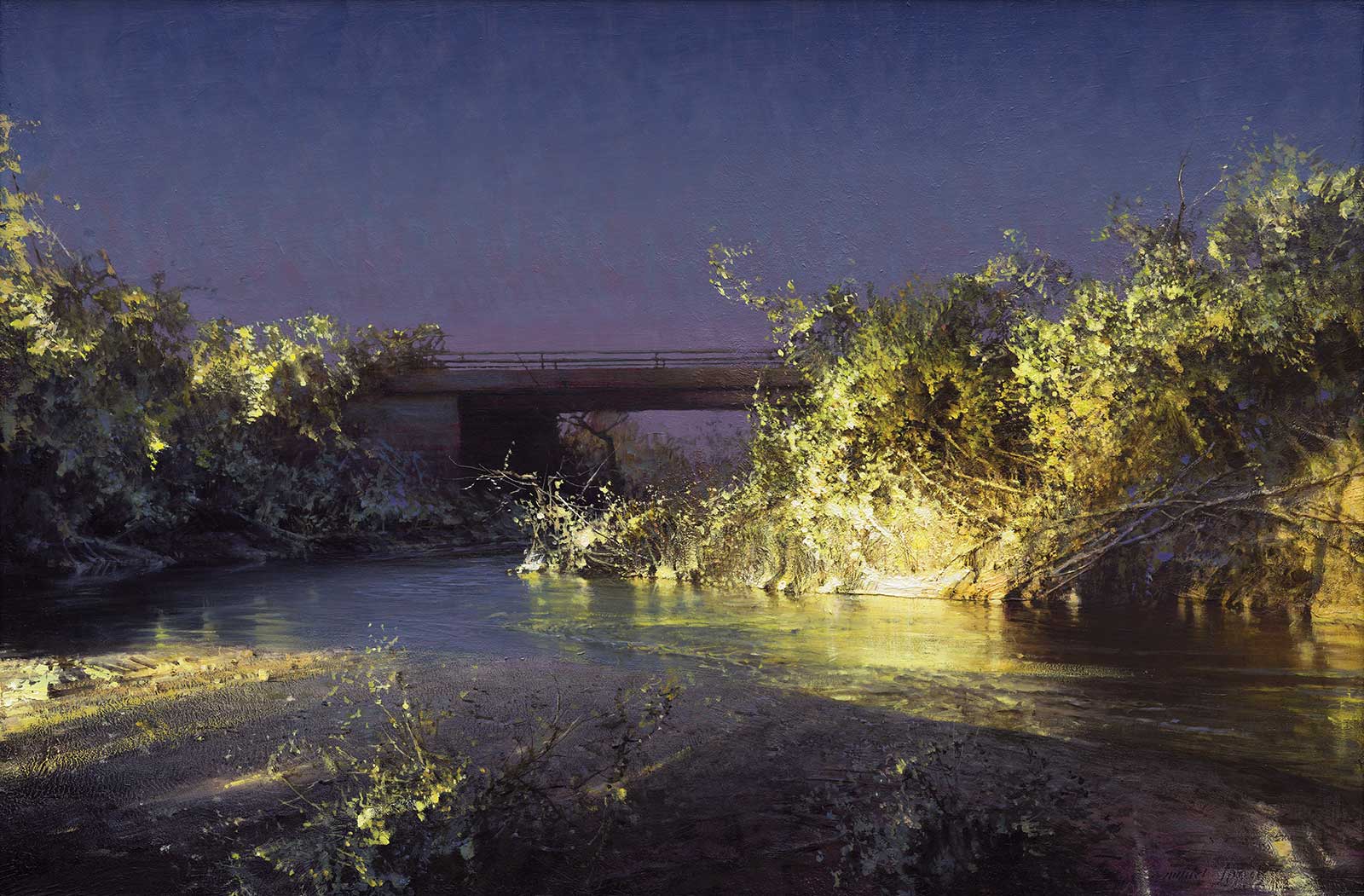
Cherry Creek at Colorado Blvd, oil on board, 24 x 36"
“The way it’s a diary of my life, is that guys would come up and talk to me, and where I was painting was right in front of this kind of watering hole type liquor store, real seedy. The guys that would stagger in and out of it loved the fact that I was painting there, and they’d just pat me on the back, and [want] to take selfies with me…It made me so happy that people enjoy art like that, and you know, to engage people like that is really a lot of fun for me. And doing a subject that, I mean, a lot of artists have actually taken on these urban scenes, and urban decay, and urban prosperit and everything like that.
“I’m right in there with them. There’s nothing original about it. It’s something that looked good to me, and I’d paint it again.”
The exhibition continues through May 3. —
Fleeting Presence: The Liminal Art of Daniel Sprick
Through May 3, 2024
Madden Museum of Art
6363 S. Fiddlers Green Circle, Greenwood Village, CO 80111
www.maddenmuseum.com
(720) 773-0400
Powered by Froala Editor