
Last autumn, North Carolina sculptor Wesley Wofford unveiled a stunning monument honoring the heroic life and legacy of American abolitionist and political activist, Harriett Tubman. Titled The Beacon of Hope, the 11-foot bronze sculpture was permanently installed and dedicated on September 10, 2022, the fourth annual Day of Resilience at the Dorchester County Courthouse in Cambridge, Maryland. The courthouse is stop number three along the Harriet Tubman Underground Railroad Byway and a former site of slave auctions, as well as a courageous escape-to-freedom guided by Tubman in the 1800s. The statue was brought to Cambridge through the work of the Alpha Genesis Community Development Corporation, who hosted Wofford’s travelling sculpture of Tubman, The Journey to Freedom,in 2020.
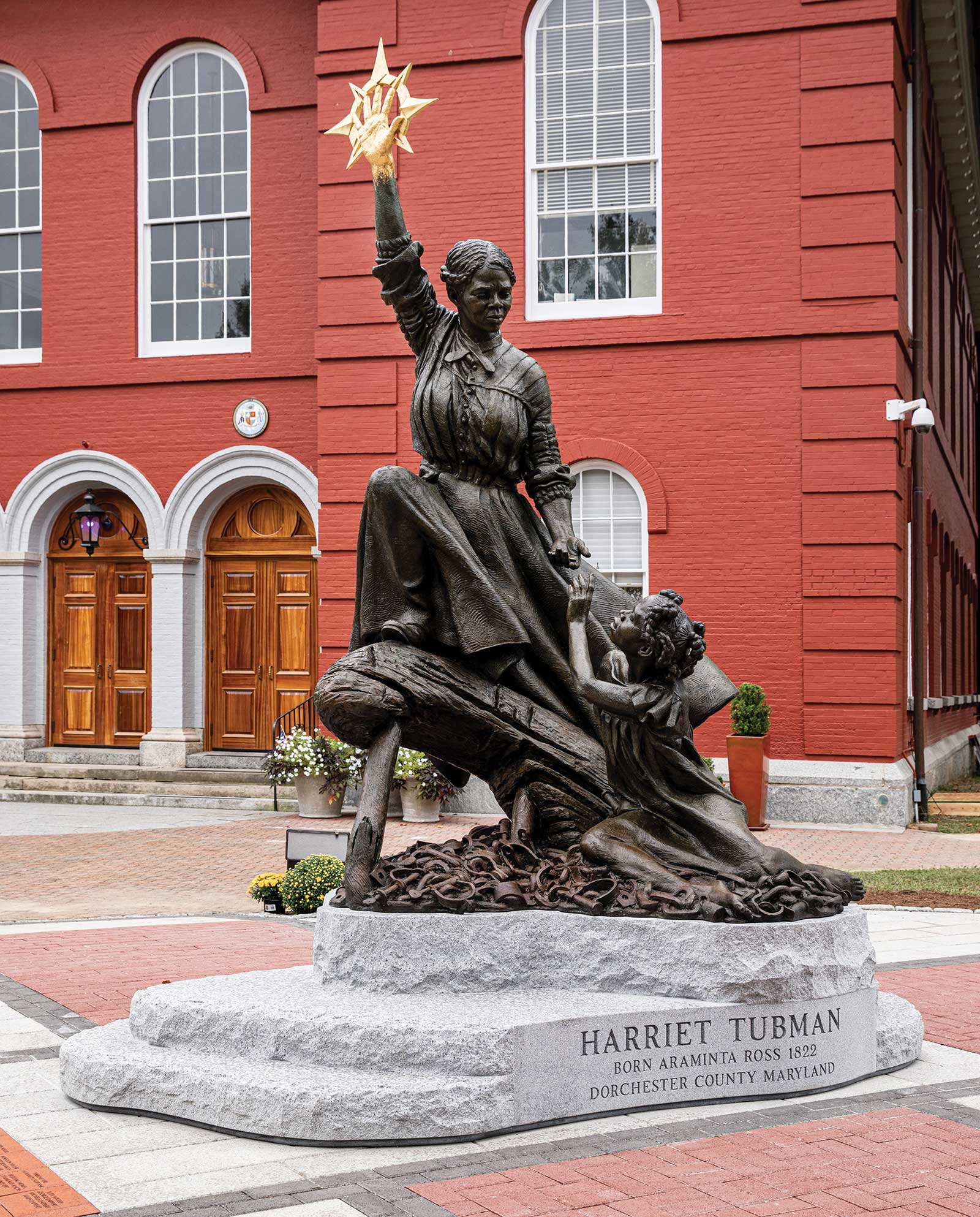
The Beacon of Hope, bronze, 2022
Tubman was born a slave (ca. 1820s) and raised on the Eastern Shore of Maryland, a border state during the Civil War. After a brief marriage to a freed man, Tubman fled to Pennsylvania, a free state, and settled in Philadelphia in 1849. Not long after, she began making dangerous trips back to Maryland to rescue her family members, as well as many other African Americans who were still suffering under the repressive yoke of slavery. Through her courage and dedication, she earned the respect and admiration of generations work as an abolitionist, liberator, suffragette and political activist.
The Beacon of Hope depicts Tubman as an adult and as a child. The adult figure of Tubman is handing a young version of herself the key to her destiny while reaching toward the North Star with her opposite hand. Jada Bryson, a descendant of Tubman, was one of the models for the adult figure, and Otelia Burrell, a seventh generation great niece of Harriet, posed for the child figure of Tubman.
In preparation for the work, Wesley traveled to Cambridge and conducted several public forums at the courthouse where he talked to people about what they liked about The Journey to Freedom sculpture and what they wanted to see in the new statue to reflect the key themes that were identified. The community determined that they wanted their statue of Harriet to look determined and heroic, but not “pretty.” Wofford included detailed shackles around the base of the girl’s feet to represent the location’s troubled history as a former site of slave auctions. The community also determined that they want to see Tubman as a young girl because Maryland was where she grew up. The sculpture works to tell the story of Tubman and her courageous life, and amplifies her powerful message of equality to contemporary audiences. Funders of the project include the Maryland Heritage Authority, Maryland General Assembly Legislative Bond, Dorchester County Tourism, Heart of Chesapeake Country Heritage Area, the Waddell Foundation, Crescent City Charities, The Green Field Foundation, the Nathan Foundation and the Maryland Humanities Council. For more information about Wofford’s work, visit woffordsculpturestudio.com. —
Powered by Froala Editor