In his book, A Sand County Almanac, the conservationist Aldo Leopold (1887-1948) wrote, “Our ability to perceive quality in nature begins, as in art, with the pretty. It expands through successive stages of the beautiful to values as yet uncaptured by language.”
The water from mountain springs trickles over rocks to form streams that fill lakes, becomes rivers that flow to the sea and evaporates along the way to form clouds of droplets that eventually become too heavy to stay suspended and fall to the ground as rain.
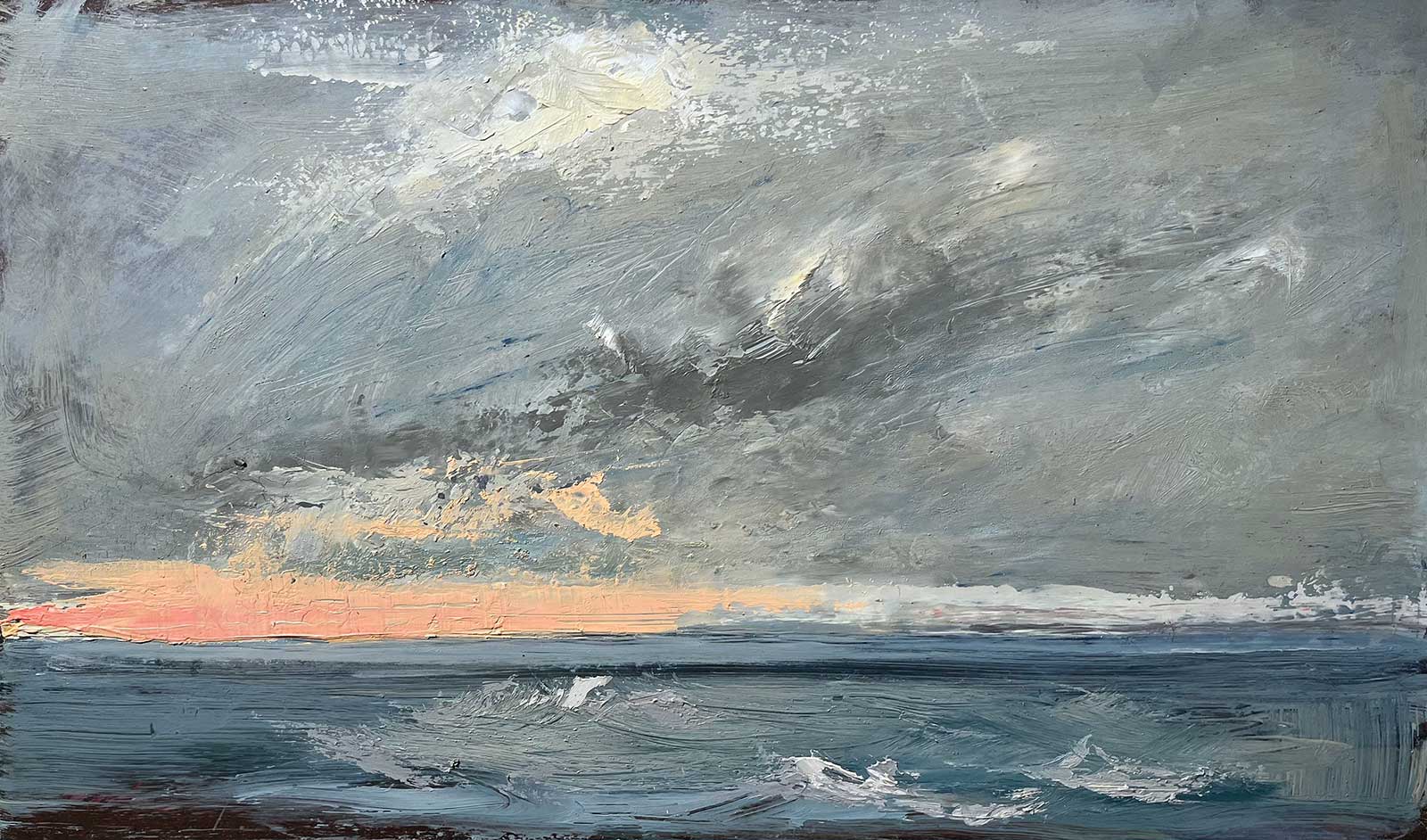
Lancaster Galleries, Back Shore Storm, oil on panel, 14 x 24", by John David Wissler.
Thomas Cole (1801-1848), emigrated to the U.S. when he was 17 and became the country’s first major landscape painter, inspiring a generation of artists who became known as the Hudson River School. In his 1836 “Essay on American Scenery” he wrote, “I will now speak of another component of scenery, without which every landscape is defective—it is water. Like the eye in the human countenance, it is a most expressive feature: in the unrippled lake, which mirrors all surrounding objects, we have the expression of tranquility and peace—in the rapid stream, the headlong cataract, that of turbulence and impetuosity.”
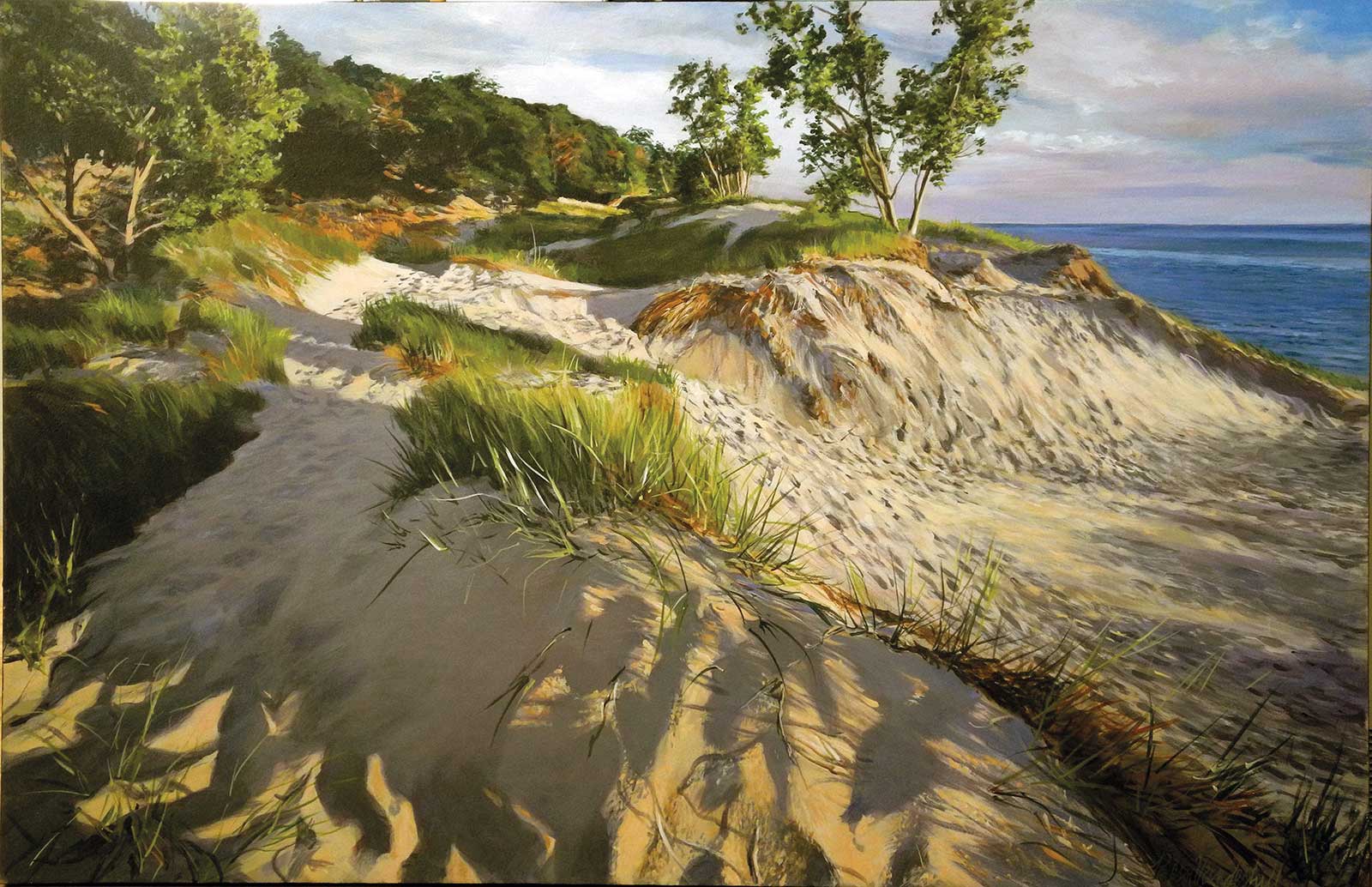
J. Petter Galleries, Well Traveled Dunes, acrylic, 40½ x 62¼", by Rein Vanderhill.
John David Wissler’s manipulation of the viscosity of paint creates convincing spaces especially when he is in and inspired by the weather on Great Cranberry Island off the coast of Maine. He began painting and drawing as a perfectionist, scrupulously examining every detail. As he studied the great landscape painters he began to open up, creating atmosphere and openness.
Back Shore Storm, in rich gestures of paint, captures the turbulent sea and storm clouds and a hint of hope in the sunset along the horizon. “The island has become my muse,” he says, “its beauty and ever changing light and atmosphere. It is the place itself that inspires...that has become part of my thoughts and my actions when painting. The island is and I paint there. Rigorous looking and working spills over in my studio and I cannot separate them.”
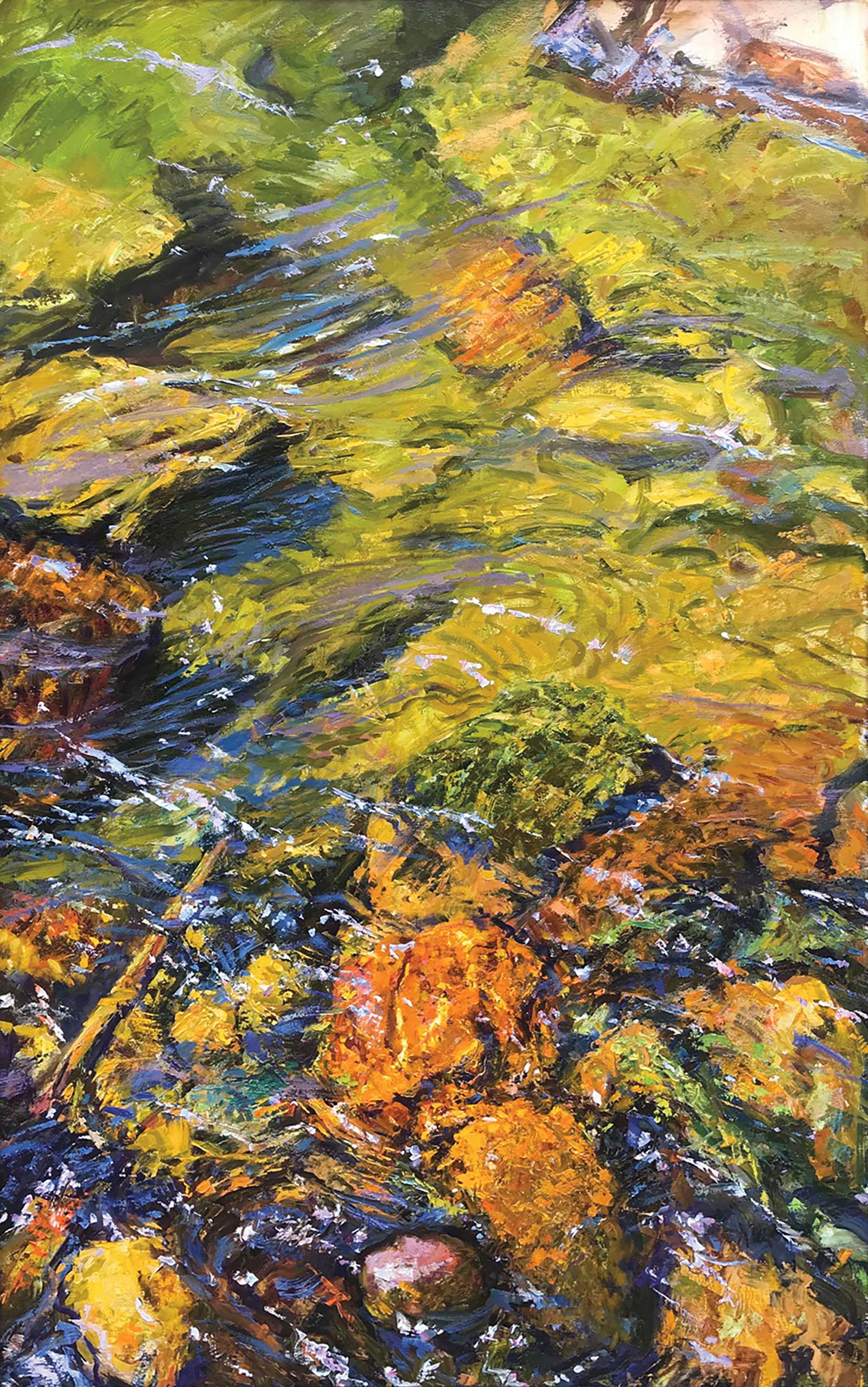
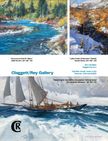
Claggett/Rey Gallery, Liquid Elegy, oil, 48 x 30", by Kent Lemon.
He comments, “I find the challenge of using what I have observed, taking it to my studio and creating a new painting invigorating. Drawing upon the memory of place and experience…using the language I have learned from nature, trying to keep the painting fresh…space, clarity, surprise…that’s painting!”
Charles Munch paints in rural Wisconsin where he has hiked, biked and paddled his canoe for years. He, too, began painting in a highly realistic manner. He had apprenticed to the paintings conservator at the The Frick Collection in New York City and learned the artistic and technical aspects of Old Master painting. Living back in the untamed nature of Wisconsin, however, he began to want to express his emotional response to the landscape and its denizens.
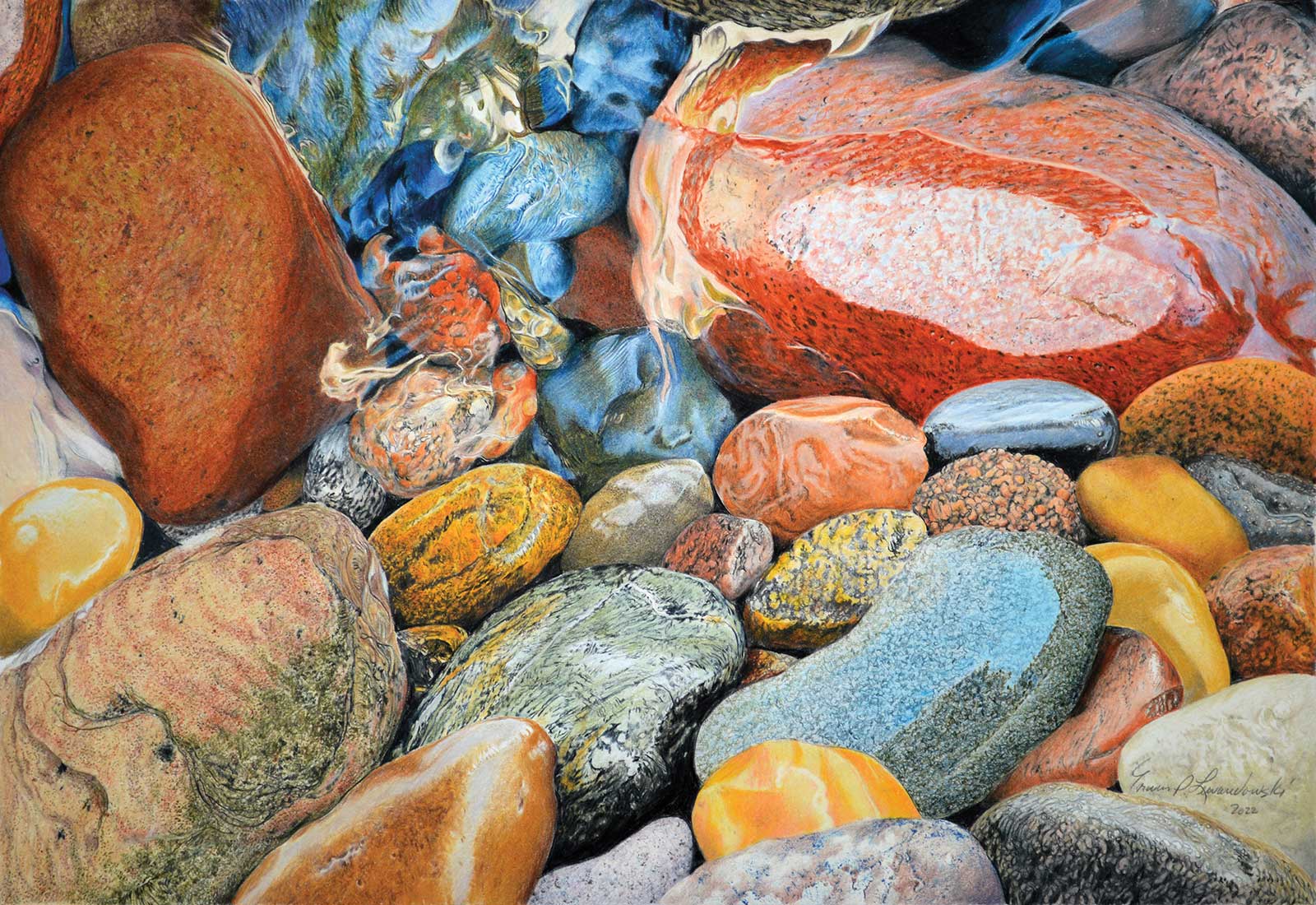
J. Petter Galleries, Lake Huron Rock Collection II, colored pencil on paper, 13 x 19", by Erwin P. Lewandowski.
“For many years,” he says, “my paintings have reflected life lived in rural southwestern Wisconsin, in the midst of countless animals and plants. However, year after year we are steadily losing our companions in the biosphere. My emotional reactions to the shifts occurring around me may account for recent changes in my work. The paintings in general are larger, darker in tone, and deeper and richer in color. My work continues to hearten the oppressed animals and help humans visualize a more balanced world.”
He eschews detail and composes intense fields of outlined color. The intensity of Spring Push-Off captures the vitality of spring, the river swollen with spring run-off and the promise of renewed life after the harsh winter. The canoeist eagerly welcomes his return to the outdoors. In this and other paintings, Munch emphasizes our oneness with nature, our participation in a greater whole.
Erwin P. Lewandowski zeroes in on water in a series of paintings: falling water, stillwater, crevice stream, cascading water and broader waterscapes. His highly realistic yet often abstract renderings of water in its many environments are created in color pencil, often combining details from different sources.
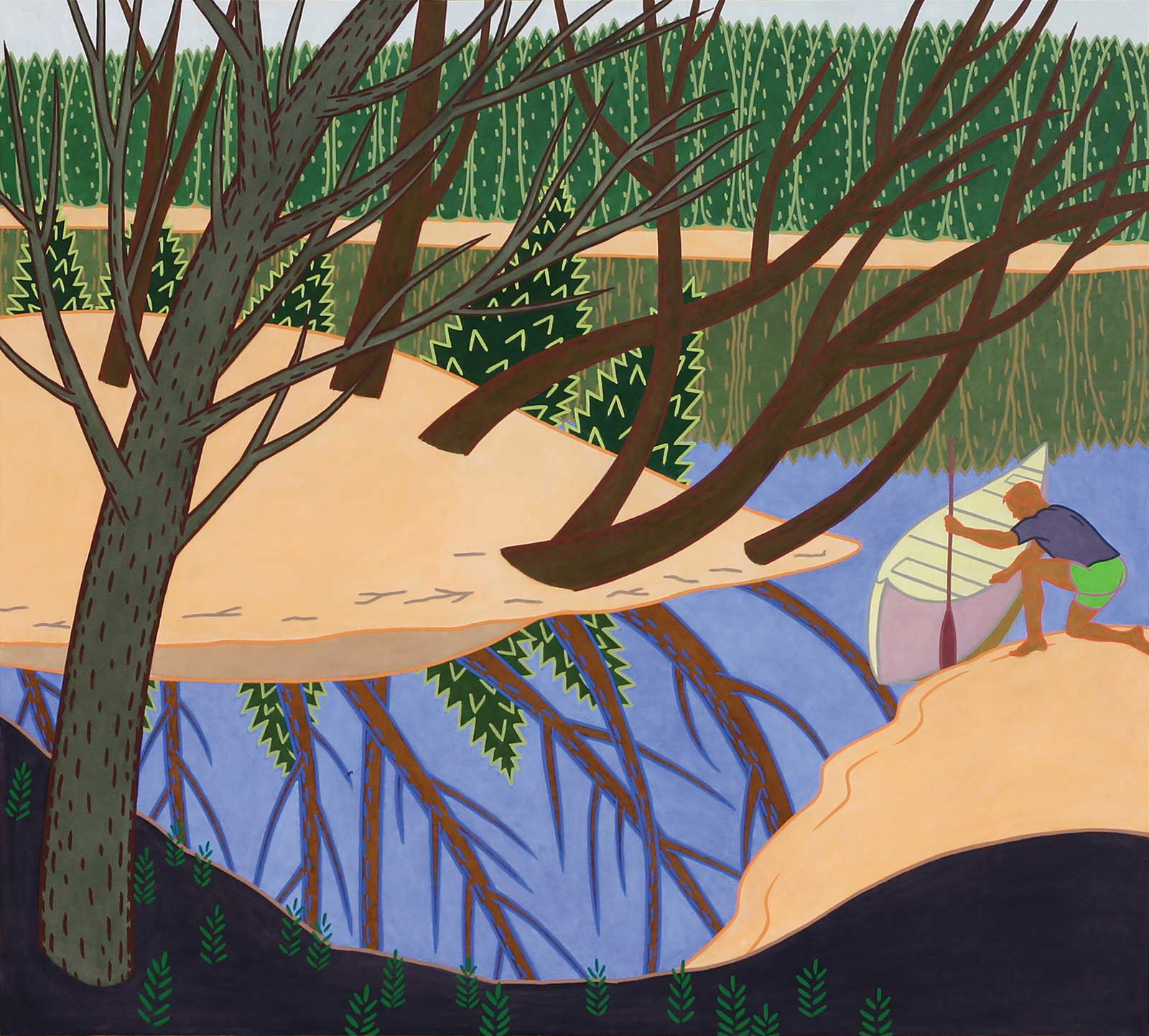
Tory Folliard Gallery, Spring Push Off, oil on canvas, 21½ x 24", by Charles Munch
Lewandowski lives in Michigan on the shore of Lake Huron, well aware of the qualities of water in different seasons and weather conditions. In Lake Huron Rock Collection II, water is barely present physically as it gently laps rocks that it has tossed around for millennia, smoothing them into soft shapes, its moisture revealing the abstractions of the geological forces that made them.
In the remainder of this collector's focus, enjoy more works that capture the ever-changing, free flowing nature of water, from ocean waves to trickling streams.
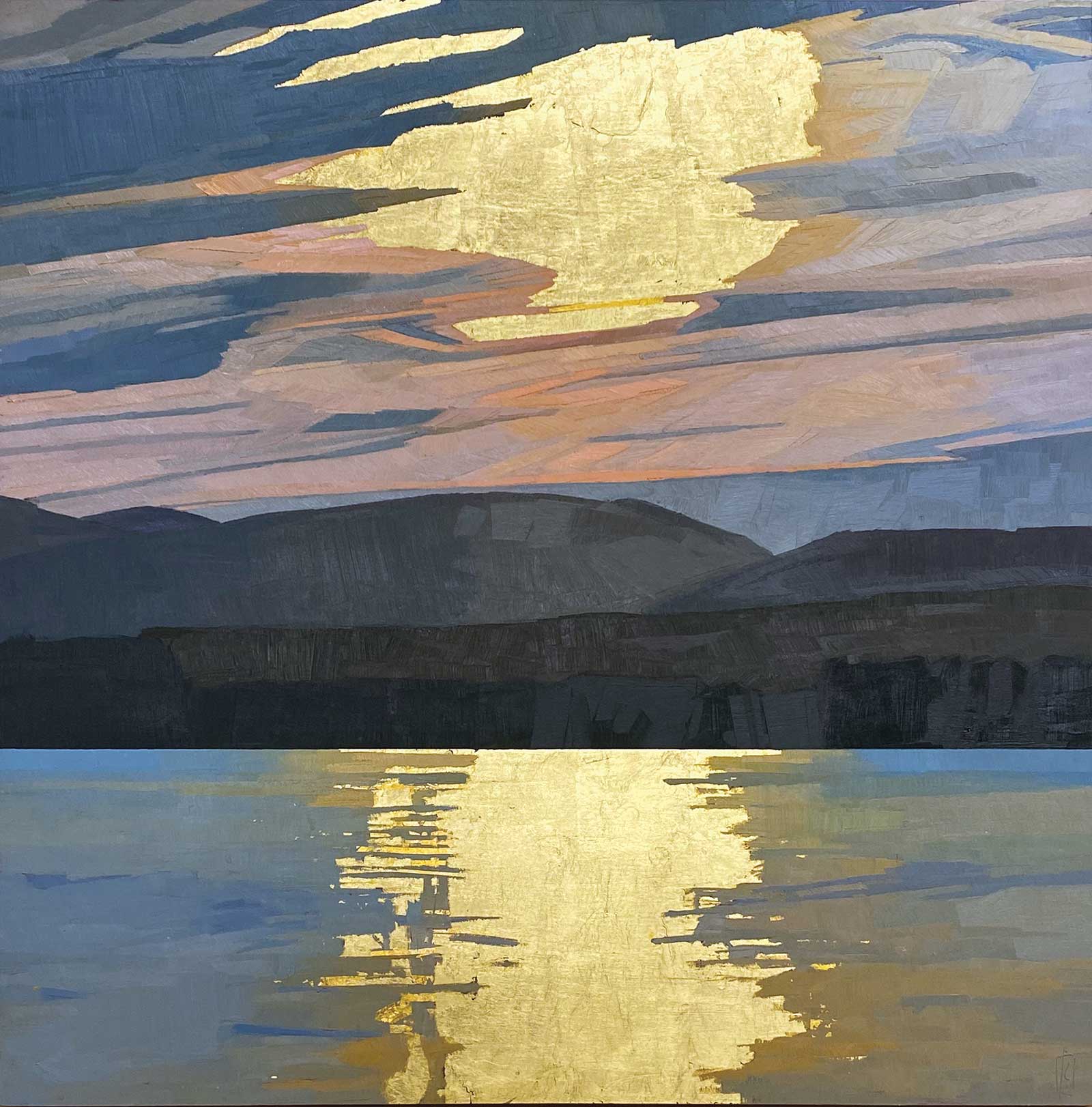
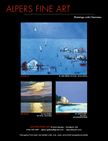
Alpers Fine Art, Big Old Sun, oil and leaf on linen, 30 x 30", by Sue Charles.
Nothing quiets the mind or soothes the spirit like gazing across crystal clear waters. J. Petter Galleries in Douglas, Michigan, is surrounded by the shoreline of our Great Lakes that cradle a treasure trove of the most coveted liquid of all—fresh water. J. Petter Galleries represents some of the top artists working in this subject matter today. Erwin Lewandowski’s colored pencil on paper details and magnifies each rock and crevice that the water follows to the lakes, Debra Reid Jenkins’ oils invite us to peer all the way through a wave to the constantly moving sand and rocks below, and Rein Vanderhill’s acrylics sing with shadows in the sand and swales along the shore.
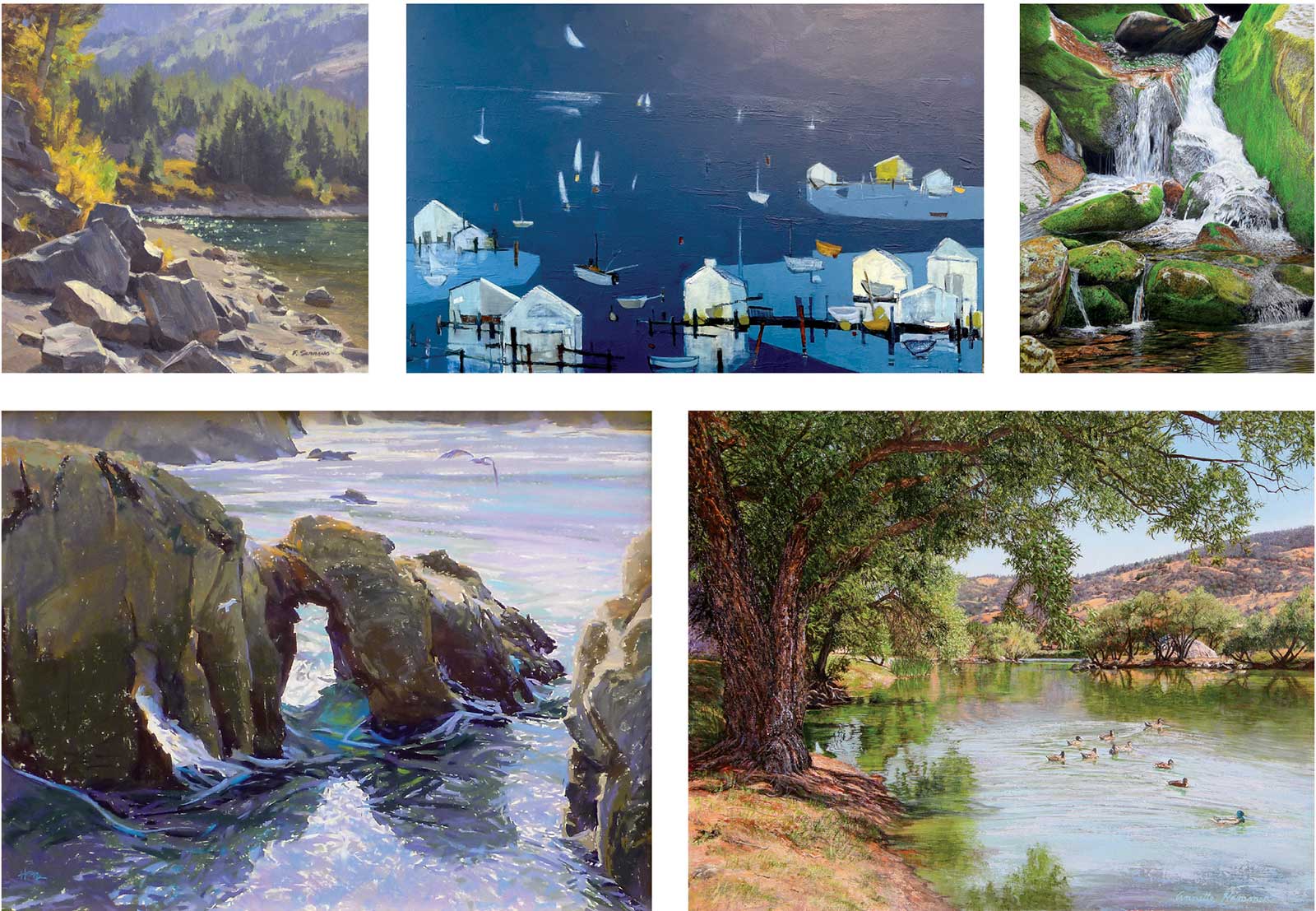
Top: Tehachapi Arts Commission, Virginia Lake Sparkle, oil on linen, 12 x 12", by Frank Serrano; Alpers Fine Art, Into the Night, oil on canvas, 24 x 36", by Julie Gifford; J. Petter Galleries, Cascading Water XXIII, paper, 21 x 17", by by Erwin P. Lewandowski. Bottom: Claggett/Rey Gallery, Arch at Point Lobos, pastel, 20 x 26", by W. Truman Hosner; Tehachapi Arts Commission, Morning-Swim, oil on canvas, 16x 20", by Annette Hammer.
“A stroll along the beach, hiking to a high mountain lake or meandering along a lazy river—as humans, being close to water gives us a sense of calm and rejuvenation,” says Maggie DeDecker, co-owner of Claggett/Rey Gallery in Edwards, Colorado. For centuries, artists have aspired to capture this element of nature. “You can almost hear the crashing waves as they navigate through the arch at Point Lobos and the gulls beckoning the next thunderous clap in W. Truman Hosner’s painting Arch at Point Lobos,” says DeDecker. “In Kent Lemon’s Liquid Elegy there is an intimate invitation for a refreshing dip of one’s tired feet after a long hike. James Reynolds pauses nature in deep meditation with the still water of Sierra Lake. Conveying a vital, reenergizing atmosphere through their work keeps the artists immersed in these environs until they absorb the essence of each scene in depth. Every collection should afford multiple illustrations of these strokes of sentiment.”
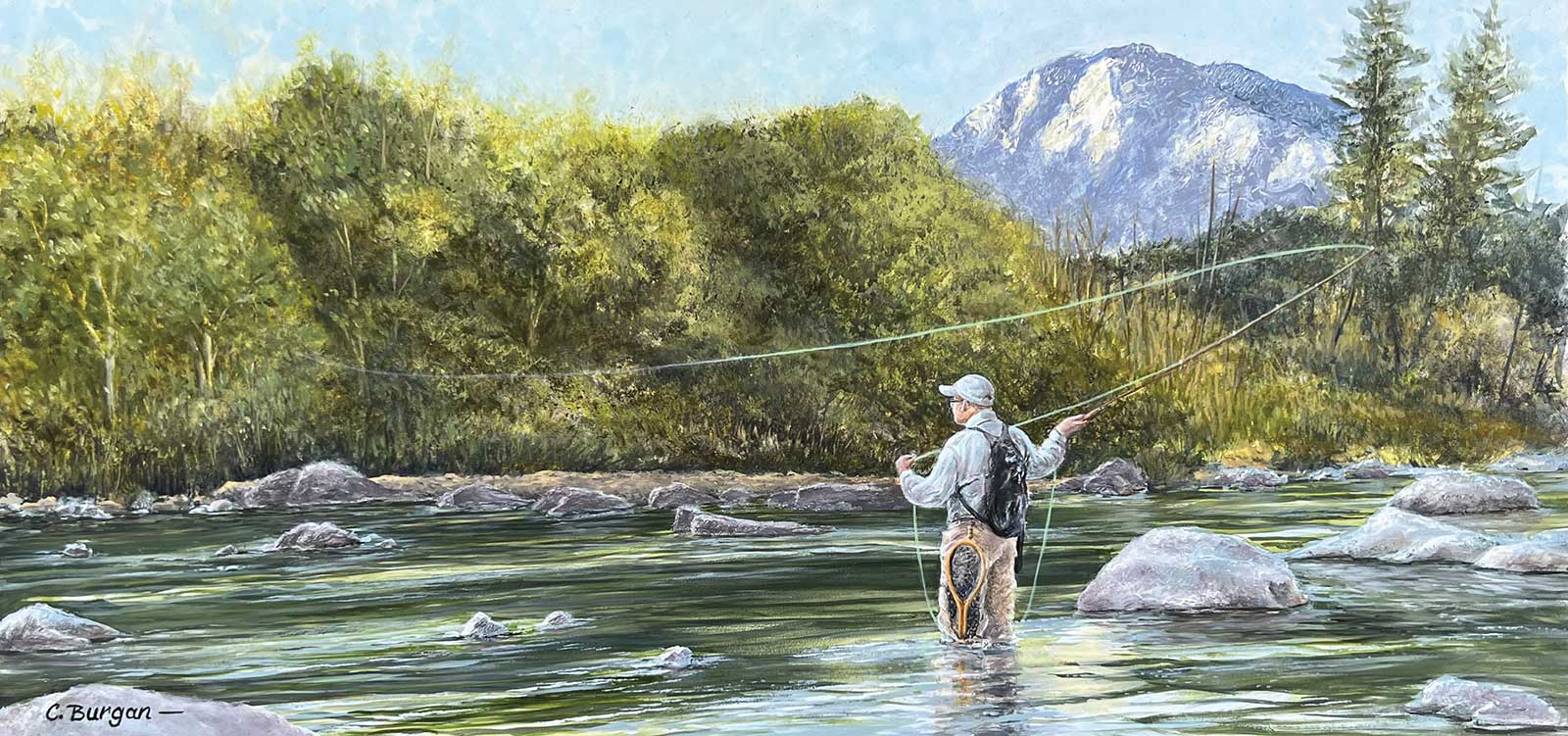
Tehachapi Arts Commission, Casting on the Kern, oil on canvas, 11½ x 24", by Christopher Burgan.
“I’ll generalize: every dealer silently exults when a gallery-visitor invests sufficient time to engage with a painting and discover precisely what makes it distinctive,” says Peter Alpers of Alpers Fine Art. Contemplating Janis Sanders’ Afternoon Shimmer, collectors can observe how the artist creates visual drama through contrast—flat blue sky juxtaposed against textured, detailed foreground. In Big Old Sun by Sue Charles, darkening hills materialize out of deft tonal calibration. “Notice, too, how Sue Charles keys up her palette to give that incandescent sky its due, then smoothly downshifts to capture the sunset’s subdued reflection on the water,” continues Alpers. And though darkness has fallen in Into the Night, Julie Gifford creates a dreamy harbor scene in the moonlight with sailboats heading out toward the beckoning moon.
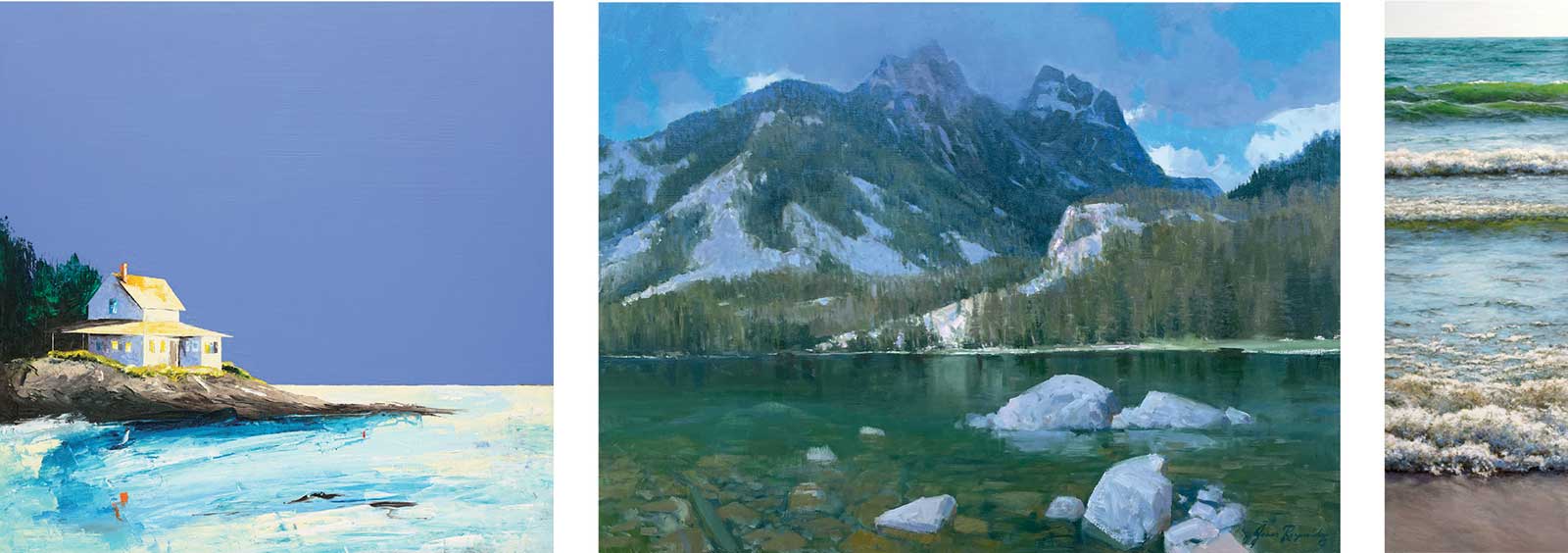
From left: Alpers Fine Art, Afternoon Shimmer, oil on braced panel, 24 x 24", by Janis Sanders; Claggett/Rey Gallery, Sierra Lake, oil, 30 x 40", by James Reynolds; J. Petter Galleries, Quiet Greens, oil, 36 x 12", by Debra Reid Jenkins.
Tehachapi Arts Commission represents the works of such artists as Annette Hammer, Christopher Burgan and Frank Serrano. Of her oil on canvas Morning-Swim, Hammer says, “We arose early to take advantage of the quiet time at Four Islands Lake in Bear Valley Springs...We quietly paddled around, enjoying nature and the other occupants that were also early risers.” Burgan’s Casting on the Kern depicts a fisherman wading in the middle of a river. “Few things bring me as much joy as putting a brush to panel or casting a dry fly onto the perfect spot on the water,” he says. And in Virginia Lake Sparkle by Serrano, sunlight glimmers across the surface of the water. “Last fall I brought a good friend with me to Virginia Lakes to experience the grandeur of the Eastern Sierra during this special time,” says the artist. “As we hiked along the shore of the lake, we came upon this sparkling view and I knew I had to capture it on canvas.” —
Featured Artists & Galleries
Alpers Fine Art
8 Dock Square
Rockport, MA 01966
(978) 760-1829
alpers.gallery@gmail.com
www.alpersfineart.com
Claggett/Rey Gallery
216 Main Street, Suite C-100
Edwards, CO 81632
(970) 476-9350
www.claggettrey.com
J. Petter Galleries
161 Blue Star Highway
Douglas, MI 49406
(269) 857-2230
www.jpettergalleries.com
Lancaster Galleries
34 North Water Street
Lancaster, PA 17603
(717) 397-5552
www.lancastergalleries.com
Tehachapi Arts Commission
(626) 945-3753
dreyerfinearts@gmail.com
www.artstehachapi.org
Tory Folliard Gallery
233 N. Milwaukee Street
Milwaukee, WI 53202
www.toryfolliard.com —
Powered by Froala Editor