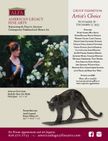
The Swiss psychiatrist and psychoanalyst Carl Jung (1875-1961) wrote about the dark side of the personality that needs to be acknowledged in order to be, as it were, whole. He wrote, “Unfortunately there can be no doubt that man is, on the whole, less good than he imagines himself or wants to be. Everyone carries a shadow, and the less it is embodied in the individual’s conscious life, the blacker and denser it is. If an inferiority is conscious, one always has a chance to correct it. Furthermore, it is constantly in contact with other interests, so that it is continually subjected to modifications. But if it is repressed and isolated from consciousness, it never gets corrected.”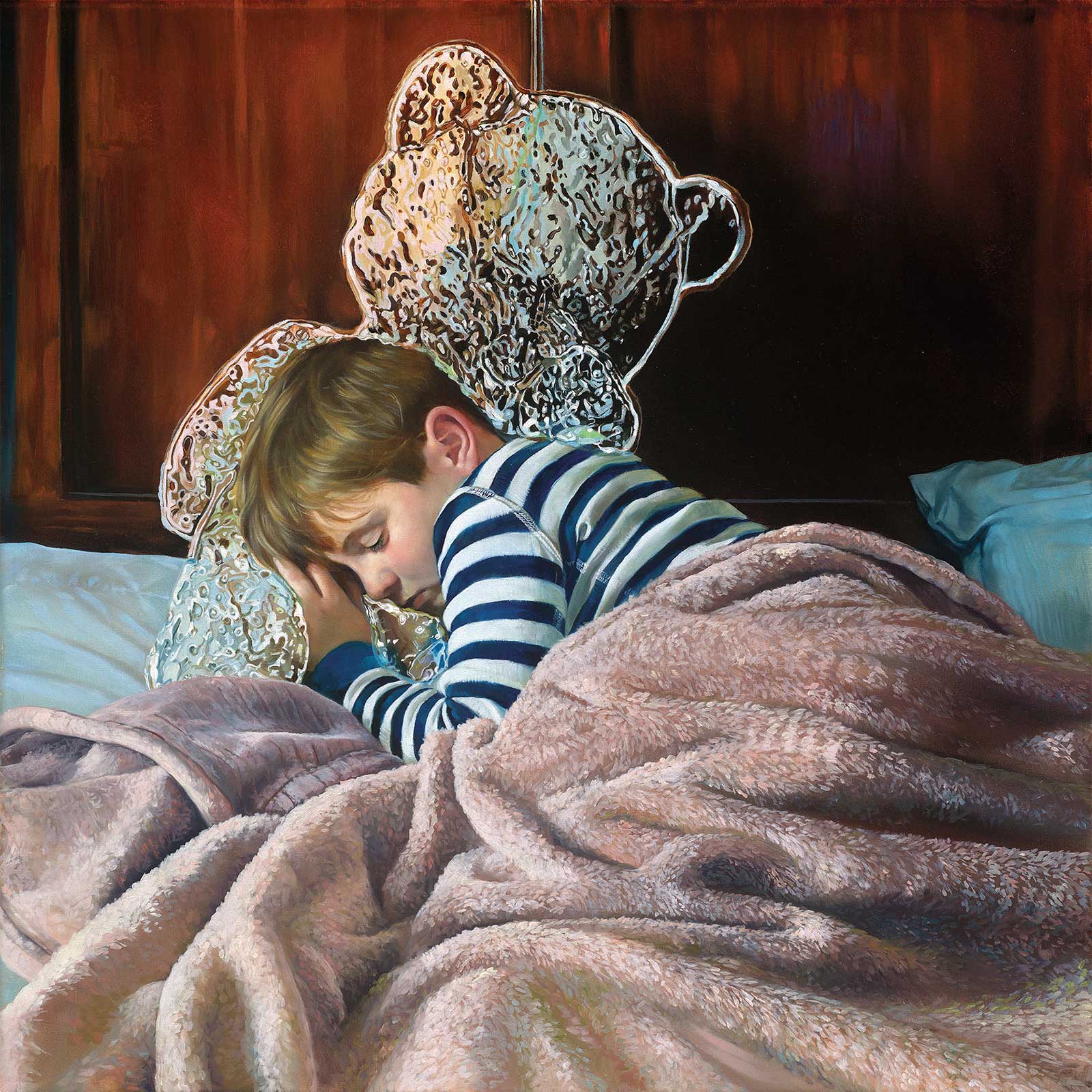 Bryony Bensly, Teddy Bear, oil on canvas, 20 x 20". Courtesy the artist.
Writers, visual artists and composers probe the depths of their individual psyches and that of our communal society, revealing themselves as well as ourselves to ourselves.
The word chiaroscuro is a combination of the Italian words for light and dark. In art, it refers to the use of bright light to bring the subject forward from a dark background—to, in effect, cause the subject to emerge from the shadow.
Michelangelo Merisi da Caravaggio (1571-1610) was the preeminent master of chiaroscuro, using street people as models for saints in his controversial religious paintings. The National Gallery in London observes, “Arrogant, rebellious and a murderer, Caravaggio’s short and tempestuous life matched the drama of his works.”
In 1605 he was commissioned by the Confraternity of the Papal Grooms to paint a portrait of their patron, Saint Anne. Caravaggio depicted an aged Saint Anne with her daughter Mary and Mary’s son, Jesus. Saint Anne appears as a wrinkled old woman, and Mary appears as a voluptuous young woman perhaps revealing too much of her physical beauty. A shaft of bright light distinguishes them from the darkness. A secretary to a cardinal at the time wrote, “In this painting there are but vulgarity, sacrilege, impiousness and disgust...One would say it is a work made by a painter that can paint well, but of a dark spirit, and who has been for a lot of time far from God, from His adoration, and from any good thought.” The reference to Caravaggio’s shadow has followed him throughout history. Why were his saints not beautiful? Why were they depicted as common people? Why did he kill a rival in a duel? 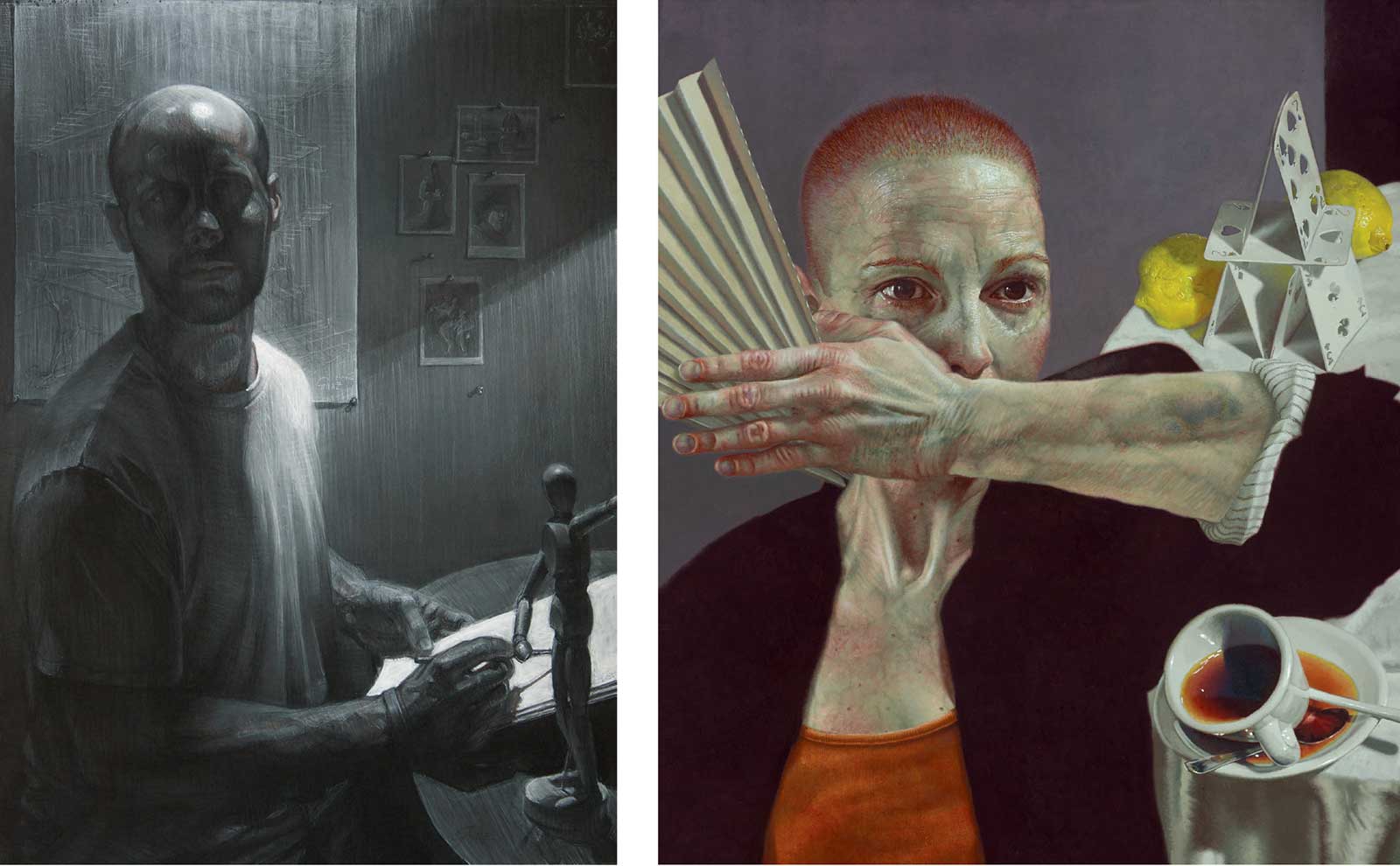 Gallery Victor Armendariz, Chiaroscuro, white chalk, white charcoal, white pastels, burnt sienna pastel, charcoal and black pastels on Somerset velvet black paper, 38 x 27½", by Christopher Ganz; Waterhouse & Dodd, Blessure, oil on Belgian linen, 55¼ x 47¼", by Edward Povey.
In Christopher Ganz’ self-portrait, Chiaroscuro, light seems divinely delivered as it illuminates his drawing board and leaves him in shadow. On the wall, deeper in shadow, are reproductions of some of the masters of chiaroscuro—Caravaggio, Rembrandt and the “Spanish Caravaggio,” Zurbaran.
Ganz writes, “I use realism to invite the viewer into mysterious inner worlds that are layered reflections of the outer. Dehumanizing environments are imbued with art historical references as a critique of power structures. The artist is an Everyman who is at odds with society and his self. Visually, my work is a celebration of society’s dark undercurrents and its overlooked absurdities. I use charcoal and printmaking media as their tenebrous values add a fitting metaphor. The nuances of light and shadow seduce viewers into a world their better judgment would have them avoid. This provokes a sense of disquietude that causes viewers to assess our world through the austerity of a colorless, yet not humorless, light.”
Bryony Bensly interpreted a 17th century work by the Dutch painter Melchior de Hondecoeter, who was famed for his paintings of birds. She brought his Palace of Amsterdam with Exotic Birds into the 21st century. 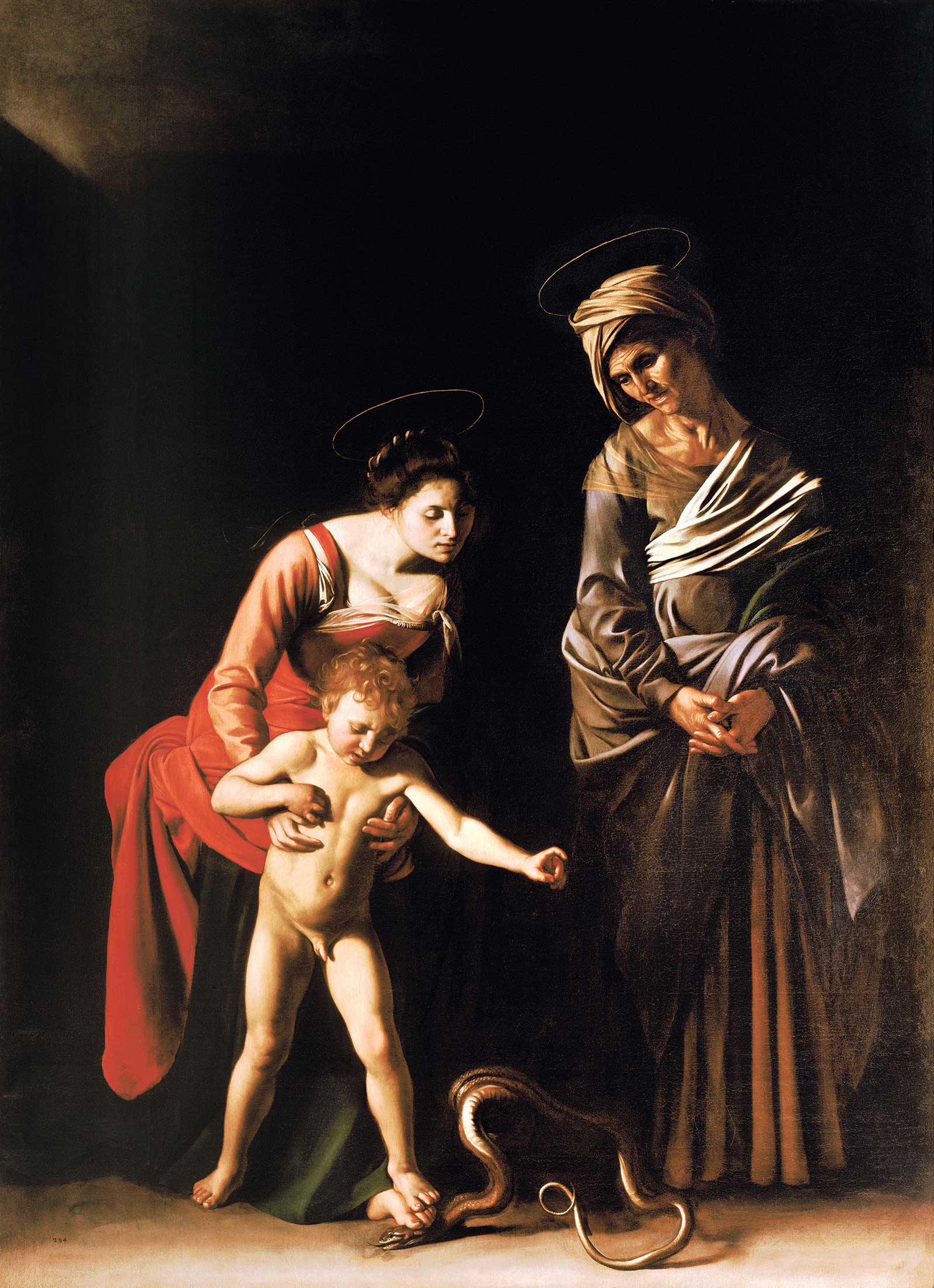 Michelangelo Merisi da Caravaggio (1571-1610), Madonna dei Palafrenieri, 1606, oil on canvas, 115 x 83". Galleria Borghese, Rome, Italy. Public Domain.
She commented at the time, “It’s incomprehensible to think of the exotic birds being extinct today. The lives of animals and our lives are in a precarious position. I wanted to show the preciousness of life and took the Palace of Amsterdam as inspiration, painting de Hondecoeter’s animals as transparent, fragile glass, substituting the royal palace with the White House.” The title of the painting is Legacy, asking “What will be our legacy?”
Bensly is fond of the works of William Blake who wrote, “The tree which moves some to tears of joy is in the eyes of others only a green thing that stands in the way. Some see nature all ridicule and deformity... and some scarce see nature at all. But to the eyes of the man of imagination, nature is imagination itself.”
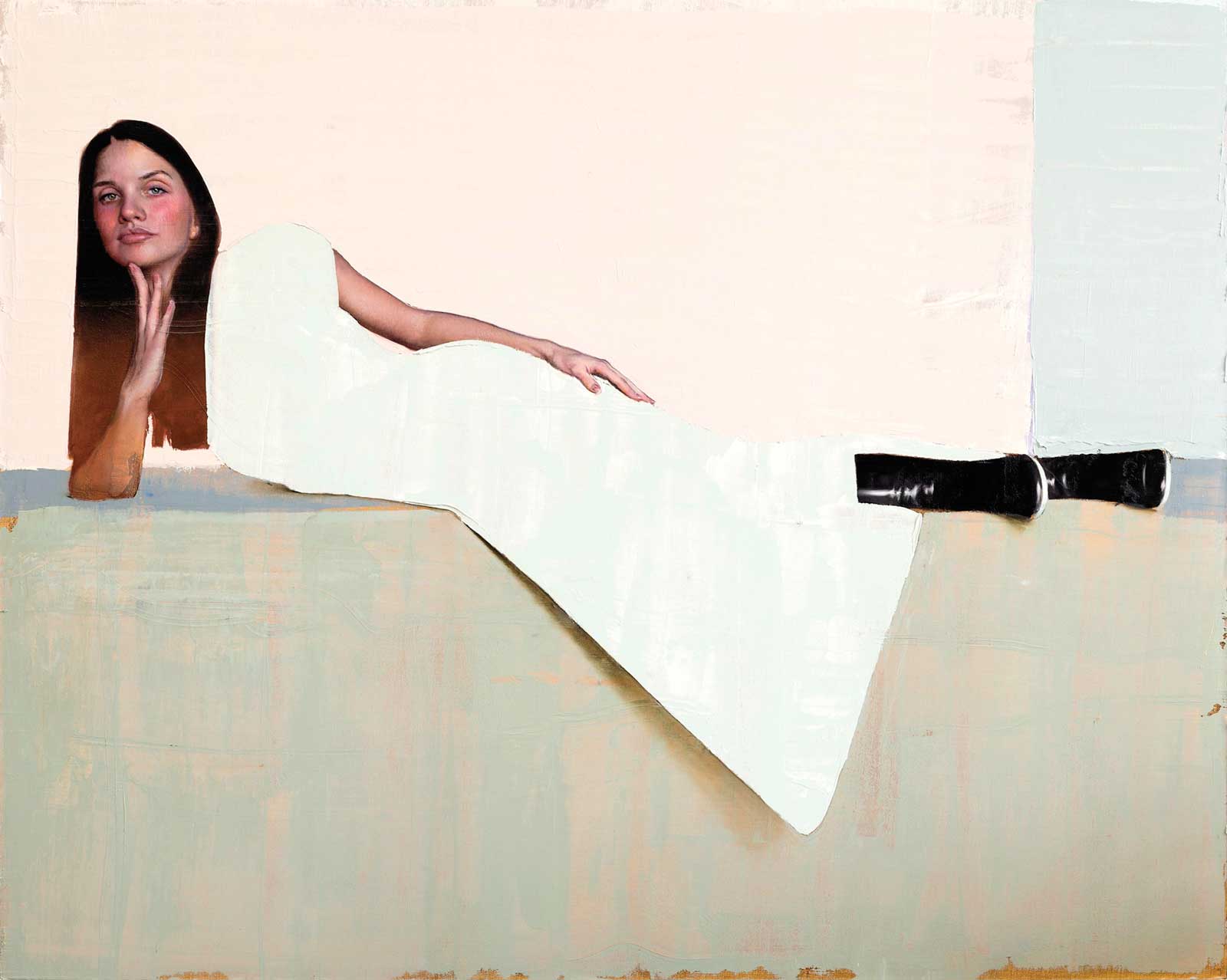 J Louis, Boots, oil on cradled linen panel, 48 x 60"
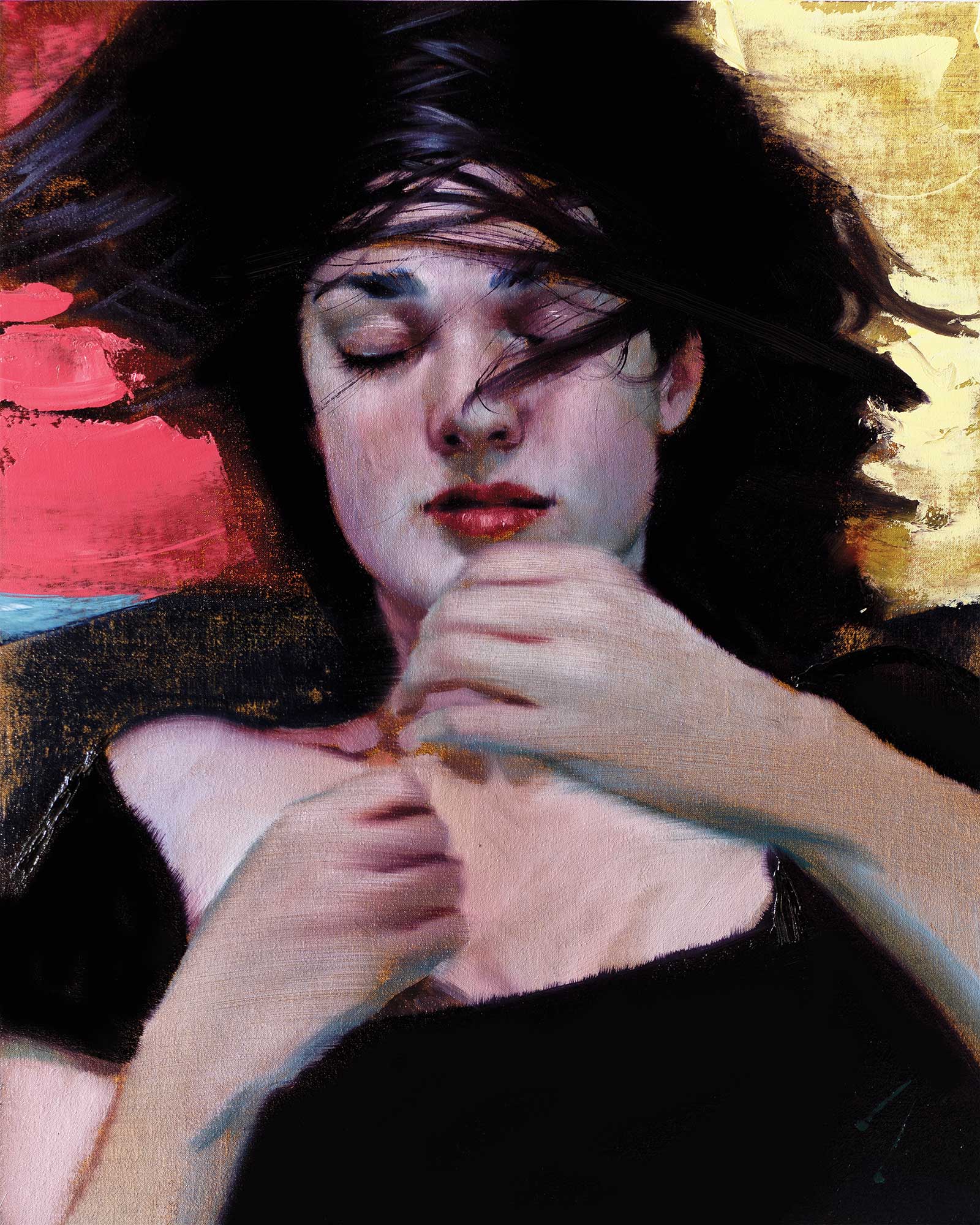 J Louis, OBE, oil on cradled linen panel, 20 x 16"
It takes little to imagine humanity’s impact on the environment given its stark reality.
Bensly uses her highly realized painting technique to comment on our interconnectedness with one another and with the environment. Those who see the tree as “only a green thing that stands in the way” are part of that interconnectedness and may yet become aware that their role can be beneficial. She comments, “Teddy Bear attempts to reconnect the beloved soft toy with the animal it represents, and focuses on its plight. The fragility of glass, and its transparency, immediately create tension in an otherwise mundane domestic scene, to highlight a situation we can no longer take for granted.” The comfort of cuddling with his teddy bear as he sleeps will be gone soon enough as the little boy grows up. The teddy bear will, one day, begin to fall apart unless it is preserved by a forward thinking mother. I cried when my ancient teddy bear lost an eye and again when it lost an ear and, finally, when the seams parted and revealed the coarse wood shavings that gave it form. 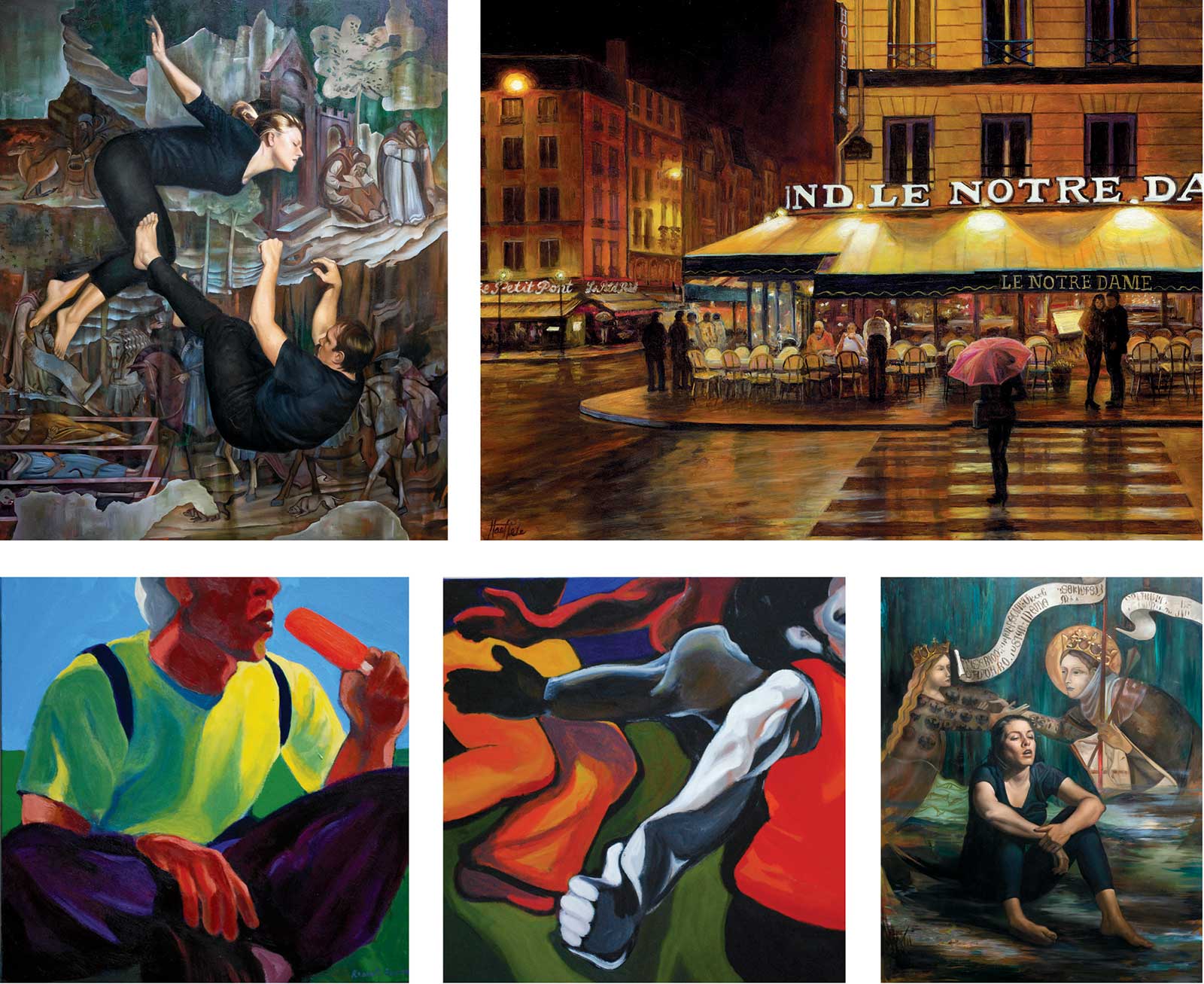 Top: Woodward Gallery, Free Fall, oil on canvas, 72 x 60", by Margaret Morrison; Deborah Haeffele, A Rainy Night at Le Hotel Notre Dame, oil on cradled gesso board, 18 x 24". Bottom: Robert Forte, The Ice Pop, acrylic on canvas, 24 x 24"; Robert Forte, Crossing the Finish Line, acrylic on canvas, 36 x 36"; Woodward Gallery, Lost Saints, oil on canvas, 60 x 48", by Margaret Morrison.
Bensly ponders the future of bears themselves. Although brown bears are not endangered today, they only occupy about two percent of their former habitat. Logging, mining and construction continue to encroach on what is left.
Edward Povey refers tangentially to the shadow. “Whatever we consider to be inevitable becomes our destiny, built by our own certainty. When this success and this disease comes calling, this accident and this great windfall, we act surprised. We wring our hands or celebrate, whilst just behind the curtain we nod and nod, knowing and knowing, because we created it long ago and then lived towards it.”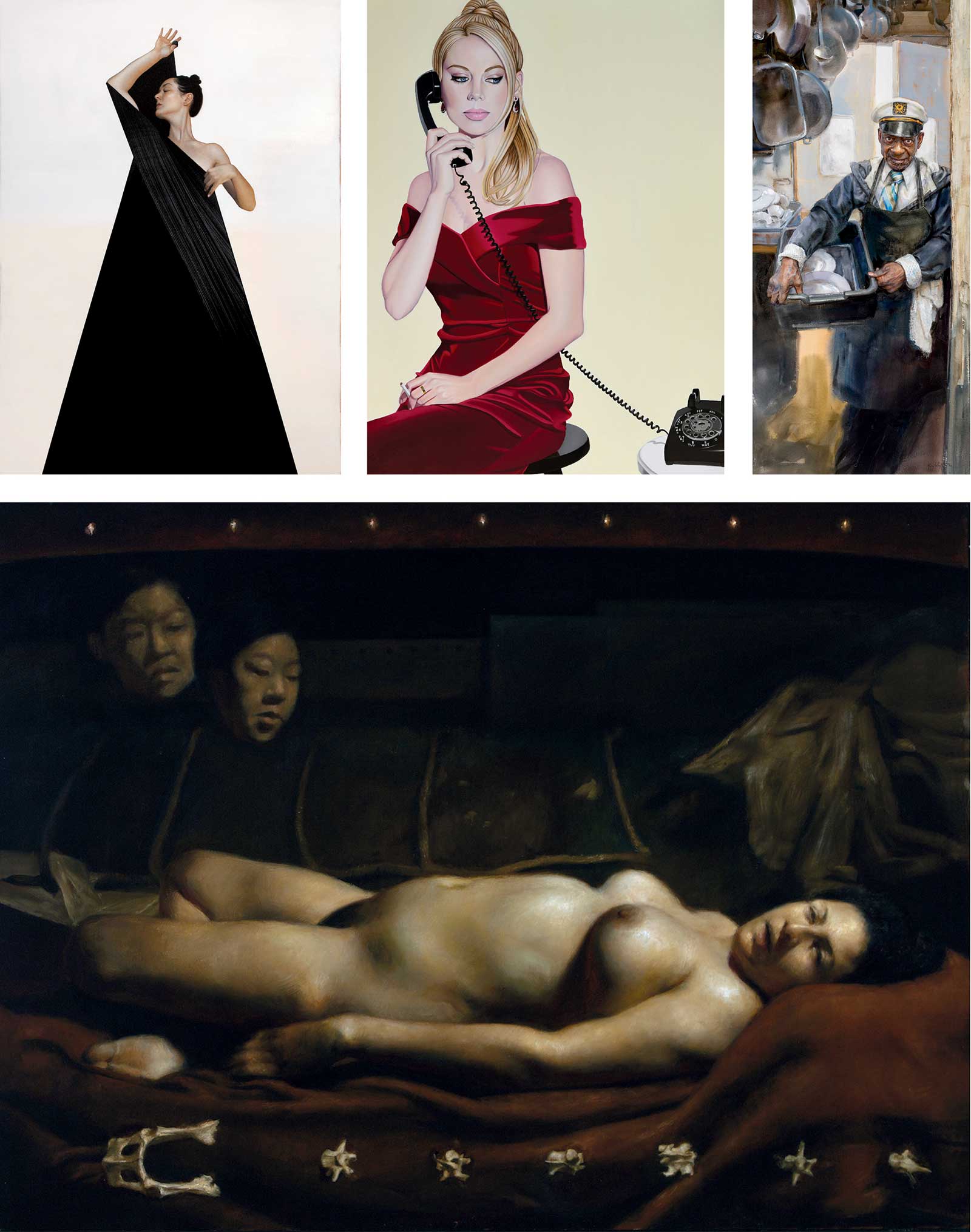 Top: J Louis, Large Pyramid 2, oil on canvas, 84 x 60"; PoetsArtists, You Called Me Up Again Just to Break Me Like a Promise, oil on Ampersand panel, 24 x 18", by Suzy Smith; Mary Whyte, Captain, watercolor, 57½ x 26". Bottom: PoetsArtists, Resting Woman, oil on linen, 36 x 48", by Annie Goldman.
Luminaries from Albert Schweitzer to Coco Chanel are credited with the truism, “At 20 you have the face which God gave you; at 40 the face life gave you; at 60 the face you deserve.” The woman in Povey’s painting Blessure (“injury”) exhibits the history of her life in her face and her present life in the wound on her arm. It is an image of precariousness—the woman’s vulnerability, the cup and saucer of spilled tea about to fall off the table, the house of cards….Yet, healing blood courses through her veins, the teaspoon may save the cup from tipping further and the suits on the cards are cut out, perhaps allowing the breeze from her fan to pass through rather than topple them.
Lemons, throughout history, have symbolized ideas from longevity and fidelity to bitterness. Their yellow in the painting enlivens its somber palette, however. The vitality of the model’s flesh was achieved by Povey’s use of an early Renaissance technique of underpainting with Verdaccio, a greenish hue, followed by layers of translucent and opaque paint.
The complexity of Povey’s technique echoes the complexity of human life. The woman is a product of her past, living in the now, moving toward, as we all do, an unknown future. Povey says, “We are all incomplete. We are all works in process. We are never prepared. We are always unfinished. And I want the paintings to reflect that.”
Jung said that life is, in effect, “continually subjected to modifications.” A hopeful thought in trying times.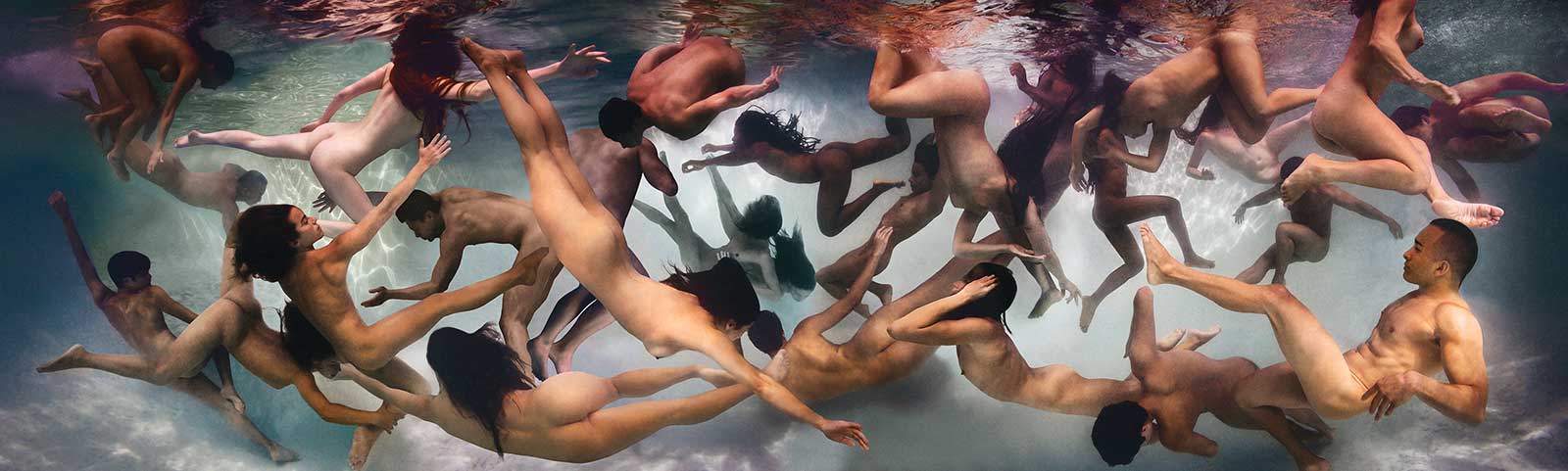 Ed Freeman, Panorama 1, archival inkjet print on watercolor paper, 36 x 120"
Throughout the pages of this special section, collectors can explore more depictions of the human form in all of its intricacy, nuance and states of change.
Esteemed figurative painter J Louis is continuously inspired by the yin and yang of life, something he says draws him toward painting women in particular. “To me, women demonstrate this beautiful duality better than anything else. I am fortunate and inspired to live a life around women that possess both the greatest tenderness and grittiest perseverance,” says Louis. His expressive paintings, a blend of abstraction and realism, capture the complexities of women and the stories behind who they are. “It is my goal in this work to present what I find to be the most beautiful and inspiring images of feminine strength.”
Louis says that when it comes to collecting, “With art, we have an incredible opportunity to curate the energy that we surround ourselves with. This should always be the intent beyond any investment considerations.”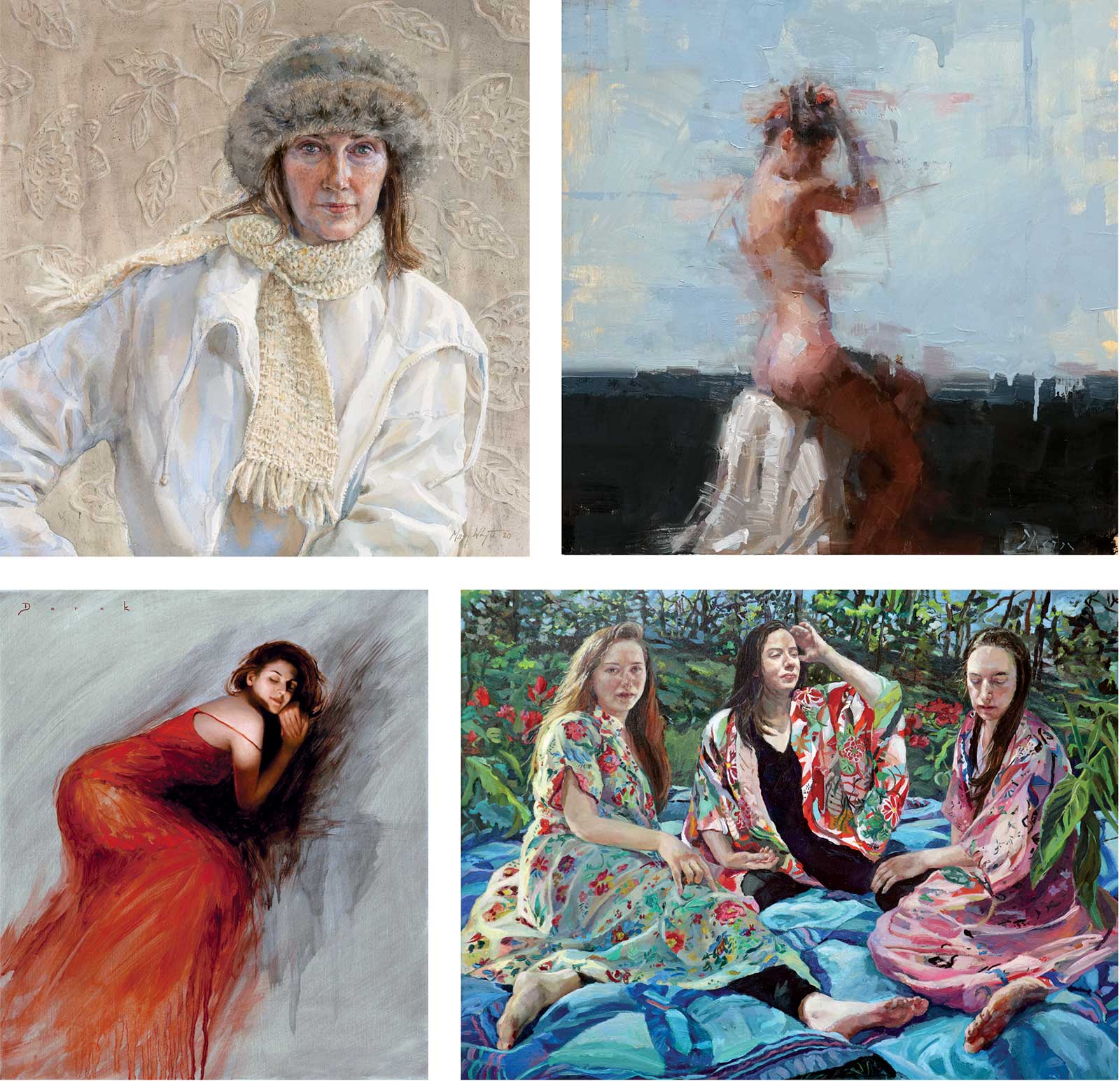 Top: Mary Whyte, Winter Whyte, watercolor, 23½ x 22"; Anne Neilson Fine Art, Nude with Blue IX, oil on panel, 19.7 x 19.7", by Jacob Dhein. Bottom: Vanessa Rothe Fine Art Gallery, Crimson, oil on linen, 16 x 14", by Derek Harrison; PoetsArtists, The Three Graces, oil on cradled board, 36 x 48", by Patricia Schappler.
PoetsArtists represents both emerging artists and established artists whose works vary from traditional to contemporary. Among these artists are Annie Goldman and Patricia Schappler, who have artwork at 33 Contemporary, as well as Suzy Smith who has work at Abend Gallery. “My work is inspired by the beauty of the human form, the relationships between people, and the connection of body, mind and environment,” says Goldman. “Narratives for paintings develop from my lived experiences and often reference biblical and art historical sources. I’m interested in representing form in a fleshy and substantive way, working in many layers of varyingly opaque and transparent oil paint. Schappler is deeply inspired by Baroque form and Eastern patterning. “My daughters became the Three Graces in this shallow spaced, intimate setting,” she says of her oil The Three Graces. “Their triad positioned within burgeoning nature and crackling air, encouraged life as I see it within them—strong bodied, thoughtful, individual.” Smith says her figurative work “has always centered around the 1960s era, where I incorporate a background of an iconic art image, mostly Pop Art, that lends itself to the narrative of the painting, while also styling my models in 60’s hair, makeup and fashion.”
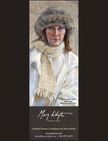
Watercolorist Mary Whyte depicts people of all backgrounds and walks of life. “I have had the privilege of painting the people of our times, and in them I have discovered the profound qualities of the unrelenting human spirit,” she says. “The binding commonness of our emotions is what drives me to keep painting, to keep exploring, and to want to demonstrate that painting a true portrait is far more than just capturing a likeness.” Whyte says that choosing a painting is like choosing a friend. “We look for what connects to our emotions, our history and our experiences. Purchasing a painting is like asking a friend for dinner, and then inviting them to stay forever.” 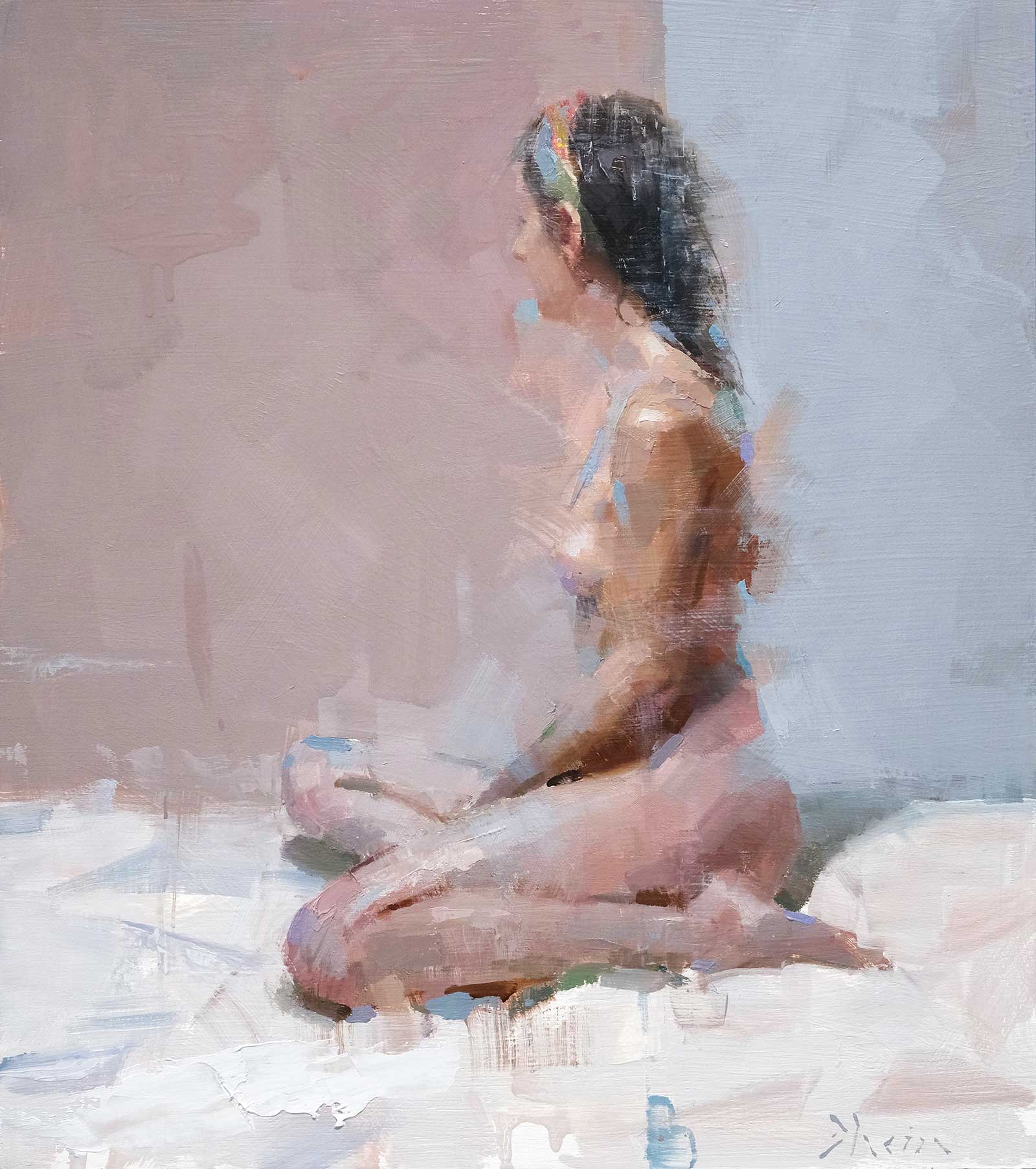 Anne Neilson Fine Art, Seated Nude Headband, oil on panel, 19.7 x 17½", by Jacob Dhein.
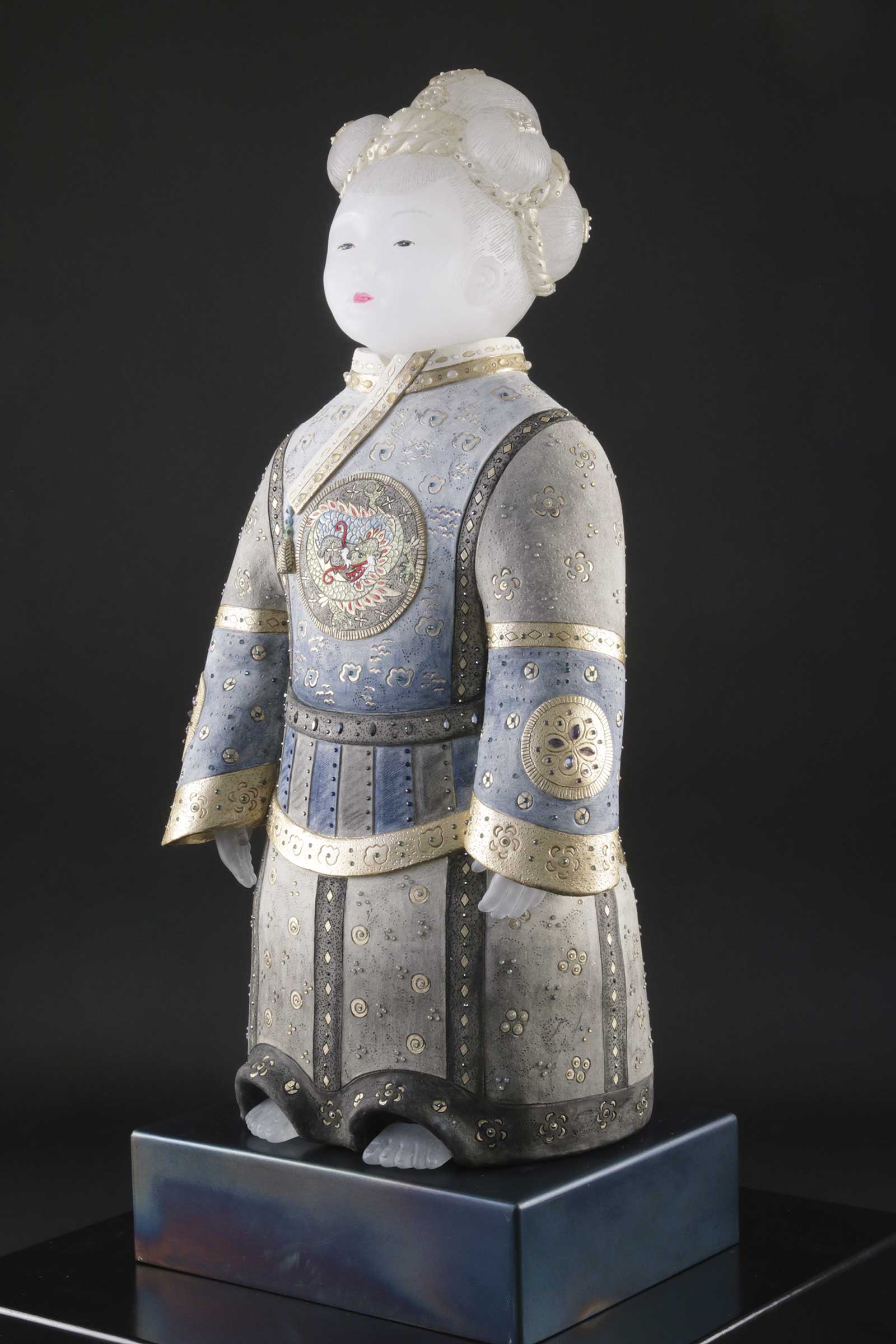 Blue Rain Gallery, Dragon and Braids, cast glass, stoneware, gemstones, crystal, silver leaf and steel base, 30½ x 14 x 9", by Vivian Wang.
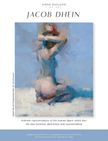
The figure has been at the forefront of art history for centuries. Represented by Anne Neilson Fine Art, the figurative paintings of Jacob Dhein employ both contemporary and traditional techniques to create a visual experience to entice the observer. The paintings possess an abstract quality when viewed at a close proximity, but as the observer steps back, the painting shifts more representational. Fragmented areas meet solid blocks of color and integrate other media to explore the limits between representation, abstraction and multimedia. While the representation of the subject will have some reference, the artist explores the beauty that lies within the division between representation and abstraction. Dhein is constantly pushing the boundaries on his modern impressionistic interpretation of the figure, and when looking for figurative works to collect, seek artists such as him that are constantly broadening the canon of contemporary art.
Collectors can explore new work by CW Mundy at Vanessa Rothe Fine Art. “This charming figure with a toy boat depicts [Mundy’s] nephew dressed up in a sailor uniform and playing with one of Mundy’s toy boat collections in the water,” says gallery owner and artist Vanessa Rothe. “This scene was set up on purpose to create the work, painted in the impressionist style, with extra attention paid to the lighting and colors within the white fabrics creating color harmony with the sea.” Other artists represented at the gallery include Tortsen Wolber and Derek Harrison. A recent piece by Wolber, The Dancer, was created from a photograph of a local ballerina and painted in a combination of styles and expressive brushstrokes. 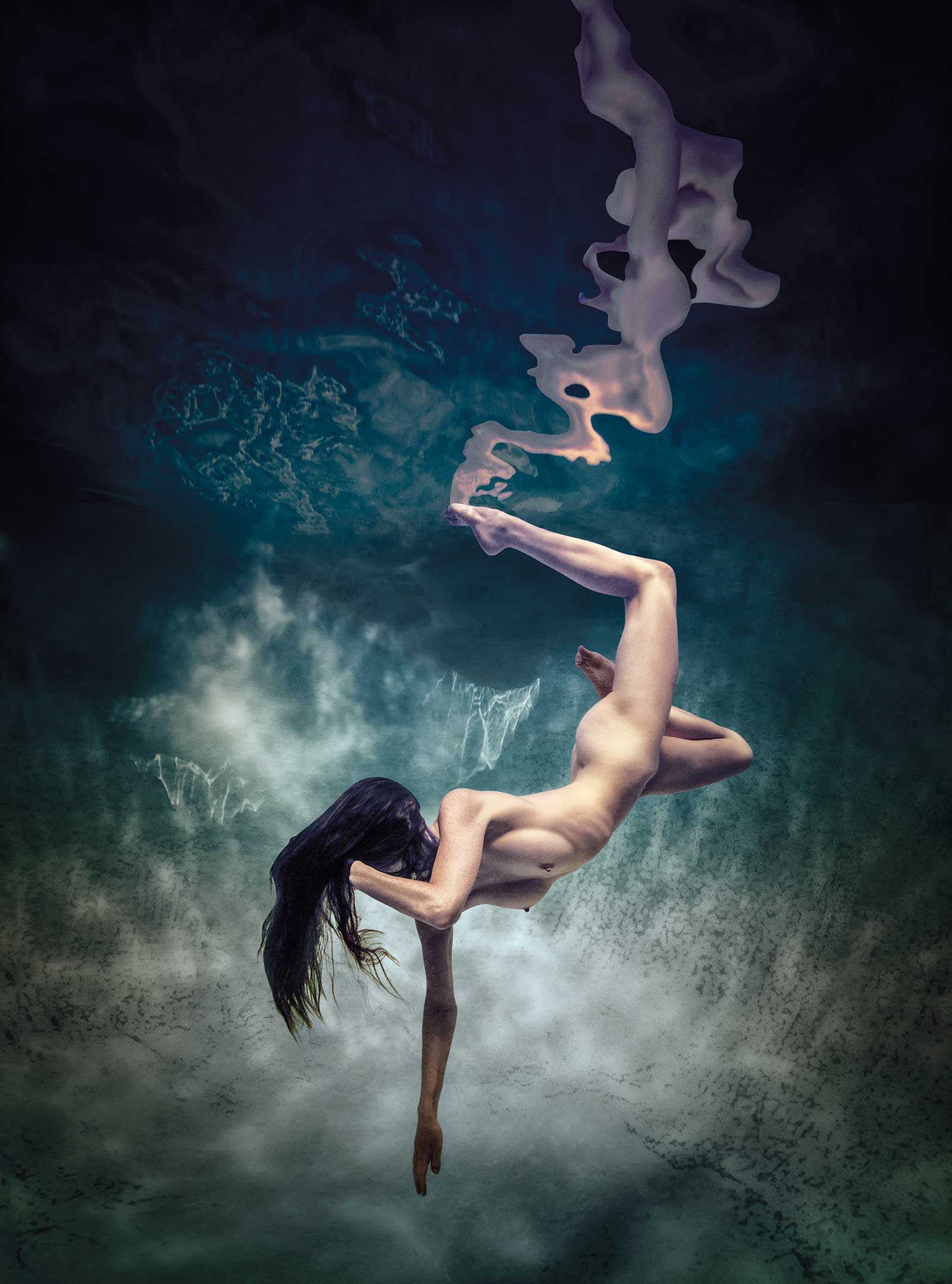 Ed Freeman, Into the Mystic, archival inkjet print on watercolor paper, 30 x 22"
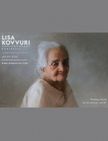
The paintings in this section by Lisa Kovvuri are from a series of portraits the artist is currently developing alongside her commissioned work. “Titled Beyond Appearances, the series uses the genre of portraiture to explore the psychology and emotions we live and move through every day. These pieces emphasize a more heightened, detailed realism than my earlier work. I want people to feel compelled to get up close and engage their senses with my subjects and feel free of barriers that may otherwise be there in real life,” says Kovvuri. “I’m particularly drawn to people who I don’t typically encounter in my usual circles, people I can learn something from. Painting them bridges a gap for me. It cultivates empathy, and that’s an important personal aspect of my work.”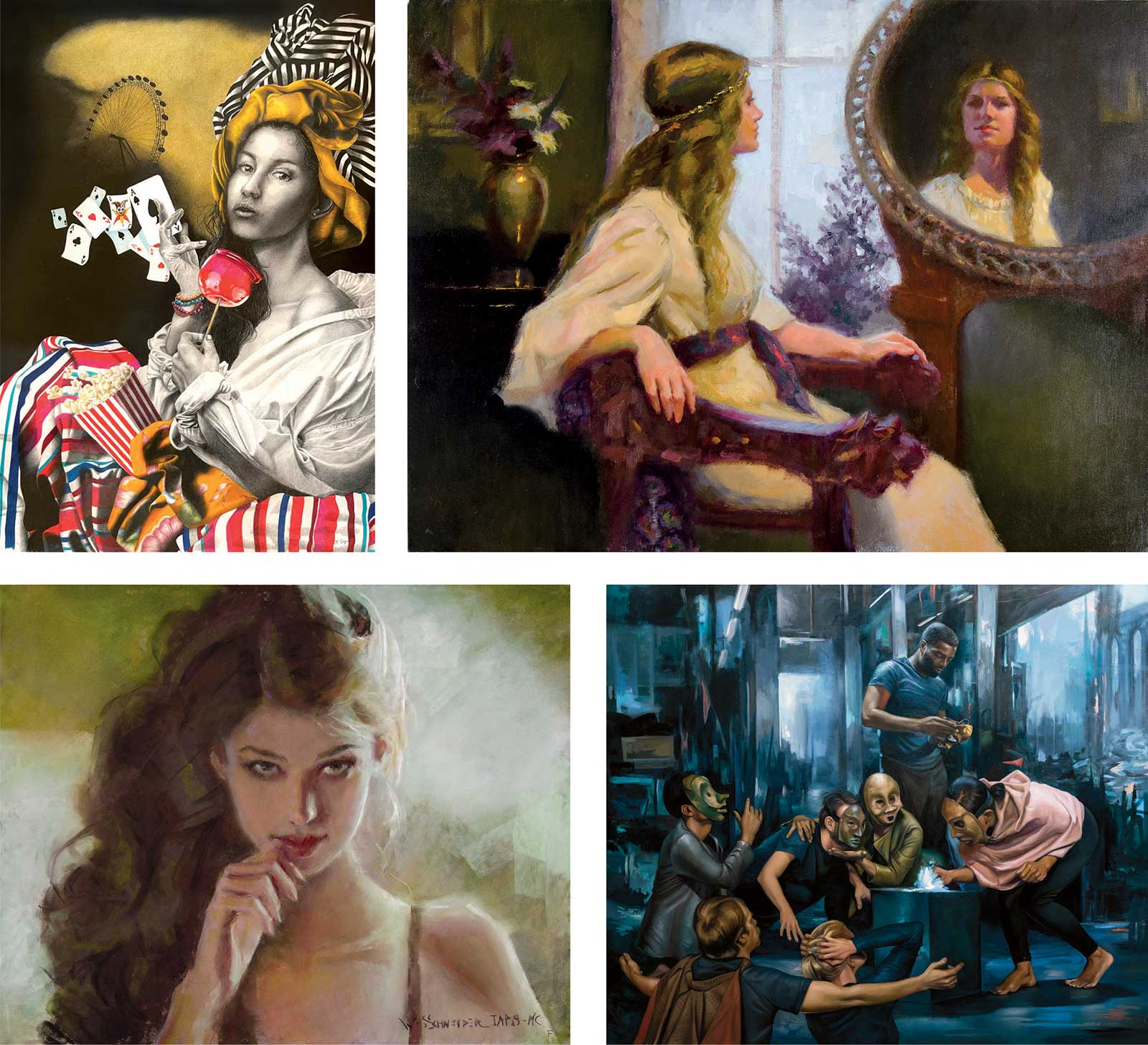 Top: Suzanne Vigil, Carnival Queen, colored pencil, 33 x 23"; William A. Schneider, Lamia Transformed, oil on linen on panel, 30 x 40". Bottom: William A. Schneider, Voulez Vous, pastel on archival support, 16 x 20"; Woodward Gallery, Constructing the Myth, oil on canvas, 60 x 72", by Margaret Morrison.
Vivian Wang is an American artist of Chinese descent, whose work is currently represented by Blue Rain Gallery in Santa Fe, New Mexico. Her glass and ceramic sculptures are largely inspired by the historic paintings and sculptures of the women and children of the Tang and Song dynasties of China, and the Heian and Edo Periods in Japan. Wang’s sculptures are at once luminous and statuesque; ancient and new. The artist pays close attention to the garments that clothe each of her subjects. As a former fashion designer, she enjoys combining patterns from ancient textiles with bold, contemporary color. She seeks to give these new sculptures a distressed and ancient look. Wang spares no detail, adorning each peaceful sculpture with casein paint, gemstones and engraved designs. Her artwork reflects the opulence and pageantry of centuries-old court life. It is a true contemporary expression of ancient art. 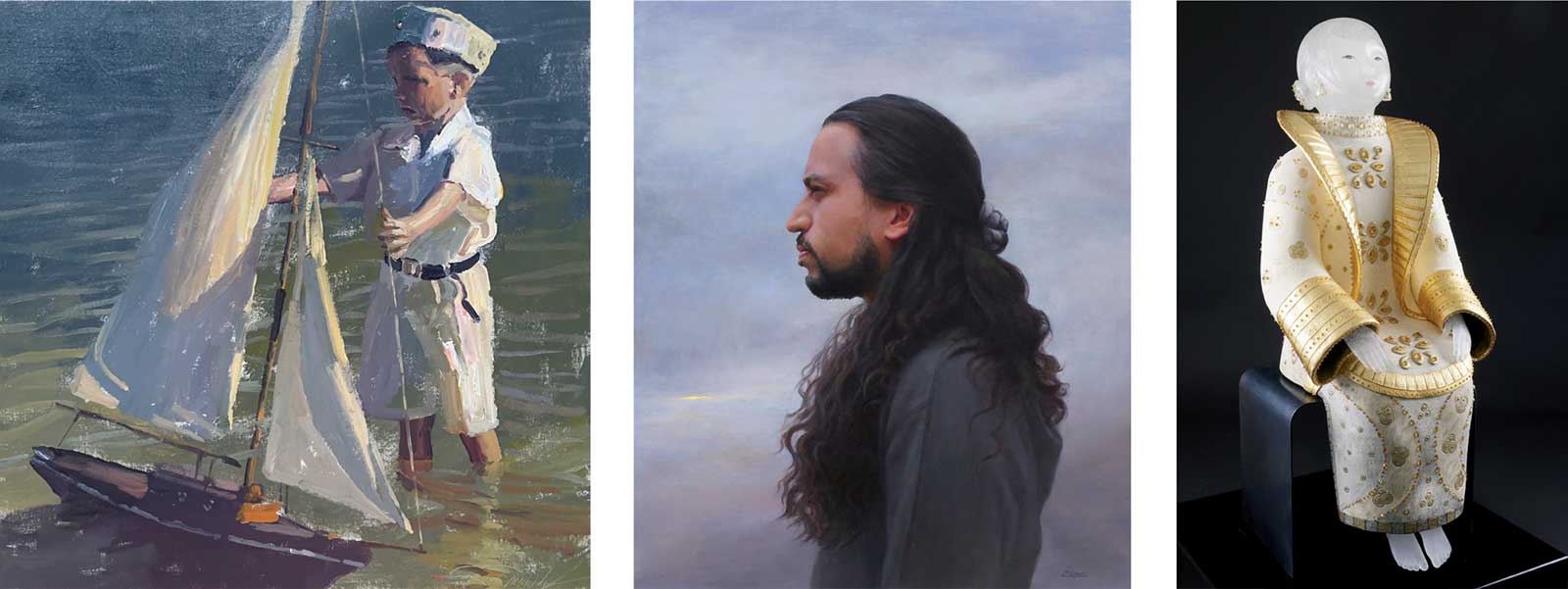 Vanessa Rothe Fine Art Gallery, The Little Sailor, oil on linen, 18 x 18", by CW Mundy; Lisa Kovvuri, Elements, oil on aluminum, 24 x 20"; Blue Rain Gallery, Deco Queen, cast glass, stoneware, gemstones, gold leaf and steel base, 31 x 13 x 13", by Vivian Wang.
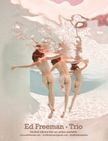
Photographer Ed Freeman wants to make beautiful images. “I take pictures of naked people because they are the most beautiful subjects I know of in this world that I can see with my eyes and photograph with a camera. Bodies and personalities both undergo a profound change in water: gravity disappears, the timid become bold, the awkward, graceful. You cannot live underwater, you can only visit for a brief moment until you run out of air. There is no time to think, to be self-conscious. It is an ideal environment for photographing people, especially naked ones. I’ve been an artist all my life, yet what I do is a mystery to me…It’s also a way to express thoughts and feelings for which there are no words.”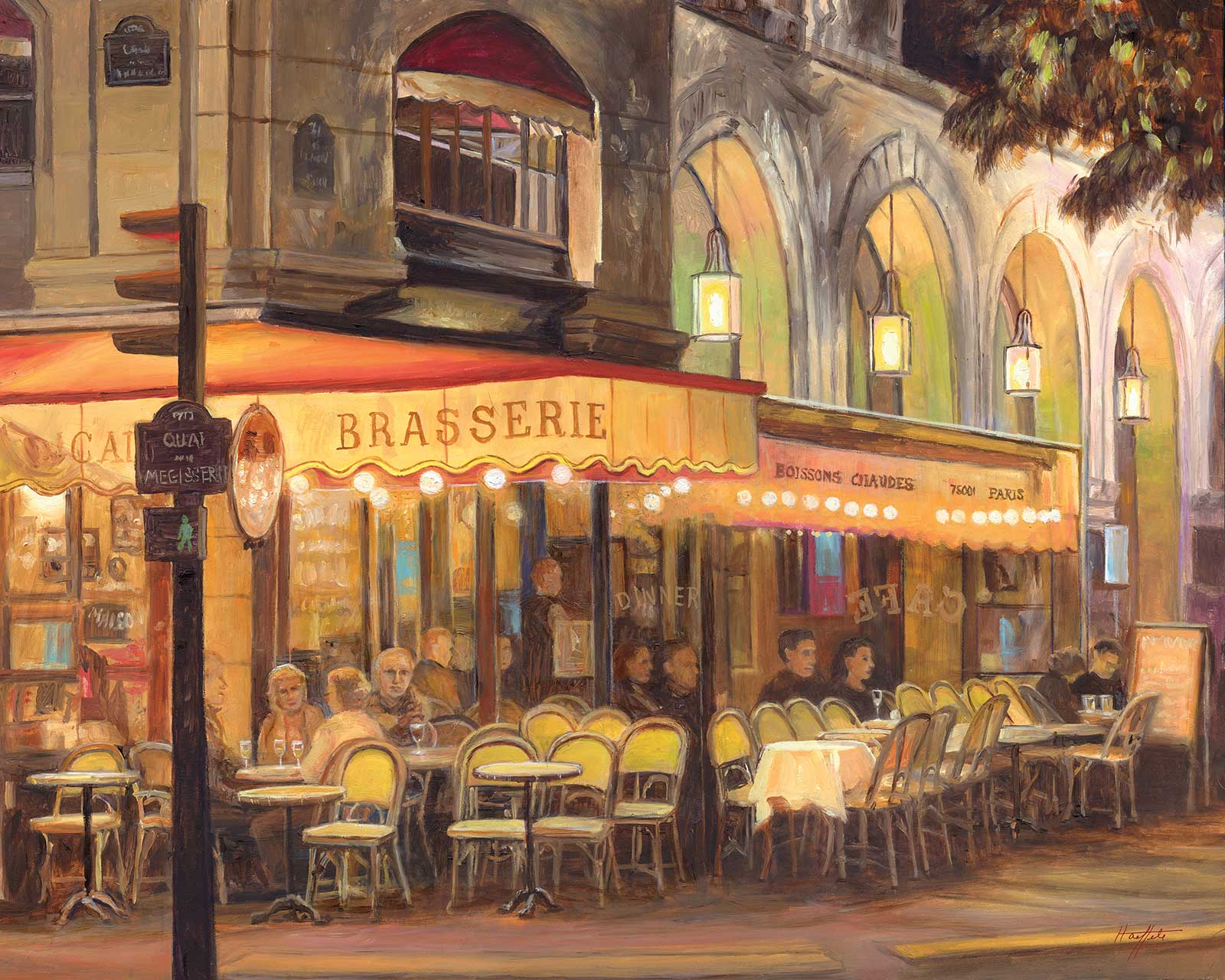 Deborah Haeffele, Brasserie Lights, oil on cradled gesso board, 16 x 20"
Teresa Vito’s Freedom to Fly started to truly evolve during Covid and the Black Lives Matter movement. “I had a vision of this model illuminated with moonlight. I read Sue Monk Kidd’s novel “The Invention Of Wings.” In it, a slave, who was the family’s seamstress, creates quilts from leftover scraps as a way of teaching her daughter their history. The black triangles were crows that represented the black people who once knew how to fly. I grew up with my mom pointing out individual pieces of the many quilts made by her mother, explaining that a piece was from my grandmother’s apron or a favorite dress. The bottom border is the Flying Geese pattern taken from the freedom quilts hung up that pointed the direction to food or safety. It represents our past, to honor and remember but not to bind and weigh us down. The triangles fly off the quilt and become ravens in flight, to soar up with freedom into the light.”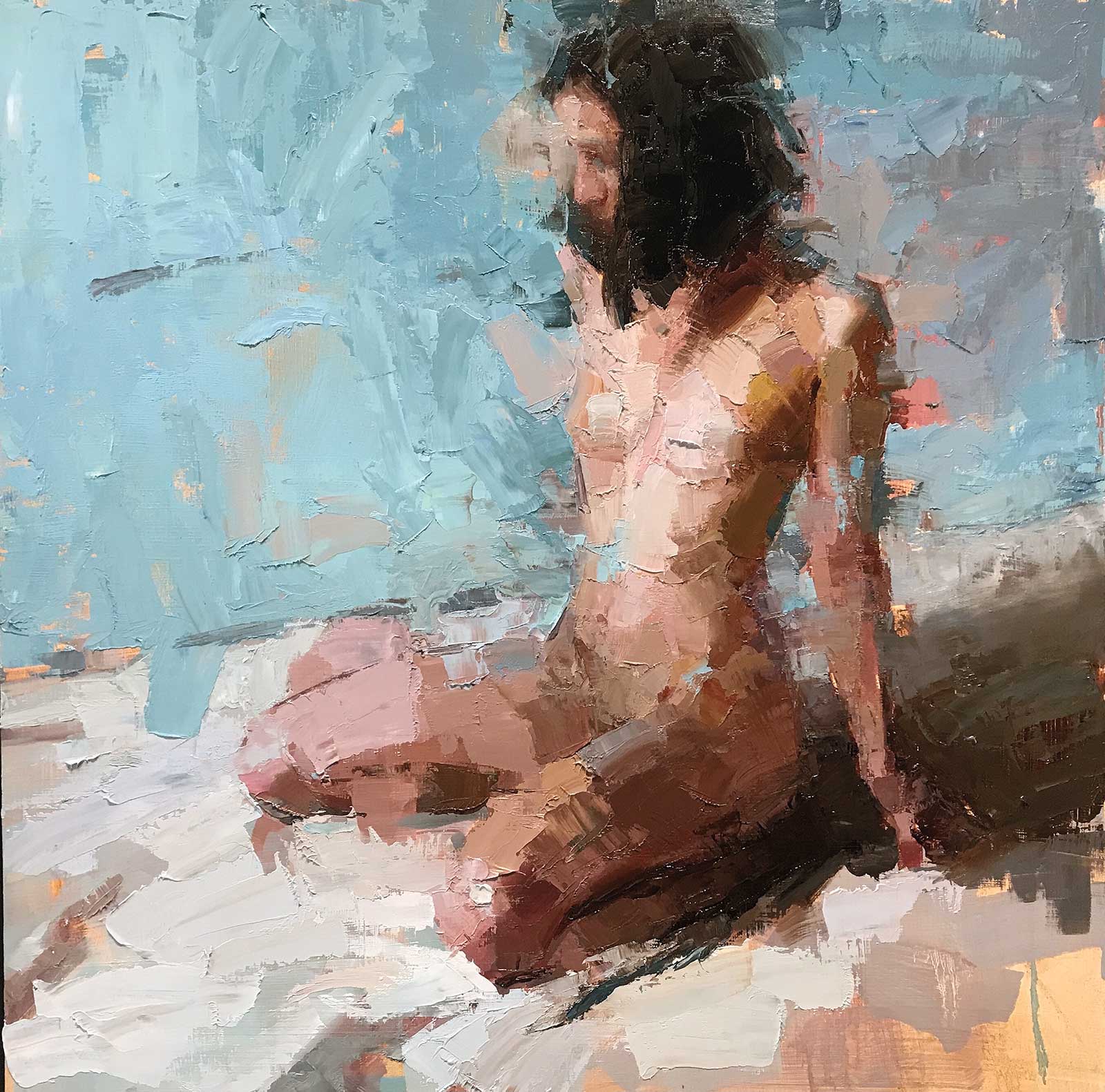 Anne Neilson Fine Art, Nude with impasto, oil on panel, 30 x 30", by Jacob Dhein.
As a figurative artist and storyteller, Suzanne Vigil’s work begs the viewer to tell their own rendition. Her paintings often feature figures in gray tones with colors surrounding them. “I begin the story with the face and let it tell me where to go next. Just like an author, I build my characters. By adding objects from my collection of props (both actual and photographic) to establish a theme. Inspiration for [Friday Night Takeout], for instance, started with a carton of Chinese food in my refrigerator. The figure with the chopsticks is based on a friend who volunteers to sit for me and tolerate the draping of fabric and unusual props. It all came together as I thought about our early days of the pandemic when isolated people conjured different ways to substitute their weekends with friends by dressing up and doing zoom dinners.”
The art of William A. Schneider stems from a combination of observed reality and reverie for his subject matter. “I try to be sensitive to not only the external appearance of things, but also my emotional response,” he says. “As I paint, the subject takes on a life as a character in an internal ‘movie.’ I try to capture the feelings that arise from that half-imagined narrative…I am glad to be living in a time when the pendulum is swinging back from the abstract/conceptual approaches of a hundred years ago to a ‘nouveau realism.’” Schneider has work at McBride Gallery in Maryland, New Masters’ Gallery in California and Illume Gallery West in Montana. 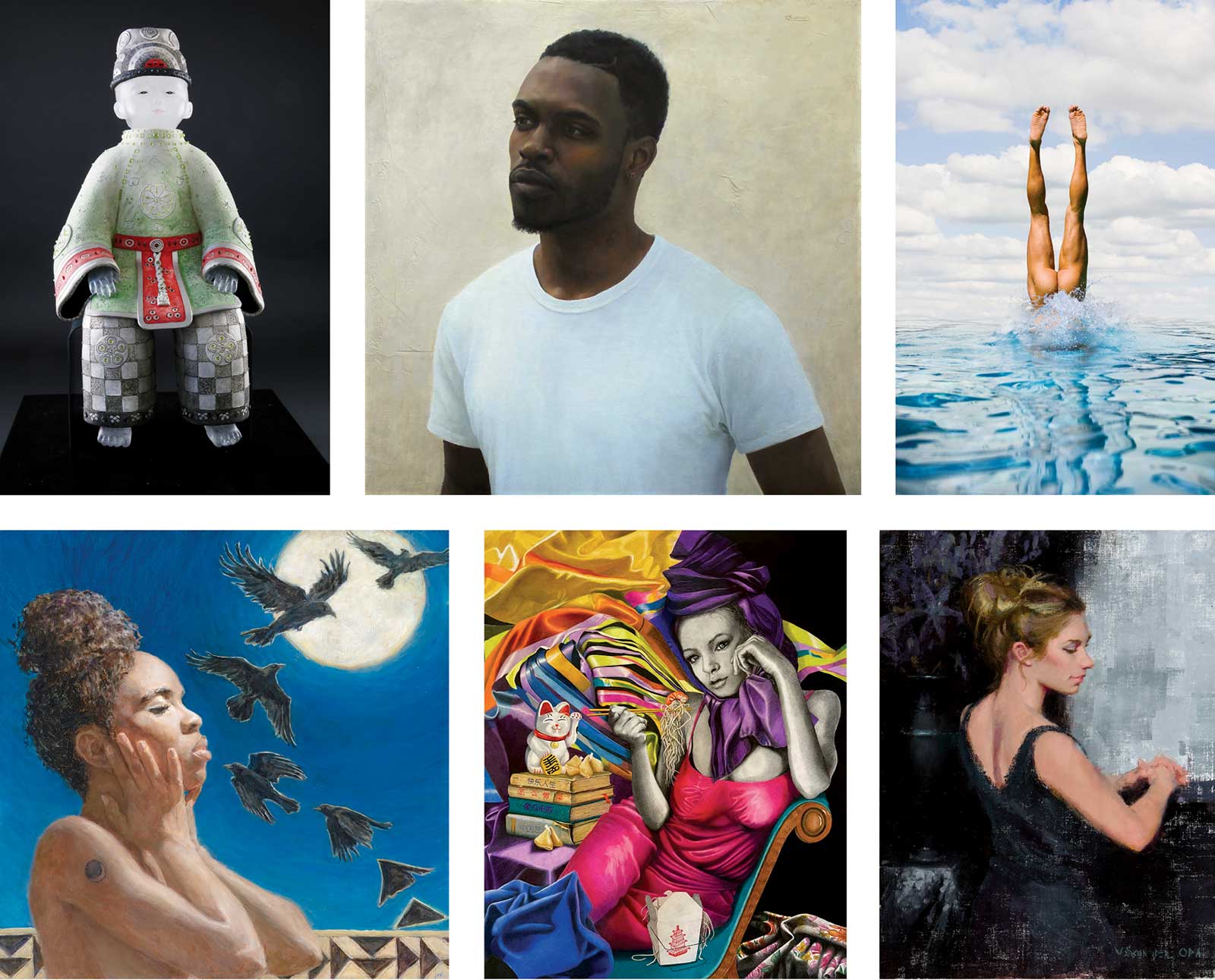 Top: Blue Rain Gallery, Shogun, cast glass, stoneware and gemstones (peridot, garnet, citrine, iolite and crystal), 26 x 12 x 12", by Vivian Wang; Lisa Kovvuri, Turning Point, oil on wood, 18 x 18"; Ed Freeman, DIVE!, archival inkjet print on watercolor paper, 30 x 20". Bottom: Teresa Vito, Freedom To Fly, oil on linen, 24 x 24"; Suzanne Vigil, Friday Night Take Out, colored pencil, 32 x 25"; William A. Schneider, After Midnight, oil on linen on panel, 24 x 18"
New York City-based Woodward Gallery represents artist Margaret Morrison, who creates deeply personal paintings that help her make sense of the world around her. “As a fifth-generation Mormon…My religious paradigm was neat and tidy, literally a part of my DNA. In the early 2000s, an enormous treasure trove of historical documents, letters and journals from Mormon history flooded the internet. I realized that the tidy ‘Faithful Narrative’ that I had been raised to believe did not exist…My Paradigm Shift paintings spring from the devastating sense of loss that I experienced when my faith imploded. How I then sifted through the ruins to build a new faith paradigm, finding a deeper spirituality, a true sense of transcendence and trusting my own voice. Each painting in the series traces the steps of my journey from a trusting follower, to a questioning believer, through a terrible sadness and eventually, transcendence.”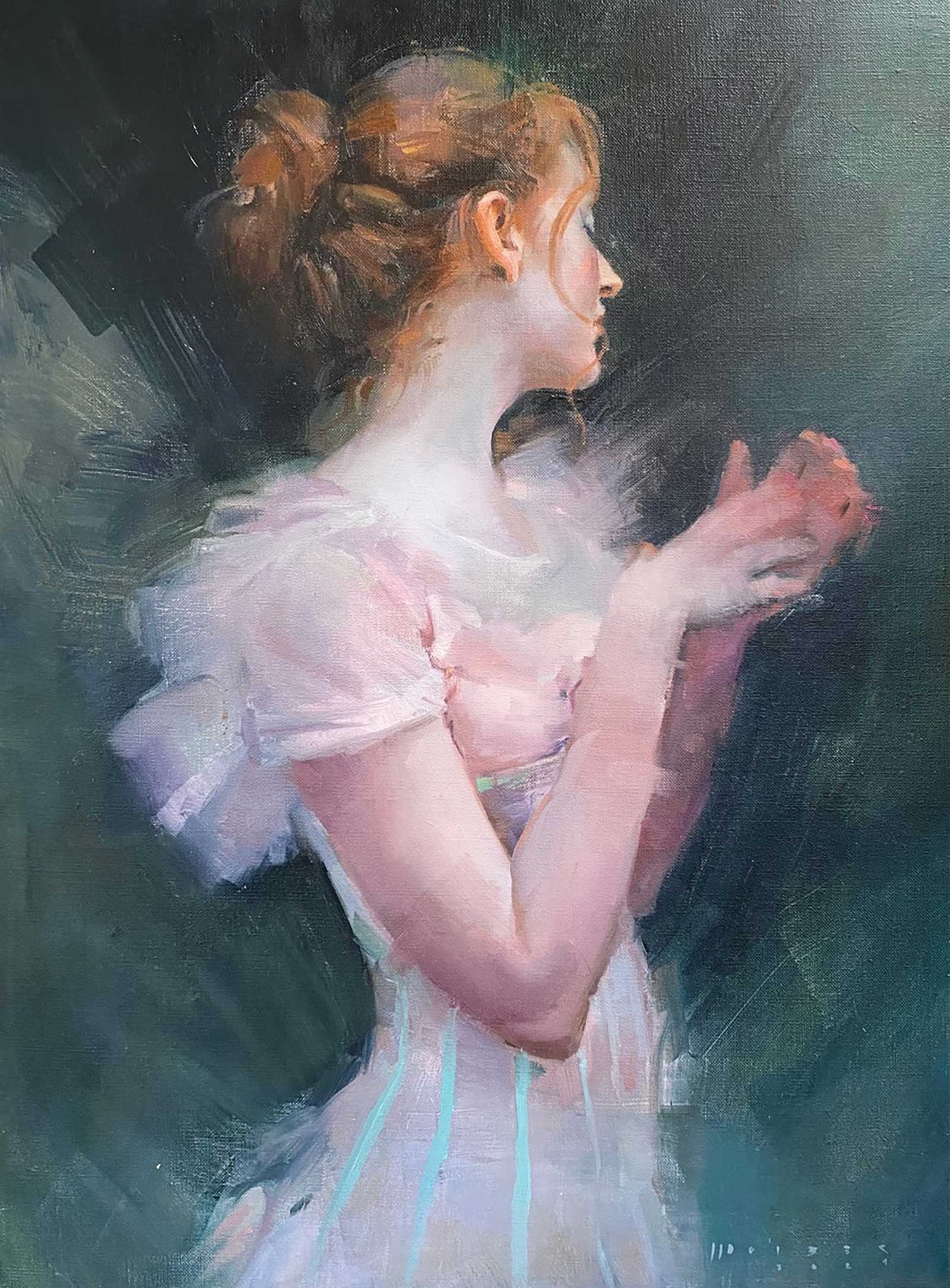 Vanessa Rothe Fine Art Gallery, The Dancer, oil on linen, 24 x 18", by Tortsen Wolber.
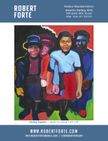
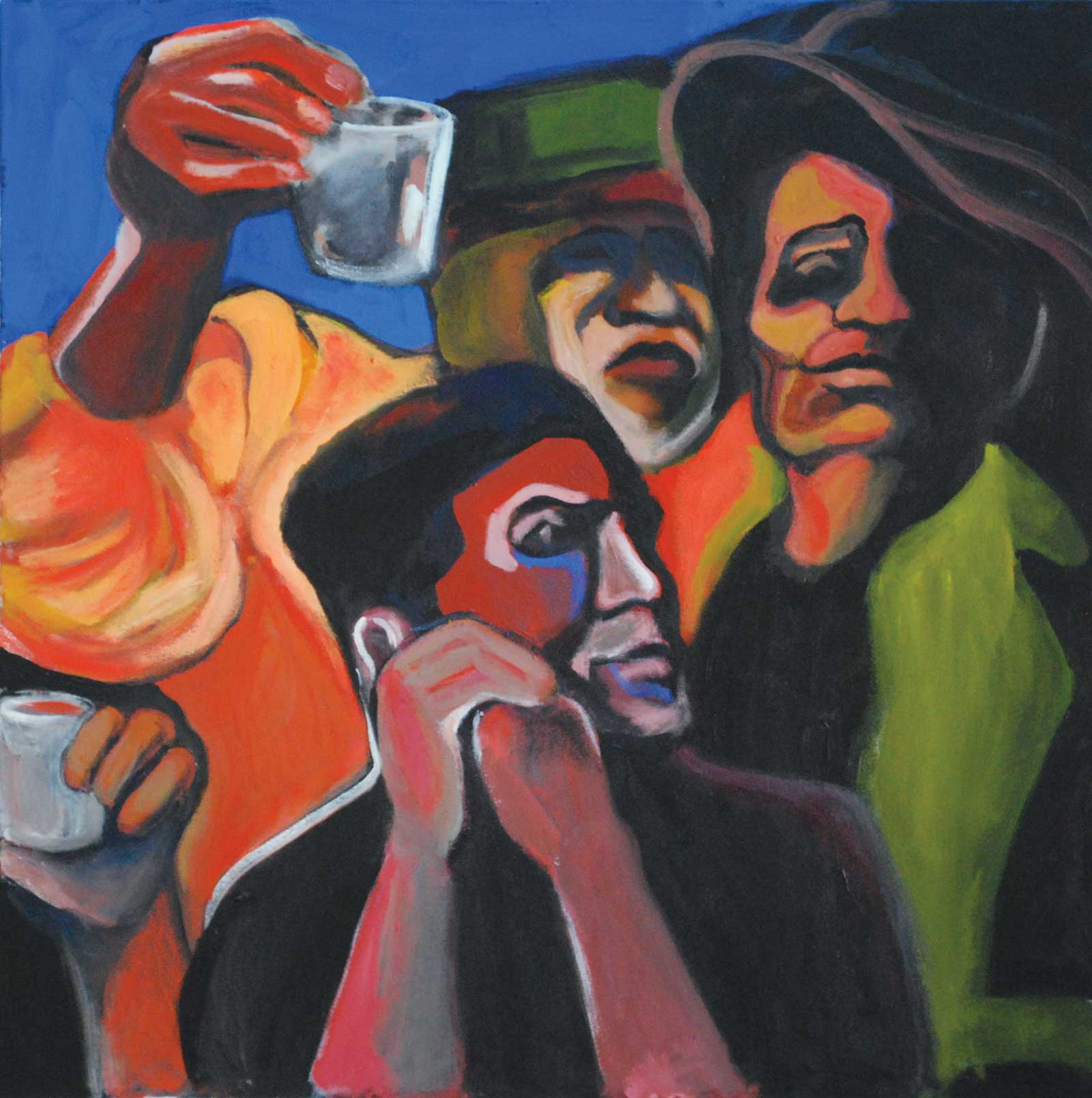 Robert Forte, Devotion, acrylic and oil on canvas, 36 x 36"
“My inspiration for painting the figure derives from its creative elasticity: its capacity for depth of expression and its ability to mirror the artist’s inner soul,” says Robert Forte, represented by Atlantic Gallery in New York. “After extensive study of drawing the figure from the model, I turned to adapting the figure to comport with my creative instincts. I found the figure to be a vessel into which I could mold images through color and design, to convey ideas that transcended the formalities of traditional figurative art. Pushing the boundaries as far as I could without crossing into abstraction, I elicited images that resonated with contemporary topics, personal experiences and emotional impact.” —
Featured Artists & Galleries
Anne Neilson Fine Art
721 Governor Morrison Street, Suite 180
Charlotte, NC 28211, (704) 496-9181
www.anneneilsonfineart.com
Blue Rain Gallery
544 South Guadalupe Street
Santa Fe, NM 87501, (505) 954-9902
info@blueraingallery.com
www.blueraingallery.com
Bryony Bensly
www.bryonybensly.net
Deborah Haeffele
Haeffele Fine Art
2250 Nectarine Drive
Santa Rosa, CA 95404, (408) 393-4484
deborah.haeffele@oilartist.com
www.oilartist.com
Ed Freeman
ef.edfreeman@gmail.com
www.edfreeman.com
Gallery Victor Armendariz
300 W. Superior Street
Chicago, IL 60654, (312) 722-6447
www.galleryvictor.com
J Louis
www.jlouis.co
info@jlouis.co
Lisa Kovvuri
(603) 397-0703, lisa@lisakovvuri.com
www.lisakovvuri.com
Mary Whyte
(843) 870-0430, sharon@marywhyte.com
www.marywhyte.com
PoetsArtists
www.poetsandartists.com
Robert Forte
info.robertforte@gmail.com
www.robertforte.com
Suzanne Vigil
13419 Pino Canyon Place NE Albuquerque, NM 87111, (703) 867-8959
mikesuzvigil@aol.com
www.suzannevigil.smugmug.com
Teresa Vito
www.teresavito.com
Vanessa Rothe Fine Art
418 Ocean Avenue
Laguna Beach, CA 92651, (949) 280-1555
www.vanessarothefineart.com
Waterhouse & Dodd
New York, NY and London, UK
www.waterhousedodd.com
William A. Schneider
Naples, FL, www.schneiderart.com
Woodward Gallery
132A Eldridge Street
New York, NY 10002, (212) 966-3411
art@woodwardgallery.net
www.woodwardgallery.net
Powered by Froala Editor