Ukrainian artist Denis Sarazhin knew the tension on the eastern border between his homeland and Russia was tightly twisted, but he had no idea of the ordeal that was about to tear apart the weft and weave of his life. Before the difficult years of the Covid-19 epidemic, he and his wife, the painter Victoria Kalaichi, planned a trip to the United States to teach a painting workshop at the Townsend Atelier in Chattanooga, Tennessee, and mount a solo show of her work. After several lockdown postponements pushed the event into the future, at last the time came to fly. The couple travelled innocently to the Kharkiv International Airport, and boarded their plane, unaware that the military maneuvers on the eastern border that would soon lead to hell-born war. While they napped, their jet slipped toward America high above the anonymous and silent landscape, and far below, shadowy Russian soldiers prepared convoys of murderous artillery and thundering rocket launchers to hurl guided missiles into the spreadeagled suburbs of the city. When Sarazhin and Kalaichi landed in Atlanta, they had no idea that Russian armies had assaulted their country.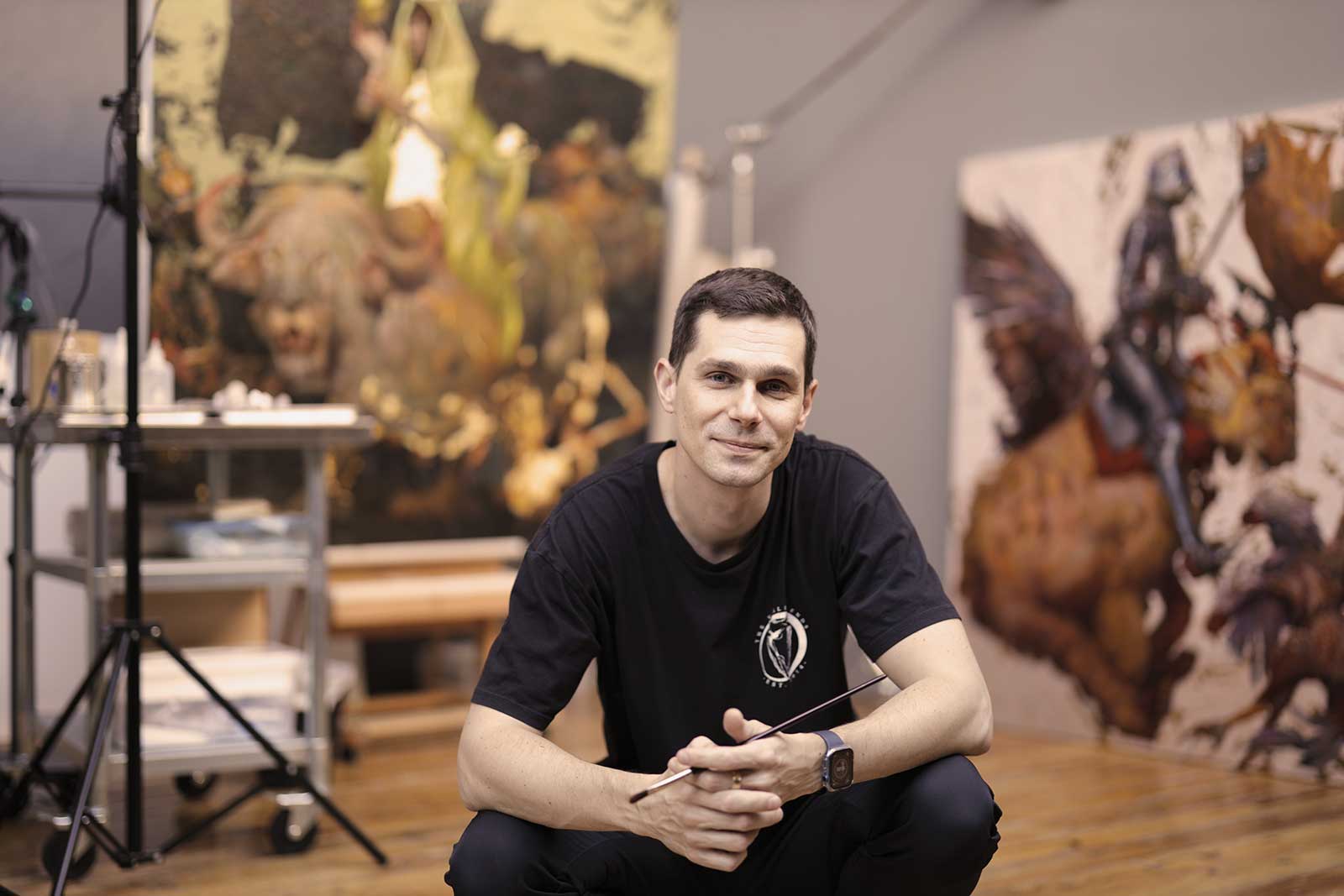 Artist Denis Sarazhin in his new Chattanooga studio
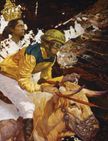
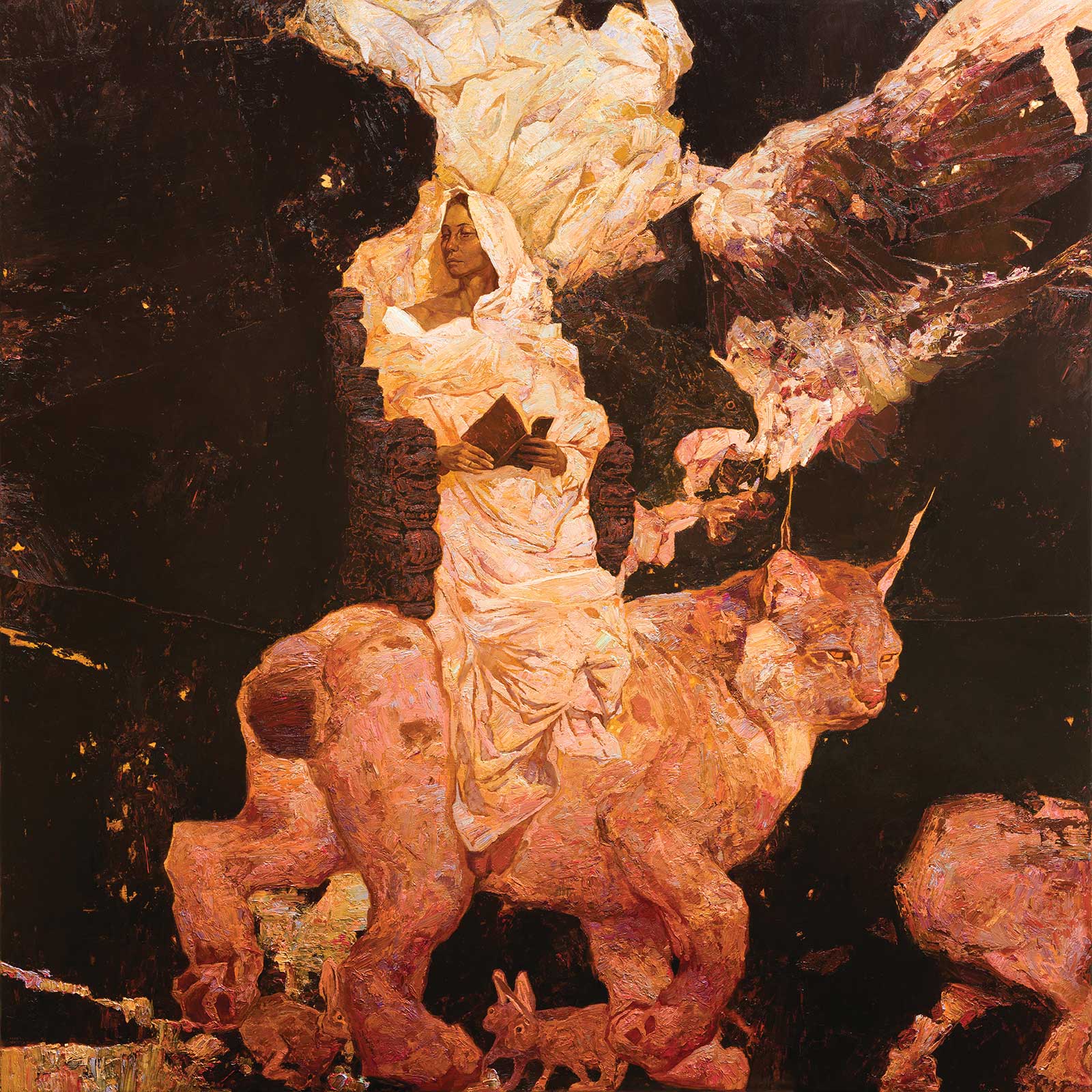 Rider with a Book, 2021, oil on canvas, 59 x 59”
A cascade of cluster bombs and scattered shells smashed their neighborhood, obliterating homes yards from their condo and shredding the gentle connections binding families and friends. The hangers protecting military jets were bombed at the pristine airport they had just flown from. Immediately after Sarazhin and Kalaichi left Kharkiv, all flights were cancelled and Ukrainian men between the ages of 16 and 60 were forbidden from leaving the country and drafted into the defense forces, and the tanks and troops of the invading forces occupied the city. The couple were stranded in Tennessee, homeless and woefully unprepared for such upheaval. “Around our building everything has been destroyed,” says Sarazhin. “One of our neighbors, an old lady who didn’t want to leave, told us our studio is still there, but I tell you this information now, and who knows? They bombed Kharkiv again today, medical buildings near where our condo is situated.” A third of the city was smashed under the bombardment. Two million people lived in Kharkiv before the war.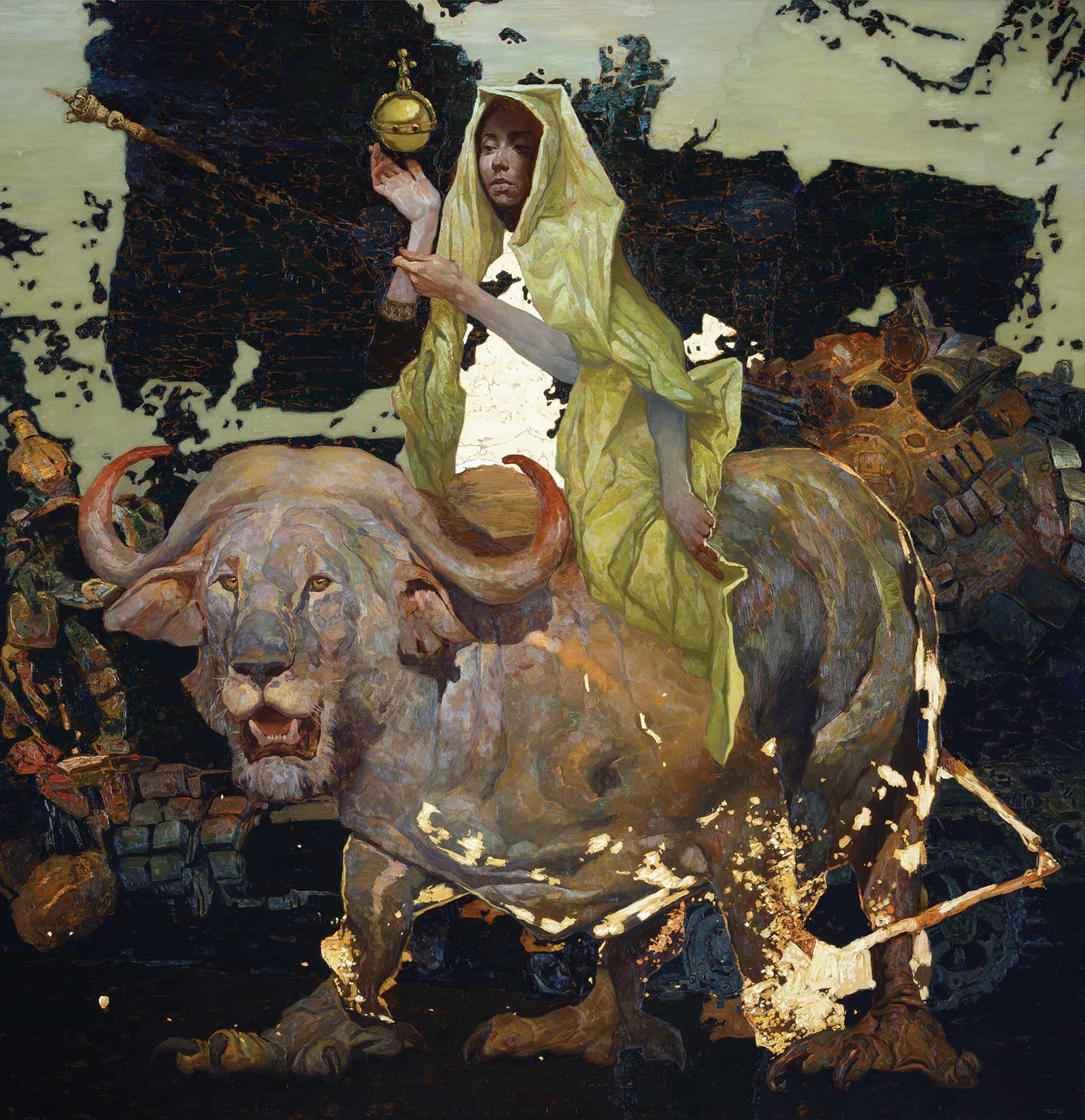 Rider in a Green Cape, 2022, oil on canvas, 62 x 64”
When Steve Diamant, the art connoisseur and owner of Arcadia Contemporary planned a solo show of Sarazhin’s work for December, he had no idea that the artist would be working as a refugee. Sarazhin had arrived in the United States with only a suitcase packed for a two-week stay. Diamant immediately sent help to Chattanooga when he heard about the artist’s plight. “We bought him enough art supplies to last as long as he could possibly need them,” he explained, “We sent him easels, paints, canvases, everything you could imagine.” He contacted Ira Goldstein and his daughter Heather, owners of the art supply company Jerry’s Artarama, and they pitched in generously, too. Sarazhin and Kalaichi were overwhelmed when “enormous boxes and parcels arrived. It would be any artist’s dream Christmas,” says Diamant, “On top of everything we bought him, Jerry’s donated thousands and thousands of dollars worth of supplies so they could set up a studio and hit the ground running, and start their life anew…He’s got an apartment with a studio. He and his wife are painting full time. When he arrived, we arranged finance for him to set him up, to find a place to live, to get a car, to study for his driver’s license.” In Chattanooga, the art community centered around the atelier was appalled by the sudden predicament of the painterly refugees, too, and Peggy Townsend organized a GoFundMe campaign for the stranded couple, which raised more than $16,000 to aid them. Sarazhin was grateful to everyone. “I cannot explain in a few words how many people have helped us,” he says. I would like to name everyone, but your whole article would be a long list.”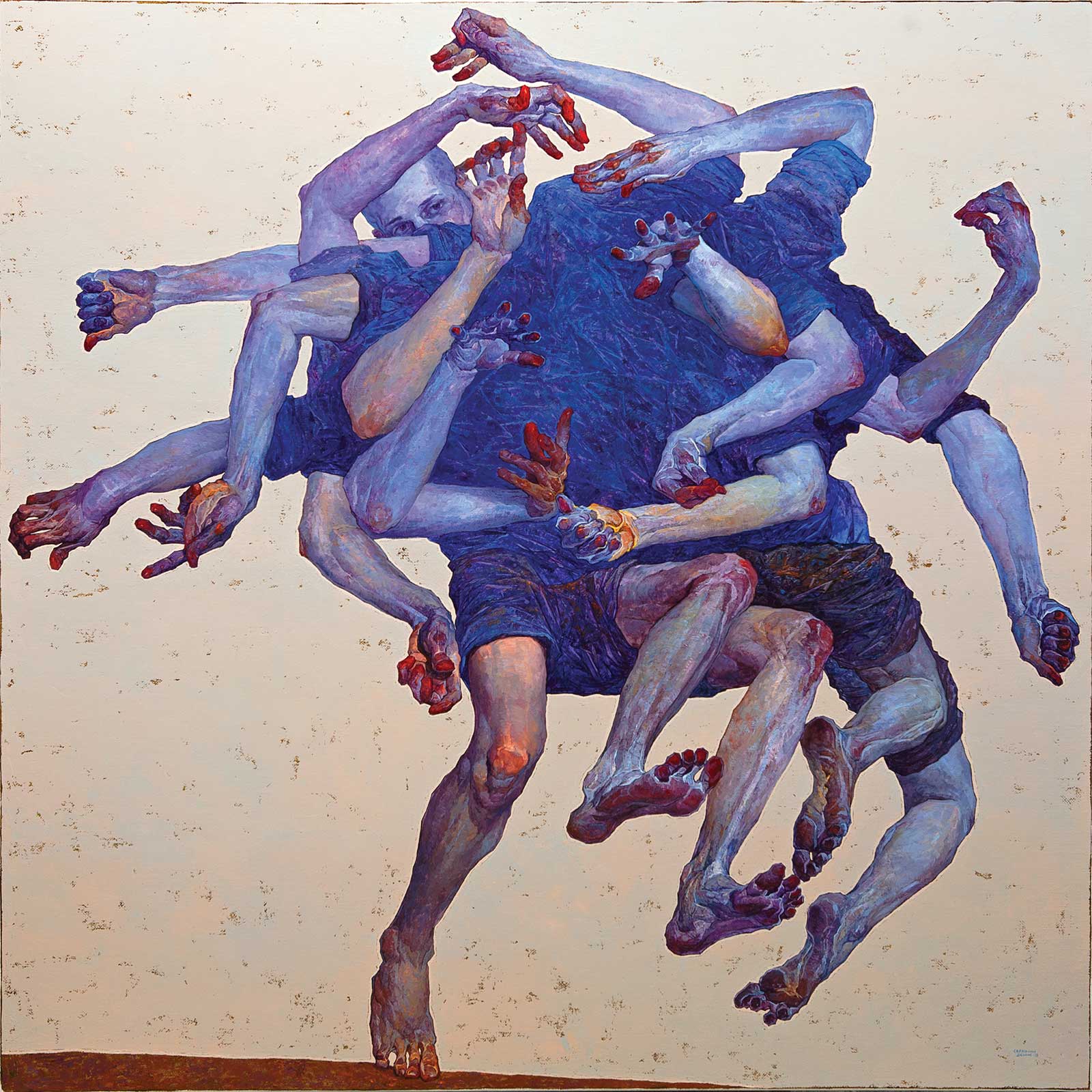 All in One Shirt, 2020, oil on canvas, 59 x 59”With this humbling support Sarazhin was able to return to work in the well-equipped new studio, but he admits, “It was very hard to start…After the 24th of February we lost all the lines of our life. You stop thinking like an artist and start thinking like a survivor. We are in a safe situation here in the United States, but our family is under bombing. It is hard to live with.” Nevertheless, this uncertainty infected his new work with an extraordinary vitality and he painted with dramatic intensity.
Before the invasion wrecked Sarazhin’s city and rearranged his future, his paintings were full of entwined figures—he created impasto dances of enlaced limbs in a festival of physicality, and painted bodies as compositional forms dividing sensual bacchanales of space. The layered figures were a choreography of muscle, posed like modern dancers in a Pina Bausch masterpiece, performing the organic melodies of the human animal. Diamant explains his enthusiasm for Sarazhin’s paintings, “I became familiar with his work on Instagram about five years ago, and saw that this was someone who had everything I look for in an artist. You can see the skill in everything he paints. No matter how abstract his figures may be, you can still see a strong sense of anatomy, of draftsmanship, even though it’s stylized. I fell in love with what he was doing. We had a one-man show for him in California, and it was a complete sell-out. The response to his work has been extraordinary.”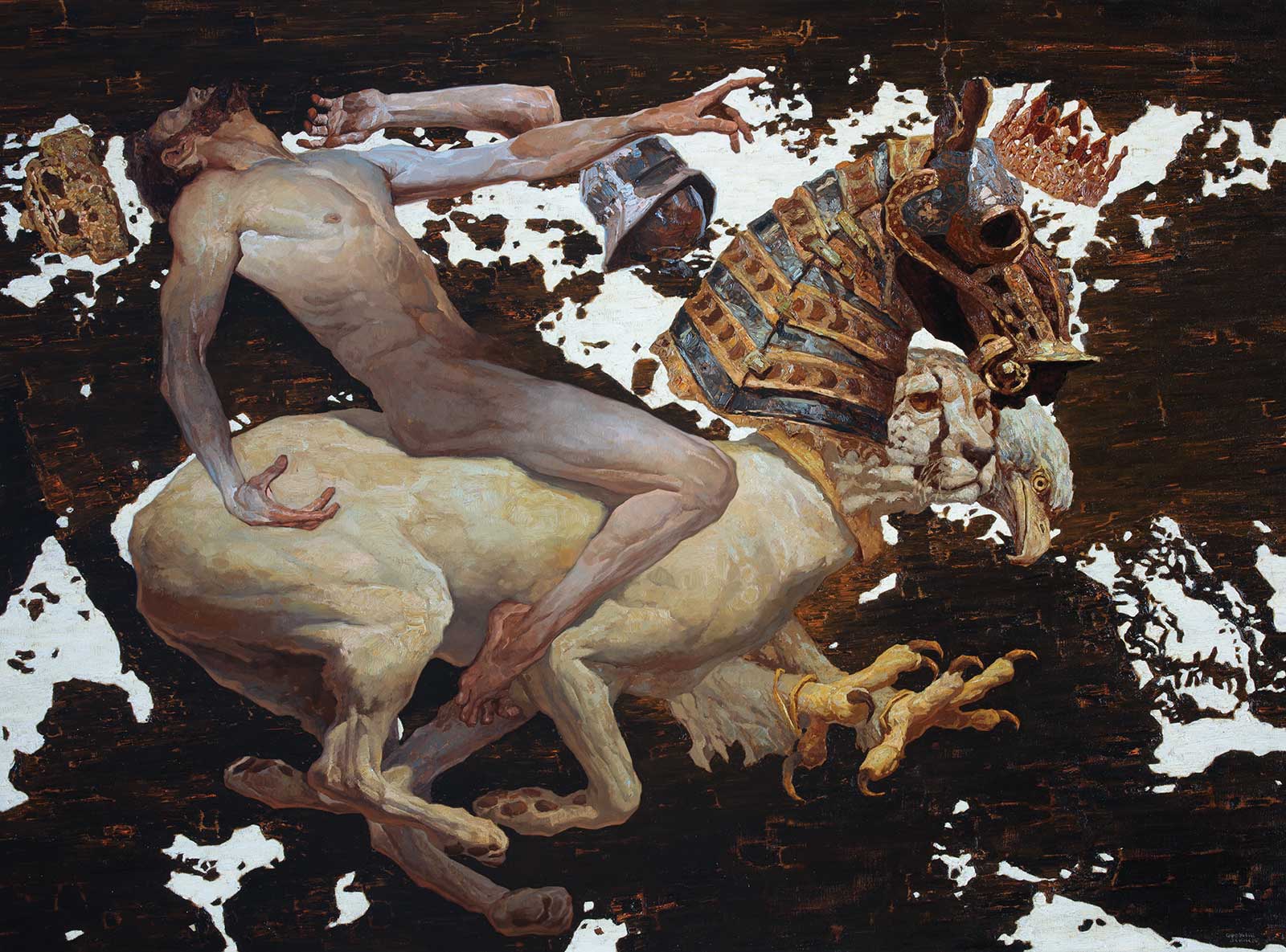 Rider with two Crowns, 2022, oil on canvas, 40 x 54”
When the invasion crashed into Sarazhin’s life the shock of witnessing familiar skyscrapers smashed in instants emphasized the soft fragility of civilian bodies caught beneath the collapse of concrete and sharp rebar, burying and obliterating brittle life, and all the anxieties of savage conflict infected the paintings—now his naked and color-dipped dancers were concealed within iron armor, and shining steel armor enclosed the body of a mace-wielding rider astride a harnessed lion with eagle’s wings, set against a backdrop of fighting roosters, and bear claws, and moose antlers, and sovereign crowns were scattered across the canvases. It was a bestiary born of war. Sarazhin looked sharply into Hieronymus Bosch’s hellish menagerie of mutated creatures. “I’m not thinking in a literal way,” he says, “I’m thinking more with images in my head, I’m not thinking about what this animal means, or explanations, I’m only thinking of what it means to me. It’s a personal symbolism.” The creatures mutated, lions metamorphosed, battling two-headed roosters, and jockey-knights rode pelican bears and eagle-clawed greyhound-bulls. As the threads of Sarazhin’s world unraveled the chaos around him turned his paintings into images of wild transformation.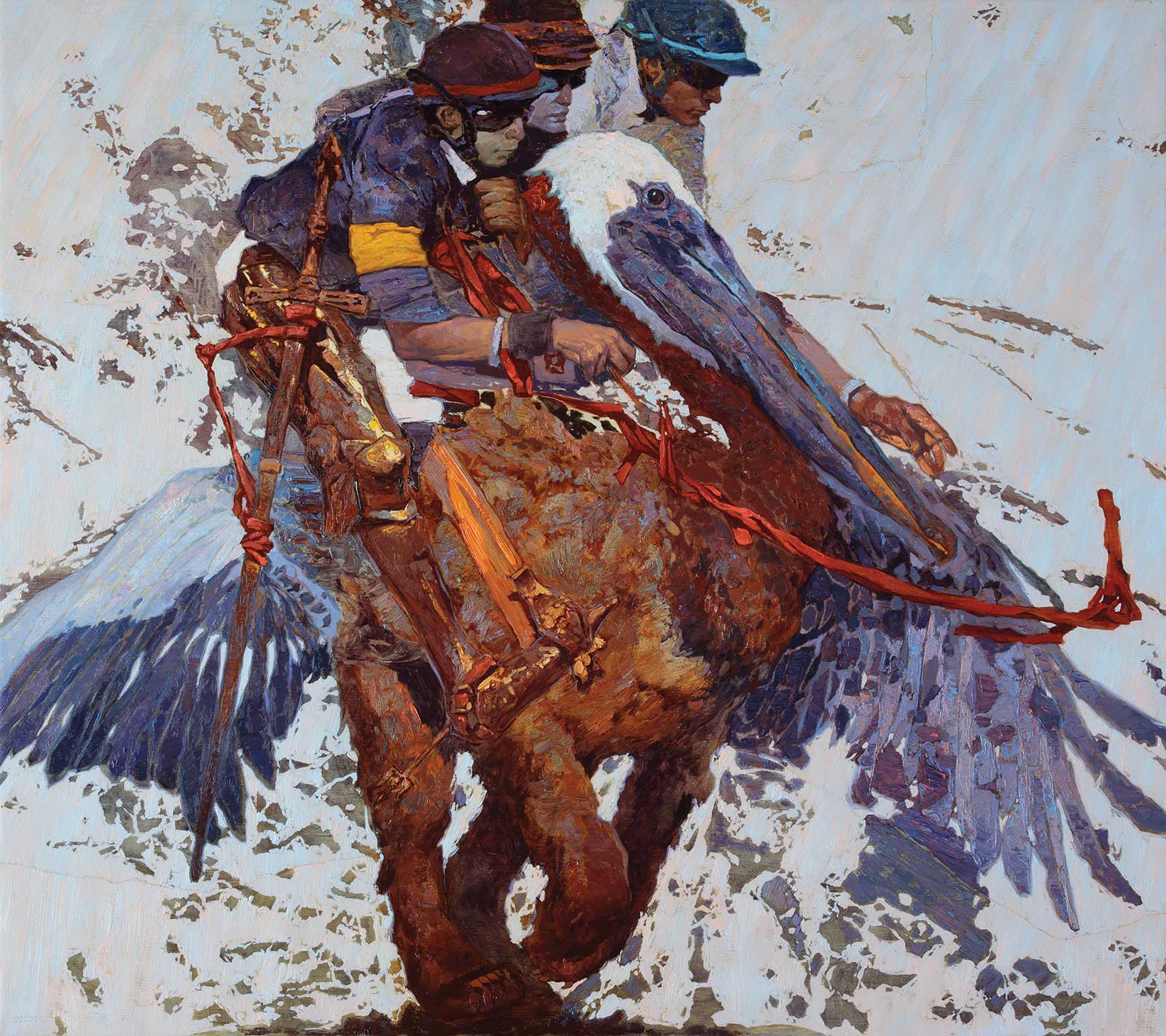 Riders with a Sword, 2022, oil on canvas, 45 x 40”
Sarazhin and Kalaichi responded quickly to the kindness of strangers. They sent money to family members suffering and struggling in Ukraine. They supported their fellow exiles in the United States with their art. Before the February invasion, the Kyiv City Ballet had left Ukraine to begin a world tour of Swan Lake, arriving in the U.S. for performances in 13 cities. When the troupe came to perform at the University of Tennessee in Chattanooga, Sarazhin and Kalaichi were invited to exhibit their work as part of benefit events to support Ukrainian civilians. Kalaichi had plenty of paintings to share, having her one-woman show to pull from, but Sarazhin had arrived in Tennessee with nothing to show. His paintings were all sequestered in his studio in enemy-occupied Kharkiv, if they still existed at all—if his studio had not been obliterated by Russian bombs. He painted enthusiastically, driven by the desire to contribute, and his still-wet work soon decorated the walls of the university’s theater, celebrating Ukrainian culture. They are the among the new threads forming the colors and hues of the tapestry of his future, and they are the heart of his second one-man show at Arcadia Contemporary.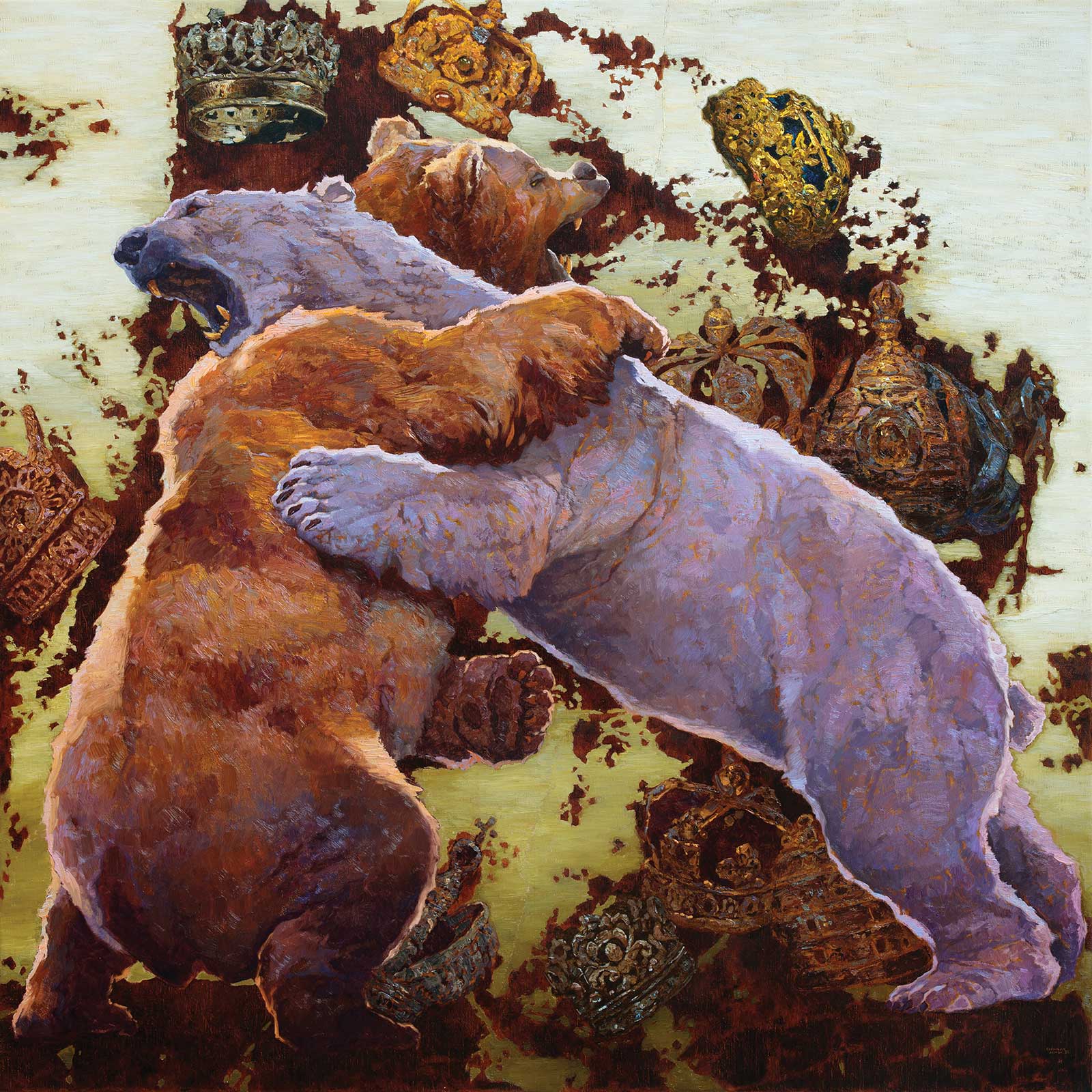 Two Bears, 2022, oil on canvas, 45 x 45”
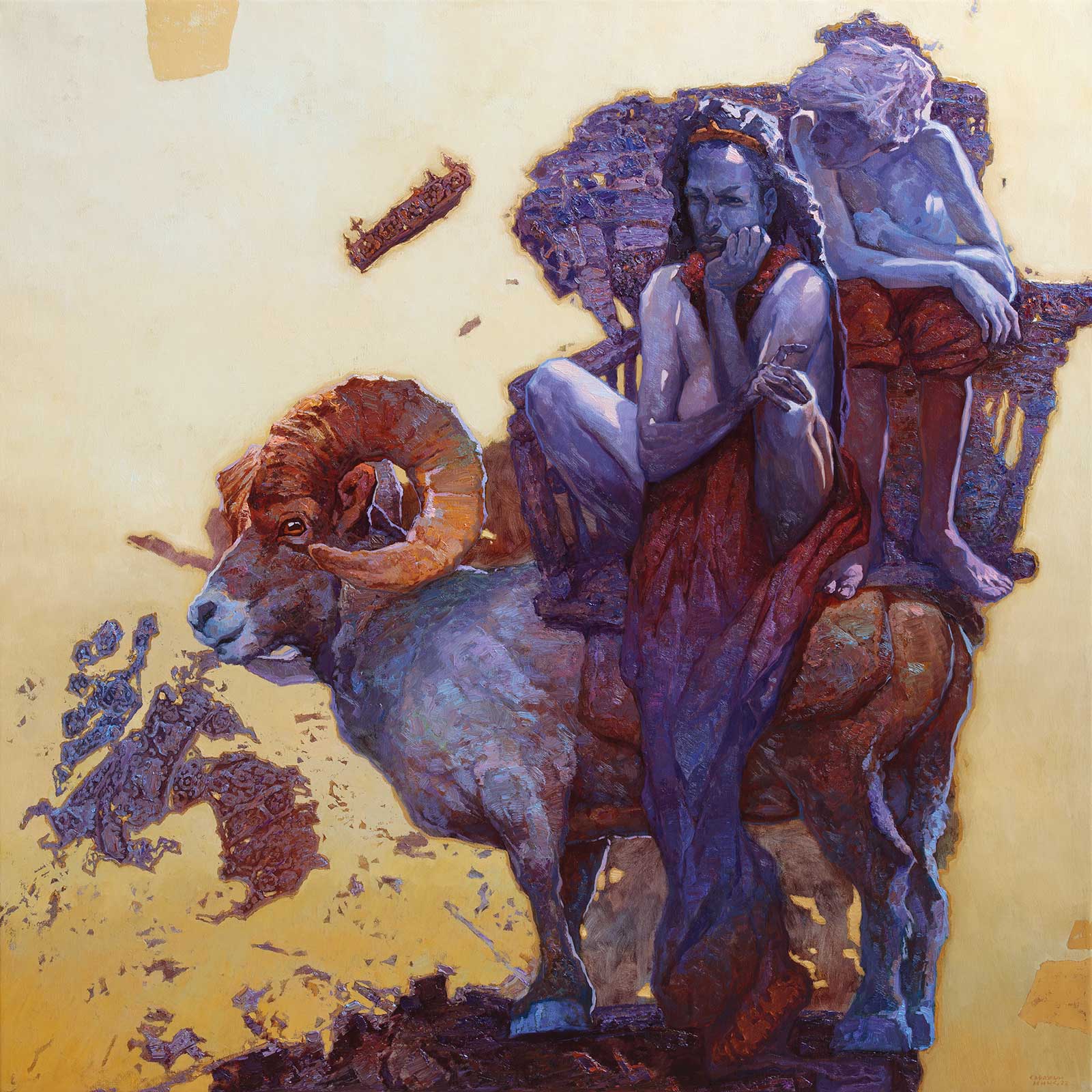 On a Ram, 2022, oil on canvas, 40 x 40”
How does Sarazhin plan when uncertainty dominates his life? He shrugs, “After February [24], we think only about one week ahead, because we don’t know what will happen next. We do what we can do right now, preparing for exhibitions. We’ll see…” But good people have helped to provide stability, and are weaving new lines together into a pattern of kindness and mutual aid. In June, a popular Ukrainian politician, Geo Leros, a member of parliament who is an advocate for the artists of his nation and a movie maker and artist himself, read about Sarazhin’s stranded paintings on social media and offered to rescue them from Kharkiv. He was the right man for the job. Leros is a member of a paramilitary police regiment known as “Safari,” whose members clear wreckage, removing unexploded ordinance and booby-traps abandoned by retreating Russian forces. Although they had never met, Sarazhin mailed his door keys to Leros, who rode the train across the country with his brother Gor, a surgeon. Using a video phone, Leros walked Sarazhin through the security gates which protected his home, and into the condo, where Sarazhin told him where to find important documents, savings and the keys to the studio and their car. At the empty studio, the hands of the surgeon and the soldier-politician set to the work of artists, pulling staples from the backs of stretcher bars, rolling canvases, wrapping panels for their journey. They loaded Sarazhin’s car, and the brothers weaved through the craters and rubble to the relative safety of Kyiv, where Leros shipped the paintings away from the war for exhibit at Galerie Thomas Fuchs in peaceful Stuttgart, Germany. Grateful, Sarazhin and Kalaichi asked Leros to donate the car to an aid agency helping hungry civilians.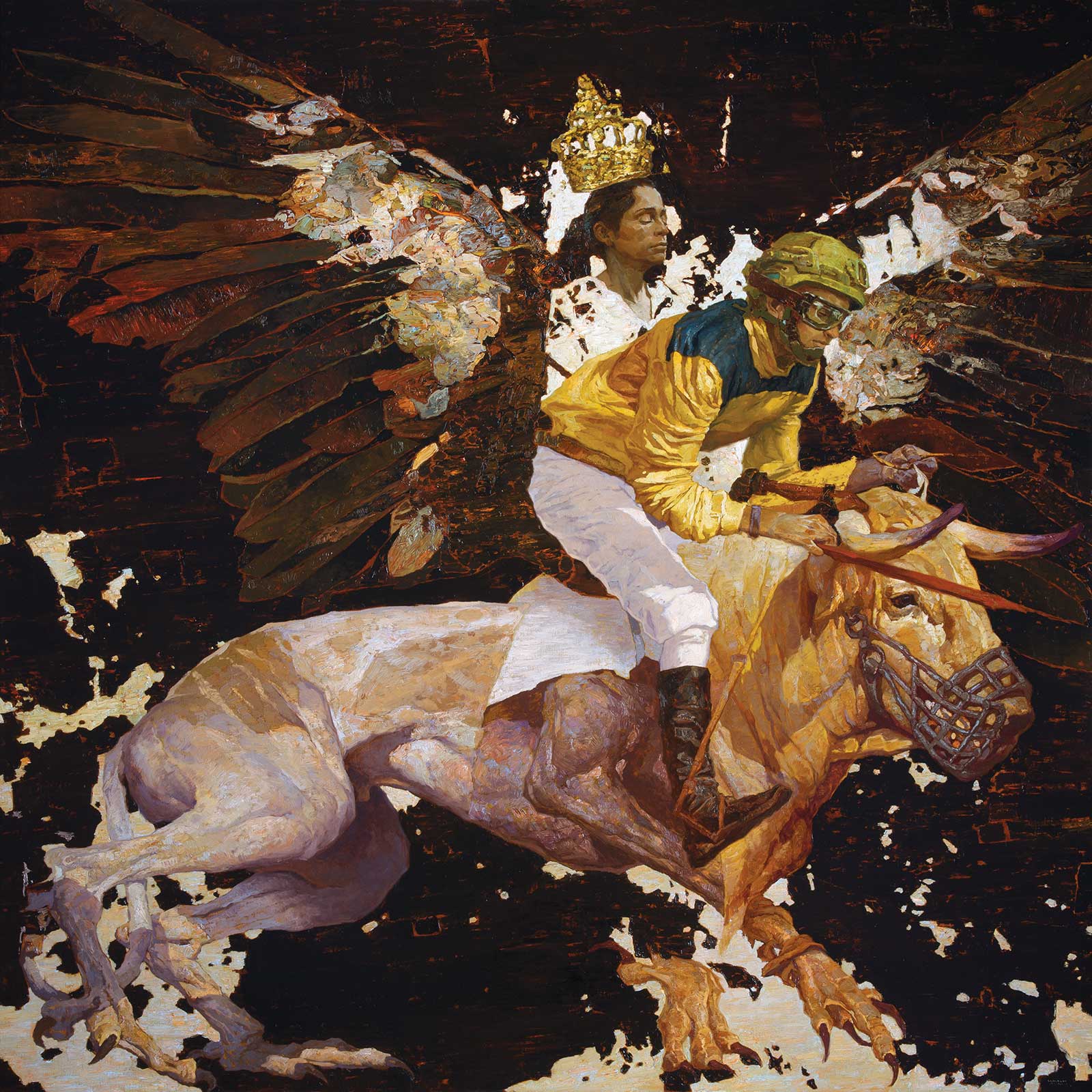 Riders with One Crown, 2022, oil on canvas, 54 x 54”
Sarazhin and Kalaichi were given temporary protected status by the United States government soon after the war began, granting them permission to work, and Sarazhin is hoping to become an American citizen. Freedom calls. —
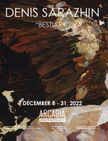
Bestiary: The Art of Denis Sarazhin
When: December 8-30, 2022
Where: Arcadia Contemporary, 421 W. Broadway, New York, NY 10012
Information: (646) 861-3941, www.arcadiacontemporary.com
+++
Michael Pearce is a dynamic writer, curator, and critic. He is a champion of skill-based art that emerges from popular culture and shapes the spirit of the age. He has published dozens of articles, and is author of Art in the Age of Emergence. He is Professor of Art at California Lutheran University.
Powered by Froala Editor