The Civil War general William Tecumseh Sherman (1820-1891) is commemorated in a gilded bronze sculpture by Augustus Saint-Gaudens on Fifth Avenue in New York City. Sherman sits astride the horse, Ontario, who is a majestic 14 feet high. The wind blows the general’s cloak and the horse and rider are led by Victory, who wears a crown of laurel leaves and carries a palm frond, both symbols of peace. Gilded olive wreaths appear on the pink marble base which was designed by Charles Follen McKim (1847-1909) of the firm of McKim, Mead & White. Olive wreaths were awarded to victorious athletes in the original Olympic games. Gold is an unusual finish for public sculptures but Saint-Gaudens wrote that he was “sick of seeing statues look like stovepipes” after they had been out in the elements for a while. Saint-Gaudens labored for years over the design and execution of the monument. The abstract expressionist painter Willem de Kooning (1904-1997) observed, “He got the guy to sit right on the horse! You know how hard that is?”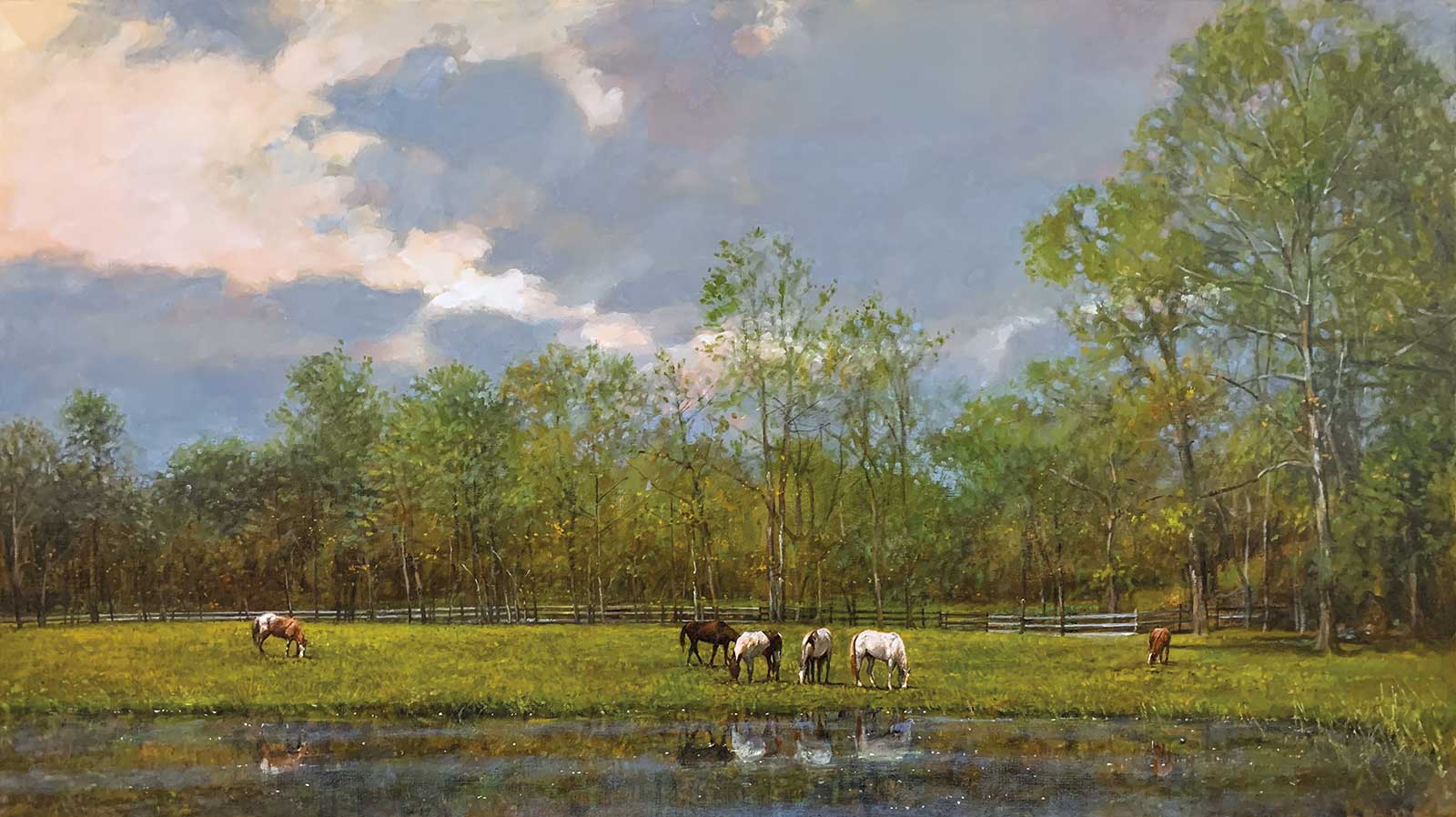 The Sportsman’s Gallery and Paderewski Fine Art, September Sky, oil on linen, 20 x 36", by Donny FinleyFew horse and rider sculptures remain from antiquity. The marble Rampin Rider (ca. 549 B.C.) was unearthed on the Acropolis in Greece. The majestic bronze of Marcus Aurelius (ca. 175 A.D.) can be seen today on the Capitoline Hill in Rome.
The Sherman monument was last restored, regilded and resited in 2014 after many redesigns of the plaza and its surroundings, and the disastrous peeling away of the gold leaf that had been applied two years before.
The monument appears in the painting Grand Army Plaza by Jenness Cortez. She often refers to familiar art in her paintings of contemporary interior still lifes. Earlier in her career, she established a reputation for her skillful portrayals of thoroughbred racehorses. Here she depicts the plaza with the Saint-Gaudens sculpture, the city’s ubiquitous pigeons and a horse and carriage loading up for a snowy Central Park carriage ride. The humble but sturdy carriage horse stands in contrast to the grand horse in the sculpture. The model for Sherman’s horse was Ontario, which had won the high jumping competition at the National Horse Show in Madison Square Garden and caught Saint-Gaudens’ eye. 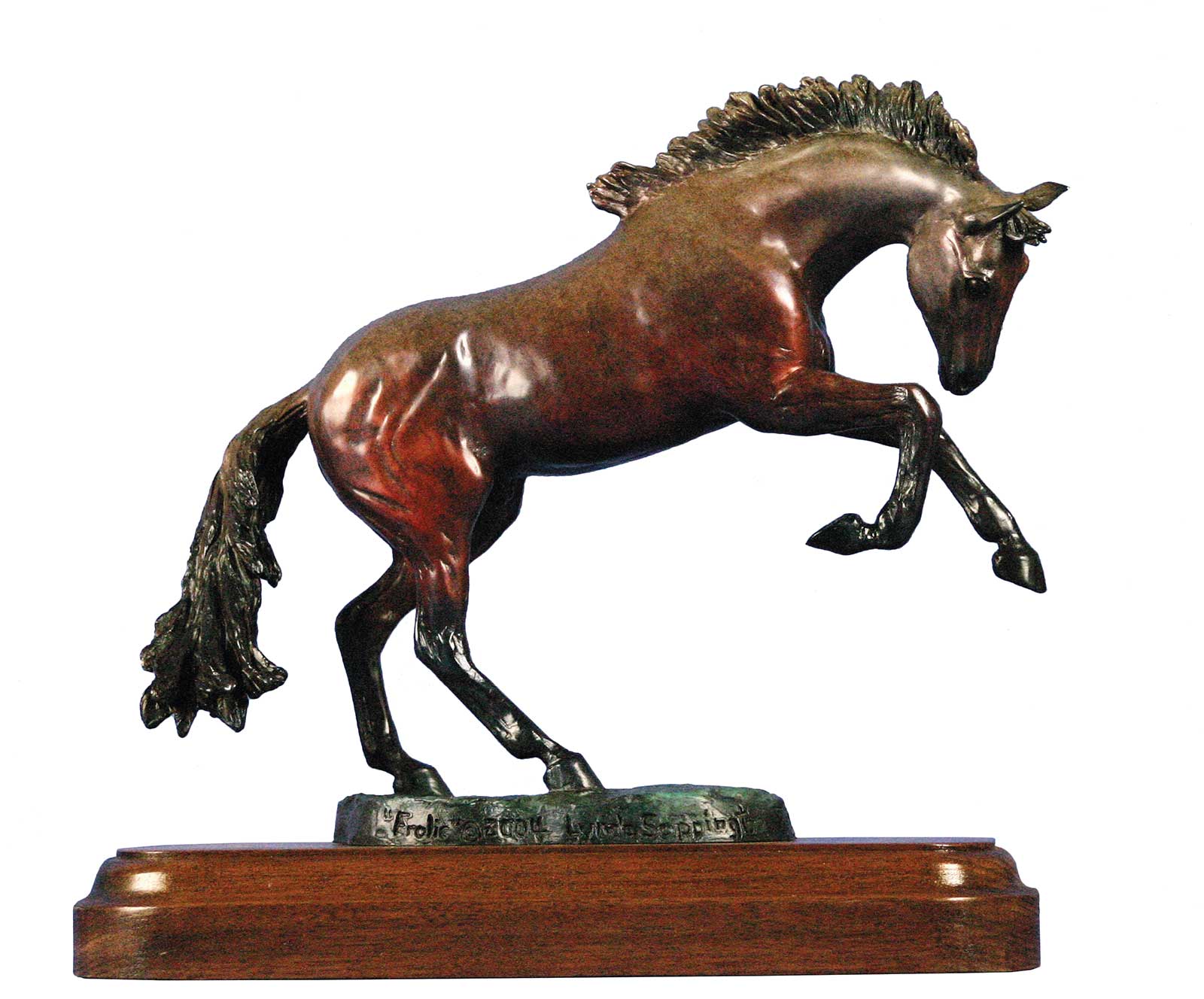 Lynda Sappington, Frolic, bronze with marbled patina on walnut base, ed. 8 of 50, 10¾ x 5 x 9¾"Far from the hustle and bustle of Manhattan, Donny Finley grew up in rural Alabama and has become known for his depictions of the life he knew there. He began sketching what he saw in the Sears catalog and grew up to win more than 70 awards for his paintings. War horses, carriage horses and work horses all need to rest. Finley depicts a group of horses peacefully grazing in a bucolic landscape in his painting September Sky.
Alice Walker, who won the Pulitzer Prize for her novel The Color Purple, wrote, “Horses make a landscape look beautiful.” 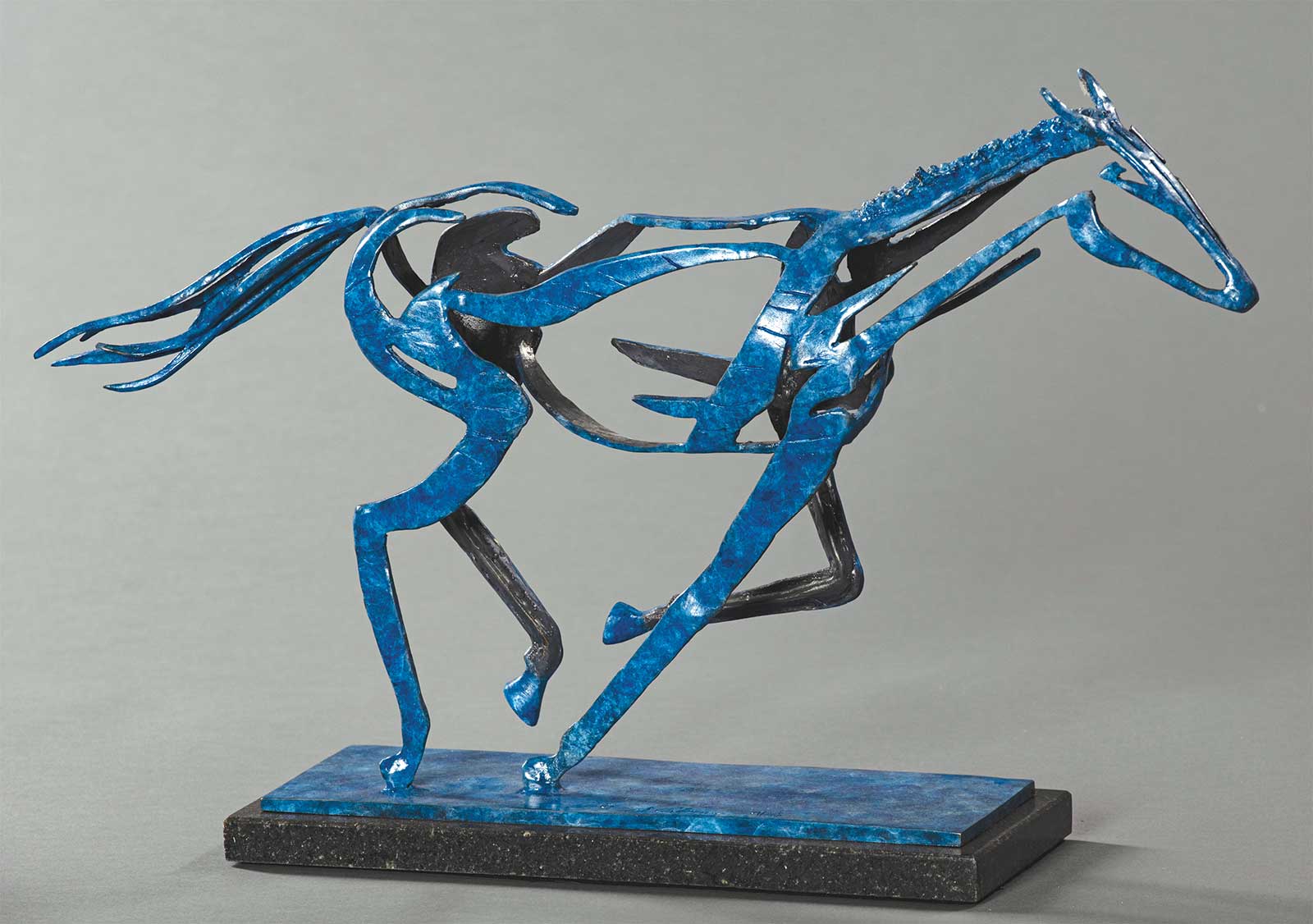 Al Glann, Blue Lightning, bronze, 13 x 22 x 3½"
 Eva van Rijn, Born in the Sage, oil on canvas, 11 x 14"
A medley of styles and mediums depicting the majesty of the horse can be seen throughout the pages of this special section. Read on to learn more about what moves and inspires each artist.
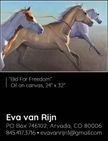
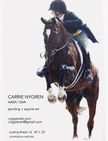
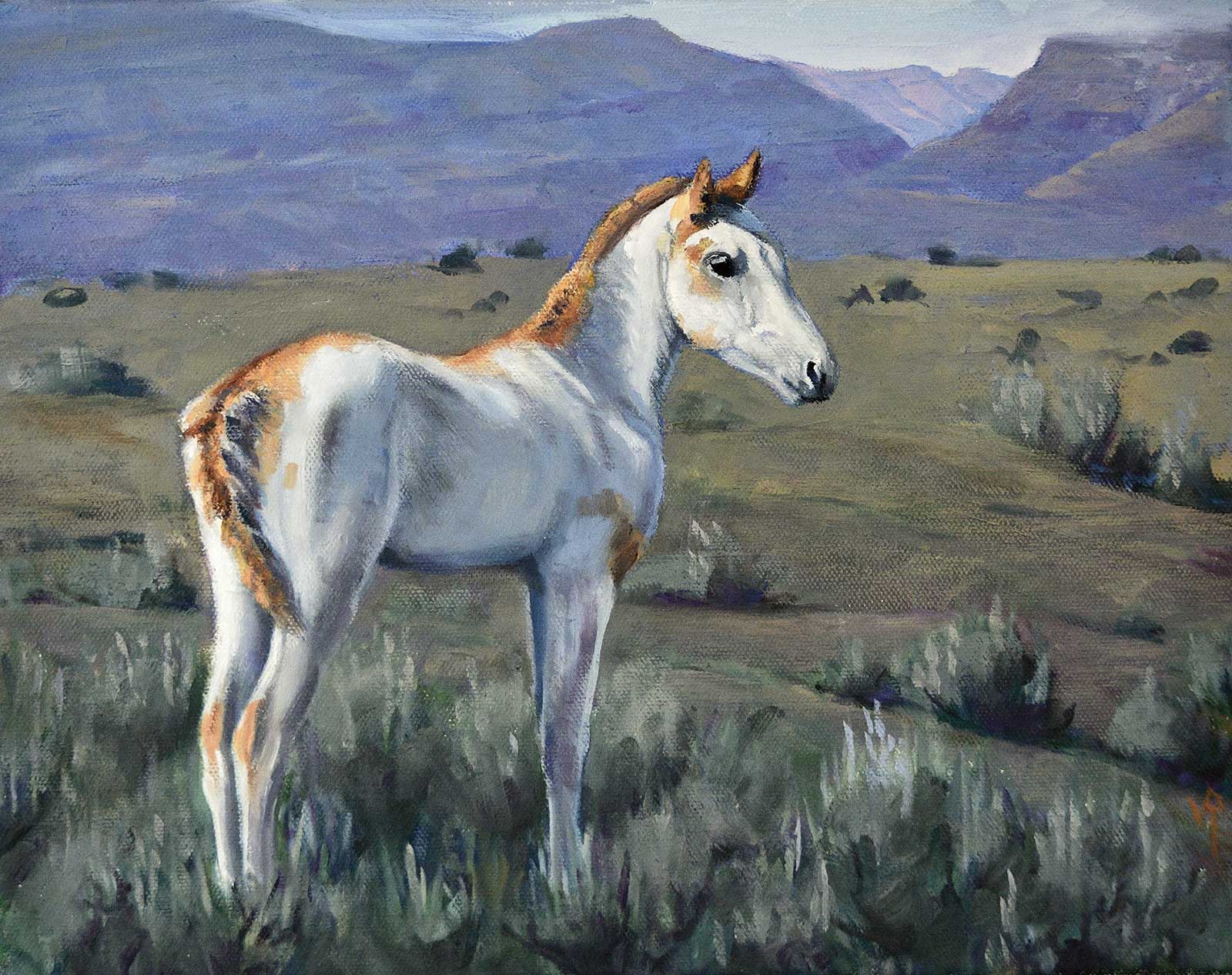
Painting in traditional oils within a modern format has become a trademark of artist Carrie Nygren’s work. “I try to capture the inherent spirit, character and personality of each horse I have the privilege of painting. Whether it’s a portrait, or a captured moment in action, there is nothing nobler than the horse and his relationship with the rider,” she says. Her intent is to find a balance between traditional painting and contemporary composition, intentionally focusing the eye on the subject. Anatomy, motion, emotion, dimensional volume, weight and tension are all integral elements of her artwork, and “contribute to paintings that capture not only the ‘portrait’ of the horse, but the nuanced and unique power and strength of equine form.” 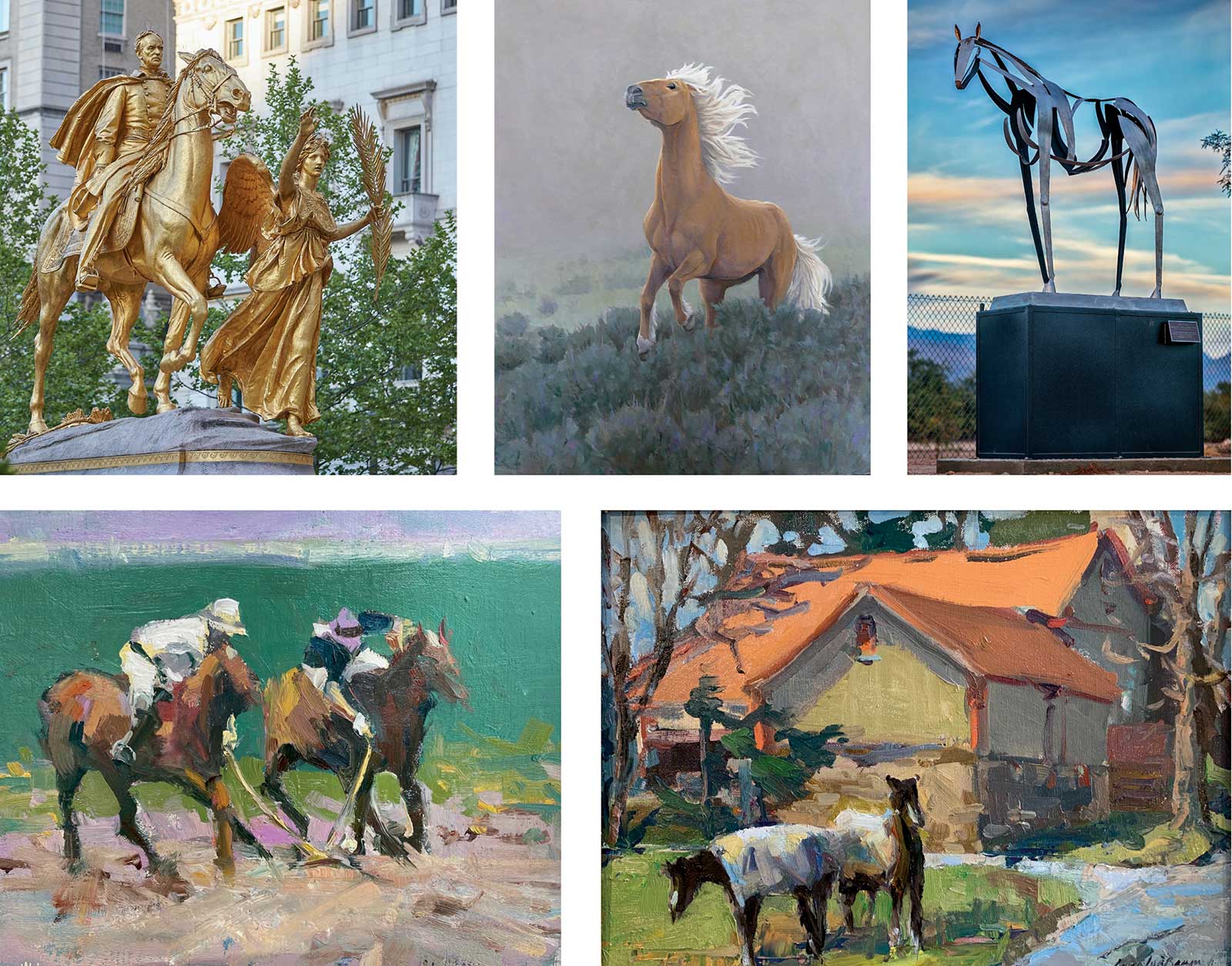 Top row: Augustus Saint-Gaudens (1848-1907), Sherman Monument, 1892-1903, gilded bronze. New York City, Grand Army Plaza. Charles Follen McKim (1847-1909) designed the pink granite pedestal. Photo by Axel Tschentscher; Eva van Rijn, Corona, stallion of Sandwash Basin, oil on canvas, 30 x 24"; Al Glann, Over There, stainless steel, 116 x 69 x 25". Bottom row: Jacalyn Beam, IT’S A REACH, oil on conservation linen panel, 8 x 10"; Jacalyn Beam, FRIENDS, oil on conservation linen panel, 12 x 16"This year, Eva van Rijn has taken to painting wild horses, with Sand Wash Basin Wild Horse Preserve in northwest Colorado a particular source of inspiration. “Along with other lovers of horses, I’ve felt an urgency to document them, as they are being culled by helicopter to reduce their numbers. For me and other horse lovers, this is a sad event,” she says. “As a landscape artist, I’ve been painting the West for many years…In Born in the Sage, I’ve painted one of these wild [horses] only weeks old, just at sunrise, with the badlands behind him.”
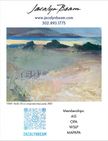
Jacalyn Beam loves painting the action and energy of polo, as seen in her piece IT’S A REACH, adding that the large shapes and colors create interesting patterns. “The uniqueness of painting polo is the horizontal and vertical lines in the painting design that are the shafts used in the game. These shafts ‘link’ the greater masses in the painting, leading our eyes around the subject matter and adding movement,” she says. “I also like the way painting permits us to relive particular moments of action in a polo game. Polo is a fast game—blink and you miss it!” Another piece, Friends, is a recent plein air painting of Bentbrook Farm in the Brandywine Valley, an equine center known for its complete training of horse and rider in the hunter/jumper world. “On this day, two horses were hanging out in front of a colorful historic barn,” says Beam. “The sun was bouncing off the horse blankets and metal roof making a colorful, inviting scene. The sun was warm with a March chill in the air—a perfect day for plein air painting.”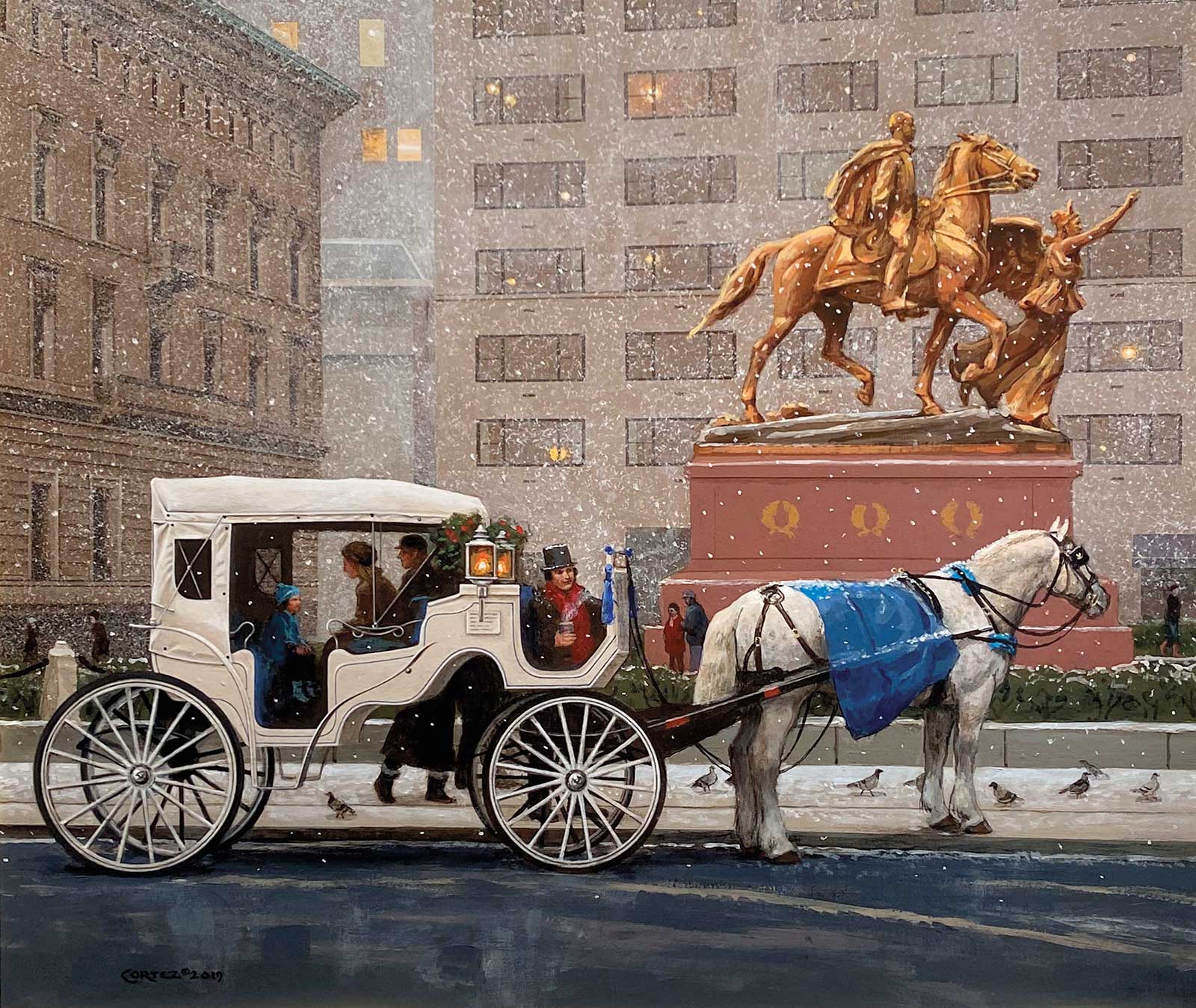 Cavalier Galleries, Grand Army Plaza, acrylic on mahogany panel, 13 x 15", by Jenness Cortez
Another artist captivated by the sport of polo is painter Joseph Sundwall. “My interest in making equestrian art came to me suddenly, having attended a polo match on impulse, purely out of curiosity,” he recalls. “Already a professional portrait painter, I was floored by the muscular beauty of the animals, and stunned by the athleticism of both the horses and their riders.” In addition to his polo paintings, Sundwall’s equestrian work includes dressage, flat track racing, fox hunting, draft animals and commissioned portraits. “Whether my equine subjects are walking, running, prancing or pulling, I’m always struck by the dignity of their simple presence,” he adds. “This is what inspires and informs my work; the here, the now.”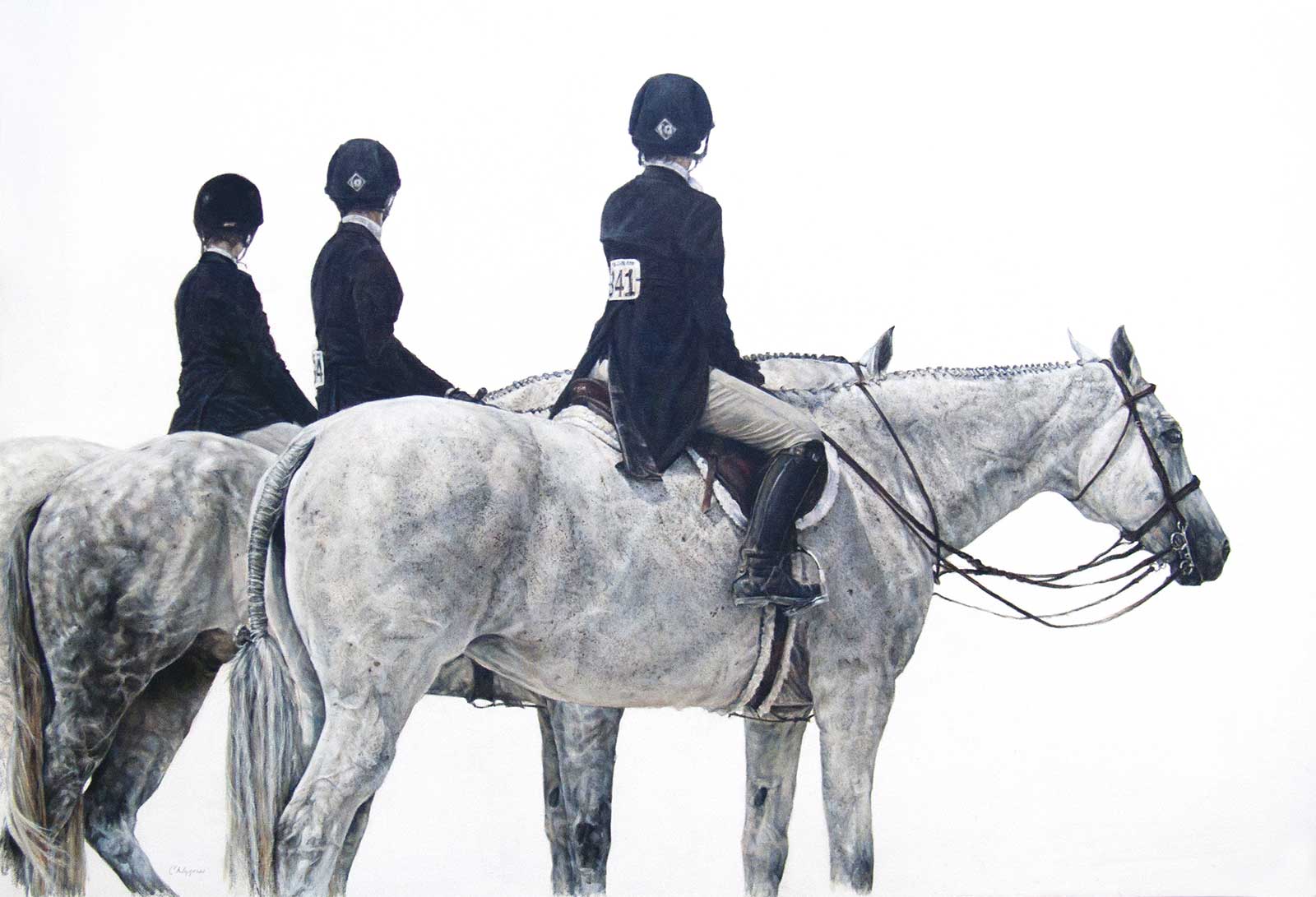 Carrie Nygren, Study in Black on Greys, oil, 30 x 40"
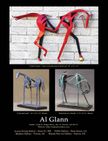
The abstract sculptures of Al Glann distill horses down to simple and pure forms, focusing primarily on energy and motion. The artist says, “I love the different personalities of horses and their unique energy. To watch them run is just amazing—thundering around a track or across a pasture. There is also the simple elegance that you find in a horse calmly grazing or just looking at you. I really want to capture the movement, personality and spirit of a horse at a singular moment. The gesture form is giving the viewer just enough information that they understand what they see and are able to fill in the rest of the image, thus they become an active participant in my sculptures.”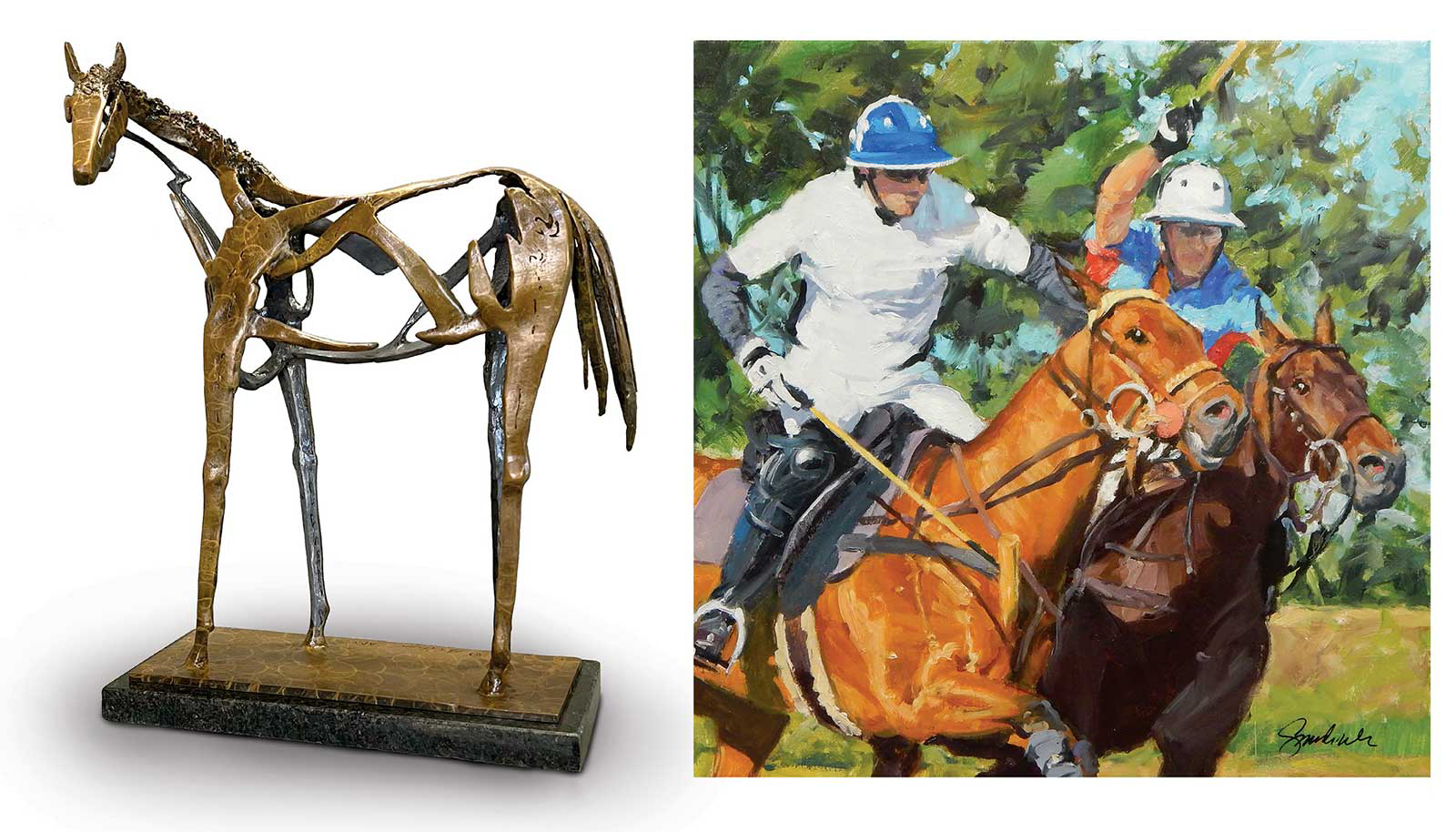 Al Glann, A Second Look, bronze, 12 x 13 x 5"; Joseph Sundwall, Ride-Off, oil on linen, 20 x 20"
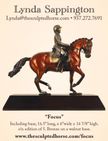
Sculptor and painter Lynda Sappington’s first word was “pretty” and her second word was “hoss,” much to the surprise of her parents. Her inspiration comes from her great appreciation for the beauty of nature, especially horses, cats and flowers. A self-taught sculptor, her early work was inspired by experiences she had as a child with horses, and the experiences of her children with theirs. Her daughter grew into a fabulous Grand Prix dressage rider and trainer. Sappington is inspired by the magnificent horses she sees at dressage shows she attends to watch her daughter compete. While, in her eyes, these horses are the epitome of equine strength and beauty, she also loves to sculpt quarter horses, Arabians, Friesians and others. Her work ranges from miniatures to lifesize, and now she is adding painting to her set of skills, and is thrilled to be playing in color now. She hopes to capture the brilliance, beauty and sweet soul of her subjects in her work. —
Featured Artists & Galleries
Al Glann
3230 N. Dodge Boulevard, Suite D
Tucson, AZ 85750, (480) 560-3240
www.alglannsculptor.com
Carrie Nygren
(414) 491-3854, cnygrenart@gmail.com
www.cnygrenart.com
Cavalier Galleries
(212) 570-4696, art@cavaliergalleries.com
www.cavaliergalleries.com
Eva van Rijn
P.O. Box 746102, Arvada, CO 80006
(845) 417-3716
Jacalyn Beam
P.O. Box 4261, Greenville, DE 19807
(302) 893-1775, www.jacalynbeam.com
Joseph Sundwall
195 Front Street, Newburgh, NY 12550
(908) 635-3717
www.josephsundwall.com
Lynda Sappington
Whimsy Hill Studio LLC
www.thesculptedhorse.com
www.lyndasappington.com
Paderewski Fine Art
158 Plaza, Beaver Creek, CO 81620
(970) 949-6036
www.sportsmansgallery.com
The Sportsman’s Gallery
165 King Street, Charleston, SC 29401
(843) 727-1224
www.sportsmansgallery.com
Powered by Froala Editor