
When he was 15, Brian Keeler won a canoe race on the Susquehanna River in Pennsylvania where he frequently paddled with family and friends. Today, he documents the Susquehanna and the Finger Lakes just north of the New York border in paintings filled with the light and color of the region.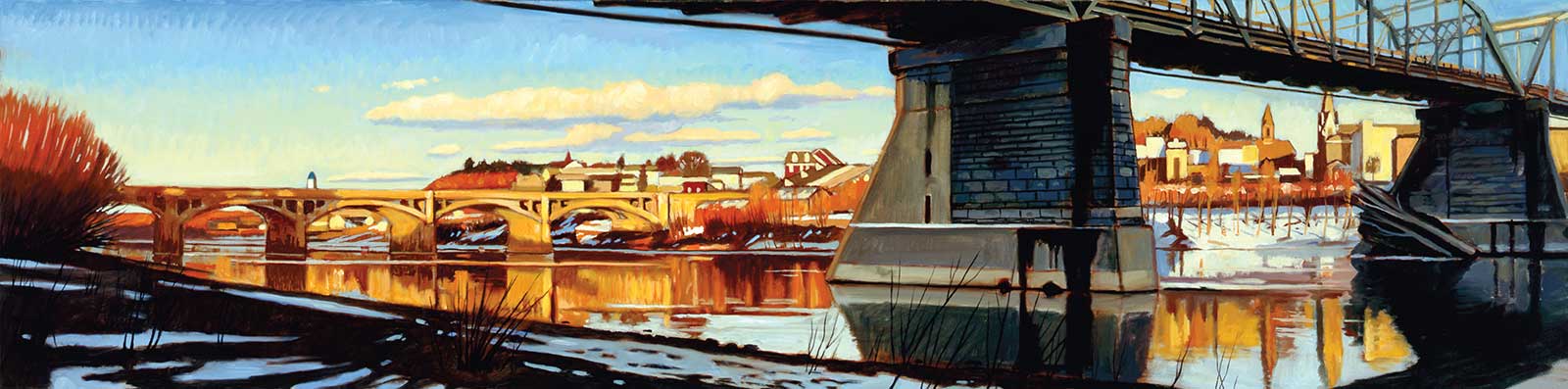 Last Light under the Pittston Bridge, oil on linen, 12 x 48”. Private Collection, Boston, MA. Courtesy the artist.
He often paints in the late afternoon Golden Hour, observing, “As I often do the out-of-doors painting late in the day because of my attraction to the heightened drama of raking light, a number of these works show the sun glinting on the lakes or glowing through trees etc. Others…are entirely painted in the studio but certainly based on impressions and studies from the motif. The play of light as it describes the form and character of the land or figure and brings out various qualities has long been of interest to me….”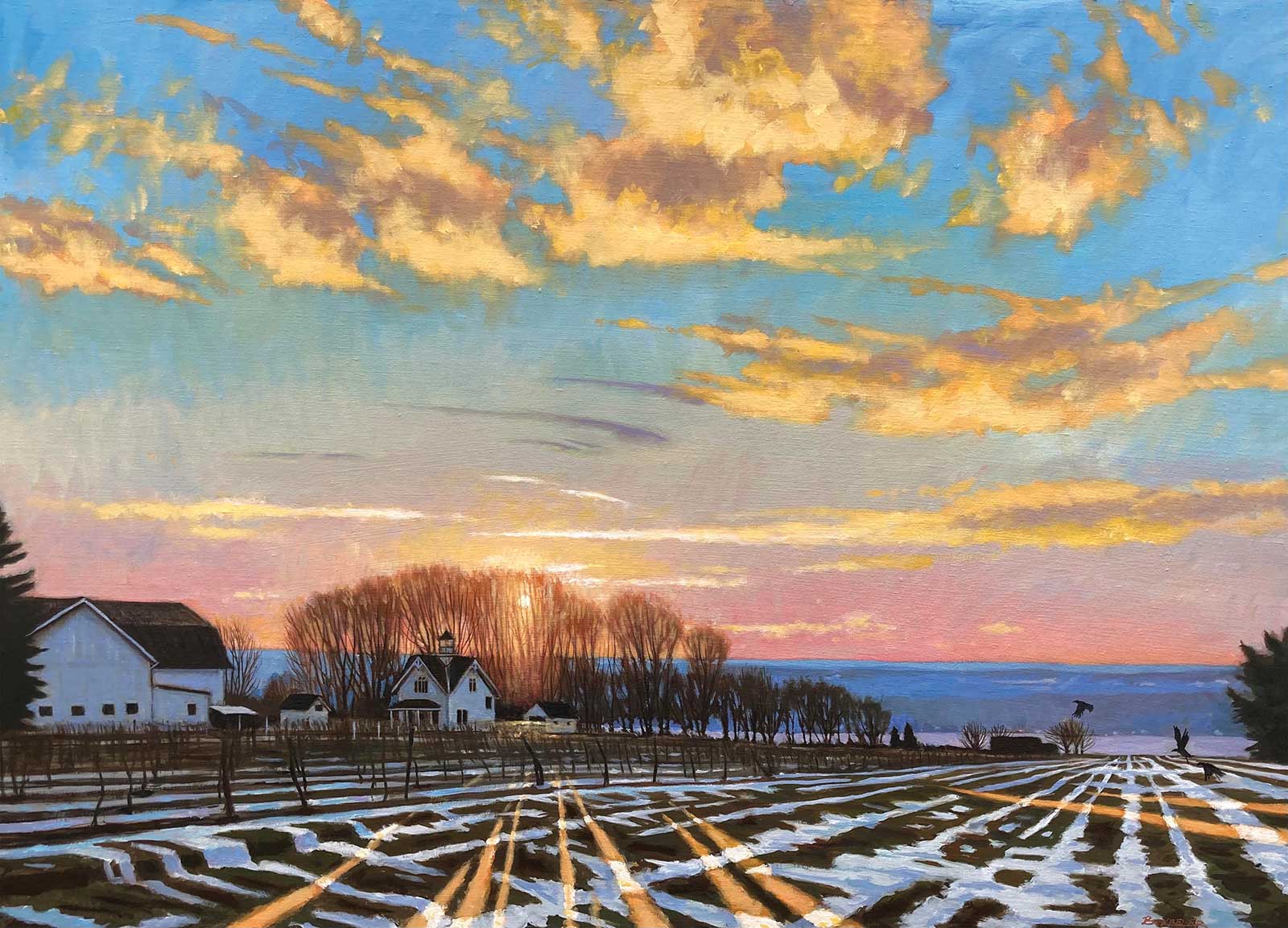 Seneca Winter Landscape with Three Crows, oil on linen mounted on panel, 36 x 48”. Courtesy the artist and West End Gallery, Corning, NY.
He often begins his paintings in plein air, as he says, capturing the fleeting light but “sticking to it as it changes.” Painting outdoors, he feels an emotional attachment to the scene from its smells, the feel of the air and the ambient sounds.
Approaching a canvas, he believes that even one line should create “some kind of interesting division of the space.” He creates the eye level a third of the way down from the top of the canvas which gives him the opportunity to emphasize the sky. He begins painting broadly and gesturally, going from broad generalizations to being more defined.
I lived in the southern Finger Lakes region for 18 years where I first became acquainted with Keeler and his paintings as well as the effects of the light on the lakes, rivers and soft rolling hills.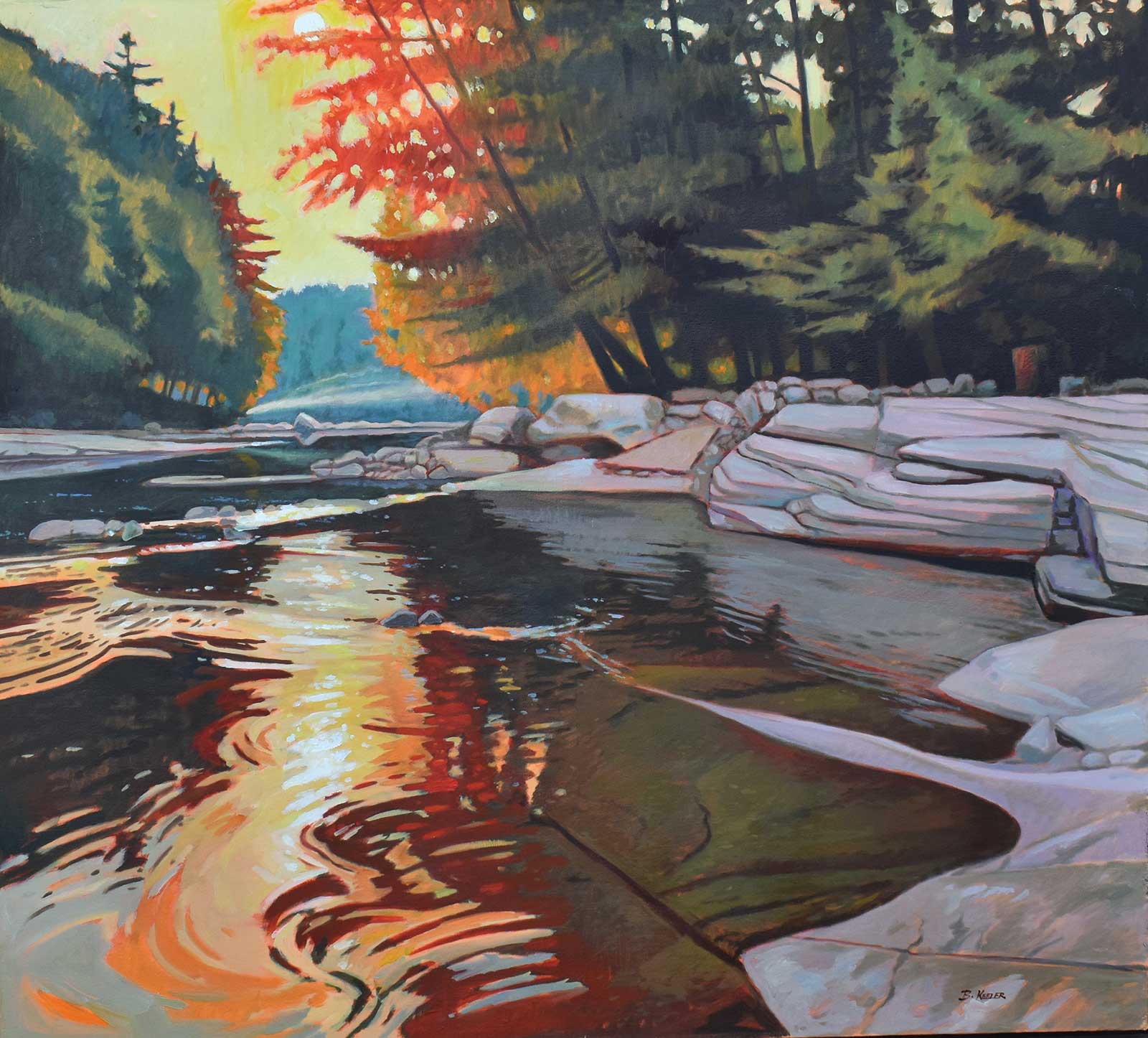 Campfire Smoke, Loyalsock Creek, oil on canvas 42 x 46”. Private Collection, Ithaca, NY. Courtesy the artist.
Although the high desert of New Mexico, where I now live, has its own stunning qualities of light, I miss the raking light of the setting sun coming through trees as Keeler depicts in his painting Seneca Winter Landscape with Three Crows.
He studied at Keystone College and York Academy of Arts in Pennsylvania where he worked with Tom Wise, Ted Fitzkee, Virgil Sova, William Falkler and others. After graduation, he took workshops with masters of realism including Dan Greene, Everett Raymond Kinstler, Jack Beal and Nelson Shanks. He has also traveled to experience scenes painted by other plein air artists such as Camille Corot who incorporated small sketches into his more majestic canvases such as Hagar in the Wilderness, now in the Metropolitan Museum of Art in New York.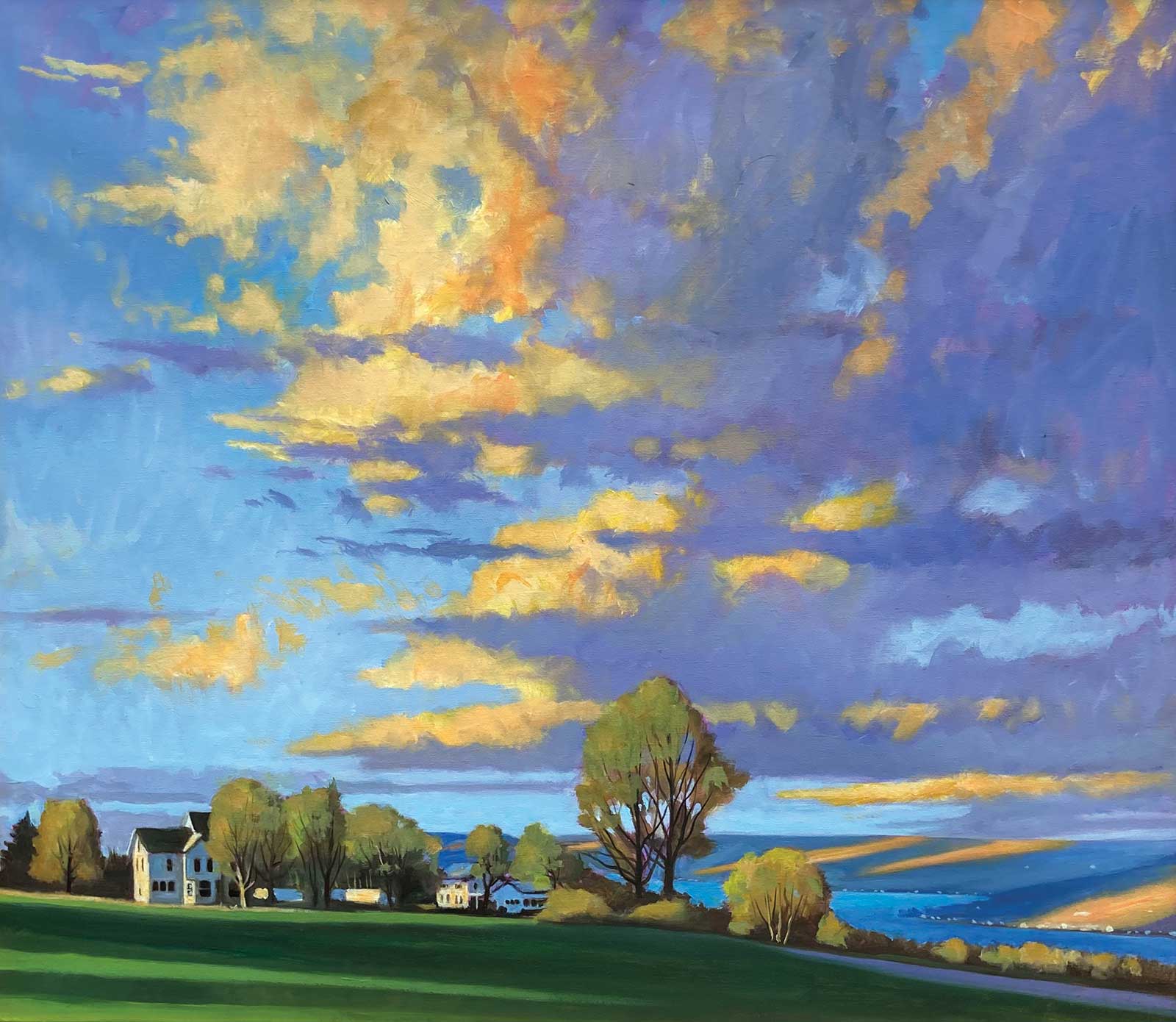 May Evening Sky - Keuka, oil on linen 26 x 30”. Courtesy the artist and West End Gallery, Corning, NY.
Having lived in the Susquehanna region all his life, he has seen it change over time. “I feel common cause and inspiration from and with Thomas Cole for his beautiful paintings, of course, but also for his early environmental activism in the 19th century.” Cole, regarded as the founder of the Hudson River School, the country’s first art movement, wrote in an 1836 essay, “Yet I cannot but express my sorrow that the beauty of such landscapes are quickly passing away—the ravages of the axe are daily increasing—the most noble scenes are made desolate, and oftentimes with a wantonness and barbarism scarcely credible in a civilized nation.”
“This interest of mine,” Keeler writes, “comes from seeing the beauty of the northern Susquehanna compromised by the huge invasion of the fracking industry. Many of the spots that I have been painting for decades have been impacted.”
The site of Friedenshutten, a Moravian mission established in the 1760s to bring Christianity to the local tribes, has been bulldozed under a 265-acre development of a liquid natural gas plant.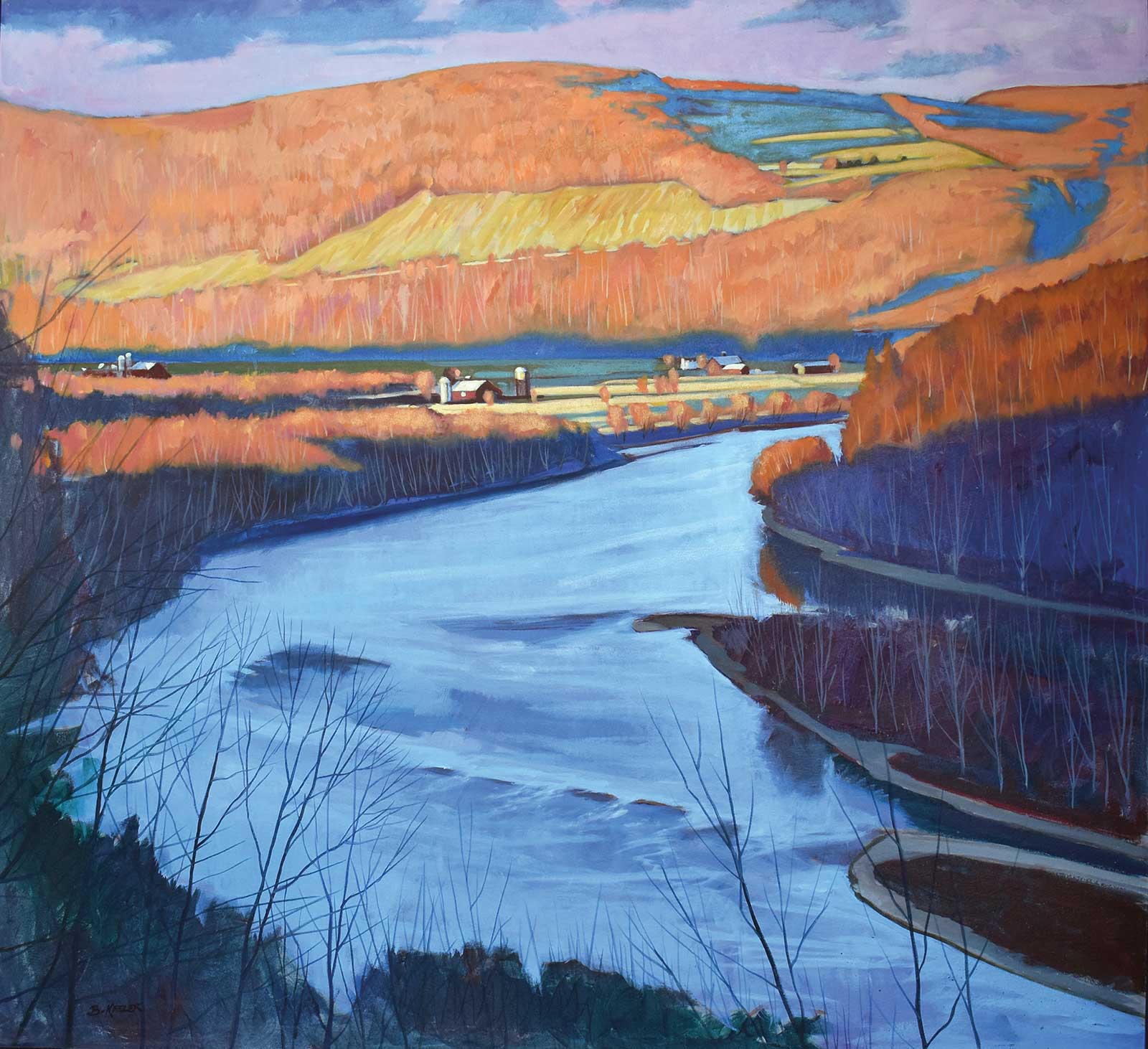 River Rhythms, French Azilum, PA, oil on canvas on panel, 44 x 48”. Courtesy the artist.
The bucolic region has been the scene of conflict when, during the Revolutionary War, to retaliate for British loyalist and Indian raids on patriot forts, General George Washington sent the Continental Army to cripple the ability of the Cayuga and Seneca Indian Nations to attack by destroying their principal villages and food supplies.
Not far from the site of Friedenshutten is another historic site depicted in Keeler’s painting River Rhythms, French Azilum, Pennsylavania. Visible from the Marie Antoinette Lookout, French Azilum was established in 1793/94 for French exiles fleeing the French Revolution. It was believed that Marie Antoinette could have come to French Azilum if she had escaped the guillotine.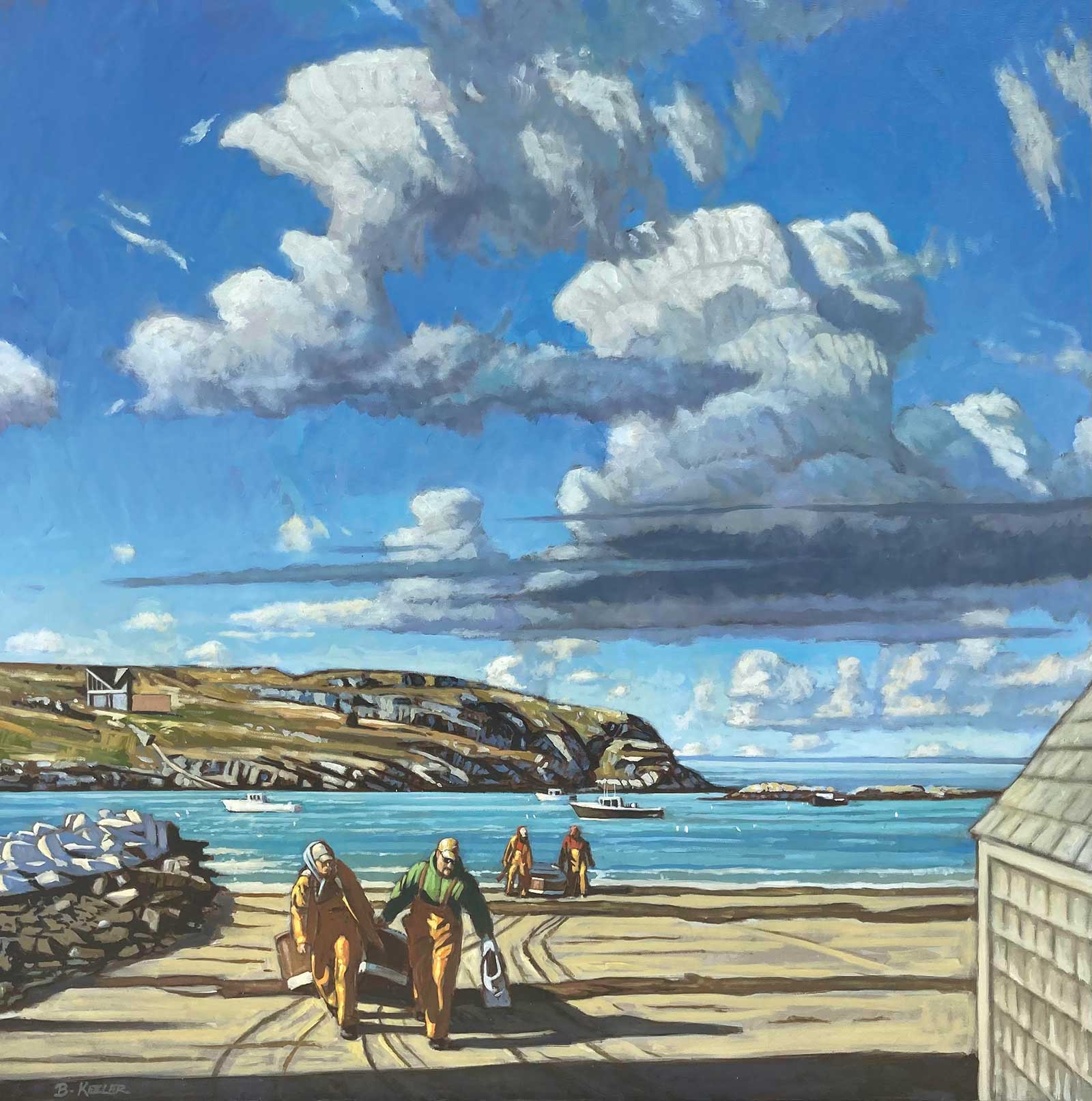 End of October, Monhegan Island, oil on canvas, 36 x 36”. Courtesy the artist.Keeler’s paintings of the Finger Lakes depict landscapes unthreatened by industry and the site of 120 wineries rated as the number one wine region in the United States. The moisture and light of the region contribute to ideal growing conditions for the wines.
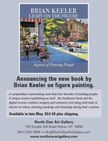
The fishermen in End of October, Monhegan Island are a reminder that he is also a painter of figural narratives and portraits. A new book, Brian Keeler: Light on the Figure, Aspects of Painting People from North Star Art Press, will be available in May. In it, Keeler writes in more detail about light: “The light that is of concern to me in paintings…has more humble beginnings. The pure delight of representing the simple play of light is almost always one of the initial inspirations for my paintings.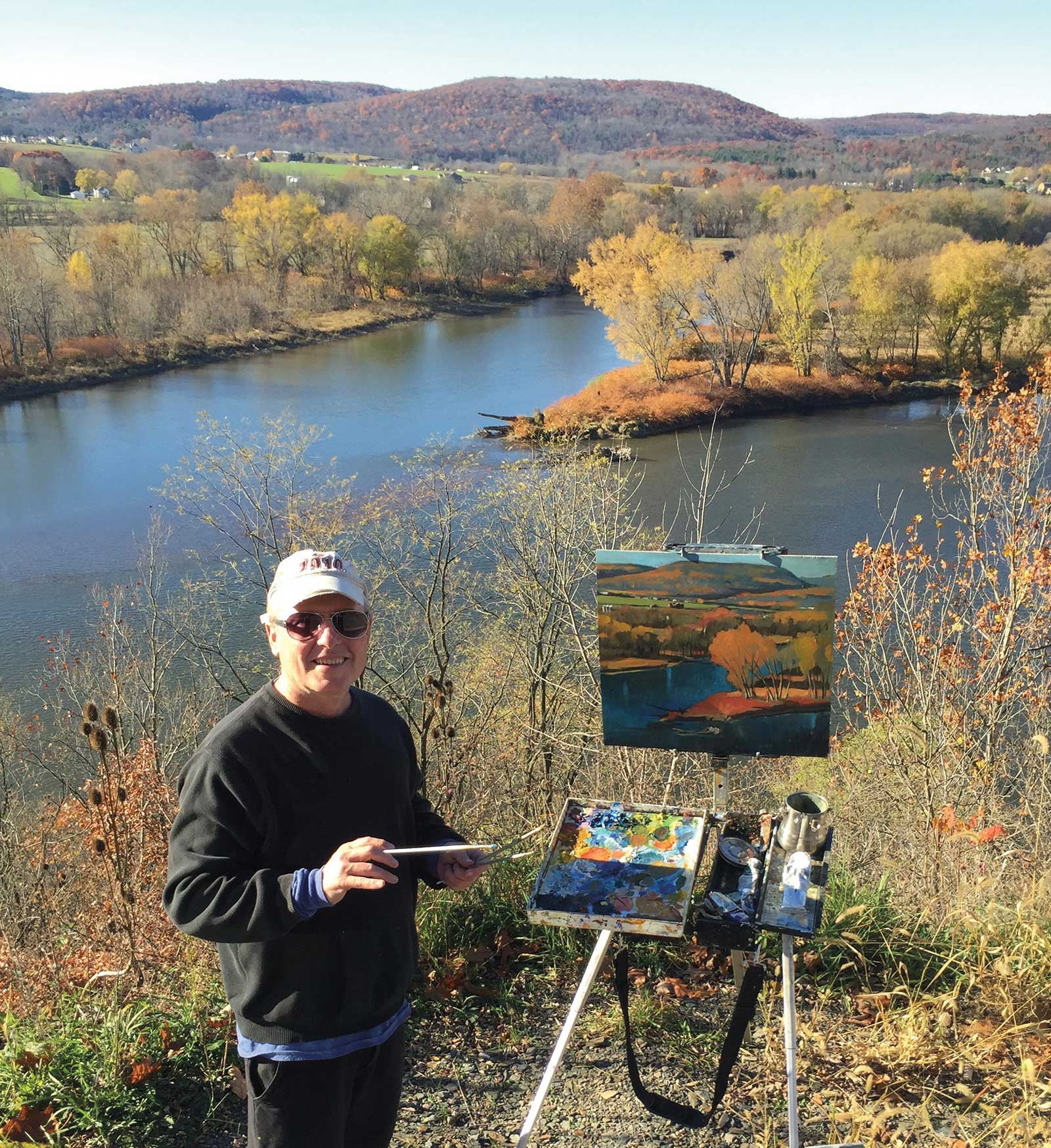 Brian Keeler at Tioga Point, Pennsylvania, where the Chemung and Susquehanna Rivers meet.
Whether I’m faced with a landscape or a figure, it is often the quality of light on a given subject that is the first lead or element that invites me to look closer. That thrill of observing how light plays on form in intriguing ways provides the emotional charge that can set the stage for a painting that encompasses and relates the visual excitement that inspired it. Then the challenge is to combine all aspects of picture making so that the process of painting becomes a weaving of concerns to facilitate the work coming into balance and harmony.”
He follows the advice of Corot who wrote, “Be guided by feelings alone. Abandon yourself to your first impression. If you really have been touched, you will convey to others the sincerity of your emotion.” —
Powered by Froala Editor