When David A. Leffel was a 19-year-old advertising student at Parsons School of Design in New York City, he took a class trip to the Metropolitan Museum of Art. “At the time, I had no idea such a thing as a painting even existed. That was my first trip to a museum,” he says. “I was so involved with studying design and layout and illustration, and I had no idea that contemporary people were still making paintings. It was completely outside of my ken.”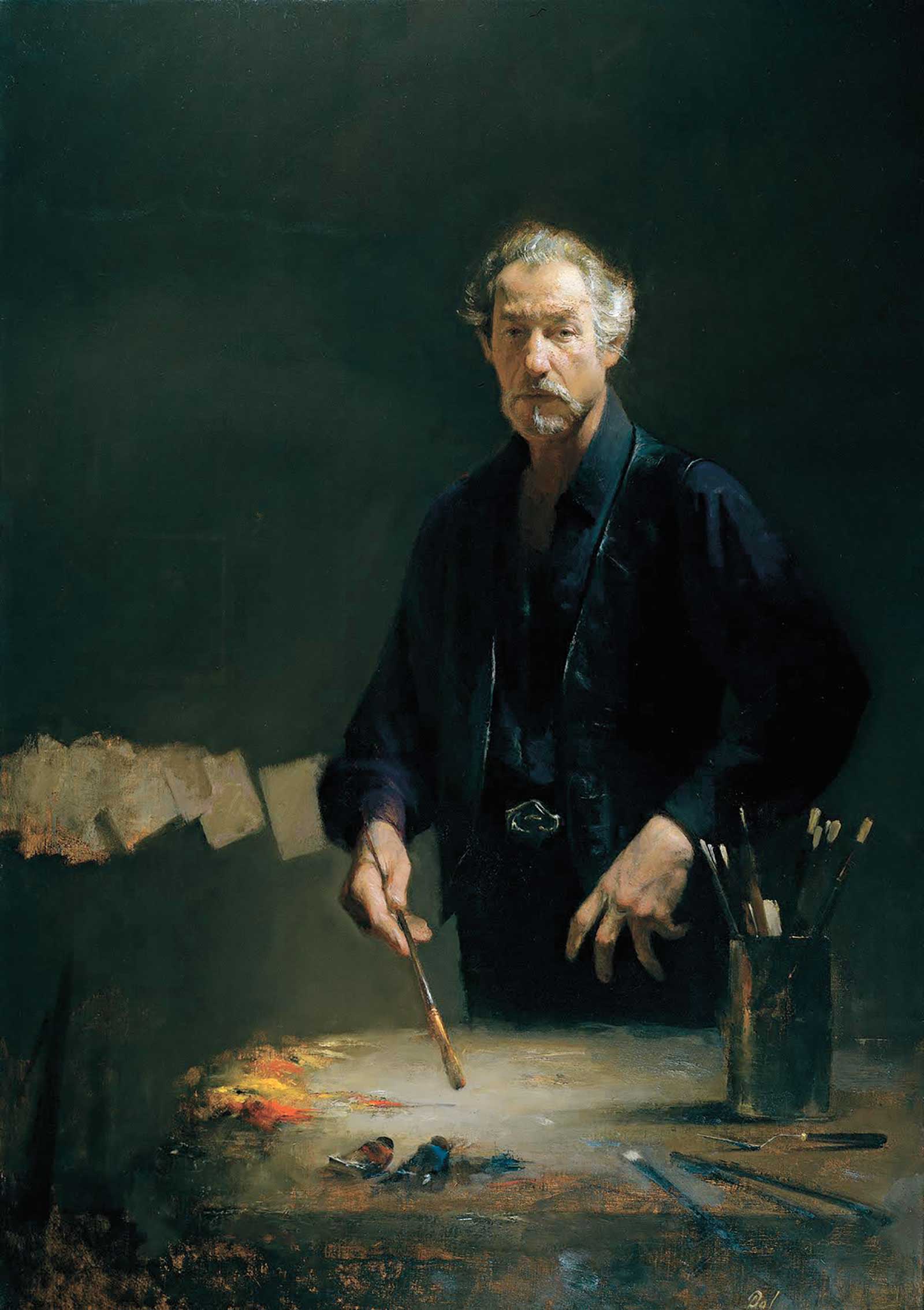 Enigma, oil, 50 x 34"
Immediately, he was taken by the work of the Dutch Old Masters—and the paintings of Rembrandt in particular struck a chord. “I felt the way he used light was unlike any other painters of that time. Something about it had an inexorable quality that really struck me,” says Leffel. But despite the impression those paintings made, it would be a decade before he started painting seriously himself.
While he was still working in advertising, Leffel began painting expressionistic works. “They weren’t quite abstract, but I was flying by the seat of my pants, so to speak,” he says. “Then, when I was 29, I decided I would go to the Art Students League to learn how to really paint. And that was the beginning of a change of life for me.”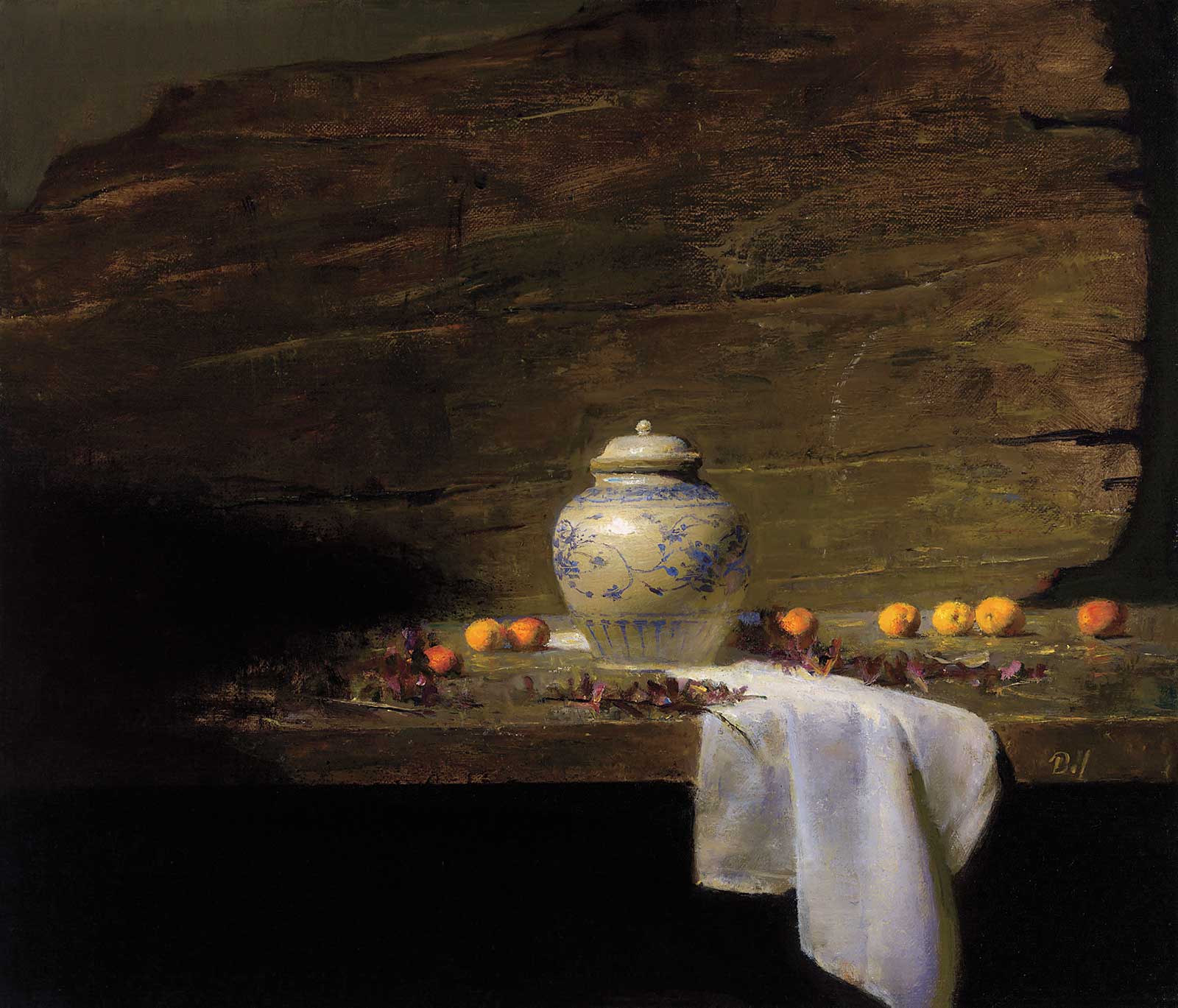 Landscape with Apricots, oil, 17 x 20"
At the Art Students League of New York, Leffel still had the same fascination with light that had ensnared him when he’d first seen those Rembrandt paintings at the Met. “I wanted to capture that quality of light, the way the light felt like it moved throughout the picture plane,” he says. He studied with painter Frank Mason while attending the school, and that fostered an even greater appreciation for the role of light in oil paintings. Leffel adds, “That was one of the cornerstones of his teaching: how to capture the feeling of light on a flat surface.”
Initially, Leffel struggled in his painting classes, but in Mason’s class, he had a breakthrough. “I saw light in a very special way,” he describes. “It was the first time I had ever seen light as a phenomenon. One day in class, I started seeing light as a moving force, flowing like water over surfaces.”
Light is still Leffel’s primary focus when he’s setting up a painting, whether it is a portrait or a still life. “I’m focusing on where the light is and what comes out of the shadows,” he says. “I try to set up the scene to capture the feeling of movement, and the thing that is moving is the light.”
While working on his painting Self Portrait with Vest, Leffel didn’t get caught up in attempting to create a faithful representation of himself, and he kept his focus on the light. “When I’m painting a self-portrait, I set myself up in the mirror with a particular problem in mind,” he says. “How the light is moving over my face, how to use a warm complexion against a cool background, a shadow problem or a color problem.” Instead of trying to portray his own personality, he concentrates on the challenge of making a flat surface feel dimensional by focusing on light, color, edges and movement.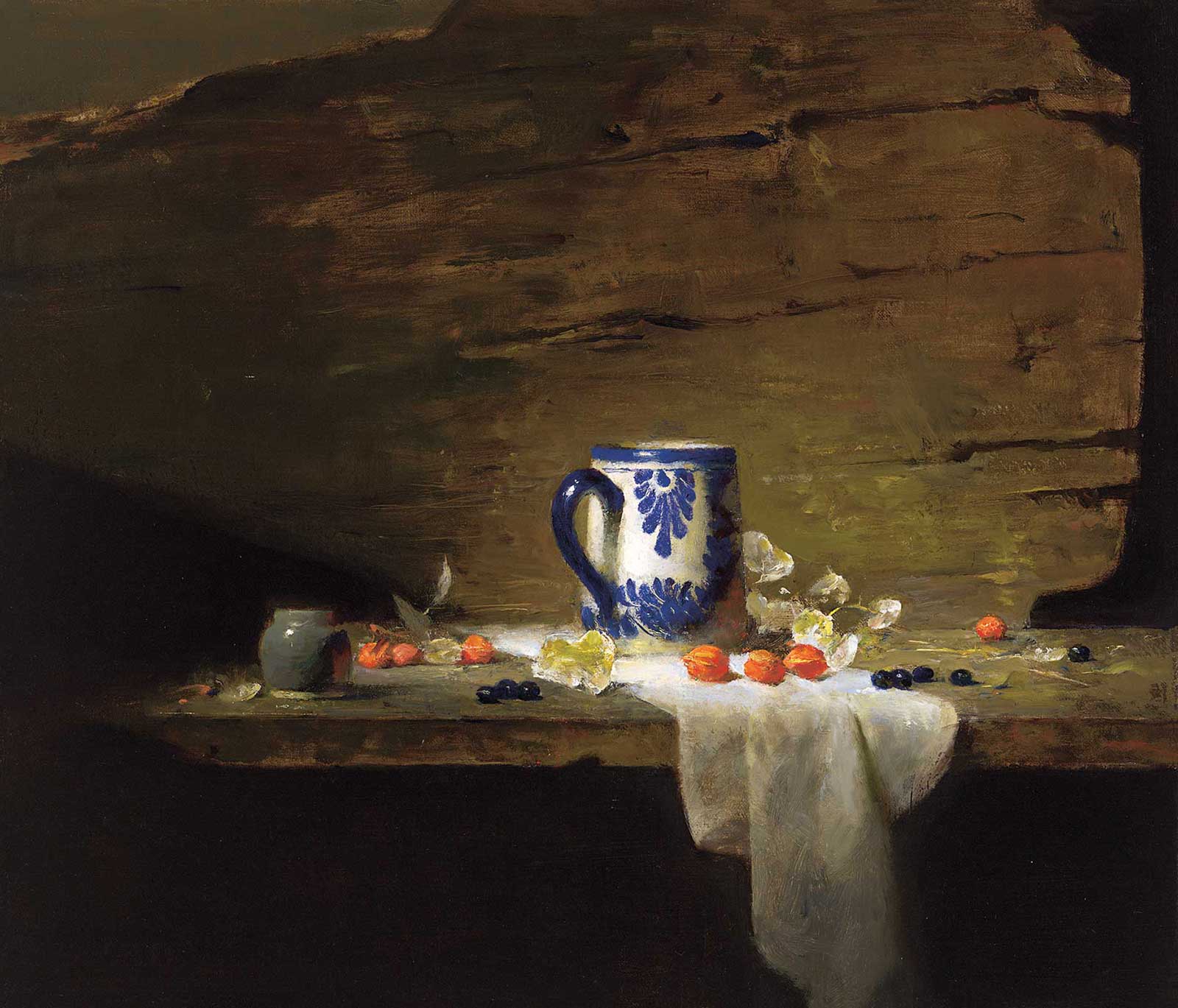 Mexican Ceramic with Red Lanterns, oil, 17 x 20"
As he paints portraits of others, Leffel concentrates on those same problems of light and color rather than attempting to capture the ineffable. “Some people painting portraits will try to capture the sitter’s personality, and I think that’s a Hollywood-ish kind of outlook,” he says. “I feel that comes through depending on who is holding the brush and the decisions they make. Their own personality causes them to make different choices, like how much color to use, how little color and what traits are picked out in a person’s face.” Those in-the-moment decisions are what ultimately add character to a portrait.
In Girl in a Black Turtleneck, a pale young woman with dark hair shines in contrast with the dark background. The sitter was a dear friend of Leffel and his first wife named Lida. She died tragically young, but he was able to paint her before she fell ill.
“She was such a sweet, lovely person,” Leffel remembers. “I just loved her face. She had this wistful quality about her, and her features always struck me, so I asked her to sit with me and I did that little portrait of her.”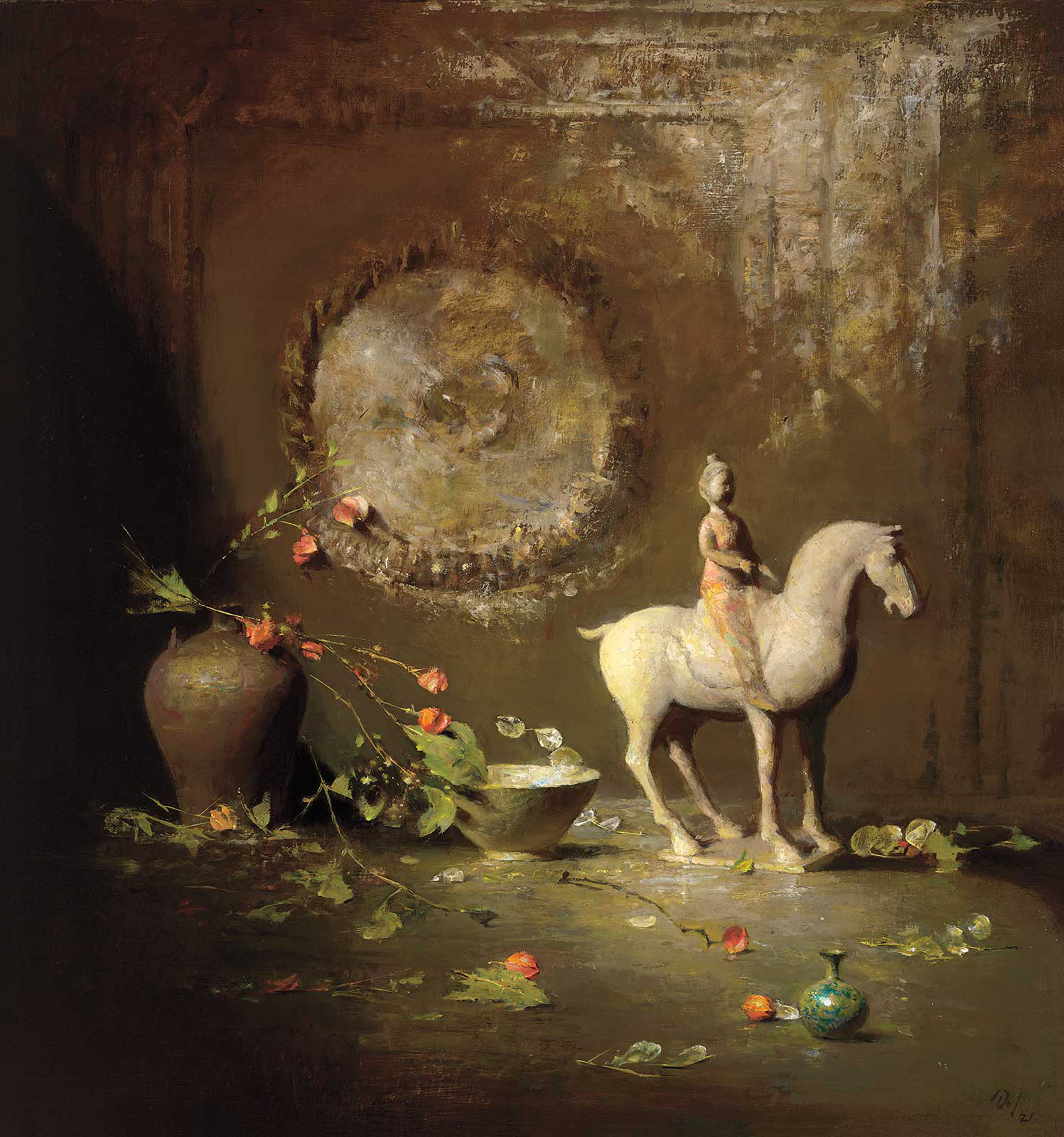 T’ang Horse with Red Lanterns and Silver Dollars, oil, 30 x 28"
Another portrait features a real-life New Mexican mountain man, who Leffel’s second wife, artist Sherrie McGraw, met and invited to sit for a portrait. “When the first sitting was done, we asked him to please wear the same costume, and he responded that it wasn’t a costume, it was his clothes. He would hunt an animal, skin the animal and then make his own clothes from the hide of the animal,” Leffel says. The mountain man had even made the staff he is posing with in the painting. “His face and everything about him were so intriguing to capture.”
When painting still lifes, Leffel chooses to paint items that have a timeless quality to them. “Aside from the fruit, I paint objects that are coated with the patina of time. Objects that have some character to them, in some fashion,” he says.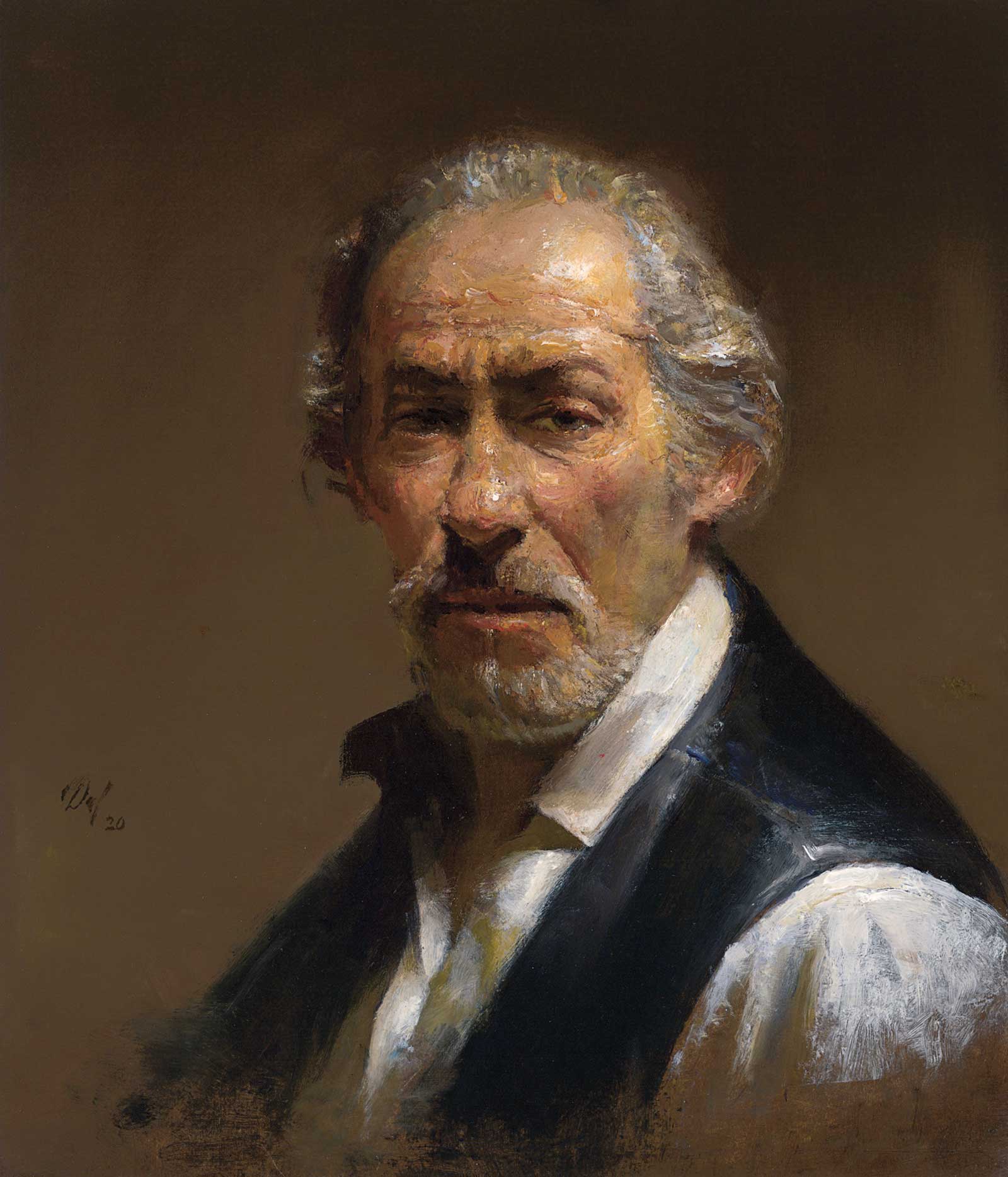 Self Portrait with Vest, oil, 14½ x 12½"
The objects featured have been collected through a variety of means. His wife Sherrie’s sister once owned an antique shop in Oklahoma and sent on objects she thought were fascinating, while dealers in New York supplied him with Persian vases or T’ang horses. “I knew a dealer in New York who had authentic Chinese T’ang horses, and I couldn’t afford to buy all of them, so he would lend me one and once I finished the painting, I would give it back to him and exchange it for another piece,” he remembers.
No matter how unique the subjects of Leffel’s still lifes are, the main attraction is still the way the light interacts with them on the canvas. “I think of it as abstract realism,” he says. “You may look at the painting and the objects are identifiable, but you’re painting more than the objects. You’re painting light moving, color moving or just movement itself, which in turn creates timelessness.”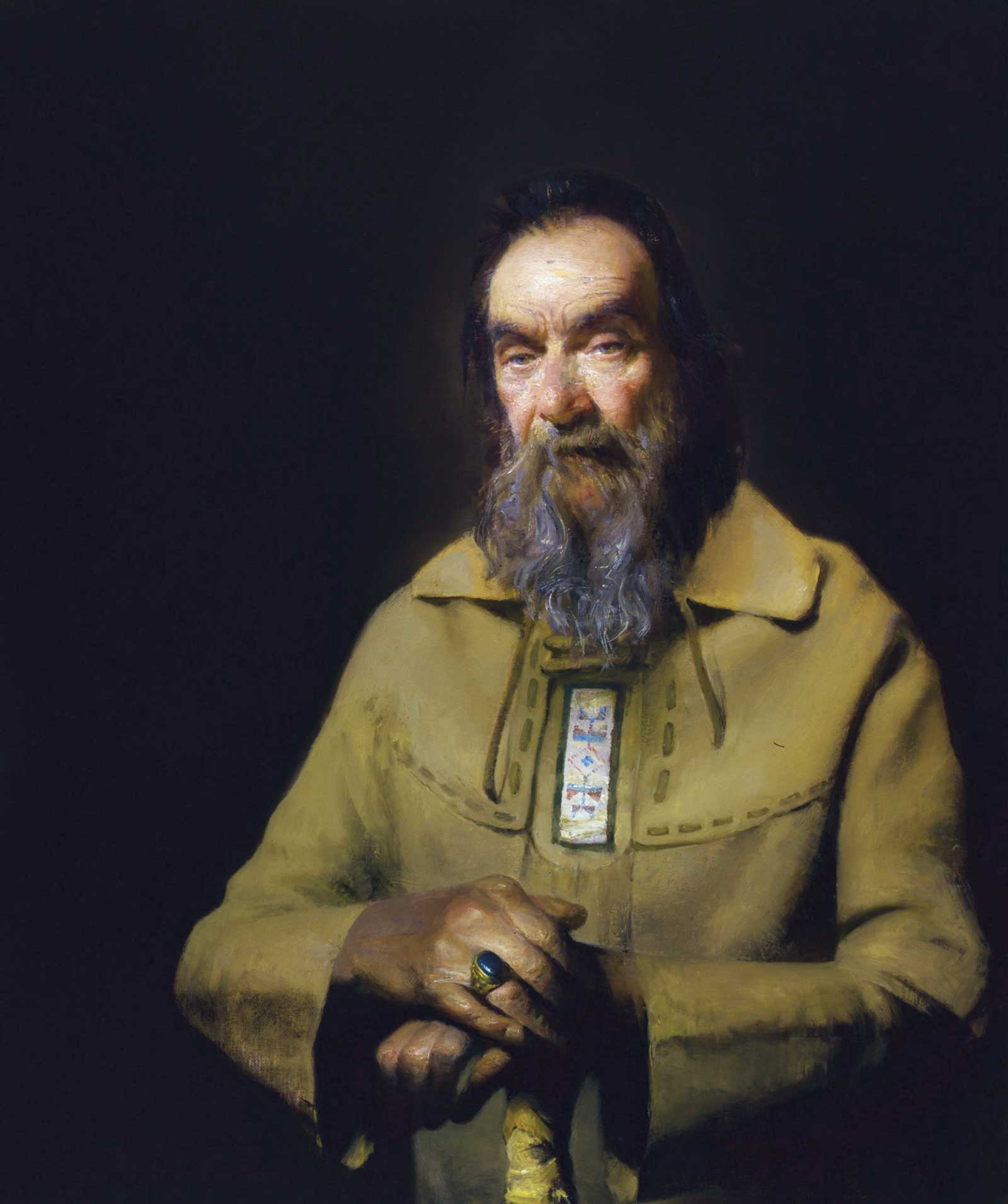 Mountain Man, oil, 28 x 23"
His painting Landscape with Apricots was envisioned to convey a feeling of space. “When I first started painting, the vase was bigger than in the final painting, and it didn’t have the vastness that I wanted to convey, which is why I called it a landscape rather than a still life,” he says. “So I wiped it down and made the vase smaller to give a feeling of emptiness.” The background features a piece of antique wood sent to him by his wife’s sister, which adds even more depth and texture to the painting.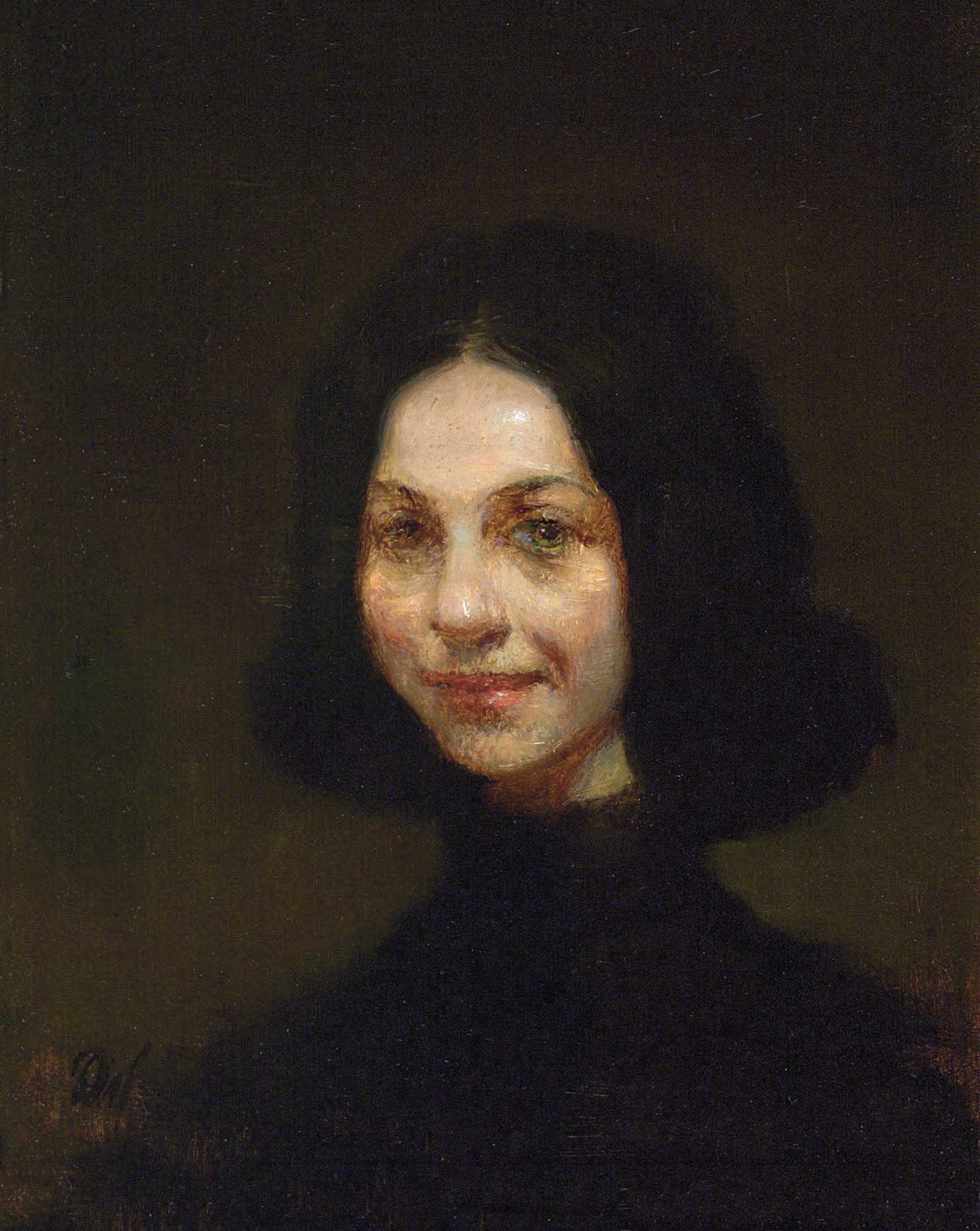 Girl in Black Turtleneck, oil, 12 x 10"
Mexican Ceramic with Red Lanterns is a companion piece to Landscape with Apricots, aiming to portray a similar feeling of vastness and space. Leffel says, “Because it was for the Prix de West show in Oklahoma City, Oklahoma, I chose to make the ceramic and red lanterns the focal point, whereas in the other painting I made the space more of the focal point.”
A selection of Leffel’s best lifetime works will be featured in a solo exhibition at InSight Gallery in Fredericksburg, Texas, which opens November 5 and remains on view through November 26. —
Passion for Light: David A. Leffel
When: November 5-26, 2021
Where: InSight Gallery, 214 W. Main Street, Fredericksburg, TX
Information: (830) 997-9920, www.insightgallery.com
+++
Erin E. Rand is a former editor of American Art Collector, Western Art Collector, Native American Art and American Fine Art Magazine. She received her MA in Publishing and Writing from Emerson College, where she was a founding editor of MinervaMag.com, and she has a BA in History and International Affairs from Trinity University. She currently resides in Kansas City, Missouri.
Powered by Froala Editor