Alex Venezia was first introduced to the paintings of Caravaggio (1571-1610) by his high school teacher when he was 18. He says, “It was the first time I saw art that was emotional and poetic instead of just cool to look at. It drew me in. I wondered if people are still able to do that today. I was already in a darker melancholic place, and I admired the drama and the emotion. At that point I couldn’t see the paintings from a technical point of view at all. My teacher gave me first oil paints and palette.”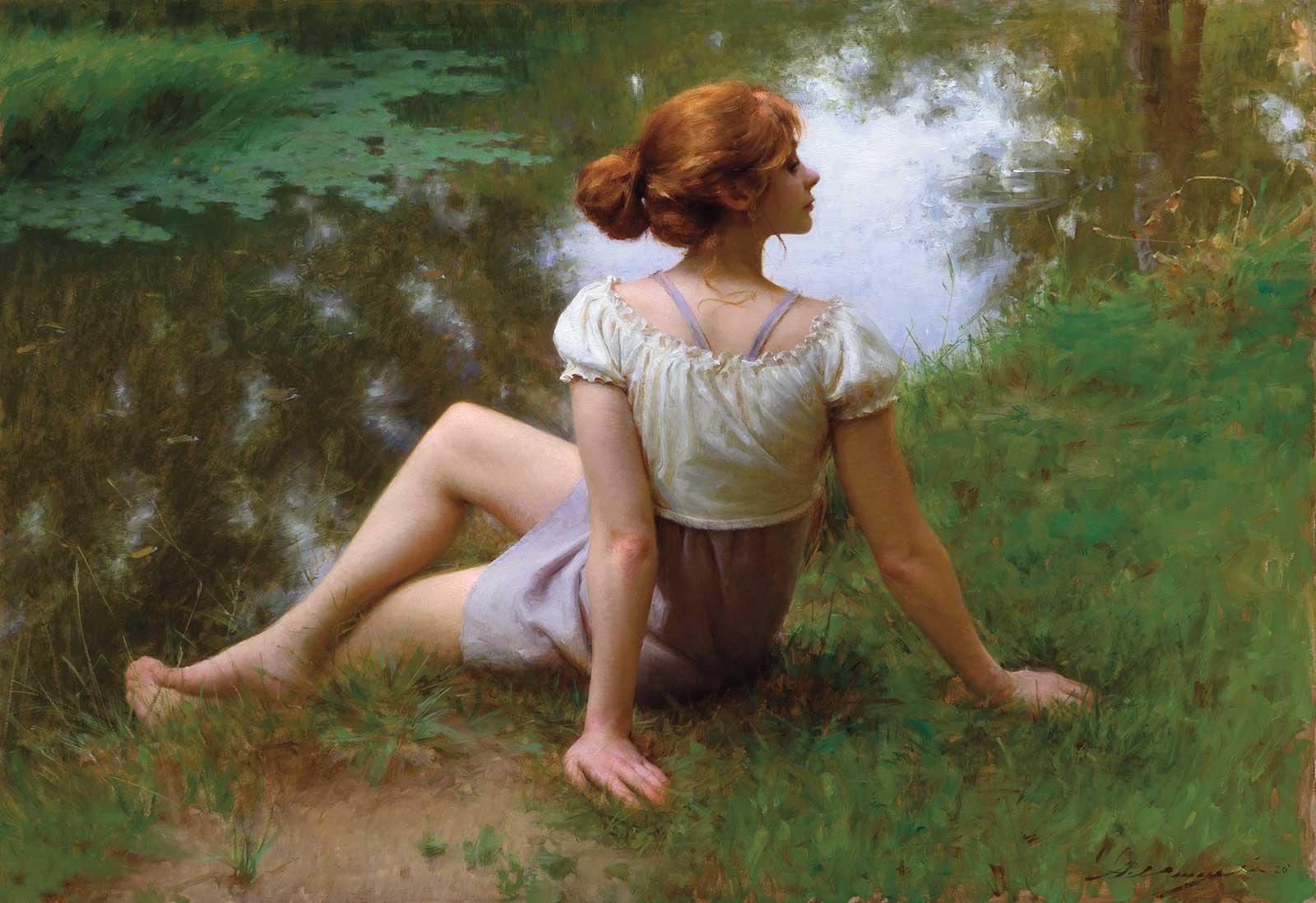 By the Water, oil on canvas, 25 x 36"
He discovered that formal art school training was not for him. Nor did he want to come out of a school painting like everyone else. “I sought out artists for a skill set they had, not to paint like them,” he says. He went to Norway to study with Odd Nerdrum, and in the U.S. he studied with Daniel Sprick, Colleen Barry, Jeff Hein and John de la Vega. He moved to Raleigh, North Carolina, in 2018 to work with artists Michael Klein, Louis Carr and Joshua LaRock at East Oak Studios.
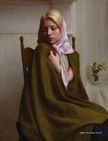
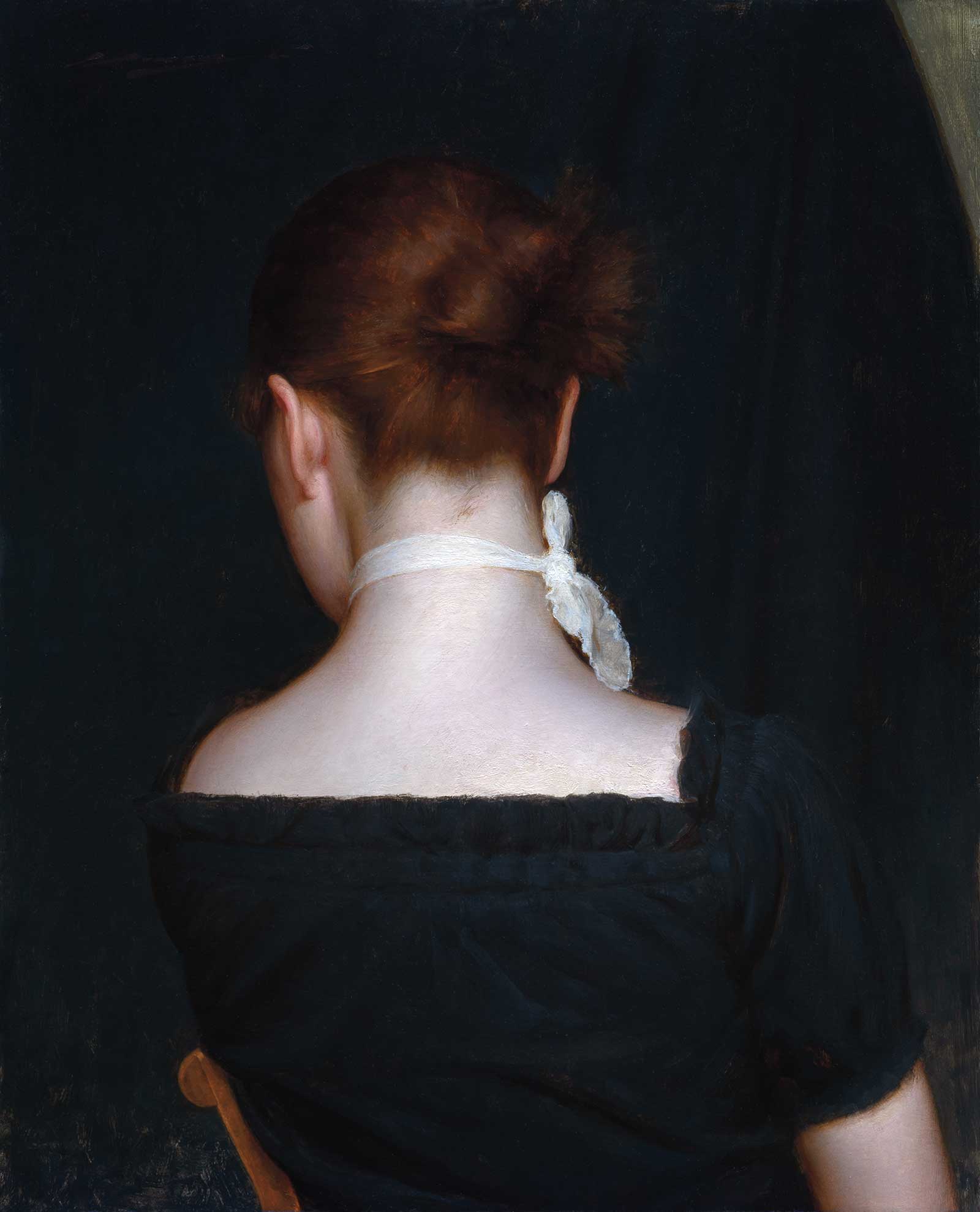 White Ribbon, oil on canvas, 20 x 16"
His most recent paintings will be shown at Arcadia Contemporary in New York, for his second solo show with the gallery and his first in New York City. Beyond the Fence opens November 13 and continues through December 5.
Venezia chose the title Beyond the Fence from an album by Iron & Wine. “I thought it’s sort of me trying to branch out to paint outdoor paintings,” he explains. “I was going to have a fence in the painting Leaving Home, but compositionally it was too cluttered.”
Leaving Home depicts a young woman setting out on a path with a heavy backpack. Her left foot is stopped in mid stride as she looks back over her shoulder, troubled and hesitant. The well-worn path leads inescapably forward into the dark of the forest, more an unknown than a threat and one that has been entered by countless people before her. David Wagoner ends his poem Lost with the hopeful lines, “You are surely lost. Stand still. The forest knows / Where you are. You must let it find you.”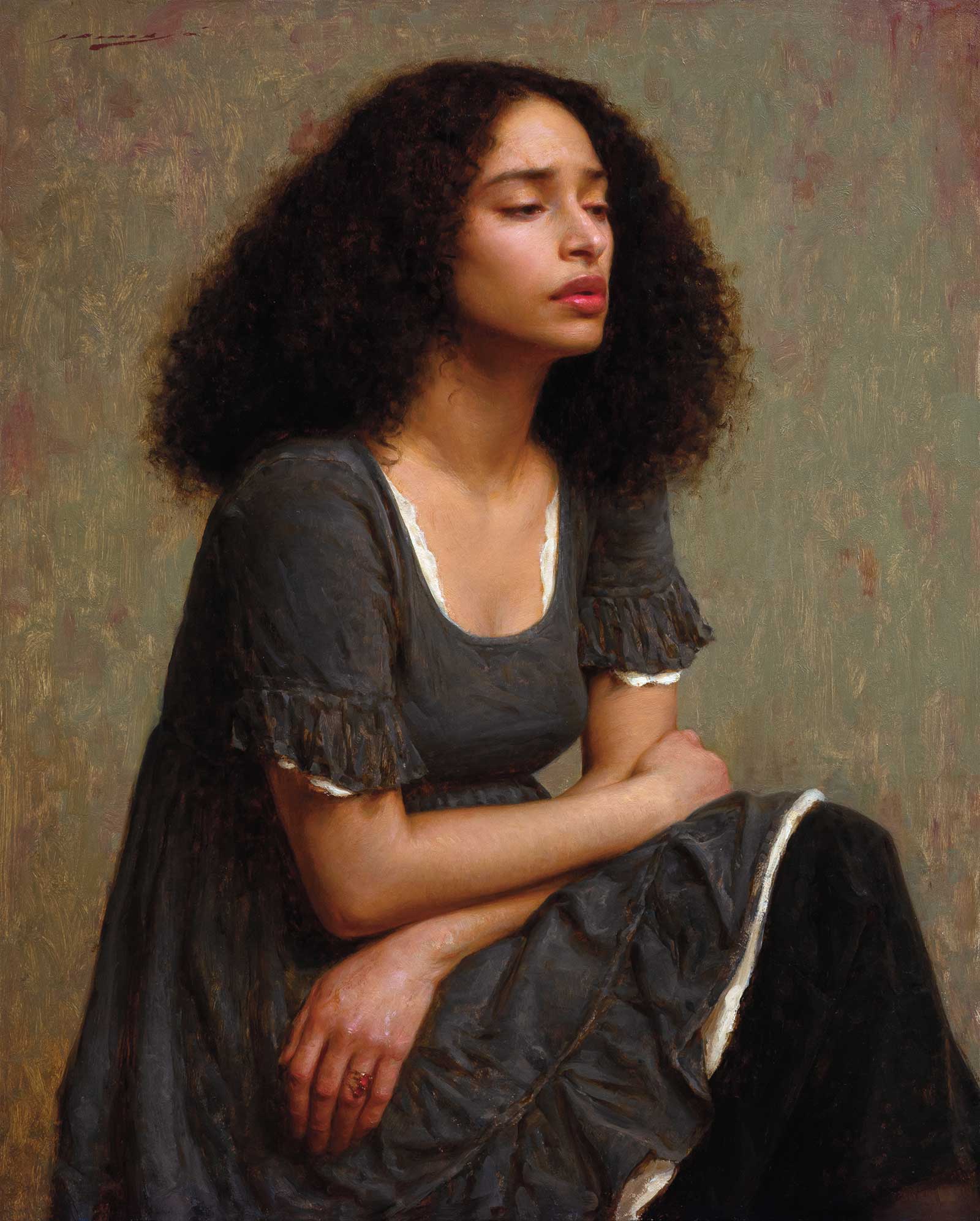 Troubled, oil on canvas, 27½ x 22"The woman is dressed in clothing not of this time nor of any definable time. Venezia says, “I choose clothes that are somewhat timeless. In this case, I wondered ‘What’s more timeless, pants or a skirt?’ I don’t want the painting to be outdated in 30 years.”
When he has an idea for painting, he writes it down in words or sketches it out, explaining, “I have a mannequin that I dress up in different outfits and then hire a model who I think best suits the idea.” He will sometimes make a color study and then draw out the composition with charcoal on his canvas.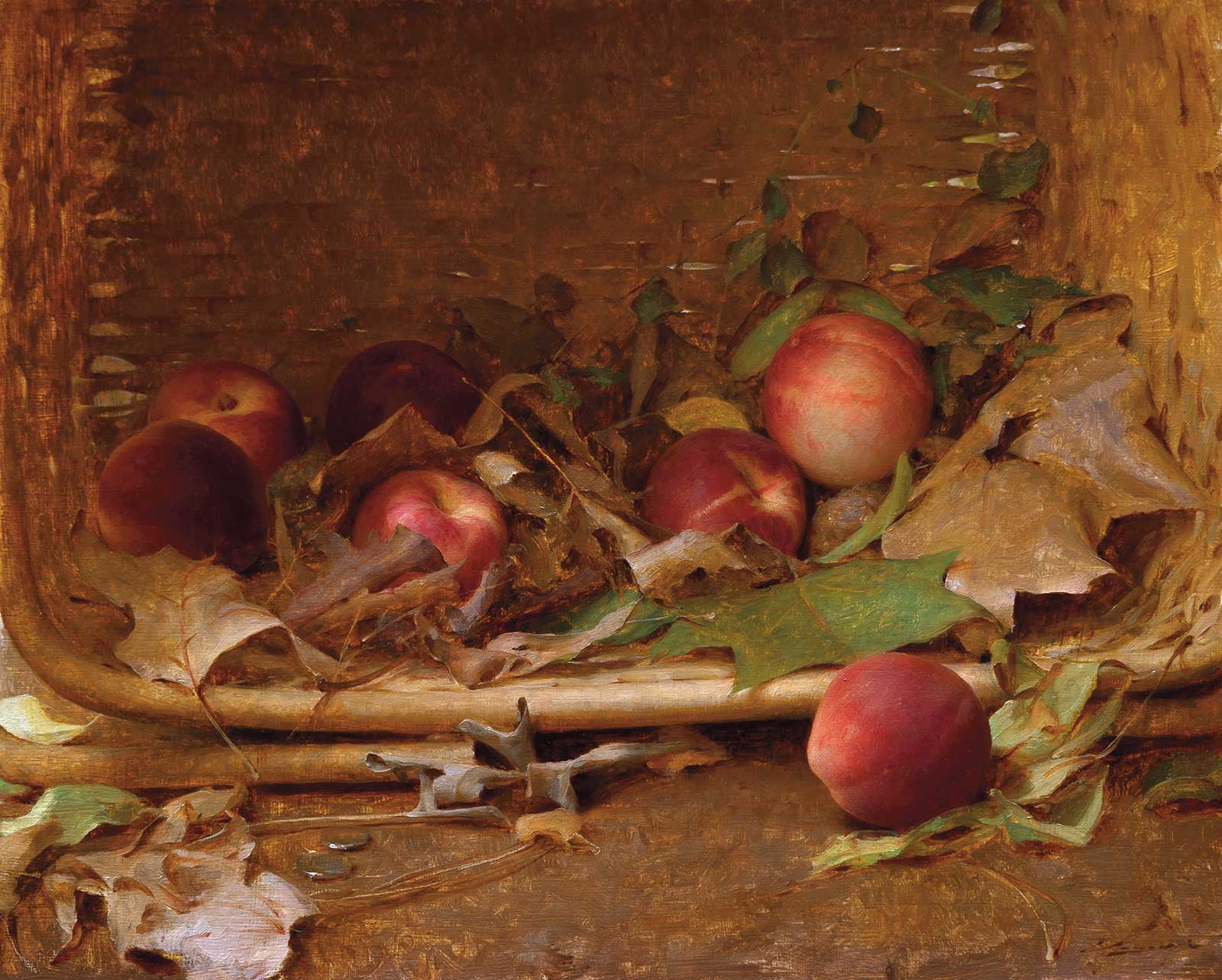 Fallen Basket, oil on canvas, 13 x 16"
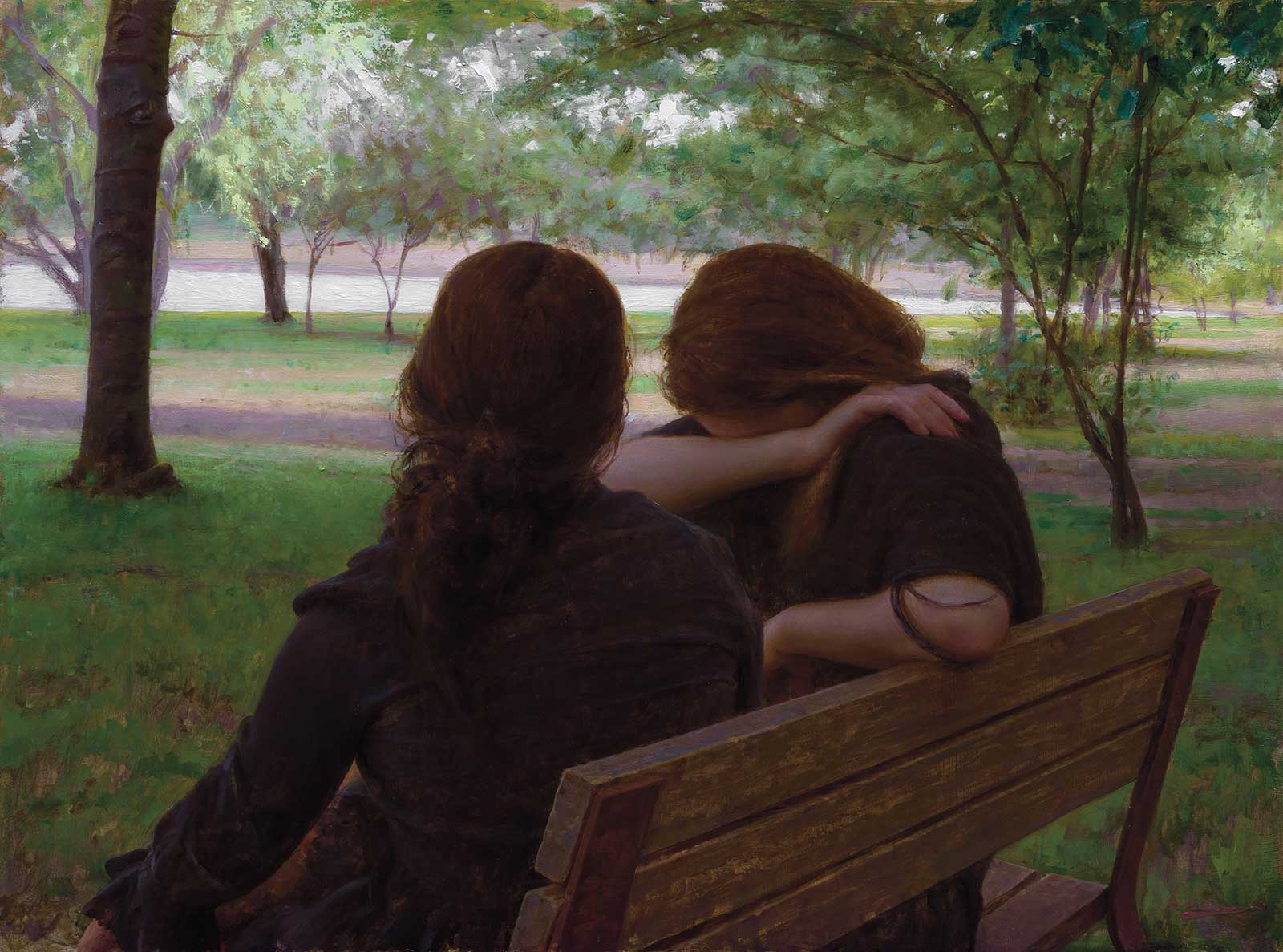 Old Friends, oil on canvas, 18 x 24"The grassy areas of Leaving Home are illustrative of his method of painting. Rather than painting alla prima, applying wet paint into wet paint, he allows each layer to dry. “If I decide to make the first layer light,” Venezia explains, “as I scumble the next layer, the light can show through, creating a glowing effect. Scumbling is almost more of an action than paint consistency.I have a good amount of paint on my brush, and I sort of scrub it on, applying it and scraping it off at the same time. Some of it is opaque, and there are some areas where you can see through.
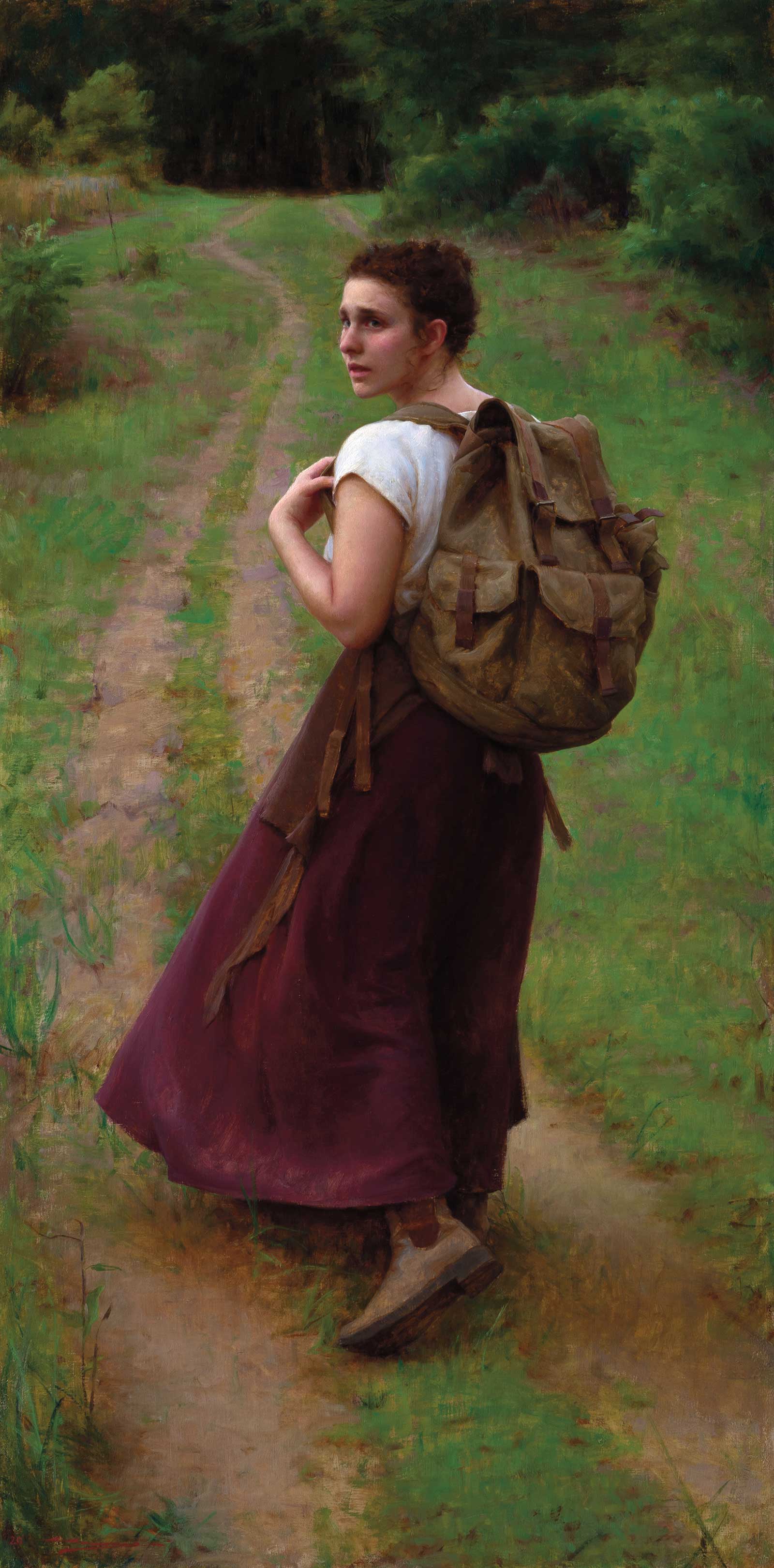 Leaving Home, oil on canvas, 48 x 24"
“I was constantly trying to make a poetic composition,” he says. “I got better over time. I wanted to avoid the situation where, in art schools, the students only paint what’s set up in front of them.”
The poetry of his painting Old Friends is the pictorial opposite of Leaving Home. One girl shares her deepest thoughts with her friend as they both sit in the shadows in a park. Yet beyond them are the rejuvenating forces of light and water. —
Arcadia Contemporary
421 W. Broadway • New York, NY 10012
(646) 861-3941 • www.arcadiacontemporary.com
Powered by Froala Editor