June 25 through July 24, Gerald Peters Gallery in Santa Fe, New Mexico, will host two solo exhibitions for artists Scott Kelley and Penelope Gottlieb. The individual shows pair together seamlessly as both highlight an interest in the natural world.
Kelley’s exhibition, titled Gray Salt - Lost in Ah-Shi-Sle-Pah, is an homage to his visit to the Ah-Shi-Sle-Pah Wilderness in San Juan County, New Mexico, which is known for its multicolored badlands and sandstone hoodoos. The harsh desolate landscape intrigued the artist, but yet his time there yielded whimsical works. Included is the triptych Armadillo, Badger, Ringed Cat (In Three Parts) – The Ah-Shi-Sle-Pah Orchestra, which is available as a triptych or as individual works.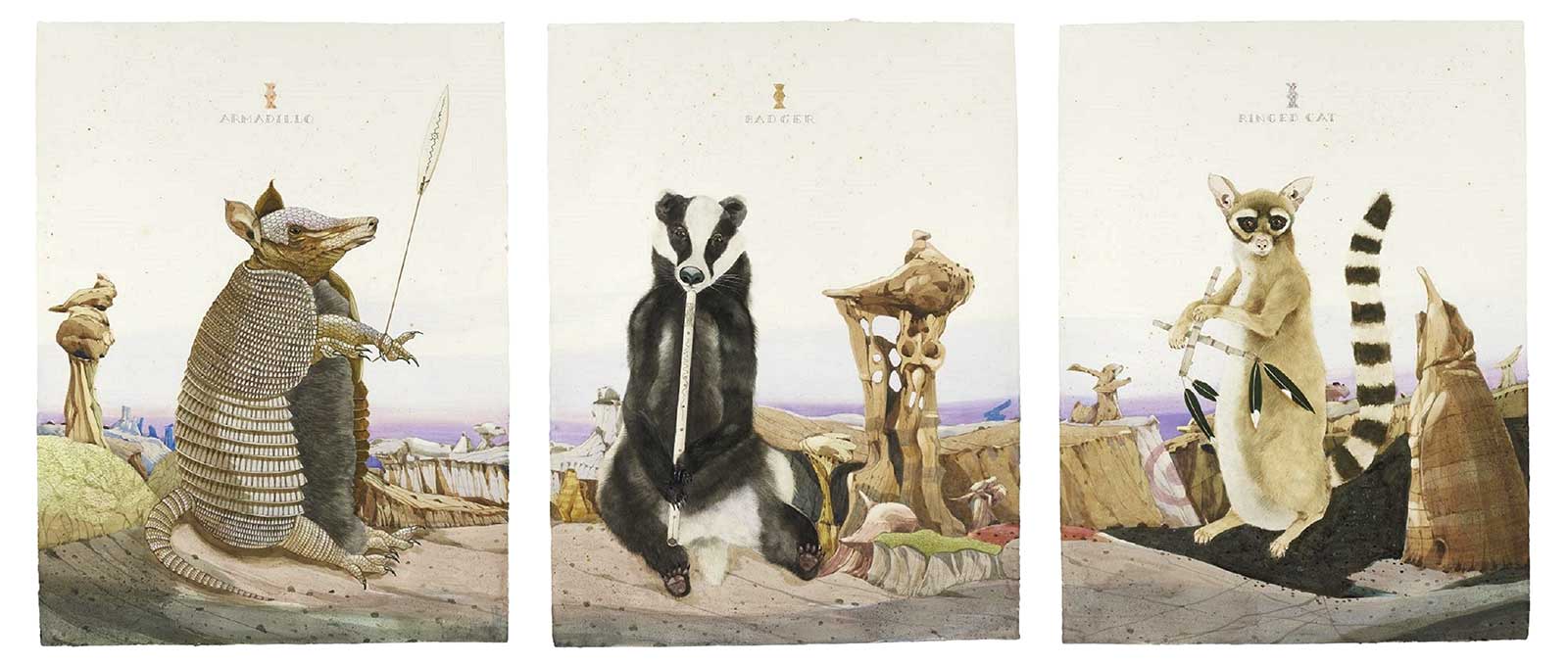 Scott Kelley, Armadillo, Badger, Ringed Cat (In Three Parts) – The Ah-Shi-Sle-Pah Orchestra, watercolor, gouache and ink on paper, 40 x 90"
“When I was in Ah-Shi-Sle-Pah incredible winds were sweeping through the canyon. As the wind made its way around and through the hoodoos and chocolate mushrooms, it sounded like music, and I thought—in the pure nerves of being slightly lost—maybe it’s a little orchestra of animals playing a symphony? I hadn’t seen much in the way of wildlife during my time in New Mexico, but I did see plenty of armadillos, a random badger and, one night in Bloomfield at the place I was staying, a ring-tailed cat was in the courtyard,” the artist explains. “So they became the orchestra. The instruments they play are among the first recorded instruments of primitive man: the bullrush, the flute, just a simple pair of sticks for percussion.”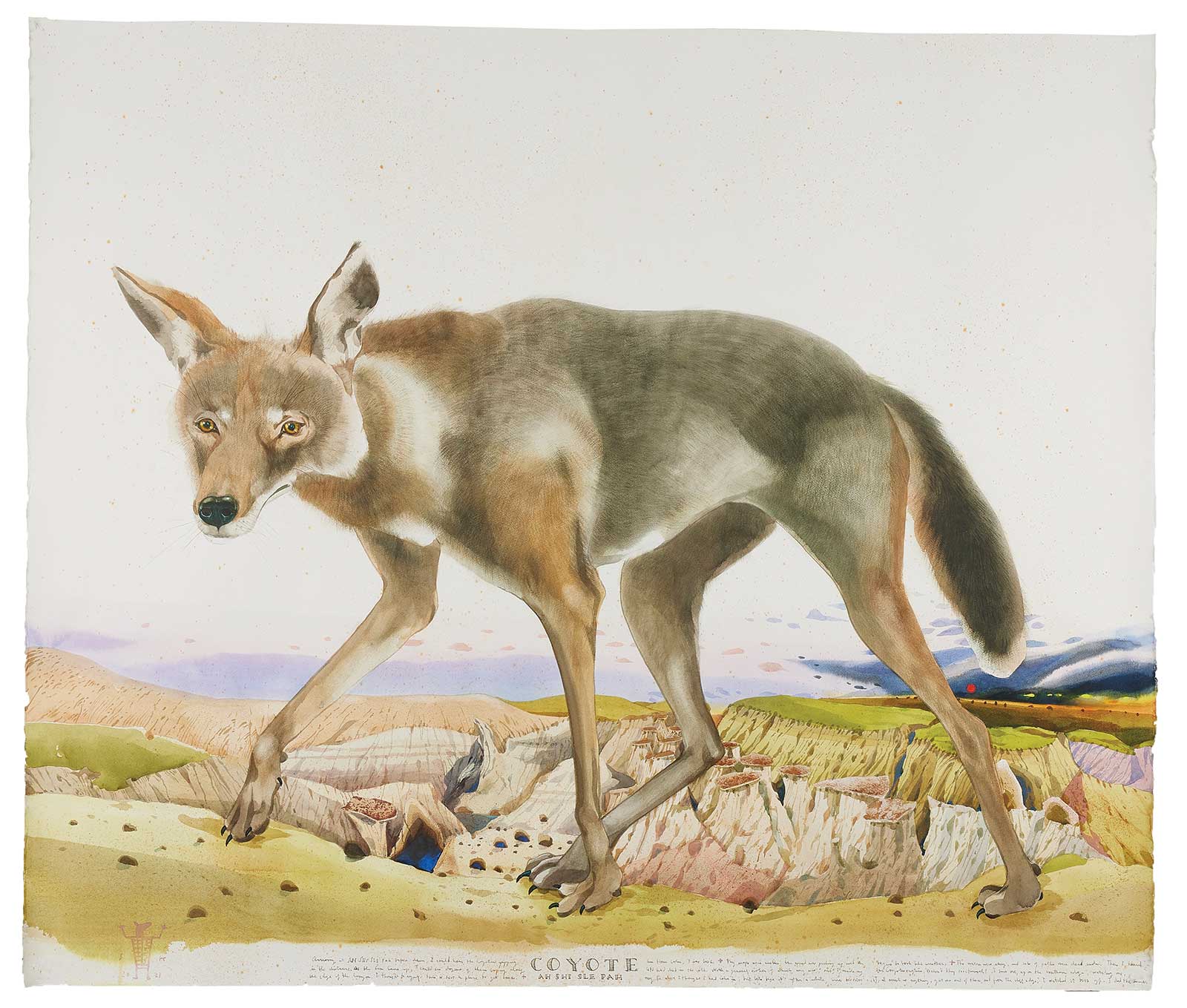 Scott Kelley, Coyote – Lost in Ah-Shi-Sle-Pah, watercolor, gouache and ink on paper, 48 x 55"
Kelley paints things that are right in front of us but often overlooked. It started with rocks and has grown to include wildlife. “Ultimately, though, I paint them because they are such a rarity in modern life. As humans continue expanding into places previously uninhabited, the wildlife gradually gets squeezed out of existence,” he says. “Even when we see them, we don’t really see them. There are whole lives out there, being lived, that we pay no attention to. And we should, because they are all, all of them, telling us something we don’t particularly want to hear.”
Gottlieb’s show features 10 works of art, including four that depict invasive plant species painted on digital reproductions of John James Audubon prints. Works such as Solanum dulcamara and Passiflora cearulea are prime examples and highlight her fascination with traditional botanical art and Dutch still life paintings. As an undergraduate she was warned against painting flowers but took it as a challenge to find a path that would represent what she finds important about nature. Gottlieb began researching and painting extinct plant species—learning one of the main reasons they were going extinct was because of “man’s introduction of aggressive non-native species”—and this became a focus for her work.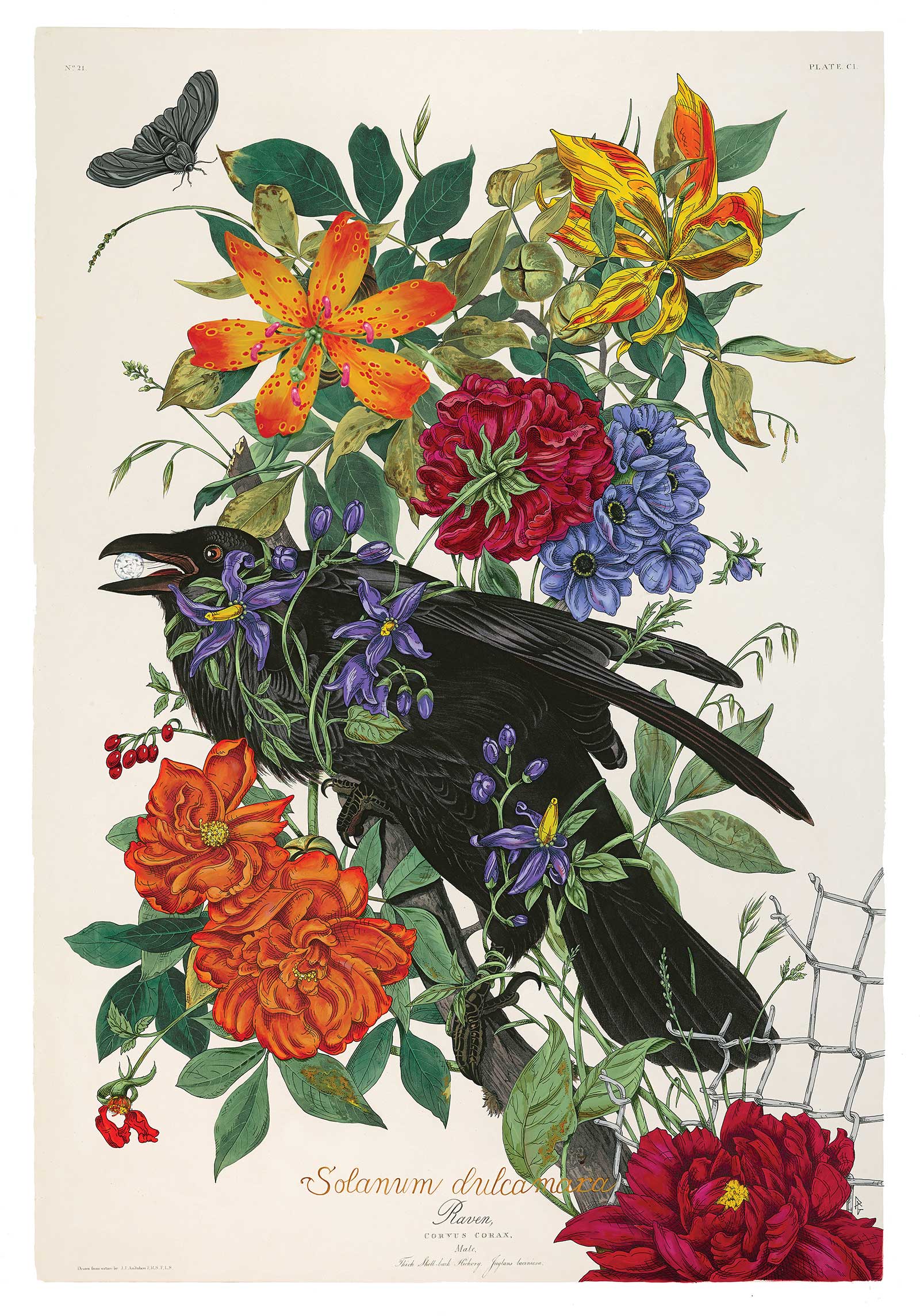 Penelope Gottlieb, Solanum dulcamara, acrylic and ink over a digital reproduction of an Audubon print, 38 x 25½"
Around the same time, Gottlieb purchased vintage frames at a thrift store that had poor quality Audubon prints in them. “As I continued to observe them off to the side in my studio, an idea began to germinate,” she says. “What if I started a new series that could have a dialogue with the past? If I appropriated the iconic work of John James Audubon, I would have the opportunity to contrast my contemporary feelings of unease and concern regarding the natural world with his 19th-century sense of unending abundance. By ‘invading’ the original pages from Birds of America I could alter the interpretation of his work and suggest a new reading. The word ‘extinction’ didn’t even exist in his day; the concept was unimaginable. There were so many birds that flocks would block the sun as they migrated. Audubon was quoted as saying, ‘A day without killing 100 birds is a day wasted.’”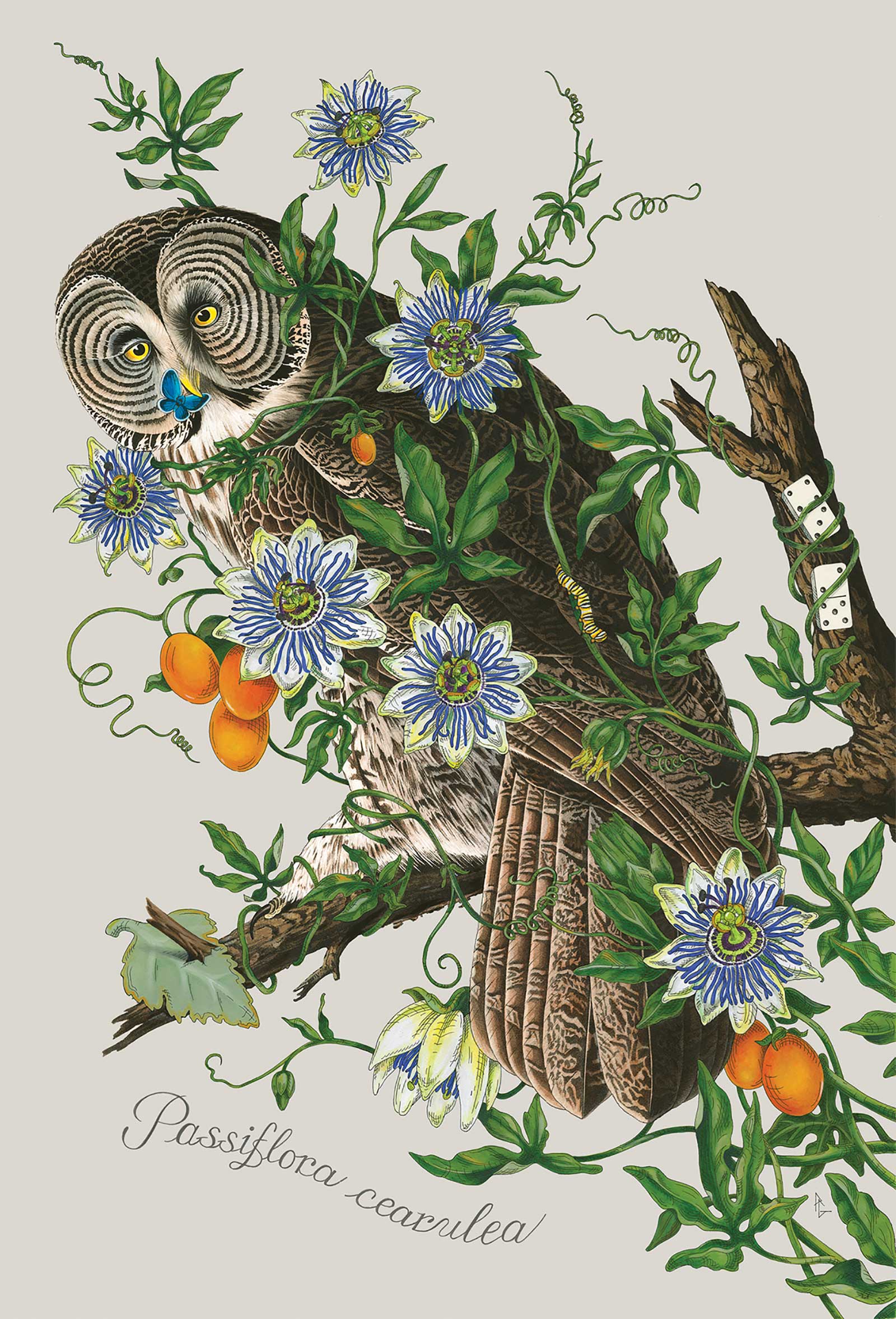 Penelope Gottlieb, Passiflora cearulea, acrylic and ink over a digital reproduction of an Audubon print, 38 x 26"
Her work adopts the style of Audubon’s allowing her paintings to have a fluid interaction with the print. She says, “I think of this as a kind of duet or dialogue between the past and the present. My intention is to draw the viewer into my work with the seduction of beauty. Closer inspection reveals a difficulty in navigating a problematic relationship between flora and fauna. This leaves the viewer with a question: What is our role as artists and as people living in this changing world? I hope that my individual efforts, as personal and solitary as they are, suggest a possibility that we all might consider; we are only as strong as these birds, these blossoms. We are all part of a fragile system and beauty can be a voice of strength.”—
Gerald Peters Gallery
1005 Paseo de Peralta • Santa Fe, NM 87501
(505) 954-5700 • www.gpgallery.com
Powered by Froala Editor