Salt marshes form in sheltered areas of the shore where sediments can be deposited and replenished by the tides. Salt resistant grasses, herbs and shrubs bind the material together.
The National Oceanic and Atmospheric Administration (NOAA) describes their importance: “These intertidal habitats are essential for healthy fisheries, coastlines and communities—and they are an integral part of our economy and culture. They also provide essential food, refuge or nursery habitat for more than 75 percent of fisheries species, including shrimp, blue crab and many finfish. Salt marshes also protect shorelines from erosion by buffering wave action and trapping sediments.”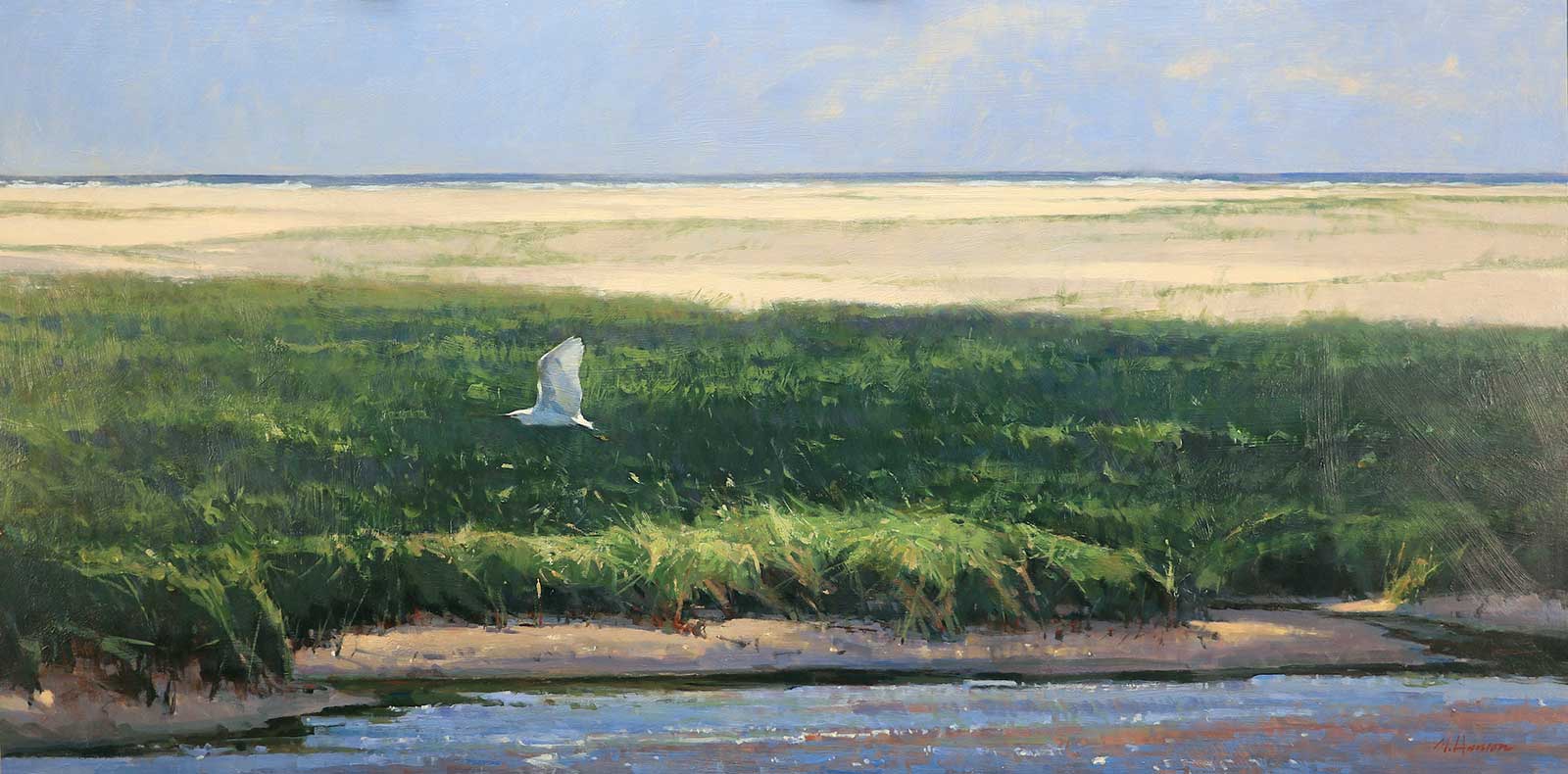 Marc Hanson, Low Tide Pass By, oil, 24 x 48". Courtesy Addison Art Gallery, Orleans, MA.
Cold Brook flowed through the salt marsh behind my family home. The Wampanoag called it Satuit, a name that eventually morphed into Scituate, Massachusetts. The town has many marshes from the tiny bit behind our home to vast stretches along the North River, a 12-mile tidal river that is the boundary between Scituate and Marshfield near its mouth, and the upstream towns of Norwell, Pembroke and Hanover. When my parents acquired our home (which was built in 1833), no longer did legal deeds for acres of salt marsh along the North River came with it.
The salt marshes were valuable property from the time of the first settlers in the early 17th century.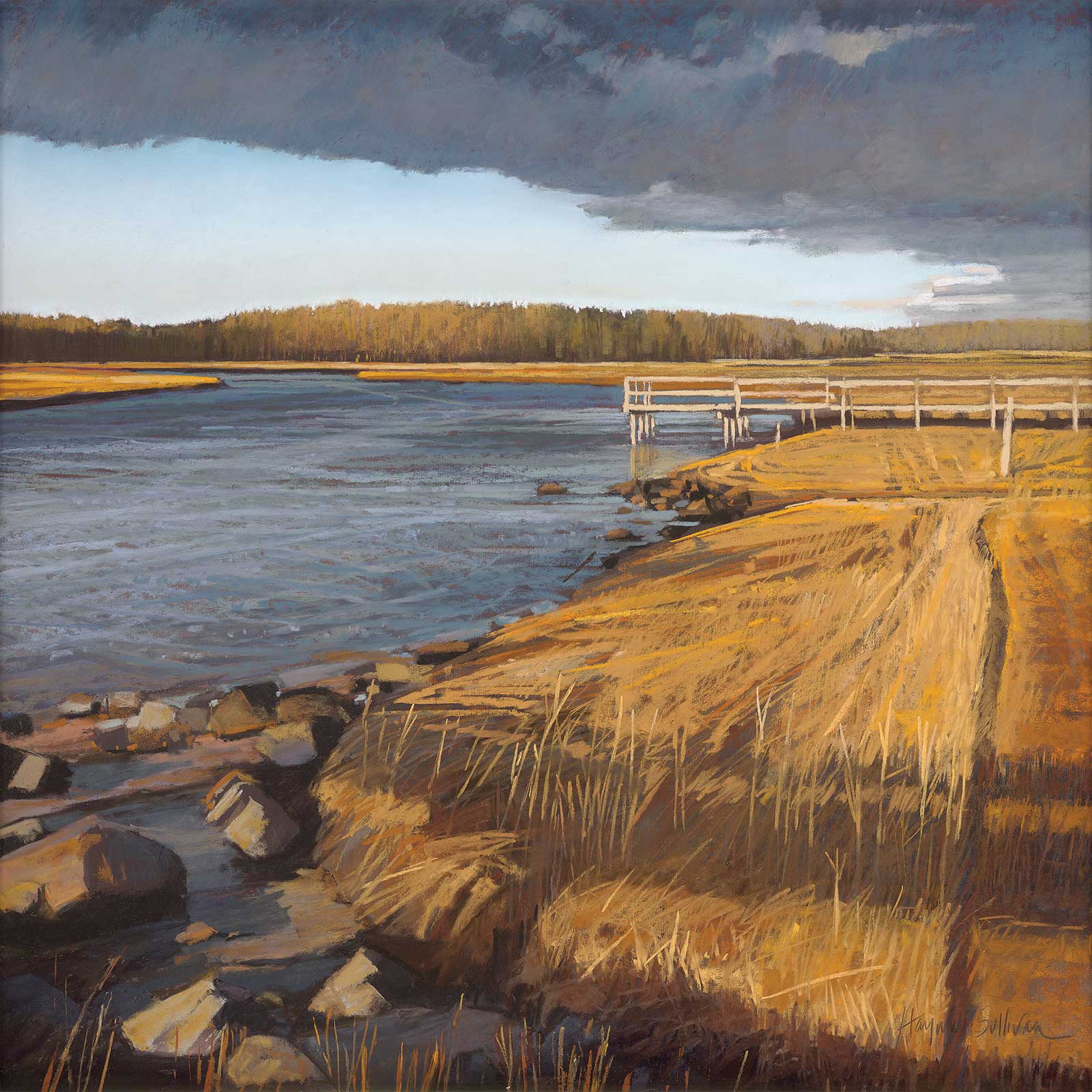 Liz Haywood-Sullivan, Riverside Landing, pastel on paper, 24 x 24". Courtesy Vose Galleries, Boston, MA.
Around 1768, Martin Johnson Heade (1819-1904) painted Marshfield Meadows, depicting the flat marsh as a place of activity. A farmer rakes the cut hay while, in the distance, workmen load it onto a wagon to carry it to make haystacks. A cow grazes on the fresh grass, and a boy fishes in the river. Heade didn’t follow the pursuit of grandeur in the landscape as his peers did. He produced 150 paintings of the vast flatness of the salt marshes. The subtlety of sunlight burning through the fog in Marshfield Meadows is complemented in other paintings by dramatic sunsets and nearly black skies of approaching storms.
At the time Heade was painting the marshes, the North River was a hot bed of shipbuilding. Between 1645 and 1871, over 1,000 vessels were built in the towns along the river. Among the great ships was the Columbia that, under Captain Robert Gray, gave its name to the Columbia River and was the first American ship to navigate the globe. The brig Beaver was owned by the British East India Company. Loaded with tea while docked in Boston Harbor, it was boarded by revolutionaries and the tea was dumped into the harbor in what is now known as the Boston Tea Party.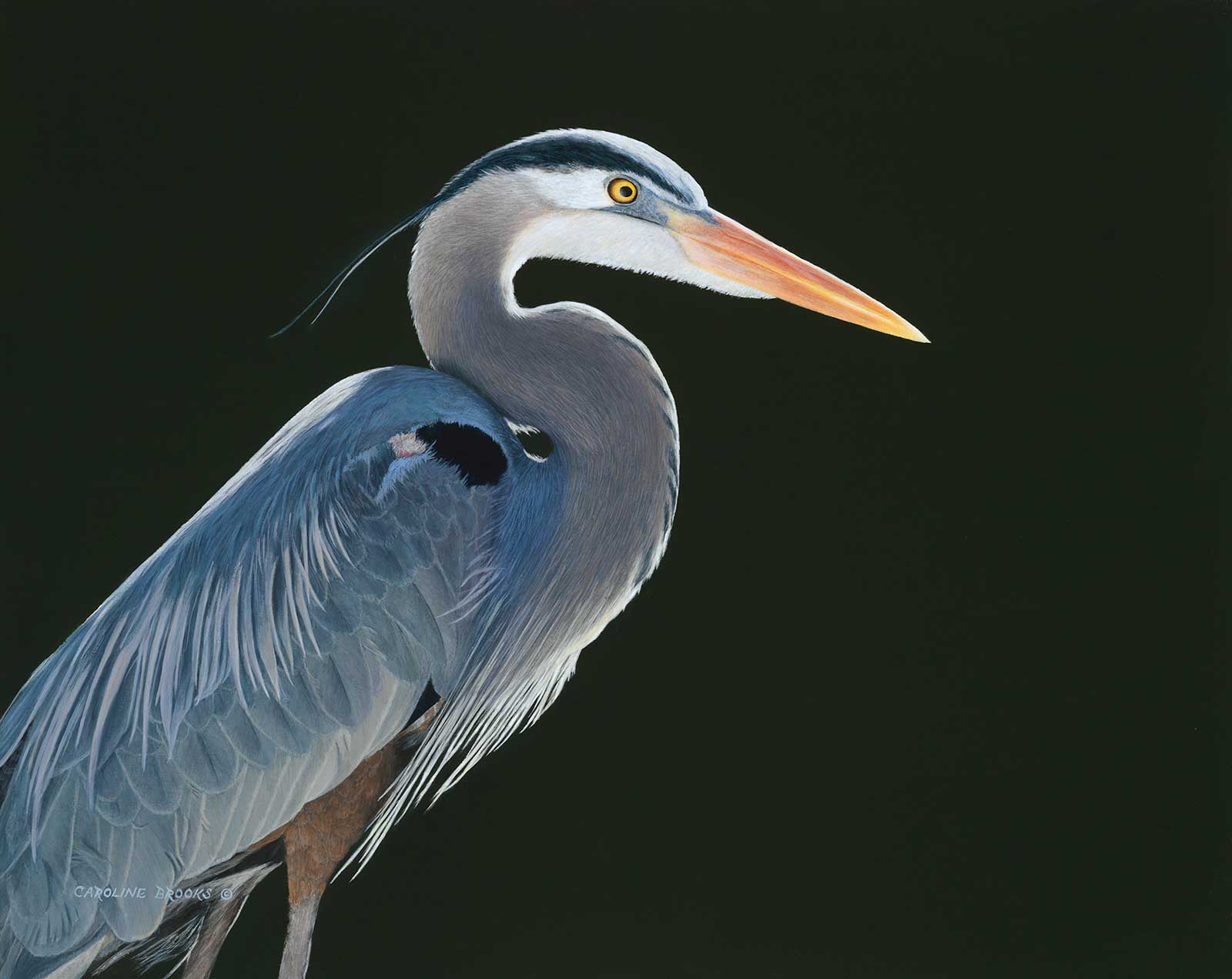 Caroline Brooks, Sunlit-Great Blue Heron, acrylic on Masonite, 16 x 20"
Liz Haywood-Sullivan lives along the North River and frequently paints its different moods in changing seasons. Riverside Landing depicts the golden grasses awaiting the coming of spring. No longer abuzz with the saws of the shipyards, the marshes quietly do what nature created them to do. The dock extends over the marsh to open water above the marsh which will be flooded at high tide. Haywood-Sullivan is the past president of the International Association of Pastel Societies and is now president of the North River Arts Society in Marshfield Hills.
In his painting Low Tide Pass By, Marc Hanson shows the relationship of estuary, marsh, beach and ocean with a local inhabitant flying to its nest in the dunes or looking for lunch in the river. An inspired teacher, he says of his students, “My goal is not to have them assimilate my style and technique, but to teach them how to more closely examine the subject and apply the principles that representational painters must follow to become effective visual communicators.”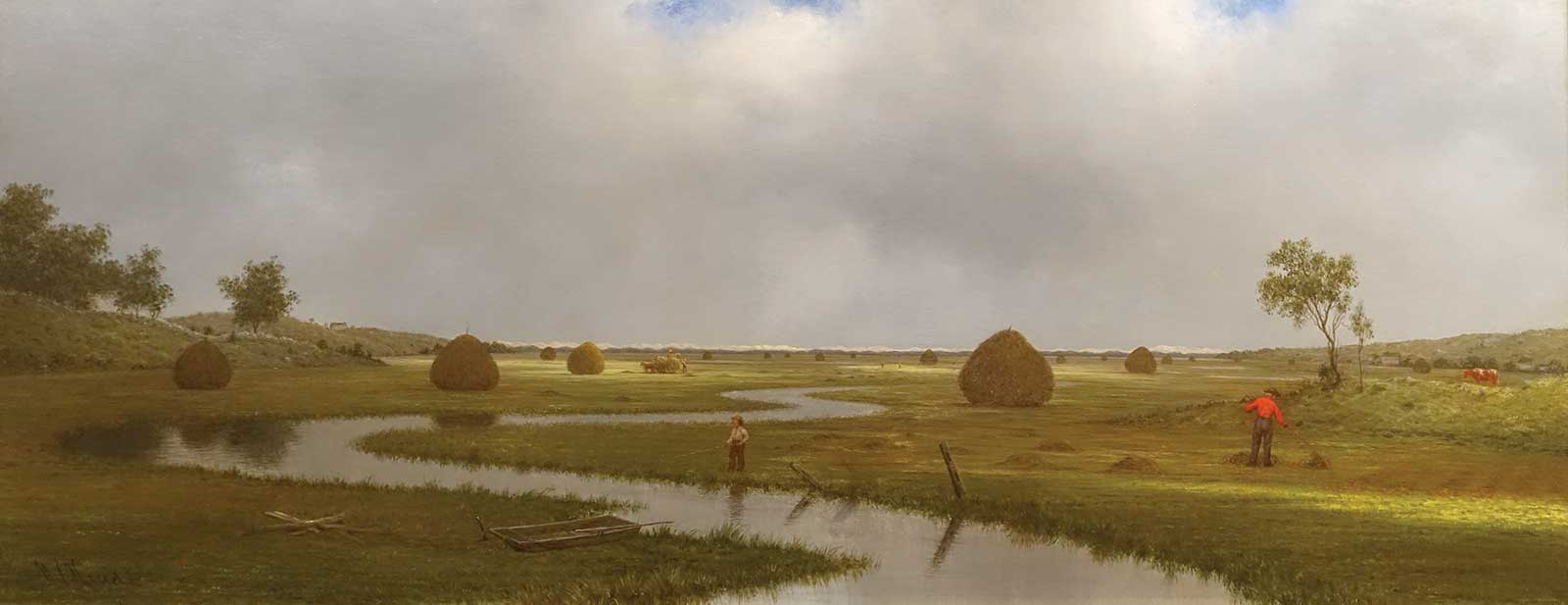 Martin Johnson Heade (1819-1904), Marshfield Meadows, ca. 1878, oil on canvas, 17¾ x 44". Currier Museum of Art, Manchester, NH.
Caroline Brooks is a signature member of Artists for Conservation, an organization whose mission is “to support wildlife and habitat conservation, biodiversity, sustainability and environmental education through art that celebrates our natural heritage.”
One of the most beautiful and stately birds of the marshes is the great blue heron. When I lived in Maine, an early spring ritual was a slow drive along the marshes to site the first great blues.
Brooks writes, “I so wanted to capture and emphasize the lovely backlighting that gave this heron’s beak a translucent quality, that I removed the original background from this painting. I wanted the result more dramatic; to be ‘just about the bird’.”
Jerry F. Smith says, “On a trip to Cape Cod, my wife and I spent a week at Eastham, Massachusetts. Surrounded by marshes and water, I was particularly drawn to the interplay and shapes created by sea grass, water and the detritus left behind by the flow of tides,” a scene he records in Eastham Marshes. Joseph Salerno, Salt Marsh, Provincetown (diptych), oil on panel, 6 x 28"
The line of flotsam among the seaweed left at the edge of the high tide is a reminder of the marshes’ fragility. Joseph Salerno’s Salt Marsh, Provincetown, shows they are also vulnerable to rising sea levels. His early paintings of Provincetown and his more recent paintings of the Vermont woods where he lives are simple compositions distilled from years of careful observation—meditations on the landscape.
I recently asked a friend who was brought up near the North River marshes, what effect they had on her. She called them edges—literally in their geographic situation and figuratively in the Celtic spiritual sense of a place between two worlds. There is, actually, another world beneath the swaying grasses and fluctuating tides, teeming with unseen life.
Fr. Richard Rohr, founding director of the Center for Action and Contemplation, writes, “The edge is a holy place, or as the Celts called it, ‘a thin place’ and you have to be taught how to live there. To take your position on the spiritual edge of things is to learn how to move safely in and out, back and forth, across and return. It is a prophetic position, not a rebellious or antisocial one. When you live on the edge of anything with respect and honor, you are in a very auspicious position.”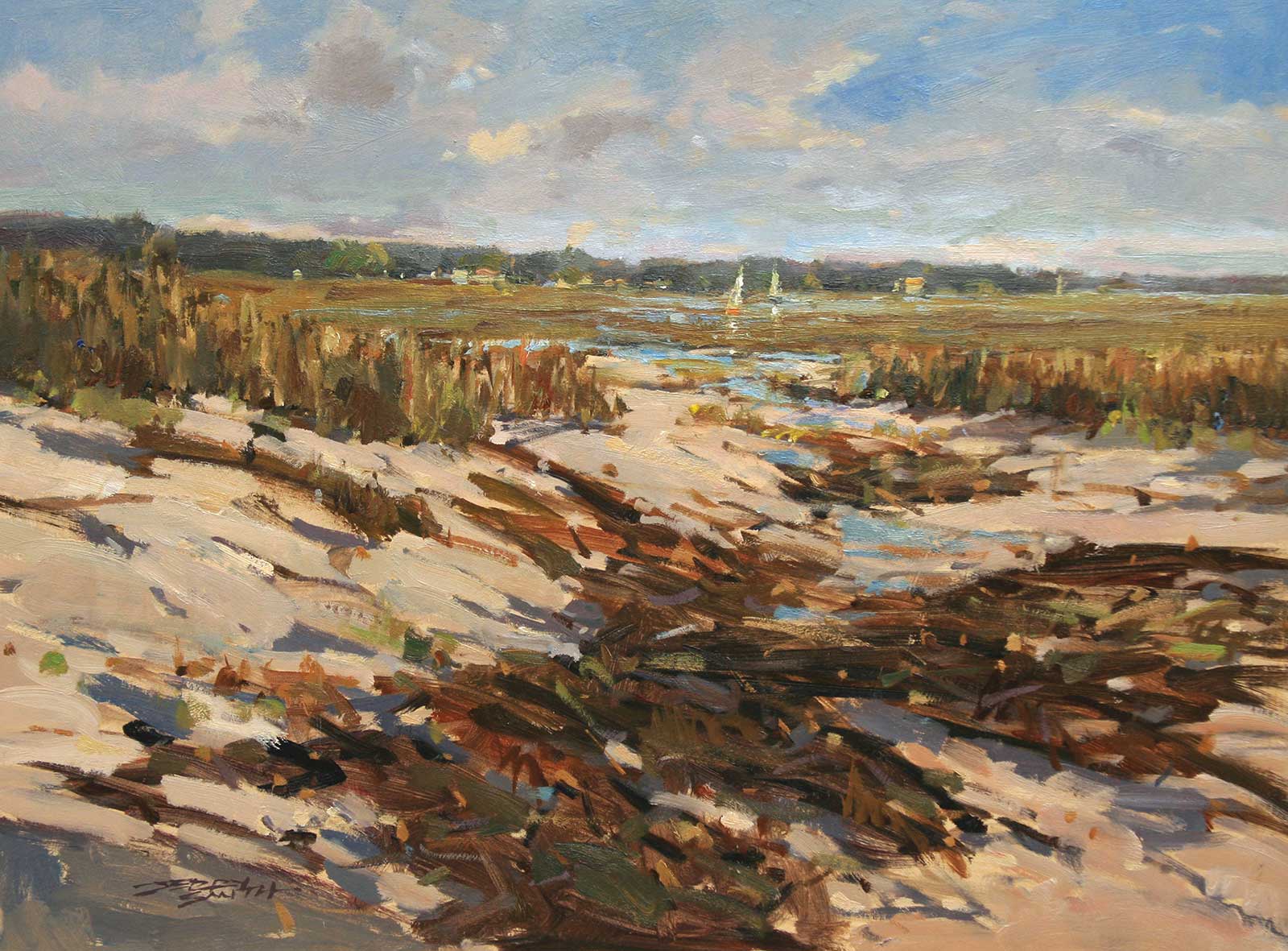 Jerry F. Smith, Eastham Marshes, oil, 18 x 24"
We need to be taught to live on the physical edge of the salt marsh, the extraordinarily fertile beginning of the food chain, inspiration to artists and place of quiet contemplation. Preserving it preserves us.
Haywood-Sullivan says, “Some of the regions I am painting were painted 150 years ago by Martin Johnson Heade. And these marshes look similar today to his paintings back then. What will these areas look like 150 years from now?” —
Powered by Froala Editor