The Prussian naturalist Alexander von Humboldt (1769-1859) wrote “The most dangerous worldview is the worldview of those who have not viewed the world.” Scientists, conservationists, artists and writers observe, absorb and communicate. They encourage us to become aware of and to understand world’s complexity, fragility and beauty.
Many wildlife artists found their love of animals early in their lives. Ewoud de Groot collected bird eggs in the dunes and learned more about birds on summer sailing expeditions with his family in Holland. Linda Besse was intrigued by her great-uncle’s African hunting stories and has traveled the world photographing and sketching. Kim Diment sketched as she wandered among the migrating birds of the AuSable River in Michigan and brought home “toads, frogs, turtles and orphaned animals.”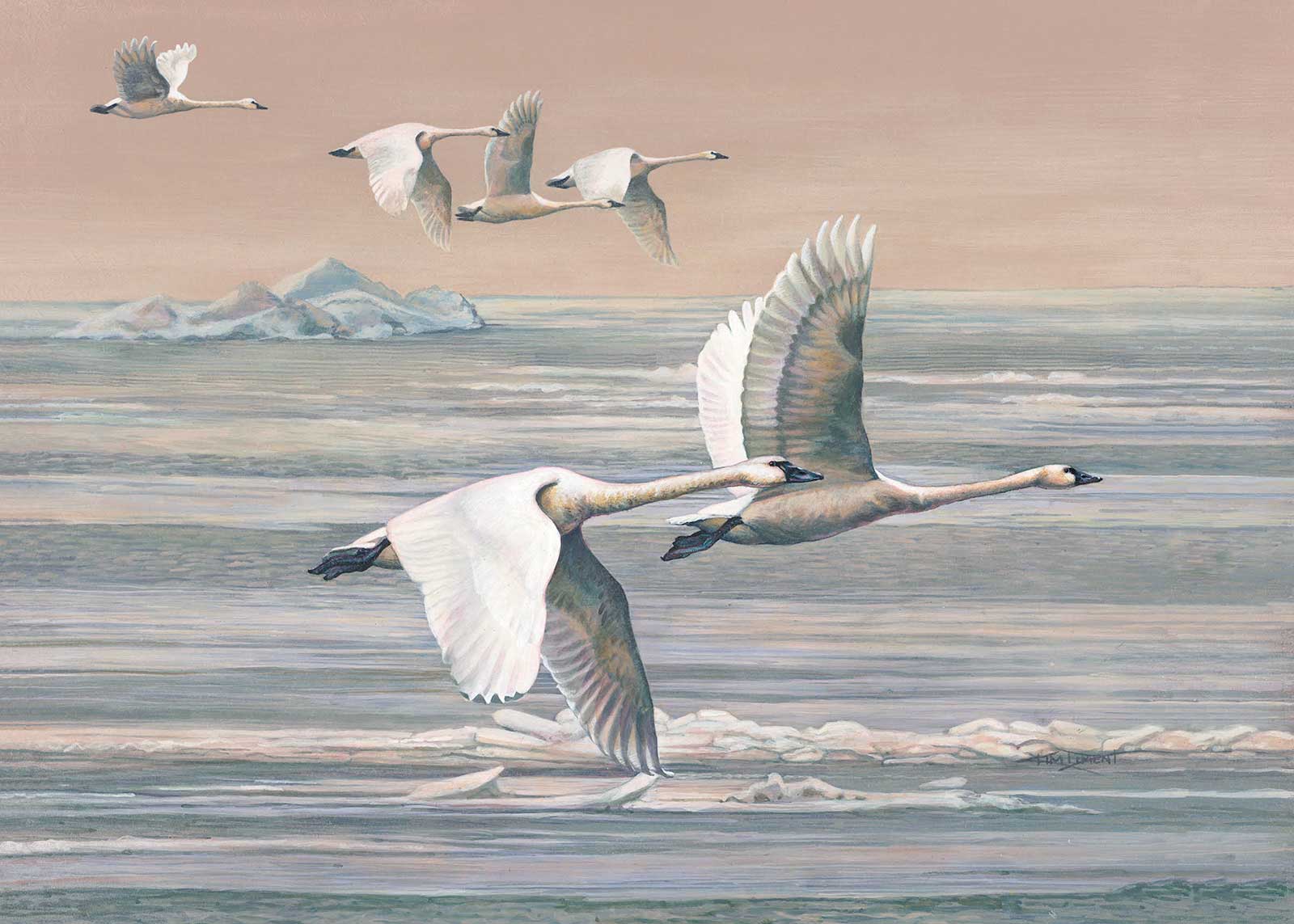 Main Branch Gallery, Tundra Swans (detail), acrylic, 16 x 20", by Kim Diment.
Donald MacMillan (1874-1970) made 30 research trips to the Arctic. In 1913, his alma mater, Bowdoin College, selected the polar bear as the athletic mascot for the college. The college’s association with Arctic exploration began with the discovery of the North Pole in 1909, by Admiral Robert E. Peary of the Class of 1877. On an expedition in Greenland, MacMillan procured a polar bear, had the hide mounted and presented it to the college where it still commands its space. It was my first and only encounter with the physical grandeur of the great Arctic mammal.
Besse went to the source to study polar bears. Discussing her painting On the Ice, she says, “The majesty of polar bears appears even more evident when they are stretching their neck and sniffing the air. Knowing that their extraordinary sense of smell can detect a seal almost a mile away, one wonders what has attracted this bear’s attention…I’ve found a curious thing about spending time in polar bear country. I’ll spend hours in a small willow blind scanning the horizons for polar bears. Just when I know I’ve spotted one, a quick look through the binoculars will reveal a large shiny boulder. Twenty minutes later and the sun reflecting off another boulder looks just like a polar bear.”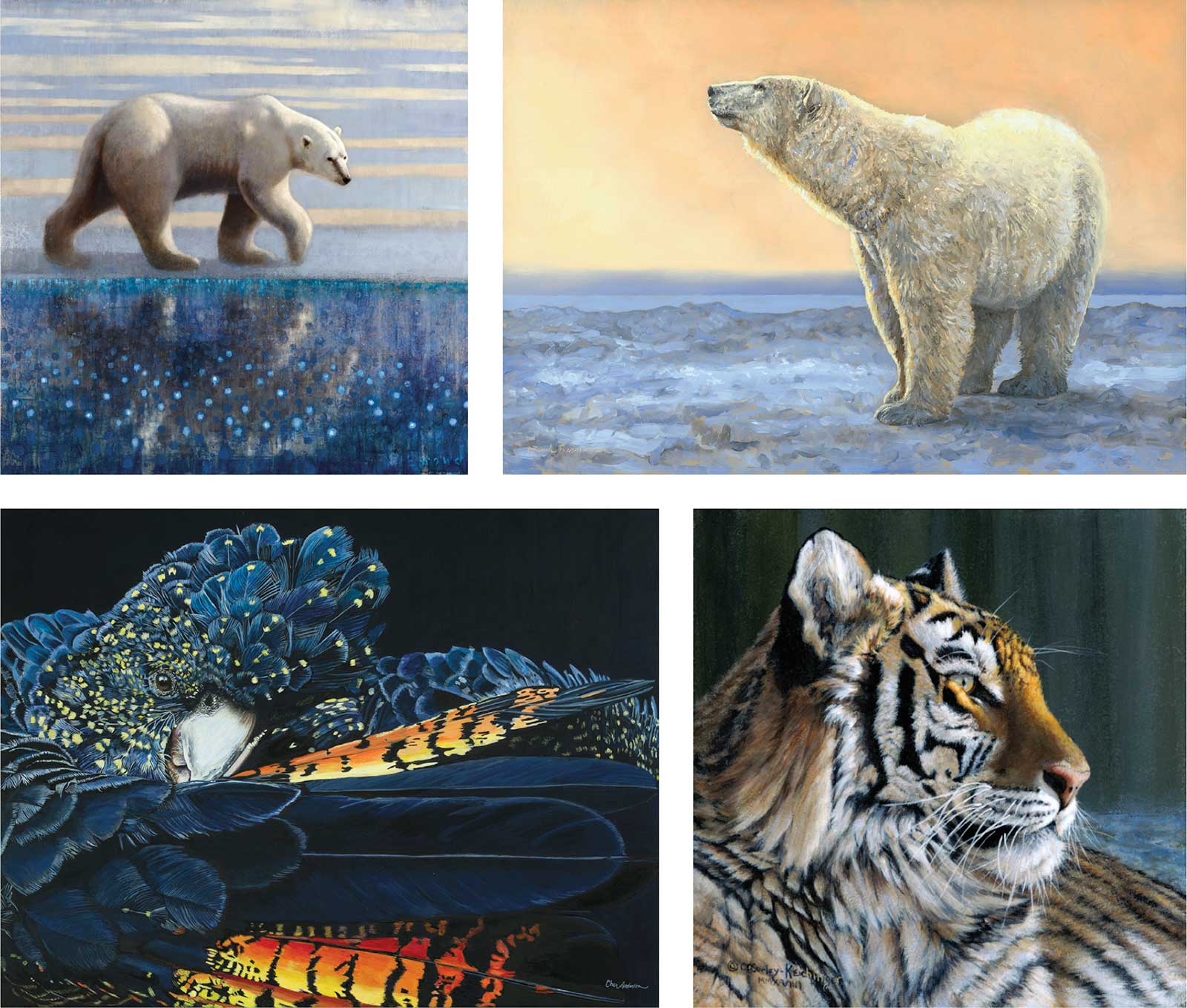 Clockwise from top left: Stremmel Gallery, Polar Bear I, oil on linen, 71 x 71", by Ewoud de Groot; Linda Besse, On the Ice, oil, 8½ x 12½"; Cindy Sorley-Keichinger, Sunning, acrylic, 8 x 8"; Cher Anderson, Aussie Banks – Red-tailed Black Cockatoo, acrylic, 24 x 32"
She continues, “But, when a polar bear comes into view it is so obvious. Their white hollow fur almost glows and there is nothing quite like it. Then I wonder how I could have ever mistaken a glacial erratic for this magnificent creature. It is that glow which the background is designed to enhance.”
De Groot’s Polar Bear I is at one with its abstracted environment of ice, water and sky. With a background in graphic design and illustration, de Groot has evolved from making realistic representations of animals to the figurative. They are set in a complementary abstract background often composed of splashes of thinned down paint that resembles a watercolor technique. They merge into and emerge from their settings. Describing his motivation, he says, The reason I depict animals in general is something which comes from an instinct, way deep I think...Deep, deep down we still all are a bunch of hunters and gatherers only with some people it surfaces.”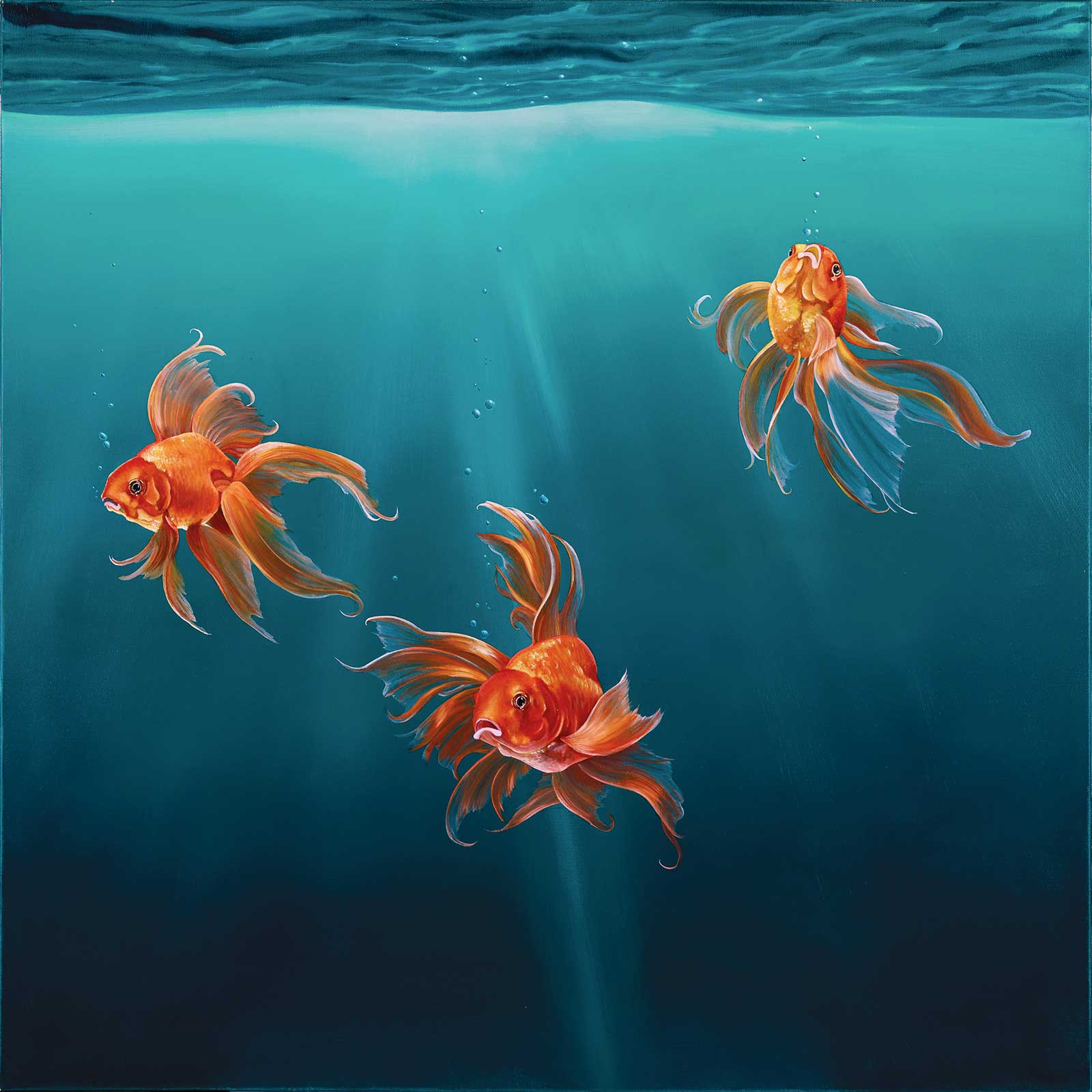 Christy Peterson, Goldfish, oil on canvas, 36 x 36"
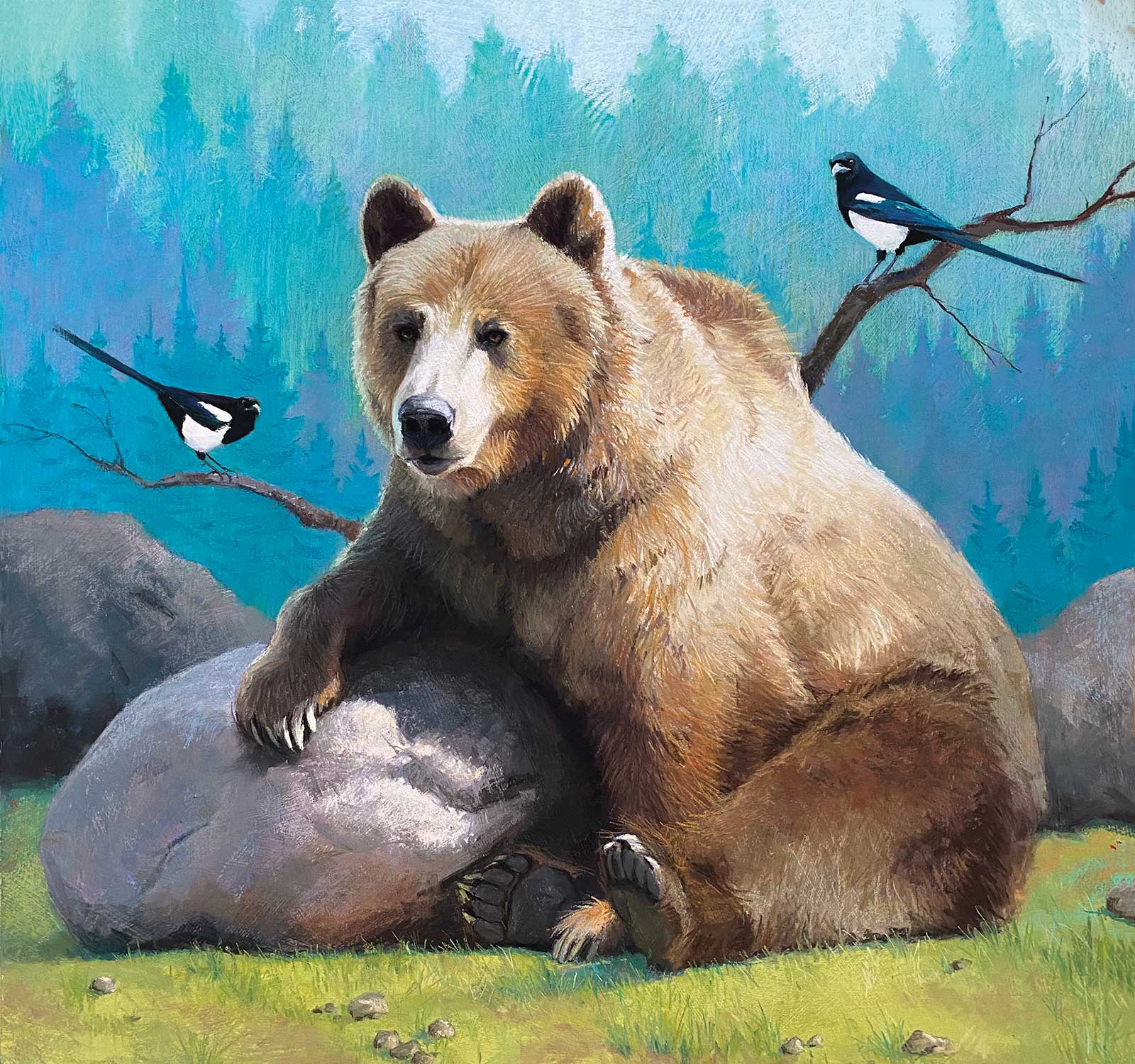 Lisa Gleim, In One Ear And Out The Other, pastel on sanded panel, 32 x 34"
Diment painted Tundra Swans. “Close to where I use to live,” she says the tundra swans would gather on the western shore of Lake Huron. They would then cross the big lake over to Ontario, Canada, and from there to the north.”
She studied zoology and fine art in college and now combines the two. She says, “Animals have always had a story to tell. One must know and understand them to comprehend these stories. Ancient man did and produced beautiful works of art on the cave walls of Lascaux tens of thousands of years ago. I choose to portray animals because I find them more beautiful, more fascinating and more symbolic than any other subject matter. I cannot comprehend a world without animals.”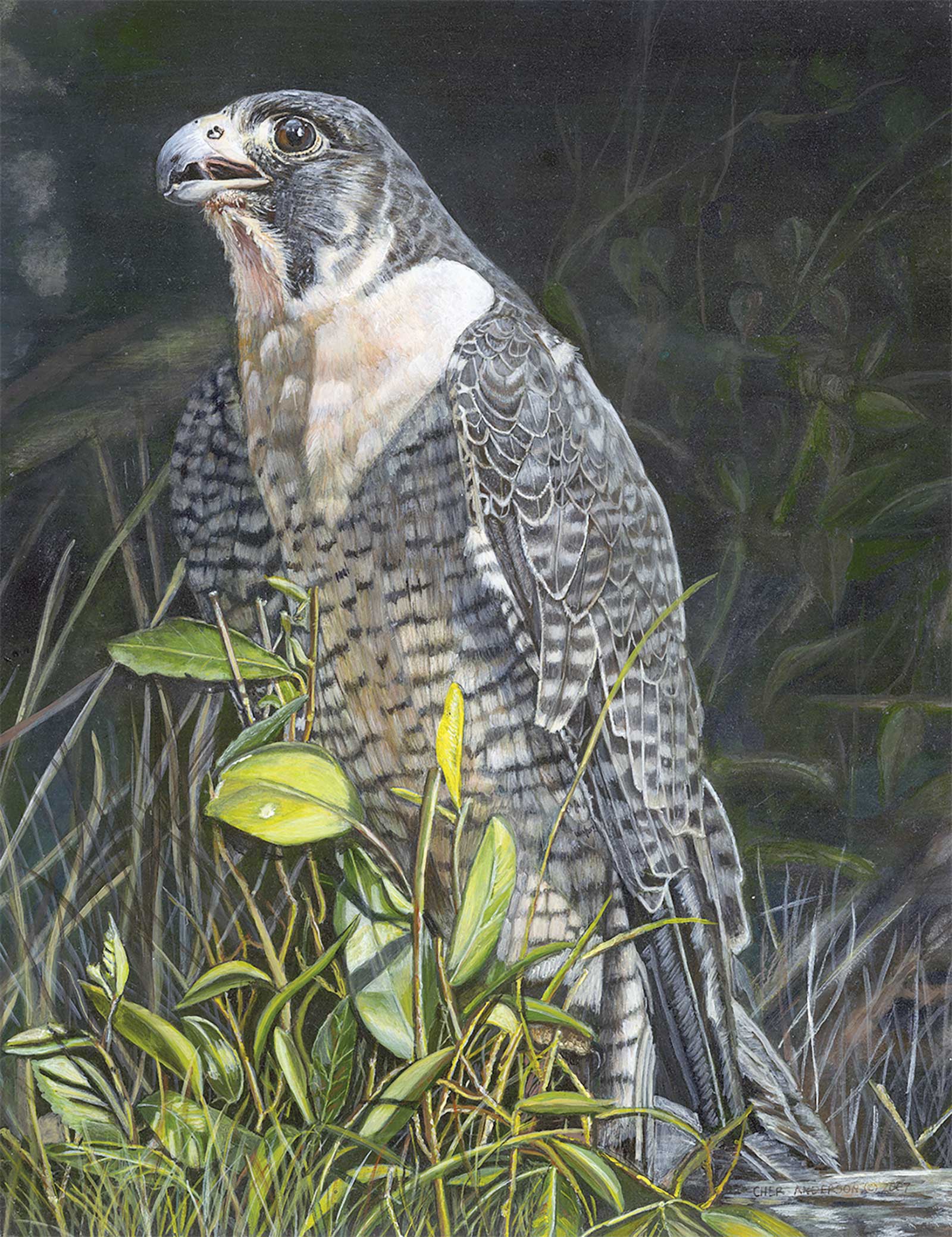 Cher Anderson, The Hunter - Peregrine Falcon, acrylics, 18 x 14"
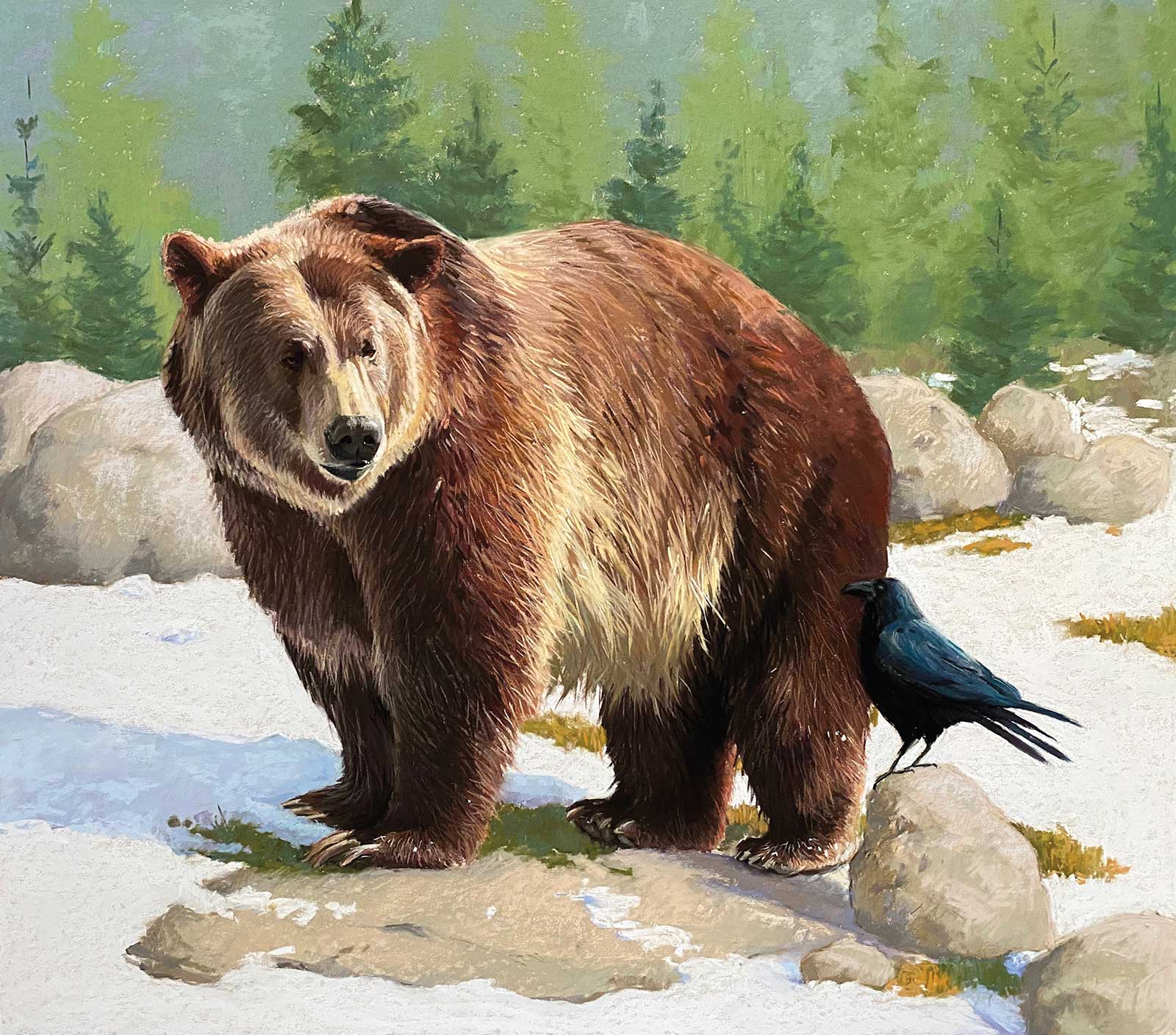 Lisa Gleim, You Don’t Say, pastel on sanded panel, 23 x 27"This special section is dedicated to artwork featuring creatures both great and small that are found across the land, sea and sky. The pieces can be tributes to beauty, to conservation and to awareness. The artists themselves share their inspirations, providing insight to how and why they have created their works.
“In my lifetime, I was blessed to raise an amazing son [and I've] seen half the planet, found the love of my life and met incredible people that became my family all over the world through helping them with their health and well-being,” says artist Cher Anderson. “Being involved in wildlife conservation and being face to face with the beauty and essence of nature has inspired me to become a better artist and to help our planet become a better place for my grandchildren and future generations to live in.”
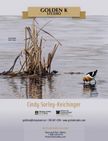
Canadian wildlife artist Cindy Sorley-Keichinger, who will participate in Picture This Gallery’s May Masterpieces in Miniature exhibition, loves using bold colors and lots of contrast in her paintings. “I feel it makes a piece stand out and speak to people. When buying art that is important. The piece should speak to you. Otherwise, it is just wallpaper.”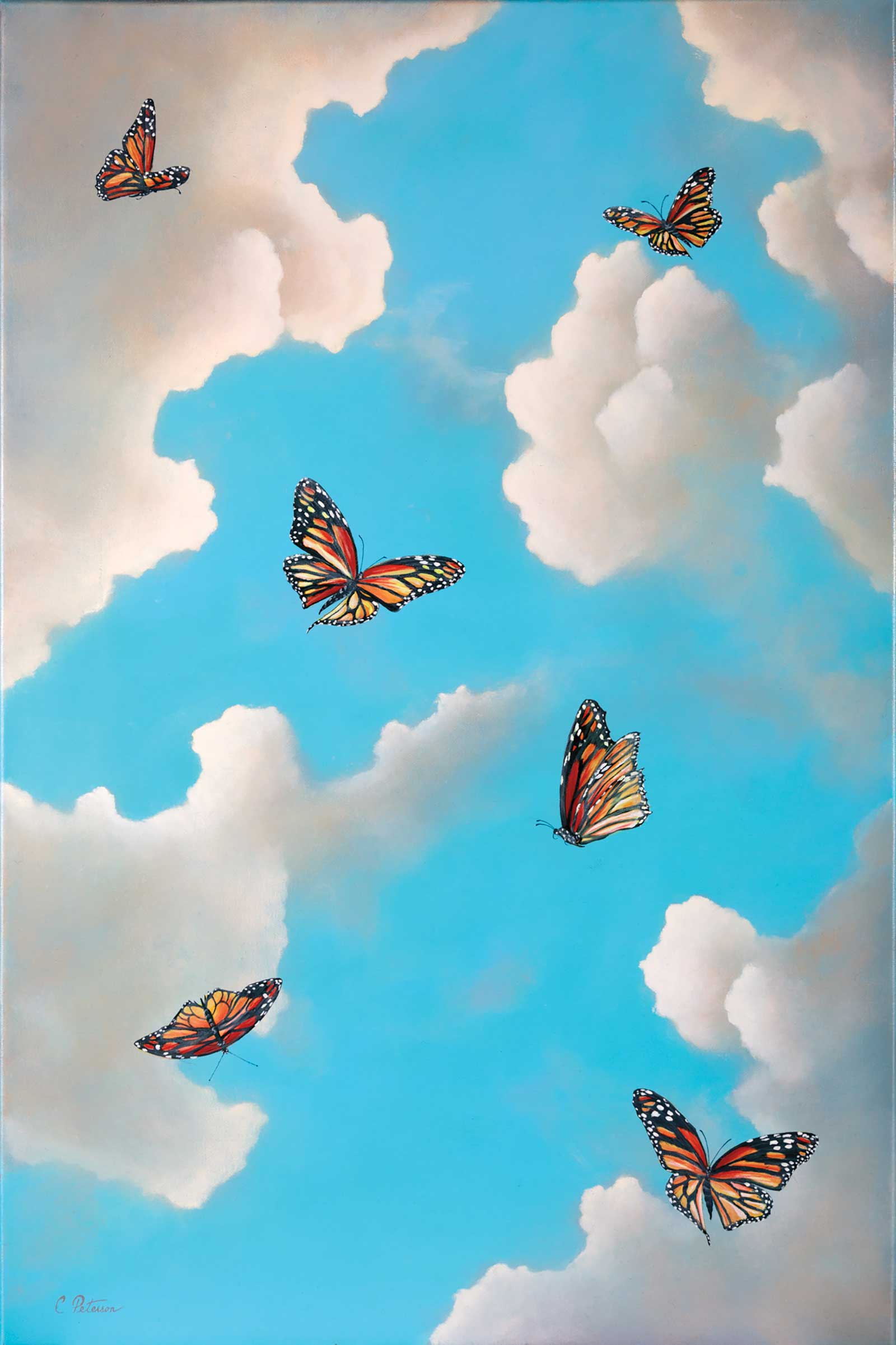 Christy Peterson, Monarchs, oil on canvas, 36 x 24"
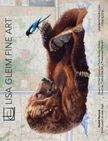
In a realism style, artist Lisa Gleim produces engaging wildlife storybook narratives. “Animal interactions are captivating and bears, in particular, fascinate me,” she says. “They are natural models, never short on different poses while at play and work. I am often asked about the coupling of bears and birds. Do bears really hang around with birds? The answer is ‘yes!’ Ravens and magpies are scavengers following hunters. And do the bears always take notice? Sometimes. In One Ear And Out The Other is a fitting title for a bear flanked by two magpies.”
Also an accomplished landscape artist, Gleim’s newest series adds a twist: road and park map backgrounds. Each work gives a viewer a nudge to head West and a map to plot the route. 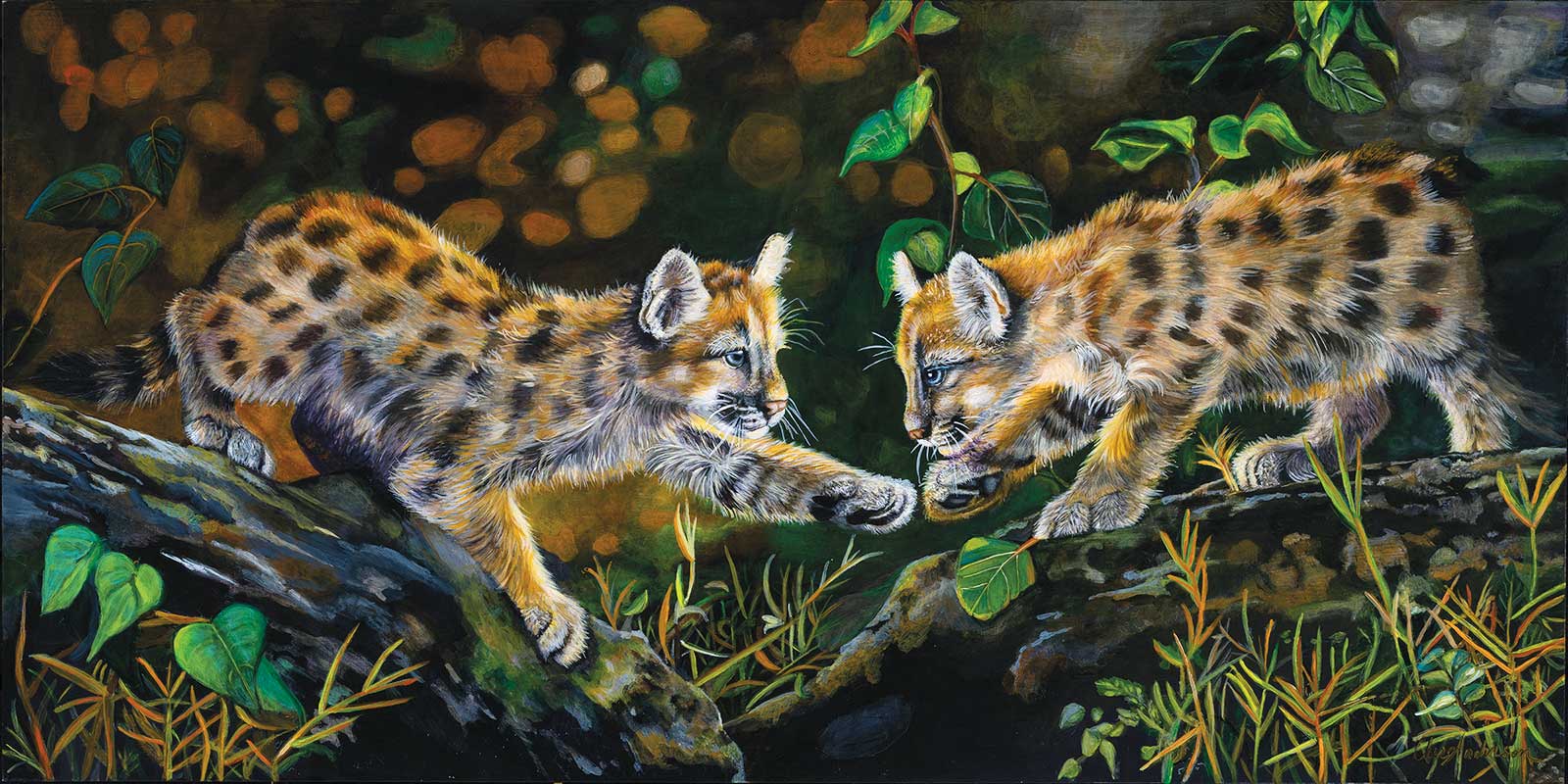 Cher Anderson, Touch – Mountain Lion Cubs, acrylic, 18 x 36"
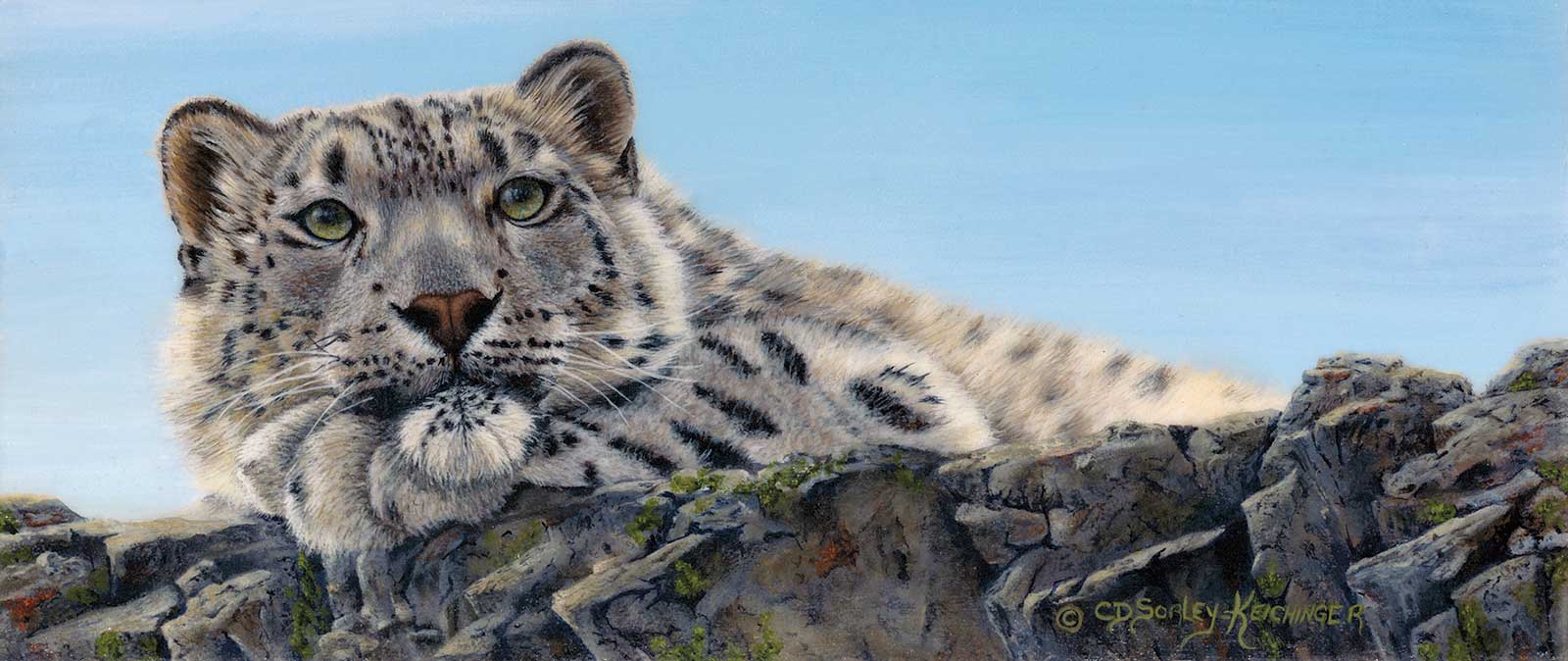 Cindy Sorley-Keichinger, Chillin, acrylic, 5 x7"
Christy Peterson’s love of color influences her as much as the subject matter she selects, which includes a variety of animals such as goldfish, tree frogs and monarch butterflies. Each piece has 10 to 20 layers of glazes to create luminosity and intensity. The exuberant hues found in nature’s creatures provide inspiration. She says, “My wish is that my work offers a sense of serenity and escape through delicate detailed brushwork and saturated color.”
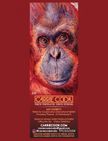
An award-winning wildlife artist and Signature Member of both the Society of Animal Artists and Artists for Conservation, Carrie Cook actually considers herself “a portrait artist, highlighting individuals who have the right to life and freedom from harm,” she says. “Everyone has a story, whether used for experimentation, food or entertainment, victimized by the illegal pet trade or facing increasing perils in the wild. Their stories are inextricably linked with our own, and like ours, are filled with both loss and hope.”
Cook was a graphic designer in New York City, a student of Disney in Los Angeles and an art teacher to middle schoolers in Colorado. “It was as head of graphic design at the Dallas Zoo, however, and the discomfort I felt around captive animals,” she says, “that led me down my current path.”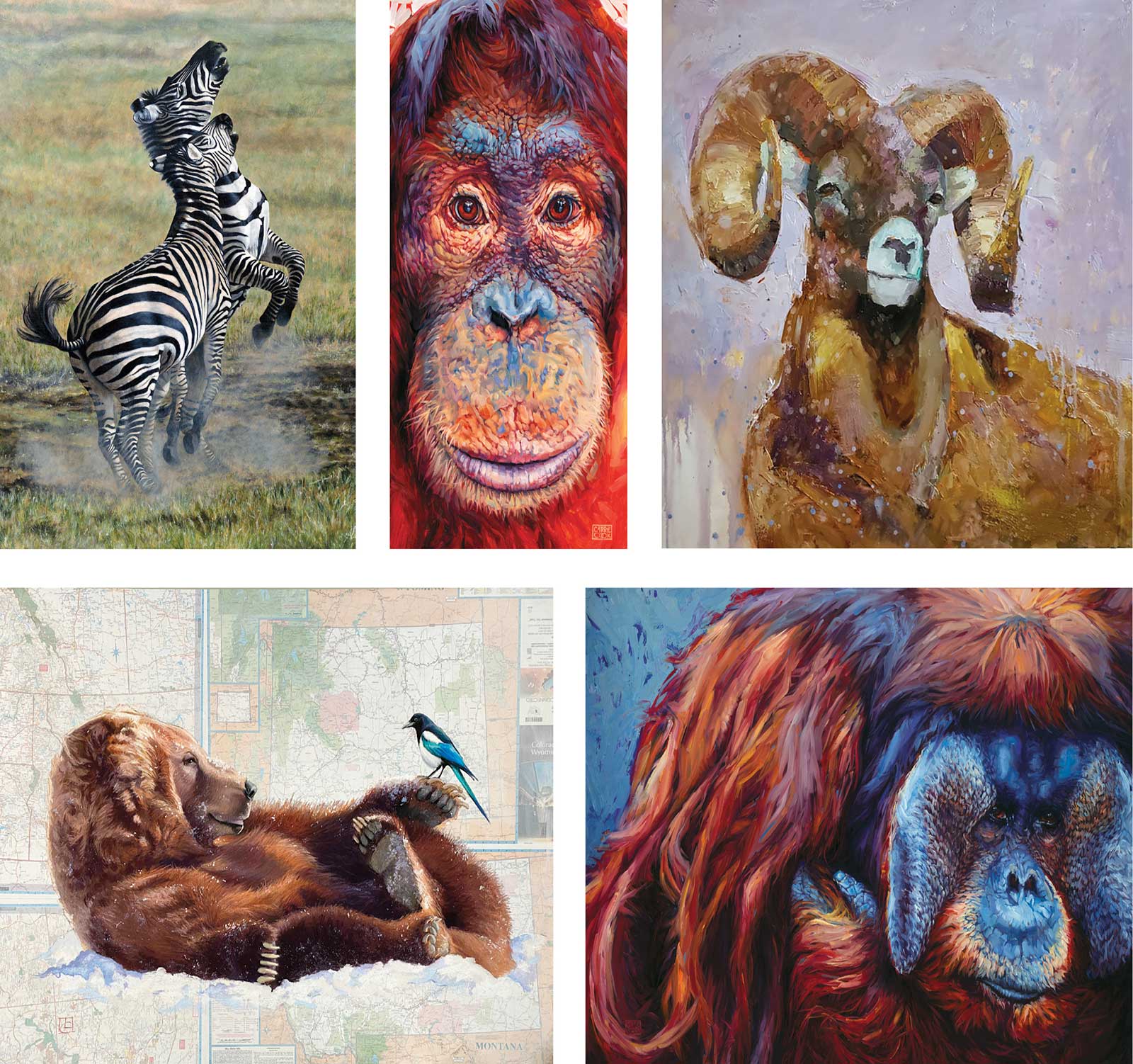 Clockwise from top left: Cindy Sorley-Keichinger, Contested, acrylic, 24 x 18"; Carrie Cook, Keagan, oil on canvas, 40 x 20"; Troy Collins, Standing His Ground, oil on canvas, 36 x 36"; Carrie Cook, Rudi, oil on canvas, 36 x 48"; Lisa Gleim, Kodiak Moment, pastel on maps and sanded paper, 30 x 40"
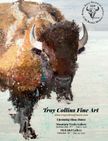
Troy Collins has long been recognized for his expressive paintings of aspen trees and American flags. “Introducing my wildlife art has been a challenge as well as a joy because it has pushed me to grow as an artist,” he says. “I create each piece with my signature bright colors and thick paint, which gives each painting texture and one-of-a-kind character. The response from collectors has been overwhelming and the work has been well received.”
When standing in front of one of wildlife photographer Chris Dei’s limited-edition prints on handmade paper, it’s hard to tell if it was shot at the turn of the century or today. The sepia-toned photos have an organic feel because of the deckled edges of the paper. Dei’s other series, the Savannah Gold Collection, is unique in the world of fine art imaging, because she uses the historic process of platinum/palladium printing with the addition of a layer of 24k gold. The combination of the three precious metals makes these limited-edition works highly collectable. 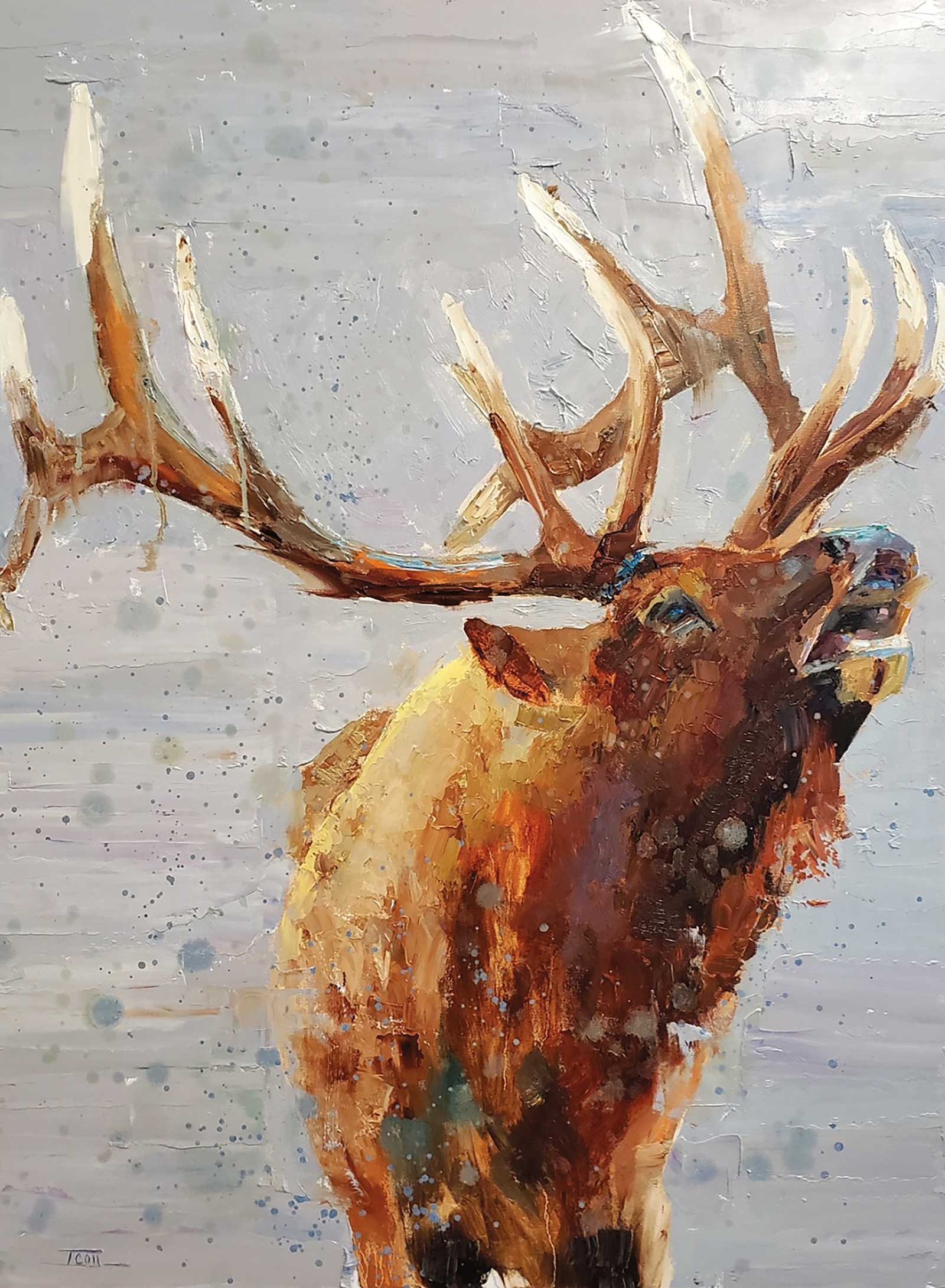 Troy Collins, Bugle Boy, oil on canvas, 40 x 30"
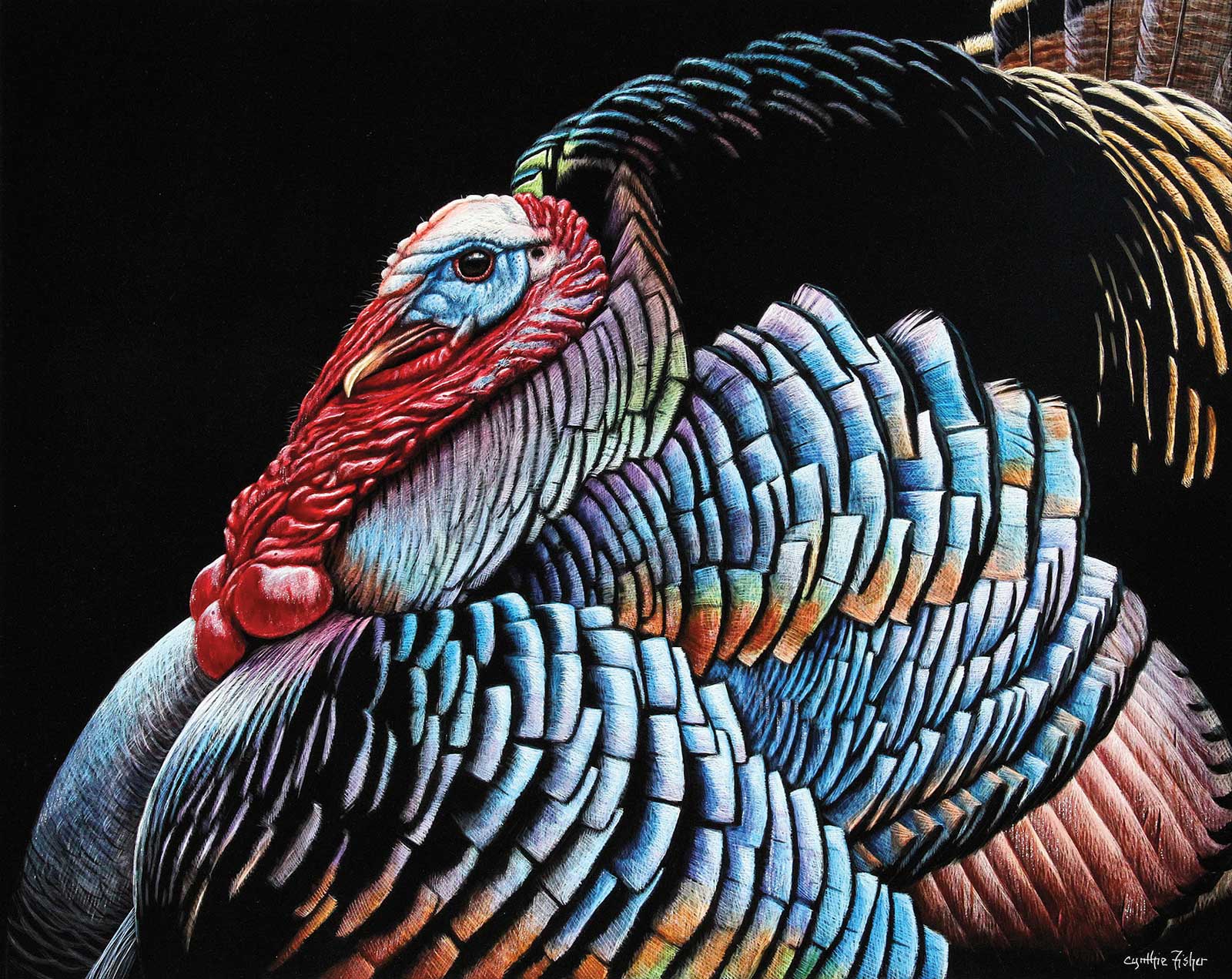 Cynthie Fisher, The General, scratchboard and watercolor, 16 x 20"
Of her photography, Dei says, “There is a generally perceived notion that an image is created during a thoughtful exchange of energy between the photographer and the subject. But for me, thought is not the main operating instrument of consciousness at that instant. Thought slows down, boundaries melt and there enters a profound silence where everything disappears. I have never found words adequate to convey the timelessness of that moment. Only silence. And the experience can only be partially relayed by the image that results. I’m simply a vehicle. The impact comes from somewhere else, that really…I have very little to do with.”
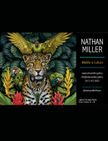
Cynthie Fisher has been a professional wildlife artist for over 30 years. Her degree in zoology aids in her favorite subject matter, wildlife from around the world. She works in eight different mediums, including bronze, glass and paint; with so many choices, she is always eager to work on her next creation. Anatomy is her strong point, as well as unique behaviors and strong lighting and color.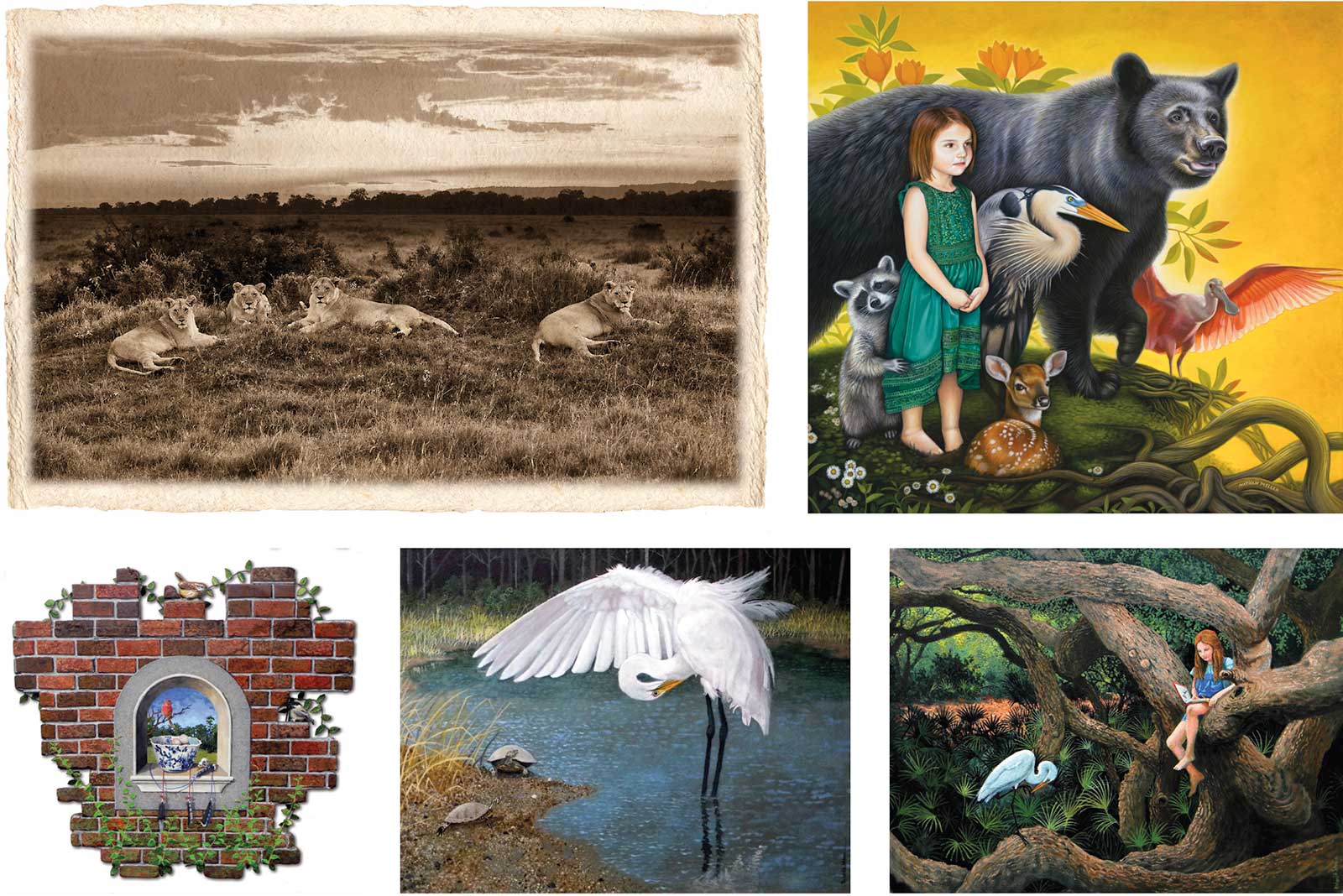 Clockwise from top left: Chris Dei, Lions at Sunset, limited edition archival pigment ink print on handmade paper, ed. of 15, 28 x 38" ; Nathan Miller, Where do we go from here?, acrylic on canvas, 36 x 36" ; Richard A. Johnson, Wild Muse, acrylic on canvas, 24 x 30"; Richard A. Johnson, Fancy Feathers and Friends, acrylic on canvas, 24 x 30"; Richard A. Johnson, Backyard Birds, acrylic on canvas and painted carved wood, 32 x 32"Nathan Miller began painting professionally while living in the small beach town of Nosara, Costa Rica. His art was profoundly impacted by the abundant wildlife and the way in which people coexisted with nature. Today Miller resides in Tampa, Florida, where he specializes in meticulous contemporary realist paintings of both people and animals. Often he combines both in order to explore and encourage a stronger connection with nature. Miller has recently begun a new series, starting with Legend of the Jaguar Shaman, which explores wildlife and culture from around the world.
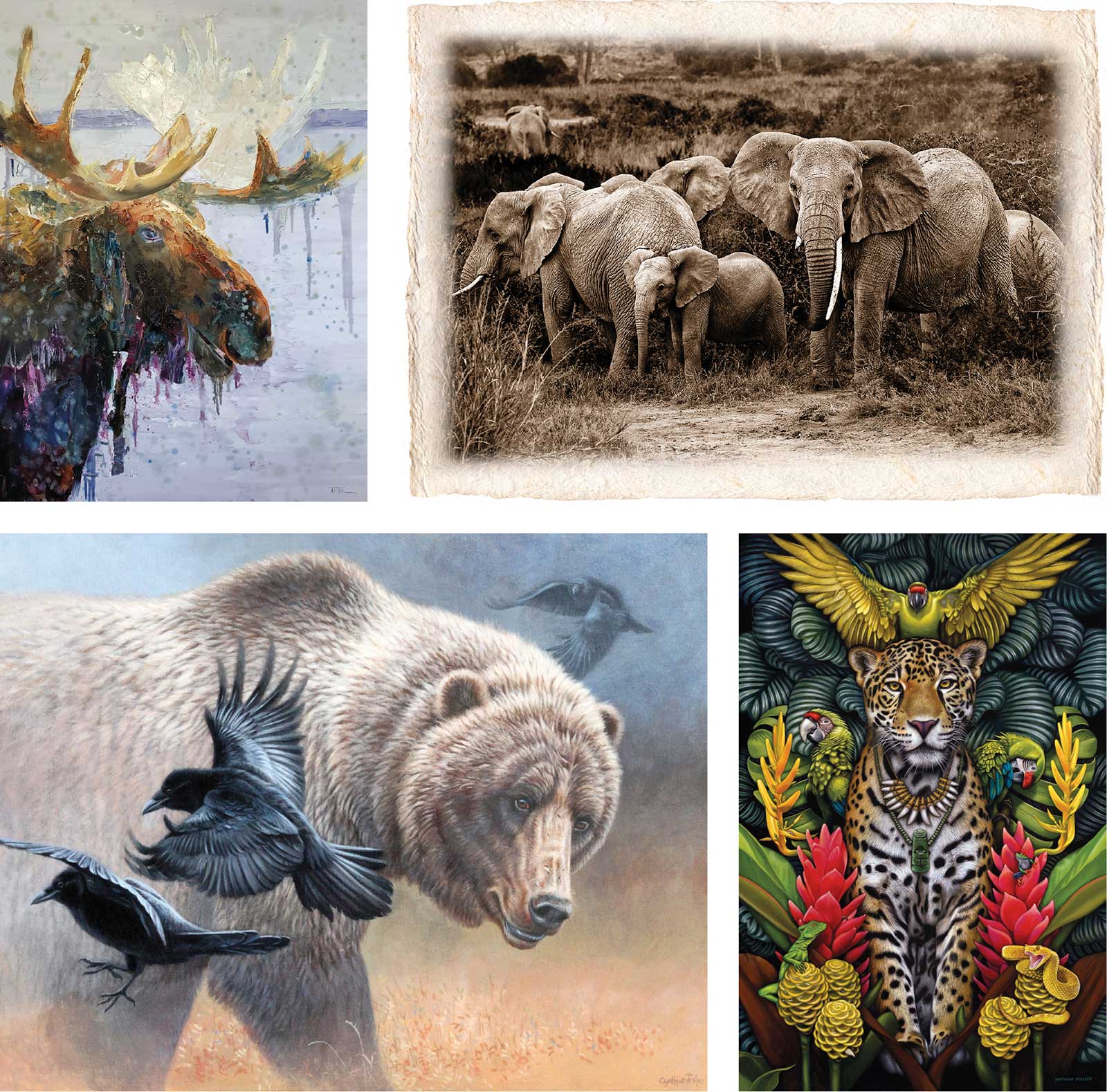 Clockwise from top left: Troy Collins, The Messenger, oil on canvas, 40 x 30" ; Chris Dei, Evening Huddle, limited edition archival pigment ink print on handmade paper, ed. of 15, 28 x 38"; Nathan Miller, Legend of the Jaguar Shaman, acrylic on board, 36 x 24"; Cynthie Fisher, The Spoils, acrylic, 24 x 30"
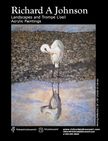
Richard A. Johnson specializes in Trompe l’Oeil and landscape paintings. His two passions combine in Backyard Birds, which was “inspired by watching the birds and squirrels that came to the bird feeders in my backyard.” He explains, “We find all kinds of bird feathers in the yard including red wing hawks and owls. On the painting I wanted parts to go beyond the edge of main canvas. So the broken brick was made of wood, which framed the canvas, and the chickadee and Carolina wren were also carved out of the same wood. I then added the vines, which were made of wire with painted canvas leaves attached. Imagination is an artist’s most important tool.”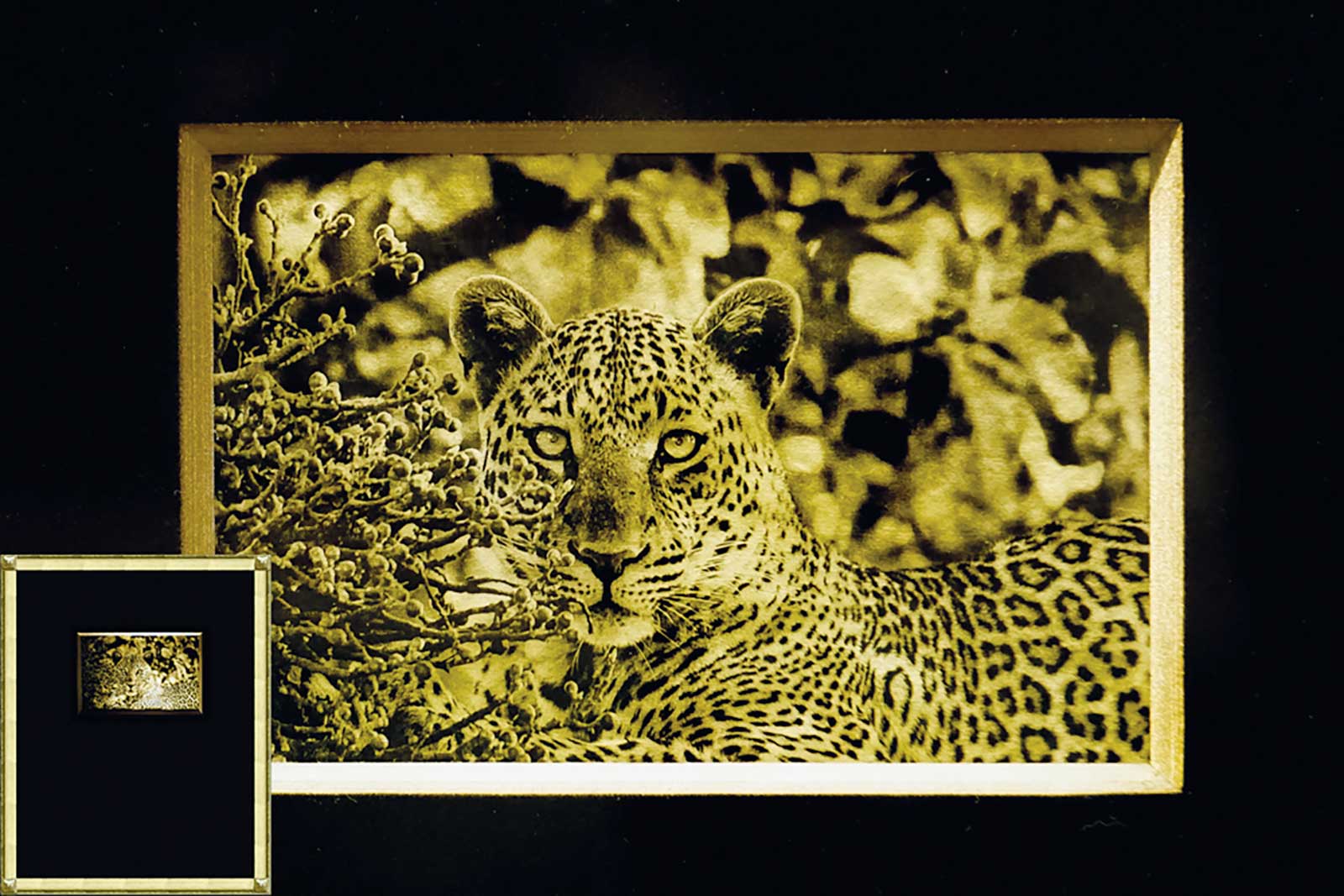 Chris Dei, Absolute Leopard, from the Savannah Gold Collection, print matted in black velvet, 4 x 6" (print), 17 x 11" (framed)
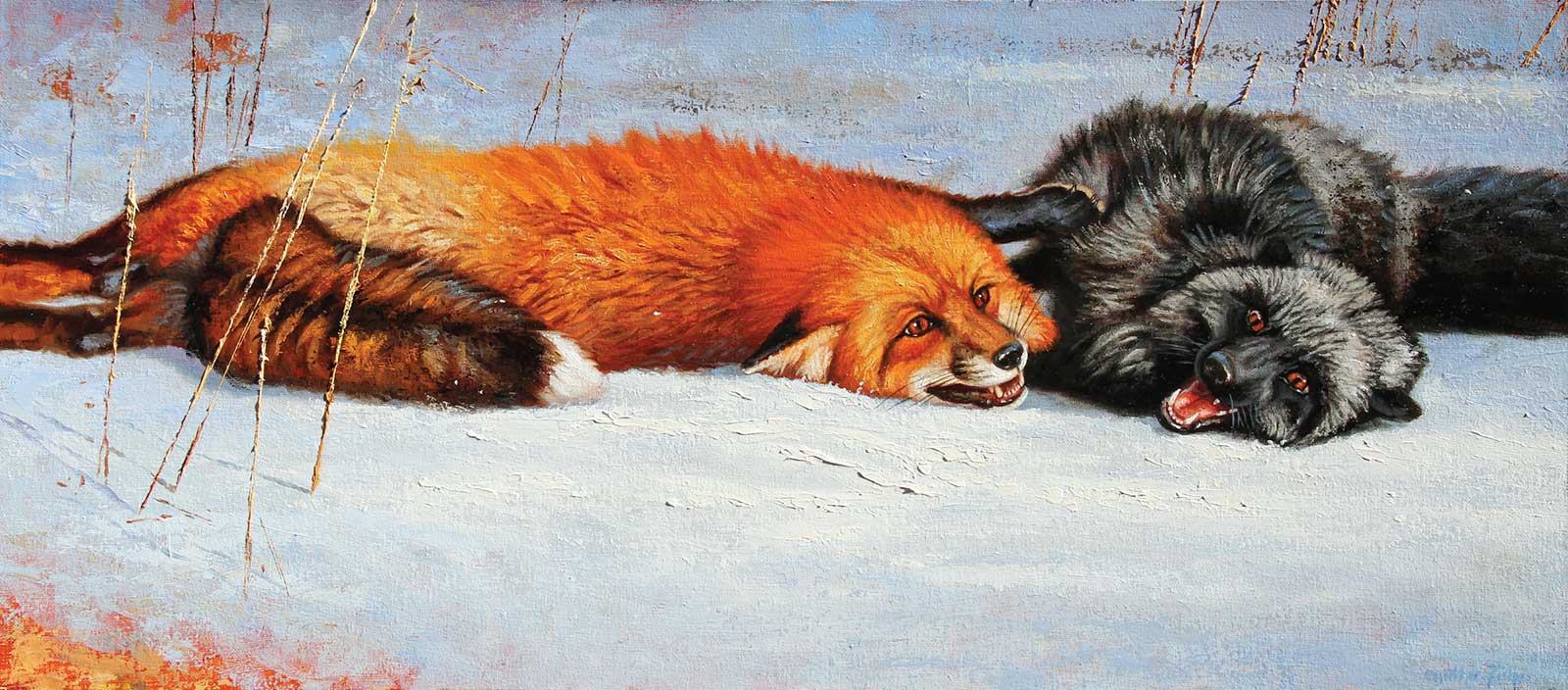 Cynthie Fisher, Fox and Friends, oil, 12 x 29"
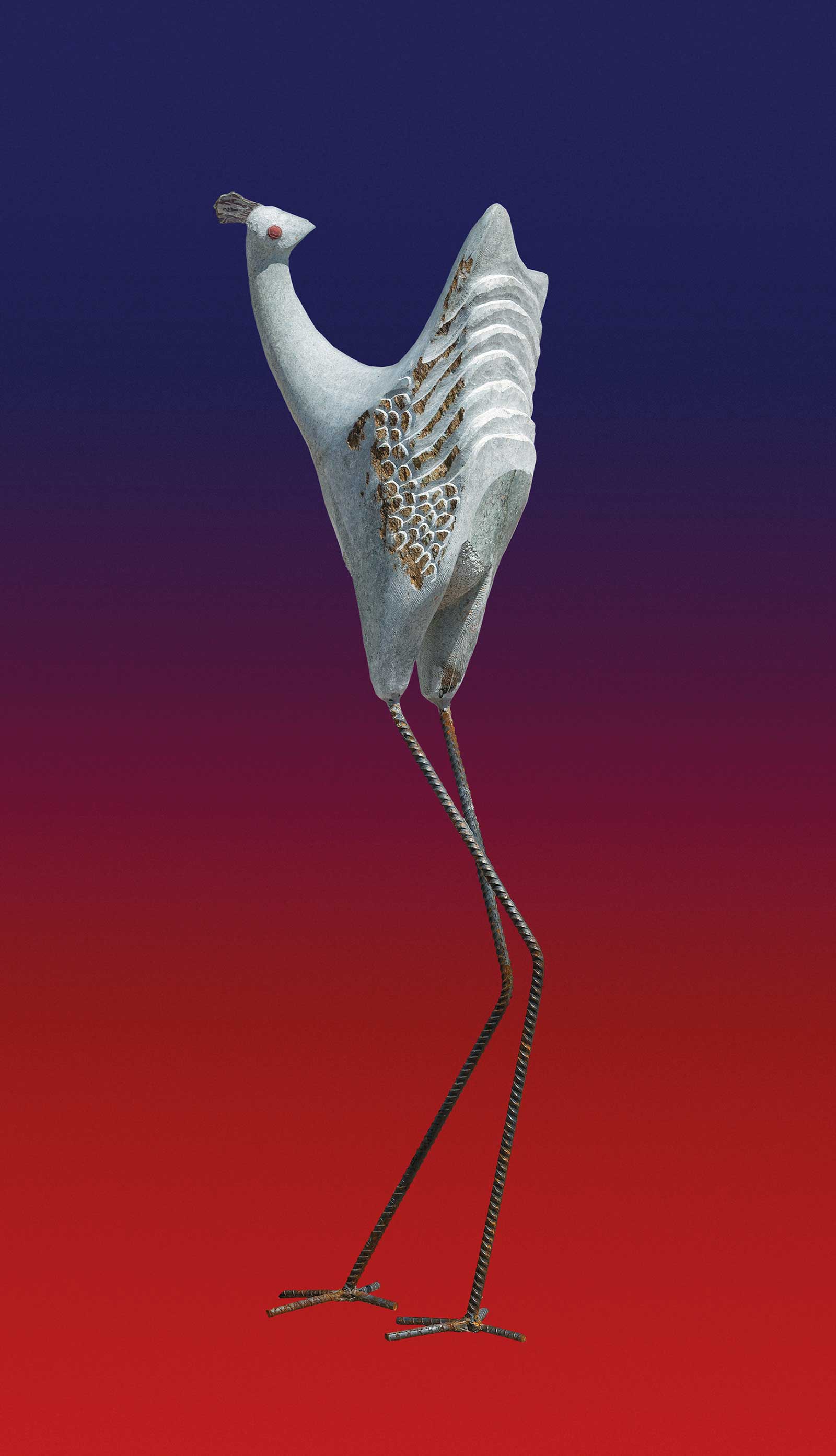 Gedion Nyanhongo, Life Wanderer, hand carved stone sculpture, opal stone, 48 x 18 x 28"
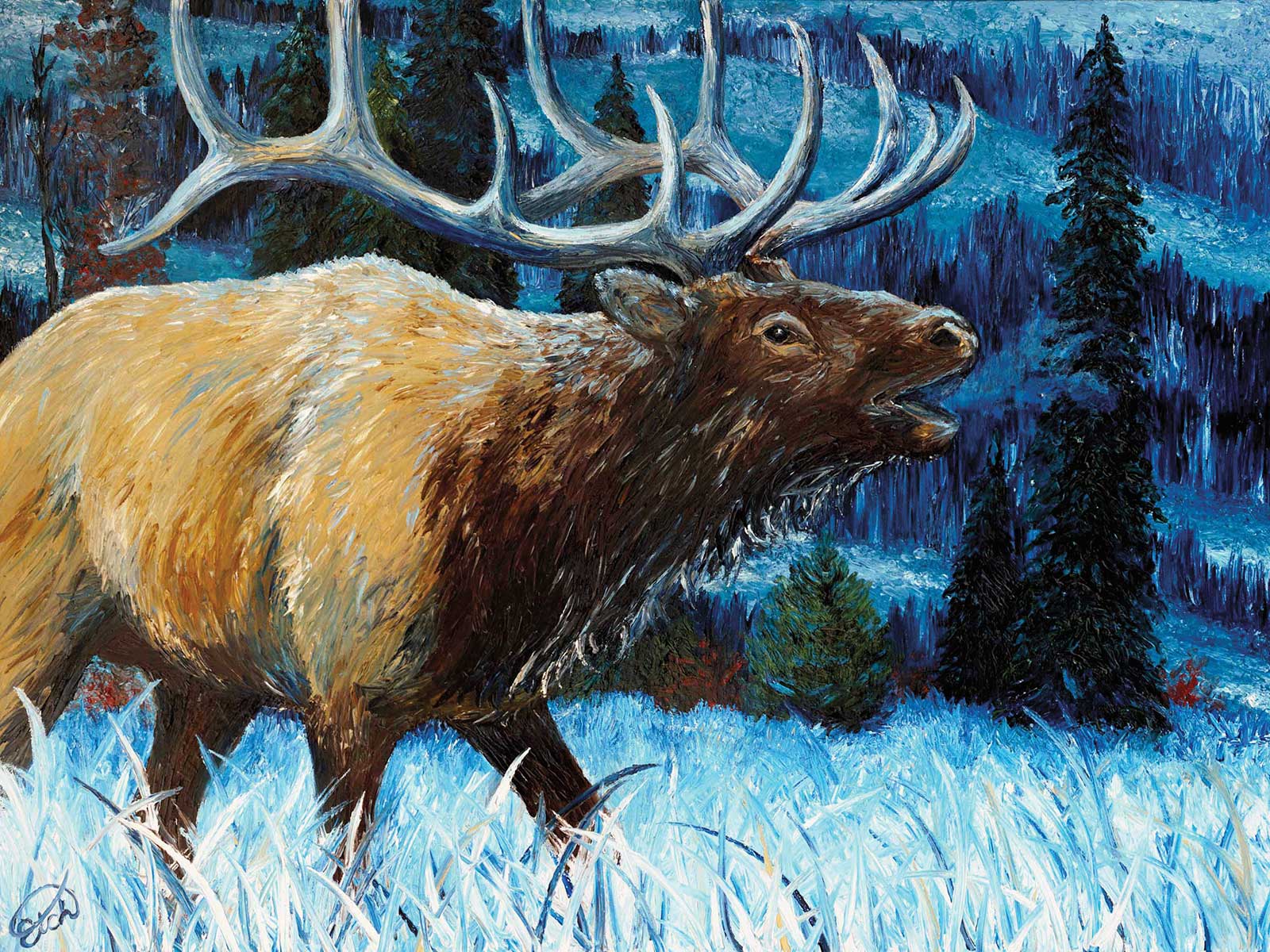 Elizabeth Mordensky, A Call in the Predawn, oil finger painting, 36 x 48"
Other works by Johnson include Wild Muse and Fancy Feathers and Friends, which were both inspired by photographs but then added in the artist’s own creative touches. For Wild Muse, the photo originally had the artist’s son where the bird is in the painting, and the girl’s book turned into a sketchbook, while Fancy Feathers and Friends is from photos of egrets and turtles combined, but on an imagined landscape.
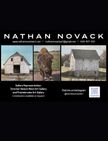
Kansas native Nathan Novack has been producing artwork for the past 23 years, and growing up in a rural setting has been his source of inspiration. His artwork is an observation of those surroundings and also reflects their importance. He adds, “I genuinely enjoy the aesthetics of the rawness within wildlife animals and rural life, captured by a limited palette and painterly application.”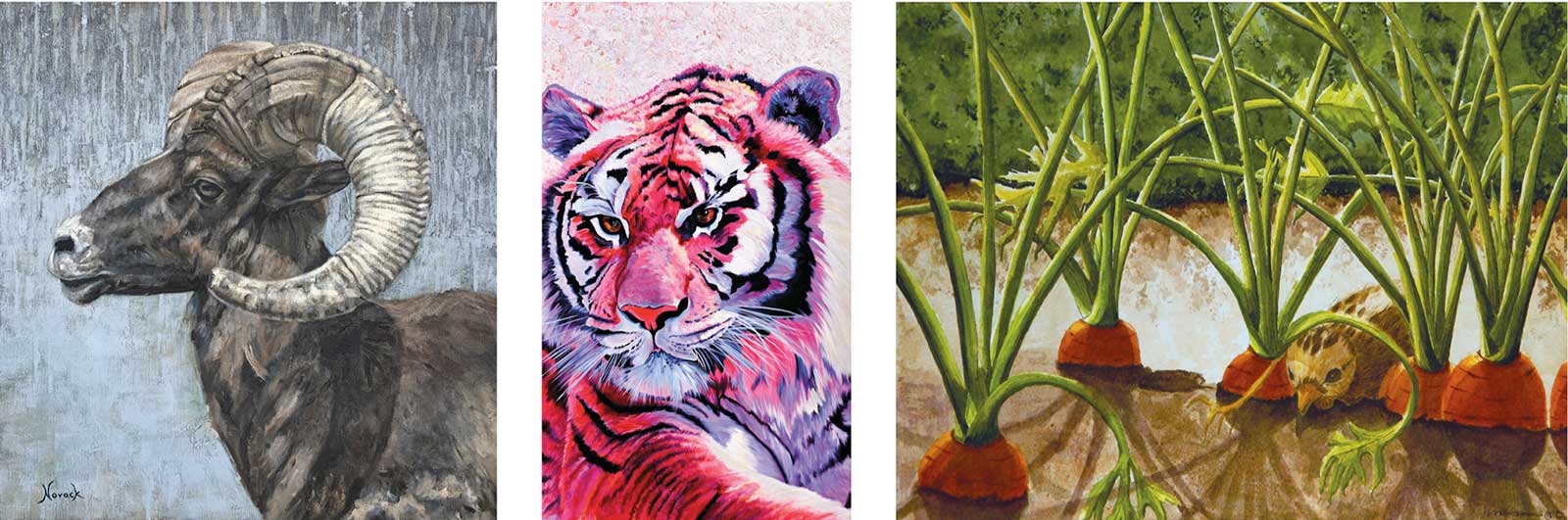 Left to right: Nathan Novack, High Roller, oil on canvas wood, 20 x 20"; Amanda Ward, Inner Strength, acrylic on stretched canvas, 48 x 30; Sally Thomason, Don’t Move!, watercolor, 12½ x 16½"
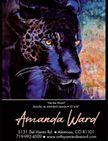
Colorado-based artist Amanda Ward, who has been working as an artist for more than 25 years, enjoys painting vibrant wildlife, still lifes and landscapes. “I express my admiration for all living creatures with my use of vibrant colors,” she says. “It is as if through this boldness of color the uniqueness and beauty of each animal is enhanced. Like they have been enchanted.”
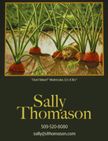
Sally Thomason finds inspiration in the ordinary moments of life, such as flowers blooming, a stormy sky, an old barn on the side of the road or the chickens from her yard. It also could be a sunset that “turns the blue mountains gold and the clouds cotton candy pink,” she says. Don’t Move! depicts a baby quail that was in her garden while she was picking carrots. “The adult quail said don’t move, and it did not,” Thomason adds.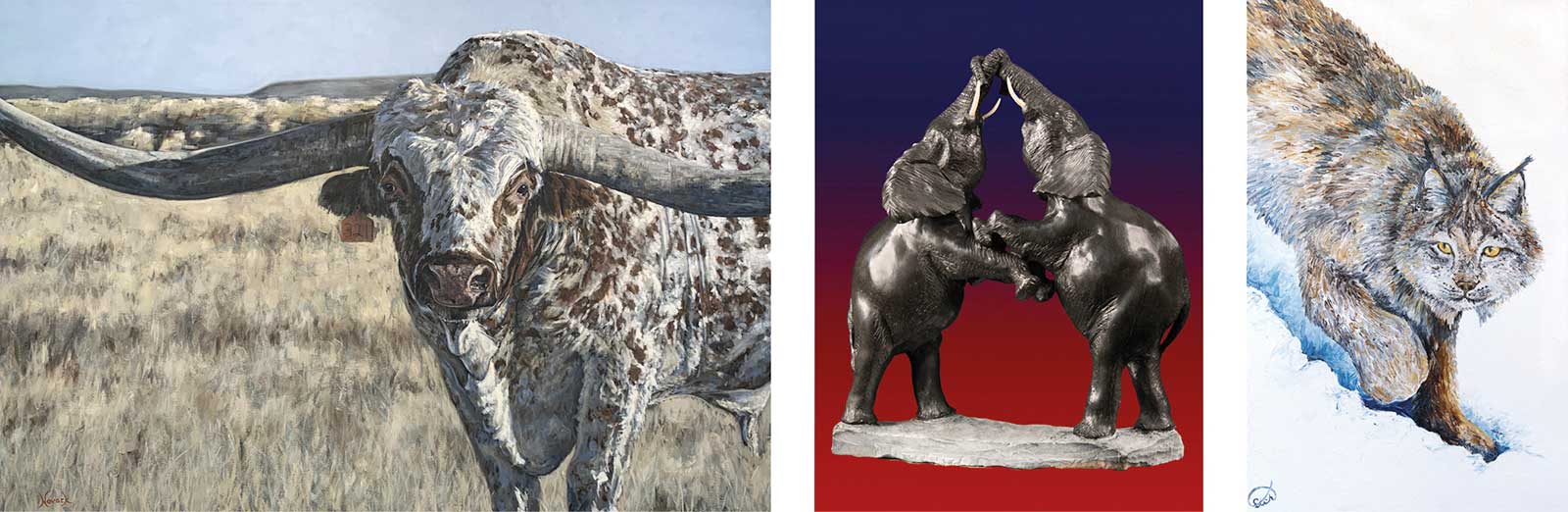 Left to right: Nathan Novack, TCC Winning Honor, oil on canvas, 36 x 54" ; Gedion Nyanhongo, Dancing Elephants, hand carved stone sculpture, springstone, 21 x 13 x 7"; Elizabeth Mordensky, Winter Prowler, oil finger painting, 48 x 30"
Sculptor Gedion Nyanhongo, who specializes in wildlife and figurative works, says, “I listen to the stone to tell me which animal or bird is residing in it, then I release it. I consider all life forms as inclusive—a common community sharing much of the same emotions, desires and needs. So it is my belief that giraffes hug, fish swim and smile, elephants entwine and owls are wise and happy.”
As a naturalist guide in Yellowstone National Park, Elizabeth Mordensky gains inspiration for her paintings every day by witnessing animals in their natural habitat and sharing their tales with visitors from around the world. She says, “My art is the perfect extension of this passion, allowing me to celebrate and share the beauty of these fascinating creatures through my bold and textured wildlife oil finger paintings.” —
Featured Artists & Galleries
Amanda Ward
(719) 992-4509
www.artbyamandaward.com
Carrie Cook
Austin, TX, (972) 313-5104
carricookstudio@gmail.com
www.carriecook.com
Cher Anderson
(602) 571-8094
cherscreations@cox.net
www.cherscreations.com
Chris Dei
(917) 887-6817
chris@chrisdei.com
www.chrisdei.com
Christy Peterson
(781) 708-5181
christypetersonfineart@gmail.com
www.christypetersonfineart.com
Cindy Sorley-Keichinger
(780) 847-2294
goldfarm@telusplanet.net
www.goldenkstudio.com
Represented by Picture This Gallery
(800) 528-4278
www.picturethisgallery.com
Cynthie Fisher
(406) 375-1445, cynthieart@gmail.com
www.cynthiesoriginals.com
Elizabeth Mordensky
Gardiner, MT, (406) 219-8307
www.elizabethmordenskyfineart.com
Gedion Nyanhongo
Phoenix, AZ,
(480) 255-4184
gedionnyanhongo@gmail.com
www.gediongalleries.com
Linda Besse
(509) 238-9129
linda@besseart.com
www.besseart.com
Lisa Gleim
(770) 919-7719
www.lisagleimfineart.com
Main Branch Gallery
208 E. Michigan Avenue
Grayling, MI 49738
(989) 344-0030
www.mainbranchgallery.com
Nathan Miller
(813) 452-8963, info@nathanmiller.gallery
www.nathanmiller.gallery
Nathan Novack
Holcomb, KS, (620) 937-2121
nathannovackart@gmail.com
www.nathannovackart.com
Richard A. Johnson
(843) 229-0660
richard@richardajohnsonart.com
www.richardajohnsonart.com
Sally Thomason
(509) 520-8080, sally@slthomason.com
Stremmel Gallery
1400 S. Virginia Street, Reno, NV 89502
(775) 786-0558
www.stremmelgallery.com
Troy Collins
www.troycollinsfineart.com
Powered by Froala Editor