Melchior de Hondecoeter (1636-1695), the famed 17th-century Dutch painter of birds, was known in the 19th century as the “Raphael of bird painters.” His Palace of Amsterdam with Exotic Birds depicts his subjects flying and posing freely in a garden with one of the homes of the king in the background.
“It’s incomprehensible to think of their being extinct today,” British artist and activist Bryony Bensly observes of de Hondecoeter’s birds. “The lives of animals and our lives are in a precarious position. I wanted to show the preciousness of life and took Palace of Amsterdam as inspiration, painting de Hondecoeter’s animals as transparent, fragile glass, substituting the royal palace with the White House.” She has titled the painting Legacy, asking “What will be our legacy?”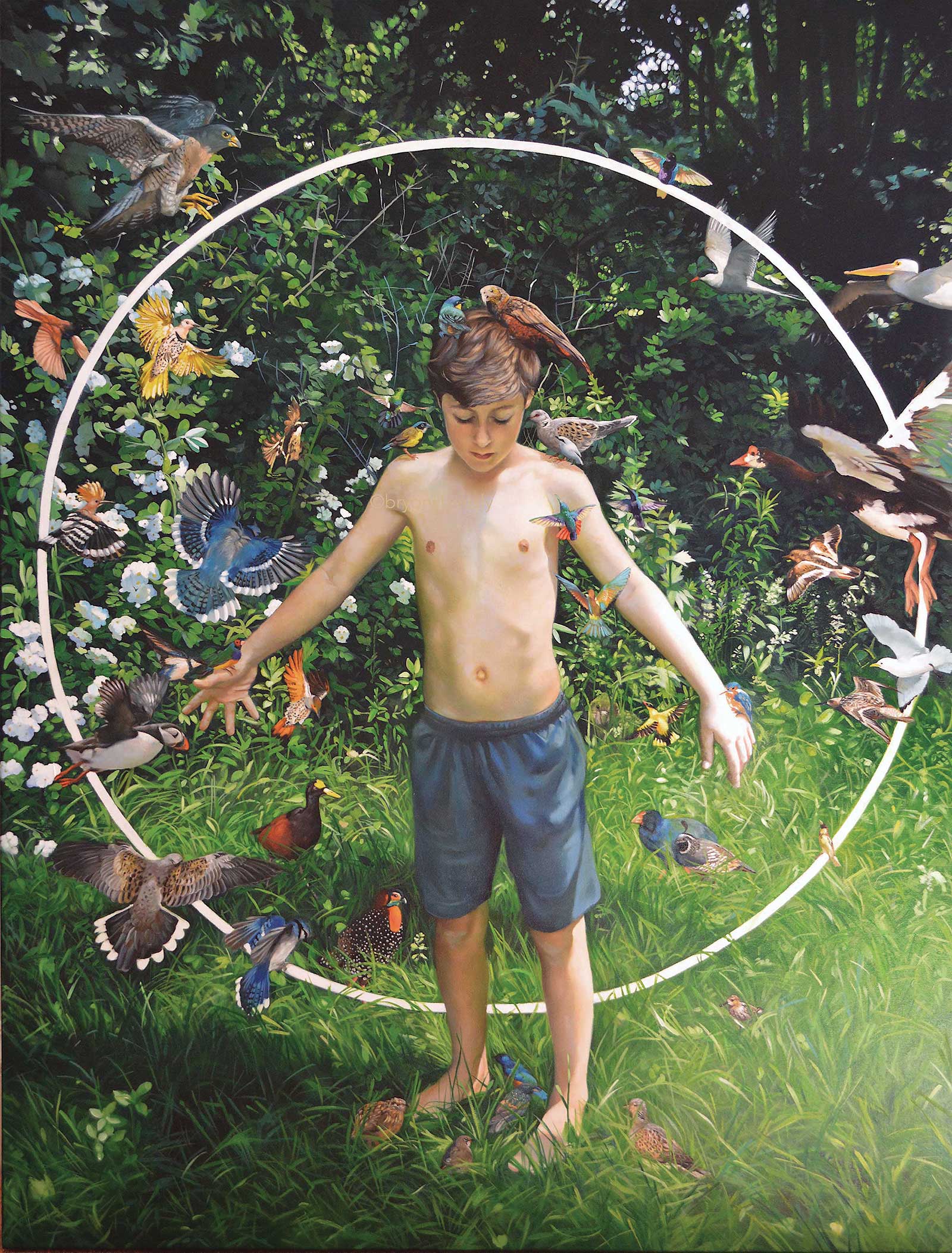 Henry’s Birds, oil on canvas, 40 x 30"
“When I was in my late teens, I was down in Devon and feeling scared at the time,” she relates. “A friend, who was the salt of the earth, told me about an old wives’ tale. She said, ‘Take a piece of chalk and mark a circle around yourself.’ It did make me feel rather safe. It became the circle of safety in my paintings.”
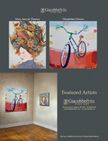
In Henry’s Birds, a shirtless, barefoot boy stands in the grass with his arms outstretched as if to form the circle that surrounds him and his bird friends, some of whom perch on the circle, others on his shoulders and head. “I attempt to illustrate the antithesis of the cause of the problems of today with an attitude of openness and receptivity,” she explains. “I am celebrating each creature that I paint and wish to express the beauty and awe that I feel for nature.” Rebirth (diptych), oil on canvas, 20 x 48"
Henry’s Birds has been selected for The Royal Society of Portrait Painters’ Annual Exhibition in London, May 6 through 15.
The circle appears again in Wishing Tree II: Connection. Throughout Celtic Britain and Ireland, there is a tradition of tying ribbons or leaving messages on sacred trees often growing near holy wells. Bensly recalls the huge beech trees at Avebury Stone Circle, the nearly 5,000-year-old monument in Wiltshire. In her painting, a girl sits beneath a tree with her leopard companions within a circe drawn on the ground distorted just enough to accommodate a tail and two paws. Barely visible in the grass behind the left-hand leopard is the shadow of a drone.
The drone is both threat and aid. It is used to hunt animals as well as to study their movement in their natural environment. The Hunting Act 2004 in England and Wales outlawed the hunting of foxes and other mammals with hounds. In her 20s, Bensly was a hunt saboteur, working with her compatriots to confuse the dogs, drawing them off the scent. Before the Hunting Act, they also used drones to disrupt the chase.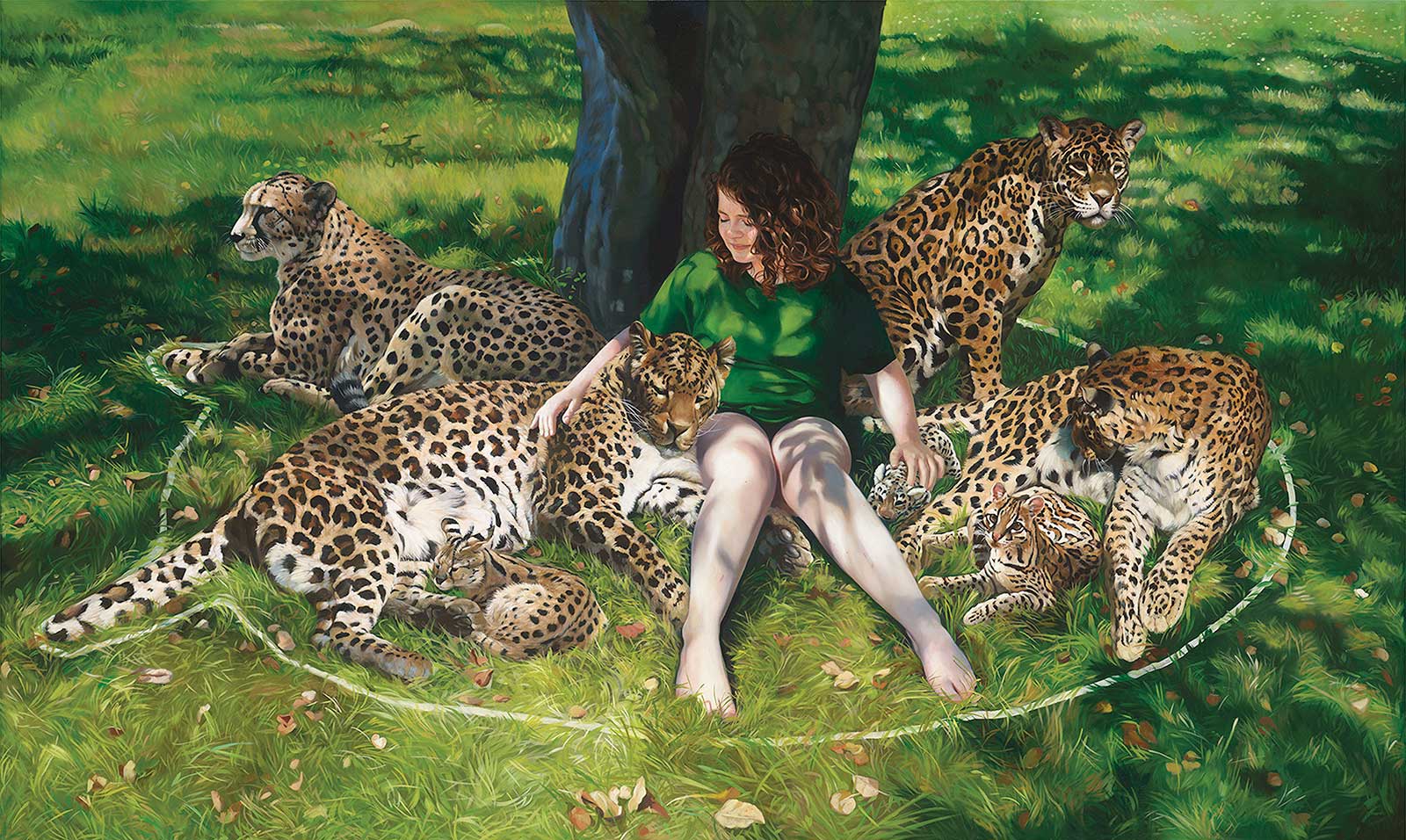 Wishing Tree II: Connection, oil on canvas, 36 x 60"
Bensly was brought up in Hong Kong where she lived with her father. “He was a good teacher and was green before anyone was green. He told me how bubbly washing up liquid went into the fields and damaged crops, so we could only use boiling water to wash dishes. All our outings were to the hills to see animals. My grandfather, Theodore Savory, was an arachnologist and taught me that spiders are like humans in their family relations. He taught me that animals are not something ‘over there.’ That immediately created a connection,” she says.
“For some reason it doesn’t seem to matter, to some people, that animals are going extinct. They just couldn’t care, as if they don’t feel any connection at all. This lack of connection seems to be at the root of all our complacency and lack of empathy. ‘If it doesn’t affect me directly, who cares,’” she muses. “People have a bio-phobia, which is so shocking. To be so disconnected from the earth, from the life that sustains us, is to be disconnected from our selves. We are encouraged to be increasingly individualistic, which only strengthens our ideas of me versus you.”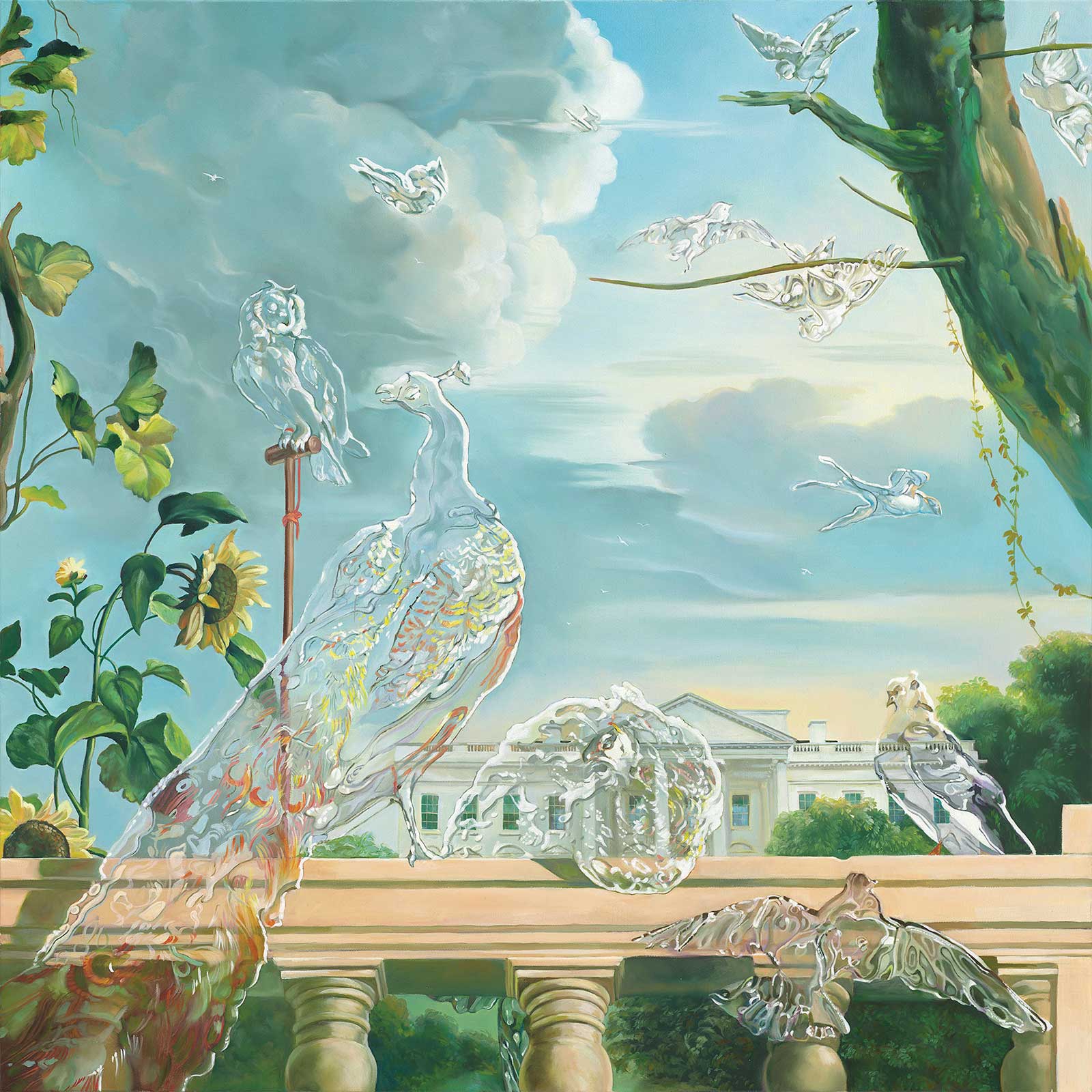 Legacy, oil on canvas, 36 x 36". Private collection.
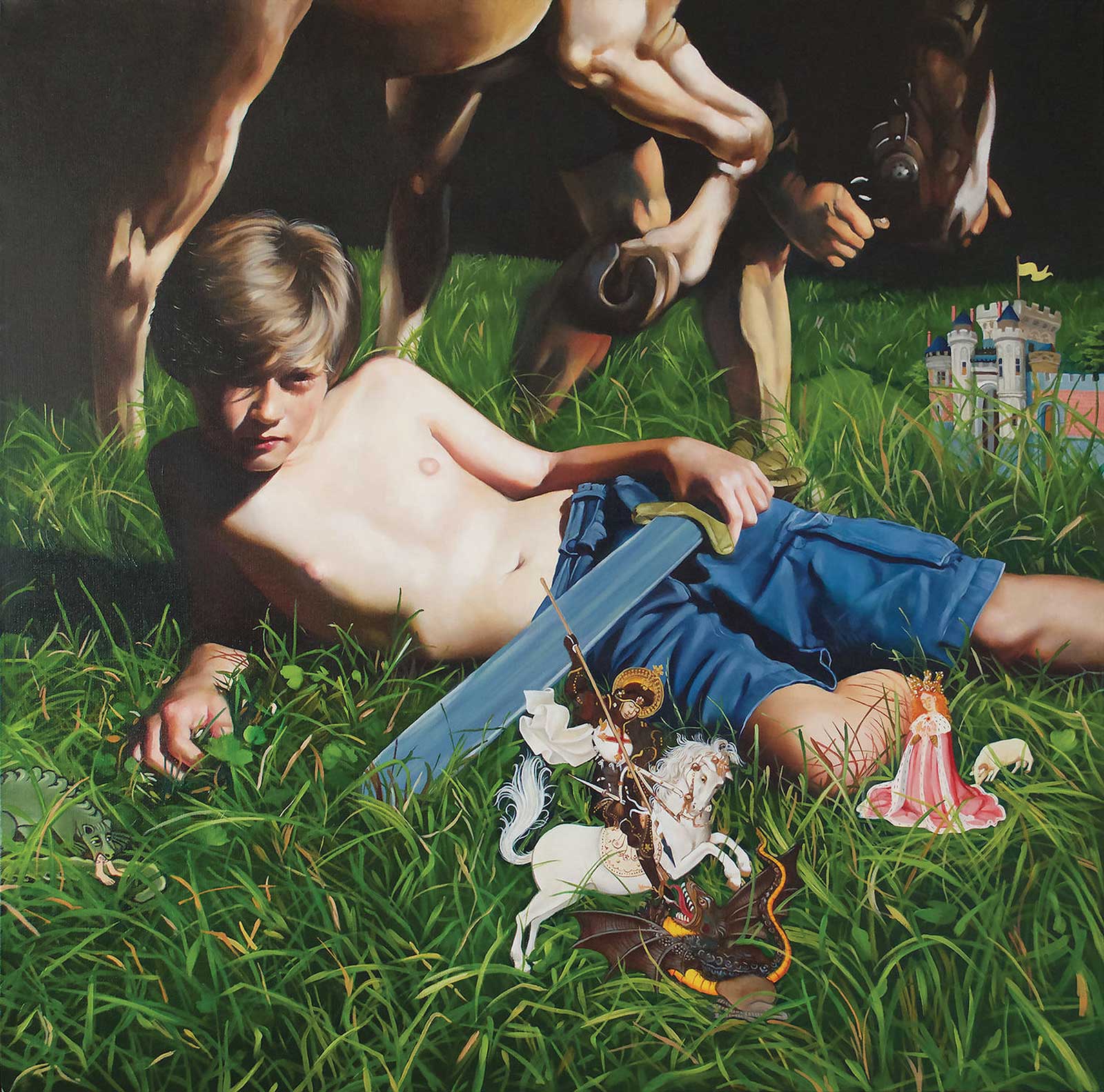 Duct Tape Sword, oil on canvas, 36 x 36"
One of her favorite poems is Auguries of Innocence by William Blake (1757-1827). Written in 1803, it wasn’t published until 1863. In it, Blake juxtaposes images of innocence with images of corruption—especially relating to animals. One couplet reads “A Robin Red breast in a Cage/Puts all Heaven in a Rage.” Another, “The wanton Boy that kills the Fly/Shall feel the Spiders enmity”, refers to the boy robbing the spider of its natural food.
Bensly’s models “are mainly friends’ kids, students or occasionally a person I ask to pose for me who I envision in a painting. Kids became crucial as I started a series that questioned, at what point, beloved soft toys were substituted by a taxidermy head on a wall. When does the separation happen? It is also to remind people of their childhood, of innocence and receptivity. The kids are lovely to work with. I love their energy, playfulness and openness.”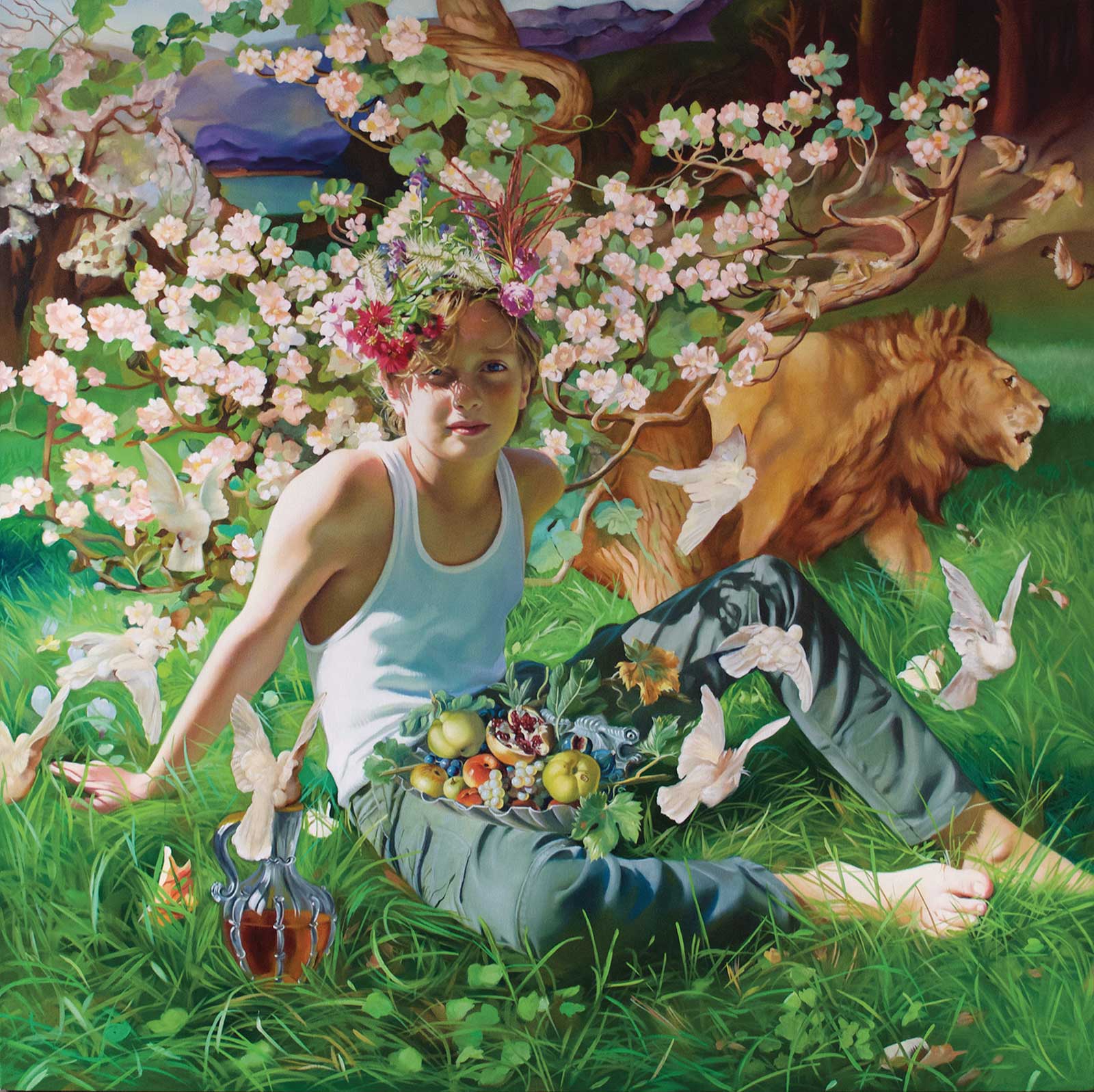 Bacchus, oil on canvas, 48 x 48". Private collection.
In Bacchus, she paints “a part of our lives when we are free, open and receptive—full of the love of nature, the love of life. He is a boy on cusp of manhood.”
Bensly’s richly detailed paintings recall the intricacies of the Unicorn Tapestries and the lushly organic designs of William Morris fabrics, “which adorned our windows and furniture” she recalls. “He feels like home to me and the symmetry and balance in his work create a feeling of well-being and beauty.”
She graduated cum laude from the New York Academy of Figurative Art in 2004, and was later awarded an Artist-in-Residence by the Historic Santa Fe Foundation for three years. She paints every day, growing her skills, and continues her activism.
She encourages us to look beyond the beauty of her animals and children to see their innocent connectedness.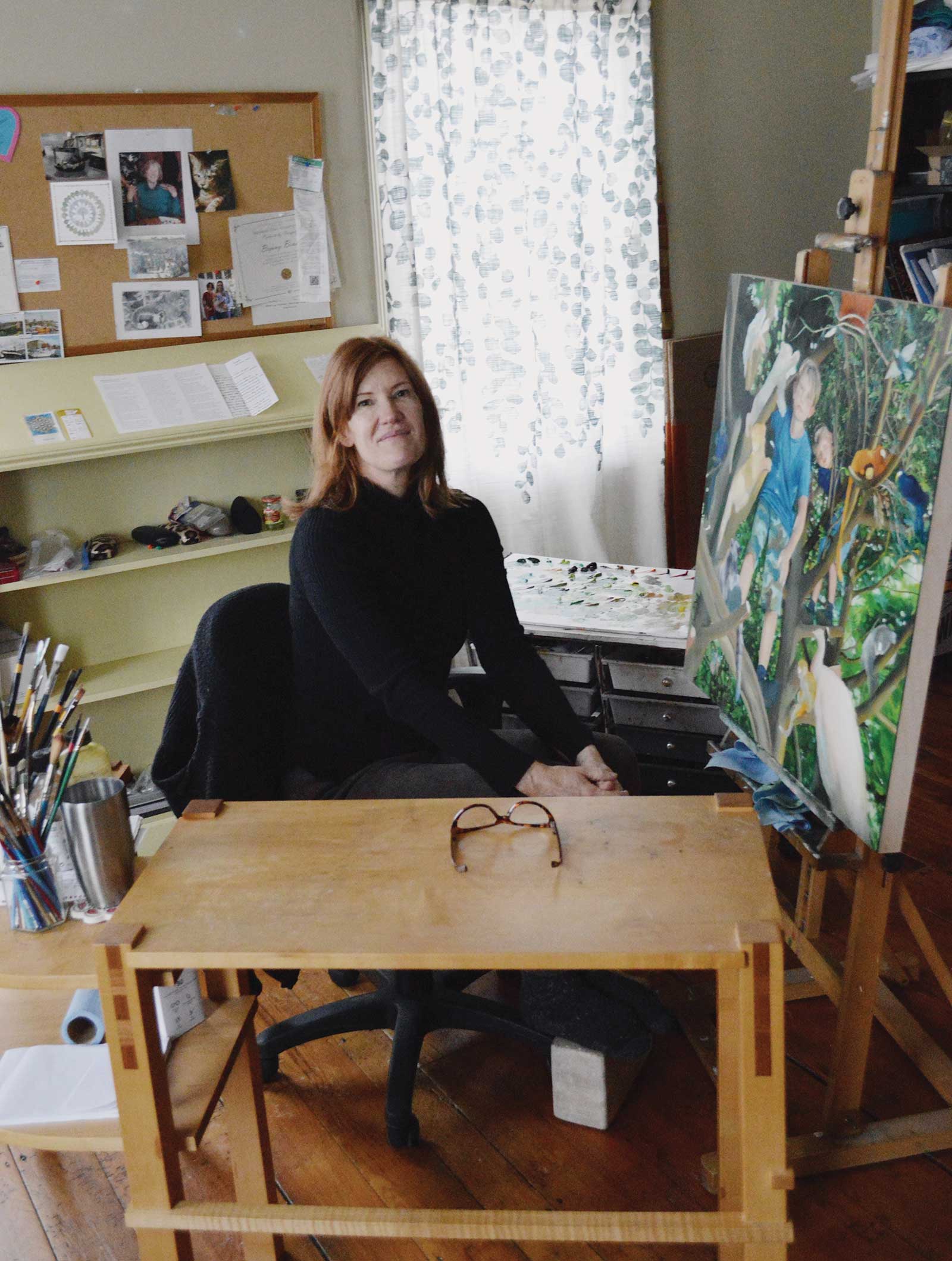 Bryony Bensly in her studio.
She cites the wisdom of the Suquamish and Duwamish Chief Seattle (ca. 1786-1866) who wrote, “Will you teach your children what we have taught our children? That the earth is our mother? What befalls the earth befalls all the sons of the earth.
“This we know the earth does not belong to man, man belongs to the earth. All things are connected like the blood that unites us all. Man did not weave the web of life, he is merely a strand in it. Whatever he does to the web, he does to himself.” —
Powered by Froala Editor