Xenophon (430-ca.354 BCE) was an Athenian mercenary warrior, a student and friend of Socrates. Among his many surviving works is the treatise, The Art of Horsemanship. As a cavalryman, he wrote about preparing a horse for war. Later, as a country gentleman, he trained a different kind of horse, “a showy, attractive animal, with a certain grandeur of bearing.” He proclaimed, “A horse is a thing of beauty... none will tire of looking at him as long as he displays himself in his splendor.” He warned, however, “To quote a dictum of Simon (who had written about horses several hundred years earlier), what a horse does under compulsion he does blindly, and his performance is no more beautiful than would be that of a ballet-dancer taught by whip and goad.” Xenophon rode bareback in battle and for pleasure.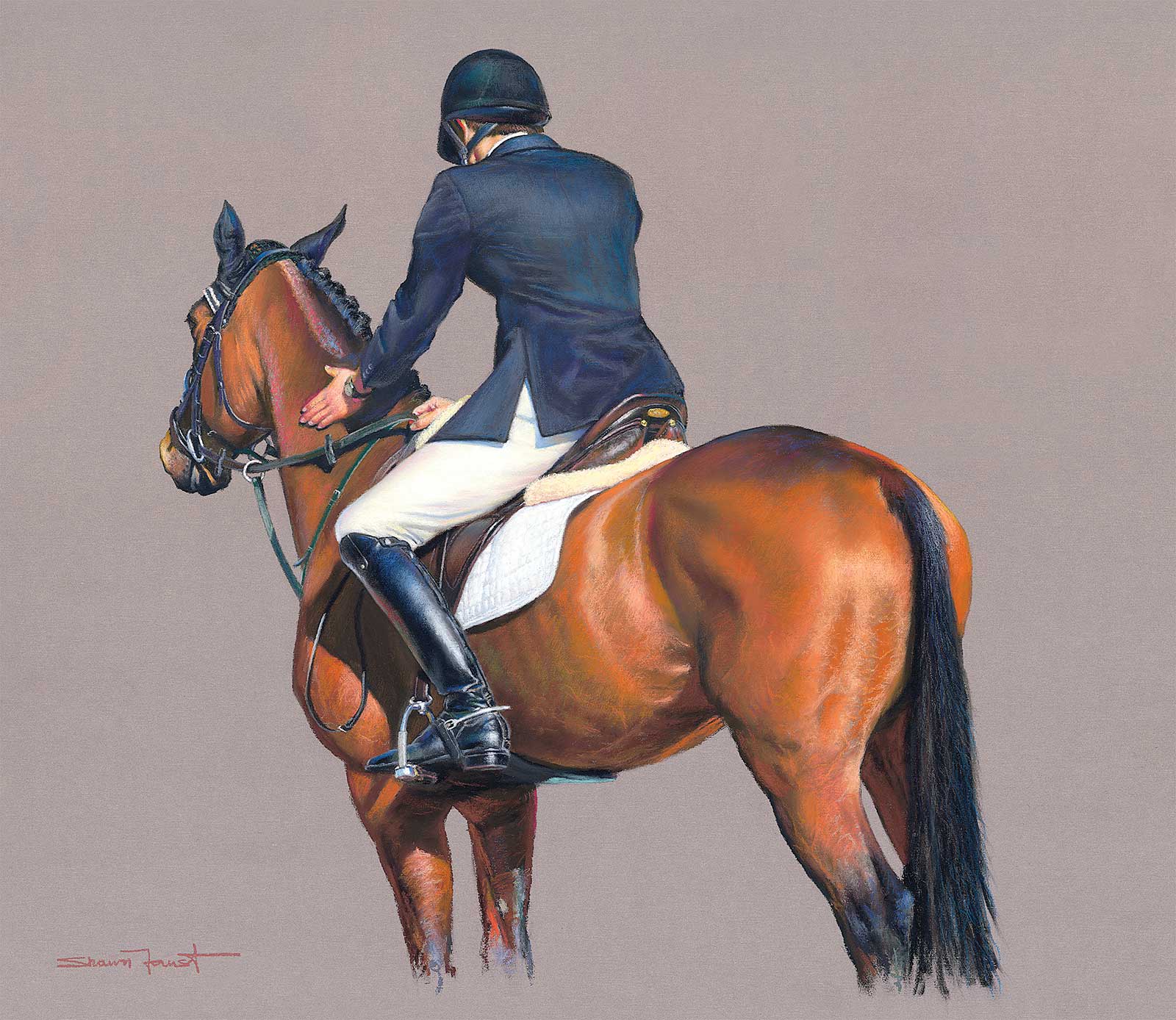 Shawn Faust, Reassuring Test, pastel, 18 x 24"
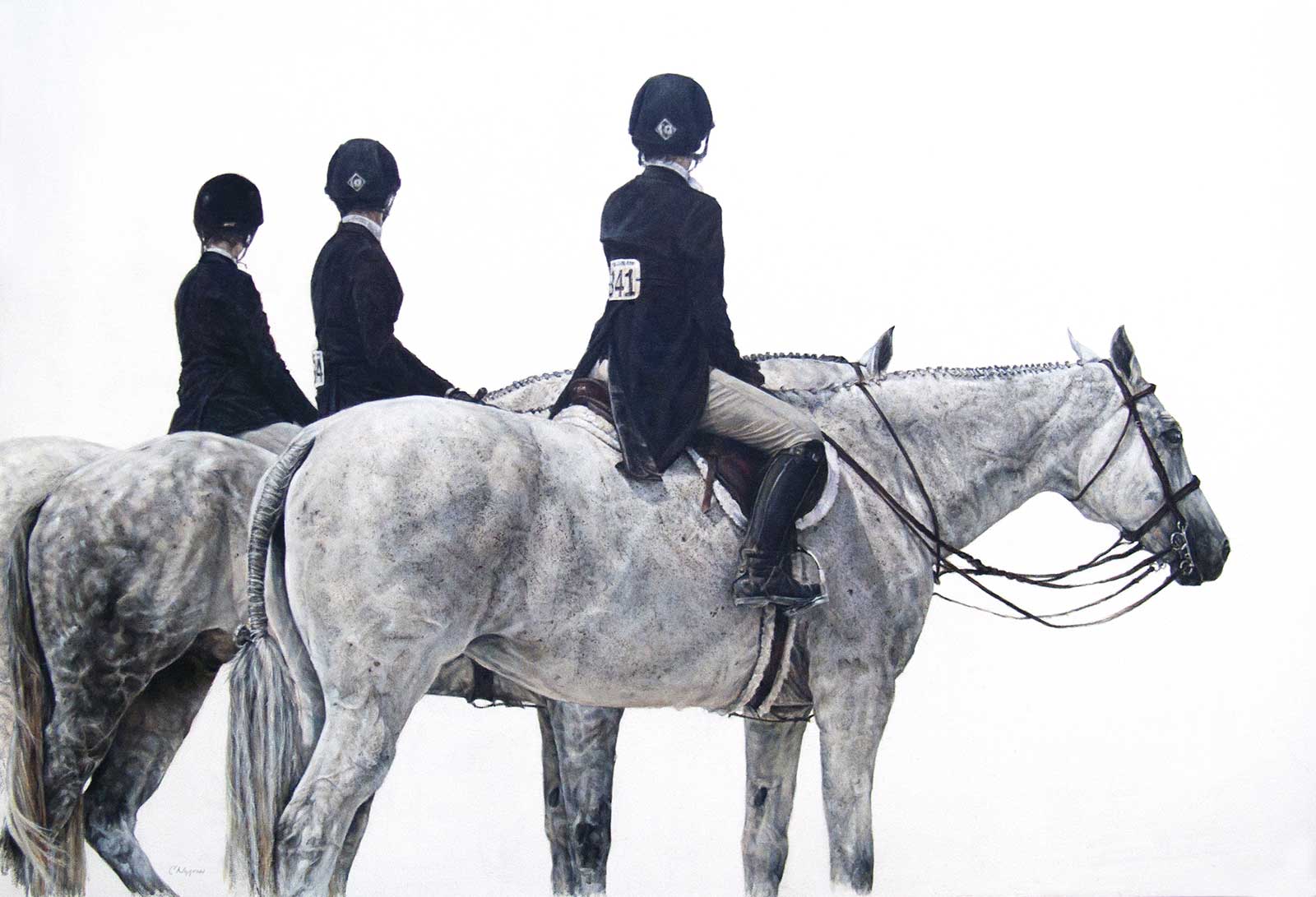 Carrie Nygren, Study in Black on Greys, oil, 30 x 40"
Equestrian events were introduced in the 1900 Summer Olympics in Paris. Today they are comprised of dressage, eventing and jumping with both men and women competing—although women didn’t participate until the 1952 Helsinki Games when they competed in dressage.
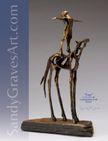
Isabelle Werth, a German athlete, has won six Olympic gold medals and four silver medals in dressage. She explains, “I always say it is 60 percent the horse and 40 percent the rider…. It is the reason why our sport is timeless and ageless, you always have this partnership, this relationship. You never get tired of trying to get better.”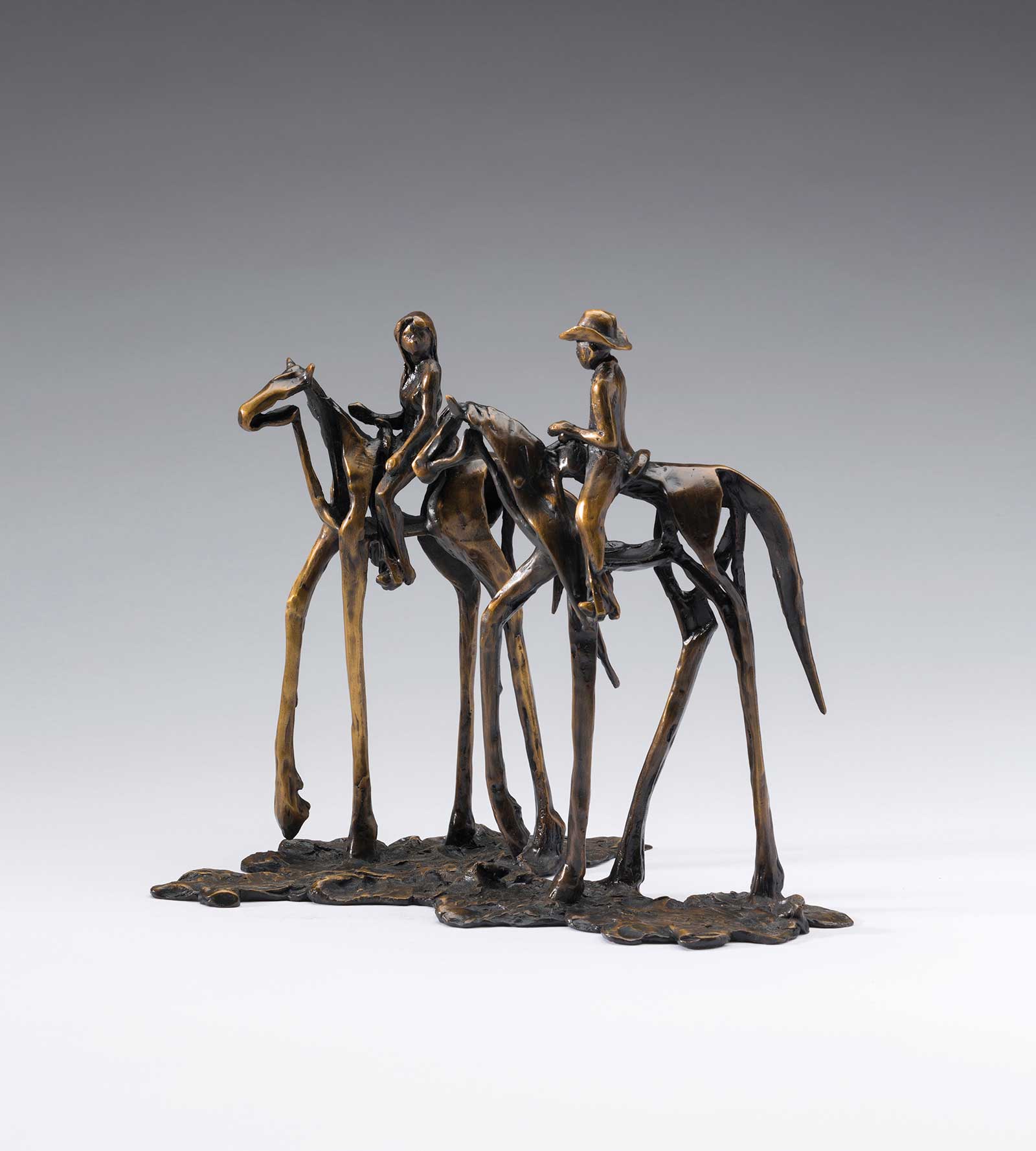 Sandy P. Graves, Ever After, bronze limited edition of 35, 9 x 10 x 6"
Shawn Faust quotes Cézanne, who wrote, “Painting from nature is not copying the object; it is realizing one’s sensations.” Faust still remembers standing in awe when he saw a horse for the first time and the excitement he felt when his grandfather broke off a small piece of pastel for him to draw with. Faust paints horse portraits capturing the unique qualities and personality of each subject. In Reassuring Test, he portrays the intimate relationship between horse and rider.
He says, “My process is positioned to interrogate the dichotomous zone between the right and left hemisphere of the brain; the space of flux between real and illusion, spiritual and representation, present and past. I enjoy exploring the formal qualities of paint to elicit its plasticity as metaphors and proxies for human and nature reciprocity.”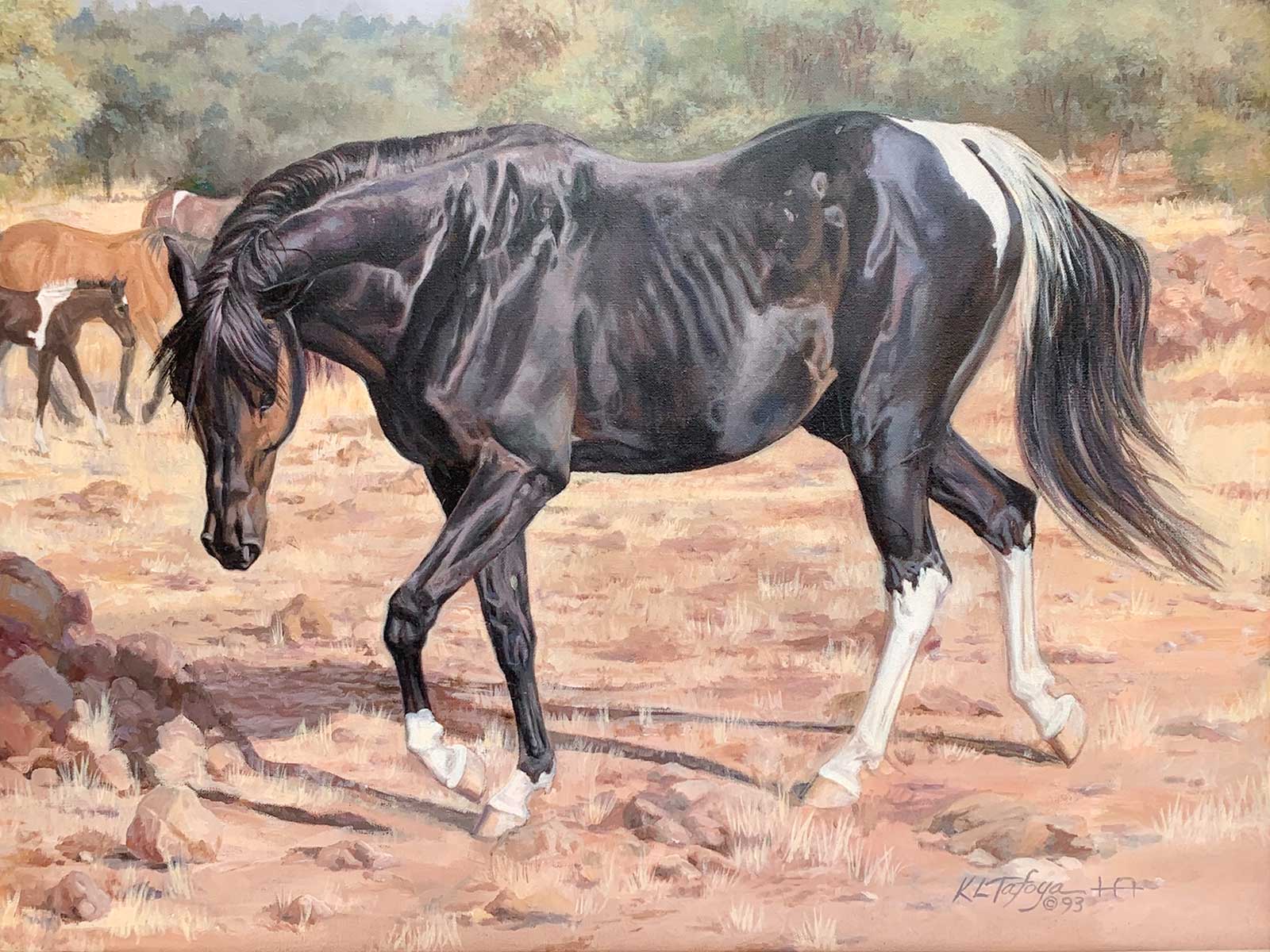 K.L. Tafoya, Ready to Rumble, oil on linen, 22 x 28"
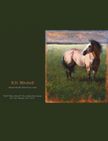
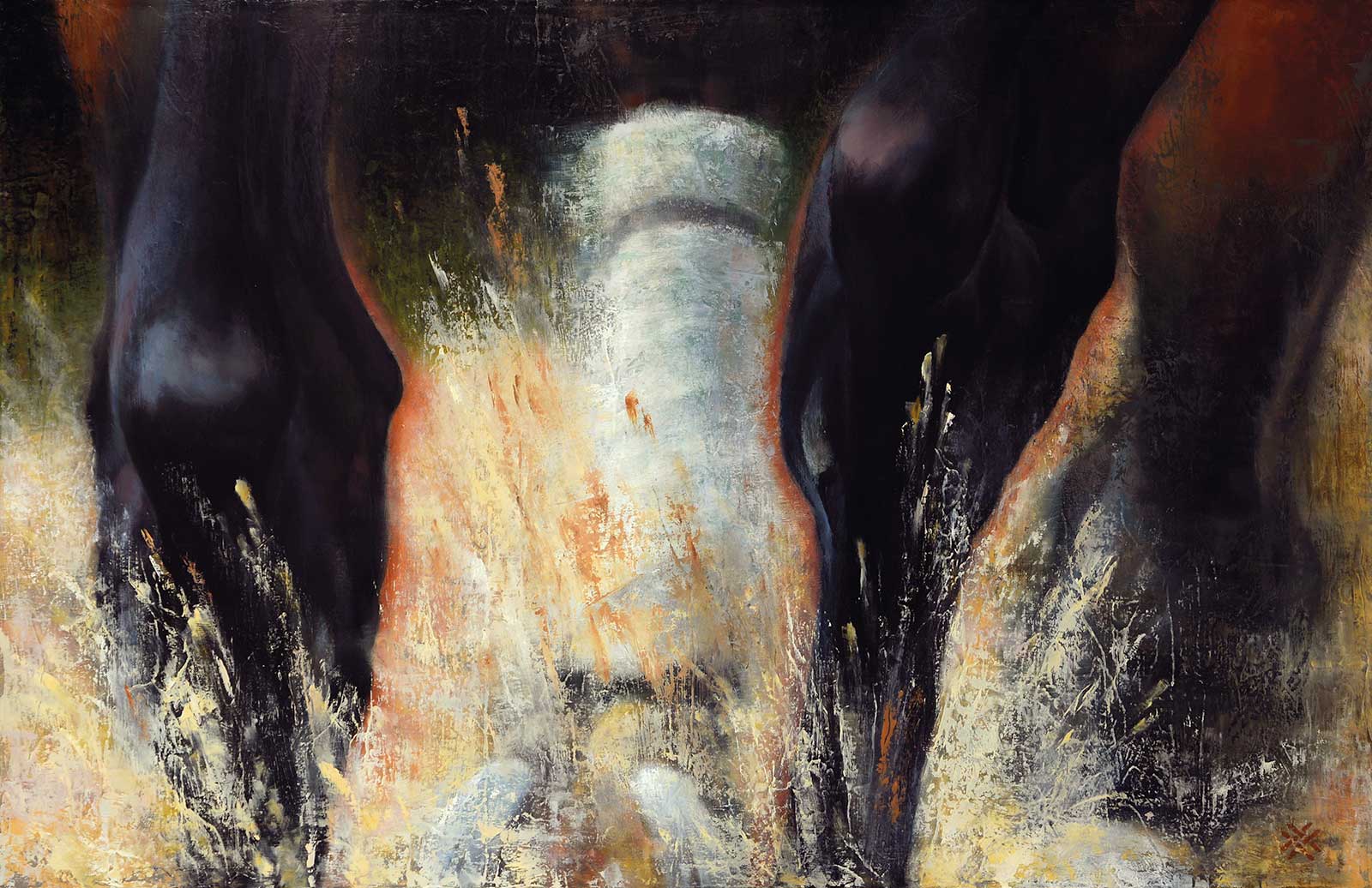 R.D. Mitchell, Thunder, oil on birch panel, 26 x 40"
Carrie Nygren was given paints by her father and later went on to earn an MFA. She had a successful career in advertising, married and raised a family while her art career went on the back burner. Well versed in the classical techniques of painting, when she was able to return to her art, the skills remained and, perhaps, over the years, her insights had deepened. She had moved from Tennessee to Wisconsin and her daughters had taken up riding. Her art had found a focus. She captures the calm before a competition in Study in Black on Greys—three black-coated riders on three grays characterized by their black skin and white hair.
R.D. Mitchell turned to painting “in earnest” in 2017 after four decades in advertising and graphic design. He received the 2020 Sam Savitt Award for depicting the horse in active endeavor by the American Academy of Equine Art. Savitt (1917-2000) was a founding member of the academy and the official illustrator of the United States Equestrian Team. Mitchell’s horses roll gleefully in the grass and race powerfully through the mud. He knows their many moods and capabilities from observation and from being in the saddle himself. Thunder becomes abstract as he narrows his attention on the horse’s forelegs and hooves powerfully propelling it and its rider forward in splendor as well as in a shower of mud.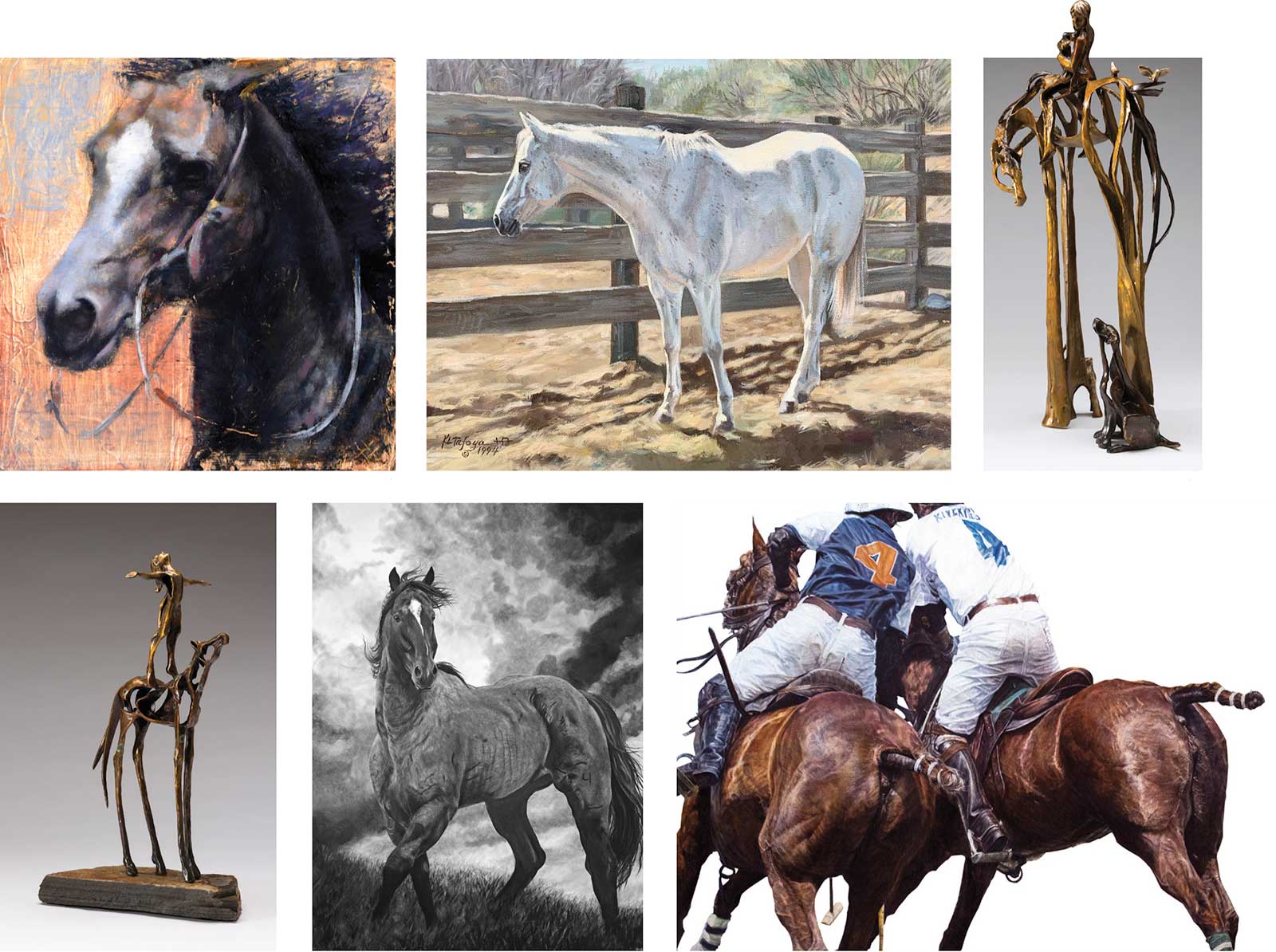
Top row left to right: R.D. Mitchell, Head Sketch #4, oil on Baltic birch panel, 10 x 9¾" ; K.L. Tafoya, Top Hand, oil on canvas, 14 x 18"; Sandy P. Graves, Kindred, bronze, ed. of 50, 24 x 11 x 6" Bottom row left to right: Sandy P. Graves, Free, bronze, ed. of 50, 17½ x 10 x 8"; Rox Corbett, Blue Roan Sky, charcoal on archival cotton paper, 29 x 22½"; Carrie Nygren, Ride Off, oil, 36 x 54"
Continue through this special section for additional insights, stories and inspirations from artists that have been enamored with the horse.
Nygren tries to capture the inherent spirit, character and personality of each horse she’s had the privilege of painting. “Whether it’s a portrait, or a captured moment in action, there is nothing nobler than the horse and his relationship with the rider,” Nygren says. “My intent is to find a balance between traditional painting and contemporary composition, intentionally focusing the eye on the subject. Integral to that is attention to anatomy, motion, emotion…which all contribute to paintings that capture not only the ‘portrait’ of the horse, but the nuanced and unique power of the equine form. It’s that unique relationship—that level of trust, partnership and athleticism, the translating that relationship to canvas, is what I find to be the ultimate challenge.”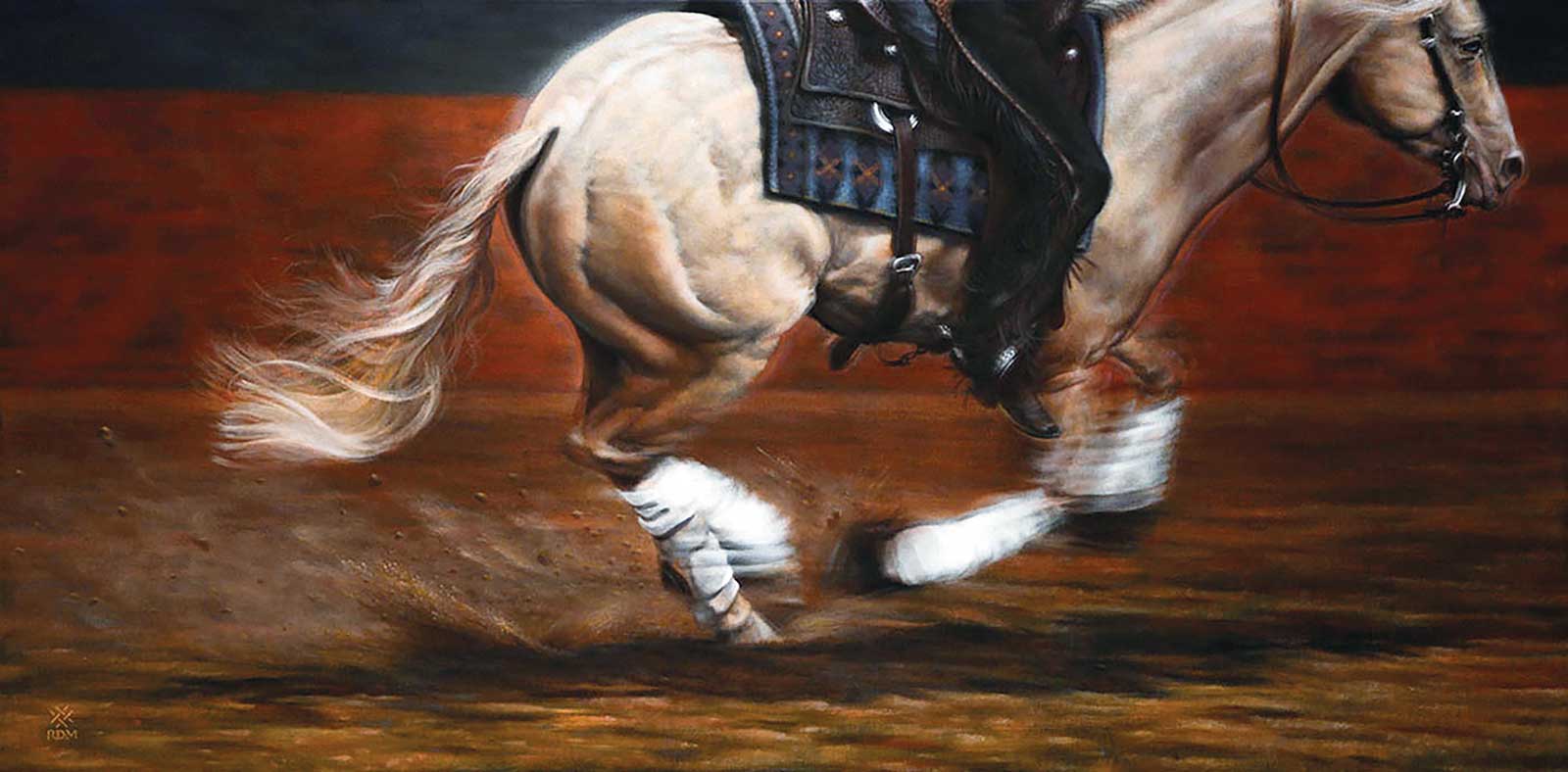 R.D. Mitchell, Big Mover Red Wall, oil on canvas, 36 x 72"
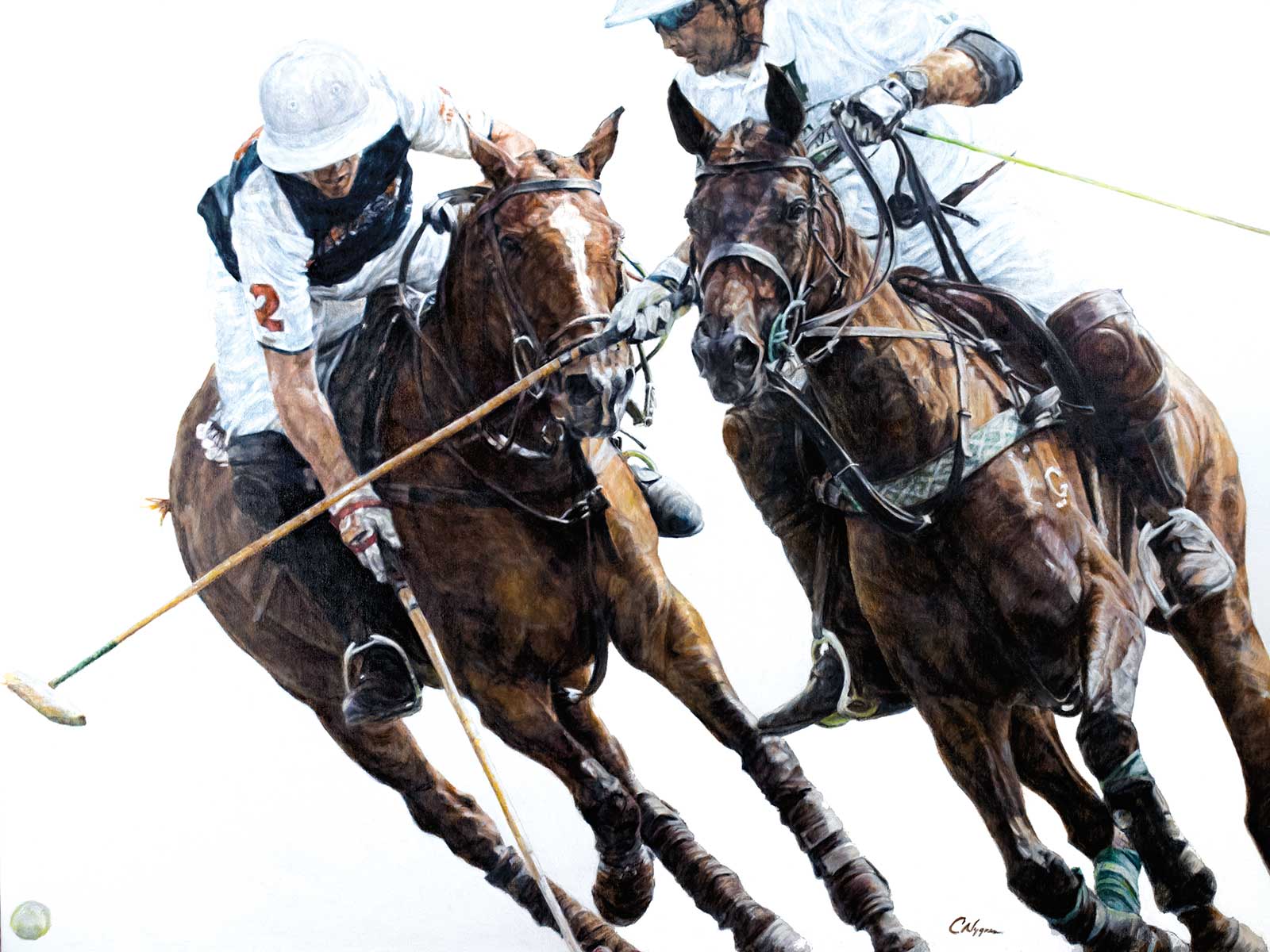 Carrie Nygren, Not a Penalty, oil, 32 x 42"
Nygren continues, “Just as painters paint what they know, collectors should collect what they love. To quote Salvador Dali, ‘a true artist is not one who is inspired, but one who inspires others.’ That is the piece to collect.”
Mitchell, a former reining competitor, capturing the expression, intensity and athleticism of a competitive horse in a painting is exciting. “When I paint a horse,” he says, “I want a collector to experience horse power—even if they’ve never been horseback. For collectors who have felt the wind and heard the thunder, I want my work to, well, spark them up. I’m a collector myself, and I can’t pry my eyes away from well-conceived, dynamic images. I search for works that present an intriguing point-of-view, and add works that I believe will never go stale.”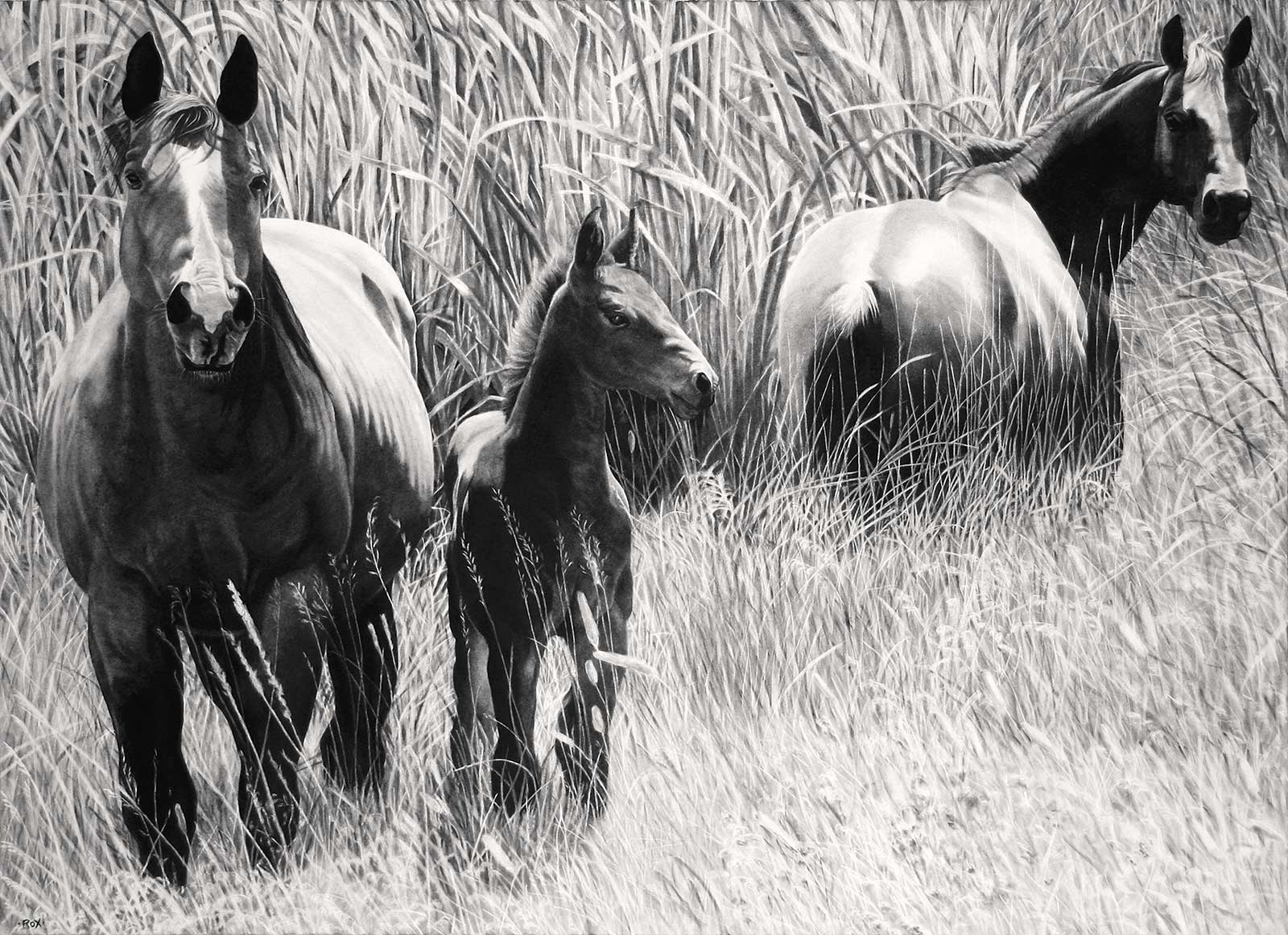 Rox Corbett, Grassfat and Sassy, charcoal on archival cotton paper, 15¼ x 21"
Artist K.L. Tafoya, sold her first artwork at age 12 to an Arabian breeder—a pencil drawing of the breeder’s mare and foal. She went on achieve a dual career as an award-winning artist and illustrator, having illustrated the board game Herd Your Horses. Her work as been sold internationally and appeared on many horse magazine covers. Tafoya loves working with bright light and shadow, and the effects of light on the beautifully made heads and bodies of all breeds of horses. On collecting art, Tafoya says, “the same advice applies to equine art as all other genres—only take home something you will enjoy seeing every day when your eyes fall on it.”
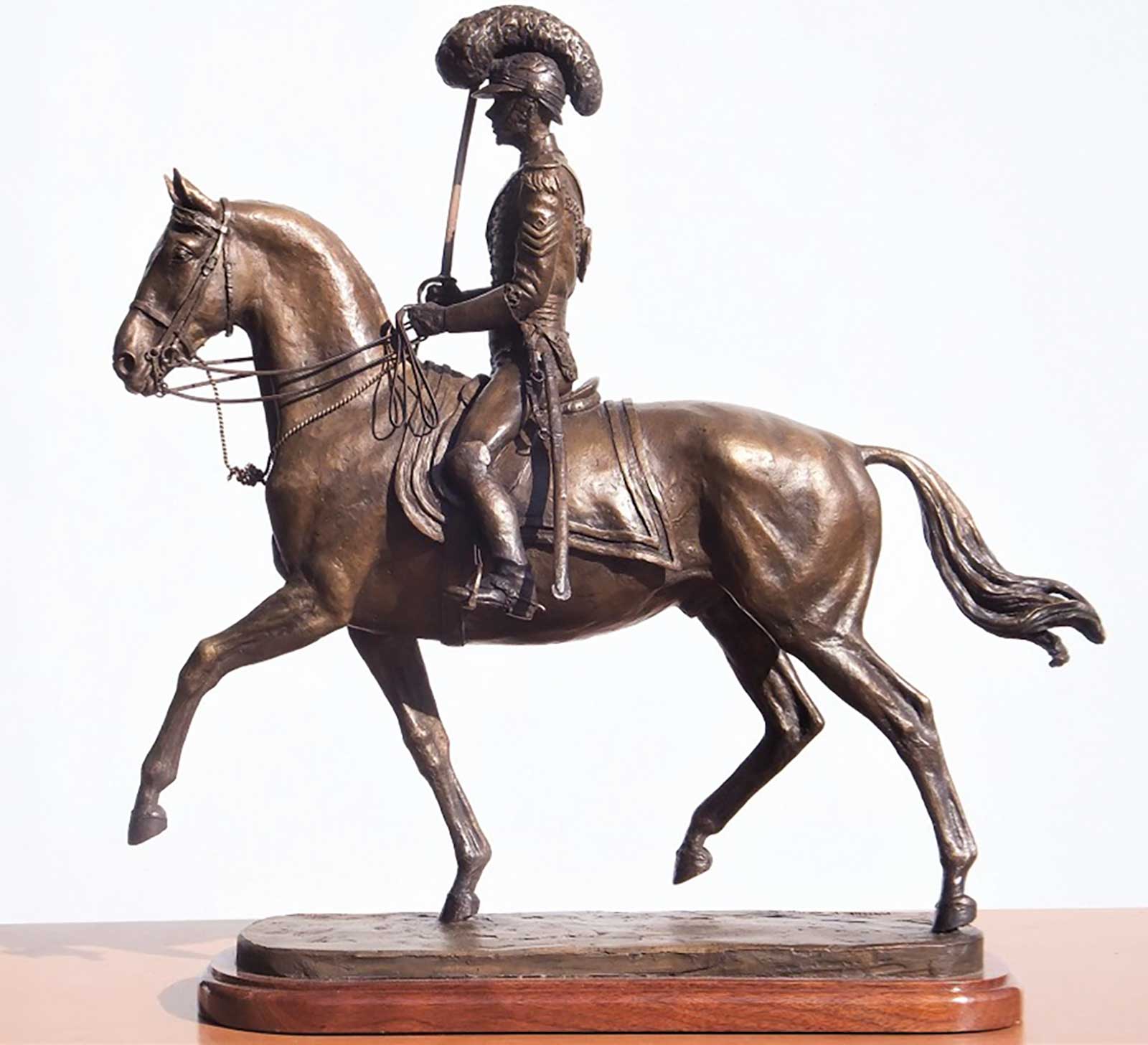 Kathleen M. Friedenberg, First City Trooper, bronze, 17 x 18, 6"
Sandy P. Graves represents the horse in her artworks as she knew horses as a child—another being that was part of her experience. “They were my playmates, responsibility, joy and friends—and integral part of being,” she says. “The horse has a way of calming and normalizing. In stylized sculptural form, a horse connects those around them with a powerful and intelligent presence that informs the overall aesthetic experience. It’s like salt in pasta—it takes a simple subject and gives it flavor and form.”
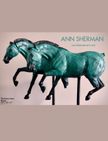
In her recent works, Graves has been exploring relationships in obvious but also deeper ways. “Relationship with another, relationship with everything that is and relationship with self,” she explains. “There is nothing in life more rewarding than to know oneself and it becomes the whole journey, if we choose to embark.”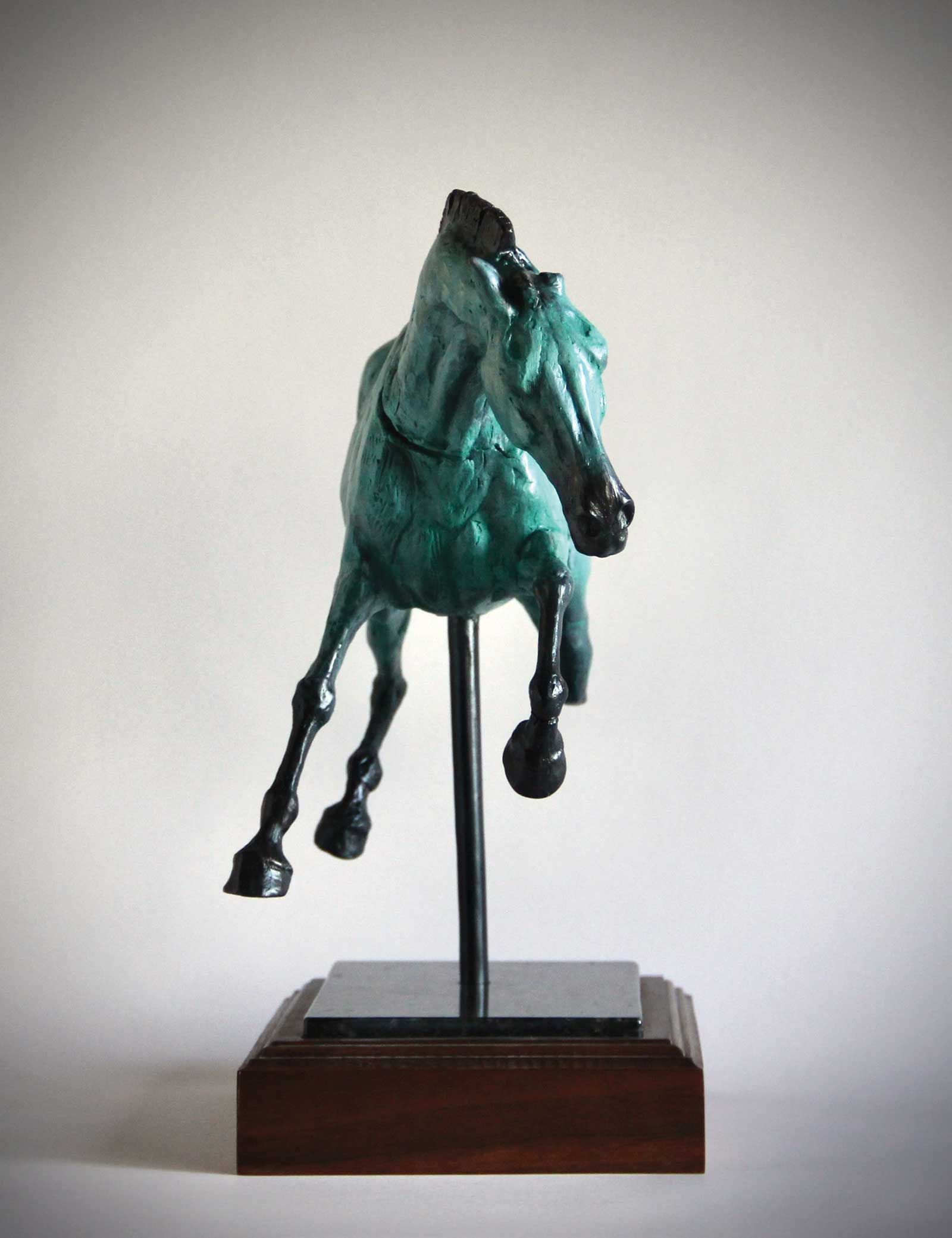 Ann Sherman, The Roman Series, bronze, 14 x 13 x 7"
About 20 years ago, not long before Joseph Sundwall’s first one-man show of figure paintings and landscapes, he saw a sign advertising a polo match the following Sunday. “I’d always been fascinated by the idea of polo but never attended a match,” he says, “and it was thrilling—the athleticism of both the riders and their ponies, and dumbfounding—how could they stop on a dime, turn around and ride in the opposite direction all at top speed? Sporting art (which includes fox hunting, flat track racing and polo) is a natural extension of my study and love of portraiture, which is grounded in anatomy and revealing of the character within.”
Sources for Kathleen M. Friedenberg’s sculpture ideas are many and varied. Frequently there’s a story or a bit of history attached to a piece. For instance, Friedenberg’s piece Rejoneador, is the Portuguese version of the bullfight, which does not involve killing the bull. Once he’s been taunted, he’s wrestled by unarmed men on foot. For her piece First City Troop, she says, “The Philadelphia First City Troop is America’s oldest cavalry regiment still in existence. For ceremonial occasions, their traditional equestrian uniform is still worn.” 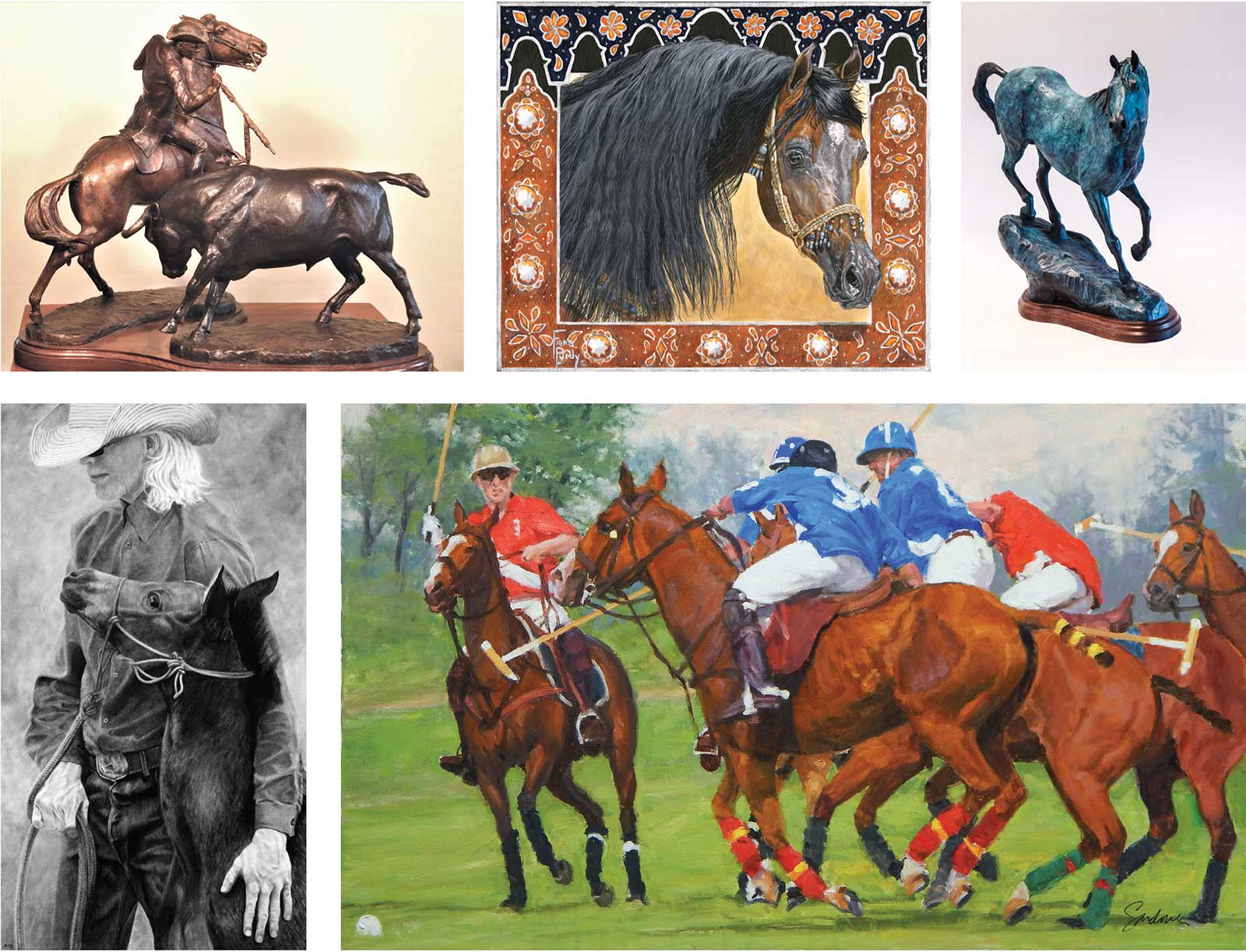 Top row left to right: Kathleen M. Friedenberg, Rejoneador, bronze, 15½ x 22 x 16"; Fiona Purdy, Portrait of Selket Marque, acrylic on canvas, 9 x 12"; Ann Sherman, Scout, bronze, 13 x 15 x 7". Bottom row left to right: Rox Corbett, Gentle Hands, charcoal on archival cotton paper, 20 x 12"; Joseph Sundwall, Hired Assassins, oil on linen, 24 x 42"
Rox Corbett is an award-winning artist who uses charcoal sticks, charcoal pencils, erasers and homemade tools to “paint” charcoal on paper. “Sometimes it doesn’t happen,” Corbett explains, “but if everything comes together, and I’ve made a picture of an animal that has pleasing or maybe startling composition, contrasts in light, dark and texture, and a hint of what’s going on in my subject’s heart or soul, then I’m relieved and happy.”
Horses were the first subject as an artist for Ann Sherman, starting as a girl crazy for horses living in the city. “I have detoured through landscape, still life and portraiture, coming full circle back to horses in my sculpture,” says Sherman. “The Roman Series is inspired by finding beauty in imperfection and the effects of time. I love the literal hands-on experience of working in clay and I like to leave some evidence of that in my pieces. Working three dimensionally forces you to really understand your subject. I’m lucky to have spent countless hours around these wonderful creatures.” —
Featured Artists & Galleries
Ann Sherman
www.annshermanart.com
Carrie Nygren
(414) 491-3854
cnygrenart@gmail.com
www.cnygrenart.com
Fiona Purdy
(602) 770-0529
fiona@petportraitsbyfiona.com
www.petportraitsbyfiona.com
Joseph Sundwall
Newburgh, NY
(908) 635-3713
josephsundwall@gmail.com
www.josephsundwall.com
Kathleen M. Friedenberg
kfriedenberg1@verizon.net
www.bronzealive.com
K.L. Tafoya
(520) 250-8478
karen@klrafoyaart.com
R.D. Mitchell
903 E. 18th Street, Suite 222
Plano, TX 75074
(214) 850-2696
www.rdmitchellcollection.com
Rox Corbett
(307) 213-0166
rox@roxcorbettart.com
www.roxcorbettart.com
Sandy P. Graves
Steamboat Springs, CO
www.sandygravesart.com
Shawn Faust
www.shawnfauststudio.com
Powered by Froala Editor